“How do they do that?” is a reasonable response to certain things we see in nature.
Pythons and snakes like them can eat prey as big as they are, sometimes even bigger, and digest their massive single meals while going weeks and even months before eating again.
That feast-and-famine diet, which suits those creatures rather than harms them, fascinated researchers at the University of Colorado Boulder, and they collaborated with scientists from Stanford and Baylor University to look at why pythons do that and what might be learned.
They found something: an appetite-suppressing metabolite molecule called para-tyramine-O-sulphate, or pTOS. This compound is crucial for snakes to sustain their extreme feast-fast feeding patterns. After swallowing an animal whole, pythons can go months without eating again. What you may not know: In the hours after such a meal, a python’s heart grows 25% larger, most of their other organs double in size, and their metabolism rapidly speeds up 4000-fold to initiate digestion.

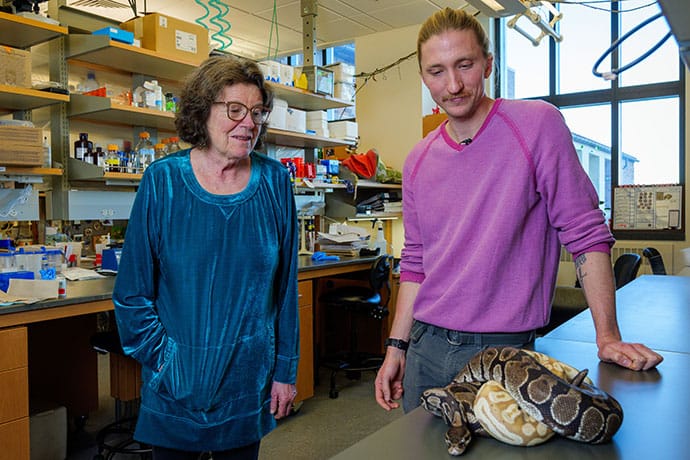
“Their metabolism goes crazy through the roof,” said Leslie Leinwand, PhD, distinguished professor of molecular, cellular, and developmental biology at the University of Colorado Boulder and senior author of the study. “That’s something a mammal could never do.”
It became a mystery to be solved. When digesting this huge meal, pythons burn a ridiculous amount of energy, said Leinwand. Once it’s digested, their metabolism and heart rate decrease, and it all regresses. In order to determine how this feat was metabolically possible, the team measured and observed blood samples from Burmese pythons and ball pythons, their smaller relatives. Samples were taken while they were fasting and immediately after they finished a meal, which happened once every 28 days.
The team found 208 total metabolites in the pythons’ blood that increased at least 32-fold and 24 that decreased by an equal margin 3 days after feeding. Among the metabolites that significantly increased was pTOS, which soared more than 1000-fold.
That was the link to humans the team was looking for.
The Unknown Metabolite
In humans, sporadic reports had identified pTOS as a molecule we excrete in our urine and present in our blood with levels that slightly increase after a meal. There is, however, not much literature exploring its role in our circulation or postprandial regulation.
The researchers set out to examine this relatively unknown metabolite, and their reasoning for doing so was simple. “When you see something changing from something that was reasonably abundant to start with, and it goes up a 1000-fold in a short period of time, it would be silly not to study it,” said Leinwand.

This journey took a turn about 2 years ago when Jonathan Long, PhD, associate professor of pathology at Stanford University, Stanford, California, contacted Leinwand out of the blue after reading Leinwand’s previous paper on python metabolomics, suggesting they work together to examine the metabolites in python plasma while they’re fasting vs fed.
“Some collaborations just don’t take off, and sometimes, once in a while, you find somebody like Jonathan,” said Leinwand. “We sent him plasma immediately, and they analyzed it the following day. So we had data within a week, and I realized we were probably going to work well together.” Long became a co-author on this study.
What we know: In snakes, pTOS is produced by their gut bacteria as a byproduct of breaking down tyrosine, a dietary amino acid, and is dependent on their microbiome. In mice, pTOS is not naturally present because they don’t have the necessary microbiome to produce it.
To better understand how pTOS functions, the researchers administered high doses of pTOS to both lean and diet-induced obese mice, finding no observable effects on their water intake, energy expenditure, movement, beta-cell proliferation, or organ size. The pTOS instead acted on the neural population of their hypothalamus — the part of their brain responsible for appetite regulation — and effectively suppressed their food intake and body weight.
This effect on food intake and body weight was dependent on the dose of pTOS. Chronic administration of pTOS at 50 mg/kg to obese mice reliably reduced how much they ate compared with the control mice. After 28 days, the obese mice had lost 9% of their weight.
Even more impressive? Their weight loss didn’t come with any muscle loss, declines in energy, or gastrointestinal problems — the most common complaints from people taking GLP-1 medications such as Ozempic and Wegovy.
“GLP-1 agonists have lots and lots of side effects, and there’s also incidence of muscle atrophy,” said Leinwand. “About 40% of people who start on at least the current existing ones that are FDA-approved stop taking them because of the side effects.”
The pTOS metabolite doesn’t work through the gastrointestinal system as GLP-1s do and so wouldn’t cause or be associated with any nausea, diarrhea, abdominal pain, constipation, or vomiting. If Leinwand and her collaborators apply these findings clinically, as they intend to eventually do after more focused research, this would be a new foray into the weight-loss therapy market. Because pTOS occurs naturally in humans, the team expects that leveraging the molecule for a potential future weight-loss treatment would be safe.
“It’s not something that we made in the laboratory,” said Leinwand. “That gives it a much clearer path than some other compounds that would have to be changed chemically.”
pTOS in Humans vs Reptiles
To get a better sense of how pTOS presents itself in humans, the researchers reviewed six publicly available datasets of blood from previously conducted studies of healthy volunteers before and after a meal. In five of the six datasets, pTOS levels elevated after eating, but only by about two- to fivefold, which they considered too small of an increase to realistically call out among other metabolic changes. The one outlier, however, was an individual who curiously experienced a surprising 25-fold increase in pTOS.
While understanding how pTOS functions in humans requires more research, without first studying pTOS in pythons, this connection would never have been made. “The main overall takeaway is that novel treatments for human diseases can be found in animals that have evolved to do things better and/or faster than humans,” said Leinwand.
In fact, it was another reptile, the Gila monster, that first inspired the development of GLP-1 agonists. The Gila monster’s venom contained a hormone that regulated blood sugar levels, similar to semaglutide.

Mark Margres, PhD, assistant professor in integrative biology at the University of South Florida, Tampa, Florida, with a long history of studying snakes, echoed Leinwand’s sentiment. (Margres was not involved in the study.)
“I broadly think that, as scientists, we need to expand our scope beyond ‘traditional’ study systems if we want to make new discoveries,” he said. “Yes, technological advances have allowed us to study model organisms and systems (eg, fruit flies) in novel ways, but much more meat is on the bone in nonmodel systems. Now, I am biased as I study non-model systems (rattlesnakes and Tasmanian devils), but nevertheless, I think many of my colleagues would agree.”

Farhan Abdullah, DO, a board-certified practicing internal medicine physician, medical director of Magnolia Functional Wellness in Southlake, Texas, and an adjunct clinical instructor at UT Southwestern Medical Center in Dallas, was also optimistic about the prospect of a future weight-loss treatment involving pTOS. (Abdullah was also not involved in the study.)
“When I think of an individual’s metabolic health, I think of an overall assessment of their lifestyle, hormonal balance, body composition, and laboratory tests such as blood sugar, lipids, and thyroid function. I also think of how their body responds to food, fasting, and energy expenditure,” he said. “The study really emphasizes how much we can learn from extreme physiology. It is an interesting example of an evolutionarily conserved gut-brain axis linking nutrient intake with energy balance. These kinds of findings may eventually allow us to improve treatments for humans, such as appetite, weight loss, and muscle preservation, through natural molecular pathways instead of drugs.”
What’s Next
In addition to continuing to explore how pTOS works, Leinwand and her team plan to catalogue the function of the other metabolites that increased by 500%-800% after the pythons ate. They noted how many of them looked like hormones and yet had no similarity with any known hormones found in mice or humans.
Meanwhile, Leinwand and her team at the University of Colorado Boulder have since formed a startup with Long called Arkana Therapeutics to work toward commercializing some of their discoveries with pythons.
“The most important thing this study demonstrates is the potential value in basic science,” said Margres. “If scientists were not interested in the feeding ecology of Gila monsters, we would not have GLP-1 drugs. Discovering new drugs was not the goal of said work. Knowledge was. We cannot possibly know the potential value in what we do not know, but if the past is any indicator, it could be quite substantial. And the only way to uncover that value is through basic science.”
Margres and Abdullah reported having no conflicts. Disclosure information for study authors is available in the original study publication.
https://www.medscape.com/viewarticle/finding-next-weight-loss-drug-python-blood-2026a1000g9z

No comments:
Post a Comment
Note: Only a member of this blog may post a comment.