Search This Blog

Wednesday, July 11, 2018

ResMed, Verily form sleep apnea treatment JV


ResMed (NYSE: RMD, ASX: RMD), a global leader in sleep apnea treatment and connected health solutions, and Verily, an Alphabet company, today announced their agreement to form a new joint venture.
Combining ResMed’s expertise in sleep apnea and Verily’s advanced health data analytics technologies, the U.S.-based joint venture will study the health and financial impacts of undiagnosed and untreated sleep apnea, and develop software solutions that enable healthcare providers to more efficiently identify, diagnose, treat and manage individuals with sleep apnea and other breathing related sleep disorders.
Sleep apnea is a sleep breathing disorder that affects an estimated 54 million Americans (calculated based on a 16-country prevalence data study),1 and is associated with heart disease, stroke, type 2 diabetes and other life-threatening conditions. Despite the condition’s high prevalence and increasing public awareness, past research has shown that approximately 80 percent of individuals with obstructive sleep apnea are undiagnosed, 2 untreated and therefore unaware of their own risk and of the benefits that therapy could provide.
“The vast majority of people with sleep apnea don’t realize they have it, and therefore don’t seek accessible, effective treatment to mitigate its effects and long-term health risks,” said ResMed Chief Medical Officer Carlos M. Nunez, M.D. “The combined industry expertise, scalable infrastructure, and data analytics capabilities of ResMed and Verily can unlock meaningful ways to identify these individuals and support their journey to improved sleep, health and quality of life.”
“Approaching a widespread health problem like sleep apnea through collecting, organizing and activating health data is central to Verily’s mission,” said Jessica Mega, M.D., M.P.H., Chief Medical and Scientific Officer at Verily. “By better identifying at-risk individuals as well as generating real-world evidence regarding the value and effectiveness of treatment, this collaboration has the potential to improve outcomes for millions of people living with sleep apnea, and potentially other related conditions.”
The joint venture, subject to customary closing conditions, including regulatory approvals, will operate as a separate venture from ResMed and Verily.

Tuesday, July 10, 2018

Bayer: U.S. judge allows lawsuits over Monsanto’s Roundup to proceed to trial


Hundreds of lawsuits against Monsanto Co by cancer survivors or families of those who died can proceed to trial, a federal judge ruled on Tuesday, finding there was sufficient evidence for a jury to hear the cases that blame the company’s glyphosate-containing weed-killer for the disease.

The decision by U.S. District Judge Vince Chhabria in San Francisco followed years of litigation and weeks of hearings about the controversial science surrounding the safety of the chemical glyphosate, the key ingredient in Monsanto’s top-selling weed-killer.
Monsanto is now a unit of Bayer, following a $62.5 billion takeover of the U.S. seed major which closed in June.
The U.S. Environmental Protection Agency last September concluded glyphosate is likely not carcinogenic to humans. But the World Health Organization in 2015 classified glyphosate as “probably carcinogenic to humans.”
Chhabria called the plaintiffs’ expert opinions “shaky” and entirely excluded the opinions of two scientists. But he said a reasonable jury could conclude, based on the findings of four experts he allowed, that glyphosate can cause cancer in humans.
The plaintiffs will next have to prove Roundup caused cancer in specific people whose cases will be selected for test trials, a phase Chhabria in his Tuesday opinion called a “daunting challenge.”
Lawsuits by more than 400 farmers, landscapers and consumers who claim Roundup caused them to develop non-Hodgkin’s Lymphoma, a type of blood cell cancer, have been consolidated before Chhabria.
Monsanto denies the allegations and in a statement said it would continue to defend the lawsuits with evidence proving there is “absolutely no connection between glyphosate and cancer.” The company said its position was supported by more than 800 scientific studies and reviews.
The company had told Chhabria in March that none of the plaintiffs’ experts satisfied scientific or legal requirements for admissibility and urged the judge to dismiss the cases.
Aimee Wagstaff, one of the lawyers representing the people suing the company, in a statement said she was pleased her clients will have their day in court. “It’s time to hold Monsanto accountable for putting this dangerous product on the market,” Wagstaff said.
Monsanto faces 5,000 lawsuits nationwide alleging Roundup caused cancer, mainly in state courts.
While Chhabria’s ruling is not binding on them, state court judges have been closely following the federal litigation and expert hearings. The California state judge who handles the most Roundup cases posted to her docket that she was attending the hearings before Chhabria in March.

GW: Cal. bill seeks exemption for 1st FDA-approved med made from marijuana


Assemblyman Jim Wood is attempting to clear the way for Californians to use the first federally approved medicine made from marijuana, removing a legal barrier that could stand in the way of an expected surge in cannabis- based pharmaceuticals.
Wood, a Santa Rosa Democrat who chairs the Assembly Health Committee, authored a bill that would make a drug approved Monday by the Food and Drug Administration for treatment of two rare and severe childhood-onset epilepsies legal for Californiaphysicians to prescribe.
The two disorders — Lennox- Gestaut syndrome and Dravet syndrome — afflict fewer than 45,000 Americans, but experts expect the drug, Epidiolex, will be prescribed for other types of epilepsy, Wood said.
Epidiolex, produced by GW Pharmaceuticals, is the first approved medicine that “contains a purified drug substance derived from marijuana,” the FDA said in a statement.
The strawberry-flavored syrup, intended for children age 2 and older, is a “pharmaceutical formulation of pure cannabidiol (CBD),” the manufacturer said.
CBD is a chemical component of cannabis, but does not deliver the mind-altering effects of marijuana, which come from tetrahydrocannabinol (THC). Increasingly popular for relief of stress and anxiety, CBD is the basis for an industry worth $200 million a year, according to the Hemp Business Journal.
Wood, the only dentist in the Assembly, said he had been hearing reports of cannabis being used to help people with epilepsy, with mixed results, and crafted his bill last year in anticipation of the new drug.
Any product that contains marijuana in any form is classified as a Schedule 1 controlled substance by both California and the federal government, Wood said.
Removal of Epidiolex from the Drug Enforcement Administration’s Schedule 1 list was expected within 90 days, GW Pharmaceuticals said. But even if that happens, Californiawould also have to exempt the drug to make it available to physicians and the public.
“I had to do something,” Wood said, when he learned the state might have such a barrier.
“I hope FDA approval of Epidiolex opens the door to more research opportunities to tap into the uses of cannabis to see what other CBD-derived medications could help patients with any number of conditions,” he said.
His bill, AB 710, passed the state Senate and Assembly earlier this month on a combined vote of 115-0 and is now before Gov. Jerry Brown.
The exemption would apply to any drug, for any condition, that is derived from CBD and approved by the FDA.
“This approval serves as a reminder that advancing sound development programs that properly evaluate active ingredients contained in marijuana can lead to important medical therapies,” FDA Commissioner Scott Gottlieb said in a statement.
“And the FDA is committed to this kind of careful scientific research and drug development,” he said.
Dravet syndrome is a rare genetic condition that appears during the first year of life with frequent fever-related seizures, the FDA said.
More serious seizures may follow, and young patients may experience poor language and motor skills development, hyperactivity and social difficulties.
Lennox-Gastaut syndrome typically involves multiple types of seizures between ages 3 and 5, and most children develop learning problems, intellectual disability and delayed development of motor skills such as sitting and crawling.

Australian Physician/Diver Played Key Role in Thai Cave Rescue


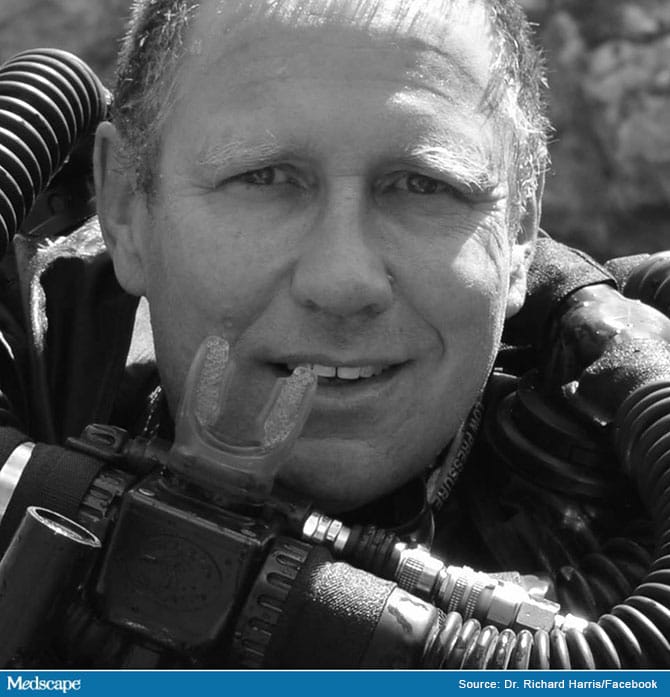
Australian anesthetist and world-renowned cave diver Richard Harris, MBBS, played a key role in rescuing the 12 youth soccer team members and their coach trapped in a cave in Thailand since June 23, according to the New York Post.
The last four boys and the coach were removed from the cave this morning, ending an 18-day ordeal.
Harris, 53, known as “Harry,” from Adelaide, works for the South Australian Ambulance Service’s aeromedical evacuation service MedStar and has 30 years’ experience as a diver.
He joined Thai medical and diving experts in the rescue from the flooded Tham Luang cave complex and entered a chamber deep inside the complex to check on the boys early Sunday, the Post reported.
After assessing their fitness, Harris recommended that the weakest boys be rescued first, which changed the initial strategy of taking the strongest first, the newspaper reported.
In a press conference  on Sunday, Harris’s boss at MedStar, clinical director Andrew Pearce, said that Harris had been headed for vacation when British officials asked for his help.
“Harry is selfless,” Pearce told reporters. “He is extremely thoughtful. He’s a quiet person. He’s the type of guy who will give of his all. He was actually meant to be on holiday and gave up his holiday to be part of this.”
In addition to his skills as a doctor, Pearce said, “He happens to have this amazing ability to do what no one else does in diving into very dark, tight spaces with not a lot of equipment.”
A Doctor in Demand
Harris’s work biography says, “His love of underwater exploration has led him to work on National Geographic documentaries, feature films and with various teams worldwide in the role of diver, underwater cameraman and of course medical support. He is a member of the Explorers Club of New York and recently received an Australian award for ‘Outstanding Contributions to Cave Exploration.”
This was not the first cave retrieval mission for Harris.
According to the publication The Australian,  Harris helped recover the body of his friend Agnes Milowka, 29, in 2011. Milowka died after running  out of oxygen in Tank Cave near Mount Gambier in South Australia.

Medical Concerns

CNN, citing information from the Mayo Clinic, said medical providers will likely check the team for signs of histoplasmosis, or “cave disease,” caused by breathing in spores of a fungus often found in bird and bat droppings. The CNN report said the team — currently quarantined — is likely to stay in a hospital for a week because of their weakened immune systems.
The New York Times has reported that at least two of the first eight boys recovered may have pneumonia, and according to Thailand’s permanent secretary for public health, Jesada Chokedamrongsuk, all are being treated with antibiotics and being vaccinated for tetanus and rabies.
Multiple media reports also cite experts discussing the high risk among the boys — ranging in age from 11 to 16  — and their coach, 25, for post-traumatic stress disorder.

Israeli non-opiate painkiller could compete with Heron med candidate


Israeli pharmaceuticals company PainReform has received approval from the U.S. Food and Drug Administration (FDA) to begin late-stage clinical studies for a pain relief drug that is a departure from opiate-based narcotics, it said on Tuesday.
Many patients today dealing with pain after surgery are prescribed opioids, which can be highly addictive and are at the heart of a costly health crisis in the United States.
PainReform said the FDA had given it a green light to carry out two Phase 3 trials on its product PRF-110, which prolongs the action of a local analgesic, or painkiller, called ropivacaine. The studies will focus on post-operative pain relief in soft and hard tissue.
The drug is administered during surgery, before the wound is sutured. An earlier study showed PRF-110 was able to relieve pain for up to 72 hours – 10 times longer than the current standard of care, PainReform said.
SPONSORED
This is a crucial period when pain is maximal and opioids are often given, said Chief Executive Eli Hazum.
“This kind of drug can help delay or prevent the prescription of opiates,” he told Reuters.
PainReform estimates the market potential for such treatment at $5 billion.
FDA Commissioner Scott Gottlieb said in a statement on Monday the agency “remains focused on striking the right balance between reducing the rate of new addiction by decreasing exposure to opioids and rationalizing prescribing, while still enabling appropriate access to those patients who have legitimate medical need for these medicines”.
Opioids were involved in more than 42,000 deaths in the United States in 2016, more than any previous year on record, according to the Centers for Disease Control and Prevention.
There are prescription versions of opioids, like oxycodone, and illegal ones, like heroin. About 40 percent of the opioid overdose deaths involved prescription drugs.
Should PainReform’s treatment pass its trials, results for which Hazum estimated could come within a year after they start, it would compete with other non-opiate drugs like Heron Therapeutics’ HTX-011, which just finished Phase 3 studies.
“This market will not depend on a single drug,” Hazum said.
The company has raised $12 million and is looking for an additional $15 million before beginning the trials, which focus on bunion and hernia operations.
It would consider an initial public offering in New York after the trials are finished, or even at the time of interim results, which could be after about six months, Hazum said.

Extended Tamoxifen May Double Endometrial Cancer Risk


There was a twofold increase in the risk of endometrial cancer following extended versus standard adjuvant tamoxifen therapy in patients with breast cancer, a meta-analysis found.
The systematic review of four randomized controlled trials showed that the absolute risk of endometrial cancer in patients receiving adjuvant tamoxifen for 10 years was 3.2% compared with 1.5% in patients receiving 5-year standard therapy (cumulative risk ratio [RR] 2.29, 1.60 to 3.28, P<0.001), reported Christina A. Fleming, MBBCh, of St. Vincent’s Hospital Group in Dublin, and colleagues.
Most tamoxifen-related uterine cancers occurred in patients who were postmenopausal and symptomatic, but diagnosed at an early stage and with a low grade, and carried a mortality risk of less than 1%, the authors wrote in the British Journal of Surgery.
“There is a paucity of clear evidence on how we should best manage endometrial cancer risk in extended tamoxifen therapy,” said Fleming in a statement. “This is a research area that requires immediate focus with expansion of extended tamoxifen therapy regimes.”
Few studies have data on endometrial surveillance in patients on adjuvant tamoxifen, the most recent of which (2003) was part of this review and did not find any benefit for routine endometrial surveillance in patients receiving tamoxifen for 5 years. Guidelinespublished by the American College of Obstetricians and Gynecologists, plus those from the Australian and New Zealand group do not recommend routine surveillance in asymptomatic patients receiving tamoxifen.
“Although it is difficult to make clear evidence-based recommendations on endometrial surveillance in the setting of extended therapy because of the sparsity of robust results, a practical approach may be to screen all patients using endometrial ultrasonography after 5 years on tamoxifen,” they wrote. “The validity of this approach should be assessed prospectively.”
Regarding breast cancer outcomes, Fleming’s group observed a non-significant reduction in breast cancer-specific mortality in patients receiving tamoxifen for 10 years, from 11.6% to 10.1% (RR 0.94, P=0.58). Likewise, the overall reduction in local recurrence, from 19.1% to 17.1% (RR 1.03, P = 0.76), and 1.7% reduction in overall mortality with 10-year tamoxifen were not significant (RR 0.93, P = 0.14).
These data would not preclude the use of extended tamoxifen in women who are deemed appropriate, Hatem Soliman, MD, of H. Lee Moffitt Cancer Center and Research Institute in Tampa, Florida, told MedPage Today. He added that there are “many factors to consider in choosing endocrine therapy,” including menopausal status, risk of breast cancer recurrence, bone health, other comorbid conditions, and tolerance of estrogen deprivation.
Soliman, who was not affiliated with the study, noted that the absolute increase in endometrial cancer rates was very small. Also, it was seen predominantly in postmenopausal women who had baseline endometrial abnormalities. “The majority of these endometrial cancers are treatable if patients are followed and counseled appropriately,” he pointed out.
“In general, higher risk women who are or have become postmenopausal during their first 5 years of tamoxifen should be counseled to try switching to an aromatase inhibitor if they have no contraindications to doing so,” advised Soliman.
When asked to comment, Marissa Weiss, MD, of Lankenau Medical Center in Philadelphia, told MedPage Today: “There are a lot of issues here that impact clinical practice, including compliance.”
Weiss, who was not affiliated with the research, noted that in one study in the meta-analysis, 17% of patients randomized to extended tamoxifen therapy didn’t finish the first 5 years, while in a second study, 40% didn’t complete extended tamoxifen therapy. Even in patients randomized to standard treatment, there was a fall-off in the number who continued taking adjuvant tamoxifen because of side effects such as vaginal bleeding.
The study confirms that premenopausal women with serious disease still derive the most benefit from taking tamoxifen for an extended period of time, Weiss said. Like Soliman, she emphasized that patients need to be assessed individually, and said the pros and cons of adjuvant tamoxifen therapy must be discussed regularly.
“This is not just one conversation,” she said. “At the time of prescription renewal, you always have a repeat conversation about tamoxifen therapy and ask the patient how it’s going.” This is also the time to revisit the increased risk of endometrial cancer and to ask your patient about signs of abnormal bleeding and so on, Weiss said.
The four randomized controlled trials included in the meta-analysis enrolled 21,361 patients from 1978 to 2005. Of these, 7,652 (35.8%) received 10 years of 20-mg oral tamoxifen daily. Follow-up ranged from a median of 7 to 10 years.
Three studies compared 10 years of adjuvant tamoxifen therapy in patients with estrogen receptor–positive breast cancer with standard 5-year therapy with or without placebo.
In the first, the National Surgical Adjuvant Breast and Bowel Project (NSABP) trial, the RR of endometrial malignancy was 6.84. However, 75% of participants in that trial were postmenopausal, with most endometrial cancers stage I with good to moderate histological grade, the study authors noted.
Both the 2012 ATLAS (Adjuvant Tamoxifen: Longer Against Shorter) trial, and the 2013 aTTom (Adjuvant Tamoxifen: To Offer More?) trial showed that younger patients with high-risk disease benefitted most from extended tamoxifen therapy.
ATLAS showed that extending tamoxifen to 10 years was associated with a twofold increase in the 15-year endometrial cancer risk and a 0.4% absolute increase in mortality. This was seen almost exclusively in postmenopausal patients. Similar observations were reported in aTTom (RR 2.28) and in the 2001 Scottish trial of adjuvant tamoxifen (RR 3.42).
None of the surveillance studies compared the benefit of routine endometrial surveillance with no surveillance in similar or matched cohorts of patients receiving tamoxifen. “This greatly limits the conclusions that can be drawn from the included studies,” the investigators wrote.
Fleming and co-authors reported having no conflicts of interest.
Weiss is the founder of Breastcancer.org.
https://bit.ly/2KOzQAH

FDA: New Warnings for Fluoroquinolones


Manufacturers of fluoroquinolone antibiotics must update their labeling to warn about mental health issues and potential low blood sugar adverse reactions, the FDA said Tuesday.
The labeling changes come after what the agency described as a “comprehensive review of the FDA’s adverse event reports and case reports published in the medical literature,” the agency said in a Drug Safety Communication.
The FDA stated that these will be class-wide updates, where they previously differed by individual drug. Mental health side effects will now be listed separately and labeled “consistently.” They are set to include “disturbances in attention, disorientation, agitation, nervousness, memory impairment and delirium.” However, the new warnings won’t come with the black border signifying the most serious types of risks.
A warning about nerve damage, specifically peripheral neuropathy, associated with the use of fluoroquinolone antibiotics was previously added in 2013.
Fluoroquinolone antibiotics will also require a separate warning about the risk of hypoglycemic coma added to the Blood Glucose Labeling Subsection, the agency said, citing “instances of hypoglycemic coma where users of fluoroquinolones experienced hypoglycemia.”
However, the FDA said that healthcare providers and patients should continue to “consider the risks and benefits” of fluoroquinolone antibiotics in treatment.
“The use of fluoroquinolones has a place in the treatment of serious bacterial infections — such as certain types of bacterial pneumonia — where the benefits of these drugs outweigh the risks, and they should remain available as a therapeutic option,” said Edward Cox, MD, FDA director of the Office of Antimicrobial Products, in a statement.
Fluoroquinolone antibiotics include levofloxacin (Levaquin), ciprofloxacin (Cipro), ciprofloxacin extended-release tablets, moxifloxacin (Avelox), ofloxacin, gemifloxacin (Factive) and delafloxacin (Baxdela), as well as more than 60 generic versions. This revised warning applies to forms of the drug taken by mouth or given by injection, the FDA said.
This is the latest in a series of escalating warnings about the safety of fluoroquinolones that date back to 2008. The latest came in 2016, when the FDA required a warning about potentially permanent musculoskeletal complications associated with the use of these drugs.