In a striking move to send the country back toward pre-pandemic life, the Centers for Disease Control and Prevention on Thursday will ease indoor mask-wearing guidance for fully vaccinated people, allowing them to safely stop wearing masks inside in most places, according to a person briefed on the announcement.
The new guidance will still call for wearing masks in crowded indoor settings like buses, planes, hospitals, prisons and homeless shelters, but could ease restrictions for reopening workplaces, schools, and other venues — even removing the need for masks or social distancing for those who are fully vaccinated.
The CDC will also no longer recommend that fully vaccinated people wear masks outdoors in crowds. The announcement comes as the CDC and the Biden administration have faced pressure to ease restrictions on fully vaccinated people — people who are two weeks past their last required COVID-19 vaccine dose — in part to highlight the benefits of getting the shot.
The new guidance comes as the aggressive U.S. vaccination campaign begins to pay off. U.S. virus cases are at their lowest rate since September, deaths are at their lowest point since last April and the test positivity rate is at the lowest point since the pandemic began.
To date about 154 million Americans, more than 46% of the population, have received at least one dose of the COVID-19 vaccines and more than 117 million are fully vaccinated. The rate of new vaccinations has slowed in recent weeks, but with the authorization Wednesday of the Pfizer vaccine for children aged 12-15, a new burst of doses is expected in the coming days.
Just two weeks ago, the CDC recommended that fully vaccinated people continue to wear masks indoors in all settings and outdoors in large crowds.
Dr. Rochelle Walensky, the director of the CDC, was set to announce the new guidance on Thursday afternoon at a White House briefing.
During a virtual meeting Tuesday on vaccinations with a bipartisan group of governors, President Joe Biden appeared to acknowledge that his administration had to do more to model the benefits of vaccination.
“I would like to say that we have fully vaccinated people; we should start acting like it,” Utah Gov. Spencer Cox, a Republican, told Biden. “And that’s a big motivation get the unvaccinated to want to to get vaccinated.”
“Good point,” Biden responded. He added, “we’re going to be moving on that in the next little bit.”
The person spoke on the condition of anonymity to preview the announcement ahead of the official release. The White House did not comment on the matter.
The easing guidance could open the door to confusion, as there is no surefire way for businesses or others to distinguish between those fully vaccinated and those who are not.
Evidence from the U.S. and Israel shows the vaccines are as strongly protective in real-world use as they were in earlier studies, and that so far they continue to work even though some worrying mutated versions of the virus are spreading.
The more people continue to get vaccinated, the faster infections will drop -- and the harder it will be for the virus to mutate enough to escape vaccines.
And while some people still get COVID-19 despite vaccination those infections tend to be milder, shorter and harder to spread to others.
CVSandWalgreensare administeringCOVID-19 vaccinesto adolescents between the ages of 12 and 15 as part of the ongoing effort to overcome the pandemic.
Appointments for the Pfizer-BioNTech vaccine at more than 5,600 CVS Pharmacy locations nationwide became available Thursday following Food and Drug Administration (FDA) emergency use authorization for the age group.
Participating CVS Pharmacy locations will begin administering the shot with parental or legal guardian consent and children must be accompanied by an adult, according to CVS.
Walgreens also opened up appointments Thursday for Pfizer’s COVID-19 vaccine for adolescents ages 12-15. This includes same-day appointments.
The Food and Drug Administration declared that the Pfizer vaccine is safe and offers strong protection for younger teens based on testing of more than 2,000 U.S. volunteers ages 12 to 15. On May 10, the Pfizer-BioNTech vaccine became the first and only FDA-authorized COVID-19 vaccine for adolescents in this age group.
"Offering vaccinations to younger populations at thousands of locations across the country brings us one step closer to prevailing over the pandemic," CVS Health CEO Karen Lynch said.
People are encouraged to schedule their appointment online on the CVS or Walgreens websites. Walgreens also suggests that patients use its mobile app or call to schedule an appointment, although walk-ins are welcome.
Authorizing emergency use of the Pfizer shot for the age group marked a "significant step in the fight against the COVID-19," according to acting FDA Commissioner Dr. Janet Woodcock.
This "allows for a younger population to be protected from COVID-19, bringing us closer to returning to a sense of normalcy and to ending the pandemic," Woodcock said.
Woodcock noted that the agency "undertook a rigorous and thorough review of all available data, as we have with all of our COVID-19 vaccine emergency use authorizations," in order to make this decision, which should reassure parents and guardians.
According to the FDA, between March 1, 2020, through April 30, 2021, approximately 1.5 million coronavirus cases in individuals 11 to 17 years of age were reported to the Centers for Disease Control and Prevention (CDC).
The U.S. Federal Reserve needs “several more months of data” before considering changes to its wide-open monetary policy, to ensure that recent weak job growth and high inflation prove temporary, Federal Reserve Gov. Christopher Waller said on Thursday.
Waller said a “ready to rip” economy will eventually work through what he regards as a temporary “mismatch” between companies’ booming demand for workers and the willingness of people on the sidelines to take jobs while the pandemic is ongoing and unemployment benefits are available to pay the bills.
April’s higher than expected 4.2% annual jump in consumer prices, meanwhile, will prove temporary as supply bottlenecks ease, and consumers spend down a surplus of savings accumulated from the flow of government funds during the pandemic, Waller said.
“The U.S. economy is hitting the gas and continuing to make a very strong recovery,” Waller said.
Still, the April inflation and job results were a surprise that led to “the jaw of every forecaster hitting the floor,” Waller said, and confirmed the need for the Fed to base changes to its policies on outcomes, not forecasts that particularly coming out of a pandemic might be off base.
The Fed has said it would not change its $120 billion in monthly bond purchases until there has been “substantial further progress” in putting people back to work, with an increase in the current near-zero target interest rate even further down the road. It also wants to nudge inflation above 2% for some time to make up for prior weak inflation, and has pledged not to overreact to short-term jumps in prices that may now be underway.
The May and June job reports “may reveal that April was an outlier, but we need to see that first before we start thinking about adjusting our policy stance,” Waller said. “Now is the time we need to be patient, steely-eyed central bankers, and not be head-faked by temporary data surprises.”
Three in 10 Americans say they are worried about contracting COVID-19, marking the lowest point in a year's worth of measurement, as vaccinations against the disease continue to rise in the U.S. This includes 5% of U.S. adults who say they are "very worried" and 25% "somewhat worried."
This latest finding, from Gallup's April 19-25 COVID-19 probability-based web panel survey, is five percentage points lower than it was in March and 19 points lower than in February. The highest reading, 59%, was recorded last summer, but it was nearly as high (57%) at the end of 2020 as the vaccine rollout was just beginning. Since then, Americans' level of worry has steadily fallen as vaccinations in the U.S. have risen sharply.
Still, one-third of those who are fully or partially vaccinated are worried about getting COVID-19, as are 44% of those who plan to get the vaccine but have not done so. Yet just 13% of U.S. adults who do not plan to be vaccinated express worry.
While worry has fallen among all partisans, Democrats' has fallen the most, from 69% in February to 43% now. At the same time, Republicans' level of concern has dropped from 27% to 14% and independents' from 43% to 27%.
Views of Pandemic Remain Positive, but Less So Than in March
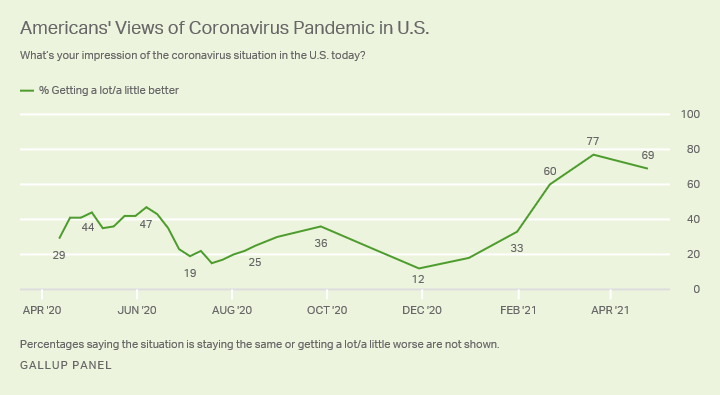
Although a broad majority of Americans, 69%, say the coronavirus situation is getting better, this measure has declined eight points since March, when it rose 17 points from the previous month
In addition, 18% of Americans say the situation is staying the same and 14% say it is getting worse.
Several events that occurred during the April poll's field period may explain the modest decline since March in perceptions the situation is getting better. The daily vaccination count in the U.S. began to decline after peaking earlier in the month. Additionally, the temporary pause of the Johnson & Johnson vaccine by the U.S. Centers for Disease Control and Prevention (CDC) and the U.S. Food and Drug Administration (FDA) due to safety concerns took effect the week prior to the start of the poll and was lifted shortly before the survey ended. By April, concerns about multiple variants of the disease continued to mount and India plunged into a deep crisis, recording the world's biggest one-day surge in new COVID-19 cases.
Social Distancing Behaviors Hit Lowest Points
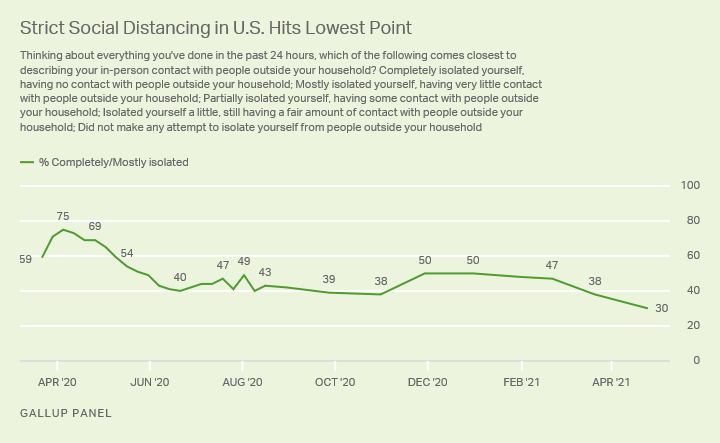
As more U.S. adults have been vaccinated, they have begun to follow the CDC's advice and relax their social distancing behaviors. Thirty percent of Americans now say they are completely or mostly isolating themselves from people outside their household, down eight points from March and the lowest reading since a year ago, when as many as 75% were doing so.
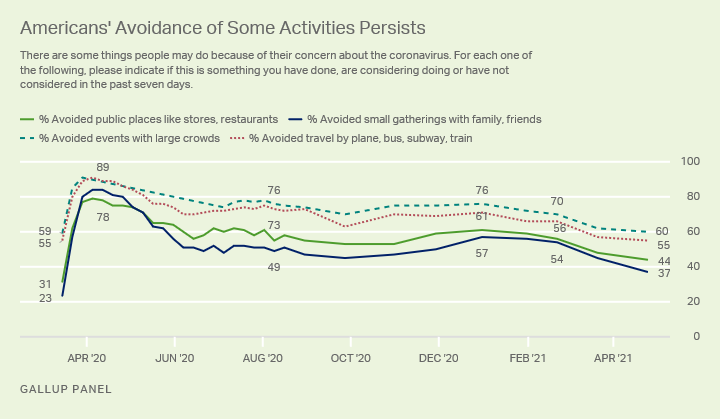
Similarly, Americans' avoidance of a variety of specific activities has fallen to the lowest points since mid-March 2020. While majorities still say they have avoided events with large crowds (60%) and travel by airplane, bus, subway or train (55%) in the past week, fewer have stayed away from public places such as stores or restaurants (44%) and small gatherings with family or friends (37%).
Although participation in more activities is on the rise, face mask use remains high, with 86% of U.S. adults saying they have worn one outside their home in the past week. It is, however, slightly diminished from the 91% recorded in late 2020 and early 2021.
Bottom Line
With COVID-19 vaccinations rising and cases in the U.S. falling, Americans are now less worried about contracting the disease than they have been since the pandemic began. They are also optimistic about the trajectory of the coronavirus situation in the U.S., although less so than in March when vaccinations were steadily increasing. By April, as supply began to catch up with demand, positivity was somewhat tempered.
As more Americans become vaccinated, states are loosening restrictions and the public is relaxing social distancing behaviors. Still, they generally remain cautious, are wearing masks in public and support requiring proof of vaccination to participate in some activities. Despite glimpses of normalcy, hesitancy to travel and be in large crowds remains high, and a majority of Americans think the disruption from the pandemic will last through the end of 2021 (44%) or longer (23%).
American Well (AMWL) reported a smaller-than-expected loss in the first quarter. However, sales missed analysts’ expectations of $58.75 million.
The telemedicine company incurred a loss of $0.16 per share in Q1, compared to the $0.19 loss per share estimated by analysts. A loss of $0.58 per share was reported in the same quarter last year.
Revenue generated in the quarter was $57.6 million which grew 7.3% from the year-ago period.
Total active providers surged 240% year-over-year to approximately 81,000, while total visits increased 120% to 1.6 million in Q1. (See American Well stock analysis on TipRanks)
American Well Chairman Dr. Ido Schoenberg said, “Our next generation platform Converge is designed to enable healthcare’s most trusted players to carry out digitally empowered, full-spectrum, unified online and in-person care. At its core, we believe Converge offers exceptional usability, reliability, scalability and flexibility.”
Schoenberg further added, “With its modular open architecture and longitudinal capabilities, we believe Converge will simplify innovative collaboration across the ecosystem. We expect Converge to expand our market opportunity and enhance our own efficiencies over time.”
For 2021, the company expects revenues to come in the range of $260-270 million. The consensus estimate is pegged at $266.21 million.
On April 15, Needham analyst Ryan MacDonald reiterated a Buy rating on American Well.
MacDonald commented, “While Amwell is priced at a discount to its digital health peers, we cannot justify enough upside to warrant a Buy rating until the mix of growth begins to shift towards less volatile, higher margin subscription revenue.”
The rest of the Street is cautiously optimistic about the stock with a Moderate Buy consensus rating. That’s based on 3 Buys versus 5 Holds. The average analyst price target of $27.75 implies 116.5% upside potential to current levels. Shares have increased 46.1% over the past six months.
The government will provide $7.4 billion to expand the nation’s public health capacity by hiring school nurses to vaccinate kids and creating a service corps around health care as well as bolstering traditional disease detection efforts, White House officials said Thursday.
Biden administration coronavirus testing coordinator Carole Johnson said it’s part of a strategy to respond to immediate needs in the COVID-19 pandemic while investing to break the cycle of ‘boom and bust’ financing that traditionally has hampered the U.S. response to health emergencies.
“We really see this as funding that can help end the pandemic and help us prevent the next one,” Johnson told The Associated Press. The money was authorized by Congress in President Joe Biden’s coronavirus response law. Officials are now acting to pump it out to states and communities through the federal Centers for Disease Control and Prevention.
About $4.4 billion will go to immediate priorities in fighting the pandemic.
That includes $3.4 billion for states and local health departments to step up hiring of vaccinators, contact tracing workers, virus testing technicians and epidemiologists, who are disease detectives trained to piece together the evidence on the spread of pathogens.
There’s also $500 million for hiring school nurses, who could play a key role in vaccination now that the Pfizer-BioNTech vaccine has been cleared for use by teenagers.
An additional $400 million will go to set up what’s being called the Public Health AmeriCorps, a service program that enlists young people early in their careers in public-spirited work. The goal is to build a structure to train and nurture young professionals interested in the public health field.
All told, the money is expected to support tens of thousands of new jobs over a period of five years, Johnson said.
Some of the money represents long-term investments. A pool of about $3 billion will go to create a competitive grant program allowing states and local communities to sustain their public health efforts after the coronavirus pandemic recedes.
“We need the resources now, but we also need to invest for the long-term in the public health workforce,” Johnson said.
Market volatility is up in recent sessions, and while that may have applied a brake to the upward trend, it also opens up opportunities for investors willing to shoulder some extra risk. Because in the markets, we frequently see that what goes down, must come back up.
It’s logic behind the old cliché to ‘buy low and sell high,’ and while it may sound obvious, it’s still a sound way to make money. And in the stock market, there are no ‘lower’ stocks than the penny stocks.
These are equities that trade for less than $5 per share, the very bottom of the price range. While they are priced that low for a reason – and the reasons may vary – low price in itself doesn’t mean that the stock’s fundamentals are sour. Smart investors can find some true bargains among the penny stocks, and set themselves up for outsized gains.
What’s the flip side? Minor share price depreciation can fuel major percentage losses. By nature of these massive movements, penny stocks are notoriously volatile.
Using TipRanks’ database, we identified two penny stocks the pros believe could see outsized gains in the coming months. Not to mention each one gets a “Strong Buy” consensus rating from the analyst community.
The first penny stock we're looking at is a pharmaceutical company with a focus on oncology therapies. GlycoMimetics' mission is to discover, develop, and commercialize new small-molecule glycomimetic drug candidates. The company’s research is focused on the complex carbohydrates that coat all human cells – and are frequently involved various disease processes, including cancers and inflammatory disorders. GlycoMimetics is working with several compounds – five in all – that are designed to selectively target particular molecular mechanisms functioning in carbohydrate biology.
The company’s lead candidate, farthest along the development pathway, is GMI-1271, also called uproleselan. This is a first-in-class targeted inhibitor of E-selectin, and has received Breakthrough Therapy Designation from the FDA as a treatment for adults with Acute myelogenous leukemia (AML). The drug is currently in a Phase 3 trial. Earlier trials showed positive results when uproleselan was combined with existing chemotherapy treatments, including better than expected remission rates and higher overall survival. The drug was well-tolerated, and adverse effects were fewer than had been anticipated.
In the Phase 3 study for uproleselan, the company is optimistic on reaching year-end 2021 targets for completing enrollment in a pivotal trial on patients with relapsed or refractory AML. GlycoMimetics has also received, through its collaborator in China, Apollomics, Breakthrough Therapy Designation for that country, and in March the collaborator began dosing patients in a Phase 1 study.
GlycoMimetics second leading drug candidate, GMI-1359, target tumor trafficking and metastatic spread, through inhibition of E-selectin and CXCR4, two adhesion molecules. The drug candidate showed promise in pre-clinical tests, and this past April the company reported additional positive results, including immune activation, in the first two patients to be dosed in a proof-of-concept Phase 1b study. The study evaluates GMI-1359 as a treatment for advanced breast cancer with bone metastases.
Based on the company's clinical programs and its $2.25 share price, major returns could be on the horizon, according to Roth Capital analyst Zegbeh Jallah.
Jallah points out the continued success of studies involving uproleselan, writing of the company’s program update: “Most important, it seemed, was the expected 2H21 enrollment completion of the ongoing Phase 3 studies of Uproleselan (E-selectin) in AML... Regarding the exact timing of the readouts, management noted that more color will be provided later, given that the readouts are event-dependent. As soon as those events occur, they'll be able to provide more granular timelines. However, it is likely that the NCI-sponsored study could meet the criteria to trigger an analysis of event-free-survival (EFS) during 1H22... This has been viewed by many as a non near-term catalyst, but as we race through 2021 the opportunity is indeed coming into view."
The analyst summed up, "With the progress of Uproleselan, which helps validate multiple other off-shoot programs in the pipeline that also target E-selectin, this remains a good long-term buy... We would expect more interest in this program as we make it through the year, given the strong scientific rationale and the drug being selected for an NCI-sponsored study... Overall, we continue to believe that Uproleselan could become a broadly used drug, with multi-blockbuster sales potential."
To this end, Jallah rates GLYC a Buy along with a $15 price target. Shares could appreciate by 567%, should the analyst’s thesis play out in the coming months. (To watch Jallah’s track record, click here)
The company’s progress has attracted 3 unanimous positive reviews from Wall Street, giving it a Strong Buy consensus rating. Based on the $14.50 average price target, the upside potential comes in at 544%. (See GLYC stock analysis on TipRanks)
Sticking with the biotech sector, we’ll shift from cancer research to eye disorders. OcuPhire Pharma is focused on developing and marketing new treatments for disorders at both the front and back of the eye.
The company’s pipeline has two main products under development; Nyxol, an eyedrop product, is designed to both reduce pupil size and improve visual acuity, and has indications for disturbances of night vision or low-light-level vision, presbyopia, and pharmacologically-induced mydriasis. The drug candidate has completed seven Phase 1 and 2 trial studies, on a total of 230 patients.
The second leading candidate, APX3330, is an oral tablet targeting retinal and choroidal vascular diseases that affect the back of the eyeball. The drug inhibits angiogenesis and inflammation pathways, and is indicated for treatment of diabetic retinopathy and diabetic macular edema. Like Nyxol above, APX3330 has completed numerous early stage trials, including six Phase 1 studies and five Phase 2 studies. The drug has been followed in over 440 patients across those studies.
During the first quarter, OcuPhire reported positive early results in the Phase 3 MIRA-2 trial with Nyxol. The product met primary and secondary endpoints on efficacy. In addition, Nyxol was initiated in the Phase 2 VEGA-1 trial, evaluating it in combination with pilocarpine as a treatment for presbyopia.
Also in the quarter, APX3330 was initiated in the Phase 2 ZETA-1 trial, an investigation of the drug as a treatment for diabetic-related eye disorders. This study continues from those referenced above.
Among the bulls is Canaccord analyst John Newman who rates OCUP a Buy along with a $25 price target. Investors could be sitting on gains of ~589%, should Newman’s forecast play out over the next 12 months. (To watch Newman's track record, click here)
"The positive results from the MIRA-2 study... increase the probability of approval for Nyxol in Reversal of Mydriasis and has positive implications for other Nyxol indications, such as presbyopia and Night Vision Disturbances... We expect additional positive Nyxol data from presbyopia in 2Q21 and from night vision disturbances in 3Q21, as well as potentially positive data from APX3330 in diabetic retinopathy and Nyxol in a second reversal of mydriasis trial by early 2022," Newman opined.
Do other analysts agree with Newman? They do. Only Buy ratings, 4, in fact, have been issued in the last three months, so the consensus rating is a Strong Buy. The average price target of $23.50 suggests an impressive 458% upside from the share price of $4.21. (See OCUP stock analysis on TipRanks)