Search This Blog

Tuesday, July 6, 2021

Source of remarkable memory of 'superagers'

 As we age, our brains typically undergo a slow process of atrophy, causing less robust communication between various brain regions, which leads to declining memory and other cognitive functions. But a rare group of older individuals called "superagers" have been shown to learn and recall novel information as well as a 25-year-old. Investigators from Massachusetts General Hospital (MGH) have now identified the brain activity that underlies superagers' superior memory. "This is the first time we have images of the function of superagers' brains as they actively learn and remember new information," says Alexandra Touroutoglou, Ph.D., director of Imaging Operations at MGH's Frontotemporal Disorders Unit and senior author of the paper published in Cerebral Cortex.

In 2016, Touroutoglou and her fellow researchers identified a group of adults older than 65 with remarkable performance on memory tests. The superagers are participants in an ongoing longitudinal study of aging at MGH led by Bradford Dickerson, MD, director of the Frontotemporal Disorders Unit at MGH, and Lisa Feldman Barrett, Ph.D., a research scientist in Psychiatry at MGH. "Using MRI, we found that the structure of superagers' brains and the connectivity of their neural networks more closely resemble the brains of young adults; superagers had avoided the brain atrophy typically seen in older adults," says Touroutoglou.

In the new study, the investigators gave 40 adults with a mean age of 67 a very challenging memory test while their brains were imaged using functional magnetic resonance imaging (fMRI), which, unlike typical MRI, shows the activity of different brain areas during tasks. Forty-one young adults (mean age of 25) also took the same memory test while their brains were imaged. The participants first viewed 80 pictures of faces or scenes that were each paired with an adjective, such as a cityscape paired with the word "industrial" or a male face paired with the word "average." Their first task was to determine whether the word matched the image, a process called encoding. After 10 minutes, participants were presented with the 80 image-word pairs they had just learned, an additional 40 pairs of new words and images, and 40 rearranged pairs consisting of words and images they had previously seen. Their second task was to recall whether they had previously seen each specific word-picture pair, or whether they were looking at a new or rearranged pair.

While the participants were in the scanner, the researchers paid close attention to the , which is the area of the brain that processes what you see and is particularly sensitive to aging. "In the visual cortex, there are populations of neurons that are selectively involved in processing different categories of images, such as faces, houses or scenes," says lead author Yuta Katsumi, Ph.D., a postdoctoral fellow in Psychiatry at MGH. "This selective function of each group of neurons makes them more efficient at processing what you see and creating a distinct memory of those images, which can then easily be retrieved."

During aging, this selectivity, called neural differentiation, diminishes and the group of neurons that once responded primarily to faces now activates for other images. The brain now has difficulty creating unique neural activation patterns for different types of images, which means it is making less distinctive mental representations of what the person is seeing. That's one reason older individuals have trouble remembering when they may have seen a television show, read an article, or eaten a specific meal.

But in the fMRI study, the superagers' memory performance was indistinguishable from the 25-year-olds', and their brains' visual cortex maintained youthful activity patterns. "The superagers had maintained the same high level of neural differentiation, or selectivity, as a young adult," says Katsumi. "Their brains enabled them to create distinct representations of the different categories of visual information so that they could accurately remember the image-word pairs."

An important question that researchers still must answer is whether "superagers' brains were always more efficient than their peers, or whether, over time, they developed mechanisms to compensate for the decline of the aging brain," says Touroutoglou.

Previous studies have shown that training can increase the selectivity of brain regions, which may be a potential intervention to delay or prevent the decline in neural differentiation in normal aging adults and make their brains more like those of superagers. Currently the researchers are conducting a clinical trial to evaluate whether noninvasive electromagnetic stimulation, which delivers an electrical current to targeted areas of the brain, can improve memory in older adults. The researchers also plan to study different  regions to further understand how superagers learn and remember, and they will examine lifestyle and other factors that might contribute to superagers' amazing .


Explore further

'Superagers' over 80 have the memory and brain connectivity of twenty-somethings

More information: Yuta Katsumi et al, Greater Neural Differentiation in the Ventral Visual Cortex Is Associated with Youthful Memory in Superaging, Cerebral Cortex (2021). DOI: 10.1093/cercor/bhab157
https://medicalxpress.com/news/2021-07-reveals-source-remarkable-memory-superagers.html

Seeking COVID protection boost for people with weakened immunity

 How effective are COVID vaccines if your immune system is compromised by HIV, cancer or a recent organ transplant?

Faced with very little data—and fears that some of these patients could be particularly vulnerable to the virus—scientists are seeking to figure out how to best protect them.

In one of the largest research projects into the issue so far, dozens of French hospitals have launched a two-year study of some 10,000 people to help shine light onto how people with these conditions respond to immunisation for the coronavirus.

"The goal is to find out how we can best protect those patients," the study's head Odile Launay told AFP.

Authorities like the United States Centers for Disease Control and Prevention say people with compromised immune systems can receive the vaccine, but stress that there is still little data on safety.

"If you have a condition or are taking medications that weaken your , you may NOT be fully protected even if you are fully vaccinated," the CDC adds, urging people to continue to take precautions and to consult their doctor.

Multiple doses

People's immune systems can be suppressed by disease—or by treatments taken to deal with other conditions—and this may mean their body has trouble producing the antibodies vaccines are meant to trigger.

Conditions where this might be the case include diabetes, obesity, cancer, organ and , chronic severe kidney failure, HIV or multiple sclerosis.

In the case of a transplant, a patient's  is suppressed on purpose to prevent his or her body from attacking the new organ.

Another French study published in the New England Journal of Medicine looked at 100  and found their immune response to vaccines was insufficient after two doses.

Scientists recommended three doses for those patients, which is now the rule in France.

The new study, which involves 30 hospitals and has been signing up participants since March, is aiming for 8,650 participants with compromised immune systems and a control group of 1,850 un-compromised people.

Participants will have their blood drawn to measure the presence of antibodies at the time of vaccination and then again after one month, six months, one year and then two years after the last dose.

"The data will allow us to adapt our vaccine recommendations to specific patient populations," Launay said.

Other measures

Health authorities could for example decide to shorten the waiting period between the first dose and the two or three booster shots that would likely follow for immune compromised patients.

And in cases where vaccines failed to produce any results, doctors would opt for other strategies like vaccinating the patient's family and caregivers and maintaining social distancing.

If a  failure results in infection with COVID-19, researchers will also sequence the virus.

This could pick up whether the illness is caused by an existing variant—or even pick up any new mutations.

While the COVID-19 virus typically infects individuals for around 10 days before being neutralised by the body, some studies have shown that certain patients, particularly those with compromised immune systems, may carry it for several weeks or longer.

This increases the window of opportunity for the virus to mutate, potentially resulting in new variants.

A similar study was launched in the UK in March, which will monitor 5,000 immunocompromised ' responses to COVID-19 vaccinations.

"We urgently need to understand if patient populations with chronic conditions such as cancer, inflammatory arthritis and kidney and liver disease are likely to be well-protected by current COVID-19 vaccines," lead researcher Iain McInnes of the University of Glasgow said at the time.


Explore further

For transplant patients, COVID-19 vaccination presents a different uncertainty
https://medicalxpress.com/news/2021-07-scientists-covid-boost-people-weakened.html

Rare 'breakthrough' COVID infections in vaccinated are milder: study

 Folks who suffer a rare "breakthrough" coronavirus infection after getting the Pfizer or Moderna vaccine will not get as sick and, importantly, are much less likely to pass the coronavirus on to others, a new study shows.

It's very unlikely that a person will become infected with COVID-19 after getting one of the messenger RNA (mRNA) vaccines, which provided 91% effective protection among the vaccinated people included in this study.

But those who got COVID-19 despite their vaccination wound up having milder symptoms over a shorter period of time compared to those who weren't inoculated, researchers reported July 1 in the New England Journal of Medicine.

Vaccinated people who caught COVID-19 also had a 40% lower viral load during their infection, compared with unvaccinated people.

"If you were at least partially vaccinated, you had less virus in you for a shorter period of time than those that hadn't been vaccinated, which means that they would be less likely to be passing the virus on to anyone else," said researcher Dr. Jefferey Burgess, associate dean for research at the University of Arizona's College of Public Health, in Tucson.

According to Dr. Amesh Adalja, a senior scholar with the Johns Hopkins Center for Health Security, in Baltimore, the findings "should give people a lot of confidence about COVID-19 vaccines. When the very rare breakthrough infections occur they are really not clinically meaningful, as the severity and infectiousness is greatly attenuated—even in not fully vaccinated individuals."

The study involved 3,975 health care workers, first responders and other essential and front-line employees who were prioritized for receiving an mRNA . Participants included 3,179 adults who got one or two shots, along with 796 people who went unvaccinated.

The researchers tracked all these people from mid-December to mid-April to determine how well the Pfizer and Moderna vaccines work.

Quite well, as it turns out. Out of the entire group, 156 unvaccinated people became infected with COVID-19, compared with only five fully vaccinated and 11 partially vaccinated people.

A full two-dose course provided 91% protection, and even just one dose gave 81% protection, the researchers calculated.

If a vaccinated person did get infected with COVID-19, they were 58% less likely to suffer a fever or chills, the results showed.

Instead, they usually had cold-like symptoms (such as the sniffles), spent two fewer days sick in bed, on average, and had an overall length of illness that was six days shorter than folks who eschewed vaccination.

This study took place before the advent of the Delta variant, which is 50 to 80 times more transmissible than the original Alpha strain of COVID-19, noted Dr. Tina Tan, a professor specializing in pediatric infectious diseases at Northwestern University's Feinberg School of Medicine, in Chicago.

Burgess couldn't say how the new strain would impact the protection reported in the study.

"I'm a little hesitant to go out on a limb on that, because we're still learning about the Delta variant," Burgess said. "I can say that from what I've seen in other studies, two doses of these messenger RNA vaccines are protective against the Delta variant."

Adalja sounded a more confident note regarding mRNA vaccine protection against Delta.

"I do not believe the Delta variant poses a problem for the vaccines, and those who develop rare breakthrough infections post-vaccination are likely to have clinically insignificant disease that is not contagious," Adalja said.

UK says braced for 100,000 daily COVID cases

 The UK announced plans to further relax to its pandemic curbs on Tuesday despite warning that the number of daily new cases is set to more than treble to reach 100,000.

From August 16, adults in England who have received both doses of a coronavirus vaccine will no longer need to self-isolate if they are in close contact with a positive case, Health Secretary Sajid Javid said.

Instead they will need to take a test and isolate only if they are found to be positive, he told parliament.

The same rules will apply to under 18s, who are not yet receiving vaccinations in Britain, Javid added. The rules will come in ahead of the return to school for the September term, after months in which entire classes have been sent home to the fury of parents.

The health minister was updating MPs a day after Prime Minister Boris Johnson revealed plans to lift most of England's coronavirus restrictions, including  and social distancing, from July 19, urging  rather than government edict.

The UK's other nations—Scotland, Wales and Northern Ireland—set their own  policy and are moving more slowly.

Johnson had initially aimed for a full reopening on June 21, but was forced to push back the date because of a surge in the highly contagious Delta variant.

That variant now accounts for nearly all new COVID-19 cases in Britain, and daily infection rates have soared to nearly 30,000 in recent days.

Javid said that figure was likely to reach 50,000 a day by July 19, and as high as 100,000 later in the summer.

But the vaccination campaign has "weakened" the link with hospitalisations and deaths, he stressed to MPs, saying that inoculations are "our wall of defence".

More than 86 percent of adults in the UK have received at least one jab, with 64 percent fully vaccinated, according to National Health Service data.

He also responded to media reports that three batches of the AstraZeneca jab made in India have not been approved for use in the EU, potentially hindering summer travel for British recipients of those doses.

Britain has not been using the Covishield-branded jab made by the Serum Institute of India, and the government is in "intensive discussions" with Brussels on the issue, Javid said.

https://medicalxpress.com/news/2021-07-uk-braced-daily-covid-cases.html

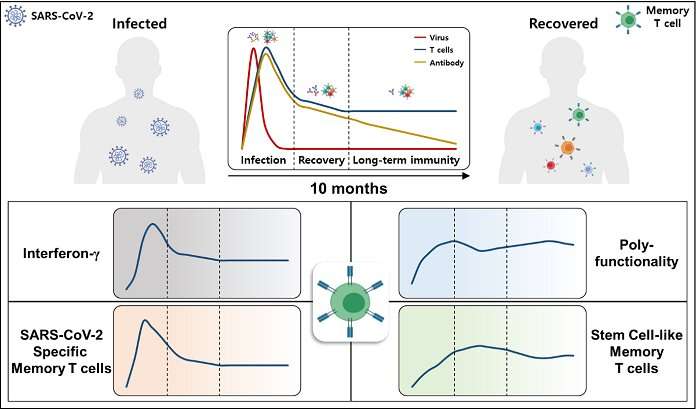
Study of T cells from COVID-19 convalescents guides vaccine strategies

 Study of T cells from COVID-19 convalescents guides vaccine strategies

Overview of the SARS-CoV-2-specific immune response kinetics. Memory T cells are maintained after recovery from COVID-19 with the generation of stem cell-like memory T cell. Credit: The Korea Advanced Institute of Science and Technology (KAIST)

A KAIST immunology research team found that most convalescent patients of COVID-19 develop and maintain T cell memory for over 10 months regardless of the severity of their symptoms. In addition, memory T cells proliferate rapidly after encountering their cognate antigen and accomplish their multifunctional roles. This study provides new insights for effective vaccine strategies against COVID-19, considering the self-renewal capacity and multipotency of memory T cells.

COVID-19 is a disease caused by severe acute respiratory syndrome coronavirus-2 (SARS-CoV-2) infection. When patients recover from COVID-19, SARS-CoV-2-specific adaptive immune  is developed. The adaptive immune system consists of two principal components: B  that produce antibodies and T cells that eliminate infected cells. The current results suggest that the protective immune function of memory T cells will be implemented upon re-exposure to SARS-CoV-2.

Recently, the role of memory T cells against SARS-CoV-2 has been gaining attention as neutralizing antibodies wane after recovery. Although memory T cells cannot prevent the infection itself, they play a central role in preventing the severe progression of COVID-19. However, the longevity and functional maintenance of SARS-CoV-2-specific memory T cells remain unknown.

Professor Eui-Cheol Shin and his collaborators investigated the characteristics and functions of stem cell-like memory T cells, which are expected to play a crucial role in long-term immunity. Researchers analyzed the generation of stem cell-like memory T cells and multi-cytokine producing polyfunctional memory T cells, using cutting-edge immunological techniques.

This research is significant in that revealing the long-term immunity of COVID-19 convalescent patients provides an indicator regarding the long-term persistence of T cell immunity, one of the main goals of future , as well as evaluating the long-term efficacy of currently available COVID-19 vaccines.

The research team is presently conducting a follow-up study to identify the memory T cell formation and functional characteristics of those who received COVID-19 vaccines, and to understand the immunological effect of COVID-19 vaccines by comparing the characteristics of memory T cells from vaccinated individuals with those of COVID-19 convalescent patients.

Ph.D. candidate Jae Hyung Jung and Dr. Min-Seok Rha, a clinical fellow at Yonsei Severance Hospital, who led the study together explained, "Our analysis will enhance the understanding of COVID-19 immunity and establish an index for COVID-19 vaccine-induced memory T cells."

"This study is the world's longest longitudinal study on differentiation and functions of memory T cells among COVID-19 convalescent patients. The research on the temporal dynamics of immune responses has laid the groundwork for building a strategy for next-generation vaccine development," Professor Shin added. This work was supported by the Samsung Science and Technology Foundation and KAIST, and was published in Nature Communications on June 30.


Explore further

Vaccines charge up natural immunity against SARS-CoV-2

More information: Jae Hyung Jung et al, SARS-CoV-2-specific T cell memory is sustained in COVID-19 convalescent patients for 10 months with successful development of stem cell-like memory T cells, Nature Communications (2021). DOI: 10.1038/s41467-021-24377-1
https://medicalxpress.com/news/2021-07-cells-covid-convalescents-vaccine-strategies.html

Biochemical pathway to skin darkening holds implications for prevention of skin cancers

 A skin pigmentation mechanism that can darken the color of human skin as a natural defense against ultraviolet (UV)-associated cancers has been discovered by scientists at Massachusetts General Hospital (MGH). Mediating the biological process is an enzyme, NNT, which plays a key role in the production of melanin (a pigment that protects the skin from harmful UV rays) and whose inhibition through a topical drug or ointment could potentially reduce the risk of skin cancers. The study was published online in Cell.

"Skin pigmentation and its regulation are critically important because pigments confer major protection against UV-related cancers of the , which are the most common malignancies found in humans," says senior and co-corresponding author David Fisher, MD, Ph.D., chief of the Department of Dermatology at MGH. "Darker-pigmented individuals are better protected from cancer-causing UV radiation by the light-scattering and antioxidant properties of melanin, while people with the fairest and lightest skin are at highest risk of developing skin cancers."

Through their laboratory work with skin from humans and animal models, the MGH researchers mimicked the natural protection that exists in people with dark pigments. In the process, they gained a fuller understanding of the biochemical mechanism involved along with their drivers, and how they might be influenced by a topical agent independent of UV radiation, sun exposure, or genetics.

"We had assumed that the enzymes that make melanin by oxidizing the amino acid tyrosine in the melanosome (the synthesis and storage compartment of the cell) are largely regulated by gene expression," explains Fisher. They were surprised to learn, however, that the amount of melanin being produced is in large part regulated by a much different chemical mechanism, one that can ultimately be traced to an enzyme in the mitochondria, the inner chamber of the cell, with the ability to alter .

That enzyme is nicotinamide nucleotide transhydrogenase, or NNT. Researchers found that topical application of small molecule inhibitors of NNT resulted in skin darkening in human skin, and that mice with decreased NNT function displayed increased fur pigmentation. To test their discovery, they challenged the skin with UV radiation and found that the skin with darker pigments was indeed protected from DNA damage inflicted by ultraviolet rays.

"We're excited by the discovery of a distinct pigmentation mechanism because it could pave the way, after additional studies and safety assessments, for a new approach to skin darkening and protection by targeting NNT," says Elisabeth Roider, MD, previously an investigator with MGH, and lead author and co-corresponding author of the study. "The overarching goal, of course, is to improve skin cancer prevention strategies and to offer effective new treatment options to the millions of people suffering from pigmentary disorders."


Explore further

Study replicates tanning response in cultured human skin

More information: Jennifer Allouche et al, NNT mediates redox-dependent pigmentation via a UVB- and MITF-independent mechanism, Cell (2021). DOI: 10.1016/j.cell.2021.06.022
https://medicalxpress.com/news/2021-07-biochemical-pathway-skin-darkening-implications.html

Lab analysis finds near-meat and meat are not nutritionally equivalent

 Plant-based meat substitutes taste and chew remarkably similar to real beef, and the 13 items listed on their nutrition labels—vitamins, fats and protein—make them seem essentially equivalent.

But a Duke University research team's deeper examination of the nutritional content of plant-based  alternatives, using a sophisticated tool of the science known as "metabolomics," shows they're as different as  and animals.

Meat-substitute manufacturers have gone to great lengths to make the plant-based product as meaty as possible, including adding leghemoglobin, an iron-carrying molecule from soy, and red beet, berries and carrot extracts to simulate bloodiness. The texture of near-meat is thickened by adding indigestible fibers like methyl cellulose. And to bring the plant-based meat alternatives up to the protein levels of meat, they use isolated plant proteins from soy, peas, and other plant sources. Some meat-substitutes also add vitamin B12 and zinc to further replicate meat's nutrition.

However, many other components of nutrition do not appear on the labels, and that's where the products differ widely from meat, according to the study, which appears this week in Scientific Reports.

The metabolites that the scientists measured are building blocks of the body's biochemistry, crucial to the conversion of energy, signaling between cells, building structures and tearing them down, and a host of other functions. There are expected to be more than 100,000 of these molecules in biology and about half of the metabolites circulating in  are estimated to be derived from our diets.

"To consumers reading nutritional labels, they may appear nutritionally interchangeable," said Stephan van Vliet, a postdoctoral researcher at the Duke Molecular Physiology Institute, who led the research. "But if you peek behind the curtain using metabolomics and look at expanded nutritional profiles, we found that there are large differences between meat and a plant-based meat alternative."

The Duke Molecular Physiology Institute's metabolomics core lab compared 18 samples of a popular plant-based meat alternative to 18 grass-fed ground beef samples from a ranch in Idaho. The analysis of 36 carefully cooked patties found that 171 out of the 190 metabolites they measured varied between beef and the plant-based meat substitute.

The beef contained 22 metabolites that the plant substitute did not. The plant-based substitute contained 31 metabolites that meat did not. The greatest distinctions occurred in amino acids, dipeptides, vitamins, phenols, and types of saturated and unsaturated fatty acids found in these products.

Several metabolites known to be important to human health were found either exclusively or in greater quantities in beef, including creatine, spermine, anserine, cysteamine, glucosamine, squalene, and the omega-3 fatty acid DHA. "These nutrients have potentially important physiological, anti-inflammatory, and or immunomodulatory roles," the authors said in the paper.

"These nutrients are important for our brain and other organs, including our muscles," van Vliet said. "But some people on vegan diets (no animal products), can live healthy lives—that's very clear." Besides, the plant-based meat alternative contained several beneficial metabolites not found in beef such as phytosterols and phenols.

"It is important for consumers to understand that these products should not be viewed as nutritionally interchangeable, but that's not to say that one is better than the other," said van Vliet, a self-described omnivore who enjoys a plant-heavy diet but also eats meat. "Plant and animal foods can be complementary, because they provide different nutrients."

He said more research is needed to determine whether there are short-term or long-term effects of the presence or absence of particular metabolites in meat and plant-based .


Explore further

How healthy are 'fake meats'?

More information: Stephan van Vliet et al, A metabolomics comparison of plant-based meat and grass-fed meat indicates large nutritional differences despite comparable Nutrition Facts panels, Scientific Reports (2021). DOI: 10.1038/s41598-021-93100-3
https://medicalxpress.com/news/2021-07-lab-analysis-near-meat-meat-nutritionally.html