Search This Blog

Friday, December 3, 2021

Califf, nominee to lead FDA, asks Woodcock to stay in leadership role if he’s confirmed

 Robert Califf, President Biden’s pick to lead the Food and Drug Administration, has asked Janet Woodcock, who has served as the FDA’s acting commissioner for the last 11 months, to stay on in a leadership role at the agency should he be confirmed by the Senate, two sources with knowledge of the discussion confirmed to STAT.

It’s still not clear exactly what Woodcock’s role would be or how she would split responsibilities with Califf, should she accept his offer. The most obvious role would be principal deputy commissioner, a position that amounts to second-in-charge at the agency and has been vacant since Amy Abernethy left it in April.

Rumors have swirled in Washington that Woodcock, a 35-year veteran of the FDA, would retire from the federal government after not being chosen to lead the agency. She gave up her longtime role as head of the FDA’s largest center, the Center for Drug Evaluation and Research, in April when she appointed her former deputy, Patrizia Cavazzoni, to that role.

Califf’s offer is likely to be welcomed by patient advocacy groups, which celebrated in January when Biden nominated Woodcock to lead the FDA in an acting capacity. However, it’s also likely to inflame critics of Woodcock who have accused her of playing a role in fueling the opioid crisis.

A confirmation hearing for Califf has not yet been set by the Senate. Woodcock can continue to serve as acting FDA commissioner until Califf is formally confirmed.

Califf did not respond to a request for comment. Woodcock declined to comment.

https://www.statnews.com/2021/12/02/califf-nominee-to-lead-fda-asks-woodcock-to-stay-in-leadership-role-if-hes-confirmed/

Logistics, lack of testing stymied finding Omicron variant in U.S.

 After South African scientists alerted the world last week to the new, concerning Omicron variant of SARS-CoV-2, researchers here in the U.S. warned that the highly mutated strain was likely already circulating on American soil. It was just a matter of time before someone found it.

On Thursday, health officials reported the country’s second Omicron infection, in a Minnesota man who attended an anime conference in New York days before his symptoms began. Notably, he had not traveled internationally, unlike the first case — a California resident recently returned from South Africa — indicating the occurrence of domestic transmission. But the timing of discovery has many wondering, “why did it take so long?”

According to details shared by the Minnesota Department of Health, the man, who is a resident of Hennepin County, home to the state’s most populous city, Minneapolis, first developed symptoms on Nov. 22. He took a PCR test on Nov. 24. News of Omicron broke on Nov. 25. Minnesota health officials didn’t confirm from sequencing data that his infection was caused by the Omicron variant until a week later, on the evening of Dec. 1.

By contrast, public health agencies in the U.K. found that country’s first cases of the new strain less than 48 hours after South Africa sounded the alarm.

“Even though we’ve increased sequencing in recent months, we still have a sampling issue,” said Eric Topol, the founder and director of Scripps Research Translational Institute in La Jolla, Calif., which is part of a SARS-CoV-2 surveillance consortium organized by the Centers for Disease Control and Prevention last year. The U.S. is only testing at a rate a quarter of what the U.K. is, and there’s not a systematic approach for testing travelers and people with breakthrough infections. So it’s less likely that something new and scary will ever get onto a swab, let alone a sequencer.

And that puts the U.S. at a big disadvantage, said Topol. “It all goes back to the same theme from the beginning of this pandemic,” he said. “We don’t have unity in this country, we have a balkanized, well, everything.”

The Thanksgiving holiday likely contributed to the slowdown. But that isn’t the whole story. While the U.S. has greatly ramped up its overall SARS-CoV-2 sequencing efforts over the past year, progress has been patchy. Urban centers close to large academic centers tend to be well covered, while rural areas are less so. That means public health departments in large parts of the country are still flying blind, even as they are figuring out ways to prioritize Omicron-suspicious samples.

“People are trying to make a concerted effort to triage as best they can, but we didn’t do enough as a nation to increase sequencing capacity since the start of the pandemic, and now here we are, and it’s a problem again,” said Lane Warmbrod, of the Johns Hopkins Center for Health and Security, who co-authored a report earlier this year outlining what an effective national surveillance program should look like.

Even when a patient lives in a major city like the Minnesota case, logistical challenges can slow the process to a crawl. In that state, it typically takes four to seven days for positive samples to get packaged and shipped to a facility that can perform sequencing, Doug Schultz, a spokesman for the Minnesota Department of Health, told STAT. Sequencing takes another four to five days. With all the testing turnarounds, that means that genomes coming off the sequencer are usually from samples collected 10 to 14 days prior.

“We’ve built in all the speed we can to the process,” said Schultz. “There’s just a certain amount of time it takes to collect samples, package, and transport them baked in.”

Minnesota is hardly alone. The fractured nature of U.S. health care means that when someone is swabbed for SARS-CoV-2 in a hospital or clinic, the majority of those samples go to one of the large private testing providers like LabCorp and Quest. Some subset of those samples will then be set aside to be sent to county or state public health labs, which either do their own sequencing, or send the samples off to academic labs or other industry partners to decode the genomes of the viruses inside.

“In a perfect world, we would have a much stronger health system that is more integrated with our public health agencies so we could have testing and sequencing being done within the same network,” Warmbrod said.

All that form-filling and ferrying about can take days to weeks. Sequencing itself can be as fast as a 24- to 48-hour turnaround. It’s the logistics of moving samples around that’s the real bottleneck.

“It’s really just stupid stuff,” said Amy Mathers, associate director of clinical microbiology at University of Virginia Health, whose lab team sequences positive coronavirus samples for the state of Virginia. Currently, they receive up to 300 samples a week, delivered in shipments once or twice weekly via courier from the state public health lab in Richmond. And if the public health department flags some samples that are suspicious because of travel history or contact tracing data, they’ll push them to the front of the line.

“We’re more integrated into the health system than we ever were before the pandemic,” said Mathers. But the data they pull off the sequencer isn’t reflective of real-time infections. Typically it shows what was circulating in the state 10 to 14 days earlier. Right now they’re running samples from mid-November.

“We tried to and are still lobbying for a system where people can send us positive samples directly,” said Mathers. “But the problem was it was hard to find a way to log them into the public health system. The forms were just too confusing for the hospitals.”

Her team has yet to find any cases of the Omicron variant, either in their sequence database or in any new samples, including ones taken from travelers and rushed to the front of the line. Mathers said her lab is sequencing every sample that tests positive in her area.

During the summer Delta surge, the backlog stretched back even further. And in the end, all that sequencing wasn’t that helpful, she said. In the month of September, her team sequenced over 1,000 samples. Every single one of them was the Delta variant. But now, it’s more important than ever to sequence every last vial of virus in the state. “As these new variants emerge we have to do heavy sampling to capture the one Omicron that’s lurking,” she said. “So I know that if someone comes to Charlottesville with Omicron, we’ll find it. But it’s not the same everywhere.”

In a press conference Tuesday, CDC director Rochelle Walensky said the U.S. is currently sequencing about 80,000 samples per week, between public health, academic, and private labs. But it’s not clear what percentage of them represent real-time windows into the virus’s spread.

That’s not information that’s readily available, Kelly Wroblewski, director of infectious diseases for the Association of Public Health Laboratories, told STAT via email. And there doesn’t seem to be an urgent, coordinated push by all players to speed things up, she said. “Having sequencing distributed to all of the states and many local jurisdictions is helpful in this way as it brings sequencing closer to patients,” she wrote.

Until broader geographic sequencing is available, there’s another step scientists can take now. Because of Omicron’s unique constellation of mutations, it leaves a tell-tale pattern with some types of PCR testing. These assays hunt for snippets of the virus’s genome, including on the S gene, which codes for its spike protein. On some assays, Omicron’s S gene snippet doesn’t show up — a phenomenon called “S gene dropout.” If scientists see that, it’s a signal that the virus likely isn’t the widespread Delta variant, and it could be Omicron. And in fact, that’s how officials in California and Minnesota found their infections.

In the case of the California individual, after he tested positive at a city testing location (using a PCR test that didn’t pick up the S gene dropout), his travel history spurred officials to send the sample to the lab of Charles Chiu, a researcher at the University of California, San Francisco, where his team ran a test looking for the S gene dropout. Within a few hours, they saw the signal so they expressed the sample to a handheld gene sequencer, which runs faster than the large ones typically used for mass sequencing. It gave them confirmation later that same night.

When they heard of the Omicron variant, Minnesota officials contacted one of their clinical lab partners in New Jersey, whose standard assay already looks for the S gene dropout. They found a handful of samples with the suspicious pattern, which they sent back to Minnesota for sequencing. The samples arrived Tuesday, and it took the state’s team less than 48 hours to complete the genomic analysis and discover that one of them was the new variant.

On Thursday night, officials in Colorado confirmed an additional case of the Omicron in a person recently returned from South Africa, and in New York, officials confirmed five cases, likely caused by local transmission. Scientists expect more to be identified in the coming days and weeks. “We were late to the Omicron party, but they’ll start cropping up fast,” said Topol. But without improvements, these discoveries will provide a picture of the variant’s spread in the past — and an incomplete one at that — not where it is today.

https://www.statnews.com/2021/12/02/just-stupid-stuff-logistics-and-lack-of-testing-stymied-finding-omicron/


1st confirmed omicron case in Pennsylvania reported

 Health officials reported the first confirmed case of the omicron variant in Pennsylvania on Friday, a man in his 30s from Philadelphia.

The Philadelphia Department of Public Health announced the case in a news release. No other details were immediately available, including whether the man was vaccinated against COVID-19 or if he had been traveling. Health officials said contact tracing was underway.

The health department said the variant's arrival was "not unexpected" in Philadelphia and that residents should "seriously reconsider" plans for indoor holiday gatherings.

"A new variant, especially one that may be more transmissible, means that we have to stay vigilant about taking steps to protect ourselves and everyone around us," Mayor Jim Kenney said in a written statement. "I know that this news is especially discouraging as we enter the holiday season, but we can get through this together."

He urged residents to get vaccinated and take additional precautions in public.

Much remains unknown about the new omicron variant of the coronavirus, including whether it is more contagious, as some health authorities suspect, whether it can thwart vaccines and whether it makes people as sick as the original strain.

People in at least five other states have tested positive for omicron, including California, Colorado, Hawaii, Minnesota and New York.

Word of Philadelphia's omicron case came as Pennsylvania reports sharp increases in COVID-19 infections and hospitalizations.

Pennsylvania reported 10,127 new COVID-19 infections on Friday - the first time since early January that daily cases exceeded 10,000 - while hospitalizations are up by more than a third since mid-November.

https://www.wtae.com/article/omicron-pennsylvania-philadelphia-variant/38425801#

Fourth NYC School Shutters Due To COVID

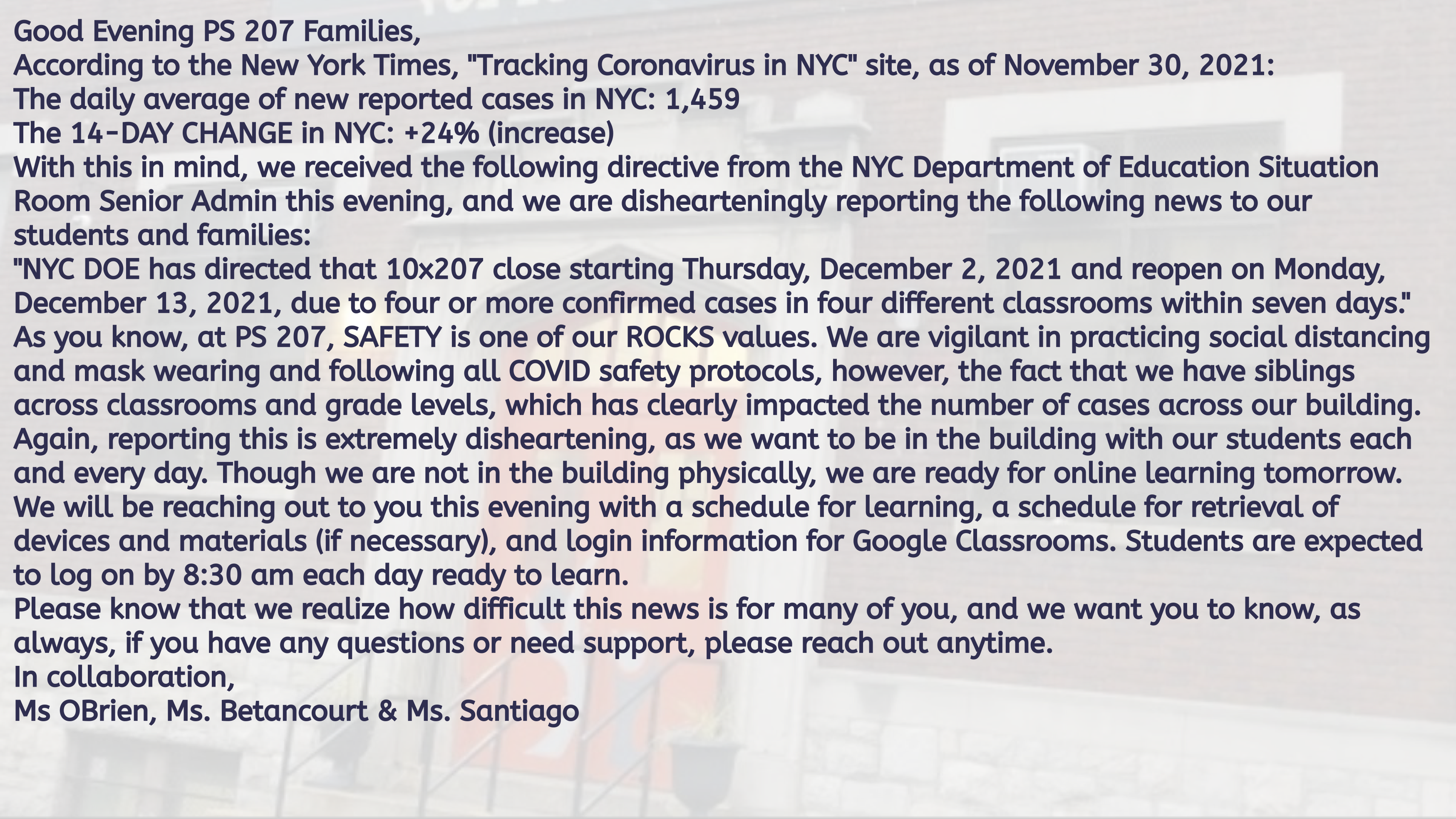
 A Bronx elementary school — P.S. 207 — closed its doors Thursday due to a COVID-19 outbreak.

School administrators said New York City’s Department of Education (DOE) directed them to close after detecting four or more cases in four separate classrooms within the last week. That’s according to a statement that was originally posted on the school’s website and later removed. The disclosure marks the first time in the 2020-2021 school year that officials have publicly described the specific criteria leading to a school shutdown.

“We are vigilant in practicing social distancing and mask wearing and following all COVID safety protocols,” read the statement, written by principal Tara O’Brien and assistant principals Leigh Betancourt and Lasheanma Santiago. The administrators cited transmission between siblings in different classrooms as a reason for the outbreak.

A website banner announcing a school closure.
The school's website linked to the closure announcement.
P.S. 207
A typed notice on a PowerPoint slide. It reads: Good Evening PS 207 Families, According to the New York Times, "Tracking Coronavirus in NYC" site, as of November 30, 2021: The daily average of new reported cases in NYC: 1,459 The 14-DAY CHANGE in NYC: +24% (increase) With this in mind, we received the following directive from the NYC Department of Education Situation Room Senior Admin this evening, and we are dishearteningly reporting the following news to our students and families: "NYC DOE has directed that 10x207 close starting Thursday, December 2, 2021 and reopen on Monday, December 13, 2021, due to four or more confirmed cases in four different classrooms within seven days." As you know, at PS 207, SAFETY is one of our ROCKS values. We are vigilant in practicing social distancing and mask wearing and following all COVID safety protocols, however, the fact that we have siblings across classrooms and grade levels, which has clearly impacted the number of cases across our building. Again, reporting this is extremely disheartening, as we want to be in the building with our students each and every day. Though we are not in the building physically, we are ready for online learning tomorrow. We will be reaching out to you this evening with a schedule for learning, a schedule for retrieval of devices and materials (if necessary), and login information for Google Classrooms. Students are expected to log on by 8:30 am each day ready to learn. Please know that we realize how difficult this news is for many of you, and we want you to know, as always, if you have any questions or need support, please reach out anytime. In collaboration, Ms OBrien, Ms. Betancourt & Ms. Santiago
A notice informing parents of the closure of P.S. 207 in the Bronx was posted on the school's website on Wednesday, December 1st.
P.S. 207

It’s the fourth public school shutdown so far this school year. Last year, schools shuttered whenever health officials determined that two cases were transmitted within the building. Later within the school year, that number increased to four. The policy changed ahead of the current term, and city officials have said that buildings will only be shut down if there’s evidence of “widespread transmission.” Health commissioner Dr. Dave Chokshi has previously described this scenario as “multiple sources of infection in multiple spaces or cohorts within a school” but didn’t list a specific number or rate of cases.

Asked about whether the criteria listed by the P.S. 207 administrators represents the citywide rule for closures, the DOE said it will continue to shutter only those schools which show evidence of “widespread transmission.”

"We do not hesitate to take action to keep school communities safe,” said DOE spokesperson Nathaniel Styer, citing the school’s low positivity rate in the city’s surveillance testing. “All staff at DOE are vaccinated and all students at P.S. 207 have access to a device to ensure live, continuous learning.”

DOE’s surveillance testing in schools is reporting a positivity rate — how many tests come back with an infection — that is three times lower than what health officials are measuring on average citywide for kids ages 5 to 18. Comparing these rates is tricky. The education department only tests kids who opted-in but are well enough to be in school, while the citywide rate reflects children getting tested after symptoms or an exposure. But regardless, kids ages 5 to 12 are also leading the city in weekly cases.

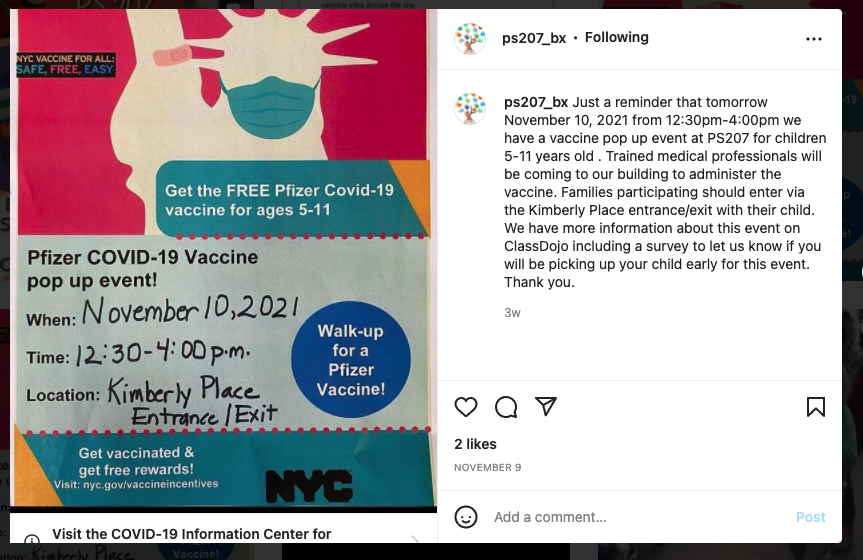
P.S. 207, located in the Kingsbridge neighborhood, serves approximately 400 students from Pre-K up through fifth grade, according to the most recent enrollment data provided by state officials. The school has recorded 12 cases since the first day of classes in September, and nine occurred over the last two weeks. The school held a vaccine pop-up for students on November 10th, according to its Instagram account.

An Instagram post advertising a vaccine clinic at P.S. 207
P.S. 207 held a pop-up vaccine clinic in November. The second clinic has been rescheduled for December 13th.
P.S. 207 INSTAGRAM

Students will learn remotely until December 13th, when the school is set to reopen. The school will also hold its second vaccination pop-up on that day, according to the education department.

The news comes as COVID-19 cases continue to rise in New York City schools. Over the last week, the education department has recorded an average of 257 new cases among students and staff at both public and charter schools. In total, 11,366 students and staff have received a positive test since classes began.


1st case of omicron variant detected in New Jersey

 Governor Phil Murphy and New Jersey Department of Health Commissioner Judy Persichilli announced that the New Jersey Department of Health has identified a case of the omicron variant in a traveler to the state.


The individual, an adult female, who is a fully vaccinated Georgia resident, had recently traveled to South Africa.

Since testing positive on November 28, the woman has remained in isolation. She experienced moderate symptoms and is now recovering after receiving care in a North Jersey emergency department. The New Jersey Department of Health laboratory performed sequencing on the specimen to confirm it was the omicron variant.

"The omicron variant is among us and we need to take steps to stop its spread. It is vital that residents remain as vigilant as possible as we await more information about the variant," Murphy said. "Vaccinations and mask wearing have proven to be an effective tool to reduce the spread of COVID-19, and I urge everyone ages 18 and over to receive a booster."

The Georgia Department of Public Health has been notified of a Georgia resident currently in New Jersey who has tested positive for COVID-19 and the Omicron variant.

The individual recently traveled from South Africa and was in Georgia for two days before traveling on to New Jersey where the testing and sequencing were done. The individual is fully vaccinated, and is isolating in New Jersey.

"With cases increasing and the identification of the omicron in the state, the fight against COVID-19 is not over,"Persichilli said. "We are still learning about the omicron variant, but we have tools to stop the spread of the virus, most important among them is to get vaccinated and get a booster dose. The public should continue to mask up, get tested if they have symptoms, physically distance, avoid crowded events, stay home when sick and wash hands frequently."

The news comes a day after New York officials announced five cases of the variant in the New York metro area.

"I'm not scaring people, I'm just saying if you're not boosted, go out and get that booster today," Gov. Kathy Hochul said. "Because that's the extra suit of armor that you need around you."

Hochul announced hospital capacity restrictions will be enforced next week and they must have 10% capacity by Friday. At least 31 states in the hospital are facing those capacity limits, but none are in the metro area.

Gov Ricketts: 'No lockdowns or mandates' following news of Omicron in Nebraska

 Six cases of the Omicron variant of the coronavirus have been detected among residents in the Public Health Solutions District in Nebraska. The health district covers Fillmore, Gage, Jefferson, Saline, and Thayer counties of southeast Nebraska.

According to the local health department, the first case was likely exposed during international travel to Nigeria. The person returned on Nov. 23 and became symptomatic on Nov. 24. PHS said the five remaining cases were likely exposed through household contact with the first case. Only one of the six people infected were vaccinated. So far, none have required hospitalization.

PHS said they are still conducting contract tracing. The patient self-identified their travel history, sought testing, and alerted PHS.

DHHS Acting State Epidemiologist Dr. Matthew Donahue said, “The identification of Omicron reinforces the urgency for Nebraskans to get vaccinated. The more Nebraskans are vaccinated, the less opportunity new SARS-CoV-2 variants will have to take hold in the state. With Delta, which is the current predominant variant, unvaccinated Nebraskans are filling hospitals at a rate 10 times higher than vaccinated Nebraskans. We are doing our part to find new variants when they emerge and arrive in the state, older Nebraskans have done their part in getting vaccinated at high rates; we need younger Nebraskans to keep stepping up to protect themselves and each other by choosing to get vaccinated.”

The Omicron variant of COVID-19 had been undetected in the U.S. until the middle of this week. By the end of Thursday, the Omicron variant had been discovered in at least five states.

Following news that the Omicron variant had been identified in Nebraska, Gov. Ricketts issued a statement.

“In Nebraska, we have learned how to balance living a more normal life while protecting our healthcare system,” said Governor Ricketts. “Coronavirus will be with us forever. That’s why we’ll continue that balance while also urging everyone to get vaccinated. Nebraska has maintained one of the lowest coronavirus death rates and protected our hospital capacity all without lockdowns, without mask mandates, and without vaccine mandates. We aren’t going to follow the Biden Administration or Dr. Fauci’s draconian policies.”

https://www.ksnblocal4.com/2021/12/03/six-cases-omicron-variant-detected-southeast-nebraska/

Why Omicron infection possibly looks like common cold

Omicron looks ‘more human’ causing mild diseases as it might have picked up the genetic sequence from the other virus in an immuno-compromised host body. 

The symptoms of the Omicron variant are apparently milder than the earlier variants as the variant is making itself look "more human". This is a result of the mutation, during which it has picked up a snippet of genetic material from another virus, probably a common cold virus, according to researchers. In a study led by Venky Soundararajan of Cambridge, it has been revealed that this mutation might have happened in a cell that can host both SARS-CoV-2 and common cold viruses.

What does this finding mean? As Reuters reported, this could mean the virus transmits more easily, while only causing mild or asymptomatic disease. Questions like whether Omicron is more infectious than other variants, whether it causes more severe disease or whether it will overtake Delta as the most prevalent variant are et to be answered as the scientific probe is going on.

The new characteristic of Omicron indicates that it might be a result of viral recombination, which is a process in which two different viruses in the same host cell interact while making copies of themselves, generating new copies that have some genetic material from both "parents".

According to this study, Omicron could have occurred in a person infected with both pathogens where a version of SARS-CoV-2 picked up the genetic sequence from the other virus and that's why Omicron's genetic sequence does not match with the earlier versions. Neither do the symptoms match with Covid caused by the earlier variants of the virus.

The same genetic sequence appears many times in one of the coronaviruses that cause colds in people - known as HCoV-229E - and in the human immunodeficiency virus (HIV) that causes AIDS, Soundararajan said.

South African scientists have earlier hinted that Omicron was probably incubated in the body of a person whose immune system was affected by HIV or by any other immuno-compromising condition.

https://www.hindustantimes.com/world-news/why-omicron-infection-possibly-looks-like-common-cold-researchers-explain-101638578866919.html