Search This Blog

Thursday, May 5, 2022

Medicare Surprise: Drug Plan Prices Touted in Open Enrollment Can Rise in Month

 Something strange happened between the time Linda Griffith signed up for a new Medicare prescription drug plan during last fall’s enrollment period and when she tried to fill her first prescription in January.

She picked a Humana drug plan for its low prices, with help from her longtime insurance agent and Medicare’s Plan Finder, an online pricing tool for comparing a dizzying array of options. But instead of the $70.09 she expected to pay for her dextroamphetamine, used to treat attention-deficit/hyperactivity disorder, her pharmacist told her she owed $275.90.

“I didn’t pick it up because I thought something was wrong,” said Griffith, 73, a retired construction company accountant who lives in the Northern California town of Weaverville.

“To me, when you purchase a plan, you have an implied contract,” she said. “I say I will pay the premium on time for this plan. And they’re going to make sure I get the drug for a certain amount.”

But it often doesn’t work that way. As early as three weeks after Medicare’s drug plan enrollment period ends on Dec. 7, insurance plans can change what they charge members for drugs — and they can do it repeatedly. Griffith’s prescription out-of-pocket cost has varied each month, and through March, she has already paid $433 more than she expected to.

recent analysis by AARP, which is lobbying Congress to pass legislation to control drug prices, compared drugmakers’ list prices between the end of December 2021 — shortly after the Dec. 7 sign-up deadline — and the end of January 2022, just a month after new Medicare drug plans began. Researchers found that the list prices for the 75 brand-name drugs most frequently prescribed to Medicare beneficiaries had risen as much as 8%.

Medicare officials acknowledge that manufacturers’ prices and the out-of-pocket costs charged by an insurer can fluctuate. “Your plan may raise the copayment or coinsurance you pay for a particular drug when the manufacturer raises their price, or when a plan starts to offer a generic form of a drug,” the Medicare website warns.

But no matter how high the prices go, most plan members can’t switch to cheaper plans after Jan. 1, said Fred Riccardi, president of the Medicare Rights Center, which helps seniors access Medicare benefits.

Drug manufacturers usually change the list price for drugs in January and occasionally again in July, “but they can increase prices more often,” said Stacie Dusetzina, an associate professor of health policy at Vanderbilt University and a member of the Medicare Payment Advisory Commission. That’s true for any health insurance policy, not just Medicare drug plans.

Like a car’s sticker price, a drug’s list price is the starting point for negotiating discounts — in this case, between insurers or their pharmacy benefit managers and drug manufacturers. If the list price goes up, the amount the plan member pays may go up, too, she said.

The discounts that insurers or their pharmacy benefit managers receive “don’t typically translate into lower prices at the pharmacy counter,” she said. “Instead, these savings are used to reduce premiums or slow premium growth for all beneficiaries.”

Medicare’s prescription drug benefit, which began in 2006, was supposed to take the surprise out of filling a prescription. But even when seniors have insurance coverage for drugs, advocates said, many still can’t afford them.

“We hear consistently from people who just have absolute sticker shock when they see not only the full cost of the drug, but their cost sharing,” said Riccardi.

The potential for surprises is growing. More insurers have eliminated copayments — a set dollar amount for a prescription — and instead charge members a percentage of the drug price, or coinsurance, Chiquita Brooks-LaSure, the top official at the Centers for Medicare & Medicaid Services, said in a recent interview with KHN. The drug benefit is designed to give insurers the “flexibility” to make such changes. “And that is one of the reasons why we’re asking Congress to give us authority to negotiate drug prices,” she said.

CMS also is looking at ways to make drugs more affordable without waiting for Congress to act. “We are always trying to consider where it makes sense to be able to allow people to change plans,” said Dr. Meena Seshamani, CMS deputy administrator and director of the Center for Medicare, who joined Brooks-LaSure during the interview.

On April 22, CMS unveiled a proposal to streamline access to the Medicare Savings Program, which helps 10 million low-income enrollees pay Medicare premiums and reduce cost sharing. Enrollees also receive drug coverage with reduced premiums and out-of-pocket costs.

The subsidies make a difference. Low-income beneficiaries who have separate drug coverage plans and receive subsidies are nearly twice as likely to take their medications as those without financial assistance, according to a study Dusetzina co-authored for Health Affairs in April.

When CMS approves plans to be sold to beneficiaries, the only part of drug pricing it approves is the cost-sharing amount — or tier — applied to each drug. Some plans have as many as six drug tiers.

In addition to the drug tier, what patients pay can also depend on the pharmacy, their deductible, their copayment or coinsurance — and whether they opt to abandon their insurance and pay cash.

After Linda Griffith left the pharmacy without her medication, she spent a week making phone calls to her drug plan, pharmacy, Social Security, and Medicare but still couldn’t find out why the cost was so high. “I finally just had to give in and pay it because I need the meds — I can’t function without them,” she said.

But she didn’t give up. She appealed to her insurance company for a tier reduction, which was denied. The plan denied two more requests for price adjustments, despite assistance from Pam Smith, program manager for five California counties served by the Health Insurance Counseling and Advocacy Program. They are now appealing directly to CMS.

“It’s important to us to work with our members who have questions about any out-of-pocket costs that are higher than the member would expect,” said Lisa Dimond, a Humana spokesperson. She could not comment about Griffith’s situation because of privacy rules.

However, Griffith said she received a call from a Humana executive who said the company had received an inquiry from the media. After they discussed the problem, Griffith said, the woman told her, “The [Medicare] Plan Finder is an outside source and therefore not reliable information,” but assured Griffith that she would find out where the Plan Finder information had come from.

She won’t have to look far: CMS requires insurers to update their prices every two weeks.

“I want my money back, and I want to be charged the amount I agreed to pay for the drug,” said Griffith. “I think this needs to be fixed because other people are going to be cheated.”

https://khn.org/news/article/medicare-drug-plan-prices-open-enrollment-rise/

Dementia Risk Tied to Antioxidant Levels

 Dementia risk was linked with blood levels of certain antioxidants, an observational study showed.

Higher serum levels of lutein+zeaxanthin and beta-cryptoxanthin -- two types of carotenoids -- were tied to a lower risk of incident dementia, reported May Beydoun, PhD, MPH, of the NIH National Institute on Aging in Baltimore, Maryland, and colleagues, in Neurology.

Findings were attenuated in adjusted analyses, suggesting socioeconomic status, lifestyle, and diet quality may mediate the associations.

When oxidative stress occurs at an abnormally high level, consuming antioxidants may help protect cells of the body, including brain cells, from damage, Beydoun noted. "Carotenoids, which are the pigments found in orange and yellow plants, are converted by the body into vitamin A. We found that the most important carotenoids in potentially protecting the brain may be lutein+zeaxanthin and beta-cryptoxanthin," she told MedPage Today.

"Unlike other studies, we did not analyze levels of dietary intakes of antioxidants or carotenoids. Instead, we analyzed levels of antioxidants and carotenoids in the blood," Beydoun pointed out.

"This is the first nationally representative study to do so in relation to dementia risk," she said. "This may be more representative of the actual antioxidant level than a person's report of what kind of foods they regularly consume. That simple fact may explain why results from dietary comparison studies for the development of dementia have been mixed."

While nutrition and diet components may be potential dementia risk targets in the future, observational studies so far have shown inconsistent findings, noted Babak Hooshmand, MD, PhD, MPH, and Miia Kivipelto, MD, PhD, both of the Karolinska Institute in Stockholm, in an accompanying editorial.

"For example, dietary total carotenoid consumption and in particular lutein+zeaxanthin and lycopene were associated with reduced incidence of Alzheimer's disease and its neuropathology among 927 older adults from the Rush Memory and Aging Project who were followed up over 7 years," Hooshmand and Kivipelto wrote.

However, several longitudinal studies about dietary components and dementia have reported null findings, they observed. "Possible explanations for the discrepancies are heterogeneities in study designs and populations, differences in antioxidant status and dietary habits, and different consideration of potential confounders," the editorialists wrote.

Beydoun and colleagues used data from 7,283 participants in the third National Health and Nutrition Examination Survey (NHANES 1988-1994), linking that information with Centers for Medicare & Medicaid Services records to identify incident dementia cases for up to 26 years.

Participants were ages 45-90 at baseline and mean followup was 16-17 years. At baseline, participants were dementia-free and had a physical exam, interview, and blood draw.

Findings included:

  • Among people ages 65 and older, serum lutein+zeaxanthin was associated with reduced risk of all-cause dementia in models adjusted for lifestyle (per SD, HR 0.93, 95% CI 0.87-0.99, P=0.037) and socioeconomic status (HR 0.92, 95% CI 0.86-0.93, P=0.013).
  • Serum beta-cryptoxanthin showed an inverse relationship with all-cause dementia in age-and sex- adjusted models of people 45 and older (per SD, HR 0.86, 95% CI 0.80-0.93, P<0.001) and 65 and older (HR 0.86, 95% CI 0.80-0.93, P=0.001). This association also was seen a model adjusted for socioeconomic status (HR 0.89, 95% CI 0.82-0.96, P=0.006), but was less strong in subsequent models.
  • No associations were found for lycopene, alpha-carotene, beta-carotene, or vitamins A, C, or E in fully adjusted models. Antagonistic interactions were seen for vitamin A and alpha-carotene, vitamin A and beta-carotene, vitamin E and lycopene, and lycopene and beta-carotene, suggesting protective effects of one antioxidant at lower levels of the other.
Green, leafy vegetables like kale, spinach, and broccoli are sources of lutein+zeaxanthin, while beta-cryptoxanthin is found in fruits like oranges, papaya, and tangerines.

"The take-home message is that a healthy diet rich in carotenoids and antioxidants from dark leafy greens and orange-pigmented fruits with or without antioxidant supplements may reduce the risk of developing dementia," Beydoun said. "But the only way to prove the connection between carotenoids and brain protection health is with a long-term, randomized clinical trial with antioxidant supplements to see whether fewer people develop dementia over time."

"Also, importantly, it is not yet known what levels of antioxidants we need to consume each day through food, beverages, and supplements to promote healthy aging of the brain," she added. "More research is needed to establish the necessary amount of antioxidants to promote brain health and healthy aging."

A limitation of the study is that antioxidant levels were based on one measurement and may not reflect lifetime habitual intakes, the researchers noted. Reverse causality also may have influenced the findings.


Disclosures

The study was supported by the National Institute on Aging.

Beydoun disclosed no relationships with industry.

Hooshmand disclosed no relationships with nidustry. Kivipelto disclosed supporting advisory boards for Combinostics, Roche, and Biogen.

More on CDC Tracking Millions Of Americans During Lockdowns

 The Centers for Disease Control (CDC) spied on millions of Americans using cell phone location data in order to track movements and monitor whether people were complying with lockdown curfews during the pandemic.

According to CDC documents from 2021 obtained by Motherboard via a Freedom of Information Act (FOIA) request, the program tracked patterns of people visiting K-12 schools - and in one case, monitored "the effectiveness of policy in the Navajo Nation." The documents reveal that while the CDC used the pandemic to justify purchasing the data more quickly, it actually intended to use it for general agency purposes.

The documents reveal the expansive plan the CDC had last year to use location data from a highly controversial data broker. SafeGraph, the company the CDC paid $420,000 for access to one year of data to, includes Peter Thiel and the former head of Saudi intelligence among its investors. Google banned the company from the Play Store in June. -Motherboard

The data which was purchased comes from cell phones - meaning SafeGraph can track where a person lives, works, and where they've been, and then sell that data to various entities. The data which the CDC bought was aggregated - which is designed to follow broad trends in how people are moving around, however researchers have raised concerns over how location data can be deanonymized to track specific individuals.

According to the CDC documents, SafeGraph's data "has been critical for ongoing response efforts, such as hourly monitoring of activity in curfew zones or detailed counts of visits to participating pharmacies for vaccine monitoring."

"The CDC seems to have purposefully created an open-ended list of use cases, which included monitoring curfews, neighbor to neighbor visits, visits to churches, schools and pharmacies, and also a variety of analysis with this data specifically focused on ‘violence,'" said Zach Edwards, a cybersecurity researcher who closely follows the data marketplace.

As far as unmasking individuals, Edwards noted how SafeGraph's data can be used to pinpoint certain people.

"In my opinion the SafeGraph data is way beyond any safe thresholds [around anonymity]," he said, pointing to one result in SafeGraph's user interface that showed individual movements to a specific doctor's office - indicating how finely tuned the 'aggregated' data actually is. If a bad actor wanted to unmask someone, they could theoretically do so using similar techniques.

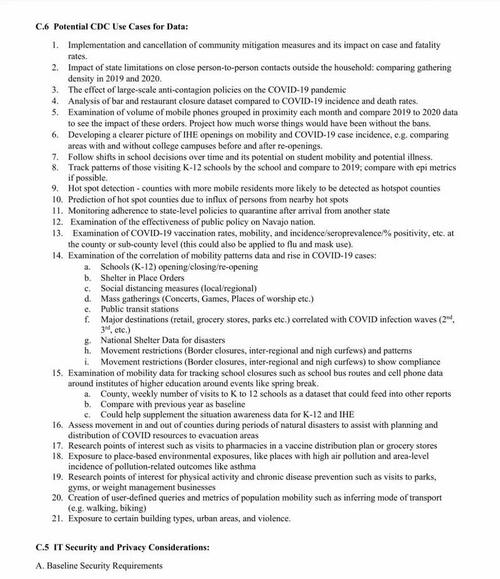
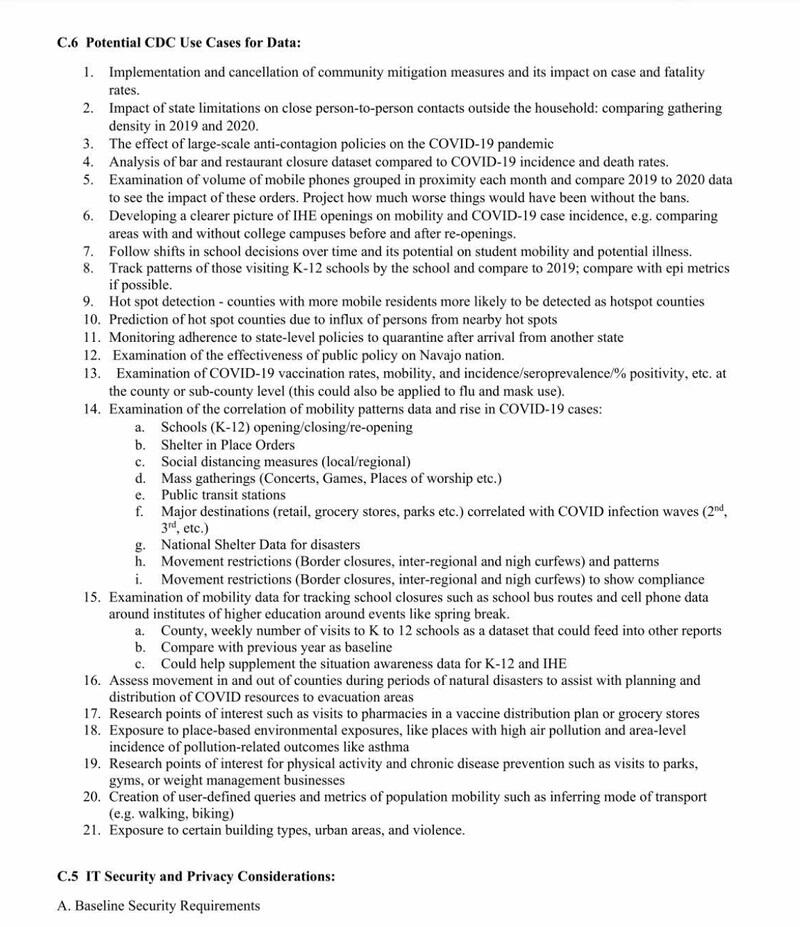
The documents contain a long list of what the CDC describes as 21 different “potential CDC use cases for data.” They include:

  • Track patterns of those visiting K-12 schools by the school and compare to 2019; compare with epi metrics [Environmental Performance Index] if possible.” 
  • Examination of the correlation of mobility patterns data and rise in COVID-19 cases [...] Movement restrictions (Border closures, inter-regional and nigh curfews) to show compliance.”
  • “Examination of the effectiveness of public policy on [the] Navajo Nation.” -Motherboard
A screenshot of the use cases proposed by the CDC. Image: Motherboard.

Cell phone location data has been used throughout the pandemic for various purposes - including by media organizations reporting on how people were traveling once lockdowns began to lift.

That said, the CDC wanted the data for more than just tracking Covid-19 policy response. While the procurement documents say the data is for "an URGENT COVID-19 PR [procurement request]," one of the included use cases reads "Research points of interest for physical activity and chronic disease prevention such as visits to parks, gyms, or weight management businesses."

Another section expands on non-Covid-19 related uses.

"CDC also plans to use mobility data and services acquired through this acquisition to support non-COVID-19 programmatic areas and public health priorities across the agency, including but not limited to travel to parks and greenspaces, physical activity and mode of travel, and population migration before, during, and after natural disasters," it reads. "The mobility data obtained under this contract will be available for CDC agency-wide use and will support numerous CDC priorities."

The data purchased by the CDC was SafeGraph's "U.S. Core Place Data," "Weekly Patterns Data," and "Neighborhood Patterns Data," the latter of which includes information such as 'home dwelling time' which is aggregated by state and census block, per Motherboard.

"SafeGraph offers visitor data at the Census Block Group level that allows for extremely accurate insights related to age, gender, race, citizenship status, income, and more," reads a CDC document.

Read the rest of the report here.

https://www.zerohedge.com/technology/cdc-tracked-millions-americans-during-lockdowns-monitor-movement-compliance

FDA approves first in vitro test for early Alzheimer’s disease

 The US FDA has authorised a new test that can detect amyloid plaques in early-stage Alzheimer’s disease without the use of PET scans, which expose patients to radiation.

Fujirebio Diagnostics’ Lumipulse G β-Amyloid Ratio (1-42/1-40) test has been cleared for use in adult patients aged 55 years and older who have cognitive impairment and are being evaluated for Alzheimer’s and other causes of cognitive decline.

The in vitro diagnostic has been awarded a breakthrough device designation, a status reserved for products that can overcome patient care challenges that accelerated its path through the review process. It has already been approved for use in the EU.

Jeff Shuren, director of the FDA’s Centre for Devices and Radiological health, said the new test could do away with the need for “time-consuming and expensive” PET scans, which carry a radiation risk, and is “great news for individuals and families concerned with the possibility of an Alzheimer’s disease diagnosis.

“With the Lumipulse test, there is a new option that can typically be completed the same day and can give doctors the same information regarding brain amyloid status…to help determine if a patient’s cognitive impairment is due to Alzheimer’s,” he added.

PET scanning can also be difficult to access for some patients, and as a result, many are not diagnosed until their disease is well advanced, with few available treatment options.

The test measures the ratio of the proteins β-amyloid 1-42 and β-amyloid 1-40 in the cerebral spinal fluid (CSF), which according to Fujirebio has the potential to be used in clinical settings and within clinical trials to predict brain β-amyloid burden.

“The lack of effective and accessible clinical tools for patients who could be on the pathway to develop Alzheimer’s disease contributes to its late diagnosis and inadequate treatment,” commented Monte Wiltse, Fujirebio Diagnostics’ chief executive.

Along with earlier diagnosis and treatment, the new test “will also facilitate the development of new drug therapies, which are urgently needed as the prevalence of Alzheimer’s disease increases with a rapidly ageing population globally,” he added.

The approval comes as Biogen has abandoned efforts to commercialise its Alzheimer’s therapy Aduhelm (aducanumab), the only drug approved for the disease that targets the amyloid, after restrictions were placed on its use.

The move leaves patients with few treatment options, centred around drugs like cholinesterase inhibitors that are used to boost neurotransmitter levels in the brain but have limited efficacy.

Biogen and partner Eisai are still working on a follow-up amyloid drug, lecanemab, and other companies including Roche and Eli Lilly also have candidates in late-stage development.

Lilly is working in parallel on a diagnostic for Alzheimer’s that uses a simple blood test, while other groups are looking at alternative ways to diagnose the disease early, such as artificial intelligence-based imaging technology and cognitive testing tools.

https://pharmaphorum.com/news/fda-approves-first-in-vitro-test-for-early-alzheimers-disease/

Amyloid testing reaches a limited market

 Never let it be said that the FDA does not have a sense of timing. Two days after Biogen pretty much gave up on its anti-amyloid drug Aduhelm, the US regulator has granted de novo clearance to the first in vitro diagnostic for amyloid plaques. The Lumipulse G β-Amyloid Ratio (1-42/1-40) test, made by Fujirebio, may now be used for patients aged 55 and older who have cognitive impairment and are being evaluated for Alzheimer’s disease. The Lumipulse test measures the ratio of two different β-amyloid fragments, 1-42 and 1-40, in cerebral spinal fluid. β-amyloid 1-42 is generally recognised as one of the major constituents of amyloid plaques. While the commercial failure of Aduhelm means that short-term uptake of Lumipulse might not be as good as it could have been, the test could still find a niche. Amyloid is used as a diagnostic criterion for Alzheimer’s, and this test might take the place of more expensive and hazardous PET scans. That said, a lumbar puncture is still fairly invasive. Perhaps Lumipulse’s best chance of ramping sales will come if another β-amyloid MAb gains approval; Lilly’s donanemab and Eisai/Biogen's lecanemab face regulatory decisions this year.

β-amyloid MAbs to the rescue?
CompanyProjectEvent 
Eisai & BiogenLecanemab (BAN2401)Rolling AA submission to complete Q2 2022
LillyDonanemabRolling AA submission to complete Q2 2022
LillyDonanemabTopline data from Trailblazer-Alz 4, H2H vs Aduhelm, due H2 2022
Eisai & BiogenLecanemab (BAN2401)Topline readout from phase 3 Clarity-AD due Q3 2022
RocheGantenerumabTopline results from phase 3 Graduate 1 and 2 due Q4 2022
LillyLY3372993
(N3pG 4)
Pivotal trials to start 2022; project is said to work similarly to donanemab but with better dosing & administration
LillyDonanemabTopline data from phase 3 Trailblazer-Alz 2 due mid-2023
AA: accelerated approval. Source: company statements.  

https://www.evaluate.com/vantage/articles/news/policy-and-regulation-snippets/amyloid-testing-reaches-limited-market

Massive Chinese hacking of trade secrets uncovered

 Security researchers on Wednesday said that hackers connected to the Chinese government have attempted to access sensitive information from dozens of global organizations. 

Security firm Cybereason published research on a cyberattack believed to have had the goal of stealing sensitive proprietary information from technology and manufacturing companies mainly in East Asia, Western Europe and North America.  

The group said it had “medium-high confidence” that the attack was linked to Winnti APT group, which specializes in cyber espionage and intellectual property theft and is believed to work for Chinese state interests. 

In a statement, Cybereason CEO and co-founder Lior Div said the group made “intricate and extensive efforts” to garner information from the organizations. 

“The most alarming revelation is that the companies weren’t aware they were breached, going some as far back as at least 2019, giving Winnti free unfiltered access to intellectual property, blueprints, sensitive diagrams and other proprietary data,” Div said. 

The attack is thought by Cybereason to be “one of the largest IP theft campaigns of its kind coming from China.”

The security firm said it has briefed both the ​​FBI and the Justice Department on the findings from its research. 

When asked about the report, Chinese Embassy spokesperson Liu Pengyu told CNN that China “will never encourage, support or condone cyber attacks.”

“China opposes groundless speculation and accusations on the issue of hacker attacks,” Liu continued. “If the firm really care [sic] about global cyber security, they should pay more attention to the cyber attacks by the US government-sponsored hackers on China and other countries.”

Last month, China made other headlines for cybersecurity reasons after Beijing allegedly launched a major cyberattack on Ukraine’s military and nuclear facilities before Moscow invaded the country.

At that time, a report in a British newspaper, The Times, said that Ukraine’s security service had accused the Chinese government of attempting to hack over 600 websites connected to the government and other key institutions.

https://thehill.com/news/3477230-new-report-uncovers-massive-chinese-hacking-of-trade-secrets/

Digital therapeutics open up new opportunities in medicine

 A wide range of companies are aiming to make waves through digital therapeutic offerings and each is doing things differently.

“We are seeing tremendous momentum for the DTx industry, with more and more products coming to market and gaining commercial coverage and recent signals from the White House and Congress demonstrating their interest and recognition of DTx products as an important way to expand access to quality treatments for populations with public coverage, especially underserved communities,” Digital Therapeutics Alliance CEO Andy Molnar told Medical Design & Outsourcing. “While we are riding a massive swell, the wave hasn’t even begun to crest. The community is expanding and convening this broad coalition of stakeholders is critical to really scale the industry and drive DTx adoption and integration to truly transform healthcare.” 

Pear Therapeutics has been at the forefront of the effort with its three FDA-authorized prescription digital therapeutics (PDTs) for treating substance-use disorder, opioid use disorder and chronic insomnia. 

The Boston-based company went public through a special purpose acquisition company (SPAC) merger at the end of 2021, shortly after its fourth PDT platform received FDA breakthrough device designation for alcohol-use disorder. 

Pear has continued to push forward, garnering new Medicare coding for its PDTs, expanding to Japan and other new geographies, and launching a platform to offer PDTs through telehealth platforms, among other steps. 

Another PDT developer is Better Therapeutics, with offerings designed to deliver a novel form of cognitive-behavioral therapy for treating cardiometabolic diseases. 

The San Francisco-based company completed enrollment in a trial for its type 2 diabetes-treating PDT at the end of last year. Like Pear, Better Therapeutics also went public through a SPAC merger. In April 2022, the company reported positive outcomes for three studies. The research included the first study of nutritional cognitive behavioral therapy (nCBT) as a potential treatment for nonalcoholic fatty liver disease (NAFLD) and nonalcoholic steatohepatitis (NASH). 

Yet another firm, DarioHealth, made big moves in March when it announced a $30 million partnership with pharmaceutical giant Sanofi. The companies said the deal will accelerate the commercial adoption of New York-based Dario’s suite of digital therapeutics and expand digital health solutions on the Dario platform. 

Dario said its AI-powered digital therapeutic platform “provides adaptive, personalized experiences that drive behavior change through evidence-based interventions, intuitive, clinically proven digital tools, high-quality software, and coaching to help individuals improve health and sustain meaningful outcomes.” 

DarioHealth and Sanofi said they will collaborate on new or enhanced solutions to be offered through the Dario platform. 

“Our collaboration with Dario is another step towards accelerating Sanofi’s mission of reversing the course of chronic diseases through the integration of healthcare and technology in a way that gives people the tools to improve their health,” Sanofi Head of U.S. General Medicines Gustavo Pesquin said in a news release. “We are excited to help payers realize the potential digital health can bring to the patient experience, and we look forward to continuing to innovate with Dario on the next generation of chronic condition therapies.” 

https://www.medicaldesignandoutsourcing.com/digital-therapeutics-open-up-new-opportunities-in-medical-design/