The New York Stock Exchange said on Wednesday a manual error triggered a technical issue that prevented the opening auctions in some listed stocks, leading to widespread confusion and attracting a review from the U.S. Securities and Exchange Commission.
The glitch, which occurred on Tuesday, impacted stocks of major companies including 3M, Wells Fargo & Co and Verizon Communications Inc.
The NYSE, owned by Intercontinental Exchange Inc, said it began trading in 2,824 securities without an opening auction, which led to erroneous prices, with nearly 4,341 trades in 251 securities "busted", or nullified. The exact cost of the fallout was still unclear.
The exchange also said it had erroneously triggered a sell short restriction (SSR) on about 80 securities on Tuesday.
The SSR is a process aimed at limiting short selling to prevent traders from pushing the shares of a company lower.
"The NYSE is trying to make up for that lost time by allowing people to trade the way they would have yesterday," Sam Stovall, chief investment strategist at New York-based CFRA Research, said.
That could potentially lead to volatile trading on Wednesday but it was "nothing investors have to worry about", Stovall added.
NYSE said it was expecting a normal open on Wednesday.
Repeated administrations of PRGN-2012 were well-tolerated with no dose-limiting toxicities and no treatment-related adverse events greater than Grade 2 –
– Clinical data show strong response in RRP patients with 50% of patients in Complete Response, requiring no post-treatment surgeries, following PRGN-2012 treatment at Dose Level 2; All complete responders remain surgery-free post-treatment with a minimum follow up of 12 months –
– PRGN-2012 treatment at Dose Level 2 significantly reduced the need for surgeries in severe, aggressive RRP patients; Median number of RRP surgeries in 12-month period reduced from 6.5 pre-treatment to 0.5 post-treatment –
– Phase 2 study is enrolling patients with a total of 32 patients enrolled at Dose Level 2 to date –
– Company to outline regulatory strategy in RRP as US Food and Drug Administration (FDA) discussions advance –
– Precigen to host R&D Day virtual event today at 4:30 PM ET –
The company will host an R&D Day virtual event today at4:30 PM ETto showcase the data and will feature presentations byClint T. Allen, MD, Senior Investigator, Surgical Oncology Program, Center for Cancer Research, National Cancer Institute (NCI) and lead associate investigator for the PRGN-2012 clinical trial, and Precigen's President and CEO,Helen Sabzevari, PhD. Participants may register and access the live webcast through Precigen's investor relations website in theEvents & Presentationssection.
GlycoMimetics (GLYC) is a clinical-stage drug developer aiming to create what's called glycobiology-based therapies for cancers.
This one has a catch, however. It's a small biotech name. But despite an approximately $150 million market capitalization, options against this equity have decent liquidity and are quite lucrative. The company also has a lot of potential.
My main worry: That Glyco could get purchased for a significant premium in which case I might leave a lot of money on the table. C'est la vie.
The company has one clinical asset, uproleselan, for acute myeloid leukemia and another one that is clinically cleared but looking for a development partner. Uproleselan has been granted "fast track" designation from the Food and Drug Administration, breakthrough therapy designations from regulatory authorities in the U.S. and China, and "orphan" designations from the FDA and the European Medicines Agency.
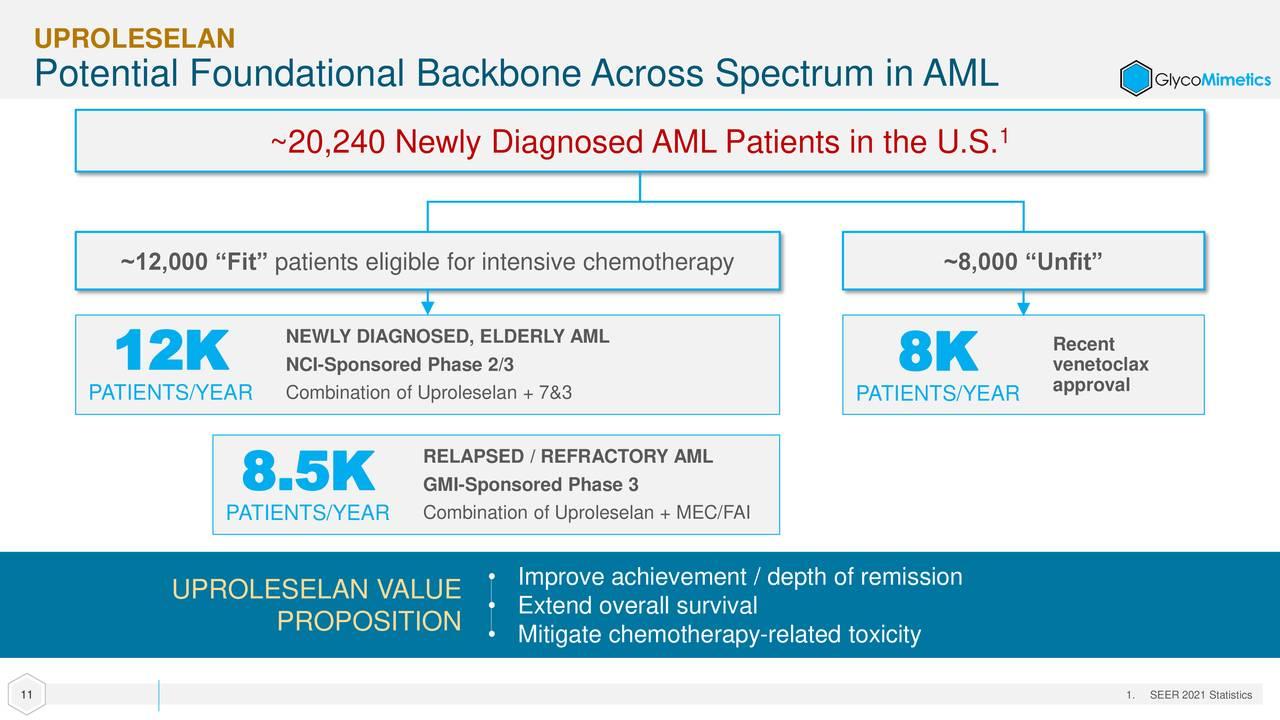
This candidate produced encouraging data in early clinical trials. Based on these results, uproleselan has been entered in multiple late-stage trials, including a double-blind, placebo-controlled phase 3 study to evaluate it in the treatment of 388 relapsed acute myeloid leukemia patients. The patients are randomized 1:1 to receive either an introductory round of uproleselan and chemotherapy, followed by three additional cycles of uproleselan and chemo -- or an introductory round of placebo and chemo followed by three additional cycles of placebo and chemo.
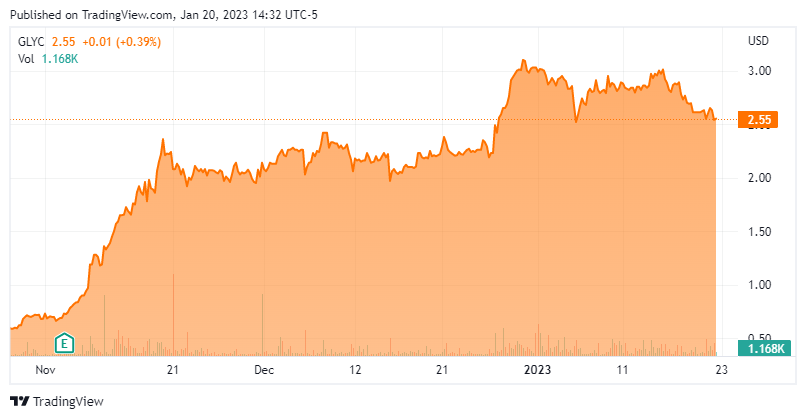
The returns to date have been potentially groundbreaking. The overall survival event trigger was initially anticipated at around 22 months -- excellent considering that Astellas' (ALPMF) Xospata and Jazz Pharmaceuticals' (JAZZ) Vyxeos were approved with median over survival rates of 9.3 months and 9.5 months, which were triggered at 17.8 months and 20.5 months, respectively. However, in an update provided in November 2022, management indicated that median follow-up is now anticipated to be triggered at 34.5 months, providing significant improvement over the other two therapies.
In fact, the news was so encouraging that the FDA elected to conduct a utility analysis in which an independent data monitoring committee will review data at 80% of planned events by the end of the first quarter of 2023 to determine if the study should proceed to 100% events triggered (near year-end 2023) or unblind the data early due to compelling evidence of benefit. An unblinding would trigger an immediate new drug application filling by the company. This disclosure has triggered a significant and justified rally in the stock over the past few months.
Furthermore, GlycoMimetics' compound is being assessed as a front-line therapy in a 262-patient Phase 2/3 study in which newly diagnosed individuals will be randomized to receive either an introductory round of uproleselan and chemo followed by three rounds of uproleselan and chemo -OR- an introductory round of chemo followed by three rounds of chemo. The Phase 2 portion was fully enrolled in December 2021 with an interim readout expected sometime in 2023.
The company ended the third quarter with just over $50 million worth of cash and marketable securities on its balance sheet. This should fund it through 2023, but I would not be surprised if the company raises additional capital in the next quarter or two. If I were the CFO, I would probably execute that raise, if the FDA unblinds the study which sometime this quarter. duration.
eHealth, Inc. (Nasdaq: EHTH), a leading private online health insurance marketplace, today announced preliminary, unaudited financial results and select operating metrics for the fourth quarter and fiscal year endedDecember 31, 2022.
"eHealth's fourth quarter results reflect the transformational initiatives that we implemented in 2022 across all key areas of the company. During the fourth quarter Annual Enrollment Period, our company helped thousands of Americans shop for and enroll in healthcare plans that we believe represent an optimal match for them based on their personal preferences, healthcare needs, and budgets. We were able to do so while exceeding our cost reduction goals and significantly improving the efficiency of our sales and marketing organizations by emphasizing our most profitable marketing channels and enhancing agent productivity," said Fran Soistman, chief executive officer of eHealth. "The Medicare market remains strong, reflecting a robust selection of quality plans, significant customer demand, and a more rational approach to enrollment growth by our peers that emphasizes profitability over growth-at-all-costs. eHealth ended 2022 with a strong cash position, and we expect to deliver further meaningful improvements to our operational and financial performance in 2023. We look forward to providing full fourth quarter and fiscal year 2022 results as well as our 2023 guidance on our upcoming fourth quarter earnings call."
Fourth Quarter and Fiscal Year 2022 Preliminary Results
Revenue for the fourth quarter of 2022 is expected to be in the range of $190 to $200 million. Revenue for the year ended December 31, 2022 is expected to be in the range of $395 to $405 million as compared to the company's guidance of $375 to $395 million.
GAAP net income for the fourth quarter of 2022 is expected to be in the range of $16 to $21 million. GAAP net loss for the year ended December 31, 2022 is expected to be in the range of $93 to $88 million as compared to the company's guidance of $115 to $92 million.
Adjusted EBITDA for the fourth quarter of 2022 is expected to be in the range of $40 to $50 million. Adjusted EBITDA for the year ended December 31, 2022 is expected to be in the range of $(50) to $(40) million as compared to the company's guidance of $(73) to $(45) million.
Total cash outflow for the year ended December 31, 2022 (excluding the impact of our $70 million term loan and associated costs and net securities activities) is expected to be $44 million as compared to the company's guidance of $110 to $90 million.
Select Operating Metrics
The company exceeded its cost reduction goals for the full year 2022 by delivering over $110 million in net operating cost savings compared to the full year 2021.
Fourth quarter of 2022 telephonic conversion rates in the company's Medicare business improved by more than 25% compared to the fourth quarter of 2021.
Medicare Advantage Approved Applications for the fourth quarter of 2022 were 131,235, a decline of 26% year-over-year. Medicare Advantage Approved Applications for the year ended December 31, 2022 were 302,949, a decline of 24% year-over-year. Decline in approved applications reflects a significant reduction in marketing costs in 2022 compared to 2021, which was partially offset by an increase in agent productivity.
180 Life Sciences Corp. (NASDAQ: ATNF) (“180 Life Sciences” or the “Company”), today announced the publication of a review entitled ‘Treatments for early stage Dupuytren’s disease: an evidence-based approach’ inThe Journal of Hand Surgery (European Volume).
In the publication, Professor Jagdeep Nanchahal, chairman of the medical advisory board of 180 Life Sciences, and his colleague at the University of Oxford, describe the limitations for the current treatments for late-stage Dupuytren’s disease and the lack of evidence based on randomized double blind, placebo-controlled trials for treatments for early-stage disease, such as intranodular injection of steroid or radiotherapy. They go on to describe how tumor necrosis factor (TNF) was identified as a potential therapeutic target through the study of cellular signaling mechanisms in tissue from patients. They also describe the results of the phase 2a dose ranging trial, which identified the most efficacious dose and formulation of adalimumab (an anti-TNF). This was followed by a phase 2b trial, which met the primary endpoint of reduction in nodule hardness and the secondary endpoint of decrease in nodule size, indicating the potential to control progression of early-stage disease.
Sonoma Pharmaceuticals, Inc. (NASDAQ:SNOA), a global healthcare leader developing and producing patented Microcyn® technology based stabilized hypochlorous acid (HOCl) products for a wide range of applications, including dermatology, eye, oral and nasal care, and wound care, today announced that Microcyn®Rx products have received a Distribution and Pricing Agreement (DAPA) for distribution by the Defense Logistics Agency (DLA).
The DAPA enables our partner, EMC Pharma, to enter into distribution agreements for Microcyn® Rx products with federal customers. The U.S. government is the world's largest purchaser of good and services. Approximately half of EMC Pharma's customers are U.S. government entities, including VA hospitals, the Department of Defense, the Federal Bureau of Prisons, as well as state and local prison systems. EMC Pharma is a 100% minority-owned and a certified Minority Business Enterprise (MBE).
The DAPA approval process was a coordinated effort by Sonoma and EMC Pharma and resulted in obtaining DAPA # SP0200-22-H-0034 for Sonoma's Microcyn Rx products including wound care, prescription dermatology products, Celacyn® and Levicyn®, and prescription eye care Acuicyn®.
George Soros is the most dangerous man in America. The investor is intent on remaking the country to his liberal image, from our foreign-policy priorities to undermining our criminal-justice system. This week, The Post takes a look at the reach of Soros’ billions. In this third essay, Matt Palumbo, author of “The Man Behind the Curtain: Inside the Secret Network of George Soros,” examines Soros’ acolytes in the Biden administration.
At 92 years old, George Soros boasts more influence than ever before in the Oval Office.
Despite dumping millions into US presidential elections before, he has, fortunately for the country, incinerated most of that money into thin air. Soros donated tens of millions to the failed presidential campaigns of John Kerry and Hillary Clinton, and even when he did score a win in Barack Obama, he would later complain that it didn’t get him the sort of influence he was looking for.
He “closed the door” on him, Soros told The New York Times. “He made one phone call thanking me for my support, which was meant to last for five minutes, and I engaged him, and he had to spend another three minutes with me, so I dragged it out to eight minutes.”
Soros donated millions to campaigns for liberal candidates.REUTERS
Biden’s transition team was formed after the 2020 election and quickly began staffing itself with liberals connected to Soros and his network.
Biden-assembled “Agency Review Teams,” which included lists of individuals “responsible for understanding the operations” of each government agency, were tapped to prepare both Biden and Kamala Harris “to hit the ground running on Day One.”
Soros was represented well by Biden’s picks, with individuals working for organizations founded by or funded by Soros making up at least 17 of them. This included individuals picked to work on the transition teams of the State Department, Consumer Financial Protection Bureau, United States Mission to the United Nations, Department of Defense, Department of Labor, Department of the Interior, Department of the Treasury, Federal Reserve, Banking and Securities Regulators, National Security Council, Office of the US Trade Representative and Department of Veterans Affairs.
A number of individuals within the Soros sphere of influence then entered Biden’s Cabinet:
Antony Blinken and his family have been linked to Soros for years.AFP via Getty Images
Neera Tanden served as president for the Soros-funded Center for American Progress (CAP) before becoming senior adviser to the president in May 2021. CAP, which bills itself as a public-policy group pushing liberal viewpoints on economic and social issues, is now headed by Patrick Gaspard, who served previously as President of Soros’ Open Society Foundations (OSF). Tanden had previously been nominated to head the Office of Management and Budget but didn’t survive the confirmation battle.
White House Chief of Staff Ron Klain serves on the board of the Center for American Progress Action, the lobbying wing of the aforementioned Center for American Progress.
Klain has been pointed to as the man dragging Biden further left and told the Daily Beast that “progressives are a big part of our party, and making sure their voices are heard here at the White House is a big part of my job.”
Sam Berger was a former vice president for democracy and government reform at the Center for American Progress and was made director of strategic operations and policy for the COVID-19 Response Team.
Secretary of State Antony Blinken arguably has the strongest connection to Soros. Antony’s father, Donald Blinken, and his wife, Vera, funded the Vera and Donald Blinken Open Society Archives at Central European University, which houses a digital collection of Hungarian historical documents. In one Soros Foundations Network report from 2002, Donald Blinken is listed on the Board of Trustees for CEU third after Soros (the chair) and Aryeh Neier, implying he’s high in the pecking order.
Joe Biden’s transition team was filled with Soros lackeys.Chris Kleponis / Pool via CNP / SplashNews.com
The daily blog Hungarian Spectrum, which boasts Soros among its donors, celebrated Blinken as a potential secretary of state pick after the 2020 election because “Hungary will not be forgotten in the next four or perhaps eight years in Washington.” After Blinken was confirmed as secretary of state, Hungarian newspaper Magyar Nemzet called it “great news for George Soros.”
And indeed it was, as one of the first actions Blinken took after assuming his position was to sanction a longtime critic of Soros. In May 2021, Blinken announced sanctions against a former Albanian president and prime minister, Sali Berisha, alleging “significant corruption,” and banned him, his wife, and his children from entering the United States.
Soros and Berisha had publicly traded blows before, with Berisha putting him on blast over the years, calling Soros, among others things, a “great gander” he accuses of “mafia acts in Albania.” Rep. Lee Zeldin couldn’t help but notice that the sanctions came seemingly out of nowhere, and when he grilled Blinken on them, the secretary of state denied having any contact with Soros regarding the sanctions but left the possibility open that “someone” at the State Department could have.
When Zeldin tried to follow up for more information from the State Department, they effectively ghosted him.
While Soros hasn’t been in the public lately, his children appear primed to take over his empire and are working overtime.
One son, 37-year-old Alexander Soros, has been his de-facto ambassador to the White House and made at least a half-dozen trips there since Biden took office, while also networking with other Democrats there, the photographic evidence for which Alexander himself posts all over social media.
There’s a Soros, or a Soros acolyte, in the ear of President Biden every day.
Alexander Soros made at least a half-dozen trips to the White House since Biden took office.
How Soros spends his money
The main organizations that George Soros uses to further his agenda:
The Open Society Foundations
With an endowment nearing $20 billion, the Open Society Foundations is the vehicle through which George Soros finances his entire empire. Acting as asort of philanthropic conglomerate, the OSF spends billions on grants financing left-wing narratives and policies on economics, education, equality, health care, journalism and justice reform. Oftentimes an individual group is set up for a particular cause — like setting up a “Justice and Public Safety Political Action Committee” in one state to fund races for district attorney — and funded through this umbrella group. Soros has funneled $32 billion of his own fortune into the OSF. The current endowment of the OSF rivals its cumulative spending since inception, indicating that it is well positioned to outlive Soros.
Center for American Progress
Influential public-policy think tank founded by John Podesta in 2003 to rival the likes of the more conservative Heritage Foundation, and has strong ties to the Democratic Party. Soros has funded the CAP with at least $3 million over the years, and Patrick Gaspard, previously the president of the OSF from 2017-2020, became president of CAP in June 2021. Politico described CAP as the “most influential think tank of the Biden era.”
Central European University
University started in Hungary by George Soros in 1991, to push a liberal agenda on the former Soviet Bloc after the fall of the wall. Members of the board of trustees include his son Robert Soros and numerous individuals also in leadership positions in the OSF. Among the school’s graduates include the former president of Georgia Giorgi Margvelashvili, the former Georgian minister of defense, former Croatian minister of justice and multiple members of European Parliament. Soros has donated over $400 million to higher education over the years, with 75% of it going to just two schools: Bard College in New York state and CEU.