Search This Blog

Wednesday, January 25, 2023

9,400 pounds of fentanyl seized at US border during 3-month period

 Fentanyl seizures across the US southern border continue to skyrocket, with 9,400 pounds of the killer drug seized between October and December, a 241% increase year-on-year, according to federal figures.

The synthetic opioid continues to poison the country, and smugglers are eschewing other drugs to bring it in, with fentanyl busts increasing 52% month-on-month in December while heroin and methamphetamine seizures were up by just 1% and 4%, respectively.

Most interceptions are made at ports of entry into the country, where people and vehicles are screened and inspected.

A recent big bust in Eagle Pass, Texas, had an estimated street value of $173,040, according to Customs and Border Protection.

In that haul, agents found more than seven pounds of fentanyl concealed inside the liner of an ice chest in a vehicle.mexico border

Fentanyl seizures at the border are skyrocketing, CBP figures show.
James Keivom for NY Post

A lethal dose of the drug, which is 50 times more powerful than heroin, can be as little as 2 mg — enough to fit on the tip of a pencil. As it is also being used to cut other types of drugs, it leads to more overdoses. In 2022, synthetic opiate deaths averaged over 70,000 a month, according to official data.

An area covering Texas, New Mexico and into Arizona has become a drug smuggling hotspot, a spokesman for the Texas Department of Public Safety told The Post.

“Just based on the cartel activity — you’ve got the Juarez Cartel and then the Sinaloa [Cartel]” Lt. Chris Olivarez of Texas DPS said, adding, “They pretty much control that whole western area of the border… from El Paso to Arizona.”

Fentanyl
Fentanyl busts increased 52% month-on-month in December.
CBP Laredo

As part of Texas Gov. Greg Abbott’s Operation Lone Star, the state has poured money into the fight against smugglers and increased inland patrols intercepting the drugs. These have initially been successful with enough fentanyl to potentially kill millions seized by authorities.

“For us to seize over 356 million lethal doses statewide [since March 2021], that’s significant, because we don’t have the luxury of being at a port of entry and having x-ray machines,” Olivarez explained.

However, he added cartels are constantly changing their methods of sneaking drugs into the country — turning law enforcement’s efforts into a cat and mouse game.

“We know it’s getting by because we see the number of people dying every single day,” he said. “We know it’s getting to other states, so we know it’s getting by us. We’re just trying to determine what tactics they’re using.”

https://nypost.com/2023/01/25/9400-pounds-of-fentanyl-seized-at-us-border/

Study Finds US Would Run Out Of Long-Range Munitions In 1 Week In China Hot War

 A new study released this week by the D.C.-based Center for Strategic and International Studies (CSIS) has concluded that America's defense industry is "not adequately prepared" for "a protracted conventional war" with an enemy with a large military like China.

The findings were the result of a war games simulation which also relied heavily on observations and statistics being gained from the Ukraine-Russia war, and Washington's ongoing military support role to Kiev.

Information from the Ukraine war led CSIS to find that the US would rapidly deplete its munitions, particularly long-range, precision-guided ones - in merely less than a week of a hot war with China in the Taiwan Strait.

“The main problem is that the U.S. defense industrial base — including the munitions industrial base — is not currently equipped to support a protracted conventional war," the study emphasized.

"The bottom line is the defense industrial base, in my judgment, is not prepared for the security environment that now exists," CSIS’s Seth Jones concluded in a statement to The Wall Street Journal.

As the study's main author, Jones posed the question: "How do you effectively deter if you don’t have sufficient stockpiles of the kinds of munitions you’re going to need for a China-Taiwan Strait kind of scenario?" According to more from the study:

"As the war in Ukraine illustrates, a war between major powers is likely to be a protracted, industrial-style conflict that needs a robust defense industry able to produce enough munitions and other weapons systems for a protracted war if deterrence fails..."

"Given the lead time for industrial production, it would likely be too late for the defense industry to ramp up production if a war were to occur without major changes."

The report additionally pointed out that the slow-moving nature of US bureaucracy and oversight is also a fundamental aspect to the problem:

The study also said that the U.S.’s foreign military sales (FMS) take too long because they need to be initiated by the Department of State and then executed by the Department of Defense and ultimately approved by Congress. Foreign sales have benefits, including supporting the U.S. defense industry, strengthening ally relations and preventing the sale of adversary systems to other countries, the study said.

"The U.S. FMS system is not optimal for today’s competitive environment — an environment where such countries as China are building significant military capabilities and increasingly looking to sell them overseas," the study stated.

It does seem the Pentagon is taking note, and is aware that events in Ukraine have exposed US defense shortcomings, as the Biden administration chooses to get more and more involved. The New York Times reported Tuesday that the US plans to boost production of artillery ammunition by 500% over the next two years.

Whereas the US Army previously produced 14,400 155mm shells a month, the new plans could see those numbers hit over 90,000 each month.

https://www.zerohedge.com/geopolitical/study-finds-us-would-run-out-long-range-munitions-1-week-china-hot-war

CDC Officials Who Spread Misinfo Apologized To Source Of False Data But Not To Public: Emails

 by Zachary Stieber via The Epoch Times (emphasis ours),

U.S. health officials who spread inflated COVID-19 child death data in public meetings apologized to the source of the false data but not to the public, newly obtained emails show.

Drs. Katherine Fleming-Dutra and Sara Oliver, with the U.S. Centers for Disease Control and Prevention (CDC), offered the false data in 2022 while U.S. officials weighed granting emergency authorization to COVID-19 vaccines for children as young as 6 months.

The study they cited for the data was published ahead of peer review by a group comprised primarily of British authors. The study was corrected after the public meetings.

Emails obtained by The Epoch Times showed that Fleming-Dutra and Oliver were alerted that they had spread misinformation. Neither the officials nor the CDC have informed the public of the false information. Newly obtained emails showed the officials apologized to Seth Flaxman, one of the study’s authors, and even offered to see whether the study could be published in the CDC’s quasi-journal.

“I feel … that we owe you an apology,” Oliver wrote to Flaxman on June 27, about 10 days after she and Fleming-Dutra falsely said there had been at least 1,433 deaths primarily attributed to COVID-19 in America among those 19 and younger. “We draw the attention of a variety of individuals with the ACIP meetings, and apologize that you got caught in it this time.

“I am also sorry that you got pulled into the attention around the VRBPAC and ACIP meetings,” Fleming-Dutra added. She had presented the data to the Vaccines and Related Biological Products Advisory Committee, which advises the U.S. Food and Drug Administration, and the Advisory Committee on Immunization Practices, which advises the CDC.

Fleming-Dutra, Oliver, and Flaxman did not respond to requests for comment.

Inflated Death Toll

Using data from the CDC, Flaxman and his co-authors claimed that there were at least 1,433 deaths primarily attributed to COVID-19 among those aged 0 to 19 in the United States. The actual number was 1,088, the authors acknowledged in the corrected version of the study.

Fleming-Dutra presented the false data as rankings to VRBPAC on June 14, 2022 and ACIP three days later. It’s not clear why the CDC didn’t examine its own database rather than relying on a preprint study.

Oliver also cited the study while speaking during the ACIP meeting.

The data had an impact. It showed “that this is not a minor illness in children,” Dr. Katherine Poehling, one of the ACIP members, said at the time.

Dr. Rochelle Walensky, the CDC’s director, later appeared to cite the inflated death toll and ACIP still cites the preprint, though it was later updated with the correct data.

Flaxman updated the study after receiving an email from Kelley Krohnert, a Georgia resident who has become a fact-checker of suspect COVID-19-related claims.

Krohnert’s concerns also made their way to Fleming-Dutra and Oliver, but the CDC officials have never publicly acknowledged promoting misinformation.

‘We Had an Error’

Flaxman acknowledged in emails to Krohnert, and in a June 27 message to Fleming-Dutra and Oliver, that he did not fully understand how the CDC’s death database works.

“Thanks for your work, and your great presentations to VRBPAC and ACIP. You cited our preprint. We’ve just updated it (see attached; it should appear on medrxiv in the next day). While none of the substantive conclusions change, we had an error which you may have seen was picked up very prominently by a blogger,” Flaxman wrote. “I am writing first to say sorry–I really regret that this happened. It was my mistake in misunderstanding the [death certificate] data, and not realizing about CDC Wonder’s provisional database.”

Flaxman also asked for feedback on the updated study and whether the officials could help with submitting the paper to the Morbidity and Mortality Weekly Report (MMWR), a quasi-journal the CDC publishes that only includes articles (pdf) vetted and shaped by top CDC officials to align with the agency’s policies.

“We’ve never tried to publish there, so I don’t know the process or how often they consider manuscripts from non-CDC authors,” Flaxman said. “If you do think this would be a possible route, perhaps one or both of you would want to help us revise the manuscript and join as an author?”

Oliver wrote back first, saying that she wanted to apologize to Flaxman and that “we will absolutely review and provide feedback,” as well as context.

We are more than happy to do that without formally being co-authors. That way you can avoid formal CDC clearance,” Oliver wrote.

Fleming-Dutra then chimed in with her apology, adding, “I am glad to hear that you and your team are continuing to do this important work.” She recommended Flaxman and his team review studies published in the MMWR to get a sense of the format of the digest. A large portion of her email was redacted under an exemption to the Freedom of Information Act for “inter-agency or intra-agency records.” The Epoch Times has appealed that and other redactions.

Flaxman then notified the CDC officials that the corrected study had been made public. Fleming-Dutra replied, but the email was redacted.

“Thanks, very useful feedback. Small update: we’re hoping to submit to JAMA Pediatrics in the next week or so, and [redacted],” Flaxman answered. He indicated that the CDC had provided feedback and questioned on how to cite it in the submission.

https://www.zerohedge.com/covid-19/cdc-officials-who-spread-misinformation-apologized-source-false-data-not-public-emails

House Panel Chair Calls For Probe Into '$60 B' In Fake COVID-19 Unemployment Claims

 by Katabella Roberts via The Epoch Times (emphasis ours),

House Ways and Means Committee Chairman Jason Smith (R-Mo.) is calling for an investigation into the “historic theft of taxpayer dollars from COVID-era unemployment programs” after a report by the Government Accountability Office (GAO) found that as much as $60 billion may have been spent on fraudulent claims for unemployment insurance during the pandemic.

The report, released on Jan. 23, said that the Department of Labor (DOL) stated that about $878 billion in total unemployment benefits were paid from April 2020 through September 2022.

GAO said that at least $4.3 billion in unemployment insurance (UI) fraud has been formally confirmed by state workforce agencies, while at least $45 billion in payments have been flagged for potential fraud by the DOL’s Office of Inspector General.

The federal government started an unemployment aid program in March 2020. GAO added that it’s difficult to know for sure the extent of fraud in unemployment insurance programs across the system during the pandemic.

For example, it noted that the Labor Department, based on states’ reviews of samples of claims, estimates that as much as $8.5 billion was spent on fraudulent UI claims in 2021.

According to GAO, if that level were to be extrapolated to total spending across all UI programs during the wider pandemic period, it would suggest more than $60 billion in fraudulent payments were made.

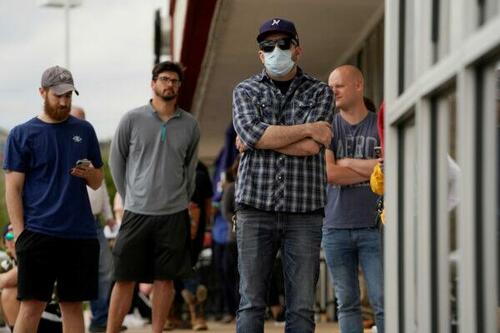
People who lost their jobs wait in line to file for unemployment at an Arkansas Workforce Center in Fayetteville, Ark., on April 6, 2020. (Nick Oxford/Reuters)

‘Hard-Earned Tax Dollars Lost to Criminal Activity, Fraud’

The report notes, however, that the figure is an estimate, subject to limitations regarding its validity and accuracy, and should be “interpreted with caution” while the actual amount is unclear.

In a statement on Monday, Smith said that the GAO report “only scratches the surface of what is publicly known about the unprecedented scope, size, and severity of the fraud.”

This report proves what Republicans have already been saying. American families, whose wages have eroded under President [Joe] Biden’s inflation crisis, have watched as hundreds of billions of their hard-earned tax dollars were lost to criminal activity and fraud because Democrats refused to acknowledge the problem and repeatedly rejected Republican efforts to put basic safeguards in place to protect against this activity,” Smith said.

“Congressional Democrats walked away from their oversight responsibilities of getting to the bottom of how this happened, what they could do to prevent it, and even how much has fully been lost, leaving criminals to profit off the backs of taxpayers. Republicans are committed to investigating fraud and conducting rigorous oversight on behalf of working families,” he added.

The Missouri lawmaker also pointed to testimony (pdf) by DOL Inspector General Larry D. Turner in March last year stating that at least $163 billion in pandemic UI benefits could have been “paid improperly, with a significant portion attributable to fraud.”

According to The Washington Post, the government has so far recovered just over $4 billion of that, which amounts to just 2.4 percent of the wrongful payments.

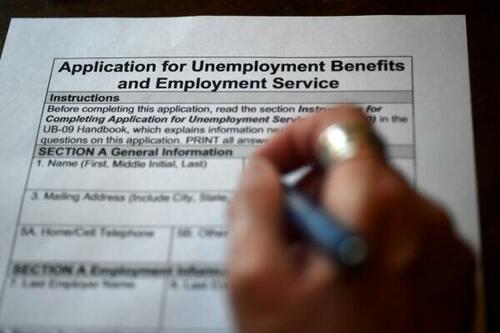
In this photo illustration, a person files an application for unemployment benefits in Arlington, Va., on April 16, 2020. (Olivier Douliery/AFP via Getty Images)

Actual Unemployment Fraud Figure Could Be Much Higher

Smith also pointed to estimates by experts including Blake Hall, CEO of ID.me, who told Axios in 2021 that as much as $400 billion went on fraudulent unemployment claims. Half of all unemployment spending may have been stolen, Hall told the publication.

A statement issued in September 2022 by the DOL inspector general said that more than 190,000 investigations relating to UI fraud have been opened since the start of the pandemic, but so far just over 1,000 individuals have been charged.

While GAO noted in its report that the DOL has taken steps to address fraudulent jobless benefits, such as issuing guidance, providing funding to states, and deploying teams to recommend improvements to state unemployment insurance programs, the watchdog noted that as of December 2022, the department has “not yet developed an antifraud strategy based on leading practices in GAO’s Fraud Risk Framework.”

https://www.zerohedge.com/political/house-committee-chair-calls-probe-60-billion-fake-covid-19-unemployment-claims

New Gun Regulation Handicaps The Disabled

 by John R. Lott Jr. via RealClear Wire,

The Biden administrationnewly released regulations regarding pistol-stabilizing braces” will instantly turn tens of thousands of law-abiding Americans into felons and create a national rifle registry. But the Biden administration and the media exaggerate the costs and ignore the benefits these braces produce.

Few seem to realize that stabilizing braces for pistols were originally designed to allow wounded and disabled veterans who may have lost the use of part of their hand to hold handguns. They are essentially a strap attached to the gun. Disabled individuals are often viewed as easy targets by criminals, and stabilizers make it easier to defend themselves. The Bureau of Alcohol, Tobacco, Firearms, and Explosives (ATF) originally approved pistol braces during the Obama administration. 

There are plenty of statements from disabled veterans, such as Rick Cicero, who lost his right arm in an explosion in Afghanistan and can still use a gun today because of the pistol-stabilizing brace. But outside of a brief mention in a Fox News story, news articles on the new regulations never mention that these braces help the disabled and make it possible for them to defend themselves. 

Obama was hardly a friend of gun ownership, but now the Biden administration has changed the Obama administrations decision. The ATF now concludes that any foreign-made pistols with stabilizing braces violate the law and are retroactively considered rifles and violate the size requirement for rifles. As such, registration or removal of the brace wont bring it into compliance. The ATF leaves only two options: the destruction of the guns or their surrender to ATF. This includes imported pistols that never had a brace added to them.

Putting aside that the ATF isn’t Congress and cant make up new laws to redefine what a rifle is, their logic is baffling. Take two otherwise identical guns, one with a pistol brace and one that never had a pistol brace: Even if the pistol brace is removed from the gun to which it was attached, it is still banned. Meanwhile, the gun that never had the brace attached could have one added, just as easily as the gun that previously had the pistol brace could have it reattached – but only the gun that once had a pistol brace attached to it is banned.

Of course, how the ATF is supposed to know whether you used to have the pistol brace attached to the gun is a mystery. Nor is it obvious why functionally identical foreign-made pistols should be treated differently than domestically manufactured ones.

All this started after President Biden cited a crime in 2021 in Colorado – where a shooter used a pistol stabilizing brace when attacking shoppers in a grocery store – to justify calling for classifying such brace-affixed pistols as machine guns. Ahmed Al Alwi murdered 10 people at close range in a Boulder, Colo. grocery store. A previous shooting in 2019 by Connor Betts, in Dayton, Ohio, also involved a pistol brace. These are the only two cases of their kind and, more importantly, neither of them had any difficulty holding their guns and all their shots were fired at a short distance. There is no evidence that the brace made any difference in their ability to carry out the attacks. And there has been no surge in crime by the disabled or others using these braces.

These new regulations aren’t surprising after Steven Dettelbach, a controversial gun control advocate, was confirmed as director of the ATF. He was narrowly confirmed only with the unanimous support of all voting Democrats, including the support of Democrats who claim to support the Second Amendment, such as Montanas Jon Tester and West Virginias Joe Manchin.

With no evidence that these two attacks were any more lethal with stabilizing braces – and with no attempt to make that case – gun control advocates haven’t seriously tried to justify the new regulation. The cost will be to the disabled Americans who will now have a harder time being able to defend themselves and their families.

John R. Lott Jr. is a contributor to RealClearInvestigations, focusing on voting and gun rights. His articles have appeared in publications such as the Wall Street Journal, New York Times, Los Angeles Times, New York Post, USA Today, and Chicago Tribune. Lott is an economist who has held research and/or teaching positions at the University of Chicago, Yale University, Stanford, UCLA, Wharton, and Rice.

https://www.zerohedge.com/political/new-gun-regulation-handicaps-disabled

Male alcohol use may be a crucial, unrecognized factor affecting IVF outcomes

 Research from Dr. Michael Golding's laboratory at Texas A&M University indicates that male alcohol use has a significant negative influence on in vitro fertilization (IVF) success rates, thus increasing patient financial burden and emotional stress.

The recently published work in Molecular Human Reproduction is part of Golding's research program focused on understanding how male drinking prior to conception contributes to the development of alcohol-induced birth defects and disease. This particular study highlights the importance of expanding fertility and pre- messaging to emphasize the reproductive danger of alcohol use by both parents, not just the mother.

Couples struggling with fertility are increasingly using assisted reproductive technologies (ART) like IVF to have children.

The Centers for Disease Control and Prevention estimates that about 2% of all babies born in the United States are conceived using ART, which would mean 1 in 50 babies were conceived using ART in 2021, according to the CDC's provisional births data.

These statistics highlight the growing importance of looking at both parents' contributions to fertility and , according to Golding, an associate professor in the School of Veterinary Medicine & Biomedical Sciences' Department of Veterinary Physiology & Pharmacology.

"We say to the woman, 'You need to be careful of what you eat. You need to stop smoking. You need to be doing all these different things to improve fertility,'" Golding said. "We don't say anything to the man, and that's a mistake, because what we're seeing here is that the couple's odds of success with their IVF procedure are increasing simply by addressing both parents' health habits."

Golding's research used a  to determine the effects of a potential father's drinking on IVF pregnancy outcomes. The model included a control group that represented males who do not drink, a group that represented males who participate in chronic drinking at the legal limit, and a group that represented males who participate in chronic drinking at one and a half times the legal limit.

The results of the research revealed that the more a male drinks before providing sperm for an IVF pregnancy, the less likely the pregnancy is to be successful.

"Seeing the negative effects in both the legal limit group and the group drinking at one and a half times the legal limit revealed that as alcohol dose increases, things get worse," Golding explained. "That really surprised me. I didn't think that it would be that cut and dry. That really emphasized that even very modest levels of exposure were breaking through and having an impact on conception, implantation, and overall IVF pregnancy success rates."

Alexis Roach, a Ph.D. candidate helping conduct research in Golding's lab, served as first author of the recently published IVF research paper. She said their findings and other research conducted in Golding's laboratory challenge the primarily maternal-focused narrative of previous IVF research. She also said it's important to make the findings of this research accessible to the public.

"The most important aspect of this research is that it makes it clear that everybody plays a role in achieving successful pregnancy outcomes, even though the general assumption is that it's just women," Roach said. "The most important thing to take away from this is that if you're a male considering having a family, abstain from alcohol until your wife gets pregnant."

The research concludes that male alcohol use hinders an embryo's ability to successfully implant in the uterus and reduces IVF embryo survival rates. The research also revealed more questions about  and paternal drinking. Golding's lab is continuing to research these questions and the paternal aspects of fetal alcohol spectrum disorders, a group of conditions that can occur when a person is exposed to alcohol before birth. His work aims to provide a holistic look at understanding fetal development and pregnancy by examining the father's role in it.

For now, he says the next step in improving IVF pregnancy outcomes is getting the discoveries from this research into the hands, eyes, and ears of the people considering ART to help start their own families.

"It is important to remember that couples struggling with fertility who have chosen to pursue IVF are under intense emotional and financial pressure, which is associated with a feeling of helplessness," Golding pointed out. "Our study demonstrates that drinking alcohol is an unrecognized factor that negatively impacts IVF pregnancy success rates. Therefore, as  use is easily changed, our study identifies a shared action item that can empower the couple to work together toward their goal of becoming pregnant."

More information: Alexis N Roach et al, Preconception Paternal Alcohol Exposure Decreases IVF Embryo Survival and Pregnancy Success Rates in a Mouse Model, Molecular Human Reproduction (2023). DOI: 10.1093/molehr/gaad002


https://medicalxpress.com/news/2023-01-male-alcohol-crucial-unrecognized-factor.html

Rural residents have 19% higher risk of heart failure than their urban counterparts

 Adults living in rural areas of the United States have a 19% higher risk of developing heart failure compared to their urban counterparts, and Black men living in rural areas have an especially higher risk—34%, according to a large observational study supported by the National Institutes of Health.

The study, one of the first to look at the link between living in rural America and first-time cases of , underscores the importance of developing more customized approaches to  failure prevention among rural residents, particularly Black men.

"We did not expect to find a difference of this magnitude in heart failure among  compared to urban communities, especially among rural-dwelling Black men," said Véronique L. Roger, M.D., M.P.H., the study's corresponding author and a senior investigator with the Epidemiology and Community Health Branch in NHLBI's Division of Intramural Research. "This study makes it clear that we need tools or interventions specifically designed to prevent heart failure in rural populations, particularly among Black men living in these areas."

Study co-author Sarah Turecamo, a fourth-year medical student at New York University Grossman School of Medicine, New York City, and part of the NIH Medical Research Scholars Program, agreed. "It is much easier to prevent heart failure than to reduce its mortality once you have it," Turecamo said.

Researchers from NHLBI and Vanderbilt University Medical Center analyzed data from The Southern Community Cohort Study, a long-term health study of adults in the southeastern United States. They compared the rates of new onset heart failure among rural and urban residents in 12 states (Alabama, Arkansas, Florida, Georgia, Kentucky, Louisiana, Mississippi, North Carolina, South Carolina, Tennessee, Virginia, and West Virginia).

The population, which included 27,115 adults without heart failure at enrollment, were followed for about 13 years. Nearly 20% of participants lived in ; the remainder lived in urban areas. Almost 69% were Black adults recruited from community health centers that care for medically underserved populations.

At the end of the study period, the researchers found that living in rural America was associated with an increased risk of heart failure among both women and Black men, even after adjustment for other cardiovascular risk factors and socioeconomic status. Overall, the risk of heart failure was about 19% higher in  than their urban counterparts.

However, Black men living in rural areas had the highest risk of all—a 34% higher risk of heart failure compared to urban-dwelling Black men. The study showed white women living in rural areas had a 22% increased risk of heart failure compared to white women in urban areas, and Black women had an 18% higher risk compared to Black women in urban areas. No association was found between rural living and heart failure risk among white men.

The exact reasons behind these rural-urban health disparities are unclear and are still being explored. Researchers said a multitude of factors may be at play, including structural racism, inequities in access to health care, and a dearth of grocery stores that provide affordable and healthy foods, among others.

"Finding an association between living in rural areas and an increased incidence of heart failure is an important advance, especially given its implications for helping to address geographic-, gender-, and race-based disparities," said David Goff, M.D., Ph.D., director of NHLBI's Division of Cardiovascular Sciences. "We look forward to future studies testing interventions to prevent heart failure in rural populations as we continue to fight heart disease, the leading cause of death in the U.S."

Heart failure is a chronic and progressive condition that develops when the heart does not pump enough blood for the body's needs. Common symptoms include shortness of breath during daily activities or trouble breathing when lying down. The condition, which has few treatment options, affects about 6.2 million American adults.

Heart failure can be prevented by following a heart-healthy lifestyle. NHLBI's Roger, who is also a practicing cardiologist, noted one of the biggest contributors to heart failure is hypertension, or high blood pressure, which Black men experience at disproportionately high levels. The condition should be intensively managed by checking blood pressure regularly and taking medications as prescribed. Other ways to reduce heart failure risk include avoiding all forms of tobacco, eating healthy, and exercising.

The research was published in JAMA Cardiology.

More information: Sarah E. Turecamo ey al, Rurality and heart failure: The Southern Community Cohort Study, JAMA Cardiology (2023). DOI: 10.1001/jamacardio.2022.5211


https://medicalxpress.com/news/2023-01-rural-residents-higher-heart-failure.html