Search This Blog

Friday, February 24, 2023

More than half of COVID patients suffer long COVID symptoms, suggests study

 Various long-term effects have been found to occur after infection by the novel coronavirus (COVID-19), and the reality of these lingering symptoms remains unknown. These unknown factors continue to contribute to a general lack of understanding and social unease.

A research group led by Dr. Waki Imoto from the Osaka Metropolitan University Graduate School of Medicine conducted a study at five Osaka hospitals. The survey looked at the long-term aftereffects for 285  diagnosed with or hospitalized for COVID-19 in 2020.

"At the beginning of 2021, we started research on the aftereffects of COVID-19 through a specialized outpatient clinic that treats people suffering from the aftereffects. We hope that this research will help people understand the aftereffects of COVID-19," said Dr. Imoto.

The results of the survey showed that more than half of the respondents experienced long-term aftereffects, even one year after recovering from their initial COVID-19. The researchers revealed that aftereffects, including fatigue, abnormalities in taste and sense of smell, , and sleep disorders may persist long after recovering from COVID-19, regardless of the initial infection's severity.

Even , people who are vaccinated, and people who have been previously infected—who are less likely to become severely ill—can still experience these residual aftereffects, making it necessary to continue treating all COVID-19 seriously.

The research results were published online in Scientific Reports on December 27, 2022.

More information: Waki Imoto et al, A cross-sectional, multicenter survey of the prevalence and risk factors for Long COVID, Scientific Reports (2022). DOI: 10.1038/s41598-022-25398-6


https://medicalxpress.com/news/2023-02-covid-patients-symptoms.html

Calming the destructive cells of ALS by two independent approaches

 Northwestern Medicine scientists have discovered two ways to preserve diseased upper motor neurons that would normally be destroyed in ALS, based on a study in mice. Upper motor neurons initiate movement, and they degenerate in ALS.

These neurons have a pathology—called TDP-43 pathology—in which aggregating proteins inside the cell become misfolded and toxic to the neuron. This happens in about 90% of all ALS patient brains and is one of the most common problems in neurodegeneration, detected also in the brains of frontotemporal dementia and Alzheimer's disease patients.

When there is TDP-43 pathology, this activates astrocytes and —two types of cells that once were supportive, but now become deleterious, to attack and destroy the diseased neurons in the brain.

"When astrocytes and microglia eat diseased motor neurons, they are gone for good, and the window of opportunity to improve their health is lost," said lead investigator Hande Ozdinler, associate professor of neurology at Northwestern University Feinberg School of Medicine. "There is no turning back from neurodegeneration when the neurons are destroyed by astrocytes and microglia.

"That is a major problem in ALS and in other neurodegenerative diseases, and one of the reasons the disease progresses fast. Normally, that fast progression correlates with the activation of the astrocytes and microglia. We need to find ways to keep them calm."

In two new studies, Ozdinler and colleagues identify two independent ways to reduce the destruction of the upper motor neurons that are diseased with TDP-43 pathology in ALS by calming the angry astrocytes and microglia. They found that a gene therapy approach and a small molecule treatment are both are effective in mouse models of TDP-43 pathology. The genetic delivery of hepatocyte growth factor (HGF) soothes the astrocytes in the brain.

The findings will be published Feb. 23 in Nature Gene Therapy.

The Northwestern scientists also found that when the integrity of the mitochondria (the energy producer for the cell) is improved inside the diseased neurons, the astrocytes stop attacking them. Scientists fed the TDP-43 mouse models of ALS with the compound SBT-272, which binds and repairs the inner mitochondrial membrane. This prevents it from breaking down or becoming leaky, a phenomenon that is broadly observed in diseased neurons in ALS and other .

"We started giving the SBT-272 to mice, when they began to show symptoms of ALS, meaning when the mitochondria were already defective," Ozdinler said. "The compound helped repair the mitochondrial damage, reducing the impact of TDP-43 . Most importantly, astrocytes and microglia stopped attacking. This is then reflected on neuronal heath."

This finding about how improving mitochondrial health was just published in Neurobiology of Disease.

The next steps in the research are to develop  to overcome complex diseases like ALS. "We believe a combination of treatments would work much better and would bring us much closer to a cure, as we need to do two things at the same time: (1) improve the  of diseased ; and (2) decrease the deleterious effects of the astrocytes and microglia that kill them," Ozdinler said.

Other Northwestern authors on the studies are Mukesh Gautam, Barıs Genç, Benjamin Helmold, Angela Ahrens, Öge Gözütok and Suchitra Swaminathan.

More information: Barış Genç et al, Novel rAAV vector mediated intrathecal HGF delivery has an impact on neuroimmune modulation in the ALS motor cortex with TDP-43 pathology, Gene Therapy (2023). DOI: 10.1038/s41434-023-00383-4


https://medicalxpress.com/news/2023-02-calming-destructive-cells-als-independent.html

Excess weight, obesity more deadly than previously believed

 Excess weight or obesity boosts risk of death by anywhere from 22% to 91%—significantly more than previously believed—while the mortality risk of being slightly underweight has likely been overestimated, according to new University of Colorado Boulder research.

The findings, published Feb. 9 in the journal Population Studies, counter prevailing wisdom that excess  boosts  only in extreme cases.

The  of nearly 18,000 people also shines a light on the pitfalls of using Body Mass Index (BMI) to study health outcomes, providing evidence that the go-to metric can potentially bias findings. After accounting for those biases, it estimates that about 1 in 6 U.S. deaths are related to excess weight or obesity.

"Existing studies have likely underestimated the  consequences of living in a country where cheap, unhealthy food has grown increasingly accessible and  have become the norm," said author Ryan Masters, associate professor of sociology at CU Boulder. "This study and others are beginning to expose the true toll of this public health crisis."

Challenging the 'obesity paradox'

While numerous studies show that heart disease,  and diabetes (which are often associated with being overweight) elevate mortality risk, very few have shown that groups with higher BMIs have higher mortality rates.

Instead, in what some call the 'obesity paradox,' most studies show a U-shaped curve: Those in the "overweight" category (BMI 25 to 30) surprisingly have the lowest mortality risk. Those in the "obese" category (30 to 35) have little or no increased risk over the so-called "healthy" category (18.5-25). And both the "underweight" (less than 18.5) and extremely obese (35 and higher) are at increased risk of death.

"The  is that elevated BMI generally does not raise mortality risk until you get to very high levels and that there are actually some survival benefits to being overweight," said Masters, a social demographer who has spent his career studying mortality trends. "I have been suspicious of these claims."

He noted that BMI, which doctors and scientists often use as a health measure, is based on weight and height only and doesn't account for differences in body composition or how long a person has been overweight.

"It's a reflection of stature at a point in time. That's it," said Masters, noting that Tom Cruise (at 5 feet 7 inches and an extremely muscular 201 pounds at one point), had a BMI of 31.5, famously putting him in the category of "obese." "It isn't fully capturing all of the nuances and different sizes and shapes the body comes in."

Duration matters

To see what happened when those nuances were considered, Masters mined the National Health and Nutrition Examination Survey (NHANES) from 1988 to 2015, looking at data from 17,784 people, including 4,468 deaths.

He discovered that a full 20% of the sample characterized as "healthy" weight had been in the overweight or obese category in the decade prior. When set apart, this group had a substantially worse health profile than those in the category whose weight had been stable.

Masters pointed out that a lifetime carrying  can lead to illnesses that, paradoxically, lead to rapid weight loss. If BMI data is captured during this time, it can skew study results.

"I would argue that we have been artificially inflating the mortality risk in the low-BMI category by including those who had been high BMI and had just lost weight recently," he said.

Meanwhile, 37% of those characterized as overweight and 60% of those with obese BMI had been at lower BMIs in the decade prior. Notably, those who had only recently gained weight had better health profiles.

"The health and mortality consequences of high BMI are not like a light switch," said Masters. "There's an expanding body of work suggesting that the consequences are duration-dependent."

By including people who had spent most of their life at low-BMI weight in the high-BMI categories, previous studies have inadvertently made high BMI look less risky than it is, he said.

When he looked at differences in fat distribution within BMI categories, he also found that variations made a huge difference in reported .

Exposing a public health problem

Collectively, the findings confirm that studies have been "significantly affected" by BMI-related bias.

When re-crunching the numbers without these biases, he found not a U-shape but a straight upward line, with those with low BMI (18.5-22.5) having the lowest mortality risk.

Contrary to previous research, the study found no significant mortality risk increases for the 'underweight' category.

While previous research estimated 2 to 3% of U.S. adult deaths were due to high BMI, his study pegs the toll at eight times that.

Masters said he hopes the research will alert scientists to be 'extremely cautious' when making conclusions based on BMI. But he also hopes that the work will draw attention to what he sees not as a problem for individuals alone to solve, but rather a public health crisis fueled by an unhealthy or "obesogenic" environment in the U.S.

"For groups born in the 1970s or 1980s who have lived their whole lives in this obesogenic environment, the prospects of healthy aging into older adulthood does not look good right now," he said. "I hope this work can influence higher-level discussions about what we as a society can do about it."

More information: Ryan K. Masters, Sources and severity of bias in estimates of the BMI–mortality association, Population Studies (2023). DOI: 10.1080/00324728.2023.2168035


https://medicalxpress.com/news/2023-02-excess-weight-obesity-deadly-previously.html

Palliative care doesn't improve psychological distress: study

 Palliative care—a specialized medical care focused on quality of life for people with a serious illness such as cancer or heart failure—isn't likely to reduce psychological distress, according to a Rutgers study.

Researchers involved with the study, published in the Journal of Pain and Symptom Management, found there were no statistically significant improvements in patient or caregiver anxiety, depression or  in a meta-analysis of 38 randomized  of palliative care interventions. This study took results from 38 previously published studies and combined them to examine the average effect of the interventions on psychological distress.

In palliative care, general psychosocial support is often offered, but this approach is less effective than evidence-based therapeutic interventions such as cognitive behavioral therapy. Palliative care interventions vary widely in terms of professional backgrounds of team members and use of evidence-based therapies for psychological distress.

Palliative care clinicians encounter psychological distress symptoms such as depression, sadness, anxiety, negative affect and fear among patients and their families regularly. Patients with cancers,  and lung disease frequently experience increased depression symptoms as they approach the end of life.

Palliative care aims to identify, assess and manage pain and physical, psychological, social and spiritual concerns among patients experiencing serious illnesses and their families. However, the implementation of palliative care often has lacked fully integrating advances from  and psychiatry to manage psychological distress.

Rutgers researchers, led by doctoral student Molly Nowels, utilized a protocol-based  and  to examine whether there are changes in psychological distress resulting from palliative care interventions.

The researchers uncovered no evidence to support the idea that palliative care interventions reduce psychological distress but did identify conceptual and methodological problems in the literature that could be remedied, such as including patients with existing  in studies and increasing transparency and accountability through pretrial registration.

More work is needed to adapt and integrate evidence-based psychological interventions into studies of palliative care and evaluate outcomes in seriously ill populations. according to the researchers.

"We also found that over a third of randomized clinical trials included in our study excluded people with existing mental health conditions," said Nowels.

"This means that some of the people who might be most in need of palliative care's integrative approach to suffering are not being represented in clinical trials, which could perpetuate inequalities for people with mental health conditions. We believe that researchers must include patients with existing mental health conditions in future  intervention studies to improve the quality of care for this group."

More information: Molly A. Nowels et al, Palliative Care Interventions Effects on Psychological Distress: A Systematic Review & Meta-Analysis, Journal of Pain and Symptom Management (2023). DOI: 10.1016/j.jpainsymman.2023.02.001


https://medicalxpress.com/news/2023-02-palliative-doesnt-psychological-distress.html

Vaccine-derived polio reported in 4 countries

 Four countries reported vaccine-derived polio cases this week, according to the latest update from the Global Polio Eradication Initiative (GPEI).

The Democratic Republic of the Congo reported four cases of circulating vaccine-derived poliovirus type 2 (cVDPV2) in Haut Lomami province, bringing the number of 2022 cases to 287. Yemen reported 1 cVDPV2 case in Alhudaidah, bringing its 2022 total to 161 cases, along with five cVDPV2-positive environmental samples—two in Alhudaidah and three in Aden.

Mozambique reported two cVDPV type 1 cases in Zambezia, after recording 21 cases in 2022. Madagascar reported one cVDPV1 case in Sava and eight cVDPV1-positive environmental samples in Analamanga. The country has reported 14 cVDPV1 cases for 2022.

Vaccination efforts

In other polio news, GPEI said approximately 585 million doses of the novel oral polio vaccine type 2 (nOPV2) have been administered to date under the World Health Organization's Emergency Use Listing procedure.

The vaccine is a modified version of the type 2 monovalent OPV that has been shown in clinical trials to provide comparable protection while being more genetically stable and less likely to be associated with the emergence of cVDPV2 in low-immunity settings.

https://www.cidrap.umn.edu/polio/vaccine-derived-polio-reported-4-countries

Verapamil benefits pancreas in children with newly-diagnosed type 1 diabetes

 A University of Minnesota led study published in JAMA shows that verapamil, a drug commonly used to treat high blood pressure and heart conditions, can have a beneficial effect on the pancreas in children with newly-diagnosed type 1 diabetes (T1D).

Results of the CLVer clinical trial showed that oral verapamil taken once a day improved the pancreas'  by 30% over the first year following diagnosis of T1D when compared with a control group that received a placebo.

"The beneficial effect of verapamil observed in the trial is extremely exciting," said Antoinette Moran, MD, the study's principal investigator and professor at the University of Minnesota Medical School. "Although we don't know whether the beneficial effect of verapamil on insulin secretion by the pancreas will be sustained once treatment was stopped at 12 months, we do know that better pancreas function in the first year is associated with better long-term outcomes in type 1 diabetes."

The University of Minnesota was one of six pediatric diabetes centers in the U.S. that participated in the study. The trial included 88 children 8 to 17 years old who started the trial within 31 days of their T1D diagnosis. Participants were monitored for known side effects of verapamil, including effects on the heart,  and liver function. The study found that verapamil was well tolerated and very few of these side effects occurred.

In addition to evaluating verapamil, the trial also assessed whether an intensive glucose management approach that included use of an automated insulin delivery system to try to get glucose levels as close to normal as possible could have a beneficial effect on the pancreas' insulin secretion.

As reported in a companion paper in JAMA, much better glucose levels were achieved with this approach compared with standard care that included use of continuous glucose monitoring; however, a benefit on the pancreas was not observed. Nevertheless, the  achieved could have long-term benefits in reducing complications of diabetes.

"The fact that verapamil is low cost and readily available, is taken orally once a day, and has a very favorable safety profile makes it a very appealing treatment for children and adults who are diagnosed to have type 1 ," said Dr. Moran.

More information: Gregory P. Forlenza et al, Effect of Verapamil on Pancreatic Beta Cell Function in Newly Diagnosed Pediatric Type 1 Diabetes, JAMA (2023). DOI: 10.1001/jama.2023.2064

Jennifer McVean et al, Effect of Tight Glycemic Control on Pancreatic Beta Cell Function in Newly Diagnosed Pediatric Type 1 Diabetes, JAMA (2023). DOI: 10.1001/jama.2023.2063


https://medicalxpress.com/news/2023-02-verapamil-beneficial-effect-pancreas-children.html

Healing the brain: Hydrogels enable neuronal tissue growth

 Synthetic hydrogels were shown to provide an effective scaffold for neuronal tissue growth in areas of brain damage, providing a possible approach for brain tissue reconstruction.

While growing brains may sound like something out of a science fiction movie, a cross-disciplinary team of researchers at Hokkaido University have made a step in that direction. They used hydrogel materials, in combination with , to grow new . This is important because when tissue in our brain is damaged, the neuronal tissue does not have the same regenerative capacity as other parts of our body, such as skin.

The first step for researchers was to develop a hydrogel material in which neural stem cells could survive. They found that a neutral gel made with equal parts positively and negatively charged monomers resulted in the best cell adhesion. Researchers then adjusted the ratios of crosslinker molecules to achieve a stiffness similar to that of brain tissue; pores were then created in the gel in which cells could be cultured.

"When I saw the 3D structure of the porous hydrogels that my colleague Tomáš showed in a meeting, I thought they could be utilized in regenerative treatments as a scaffold for growing ," recalled lead author Satoshi Tanikawa.

Healing the brain: Hydrogels enable neuronal tissue growth
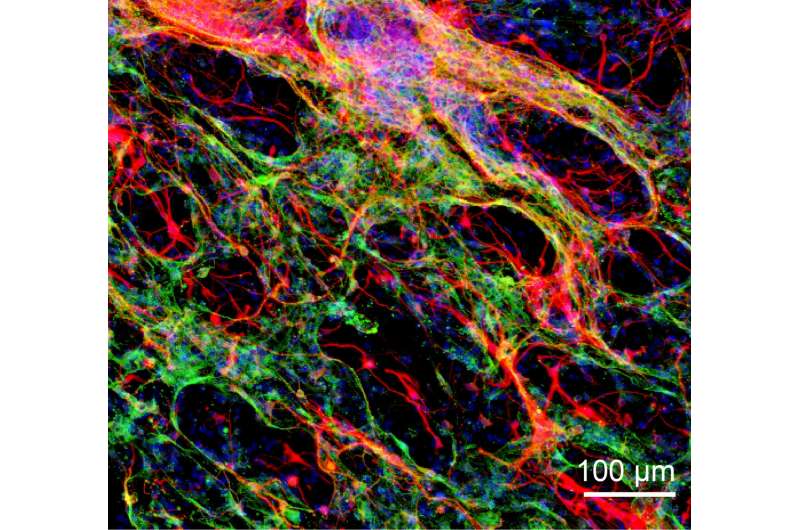
Immunofluorescence image of neurons and astrocyte cells in the engineered hydrogel. Credit: Satoshi Tanikawa et al, Scientific Reports, February 14, 2023. DOI: 10.1038/s41598-023-28870-z

Once the gels were optimized, they were soaked in a growth factor serum to encourage , and then they were implanted in damaged areas of the brain in a mouse model. After three weeks, researchers found that  and neuronal cells from the surrounding host brain tissue had entered the hydrogel and that  had grown.

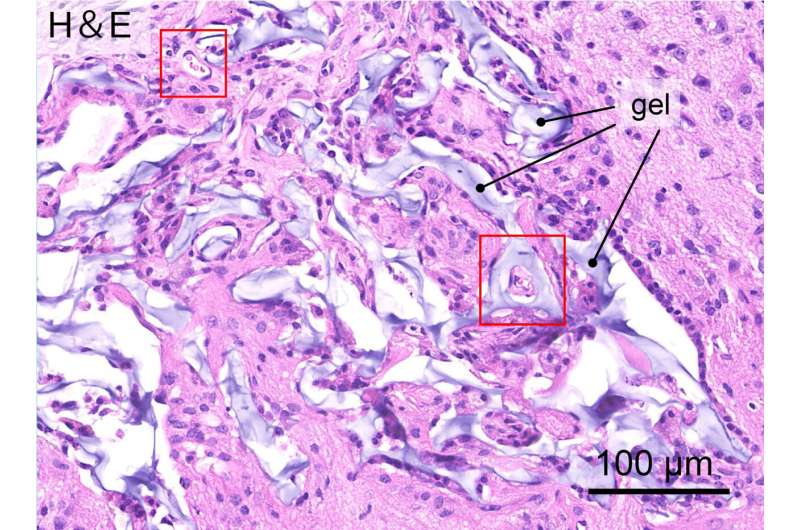
At this point, researchers injected neural stem cells into the hydrogel. After 40 days, stem cell survival rate was high, and some had differentiated into new astrocyte cells or neuronal cells. It was observed that host cells infiltrated the hydrogel, while some new  from the hydrogel migrated to the surrounding brain tissue, showing some degree of integration between the hydrogel and host brain tissue.

The stepwise nature of the process was key, as implanting the hydrogel and transplanting the neural stem cells at the same time proved unsuccessful. This study marks an important step toward developing therapies involving brain tissue regeneration; the next steps involve studying the optimal transplant timing and the effect of the inflammatory response on transplanted cells.

Healing the brain: Hydrogels enable neuronal tissue growth
Neural stem cells at 64 days after transplantation into hydrogel. Red boxes indicate blood vessels. Credit: Satoshi Tanikawa et al, Scientific Reports, February 14, 2023. DOI: 10.1038/s41598-023-28870-z

"Conditions affecting blood vessels in the brain, such as cerebral infarction, are a major disease," commented Tanikawa. "They not only have a  but those that survive struggle with severe after-effects. I think this research will become the foundation for medical treatments that could help such patients."

The study is published in the journal Scientific Reports.

More information: Satoshi Tanikawa et al, Engineering of an electrically charged hydrogel implanted into a traumatic brain injury model for stepwise neuronal tissue reconstruction, Scientific Reports (2023). DOI: 10.1038/s41598-023-28870-z


https://medicalxpress.com/news/2023-02-brain-hydrogels-enable-neuronal-tissue.html