Search This Blog

Saturday, February 25, 2023

Impact of Taxes and Government Handouts on Personal Income


Chart Notes

  • DPI stands for Disposable Personal Income
  • Disposable Income means income after taxes
  • PCE means Personal Consumption Expenditures, in simple terms, consumer spending
  • Real means inflation adjusted by the PCE Price Index, not the CPI

Transfer Payments

Transfer payments are redistributions of money for which there are no goods or services exchanged.

Social Security, Medicare, Medicaid, and food stamps (now called SNAP) are examples of transfer payments.

Real Income Minus Transfer Payments is part of what the NBER looks at when determining recessions

Real Disposable Income Minus Transfer Payments

The Bureau of Economic Analysis (BEA) released Personal Income and Outlays data for January of 2023 on February 24.

Yesterday, I posted charts in Personal Spending Rebounds Strong in January, But What About Income?

My charts were accurate but my comment "Consumers went on a buying spree with a strong rebound in both goods and services. Income excluding government handouts is another matter" was off the mark. 

Today, I added a new line to my charts, Real DPI Minus PCTR. 

Neither the BEA nor Fred (St. Louis Fed data repository) provide that number. Fred does provide Real Personal Income Minus PCRT but that is a misleading number. 

With Fred charts, one can calculate Real DPI Minus PCTR. I added that calculation to my charts. As a crosscheck, my calculation of Real Personal Income Minus PCTR matches Fred.

Let's take a look at how these numbers have evolved over time.

Personal Income Five Ways, Billions of Dollars Long Term 

Real Income data from the BEA, chart by Mish

Real Income data from the BEA, chart by Mish

Current Personal Income Five Ways

  • Personal Income (PI): $22,562
  • Disposable Personal Income After Taxes (DPI): $19,595
  • Real (Inflation-Adjusted) DPI: $15,568
  • Real Personal Income Minus PCTR: $14,741
  • Real DPI Minus PCTR: $12,384

The impact of government handouts and inflation get more and more extreme over time.

Note that Real DPI Minus PCTR has not grown in nearly three years. 

Personal Current Transfer Receipts

Personal Current Transfer Receipts (PCTR) data from BEA, Real PCTR calculation by Mish.

Personal Current Transfer Receipts (PCTR) data from BEA, Real PCTR calculation by Mish.

Those three rounds of fiscal stimulus coupled with eviction moratoriums and student debt cancellation fueled inflation. 

Personal Current Transfer Receipts Percent Change

Personal Current Transfer Receipts (PCTR) data from BEA, Real PCTR calculation by Mish.

Personal Current Transfer Receipts (PCTR) data from BEA, Real PCTR calculation by Mish.

In real terms, PCTR dropped significantly in January. This is almost entirely due to the PCE price index rising by 0.6 percent. 

In nominal terms, PCTR only declined 0.01 percent. 

Personal Income Five Ways Percent Change 

Personal Income Five Ways Percent Change 2023-01

That is the chart that matters most and it's one that I did not have yesterday, nor have I seen posted anywhere else.

Month-Over-Month Personal Income

  • Personal Income: 0.58
  • DPI: 2.02
  • Real DPI: 1.39
  • Real PI Minus PCTR: 0.09
  • Real DPI Minus PCTR: 1.92
That last line is a real kicker.

Although Real DPI Minus PCTR has gone nowhere for three years, it took a big leap in January. This will certainly catch the Fed's attention. 

I will explain the jump in a follow-up post. 

Who Is to Blame for Inflation?

President Trump, President Biden, Congress, and the Fed have all played a roll in the inflationary mess we are in. 

One can also blame the War in Ukraine and Covid, but supply chain disruptions of Covid were temporary. Policy responses, however, are ongoing. 

President Biden's push for more free education, unions, EVs, and student debt cancellation are hugely inflationary. 

So is the administration's political response to the war in Ukraine. 

How the Fed Messes With People's Lives 

The Fed is attempting to undo the damage it has caused by hiking rates. 

Alas, it is impossible for the Fed to quickly, if ever, undo the damage it has done. 

https://mishtalk.com/economics/what-is-the-impact-of-taxes-and-government-handouts-on-personal-income

Medicaid, with planned payment pilot, girds for influx of pricey gene therapies

 People with the blood disorder sickle cell are anticipating the arrival of two gene therapies that could dramatically reshape their disease, potentially offering something approaching a cure.

Insurers, too, are preparing for the treatments, which are expected to carry price tags in the seven figures. While five other expensive gene therapies are already available in the U.S., sickle cell is far more prevalent than the inherited diseases they treat, affecting an estimated 100,000 people in the country. Many are covered through Medicaid, the federal insurance plan for people with limited income.

An experimental model proposed by the Centers for Medicare and Medicaid Services last week could help state agencies better afford those medicines, as well as offer a testing ground for payment schemes that could apply to other pricey gene therapies. Yet the timeline for its implementation might mean it comes after the first sickle cell gene therapies reach market.

“Sickle cell is a call to action,” said Michael Sherman, chief medical officer of Point32 Health, the parent company of Harvard Pilgrim Health Care and Tufts Health Plan.

“Without these kinds of models, we’re going to see access issues,” he added. “The Medicaid state agencies, like other parts of the financing system, were never designed with this sort of upfront shock.”

The gene therapy model is one of three pilot programs CMS will test in the coming years in response to an executive order from President Joe Biden directing the agency to find further ways to lower prescription drug costs. Administration officials described these programs as building on last year’s Inflation Reduction Act, which gave Medicare the authority to negotiate prices for a limited number of drugs.

Under the gene therapy model, state Medicaid agencies could delegate authority to CMS to coordinate multistate frameworks to pay for gene therapies based on how much patients benefit from treatment. In sickle cell, for example, payment could be contingent on whether patients remain free of the pain crises they regularly experience.

These types of payment schemes, typically known as outcomes-based arrangements, are already used in some cases for the currently available gene therapies. But budget limitations and federal price reporting requirements have limited their use within Medicaid, indirectly shaping how they’re designed for private insurers, too.

“There’s a lot of benefit, I think, to having both more of a centralized purchaser or negotiator across Medicaid programs … and having more centralized data collection,” said Stacie Dusetzina, a professor of health policy at Vanderbilt University Medical Center. “I think it also gives CMS a little bit of an upper hand at the negotiating table.”

Jeff Marrazzo, the former CEO of gene therapy developer Spark Therapeutics, agrees that a centralized approach in Medicaid could help.

“What I’ve observed is that state Medicaid agencies … generally have experienced more challenges with providing access to cell and gene therapies,” he wrote in an email. “This is due in part to the cost density of cell and gene therapies, but also because these organizations lack the infrastructure required to implement alternative pricing, reimbursement, and access models.”

Marrazzo cited data collection as one example, noting that some state agencies might lack the ability to appropriately track clinical outcomes for patients treated with a gene therapy.

CMS envisions testing several different types of outcomes-based arrangements, including an annuity model where continued payment is based on continued benefit. (To date, gene therapy developers have favored a rebate-based approach, where a certain percentage of their treatment’s cost is returned to the insurer if a specific outcome is not achieved.)

Five years ago, Spark proposed a similar annuity-based idea to help insurers pay for its then newly approved gene therapy Luxturna, for a type of childhood blindness. Spark priced the treatment at $425,000 per eye and sought to offer an installment payment plan, proposing the CMS run a demonstration project around Luxturna.

Its ability to do so was limited by Medicaid rules requiring drugmakers give the program the “best price” they offer on their products. In the event a patient didn’t benefit from treatment, and an insurer therefore didn’t owe the remaining installment payments, Spark would have had to report that fractional cost as its best price.

CMS recently tweaked its policy, allowing drugmakers to report multiple “best prices” in the context of outcomes-based arrangements. “This was an important first step,” Marrazzo wrote. “Along with the [recent] policy change, I do believe CMS providing a more centralized approach could lead to more annuity models being taken up, particularly by Medicaid plans.”

The agency plans to focus the model on a specific disease, and indicated sickle cell as a likely candidate. Behind the advancing sickle cell treatments is a growing pipeline of other gene therapies in development.

“Our concern has been that, for some of these more rare diseases, we haven’t seen the access that we would like to see. Sickle cell is one of them,” said CMS Administrator Chiquita Brooks-LaSure on a call with reporters last week. “One of the reasons we’re so excited about this model is because we think states need some assistance from us to really be effective in the space.”

But CMS doesn’t envision launching the gene therapy model until 2026 at the earliest, years after the two gene therapies now nearing market are expected to be approved. Their developers — Bluebird bio and partners Vertex Pharmaceuticals and CRISPR Therapeutics — are currently preparing approval applications that they expect to finish filing with the FDA this quarter.

Under current timelines, CMS would begin developing the model this year and announce model specifications in 2024 and 2025, with implementation following the year after. The agency would then track metrics like gene therapy spending, use and change in access over time to evaluate its success.

To some, earlier would be better. “Being in a business, I don’t understand why it takes two years to announce model specifications,” Sherman said.

The planned model is also voluntary, so CMS would need to rely on participation from both state Medicaid agencies and from drugmakers. The latter group, CMS argued in its report, would be enticed by the prospect of simpler market access.

That access could come with some tradeoffs, however. “It may be a little bit less attractive because of the inability to command the highest possible price, especially if there is a large population that’s going to be treated and many Medicaid programs are interested in joining together into this kind of one model,” Dusetzina said.

https://www.biopharmadive.com/news/gene-therapy-medicaid-payment-model-outcomes/643102/

Norfolk Southern train derails in North Carolina, no danger to the public reported

 A Norfolk Southern freight train derailed in Lexington, North Carolina on Saturday morning.

A spokesperson for the company told Fox News Digital that one of the freight train's 132 cars derailed, adding that there are no reports of a danger or hazmat situation to the public.

"One of our trains traveling through Lexington derailed this morning. Of the train’s 132 cars, 1 has derailed. There are no reports of a hazmat situation or danger to the public. Our crew is safe and additional personnel are on their way to begin cleanup. We appreciate the public’s patience and care near this area during the cleanup work," the spokesperson said

The derailed Norfolk Southern freight train caused multiple Amtrak trains to be stopped, according to the report.

Saturday's derailment comes less than one month after another Norfolk Southern train with 50 rail cars, 10 of which were carrying vinyl chloride, derailed in East Palestine on Feb. 3. That derailment caused hazardous chemicals to spill onto the ground and sent a plume of smoke into the air. 

https://www.foxnews.com/us/norfolk-southern-freight-train-derails-north-carolina-no-danger-public-reported

Big pharma’s looming threat: a patent cliff of ‘tectonic magnitude’

 At the start of the last decade, big pharma was getting smaller. Blockbuster medicines that had fueled years of growth were losing patent protection, exposing the industry’s largest companies to generic competitors. The resulting impact was so substantial it temporarily stalled the relentless upward march of U.S. drug spending.

Today, big drugmakers are facing an even larger “patent cliff,” with more than $200 billion in annual revenue at risk through 2030. But this time around, many of the brand name drugs losing market exclusivity are biologic products, manufactured from living cells, rather than the chemical pills that previously dominated the ranks of pharma top-sellers.

These biologic drugs, like AbbVie’s anti-inflammatory treatment Humira and Merck & Co.’s top-selling cancer medicine Keytruda, will face competition from so-called biosimilar drugs that, unlike generics, may not be as easily substitutable. Still, it will be a treacherous period for drugmakers to navigate, as they will need to replenish their research pipelines and carefully manage new product launches to replace lost revenue.

“This is of tectonic magnitude,” Arda Ural, health sciences markets leader at the consultancy EY. The looming patent expirations “capture most blockbusters,” he added.

Besides Humira and Keytruda, drugs like Bristol Myers Squibb’s immunotherapy Opdivo, Johnson & Johnson’s immune disease medicine Stelara and Regeneron’s eye treatment Eylea will reach the end of their patent protection this decade.

The launch of Amgen’s copycat version of Humira last month represented a start of sorts for this looming industry-wide patent cliff. Nine other Humira biosimilars are set to arrive by mid-year. As a result, U.S. sales of the drug, which totaled $18.6 billion in 2022, are predicted to steadily shrink.

A different sort of cliff

The pattern of sales decline for Humira and other blockbuster biologics like it is expected to be different for several reasons, though.

Many biosimilars won’t be interchangeable, or directly substitutable, by pharmacists, for example. Physicians, meanwhile, may be reluctant to switch patients who are stable on the branded drug, meaning that initially it will be newly diagnosed patients with chronic diseases who are most likely to receive biosimilars. And because biosimilars are more expensive to develop and make, their manufacturers won’t be able to afford cutting prices by nearly as much as with generic pills.

“If you track the sales of a typical small molecule that goes generic it really goes off the cliff — 80% of the market can be gone in 30 to 90 days and the price goes down even more,” said Richard Kelly, a senior partner with the law firm Oblon, McClelland, Maier & Neustadt who specializes in life sciences intellectual property.

“[Biosimilars] have to be sold,” he added. “[Salespeople] have to go around to the doctors to sell a drug. It’s just another product in the detail-man’s bag.”

Take the statin Lipitor, once the world’s most lucrative drug. Sales fell from nearly $11 billion in 2010, the year before it faced generics in the U.S., to $4 billion in 2012. Pfizer’s overall revenue fell from $68 billion to $59 billion over the same period.

In the case of Humira, the fall is expected to be more gradual, with the company forecast to retain more than one-third of its 2022 U.S. revenues in 2024 and hold onto more than $2 billion through 2030, according to Evaluate Pharma.

The impact will be felt, nonetheless: AbbVie and analysts alike expect company-wide revenue to fall for at least a year because of Humira competition. And AbbVie executives recently indicated sales are likely to be sluggish in 2024, too, walking back earlier predictions that the company would see a return to growth then.

Humira’s sales erosion will be closely watched throughout the industry as executives and investors try to understand the long-term effects of biosimilar entry. Early biosimilars didn’t impact prices the way that payers and lawmakers had hoped, in part because there weren’t many of the copycat drugs. (While 40 biosimilars are now approved in the U.S., only 26 are available on the market.) Branded drugmakers also successfully used contracts and rebates to stave off competition.

However, analysts and industry experts believe the sheer number of Humira copycats and the entry of interchangeable products will allow them to take share from AbbVie.

The chief question facing AbbVie is how quickly it can recover through two replacement products: Skyrizi for psoriasis and Crohn’s disease, and Rinvoq for rheumatoid arthritis and several other inflammatory disorders. The company has upgraded its forecasts for both drugs, which it now says will earn $21 billion combined in 2027, approximately equalling Humira’s peak sales.

One major reason Humira achieved its massive sales was the many different autoimmune disorders for which it gained approval. With follow-on biologic drugs, however, the incentives to do so may be limited by the Inflation Reduction Act, which gives the federal government the power to negotiate lower prices within Medicare, said Mara Goldstein, Mizuho Securites’ senior biopharma analyst.

“We’re living through this real time and it’s a little challenging,” she said. “Does it truly create a disincentive to develop indications? Will companies continue to invest in new clinical trials right up to patent cliffs? How does [the law] change the value of dollars invested over time?”

New lessons to learn

AbbVie followed the lessons of the previous patent cliff by merging with Allergan in a 2019 deal that gave it enough new revenue to withstand the expected erosion of Humira’s sales. Its approach was similar to large pharmaceutical companies’ strategy ahead of the 2010s patent cliff, which spurred the megamergers of Pfizer with Wyeth and Merck with Schering-Plough.

Megamergers might not be the answer this time, however. For one, current pharma executives have expressed reluctance to do big deals because of the complexity of combining two companies. There is debate, too, over the effects such deals have on market valuation and R&D productivity afterwards.

Another reason is that, after years of industry consolidation, there are not many major large drugmakers left as attractive merger targets. Those that remain have patent cliffs of their own, Goldstein said.

Instead, the hunt for new products will either be in big drugmakers’ own laboratories or in those of smaller biotechnology companies. By having two successor blockbusters already in waiting, AbbVie has shown it can execute on the former approach.

Yet, across the industry, big drugmakers’ “R&D productivity is not necessarily corresponding to the R&D investment,” Ural said. R&D productivity and returns have, with a few exceptions, steadily declined each year over the past decade, according to data from both IQVIA and Deloitte.

Meanwhile, in biotech, “there may not be enough assets out there,” Ural added. “It’s going to be a fight for established assets, of which there aren’t that many.”

That fight will be fueled by large cash holdings. Jefferies analyst Michael Yee estimates big drugmakers have $500 billion in cash to spend on acquisitions and other pipeline-building transactions. Small and mid-sized biotechs have simultaneously seen their valuations drop, limiting their financial options, Yee wrote in a Feb. 5 note to clients.

The experimental drugs large pharma companies chase, through acquisition, licensing or inside research, might need to be different, too. They could find advantages in development platforms that can generate multiple new medicines like messenger RNAgene editing or next-generation antibody technology, or in drugs that have promise across multiple indications.

Humira-sized blockbusters may become harder to achieve, though, which will change how drugmakers develop and commercialize new products, said Bill Coyle, global head of biopharma at consulting firm ZS. AbbVie, for example, needs two drugs — Sykrizi and Rinvoq — to replace sales of Humira.

“I think we’re potentially entering an era of fewer blockbusters and a lot more smaller products,” he said. “The other shift for many of the big pharmas is that their cadence of launch needs to be more efficient and frequent. They need to become more effective launchers of new assets.”

Patent thicket-ing

For drugs further from patent expiration, extending the date of generic or biosimilar entry through the construction of a “patent thicket” is another tactic drugmakers are pursuing. By surrounding Humira with dozens of patents in the U.S., for example, AbbVie pushed off biosimilar entry by seven years after the drug’s principal patent expired.

Others in the industry are seeking to do the same. Merck is testing a subcutaneous version of the intravenous Keytruda, which could potentially merit a separate patent and extend its market exclusivity by years.

A trial of subcutaneous Keytruda in lung cancer is due to deliver results this spring. While subcutaneous Keytruda would likely still be delivered by physicians, it could be more convenient. “It’s not the same as having to get an IV, where you have to sit in a chair for an hour or two,” Kelly said.

Other drugmakers sought to push out the entry of biosimilars using this strategy, including Johnson & Johnson with its multiple myeloma medicine Darzalex and Bristol Myers with its Keytruda rival Opdivo.

Already, Bristol Myers has benefited from such intellectual property practices with its medicine Revlimid. The blood cancer drug’s exclusivity was protected by patents held by its original developer, Celgene, that were strong enough to keep most generic competition at bay through 2026. That will give Revlimid, a small molecule drug, a pattern of sales decline that looks more similar to biologic drugs, at least for a few years.

Tahir Amin, founder and executive director of the Initiative for Medicines, Access & Knowledge and a critic of pharma companies’ intellectual property practices, said he expects drugmakers with approaching cliffs to use late-earned patents to delay competition.

Striking limited distribution deals with copycat drugmakers, as Celgene did with Revlimid, could also be a tactic to stave off government drug price negotiation, because the Inflation Reduction Act limits that authority to only those products with no competition.

“At the end of the day the patent system is going to define how they shape the market,” he said.

https://www.biopharmadive.com/news/pharma-patent-cliff-biologic-drugs-humira-keytruda/642660/

Paris mental illness documentary wins top Berlin film prize

 "On the Adamant", a documentary about a floating daycare centre in Paris for adults with mental illness, clinched the Berlin Film Festival's Golden Bear award on Saturday.

Its director Nicolas Philibert said he was deeply touched by the jury's decision to award the Berlinale's top prize to a documentary rather than a work of fiction.

"That documentary can be considered cinema in its own right touches me deeply," he said. "For 40 years I have always fought for it to be seen as much."

Shot over three years, the film follows life at a daycare centre aboard The Adamant, a barge moored on the right bank of the Seine, where patients and carers interact in ways that break with what Philibert sees as the dehumanisation of psychiatry.

"Patients in psychiatry are always stigmatised ... and always considered through the prism of violence and I wanted to reverse the cliche and show how human they are," he said on the red carpet after his film won.

"I hope it will help to awake the consciousness of society."

The festival's Silver Bear for best leading actor went to Sofia Otero, who plays an eight-year-old transgender child in "20,000 Species of Bees".

"It is rare to see someone convey so many emotions but remain simple and shattering," said jury president Kristen Stewart. "Especially in performances given to us by a child."

https://www.marketscreener.com/quote/commodity/SILVER-16221/news/Paris-mental-illness-documentary-wins-top-Berlin-film-prize-43087336/

Spain: Patient does not have Marburg disease

 A man in Spain who was initially suspected of having the deadly Marburg disease tested negative on Saturday and does not have the virus, the health ministry said.

Health authorities in Valencia earlier said they had detected the country's first suspected case of the infectious disease that has led to the quarantining of more than 200 people in Equatorial Guinea.

The 34-year-old man, who had recently been in Equatorial Guinea, had since been given the all clear but would be tested again in the coming weeks, officials said.

He had been transferred from a private hospital to an isolation unit at the Hospital La Fe in Valencia while tests were carried out, the Valencian regional health authorities said.

Three health staff who are treating the man were also isolated as a precautionary measure, authorities said.

Marburg virus can have a fatality rate of up to 88%, according to the World Health Organization. There are no vaccines or antiviral treatments approved to treat it.

Equatorial Guinea quarantined more than 200 people and restricted movement on Feb. 13 in its Kie-Ntem province, where the hemorrhagic fever was first detected.

The small central African country has so far reported nine deaths as well as 16 suspected cases of the disease, with symptoms including fever, fatigue, blood-stained vomit and diarrhoea, according to the WHO.

Cameroonian authorities detected two suspected cases of Marburg disease on Feb. 13 in Olamze, a commune on the border with Equatorial Guinea, the public health delegate for the region, Robert Mathurin Bidjang, said on Feb. 14.

Cameroon had restricted movement along the border to try to avoid contagion.

https://news.yahoo.com/spanish-authorities-detect-first-suspected-081558177.html

Hunter Biden Business Partner Flips, Now 'Cooperating' With GOP Investigators

 Eric Schwerin, a close business associate of Hunter Biden who also dealt with Joe Biden's business and tax affairs, is now working with House GOP investigators looking into Biden family dealings - particularly in Ukraine and China, where the family collected millions of dollars, Just the News reports.

"He is cooperating with us," House Oversight and Accountability Committee Chairman James Comer (R-KY) told the outlet.

"His attorneys and my counsel are communicating on a regular basis. Now, I feel confident that he's going to work with us, and provide us with the information that we have requested," Comer continued. "I think that Schwerwin is going to be a very valuable witness for us in this investigation."

Of note, Schwerin, the former president of Hunter Biden’s now-dissolved investment firm Rosemont Seneca Partners, visited the White House at least 19 times from 2009 to 2015, according to White House visitor log records reviewed by The Epoch Times and first reported by the New York Post.

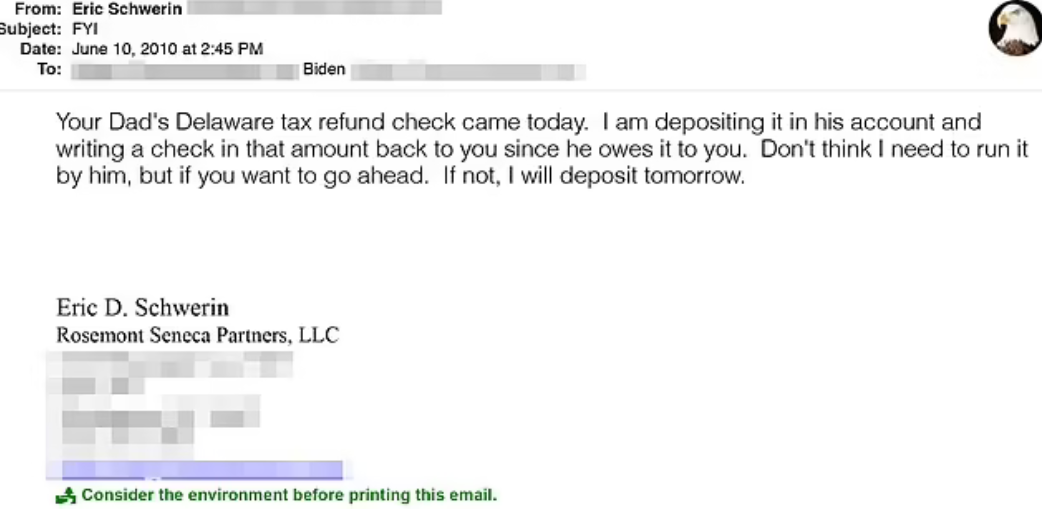
Emails between Hunter and Eric Schwerin, his business partner at consultancy Rosemont Seneca, show Schwerin was working on Joe's taxes. The emails were recovered from Hunter's laptop

Schwerin's cooperation comes after the committee received word that Hunter and his uncle, James Biden, don't plan to be forthcoming with all the information Comer's committee has sought in their wide-ranging probe.

According to Comer, subpoenas are imminent for non-cooperating witnesses.

"We know individuals, many are cooperating with us now, but others, not so much," he said. "We're going to start subpoenaing people in the private sector, we're going to start subpoenaing financial institutions to get us the information. And then we'll go from there."

Comer then suggested that if innocent, Hunter Biden would want to clear his name in front of the committee.

"He could come in front of the House Oversight Committee right now and defend his good name," Comer said. "He would have 20 Democrats that would definitely support him, and he could make 26 Republicans look bad if all this information we have from his laptop, all the emails that were in his own words, all the audio that are in his own voice, if for some reason we're misinterpreting that, then he could make us look bad.

"But we all know that this family was involved in influence peddling. And this administration is doing everything in its ability to try to block oversight."

Both Joe Biden and Hunter Biden have denied the family did anything wrong, although Hunter Biden has acknowledged he is under federal criminal investigation on tax issues.

Comer said while the committee battles the White House and the Biden family for information, Schwerin's cooperation was a breakthrough that could spur other key witnesses to cooperate. -Just the News

According to White House visitor logs, Schwerin met directly with then-Vice President Joe Biden in the West Wing on Nov. 17, 2010, and had several meetings with White House aides during times when Hunter Biden was securing multi-billion dollar deals overseas, including in China.

Meanwhile, as The Epoch Times reported last year, the NY Post revealed that Hunter had set up a meeting between his father and Andrés Pastrana Arango, the former president of Colombia, on March 2, 2012.

Before the March 2012 meeting, Hunter Biden and his partners at Rosemont Seneca Partners were allegedly seeking business with Brazilian construction company OAS, according to emails from the laptop, the Post reported. The Brazilian firm was interested in several projects in Columbia at the time, including a hydroelectric power plant worth $1.8 billion and a renovation project to a subway system in Bogota worth $3 billion.

If it works, we’ll all be rich,” Schwerin wrote to Hunter Biden in an email in August 2011, according to the Post. Emails showed Hunter Biden traveling to Bogota in November 2011.

Will Comer ask Schwerin about Ukraine biolabs?