Wall Street really wants to invest in Ukraine, and some of the top players are doing more than sniffing around at the prospects.
The world’s largest money-management firm BlackRock continues to hold high-level meetings with the government, including President Volodymyr Zelensky. JPMorgan recently had bankers on the ground scoping the situation as they dodged Russian missiles, I am told.
The country is ripe for massive private US investment to rebuild infrastructure destroyed in its conflict with Vladimir Putin. Zelensky is a rock star in the American media; the country is valiantly fighting off a foreign invader. The people are educated and resilient, which means returns could be as good there as any place on the planet. Banker talk has a private investment fund at between $20 billion and $100 billion at some point in the future.
So what’s stopping the private money from coming in now? A war that shows no signs of ending anytime soon. Plus, for all of Zelensky’s obvious talents as a leader, he still hasn’t demonstrated an understanding — or possibly a willingness — to fight corruption on the scale necessary to make investors comfortable, bankers tell me.
The meetings between some of Wall Street’s top executives (think Jamie Dimon of JPMorgan and Larry Fink of BlackRock) and Ukraine officials over the past month didn’t garner the same attention as President Biden’s surprise visit last week. The discussions have been going down mostly in private and without much fanfare when they conclude.
But they are revealing. The perilous nature of our continued engagement with this country doesn’t just involvea possible nuclear war with Russiabut also an economic sinkhole if we’re not careful.
The firms are skeptical about investing in Ukraine until the war ends.SOPA Images/LightRocket via Getty Images
Wary of oligarchies
For starters, in these meetings, Zelensky seemed unabashed in his request for billions of dollars in private capital to begin rebuilding his economy immediately. Yet he doesn’t seem to fully grasp what will prevent such an investment. First, money won’t flow to Ukraine (or any country) if it seeds the pockets of a Russian-style oligarchy.
In Ukraine, that brand of crony capitalism goes by the names “systema” or “oligarkhiya.” It’s an alliance of government and big business that undermines the free-market forces of competition. Payoffs and graft are part of the systema, and that’s always a dead end for significant private capital.
Zelensky said he understood the economic stakes of ending corruption. But deeds go further than words, which is why one banker involved in the process told me: “There are no guarantees here.”
Then there’s the war, and Zelensky’s so-far unyielding determination to keep fighting in order to retake all territory occupied by Putin’s forces.
Wall Street is hoping that Zelensky will compromise on land with Putin.Bloomberg via Getty Images
It’s a noble effort, to be sure, but it comes at a steep price. Bankers say private investment money won’t really flow until the war is over. They would love Zelensky to compromise on land to make that happen; maybe give up on retaking Crimea or allow Putin to save face and keep a few parts of the Donbas region in the east, which are nominally controlled by Russian separatists anyway.
There was some talk on Wall Street about a Ukrainian spring offensive and, if it’s successful in reclaiming some Russian-held territory, then Zelensky offering a possible deal with Putin so the reconstruction can begin. For now at least, that was described as a likely no-go by Ukrainian officials; Zelensky’s approval rating is at 90%, the bankers were told. It sinks to 40% with a land compromise.
Here’s where things get particularly fraught. Bankers got the impression from these conversations that Zelensky believes there is an endless supply of American money, despite the United States’ economic reality of massive and mounting debt (123% of GDP) and a looming recession that makes paying all our bills that much more difficult.
Last week, Sleepy Joe Biden told Zelensky that “freedom is priceless.” That may sound good, but common sense tells you that such blank checks often come at the expense of needs here at home.
Joe Biden pledged $2 billion to Ukraine on the one-year anniversary of Russia’s invasion.NurPhoto via Getty Images
Back in the US …
While Biden was cheering on the Ukrainian resistance, his administration was caught flatfooted dealing with the train derailment in East Palestine, Ohio, and the accompanying environmental tragedy that engulfed the area.
Residents were afraid to drink the water and lacked basic necessities while Biden was promising Zelensky another $500 million on top of everything else.
It’s reasonable to ask without the threat of censor, how much is enough taxpayer money for Ukraine as this war enters its second year.
Fortunately, there is a solution being offered by Wall Street, though it all depends on Zelensky’s willingness to compromise with a sworn enemy, combined with a willingness to read up on the fundamentals of a free-market economy.
About 64% of adults in a Medicaid-enrolled family in December said they did not know they may lose coverage once pandemic-era policy ends and eligibility checks resume on April 1, according to a survey from the Robert Wood Johnson Foundation.
The percentage of respondents who said they heard nothing about upcoming Medicaid renewals rose from June, when 62% said they knew nothing about the changes, the survey found.
Awareness was low across the board regardless of geographic region or a state’s Medicaid expansion status, according to the survey.
The federal government barred states from resuming Medicaid eligibility checks amid widespread job losses and other challenges during the pandemic.
Once eligibility checks resume, as many as 18 million people are expected to lose coverage, according to the Robert Wood Johnson Foundation.
About 7 million of those people are expected to gain coverage through the individual markets or employer-sponsored plans, though 8 million will not and will likely become uninsured, according to a report from Moody’s Investor Services.
Awareness levels regarding looming redetermination checks remained low and varied only slightly regionally, the report found.
Similarly, above 60% of respondents reported unawareness of Medicaid redeterminations both in Medicaid expansion states and those that haven’t expanded Medicaid, “which suggests the need for widespread outreach and education efforts,” the report said.
“Reducing information gaps about the change is a critical first step,” the report said.
In non-expansion states, people will need help learning about navigating marketplace options, while in expansion states they’ll need information on how to stay enrolled, the report said.
The suspension of eligibility checks led Medicaid membership to rise substantially during the pandemic, growing from 70.7 million members in February 2020 to 90.9 million in September, according to the Moody’s Investor Services report.
The end of the policy is expected to deal a blow to payers that have touted recent enrollment growth while hospitals could see more self-pay patients and “higher bad debt” for facilities, the Moody’s report said.
Teladoc Health reported a historic net loss in 2022 of $13.7 billion off revenue of $2.4 billion, mostly from an impairment charge related to the shrinking value of its Livongo acquisition. By comparison, the virtual care company reported a loss of $429 million in 2021.
The non-cash goodwill impairment charge of $13.4 billion reported over the past year reflects the waning market value of Teladoc’s $18.5 billion acquisition of chronic care company Livongo in late 2020. The impairment charge doesn’t impact the company’s financial position or its ability to invest in the business going forward, CFO Mala Murphy said on a call with investors Wednesday.
The New York-based telemedicine vendor beat Wall Street expectations for revenue but missed on earnings in fourth-quarter earnings released aftermarket Wednesday. Teladoc also issued 2023 guidance below analyst consensus, causing stock to slide in morning trading Thursday.
Teladoc, which reaches more than 80 million people across its virtual care products, has been focusing on capturing a greater slice of the healthcare delivery market by addressing whole-person health as the telemedicine industry evolves beyond its urgent care origins.
The company grew exponentially over the COVID-19 pandemic, but has struggled to maintain its growth rate over the past year. As a result, Teladoc is looking to better balance growth with profitability, management said Wednesday.
Teladoc provided an expectations reset in the quarter, in a bid to realign market standards to a more achievable place for 2023, analysts said.
Teladoc expects to bring in between $2.55 billion and $2.68 billion in revenue in 2023. That reflects about 9% growth at the midpoint.
Even though that outlook came up shorter than analysts expected on revenue, the company is putting a stronger emphasis on profitability through cost controlling measures. Market watchers have raised concerns about the long-term solvency of digital health companies, as valuations took a sizable hit last year. Experts don’t expect the market volatility to let up.
Teladoc was the latest digital health company to announce restructuring plans earlier this year, laying off 6% of its global workforce and culling its geographic footprint in a bid to lower operating costs.
“You should expect us to balance growth and margin with an increased focus on efficiency going forward,” Teladoc CEO Jason Gorevic said on the Wednesday call.
Rebecca Pifer/Healthcare Dive; NYSE data
BetterHelp, Teladoc’s direct-to-consumer mental health business, has been the main driver of the virtual care vendor’s revenue growth over the past two years. But the 2023 guidance suggests that Teladoc expects BetterHelp’s growth to slow as well. Management now expects to see low-double digits to mid-teens revenue growth in 2023 — below Wall Street expectations.
That’s compared to mid- to high-single digit revenue growth for Teladoc’s core business.
“While the slowdown is partially due to the law of large numbers, the slowdown is somewhat of a disappointment,” Credit Suisse analyst Jonathan Yong and A.J. Rice wrote in a note on the quarter. “But the segment is expected to see improved profitability,” while Teladoc’s core business is expected to grow to better than 2022 growth, with some margin expansion.
SVB Securities analyst Stephanie Davis said that overall, the 2023 guidance “marks a reset to achievability,” with “a healthy level of macro conservatism baked into the outlook,” especially for BetterHelp.
“At this point BetterHelp is over a billion-dollar business. I don’t think you’ll see this business return to hypergrowth ... but we do think there remains a long runway for growth in this market,” Teladoc’s Murphy said.
Teladoc pulled back on advertising spend for BetterHelp in the fourth quarter, which will pressure margins early in 2023, according to Murphy. As a result, BetterHelp earnings should ramp over the year.
Teladoc’s core virtual care business grew 7% year over year in the fourth quarter. On the call, management were particularly upbeat on growth in Primary360, its virtual primary care offering.
Historically, Primary360 hasn’t been a meaningful driver of growth, but Teladoc is seeing a lot of client demand and expects revenue from the product to triple in 2023, according to Murphy.
NewsGuard is a self-appointed misinformation watchdog. It seems to be just one more way Americans are not allowed to think for themselves...
Co-CEOs Steven Brill and Gordon Crovitz claim it is the “librarian for the internet.” Set up specifically to rate online journalistic integrity, Brill states NewsGuard provides services that “explain to people something about the reliability and trustworthiness and background of those who are feeding them the news.” Eric Effron is the organization’s Editorial Director.
According to MintPressNews, “Crovitz held a number of positions at Dow Jones and the Wall Street Journal, eventually becoming executive vice president of the former and the publisher of the latter before both were sold to Rupert Murdoch’s News Corp in 2007. He is also a board member of Business Insider, which has received over $30 million from Washington Post owner Jeff Bezos in recent years.”
Crovitz’s alliances might account for the organization’s favorable 100 ratings for WSJ and the Washington Post. He is also a contributor “to books published by the American Enterprise Institute and Heritage Foundation,” which are also favorably rated by NewsGuard.
Crovitz and Brill/NewsGuard
Notable NewsGuard Partnerships
NewsGuard has partnered with Microsoft, Pfizer, the Department of Defense with a 2021 $749,387 one-year contract, the American Federation of Teachers (AFT), and the WHO using NewsGuard’s trademark “new Misinformation Fingerprints” analyst and AI cataloging tool. NewsGuard’s other products include NewsGuard, HealthGuard, and BrandGuard—which help marketers concerned about their brand safety.
NewsGuard mentions its partnership with the WHO in August 2020 and discusses its Misinformation Fingerprints cataloging tool. The tool is essentially a database with a “unique identifier for each hoax that, when combined with the platforms’ machine learning tools, will allow platforms to identify each hoax across the entirety of their platforms.” NewsGuard describes Misinformation Fingerprints as an “extraction and cataloging” tool. It provides “data seeds for existing AI/Social Listening tools to trace false claims across the internet and social media or can be used by human analysts to understand mis- and disinformation risks.”
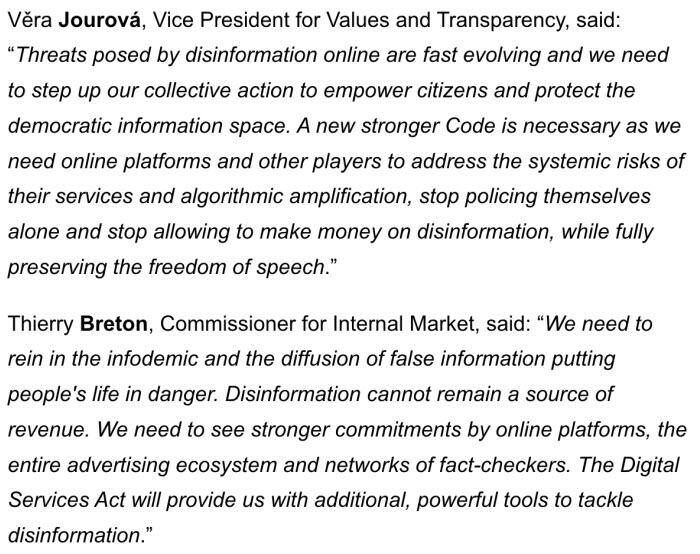
NewsGuard was also a signatory in 2021 to the Code of Practice on Disinformation for the European Commission. Commissioner statements from the May 2021 announcement are below:
Microsoft was the first signatory to “provide NewsGuard ratings and labels to its users as a “middleware solution” for empowering consumers.” Microsoft licensed NewsGuard ratings and labels. They are “free of charge” to users of the Edge browser.
NewsGuard Wins Contest Run by Pentagon and DoD in 2020
NewsGuard won a 2020 contest run by the “Pentagon and Department of State to offer solutions to hoaxes related to the COVID-19 pandemic.” The contest focused specifically on the “pre-bunking” of internet hoaxes. NewsGuard was also “a winner of the Countering Disinformation Challenge, a contest offered jointly by the State Department and the Department of Defense (DoD) as a part of the DoD’s National Security Innovation Network (NSIN).” NSIN is a “government program office within the Office of the Secretary of Defense for Research and Engineering (OSD (R&E)) that collaborates with major universities and the venture community to develop solutions that drive national security innovation.”
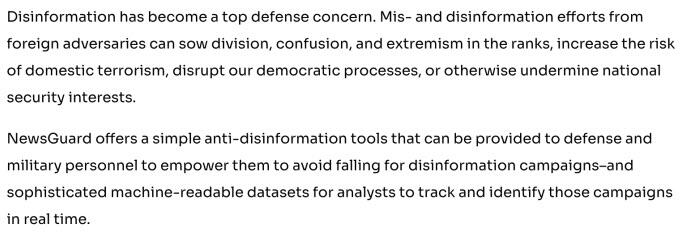
NewsGuard equips “defense and military personnel” with the tools to fight disinformation from foreign and domestic adversaries “in real-time.”
“As a winner, NewsGuard will receive $25,000 to conduct a pilot and will work with the State Department’s Global Engagement Center to scope and develop a test in support of the DoD’s Cyber National Mission Force. Two other companies, PeakMetrics, which offers a dashboard for tracking mentions of a topic across multiple media channels, and Omelas, which offers a product for visually mapping online information, were also named winners of the contest.”
Notably, the tech company Omelas focuses on the “actions of overt state and nonstate actors” who exert “malicious influence on the web.” Omelas regularly contributes with speeches and written submissions to influential global organizations and domestic institutions like UChicago’s Data and Democracy initiative and the UChicago Center for Effective Government, attended by the likes of Tiana Epps-Johnson with CTCL.
Teachers’ Union Signs Contract with NewsGuard in 2022
The American Federation of Teachers, with its 1.7 million members, announced its “pathbreaking” partnership with NewsGuard in January 2022 with the rollout of the “free, real-time traffic light news ratings,” a “crucial news literacy tool” for students nationwide. The announcement coincided with National News Literacy Week. They released this video on the dangers of misinformation at the time of the announcement:
Touted as a “game-changer for teachers and families drowning in an ocean of online dishonesty,” a “licensed copy of NewsGuard’s browser extension” would help students “separate fact from fiction, as we help them develop their critical-thinking and analytical skills.” AFT President Randi Weingarten gave NewsGuard glowing reviews:
“NewsGuard is a great tool in this regard. It is a beacon of clarity to expose the dark depths of the internet and uplift those outlets committed to truth and honesty rather than falsehoods and fabrications. This historic deal will not only help us steer clear of increasingly fetid waters—it will provide a valuable lesson in media literacy and a discussion point for teachers in class on what can and can’t be trusted.”
NewsGuard’s 2022 Social Impact Report
NewsGuard issued its first “social impact report” in 2022. The report championed NewsGuard’s provision of tools that would promote “online safety for readers, brands, and democracies.” Its CEOs proudly state a mission to fight false claims of “Nazis running Ukraine’s government and Americans running bioweapons labs in Ukraine,” COVID-19 misinformation, and misinformation surrounding the mid-term elections.
According to the report, “more than 938,200 people were exposed to COVID-19 vaccine myths between Oct. 2021-Feb. 2022 on social media.” The report also reveals NewsGuard’s exposure of “pink slime sites pushing Democratic propaganda in battleground states ahead of the midterm elections.”
NewsGuard 2022
What are NewsGuard’s Stated Standards and Procedures?
The NewsGuard Dashboard “helps clients access NewsGuard’s database of News Reliability Ratings and Misinformation Fingerprints through a powerful, searchable web interface purpose-built for use by businesses seeking to identify and mitigate risks from misinformation and disinformation. Users can browse NewsGuard’s ratings, get alerts about changes in the news and information environment, and stay on top of emerging false narratives and trends.”
The site issues “stoplight red/green journalistic ratings” for news sources. Influence watch describes NewsGuard as a “web browser extension that rates the trustworthiness of online news sites based on nine criteria, providing a trust score between 0 and 100.” Nine basic “apolitical criteria” for journalistic practice are outlined on the NewsGuard website. The criteria are listed in order of importance and weighted accordingly. Satire sites, platforms, and news aggregators “are given separate designations and are not scored using the nine criteria.” The nine criteria and standards for credibility are as follows:
Does not repeatedly publish false content (22 Points)
Gathers and presents information responsibly (18 Points)
Regularly corrects or clarifies errors (12.5 Points)
Handles the difference between news and opinion responsibly (12.5 Points)
Avoids deceptive headlines (10 Points)
Website discloses ownership and financing (7.5 Points)
Clearly labels advertising (7.5 Points)
Reveals who’s in charge, including possible conflicts of interest (5 Points)
The site provides the names of content creators, along with either contact or biographical information (5 Points)
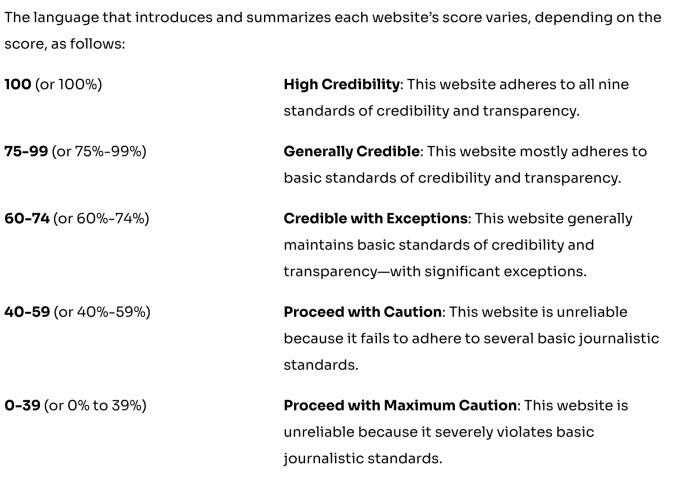
NewsGuard Ratings/0-100
According to the website, NewsGuard substantiates the basis for its ratings with “evidence and examples to back up its assessments, includ[ing] any relevant comments from the publisher, and indicat[ing] the history of the sites’ ratings.” NewsGuard employs “a team of journalists and experienced editors” who make an effort to contact publishers who might “fail” specific criteria before a rating or an updated rating is published, “ensuring a publisher[‘s] ability to reply.” NewsGuard has recently dropped its stoplight rating system and now uses its “nutrition label” exclusively.
Are Conservatives Being Targeted by NewsGuard?
According to a series of email exchanges made public by the Conservative organization PragerU, Newsguard targets conservative organizations unfairly. NewsMax, Dave Rubin, and Harmeet Dhillon also allege having been targeted by NewsGuard. Rubin says the service sums up “so much of what is wrong right now in American culture relative to big tech and government.”
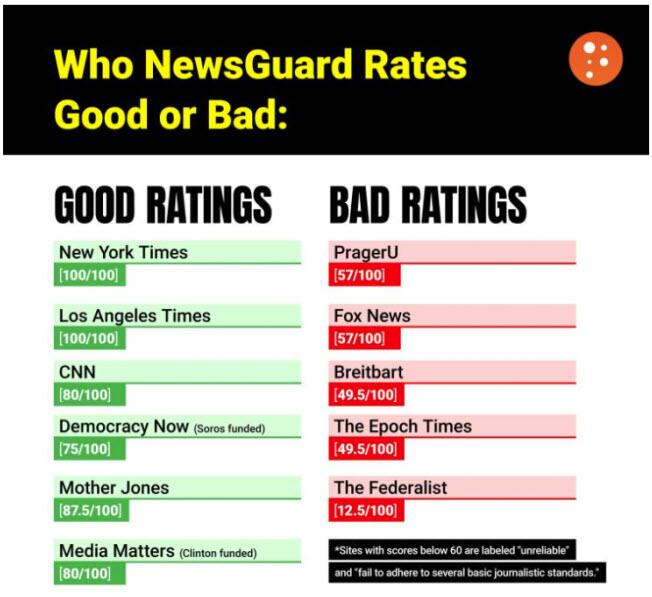
NewsGuard claimed PragerU was spreading “misleading content” on its website. Sites with scores below 60 are labeled “unreliable.”
PragerU/NewsGuard Ratings
PragerU and NewsGuard Exchange Emails
The emails from 2021 between PragerU’s Chief of Staff Adrienne Johnson and the NewsGuard Co-CEOs seem to indicate PragerU was reputationally and financially damaged by a NewsGuard red rating of 57.
Notably, officials from PragerU clarified in its emails that it is not a news website, but a “nonprofit focused on producing and marketing well-researched, issue-driven educational content” featuring healthy debate from experts. As such, PragerU discloses its donations with the required IRS 990 form and does not disclose that information on its website as “required by NewsGuard.” NewsGuard disregarded the disclosure because of its standards, not because the information was unavailable.
NewsGuard penalized PragerU for never having “corrected one-sided claims related to COVID or hydroxy,” all of which were objectively and verifiably true. Specifically, NewsGuard challenged PragerU’s sharing of videos featuring America’s Frontline Doctors “that promoted false claims about the anti-malaria drug hydroxychloroquine” as a “proven cure for COVID-19.” Hydroxychloroquine and Ivermectin have been well-known as effective early treatments for COVID-19 since early in the pandemic but were suppressed by the government and its overly helpful legacy media partners. NewsGuard challenged PragerU’s removal of the videos because PragerU failed to publish a correction once the videos were removed.
Sadly, PragerU had removed the videos not because they were incorrect but “due to overall social media censorship on the topic.” One of the emails shows CEO Marissa Streit writing that PragerU “created an ROI analysis on our end, and we removed it rather than face the penalties of censorship.”
NewsGuards also reprimanded PragerU influencer Will Witt who stated in a video that “children aren’t actually dying from the virus.” Witt allegedly cited without attribution a “study with the statistics of children ages 0-18 who had died from COVID-19, “none of whom died.” Witt’s statement was not far from the mark because CDC data shows that almost no healthy children have died from COVID-19.
It appears that NewsGuard may have held Witt accountable for inexact wording, not for the spirit of the claim. It is not clear from the emails whether NewsGuard upheld its promise to “ensure” Witt or PragerU had a chance to be more exact in its language or supply “feedback” for the “failed” information on its website.
At one point in the exchange, Streit asks for confirmation from NewsGuard to certify that the “removal of certain content” will “remove any negative marks on our ratings and provide us with “Green” status—a stamp of approval that should be unnecessary in America as a prerequisite to the exchange of ideas.
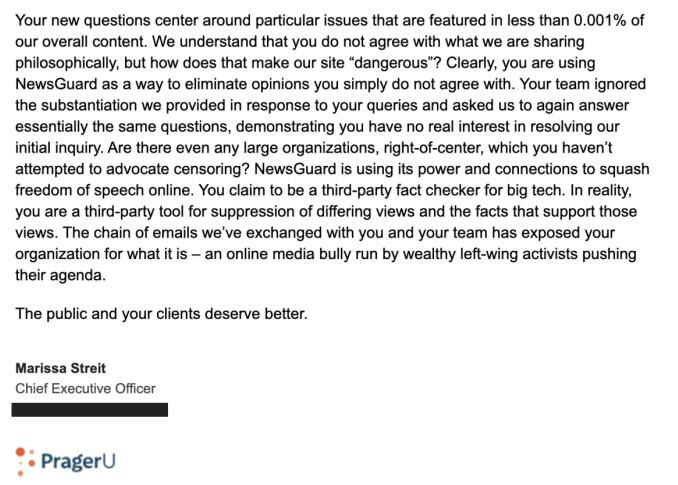
Streit ultimately revealed that NewsGuard held PragerU to account for “less than 0.001% of its overall content.” Even though Streit made specific good-faith efforts to reply directly to the ratings and even removed truthful content to avoid censorship, NewsGuard doubled down and persisted with its bias. Streit wrote:
PragerU Email/NewsGuard/Streit
Directors, Advisors, and Investors
NewsGuard’s directors, advisors, and investors are an interesting cast of characters. One of the investors, Publicis Groupe, is “the third largest communications group in the world.” Publicic allegedly has “shadowy ties to Saudi Arabia.” Pfizer and Bayer/Monsanto are two of its top clients. Ironically, many of the advisors/directors are former U.S. government officials, entertainment moguls, and journalists “associated with agencies known for producing false news.”
Among the advisors is Michael Hayden, former Director of the NSA and CIA, who was “the architect of George W. Bush’s secret domestic spying program.” Tom Ridge was the first Office of Homeland Security Director following 9/11. Richard Stengel “is a former senior official in Obama’s state department who once described his role as being that of ‘chief propagandist.‘”
Below are two videos with Stengel discussing his thoughts on free speech and NewsGuard’s role in the information landscape.
He says he used to be a “free-speech absolutist” but has changed his point of view as he has traveled the world. Stengel states that his travels have taught him that “Our notion of free speech is an outlier to people. The First Amendment is no longer working.”
He shares he has become more sympathetic to legislation for hate speech. “There is a design flaw in the First Amendment in the age of social media. We need to start thinking about hate speech laws.”
Hundreds of thousands of Michigan residents remained without power Saturday following an historic ice storm that brought down power lines throughout the state earlier this week.
The storm froze and disabled power lines on Wednesday, causing up to 700,000 utility customers to lose power at some point.
Crews from Michigan's two largest utility companies, Consumers Energy and DTE Energy, have since been working to repair the damaged lines and restore service.
As of late Saturday afternoon, DTE Energy reported 237,599 customers were still without power, while service had been restored to 330,000 customers.
Consumers Energy reported nearly 118,000 customers were without power on Saturday.
"This storm was one of the worst ice storms in recent memory, resulting in widespread damage and more than 11,000 downed wires," Consumer Energy spokesman Norm Kapala said in a statement issued to MLive.com. .
Federal environmental authorities have ordered a temporary halt in the shipment of contaminated waste from the site of a fiery train derailment earlier this month in easternOhionear thePennsylvaniastate line.
Region 5 administrator Debra Shore of the Environmental Protection Agency said Saturday the agency ordered Norfolk Southern to “pause” shipments from the site of the Feb. 3 derailment in East Palestine but vowed that removal of the material would resume “very soon.”
“Everyone wants this contamination gone from the community. They don’t want the worry, and they don’t want the smell, and we owe it to the people of East Palestine to move it out of the community as quickly as possible,” Shore said.
Until Friday, Shore said, the rail company had been solely responsible for the disposal of the waste and supplied Ohio environmental officials with a list of selected and utilized disposal sites. Going forward, disposal plans including locations and transportation routes for contaminated waste will be subject to EPA review and approval, she said.
“EPA will ensure that all waste is disposed of in a safe and lawful manner at EPA-certified facilities to prevent further release of hazardous substances and impacts to communities,” Shore said. She said officials had heard concerns from residents and others in a number of states and were reviewing “the transport of some of this waste over long distances and finding the appropriate permitted and certified sites to take the waste.”
The Ohio governor's office said Saturday night that of the twenty truckloads (approximately 280 tons) of hazardous solid waste hauled away, 15 truckloads of contaminated soil was disposed of at a Michigan hazardous waste treatment and disposal facility while five truckloads had been returned to East Palestine.
Liquid waste already trucked out of East Palestine would be disposed of at a licensed hazardous waste treatment and disposal facility in Texas, but that facility would not accept more liquid waste, the Ohio governor's office said.
“Currently, about 102,000 gallons of liquid waste and 4,500 cubic yards of solid waste remain in storage on site in East Palestine, not including the five truckloads returned to the village,” the governor's office said. “Additional solid and liquid wastes are being generated as the cleanup progresses.”
No one was injured when 38 Norfolk Southern cars derailed in a fiery, mangled mess on the outskirts of town, but as fears grew about a potential explosion due to hazardous chemicals in five of the rail cars, officials evacuated the area. They later opted to release and burn toxic vinyl chloride from the tanker cars, sending flames and black smoke billowing into the sky again.
Shore said the EPA was not involved in the decision to do the controlled burn, but she called it a “well-founded” decision by local and state officials based on the information they had at the time “to deal with a highly explosive toxic chemical.”
Federal and state officials have repeatedly said it’s safe for evacuated residents to return to the area and that air testing in the town and inside hundreds of homes hasn’t detected any concerning levels of contaminants from the fires or burned chemicals. The state says the local municipal drinking water system is safe, and bottled water is available while testing is conducted for those with private wells.
Despite those assurances and a bevy of news conferences and visits from politicians, many residents still express a sense of mistrust or have lingering questions about what they have been exposed to and how it will impact the future of their families and their communities.