Search This Blog

Sunday, February 26, 2023

Chinese bank says missing chairman is cooperating with Chinese authorities in an investigation

 China Renaissance Holdings said in an exchange filing on Sunday that its missing chairman and star dealmaker Bao Fan was currently cooperating with relevant Chinese authorities conducting an investigation.

This is the first time the mainland China-based boutique bank has given a reason for the disappearance of its founder -- who was reported missing 10 days ago -- though no details about the investigation were shared.

"The Board would like to reiterate that the business and operations of the Group are continuing normally," the bank said in the exchange filing.

Reuters previously reported, citing sources, that authorities took Bao away earlier this month to assist in an investigation into a former colleague, Cong Lin, the company's former president.

Shares of the company slumped last week after it said in an exchange filing the company had been unable to contact Bao.

The dealmaker's disappearance is the latest in a series of cases of high-profile Chinese executives going missing with little explanation during a sweeping anti-corruption campaign spearheaded by President Xi Jinping.

In 2015 alone, at least five executives became unreachable without prior notice to their companies, including Fosun Group Chairman Guo Guangchang, who Fosun later said was assisting with investigations regarding a personal matter.

Bao's disappearance also comes against the backdrop of more than two years of sweeping regulatory crackdown on technology companies.

Bao, also China Renaissance's controlling shareholder, started the firm in 2005 as a two-person team, seeking to match capital-hungry startups with venture capitalist and private equity investors.

The firm later expanded into services including underwriting, sales and trading.

Known to be well connected in the corporate world, Bao was involved with tech mergers including the tie-up of ride-hailing firms Didi and Kuaidi, food delivery giants Meituan and Dianping, as well as travel platforms Ctrip and Qunar.

https://www.yahoo.com/news/chinese-bank-says-missing-chairman-124126895.html

US Believed 'Economic Nuclear Weapon' Would End Russian War In Ukraine

 by Kyle Anzalone Via AntiWar.com,

In the days after the invasion of Ukraine, the White House assessed President Vladimir Putin would end the attack if the US froze over $300 billion owned by the Russian central bank. However, the Washington-led economic war on Moscow has failed to have a major impact on the Russian economy.

According to Bloomberg, in the immediate reaction to Russian forces invading Ukraine on February 24, 2022, the White House began to develop the "economic equivalent of a nuclear weapon" to use against Moscow. National Security Advisor Jake Sullivan led the team that designed the sanctions on Moscow’s economy and froze $300 billion in assets of the Russian central bank.

The Most Common Weakness I Observe Among Traders

 There is a myth among developing traders that all you need to do for success is find a style of trading that fits your personality and then stick to that style with discipline and consistency.

What nonsense.

Consider other performance domains, such as basketball or surgery or opera singing.  Does a basketball team stick with a single defensive style regardless of the competition?  Do surgeons follow techniques based upon their personalities or based on objective scientific data?  Do professional singers adopt the same style to every composition they perform? 

The reality is that high performance professionals learn to adapt their styles to the conditions of performance.  A tennis player adapts to clay and grass courts.  A football team adapts to changing defensive alignments.  Actors adapt to their roles.

The most common weakness I observe among traders is that they seek a style of trading and attempt to fit that style into all market conditions.  For example, a trader may seek to profit from trend or momentum, only to become frustrated when markets are "choppy"  A trader may seek to trade one time frame when market cycles operate on very different scales.

My favorite analogy for this situation is the dancer who has a single style of dancing regardless of the music playing.  While everyone else is slow-dancing to a waltz, they are thrashing about, mosh-pit style.  Then they wonder why no one will dance with them...

The first question a trader must ask is not about "setups" and what is moving.  The first question is:  How is this market behaving and does that behavior present opportunities that I can exploit?  Before you start dancing, you listen to the music.  Before you begin surgery, you study the patient's condition.

Having a single style that you impose across all markets is not discipline; it is inflexibility.  Some of the best market opportunities come from occasions when trades that had been working suddenly don't work.  That can be a wonderful heads-up that conditions have changed and that it's time to adapt.


http://traderfeed.blogspot.com/2023/02/the-most-common-weakness-i-observe.html

Generative AI could be an authoritarian breakthrough in brainwashing

 Generative AI is poised to be the free world’s next great gift to authoritarians. The viral launch of ChatGPT — a system with eerily human-like capabilities in composing essays, poetry and computer code — has awakened the world’s dictators to the transformative power of generative AI to create unique, compelling content at scale.

But the fierce debate that has ensued among Western industry leaders on the risks of releasing advanced generative AI tools has largely missed where their effects are likely to be most pernicious: within autocracies. AI companies and the U.S. government alike must institute stricter norms for the development of tools like ChatGPT in full view of their game-changing potential for the world’s authoritarians — before it is too late.

So far, concerns around generative AI and autocrats have mostly focused on how these systems can turbocharge Chinese and Russian propaganda efforts in the United States. ChatGPT has already demonstrated generative AI’s ability to automate Chinese and Russian foreign disinformation with the push of a button. When combined with advancements in targeted advertising and other new precision propaganda techniques, generative AI portends a revolution in the speed, scale and credibility of autocratic influence operations. 

But however daunting Chinese and Russian foreign disinformation efforts look in a post-GPT world, open societies receive only a small fraction of the propaganda that Beijing and Moscow blast into their own populations. And whereas democratic powers maintain robust communities of technologists dedicated to combating online manipulation, autocrats can use the full power of their states to optimize their propaganda’s influence.

In 2019, China’s Xi Jinping demanded just that when he ordered his party-state to leverage AI to “comprehensively increase” the ability of the Chinese Communist Party to mold Chinese public opinion. Russia’s Vladimir Putin has similarly doubled down on AI-enabled propaganda in the wake of his Ukraine invasion, including a fake video of Ukrainian President Volodymyr Zelensky calling for Ukrainians to surrender. These efforts are buttressed by a dizzying array of Chinese and Russian agencies tasked with thought control, cultivating a competitive ecosystem of digital propaganda tools underwritten by multibillion-dollar budgets each year.

China and Russia are, in other words, fertile ground for generative AI to usher in a historic breakthrough in brainwashing — a recipe for more international catastrophes, greater human rights abuses, and further entrenched despotism. As China refines and exports its techno-authoritarianism, would-be tyrants the world over are likely to cash in on the propaganda revolution.

Luckily, companies in the United States and allied nations have largely led the advance of generative AI capabilities. As the technology matures, this advantage will be increasingly important in giving open societies time to understand, detect and mitigate potential harms before autocratic states leverage the technologies for their own ends. But the free world risks squandering this advantage if these pioneering tools are easily acquired by authoritarians.

Unfortunately, keeping cutting-edge AI models out of autocrats’ hands is a tall order. On a technical level, generative AI models lend themselves to easy theft. Despite requiring enormous resources to build, once developed, models can be easily copied and adapted at minimal cost. That’s especially bad news as China routinely pillages American corporations’ tech.

American tech companies may also be tempted to sell generative AI capabilities, just as they inadvertently helped lay the foundations for China’s Great Firewall, ubiquitous surveillance apparatus, and Muslim minority gene harvesting through commercial enterprises.

Additionally, Chinese or Russian AI researchers can simply exploit several companies’ efforts to keep generative AI open source. Meta has begun “democratizing” access to its OBT-175B language model, just as AI company Hugging Face helped launch BLOOM, an open-access, multilingual model. Well-intentioned as such efforts may be, they are a boon to propagandists.

Companies instead need to treat generative AI development with the caution and security measures appropriate for a technology with immense potential to fuel despotism, and refrain from open-sourcing technical specifics of their cutting-edge models.

The U.S. government should clarify the strategic importance of generative AI, and restrict the export of cutting-edge generative AI models to untrustworthy partners now, building on similar measures that restrict the export of American surveillance tech. Federal research funding for generative AI should be limited to only trusted recipients with strong security practices. The U.S. and allies should also invest aggressively into counter-propaganda capabilities that can mitigate the coming waves of generative AI propaganda — both at home and within autocracies.

The alternative is a well-trod path: American tech companies bolstering techno-authoritarianism through a combination of profit-incentives and naivete. It’s time to do better.

Bill Drexel is an associate fellow at the Center for a New American Security (CNAS), where he researches AI and national security. He studied Chinese authoritarian technologies at Tsinghua University, Beijing, as a Schwarzman Scholar.

Caleb Withers is a research assistant at CNAS, focusing on AI safety and stability.

https://thehill.com/opinion/technology/3871841-generative-ai-could-be-an-authoritarian-breakthrough-in-brainwashing/

Rick Scott: ‘All that Biden does is pacify China’

 Sen. Rick Scott (R-Fla.) slammed President Biden for his approach toward relations with China on Sunday, accusing him of attempting to appease Beijing.

“All that Biden does is pacify China,” Scott told John Catsimatidis on WABC’s “Cats Roundtable,” adding, “I don’t know what it is, but this is a guy who won’t stand up to dictators around the world.”

Scott’s comments echoed similar criticisms that he levied at the Biden administration earlier this week.

“Communist China has chosen to be our enemy,” he said in a tweet on Thursday. “The CCP wants to destroy our way of life, and @JoeBiden shows nothing but weak appeasement. The American people deserve a leader in Washington who stands up to evil regimes and puts America first.”

U.S.-China relations have become increasingly strained in recent weeks, after a suspected Chinese spy balloon traveled over the U.S. in early February and reportedly surveilled strategic sites.

The balloon drama was followed by Secretary of State Antony Blinken’s allegations last weekend that China was “strongly considering” providing Russia with lethal aid in its war against Ukraine. Several other top U.S. officials have reiterated the accusations in recent days and warned of significant consequences if China were to take such a step.

Amid the concerns about China, the U.S. military is reportedly planning to increase its presence in Taiwan by between 100 and 200 troops — a move that Scott voiced support for.

“I’m glad we’re taking the threat Communist China poses to Taiwan seriously, but more must be done,” he said in a tweet on Thursday.

https://thehill.com/policy/international/3874224-rick-scott-criticizes-current-us-relations-with-beijing-all-that-biden-does-is-pacify-china/

UK pol's advice to 'work more' to afford food under skyrocketing inflation causes firestorm

 Britain’s environment secretary suggested people struggling to pay for food during a historic cost-of-living crisis consider working more hours.

Taking questions on food insecurity Thursday in the House of Commons, Therese Coffey, a Conservative, told fellow members of Parliament that "one of the best ways for people to boost their income is not only to get into work if they are not in work already, but to work more hours or get upskilled to get a higher income."

Britain’s Office of National Statistics reported food inflation stood at 16.8% in January, and Coffey acknowledged that the United Kingdom’s inflation rate was pushing Britons to their financial limits, calling the skyrocketing prices "really tough." 

Therese Coffey, UK Secretary for Environment, Food and Rural Affairs

Environment Secretary Therese Coffey speaking during the National Farmers Union Conference at the ICC, Birmingham, Feb. 22, 2023. (Jacob King/PA Images / Getty Images)


Labour MP Rachael Maskell called Coffey’s suggestion that struggling Britons should work more "out of touch" and "utterly disgraceful." 

Compounding Britain's inflation problems is a nationwide shortage of fresh vegetables, leading some stores to limit sales. Coffey pinned the shortage on poor weather in Spain and Morocco, noting that the U.K. imports billions of pounds of fresh fruits and vegetables from abroad but insisting the supply chain was "highly resilient."  

Coffey came under fire for telling MPs that Britons should "cherish" U.K.-grown produce like turnips while tomatoes and cucumber supplies are limited. Shadow Environment Secretary Jim McMahon called her remarks a "slow motion tractor crash" and an "insult to hardworking farmers." 

British consumers aren’t the only shoppers being battered by surging food prices and shortages. An ONS report details an explosive rise in energy prices, with gas prices up 129.4% year over year and electricity prices up 66.7%. 

Less than four years ago, the Tories' future looked bright after they won an overwhelming majority in the 2019 general election under Boris Johnson’s leadership. Now, the battered party led by Rishi Sunak is fighting crises on multiple fronts from the National Health Service to mass industrial strikes. 

Coffey’s statement adds to the Conservative Party’s electoral woes as a February YouGov poll indicated 50% of Britons would vote for the Labour Party in the next election, compared to just 22% for the Conservatives.

https://www.foxbusiness.com/economy/politicians-advice-work-more-afford-food-under-skyrocketing-inflation-causes-firestorm-disgraceful

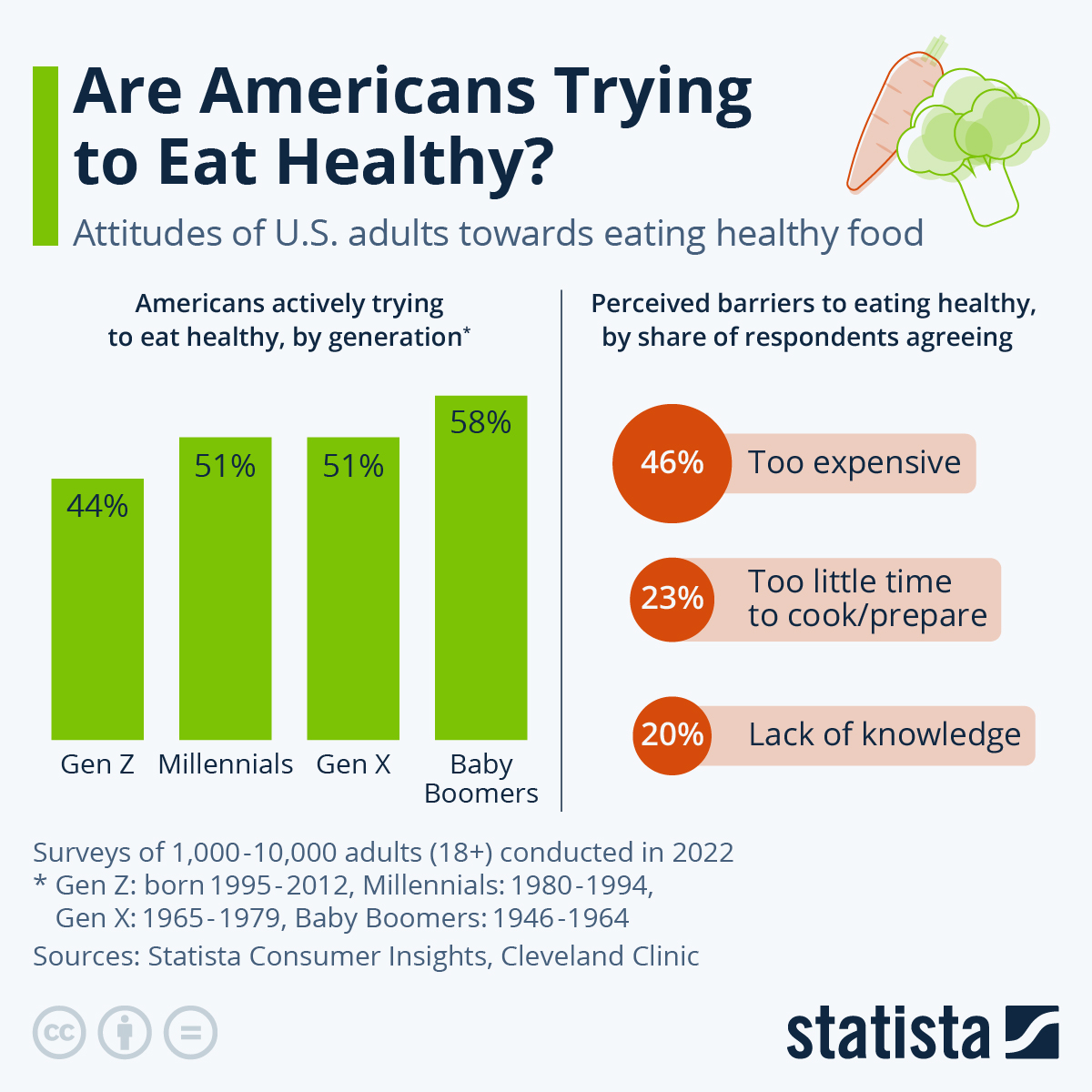
Are Americans Trying To Eat Healthy?

 Around half of Americans are healthy eaters, at least according to their own testimonies.

As Katharina Buchholz reports, according to Statista Consumer Insights, 50 percent of Americans claim to actively try to eat healthy. 

Infographic: Are Americans Trying to Eat Healthy? | Statista