Search This Blog

Sunday, February 26, 2023

State Nursing Boards React to the Fake Diploma Scheme

 On the heels of a federal takedown of a fraudulent nursing diploma scheme

opens in a new tab or window -- dubbed Operation Nightingaleopens in a new tab or window after Florence Nightingale, the founder of modern nursing -- questions remain as to just how sprawling the fallout may be.

More than two dozen individuals have been charged for their alleged participation in the scheme to sell fake diplomas and transcripts from accredited Florida-based nursing schools to those seeking licenses and jobs as registered nurses (RNs) and licensed practical/vocational nurses (LPN/VNs), according to the Department of Justice (DOJ)opens in a new tab or window.

These fraudulent documents allowed purchasers to sit for the national nursing board exam, and if they passed it, to obtain licenses and jobs in various states, the DOJ said. Overall, the scheme involved the distribution of more than 7,600 fake diplomas issued by a trio of since-shuttered schools: Siena College and Sacred Heart International Institute, both in Broward County, and Palm Beach School of Nursing in Palm Beach County.

State nursing boards across the country have begun taking action against those who received fake credentials, as well as those who were seeking fake documents, who may have been involved in the scheme.

For example, the Texas Board of Nursing announced that it has filed formal charges against 23 nursesopens in a new tab or window who allegedly fraudulently obtained credentials. However, the board noted that the charges are not a final disciplinary action, and that a nurse is permitted to work while charges are pending.

Meanwhile, the New York State Education Department issued an interim update stating that hundreds of licensees and more than 2,000 applicants

opens in a new tab or window graduated from the involved schools. The individuals who graduated from the programs and received a license to practice nursing have been contacted.

"Since the education submitted is not acceptable, the department requested the individual to either 1) return the license parchment or 2) have a qualified nursing program submit verification of acceptable education. Applications from individuals who applied with education from one of the schools ... but who have not been licensed, will be contacted in the coming weeks. Those applications will be held until the applicant demonstrates that they have met the requirements for acceptable education, examination, and moral character," the update said.

The department also noted that it is "actively pursuing additional information from the federal authorities and will take appropriate action regarding the licensure or application status of any individual who is confirmed to have been approved to sit for the examination or obtained their license based on false and misleading information."

The update further advised employers that if they have an employee who is believed to have been issued fraudulent credentials, they should consult their legal counsel and human resources director for guidance, and potentially speak with the employee directly.

The Arizona State Board of Nursing also issued a statement, noting that it has identified 10 individualsopens in a new tab or window with current licenses who may be involved in the scheme.

"If credentials are fraudulent, the board has the ability to revoke or deny licensure, after providing due process to the individual involved," the statement said.

The board further explained that individuals identified by the investigation as possibly having illegitimate credentials have been flagged in the National Council of State Boards of Nursing nationwide data system. "This means that all state boards of nursing, including Arizona's, can monitor the individuals until their case is resolved. Once a disciplinary action has been taken by one state board of nursing related to diploma fraud, all of the other state boards of nursing will have access to that information in order to prevent additional fraud."

According to WSB-TV in Georgia

opens in a new tab or window, while the state has 22 practicing nurses who have been identified as allegedly fraudulently obtaining their licenses, the nurses are maintaining their innocence, raising the question of whether there may be others who plan to take the same stance.

"While we have not received reports from our members about this issue, all leaders in nursing education must take reports of alleged fraud seriously," said Beverly Malone, PhD, RN, president and CEO of the National League for Nursing, which represents nurse faculty and nursing education programs, in a statement provided to MedPage Today. "Prospective nursing students should do their research to make sure they are applying to a legitimate nursing school or program, including members of the National League for Nursing. Many schools and programs have achieved accreditation, such as with the NLN Commission for Nursing Education Accreditation ... which demonstrates that they meet high quality standards. The National League for Nursing encourages all nursing schools and programs to pursue accreditation to ensure they are recognized as reputable, quality programs."

https://www.medpagetoday.com/special-reports/features/103259

Zelensky Berates, Threatens Unsupportive Americans

This is an example of how not to win over the American people: shame and berate them while claiming Washington's 'global leadership' is in peril.

"If they do not change their opinionthey will lose NATO, they will lose the clout of the United States, they will lose the leadership position they are enjoying in the world," Zelensky said at a press conference late last week, in reference to the US public... As if the average American struggling to get by amid soaring food and cost-of-living prices stays awake at night worrying about US global "clout":

The Two Great Myths of Social Security Reform


Misled

The two big myths of Social Security reform are 1) balancing Social Security’s books is necessary; and 2) if attempted, such a task would be difficult.

I realize that this statement seems scarcely credible. Please bear with me.

To address the first issue, Social Security is, to use the parlance, a “pay as you go” system. Mutual funds hold investments. So, too, do pension and endowment funds. The Social Security program does not.

That assertion may confuse you, because the Social Security Administration insists otherwise. It purports to run two “trust funds,” one for its retirement payments and the other for reimbursing disability claims. These funds are said to contain the Social Security system’s “accumulated asset reserves.” In truth, however, those “asset reserves” (this column is stuffed with air quotes) are not marketable investments. They are instead Treasury Department IOUs—promises that the federal government will fulfill its future obligations.

Consequently, forecasts of the “Social Security Trust Fund’s” solvency are moot. We might as well monitor the health of Thor, Godzilla, or the Stay Puft Marshmallow Man. No pool of marketable securities increased when Social Security’s tax revenue surpassed its costs, and no pool of marketable securities is shrinking today, when the program’s expenditures exceed its specified income.

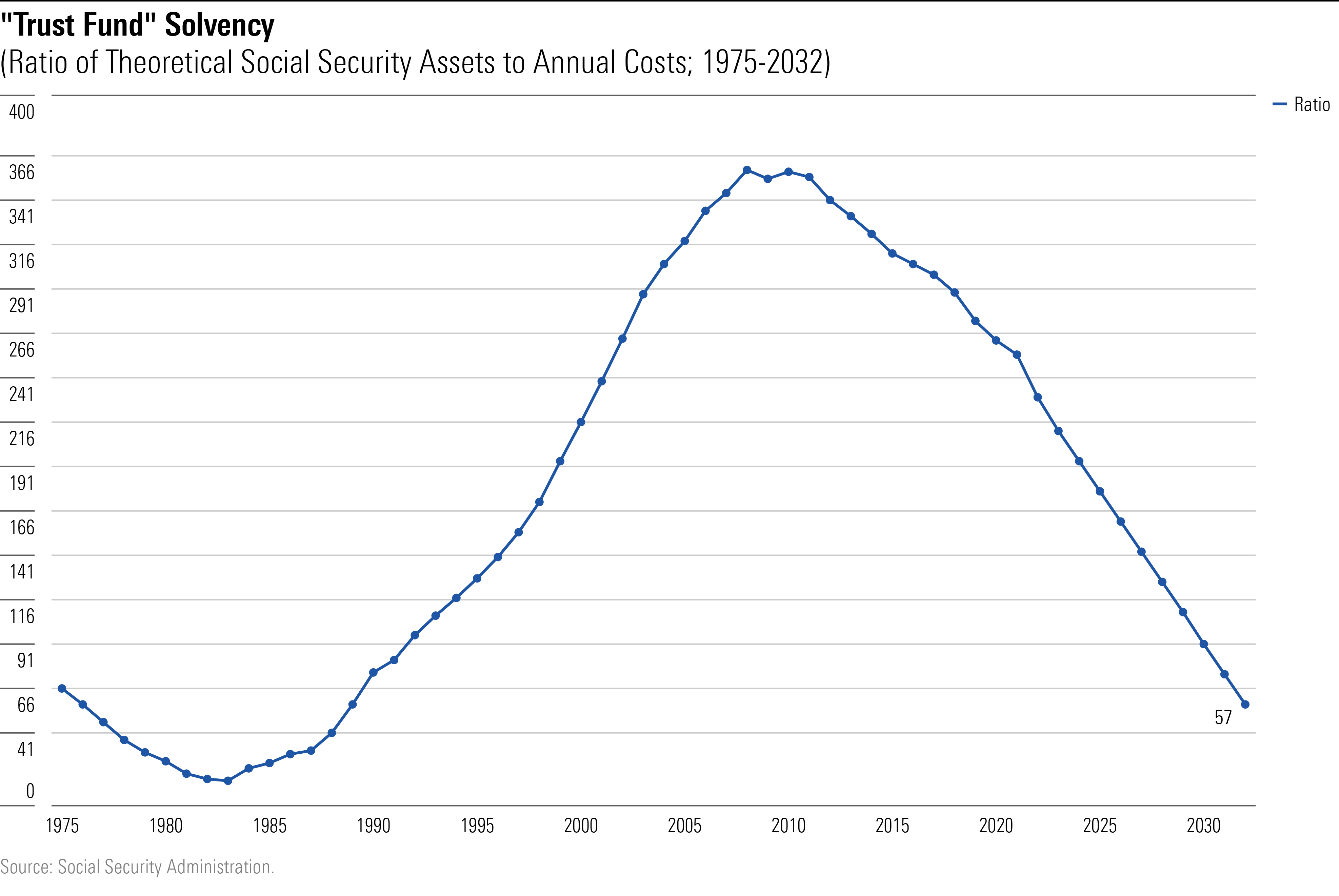
In other words, this oft-printed graph, which represents the assets/annual cost ratio of the two “Social Security Trust Funds” (combined to form a single entity), is an accounting creation:

A line chart showing the annual ratio of 1) the size of the Social Security Trust Fund when compared to 2) the annual cost incurred by that fund, from 1975 through the projection until 2032.

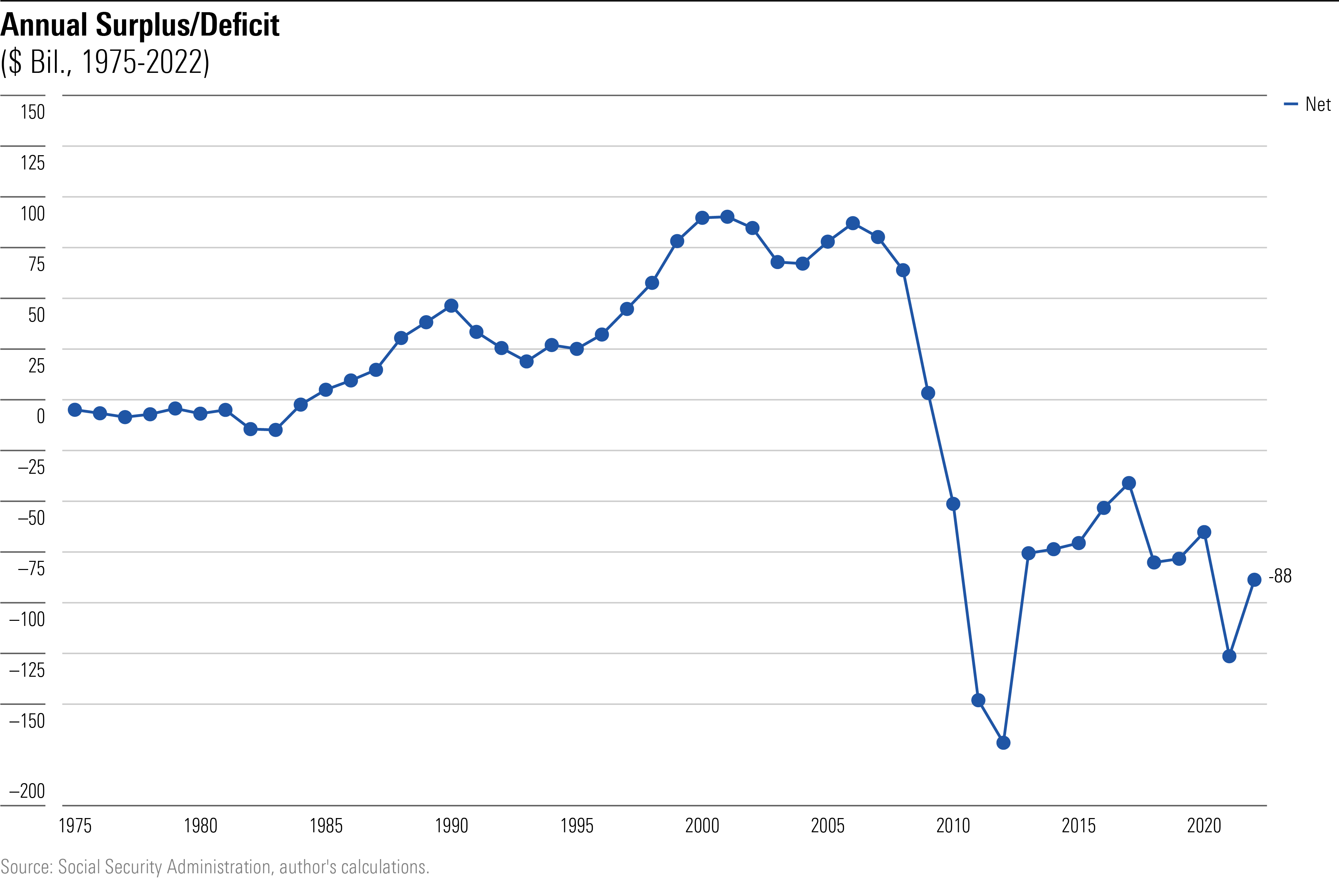
An accurate illustration of Social Security’s finances would not show the rise and fall of a fictional fund, but instead the administration’s annual surplus/deficit. That picture looks like this, below.

A line chart showing the annual suprlus or deficit for Social Security, as measured by payroll tax receipts minus expenditures.

The Multiverse

Wait now, you might wonder. (I would.) The conventional view of Social Security shows its balance expiring during the mid-2030s, while by my account the system is already bleeding assets. How is that an improvement?

To answer, let’s conduct a thought experiment. Imagine that when the Social Security program was launched, it was financed through general revenue. In that alternative universe, President Franklin Roosevelt created a new payroll tax not to defray Social Security’s costs, but instead to expand the U.S. military, in response to Japan’s imperialist ambitions. To convince a skeptical American public that he wouldn’t break the federal budget, Roosevelt pledged to cover all current and future defense spending through his new tax. The military would be self-funding.

The political discussion in that alternative nation would be very different from ours. Social Security’s costs would be taken for granted. The benefit would exist, payments would be made, and the country would quietly pay those bills—as we currently do with military costs. However, the “Defense Budget Trust Fund” would be heavily discussed and criticized, with debates raging about how best to “reform” military spending—as we currently do with the Social Security system.

In short, today’s Social Security discussions are the product of arbitrary decisions that have no effect on the nation’s financial health. Whether the payroll tax is alleged to cover Social Security’s costs, or is alleged to cover the military’s costs, matters not. The distinctions are immaterial.

Up for Discussion

This does not mean that Social Security’s finances should be taken for granted. Quite the contrary. The payroll tax is a major method by which the federal government generates revenue, and Social Security benefits are among its two largest costs, along with Medicare/Medicaid. If Congress and the White House decide that reducing the national debt is a task worth pursuing, then the Social Security program is a logical starting point. It deserves hard scrutiny.

But so do other aspects of the federal government’s budget. It little avails the nation’s financial health to “fix” Social Security, yet run a ruinous aggregate deficit. (What level of deficit qualifies as “ruinous” is a topic for another time; ask 20 leading economists and you will get 20 different answers.) The problem must be resolved holistically rather than piecemeal.

Let’s consider the subject from another perspective. For a quarter-century, payroll tax receipts eclipsed Social Security payments, meaning that the plan generated a surplus that was used for other purposes. During that time, did anybody say, “The United States should rationalize its infrastructure spending, because not only are highways failing to pay for themselves, but they are also taking from Social Security”? Not to my knowledge. Implicitly, people accept that when running a surplus Social Security can help to pay for other programs, but when running a deficit, it should not receive similar support.

In short, the Social Security “crisis” is an unhelpful construction. Today’s debate relies upon a financial misperception stemming from historic accident. It distracts us from the matter at hand, which is to determine the appropriate overall level of government spending and revenue, while also helping to advance—or at least not obstruct—the nation’s economic growth. (More than 20 years ago, the director of the Congressional Budget Office advanced this same argument. It continues to hold today.)

Looking Forward

Which brings us to the second myth mentioned at the beginning of this article: that if one were to attempt to balance Social Security’s books, the task would be difficult. Not so. Several reasonable levers exist for matching Social Security’s revenue with its costs. In fact, they could even be used to put the Social Security system in the black. If so, Social Security could once more become part of the federal budget’s solutions, rather than among its problems.

Next Tuesday’s column will cover that ground.

John Rekenthaler (john.rekenthaler@morningstar.com) has been researching the fund industry since 1988. He is now a columnist for Morningstar.com and a member of Morningstar's investment research department. John is quick to point out that while Morningstar typically agrees with the views of the Rekenthaler Report, his views are his own.

https://www.morningstar.com/articles/1139948/the-two-great-myths-of-social-security-reform

Amazon has a donkey meat problem

 When Cindy first tried the Artemisia Anti-Hemorrhage Formula dietary supplements that she purchased on Amazon, she had no reason to suspect that she was eating donkey. A California native and lifelong vegetarian, she assumed that the world’s largest online retailer had vetted the bottle’s claims of being made from “100 percent pure, natural herbs.” But while reading the back of the bottle, she noticed an ingredient she hadn’t seen before: “gelatina nigra.” She googled it, and what she found made her stomach turn.Every year, millions of donkeys are slaughtered and skinned to make the so-called gelatina nigra found in Cindy’s dietary supplement. More commonly called “ejiao” or “donkey-hide gelatin,” the animal product is made from donkey skin. It’s in such high demand due to its alleged health benefits that it’s decimating the global donkey population and has led to increasingly brutal treatment of the animals, according to a 2019 report by the Donkey Sanctuary, an advocacy organization. A video the organization obtained shows workers in Tanzania bludgeoning donkeys with hammers to meet their slaughter quotas. “It’s not herbal. It’s literally made with donkeys,” says Cindy, who asked to go by only her first name for privacy reasons. “Why would Amazon sell something that cruel?”

While some retailers like Walmart and eBay have committed to drop products that contain ejiao, edible items containing this ingredient are widely for sale on Amazon in spite of multiple petitions asking that it stop selling them. A legal complaint filed in California last week by the law firm Evans & Page on behalf of the Center for Contemporary Equine Studies, a nonprofit, claims Amazon’s continued sale of these donkey-based products is more than distasteful—it may be illegal.

The Center alleges that Amazon’s distribution and sale of ejiao violates an obscure California animal welfare law called the Prohibition of Horse Slaughter and Sale of Horsemeat for Human Consumption Act. The 1998 ballot initiative, known at the time of its passage as Proposition Six, makes the sale of horsemeat for human consumption a crime on the grounds that horses, like dogs and cats, are not food animals and deserve similar protections. The Center is arguing that, under the statute, horsemeat is defined to mean any part of any equine, including donkeys.

For Frank Rothschild, director of the Center for Contemporary Equine Studies, the law is clear: Donkeys are equines, and the sale of ejiao for human consumption in California is illegal. “We are a scientific organization and not in the business of national advocacy. We want the defendants to stop selling ejiao because it’s illegal,” he says. “That’s the law.”

Bruce Wagman, an attorney unaffiliated with the complaint who has practiced animal law in California for 30 years, says that while the center presents a reasonable argument, it’s unclear whether a judge would agree because the law’s wording leaves room for interpretation. “Horsemeat is not really defined in the text of the relevant statute,” he says. “But the spirit of Proposition Six is absolutely to prevent equines, including donkeys, from being slaughtered for people to consume. Period.”

The complaint demands that Amazon stop selling ejiao immediately. If a judge ultimately finds Amazon in violation of the law, the state of California could fine Amazon for each sale. This type of regulatory pressure is not unprecedented. In 2018, prosecutors in three California counties accused Amazon of violating a 2004 state law banning sales of foie gras. In a settlement, Amazon agreed not to sell the fatty goose liver in California and paid $100,000 in civil penalties.

To test the center’s claims, WIRED scraped more than 1,000 Amazon product search results using terms like “ejiao,” “donkey hide,” and “ass hide,” and found at least 15 edible items that claim to contain donkey. These items had names like Chinese Special Snack Seedless, Ass Hide Glue Lumps, and Ejiao Slice. In total, we found that while every listed item was sold by third parties, at least four were available to ship from Amazon’s warehouses.

Amazon’s website typically alerts users who attempt to purchase items banned in their state and blocks their sale. We filled an Amazon shopping cart with these edible products and went through the checkout process to see whether Amazon would deliver them to a California address. At no point did we encounter any notifications that the items couldn’t be shipped to California. However, when we added a lightbulb to our cart that is not compliant with California state regulations, Amazon prevented us from completing our purchase. We were ultimately able to purchase several ejiao products and successfully ship them to a California address.

Amazon spokesperson Amanda Cruz declined WIRED’s request to comment on the sale and shipment of products containing donkey meat to a California address. NSD Herbal, which sells the supplement Cindy purchased, did not yet respond to a request for comment.

Though Amazon has policies against selling illegal or prohibited products, it’s possible that the distribution of ejiao, if illegal, has evaded the company’s content moderation. Amazon has often come under fire for its lax product controls. In 2019, an investigation by The Wall Street Journal found thousands of unsafe and banned products for sale on the site. A CNBC report that same year revealed Amazon was shipping expired baby formula. WIRED also found books on Amazon peddling scientifically unproven and potentially fatal “treatments” for autism.

“Amazon is a big company that has tons of resources. With that position comes responsibility, and if it seems like they aren’t abiding by state laws, then clearly they need to do better,” says Teresa Murray, director of the Consumer Watchdog Program at the nonprofit Public Interest Research Group. “It’s their job to know the law.”

https://arstechnica.com/tech-policy/2023/02/amazon-has-a-donkey-meat-problem/

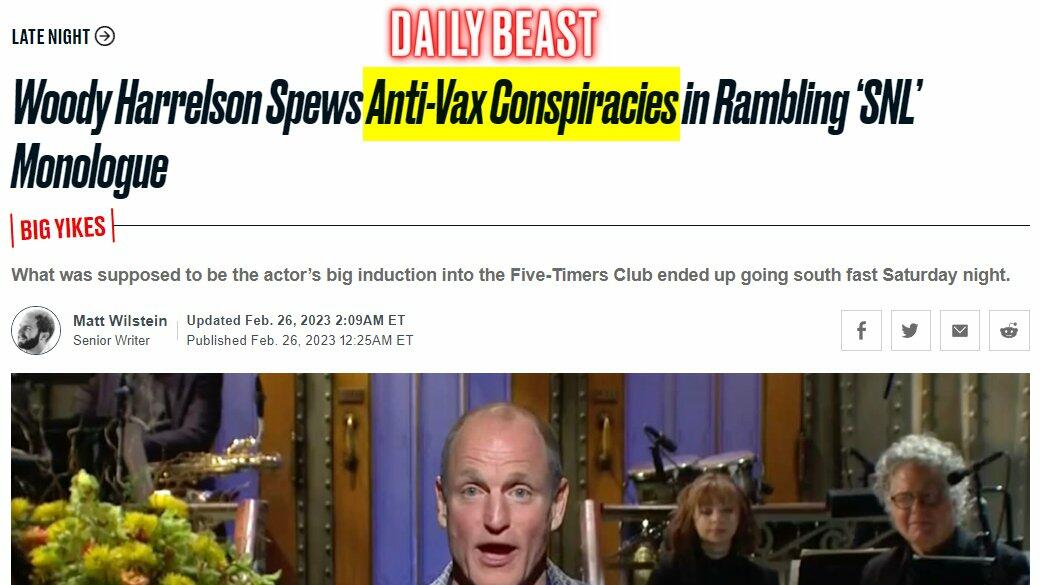
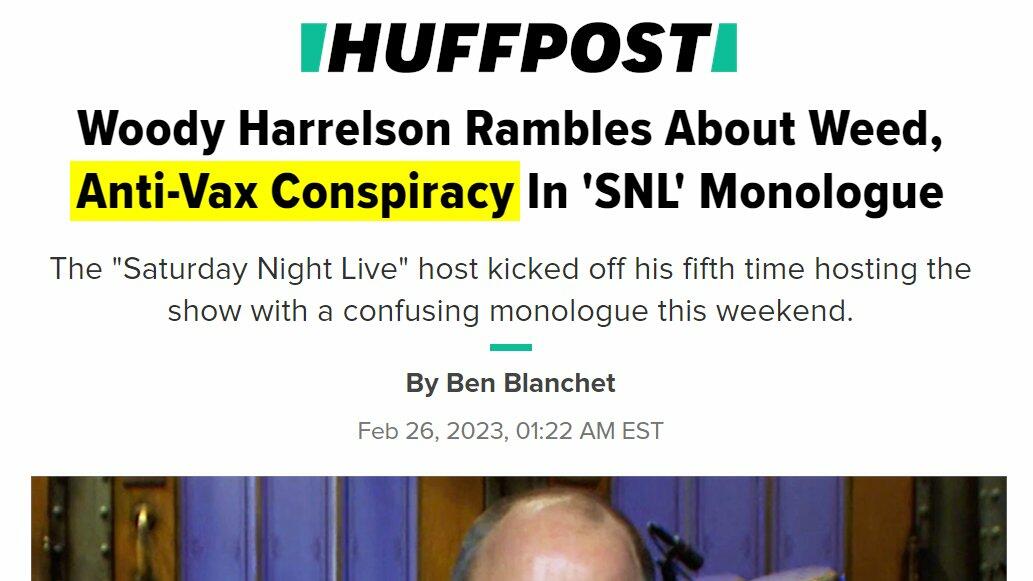
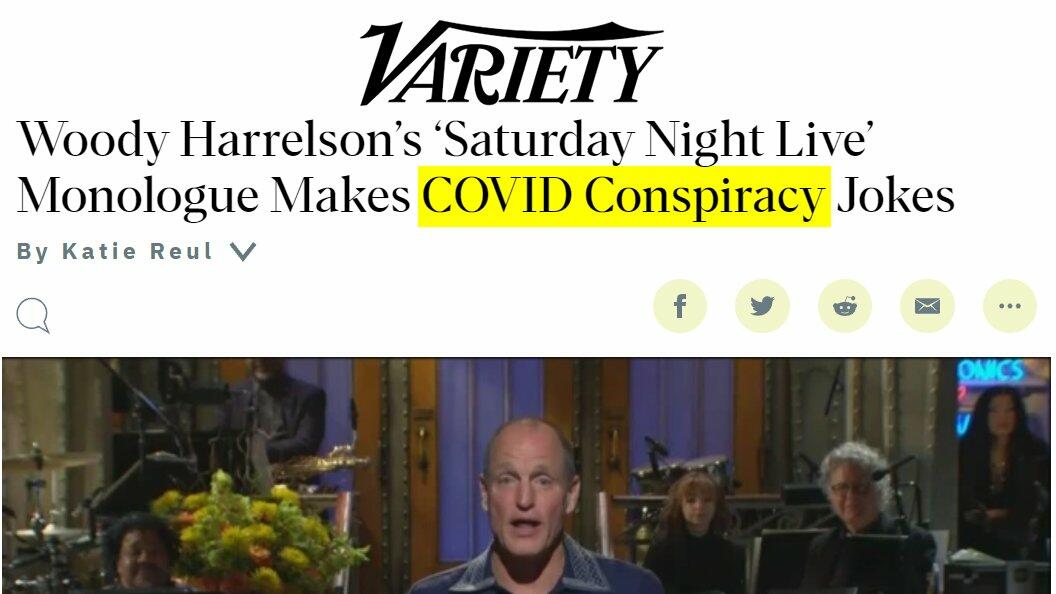
Leftists Furious As Woody Harrelson Sneaks Covid Vaccine Mandate Joke Onto SNL

 On his fifth time as guest host on the now far-leftist Saturday Night Live, Harrelson entered into a monologue which seemed to catch the New York audience off guard as the joke ended with a scathing indirect indictment of Big Pharma, lockdowns and vaccine mandates.

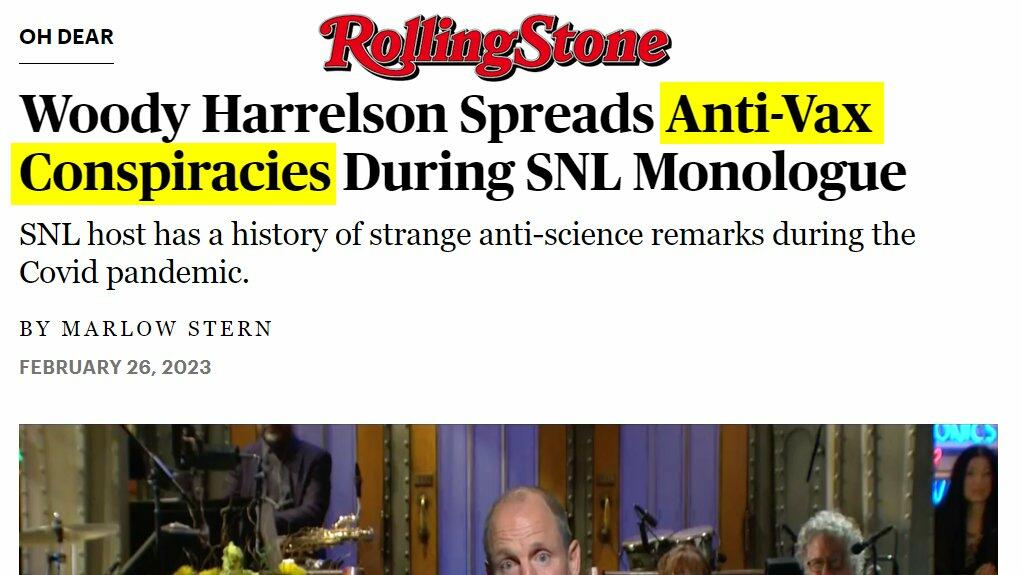
The progressive media is, not surprisingly, furious, accusing Harrelson of not only spreading a "conspiracy theory" but being high with the Rolling Sone's Marlow Stern claiming he was "apparently under the influence."


The same Rolling Stone, of course, which was caught in that whole Ivermectin fabrication-cum-retraction...

As if given a green light by the Pfizer C-Suite, the leftist pile-up began...

Still, the trend of celebrities and mainstream figures coming out in opposition to the draconian covid restrictions is growing along with skepticism about the vaccines, though, the starved for ratings and pro-establishment SNL is probably the last place we would expect to see such voices given a "platform." Unless, of course, this was just a marketing ploy to end the viewership bleeding...

And while the old media - a melting ice cube still generously funded by ads from companies such as, oh, Pfizer - is losing its mind, Twitter owner Elon Musk had a clear and sobering reaction to the monologue.

States with Less Restrictive COVID Policies Outperformed Restrictive States

 
Overview
The most important health event of the recent past was the COVID-19 pandemic. Policymakers must now learn which government responses were helpful and which were not. Paragon’s new report, “Freedom Wins: States with Less Restrictive COVID Policies Outperformed States with More Restrictive COVID Policies,” assesses the impact of state government pandemic measures on health, economic, education, and domestic migration outcomes.
The paper was coauthored by Paragon’s Public Health and American Well-being Initiative director Dr. Joel Zinberg, Paragon’s President Brian Blase, Dr. Eric Sun at Stanford University, and economist Casey Mulligan at the University of Chicago. 

Methodology
The study compared a quantitative measure of state government response measures developed by Oxford University to health, economic, and educational outcome measures in all 50 states and the District of Columbia that had been developed by Casey Mulligan in an earlier paper. Oxford’s index measured government interventions including mandatory, state-enforced closures of businesses, schools, and recreational and religious facilities; restrictions on public gatherings; stay-in-place orders; and masking and social distancing requirements. The study also compared the Oxford index to changes in state-to-state migration patterns.
 
Government interventions did not produce health benefits but had large economic and education costs
  • States with severe government interventions did not significantly improve health outcomes (age-adjusted and pre-existing-condition adjusted COVID mortality and all-cause excess mortality) compared to states with more restrained approaches. This may be partly because government interventions appear to have increased excess mortality from non-COVID health conditions.
  • Severe government interventions were strongly correlated with worse economic (increased unemployment and decreased GDP) and educational (fewer days of in-person schooling) outcomes. The economic and education damage was most severe for lower-income families and children. 

People voted with their feet and moved away from states with severe restrictions to states that took a more restrained approach
  • Census data on domestic migration (movements across states) showed a substantial increase in domestic migration during the pandemic (July 1, 2020—June 30, 2022) compared to pre-pandemic trends (July 1, 2014—June 30, 2019). 
  • Severe government interventions were strongly correlated with net out migration from states, suggesting that people fled states with more severe lockdowns and moved to states with less severe measures.

Florida outperformed California

The paper contains a case study of California and Florida, two large states with some common characteristics but that took much different pandemic responses. Despite its less severe approach and older population, Florida’s outcomes were far superior to California’s outcomes.
 
Here are a few key findings about the two states’ approaches and outcomes from the paper:
  • Florida relaxed general lockdowns after a short time, resulting in a low Oxford index score. Florida focused its remaining measures on protecting the people most vulnerable to COVID.
  • California imposed strict and prolonged lockdowns and had one of the highest Oxford index scores in the nation. 
  • The two states had roughly equal health outcomes scores, suggesting little, if any, health benefit from California’s severe approach.
  • California suffered far worse economic and education outcomes than Florida, which scored well above average on each. 
  • California’s severe lockdowns seemed to elicit a jump in its already high out-migration, while Florida experienced a significant in-migration increase during the pandemic as compared with pre-pandemic trends. 
Florida’s approach was similar to Sweden’s approach of avoiding lockdowns, keeping schools open, and relying on individuals to make their own decisions. The paper discusses how well Sweden and Florida fared relative to other countries and states.

Recommendation
In future pandemics, policymakers should avoid severe, prolonged, and generalized restrictions and instead carefully tailor government responses to specific disease threats, encouraging state and local governments to balance the health benefits against the economic, educational, health, and social costs of specific response measures.