Search This Blog

Monday, February 27, 2023

Large Russian Plane Destroyed At Belarus Airstrip, Say Opposition Saboteurs

 Ukrainian media reports began claiming Sunday that a large explosion rocked Machulishchy airbase in Minsk Oblast in Belarus, with reports saying a Russian aircraft had been damaged. Eyewitness accounts suggested two explosions in the Sunday morning hours. 

"According to preliminary reports, the traffic police stopped the cars in several places around the airbase and checked the trunks and ID of the drivers," Ukrainska Pravda reported, also citing the presence of emergency vehicles on the scene. But now there appears further confirmation in AFP that a Russian military airplane was likely destroyed at the airfield.

Belarus's air base at Machulishchy. source: Belarusian opposition figure Franak Viacorka/Twitter

US Durable Goods Orders Plunged Most Since COVID Lockdowns In January

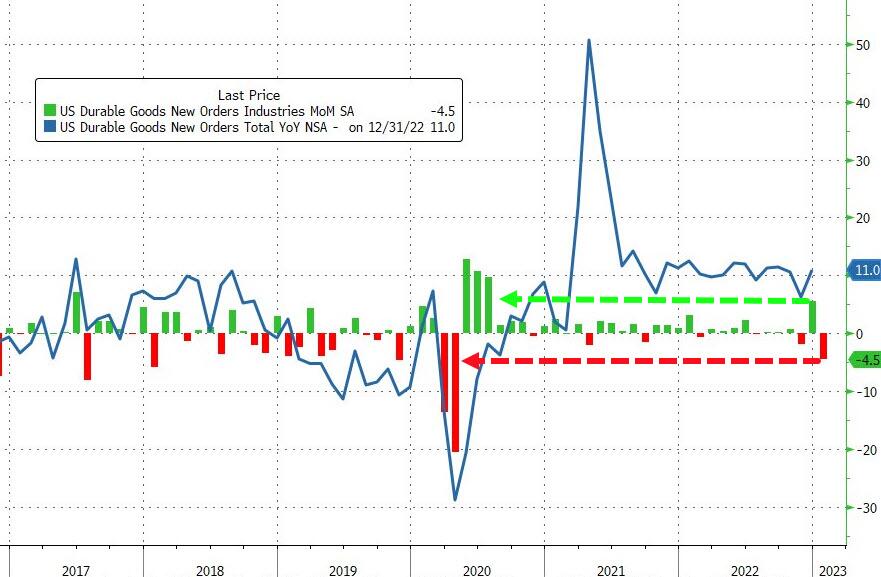
 After a shockingly large upside surprise surge (+5.6% MoM)  in December, analysts expected preliminary January durable goods orders to tumble (-4.0% MoM). The actual print came in worse with a 4.5% MoM drop - the biggest drop since April 2020.

Source: Bloomberg

But, everything else was super strong...

Core Durable Goods (ex-Transports) jumped 0.7% MoM (+0.1% exp) - biggest jump since March 2022 (but YoY Core is up just 1.6%)...

Source: Bloomberg

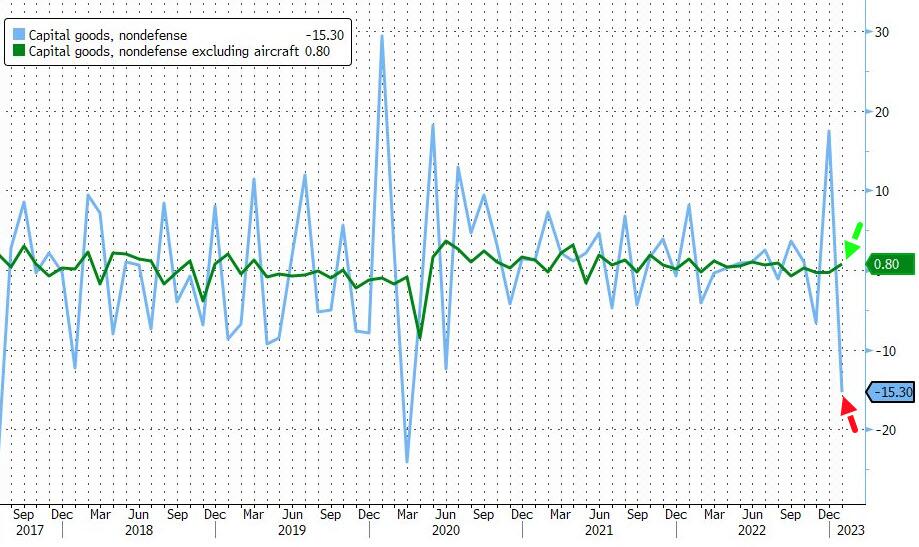
Additionally, the value of core capital goods orders, a proxy for investment in equipment that excludes aircraft and military hardware, increased 0.8% last month after a downwardly revised 0.3% decline in December, Commerce Department figures showed Monday.

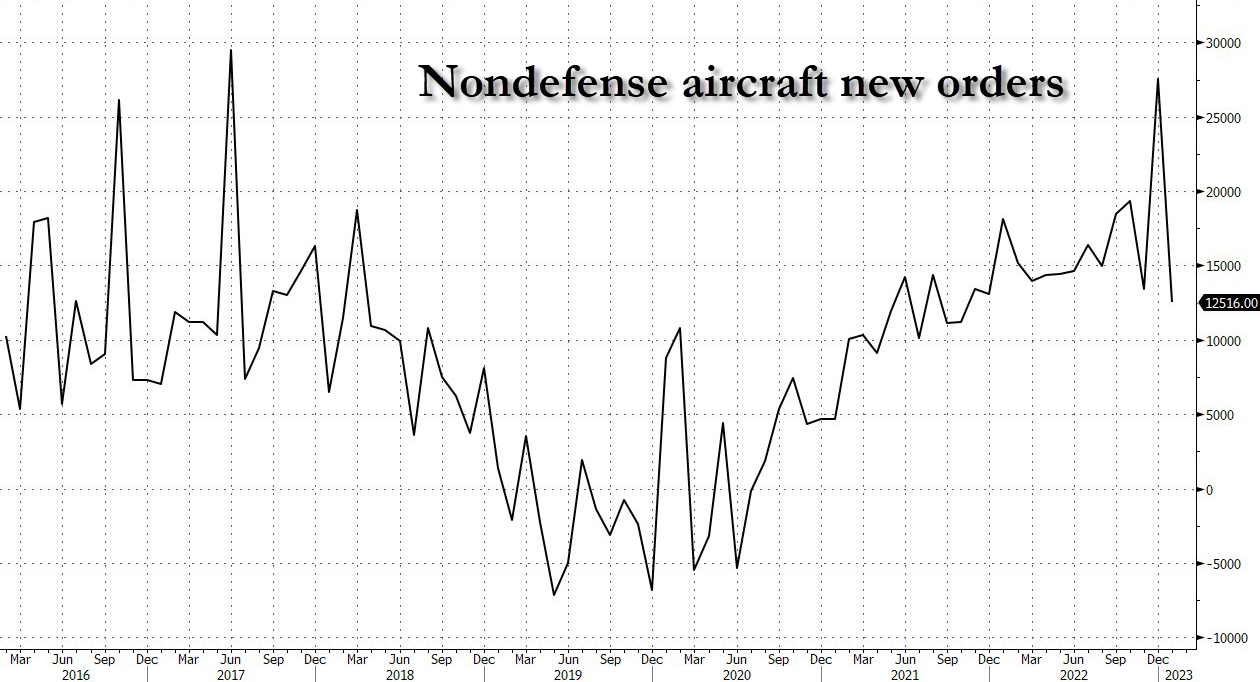
The big swing factor was no Boeing orders as non-defense aircraft new orders tumbled 54.6% MoM...

We see the same picture with capital goods (non-defense) orders: Total (incl aircraft) -15.3%, Ex aircraft +0.8%

Core capital goods shipments, a figure that is used to help calculate equipment investment in the government’s gross domestic product report, jumped 1.1%.

So, all in all, this is 'good' news for the economy and thus 'bad' news for The Fed.

https://www.zerohedge.com/economics/us-durable-goods-orders-plunged-most-covid-lockdowns-january

UpHealth to Sell Innovations Group Belmar Pharma Solutions for $56 M

 Represents a Substantial Milestone in UpHealth’s Focus on Further Integration of its Telehealth, Integrated Care and Behavioral Health Businesses ~

~ Reflects Execution of UpHealth’s New Strategic Vision of Large Data Driven Digitally Integrated Healthcare Services ~  

~ Delivers Significant Liquidity to UpHealth’s Balance Sheet ~


https://finance.yahoo.com/news/uphealth-announces-strategic-sale-innovations-130000762.html

Shionogi sees COVID pill reaping $2 billion in annual sales upon U.S. approval

 Japan's Shionogi & Co Ltd believes its COVID-19 pill will easily garner $2 billion in annual sales if it secures U.S. approval, which the company expects to receive in late 2024, its chief executive said.

Xocova, a protease inhibitor like the COVID treatments developed by Pfizer Inc and Merck & Co, was granted emergency approval by Japanese regulators in November, making it the nation's first domestically produced oral treatment for COVID.

CEO Isao Teshirogi told Reuters that the drug - seen as the biggest of heavy bets by Shionogi on pandemic-related treatments - could be approved in South Korea and China as early as next month.

While Xocova came later to the market than Shionogi initially hoped for after Japanese regulators twice requested more data, the company says interim results of a study suggest taking the pill could lessen a patient's chances of developing long COVID.

"If you kill the virus fast enough and sharp enough, the lower the probability of long COVID. That's our hypothesis, but we need to prove that," Teshirogi said in an interview.

Competing drugs are also under the microscope for their potential to deliver similar outcomes. According to one study by the Veterans Affairs St. Louis Health Care System, Pfizer's antiviral drug Paxlovid cuts the risk of developing many long COVID symptoms.

Shionogi sold 2 million courses of Xocova, taken once daily for five days, to the Japanese government last year for 100 billion yen ($740 million).

Jefferies analyst Stephen Barker estimates, however, that only about 11,000 courses of Xocova are being consumed each month in Japan.

Shionogi is hoping for Xocova sales of around $1 billion to $1.5 billion this year.

Teshirogi said he expects U.S. approval of the drug could also come by the winter of 2024, pending a Phase III trial funded in part by the National Institutes of Health.

"I think $2 billion out of the COVID-19 market is not very difficult," he said, basing his estimate on Pfizer's forecast for more than $20 billion in COVID-related sales in 2023.

Medical tourism looking sickly as patients watch their spending

 Attila Knott has an empty dental hospital in Hungary.

The foreigners with bad teeth he was counting on never arrived, deterred first by COVID-19 and now by a cost-of-living crisis that has left the medical tourism industry struggling to recover even after the lifting of pandemic travel restrictions.

"People are more cautious," Knott told Reuters, staring at the empty building across the street from his existing Kreativ Dental clinic. "They think twice about spending big money all at once on something like dental treatment."

The businessman had aimed to open the new facility in March 2020 to serve more patients seeking procedures in Hungary for a cheaper price than at home.

Now, with patient numbers having halved from around 600 a month before COVID struck, he is thinking of branching out into colonoscopies and knee replacements.

For years, travelling abroad to clinics in countries like Hungary and Turkey has been an option for British and North American patients who face long waits, high costs or both for dental and medical procedures at home.

Operators had hoped for a rapid bounce back after curbs on travel were lifted.

But inflation fuelled by soaring energy and food prices since the Ukraine war started a year ago has left people with little money to spare, especially for cosmetic procedures.

In Hungary, which borders Ukraine, the war itself is making foreigners wary, Knott said.

Rising air fares and fewer flights - and the memory of last summer's travel chaos - are also putting off would-be patients, clinic operators and analysts told Reuters.

For some trips, like those to Turkey, airline tickets can be twice what they were in 2019, according to WeCure, which specialises in medical tourism to large hubs like Turkey from countries like Britain.

WeCure said flights, ground transfers and petrol now accounted for about 15% of the cost of its travel and treatment packages, roughly double their proportion pre-COVID, putting upward pressure on overall prices.


Western Leaders Privately Admit Ukraine Can't Win The War

 by Joe Lauria via ConsortiumNews.com,

Western leaders privately told Ukrainian President Volodymyr Zelensky that Ukraine can not win the war against Russia and that it should begin peace talks with Moscow this year in exchange for closer ties with NATO. 

The private communications are at odds with public statements from Western leaders who routinely say they will continue to support Ukraine for as long as it takes until it achieves victory on the battlefield. 

The Wall Street Journal, which reported on the private remarks to Zelenksy, said:

“The public rhetoric masks deepening private doubts among politicians in the U.K., France and Germany that Ukraine will be able to expel the Russians from eastern Ukraine and Crimea, which Russia has controlled since 2014, and a belief that the West can only help sustain the war effort for so long, especially if the conflict settles into a stalemate, officials from the three countries say.

‘We keep repeating that Russia mustn’t win, but what does that mean? If the war goes on for long enough with this intensity, Ukraine’s losses will become unbearable,’ a senior French official said.

‘And no one believes they will be able to retrieve Crimea.’

French President Emmanuel Macron and German Chancellor Olaf Scholz told Zelensky at an Ã‰lysée Palace dinner earlier this month that he must consider peace talks with Moscow, the Journal reported.

According to its source, the newspaper quoted Macron as telling Zelensky that “even mortal enemies like France and Germany had to make peace after World War II.”

Macron told Zelensky “he had been a great war leader, but that he would eventually have to shift into political statesmanship and make difficult decisions,” the newspaper reported.   

A Return to Realism

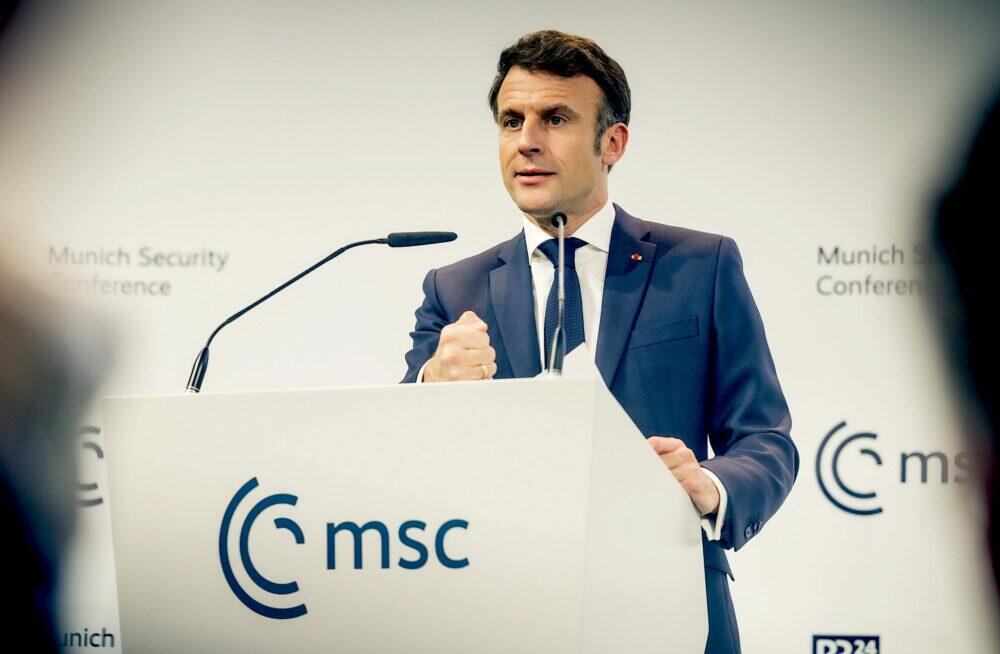
Macron at the Munich Security Conference last week. (Kuhlmann/MSC)

At the Munich Security Conference last week, Gen. Petr Pavel, the Czech Republic’s president-elect and a former NATO commander, said:

“We may end up in a situation where liberating some parts of Ukrainian territory may deliver more loss of lives than will be bearable by society. … There might be a point when Ukrainians can start thinking about another outcome.”

Even when he was a NATO commander Pavel was a realist in regard to Russia. During controversial NATO war games with 31,000 troops on Russia’s borders in 2016 — the first time in 75 years that German troops had retraced the steps of the Nazi invasion of the Soviet Union — Pavel dismissed hype about a Russian threat to NATO. 

Pavel, who was chairman of NATO’s military committee at the time, told a Brussels press conference that, “It is not the aim of NATO to create a military barrier against broad-scale Russian aggression, because such aggression is not on the agenda and no intelligence assessment suggests such a thing.”  

The German foreign minister at the time, Frank-Walter Steinmeier, also embraced realism towards Russia, saying: “What we shouldn’t do now is inflame the situation further through saber-rattling and warmongering. Whoever believes that a symbolic tank parade on the alliance’s eastern border will bring security is mistaken.”

Instead of an aggressive NATO stance towards Russia that could backfire, Steinmeier called for dialogue with Moscow. “We are well-advised to not create pretexts to renew an old confrontation,” he said, saying it would be “fatal to search only for military solutions and a policy of deterrence.”  Under U.S. leadership NATO clearly did not follow that advice, as it continued to deploy more troops to Eastern Europe and to arm and train Ukraine (under cover of pretending to back the Minsk Accords).

Before its intervention in Ukraine, Russia cited NATO’s eastward expansion, the deployment of missiles in Romania and Poland, war games near its borders and the arming of Ukraine as red lines that the West had crossed. 

After a year of war, Western leaders appear now to be turning to a realist approach. Macron, for instance, at the Munich Security Conference dismissed any talk of regime change in Moscow. 

 No US Reaction

Left to Right: Ukrainian Foreign Minister Dmytro Kuleba, U.S. Secretary of State Antony Blinken and German Foreign Minister Annalena Baerbock at Munich Security Conference. (Schulmann/MSC)

Washington has not commented on the Journal‘s story about the peace talks-for-arms proposal.

U.S. Secretary of State Antony Blinken last month discussed with The Washington Post arming Ukraine post-war but he did not say that Ukraine should seek peace talks.

“We have to be thinking — and we are — about what the postwar future looks like to ensure that we have security and stability for Ukrainians and security and stability in Europe,” Blinken told the conference in Munich.

The proposal to bring Ukraine even closer to NATO than it already is, with greater access to weapons after the war, should be on the agenda at NATO’s annual meeting in July, said Rishi Sunak, the British prime minister, at the Munich conference.

“The NATO summit must produce a clear offer to Ukraine, also to give Zelensky a political win that he can present at home as an incentive for negotiations,” a British official told the Journal. 

The deal with NATO would not include membership with its Article 5 protection, the newspaper reported. “We would like to have security guarantees on the path to NATO,” Zelensky told a press conference on Friday.

 In the meantime, Macron, according to the WSJ report, said that Ukraine should press forward with a military offensive to regain territory in order to push Moscow to the peace table. 

There has been no reaction from Moscow about the proposal. Political analyst Alexander Mercouris, in his video report on Saturday, said Russia would likely be incentivized to continue fighting rather than enter peace talks with the knowledge that Ukraine would be heavily armed by NATO after the war.   

“The Russians are never going to agree with something like this,” Mercouris said.

“They must be saying to themselves that instead of agreeing to this plan, it actually makes more sense … to continue this war because one of [Russia’s] objectives is the total demilitarization of Ukraine.”

What the Western powers are proposing is the opposite, he said. Given that Russia considers it is winning and “there seems to be a general acknowledgment amongst Western governments that Ukraine can’t win this war, …where is the incentive for … Russia to even consider this plan?”

For Moscow, Mercouris said, Ukraine’s demilitarization is an “absolute, existential matter.”  

If Ukraine is going to get even more advanced weapons from NATO after the war as opposed to what it would get “whilst the war is still underway, then it makes even less sense” for Russia “to stop the war and agree to this plan.” 

Russia is facing a “weakening adversary now,” Mercouris said, and Moscow clearly prefers that to facing a “strengthened adversary later.”  

https://www.zerohedge.com/geopolitical/western-leaders-privately-admit-ukraine-cant-win-war

SpringWorks: FDA Acceptance and Priority Review of Tumor Treatment

  SpringWorks Therapeutics, Inc. (Nasdaq: SWTX), a clinical-stage biopharmaceutical company focused on developing life-changing medicines for patients with severe rare diseases and cancer, announced today that the U.S. Food and Drug Administration (FDA) has accepted the Company’s New Drug Application (NDA) for nirogacestat, an investigational gamma secretase inhibitor, for the treatment of adults with desmoid tumors. The NDA was granted Priority Review and has been given a Prescription Drug User Fee Act (PDUFA) action date of August 27, 2023. The FDA’s Priority Review designation is given to investigational medicines that treat a serious condition and offer significant improvements in safety or effectiveness. In addition, the FDA has stated that it is not currently planning to hold an advisory committee meeting to discuss the application.

"People with desmoid tumors can experience severe pain and other debilitating morbidities, and we are excited by the opportunity to potentially transform the standard of care for these patients,” said Saqib Islam, Chief Executive Officer of SpringWorks. "The acceptance of our NDA for nirogacestat with Priority Review represents a significant milestone in our ambition to provide the first approved therapy for patients with desmoid tumors. We look forward to working closely with the FDA during the review process and remain focused on ensuring that we are well-positioned to expeditiously serve the desmoid tumor patient and the physician communities following approval."

The NDA is being reviewed under the FDA’s Real-Time Oncology Review (RTOR) program and is based on the previously announced positive results from the Phase 3 DeFi trial, a global, randomized, double-blind, placebo-controlled trial evaluating nirogacestat in adult patients with desmoid tumors. The FDA granted Fast Track and Breakthrough Therapy designations to nirogacestat for the treatment of adult patients with progressive, unresectable, recurrent or refractory desmoid tumors or deep fibromatosis. Nirogacestat has also received Orphan Drug designation from the FDA for the treatment of desmoid tumors.

https://www.biospace.com/article/releases/springworks-therapeutics-announces-fda-acceptance-and-priority-review-of-new-drug-application-for-nirogacestat-for-the-treatment-of-adults-with-desmoid-tumors-pdufa-action-date-set-for-august-27-2023-/