Search This Blog

Monday, April 17, 2023

Pharma lobby lambasts CMS' 'punitive' Part D drug pricing plans

 The pharmaceutical lobby has brought a laundry list of complaints to the Centers for Medicare & Medicaid Services (CMS) regarding its recently proposed plans to begin negotiating Medicare Part D drug prices in 2026 and beyond. 

Industry group PhRMA said Friday that the agency's proposed implementation of the Inflation Reduction Act "is in no way a 'negotiation,'" and that "CMS chose to go beyond what was outlined in the statute, taking the most extreme stance to sweep in as many medicines as possible and be as punitive as possible." 

CMS released initial guidance on March 15 describing how up to 10 Part D drugs with no generic or biosimilar competition would be subjected to "maximum fair prices," the back-and-forth process CMS would use to determine that pricing threshold and how the process would be expanded to more products in later years (see below). The initial guidance was accompanied by a one-month call for comments from stakeholders and the public. 

In 76 pages of comments submitted to the agency, PhRMA critiqued the agency for only allowing a 30-day comment period for such an "unprecedented" change to the Medicare program and suggested that the brief turnaround "falls short of legal requirements, as well as what is widely acknowledged to be a sound policy development process." 

Other major points of contention highlighted by the group in comments and accompanying materials included:

  • CMS' decision not to solicit stakeholder feedback on certain critical portions of the guidances, including the section covering which medicines and forms will be subject to price setting, the statute’s orphan drug exclusion and the special rule for biosimilars;
  • Limited meetings between the agency and the manufacturer during the price-setting process that "cannot occur until the manufacturer's counteroffer has already been submitted;"
  • A gag clause on manufacturers to be imposed on manufacturers during the price-setting process;
  • CMS' decision to delay the release of its explanation for how prices have been set until months after the price was imposed, which limits industry insights for the following year's negotiations;
  • Limited opportunity for patient and provider feedback;
  • An inclusion of products that have remaining patents and exclusives that could disincentivize industry innovation;
  • An 'extremely broad definition" that subjects a manufacturer's products with the same core molecule or active ingredient into a single price-setting process; and
  • Potential negative access to medicines for patients due to market effects resulting from the price setting.

"Rather than take a thoughtful, careful approach in this first year, CMS chose the opposite," PhRMA wrote in a blog post. "Given the stakes for patients, CMS should be taking a more measured approach when implementing the price setting provisions of the [Inflation Reduction Act]."

The Centers for Medicare & Medicaid Services' (CMS') Medicare Drug Price Negotiation Program will kick off in 2026 with “maximum fair prices” for up to 10 Part D drugs with no generic or biosimilar competition, according to initial guidance for the program released by the agency Wednesday.

CMS will then select a max of 15 additional “high expenditure, single source” Part D drugs for negotiation in 2027, followed by up to 15 more Part B or Part D drugs for 2028, according to the initial guidance (PDF). The agency will then add up to 20 new Part B or Part D drugs to the program during each subsequent year, it said.

“President Biden is leading the fight to lower the cost of prescription drugs—and with the Inflation Reduction Act, we’re making historic progress,” Department of Health and Human Services Secretary Xavier Becerra said in a press release. “Through the Medicare Drug Price Negotiation Program, we will make sure seniors get a fair price on Medicare’s costliest prescription drugs, promote competition in the market, and ensure Medicare is strong for beneficiaries today and into the future.”

The release was accompanied by a call for public comment on the initial guidance. CMS said it will consider comments received by April 14 for the release of its revised guidance, which it “anticipates” issuing for the 2026 negotiations sometime this summer.

The Medicare Drug Price Negotiation Program was established as part of the Inflation Reduction Act passed in August 2022.

The first round of negotiations between the government and drugmakers will begin in 2023 and continue into 2024 before negotiated prices go into effect Jan. 1, 2026, according to the initial guidance. Negotiated maximum fair prices for the selected drugs are scheduled to be released Sept. 1, 2024.

CMS’ guidance outlined how it would select the 10 or fewer Part D drugs for 2026. Of note, at least seven years will have to have passed since a drug was approved by the Food and Drug Administration as of Sept. 1, 2023, whereas biological products will have to have been licensed for at least 11 years. Certain orphan drugs, low-spending Medicare drugs and plasma-derived biological products will be excluded, as per the requirements of the Inflation Reduction Act.

When putting together an initial offer to kick off negotiations with manufacturers, CMS said in a fact sheet that it “intends to focus on the clinical benefit that the drug provides to people with Medicare as well as whether the drug addresses an unmet medical need and its impact on specific populations compared to its therapeutic alternatives."

CMS will then hear a counteroffer from manufacturers before issuing a maximum fair price for the drug, The agency said it is seeking feedback on aspects of the offer-counter-offer exchange process—alongside other concerns such as confidentiality terms following an agreement, penalties for violations, dispute resolution processes—during the public comment period.

“Drug price negotiation is a critical piece of how this historic law improves the Medicare program,” CMS Administrator Chiquita Brooks-LaSure said in a press release. “By considering factors such as clinical benefit and unmet medical need, drug price negotiation intends to increase access to innovative treatments for people with Medicare.” 

Administration officials said they have been hitting internal timelines regarding the design of, hiring for and implementation of the negotiation program and do not expect any delays in the run-up to 2026. A full timeline of key dates (PDF) is available as part of the new guidance.

The initial guidance is limited to the first year negotiated prices will apply, and as such does not address renegotiation. CMS said it will provide information on program guidance for future years further down the line.

In a speech given Wednesday afternoon, President Joe Biden likened CMS’ upcoming negotiation capabilities to those already granted to the Department of Veterans Affairs. He also painted the program and other drug price control efforts authorized by the Inflation Reduction Act as a long-overdue government victory over the pharmaceutical industry.

“Look, I'm a capitalist, if you want to go out and make a lot of money, go make money. Just pay your fair share,” Biden said. “For real, I have no problem with a company making reasonable profits—but my lord, not on the backs of working families and seniors.”

Biden’s fiscal year 2024 budget proposal included calls for Congress to give Medicare broader negotiating authority so the program could cover more drugs sooner after launch.


https://www.fiercehealthcare.com/payers/cms-gives-early-look-how-it-plans-negotiate-part-d-drug-prices-2026

California City Can't Enforce Natural Gas Ban, Appeals Court Says

 Berkeley, California, cannot ban natural gas hookups in new buildings because a U.S. federal law preempts its rule, a federal appeals court said Monday, siding with a challenge the state's restaurant industry made.

The 9th U.S. Circuit Court of Appeals in San Francisco said Berkeley's 2019 ban on new gas hookups effectively barred appliances that use the fuel, and that the U.S. Energy Policy Conservation Act preempts such a move.

The federal appeals court is the first to weigh in on bans against new natural gas hookups. New York City, San Francisco, San Jose and Seattle are among dozens of U.S. municipalities that have enacted similar restrictions since Berkeley adopted its rule, citing environmental and health concerns.

The California Restaurant Association challenged the ban in court in 2019 alongside other industry groups including natural gas utilities and homebuilders, claiming the ordinance would introduce major costs and burdens. The restaurant group said the ban would mean restaurants can no longer prepare popular dishes.

Representatives for the restaurant association and the city of Berkeley did not immediately respond to requests for comment Monday.

https://www.usnews.com/news/top-news/articles/2023-04-17/california-city-cant-enforce-natural-gas-ban-appeals-court-says

Greenwald: The Government Is Abusing Secrecy Powers

by Steve Watson via Summit News,

Journalist Glenn Greenwald charged Sunday that the latest intelligence leaks have shown that “The U.S. government abuses its secrecy powers. They essentially label every document ‘classified information’.”

“The government always claims that people are endangered when their secrets get out, that’s not this case,” the journalist told Fox News host Howard Kurtz.

Greenwald noted that when he was working on the Snowden files, there were banal documents about vacations and parking credentials for government employees that were all classified.

“A lot of times what the government says is top secret or classified isn’t harmful to leak at all. What they often are though are secrets that the public has a right to know,” Greenwald urged.

“It’s the job of the FBI to catch people who leak classified information, [but] as a journalist, those are the people we cultivate, those are the people we rely on to do our jobs,” Greenwald further noted, adding that “Every single day the New York Times, the Washington Post, NBC News, Fox has stories along the lines of ‘senior officials told us XYZ’ and they claim that this information is classified.”

“The difference here is that this person did not give the information to the New York Times, The Washington Post, and so bizarrely they went on a hunt to find him and out him,” Greenwald said, adding “I think it’s incredibly bizarre for media corporations to unearth sources and leakers.”

Greenwald also noted that the media feels a pressure to insert itself into such cases in order to stay relevant.

“I think there’s a growing recognition on the part of these sources that they don’t need the media anymore, and they don’t trust the media,” he said.

Watch:

Related:

Video: Carlson Exposes How Establishment Media Is Desperate To Help Cover Up Info From Intel Leaks


https://www.zerohedge.com/geopolitical/greenwald-government-abusing-secrecy-powers

Leaked Document Shows American Smart Bombs Are Failing In Ukraine

 American-made smart bombs are failing in Ukraine, based on successful Russian electronic jamming measures, according to a Pentagon document connected to alleged leaker Jack Teixeira.

The highly-classified document not only reviews use of effective Russian countermeasures to make the smart bombs ineffective, but also says that in some cases technical problems are resulting in failure to detonate.

A Biden administration defense aid program has involved sending the Joint Direct Attack Munition-Extended Range (JDAM-ER) to Ukraine in order to turn unguided bombs into GPS guided "smart bombs" capable of hitting targets over 50 miles away.

According to Politico

A larger problem is that Russia is using GPS jamming to interfere with the weapons’ targeting process, according to the slide and a separate person familiar with the issue who’s not in the U.S. government. American officials believe Russian jamming is causing the JDAMs, and at times other American weapons such as guided rockets, to miss their mark.

"I do think there may be concern that the Russians may be jamming the signal used to direct the JDAMs, which would answer why these munitions are not performing in the manner expected and how they perform in other war zones," said Mick Mulroy, a former Pentagon official and retired CIA officer.

The document mentions that "1,000 arming lanyards" were approved for Ukrainian forces, suggesting that over 1,000 of the smart bomb kits will be sent.

Far from being the 'game changer' that Kiev hoped for, other major US-provided systems are failing as well. The leaked Pentagon documents elsewhere make mention of M270 and HIMARs rockets being thwarted by Russian forces' GPS jamming tactics. Some documents among the trove of leaks have consistently shown that Ukraine's military is generally beset by ammunition and weapons shortages, despite the billions in defense aid pledged from the West.

https://www.zerohedge.com/military/leaked-document-shows-american-smart-bombs-are-failing-ukraine

China Floods Market With Cash As Mixed Data Leaves 'COVID Rebound' In Doubt

 March data painted a mixed picture of China’s recovery raising doubts about just how much China coming out of its COVID lock-down will spur global growth.

The good - most-surprising was that exports recorded year-on-year growth - an outcome that was unexpected as outbound shipments from competitors South Korea and Taiwan plunged. Macquarie economists led by Larry Hu said the expansion was mainly driven by the clearing of the backlog of orders. The large trade surplus bolsters the case for an above-consensus GDP growth.

“China is in the early stage of a recovery. It’s a bit like early spring, when the weather is volatile,” Macquarie economists wrote in a report.

The bad - more worrying sign came from consumer and producer prices, which pointed to subdued domestic demand. The numbers - which were the first of the three data sets to be released - spurred speculation that authorities may deploy more stimulus to support growth.

The potentially ugly - figures on overall credit expansion came in better than expected, with a spike in household mid- and long-term loans pointing to reviving mortgage demand.

Which brings us to the point that Bruce Wilds details below via Advancing Time blog, that China is staying afloat by flooding its market with cash...

While this rebound may drive some commodity prices higher, the potential may be overstated. In short, it could be argued that China has enjoyed a growth bubble similar to what Japan went through during the 1980s and that it is now over.

The idea that Chinese savers are flush with cash and will roll out in mass following the lockdown may be flawed. If they do, most of the spending will be contained within China and still not be enough to offset other factors. Some people seem to be forgetting that much of Chinese household wealth is invested in China's falling housing market. It is unlikely those losing money on their housing investments will feel like rushing to spend. 

The largest financial issue China must face is that its real estate market which made up north of 25% of its economy has imploded. The far-reaching impact of a housing crash in China has just started and may take years to play out. The Chinese people have up until now had three-quarters of their wealth and savings stashed away in housing. With prices falling they are feeling a full-blown reverse wealth effect flow over the economy.

In the middle of January China's central bank pumped a record amount of short-term cash into the banking system as demand rose ahead of the Chinese New Year holidays. The People’s Bank of China (PBOC) added a record-high net 1.97 trillion yuan (S$384 billion) via open market operations according to Bloomberg. To clarify, the Chinese Yuan (CNY) and Renminbi (RMB) are interchangeable terms for China's currency.

The trade in goods between the US and China climbed to a record in 2022. This kept the world’s two biggest economies deeply connected despite their efforts to forge separate paths. It is now projected that imports from China are likely to come under pressure due to consumer spending and business investment growth moderating. American companies are also making efforts to find substitute suppliers or shorten supply chains and bring jobs home. 

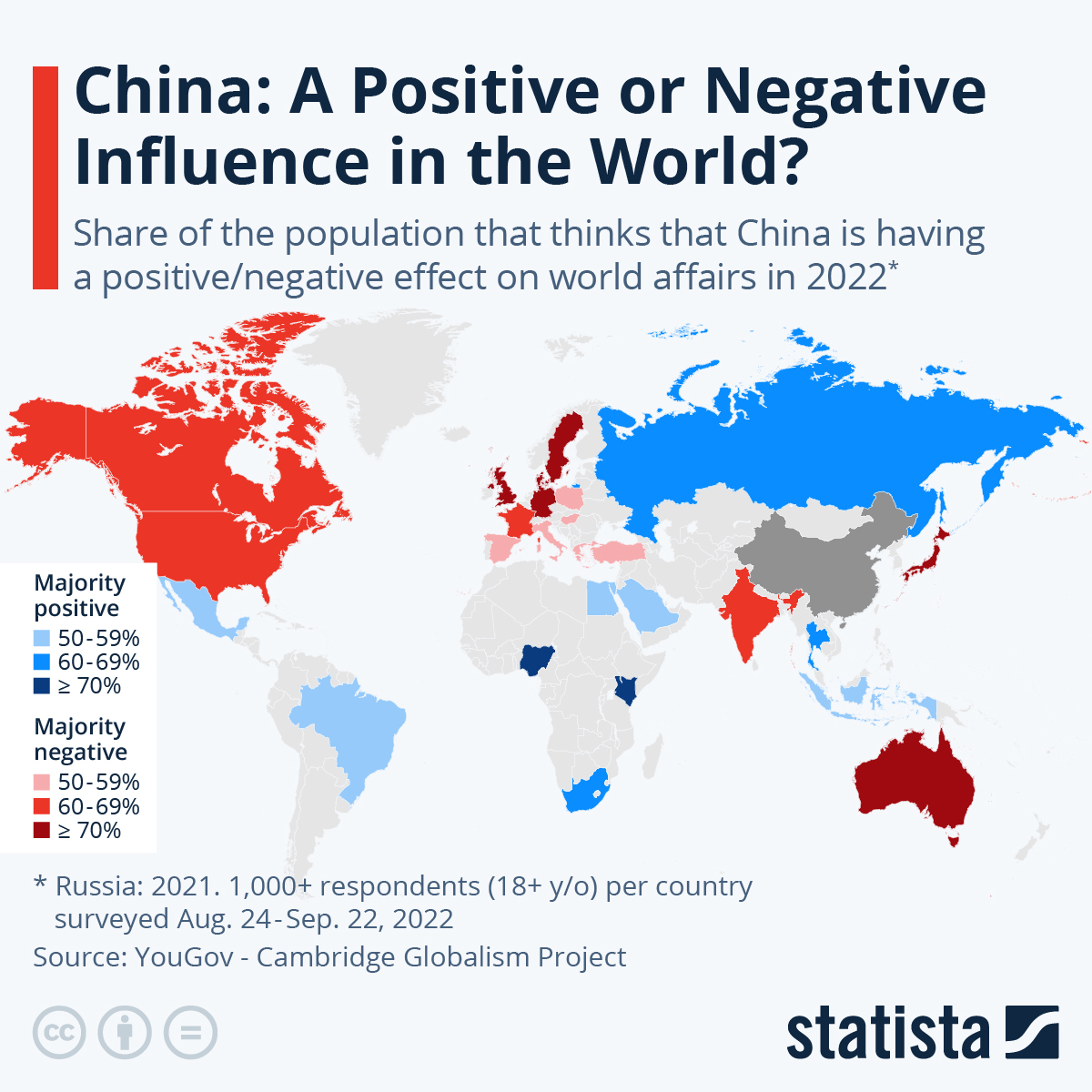
With China now having put its One Belt One Road initiative into full motion, the world is busy trying to understand whether China deserves to be looked upon as a favorable force. Statista's Katharina Buchholz reports  that out of 26 countries surveyed, negative views of China prevailed in 16. The number of countries looking unfavorably at China has increased since the poll started in 2019.

Infographic: China: A Positive or Negative Influence in the World? | Statista


The countries with the most respondents favoring China were Nigeria, Kenya, Thailand, Russia, Egypt, and Saudi Arabia. Still, views of China are broadly negative across most of the advanced economies. Roughly three-quarters of respondents in Japan, Sweden, Australia, Denmark, the United Kingdom, and Germany had a negative view of China. 

Returning to the issue of China influencing world markets by flooding the financial system with cash, this signals that China has a problem.

Unlike in America where the US banking turmoil and the economic damage from an inevitable tightening in lending may only be starting, in China, the opposite seems to be happening. In an effort to reboot the economy the Communist Party is currently easing and loan demand is surging.

The Reason For Surging Loan Demand Matter!

A recent PBOC quarterly survey of bankers released Monday showed loan demand surged to its highest level in more than a decade. While there is a deleveraging in the household sector amid housing turmoil, the actual bank lending data indicates long-term corporate loans are shooting through the roof. It could be that this suggests a resurgence of business confidence as entrepreneurs expand factories or invest in new businesses. Still, more likely at least part of the demand for corporate debt may be companies borrowing new money to refinance existing debt. 

Michael Every, a Global Strategist at Rabobank, and based out of Singapore appeared on Wealthion the other day. Around 28 minutes into the video, he takes the stand what is now happening in China is not about to pull the global economy forward.

Linked to this topic are matters relating to why someone would rush to dump dollars and view the yaun as a competitor for replacing the dollar. I contend that China has seen its best days, is overrated by many people in the West, and has seen its best days.

https://www.zerohedge.com/economics/china-floods-market-cash-mixed-data-leaves-covid-rebound-doubt

Periprosthetic Humerus Fracture Around a Shoulder Arthroplasty Stem in 81-Year-Old

 This article originally appeared on Hospital for Special Surgery's website.

Case Report

An 81-year-old man with a left shoulder hemiarthroplasty performed 12 years prior fell while gardening and sustained a left periprosthetic humeral shaft fracture. His medical history included coronary artery disease treated with cardiac stents, hyperlipidemia, hypertension, and colon cancer in remission after chemotherapy and resection.

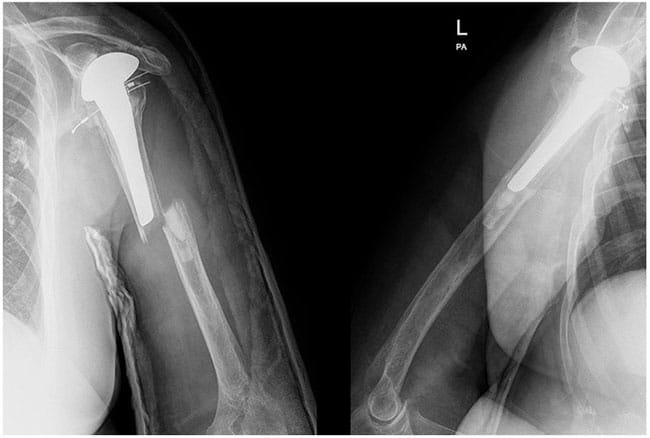
He presented 10 days after injury and was neurovascularly intact. His left shoulder had relatively poor range of motion prior to the injury, but the patient lived independently and performed all activities of daily living. Radiographs demonstrated a transverse fracture through the cement mantle of a well-fixed cemented left shoulder hemiarthroplasty (Figure 1). He was indicated for open reduction and internal fixation of the left humerus.

Figure 1. Anteroposterior and lateral images at presentation show a transverse fracture through a cemented left shoulder hemiarthroplasty performed 12 years prior.

Preoperative planning for this patient revealed difficulties commonly seen with periprosthetic humerus fractures. Standard humeral plates would allow only for unicortical screw placement in the proximal fragment due to the patient's arthroplasty stem. Unicortical screws offer inadequate rotational control, and so a periprosthetic plate with offset screw holes was selected in order to increase the likelihood of gaining adequate proximal fixation. As a backup, cerclage cables were available and a posterior approach was utilized to visualize the radial nerve and facilitate safe cable passage around the humerus if needed.

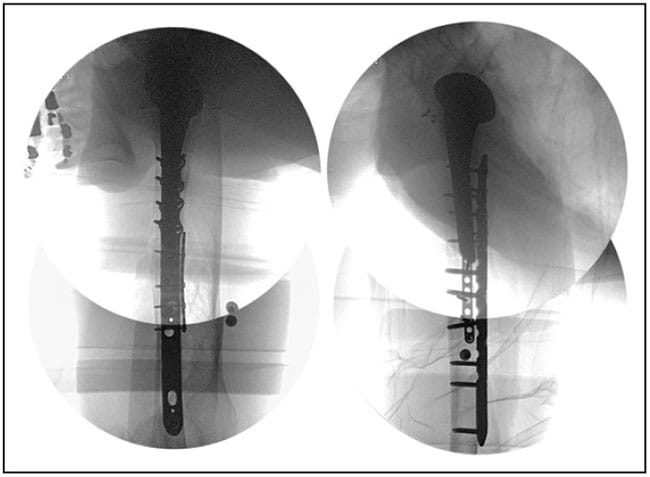
Intraoperatively, a posterior triceps splitting approach was used and the radial nerve was dissected and protected. The humeral stem was confirmed to be well fixed within the cement mantle. Next, the transverse fracture was reduced using clamps placed inside drill holes and the clamps replaced with a medial mini-fragment plate to hold the reduction. A periprosthetic plate used posteriorly allowed for placement of multiple bicortical and transcortical screws around the implant stem (Figure 2). The plate was fixed distally in standard fashion with bicortical nonlocking and locking screws.

Figure 2. Intraoperative fluoroscopy shows a dual-plate construct using mini- and large-fragment plates.

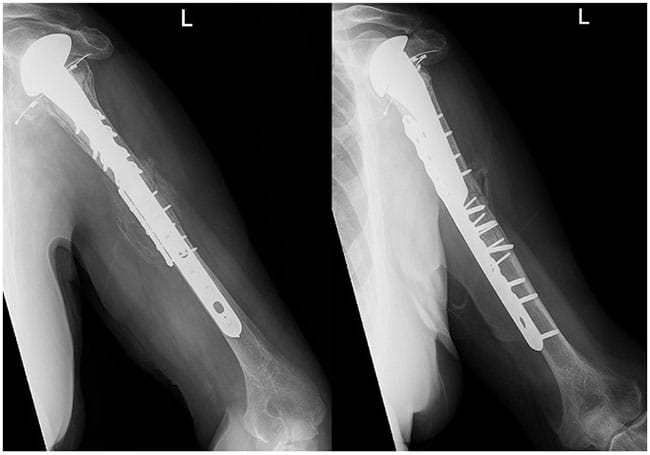
After surgery, the patient was neurovascularly intact. Physical therapy included coffee-cup weightbearing with pendulum exercises for the shoulder and active and passive range of motion of the elbow, forearm, wrist, and hand. At 6 weeks postoperatively, radiographs revealed callus formation with no evidence of hardware failure (Figure 3). The patient progressed to be weightbearing as tolerated and began active and passive range of motion of the shoulder. At final follow-up, he was able to live and function independently.

Figure 3. Radiographs at 6 weeks after surgery show callus formation.

Discussion

Postoperative periprosthetic humeral fractures with shoulder arthroplasties using a stem have a higher rate of nonunion due to preferential force transmission through the fracture site, as well as disruption to the endosteal blood supply.[1] Indications for surgical management remain controversial, and studies examining these injuries have small sample sizes and a focus on anatomic total shoulder replacements with standard-length stems.[2,3,4,5,6,7,8] Fractures proximal to or near the tip of the stem are more likely to require surgery because of increased strain due to implant stiffness and risk for implant loosening.[9] Fractures that are well distal to the tip of the stem are more amenable to nonoperative management, as these mimic non-periprosthetic fractures more closely.[10] In a series of 16 periprosthetic humerus fractures treated with surgery, nine patients were dissatisfied mostly due to loss of shoulder motion; the average time between fracture fixation and union was 278 days.[4]

In this patient, we utilized several techniques to overcome the difficulties often faced with this fracture type. A mini-fragment plate was used to hold the reduction for provisional maintenance while a definitive implant was applied, a technique that is useful for many different fracture types.[11] Next, we used a definitive plate with offset screw holes for the placement of bicortical or transcortical fixation around the humeral stem. Unicortical screws are significantly weaker in torsion than bicortical screws, and torsional forces are commonly encountered in the humeral shaft.

This technique also obviates the use of cables, which are inferior biomechanically and pose a risk to the surrounding neurovascular structures during placement.[12]

Author(s)

Aleksey Dvorzhinskiy, MD, MSc

Assistant Attending Orthopedic Surgeon, Hospital for Special Surgery; Instructor in Orthopedic Surgery, Weill Cornell Medical College; Assistant Attending Orthopedic Surgeon, NewYork-Presbyterian Hospital, New York, NY

Disclosure: Aleksey Dvorzhinskiy, MD, MSc, has disclosed the following relevant financial relationships:
Research support: Foundation for Orthopedic Trauma

William M. Ricci, MD

Chief, Orthopedic Trauma Service, Hospital for Special Surgery; Attending Surgeon, Hospital for Special Surgery, New York, NY

Disclosure: William M. Ricci, MD, has disclosed the following relevant financial relationships:
Ownership interest: HS2, LLC; McGinley Orthopaedic Innovations, LLC; Cable Fix, LLC; CrookedFoot Medical, LLC
Designer: Smith & Nephew; OsteoCentric
Royalties: MicroPort; Smith & Nephew
Consultant: Smith & Nephew
Founder: Primo MC, LLC
Editorial or governing board of medical publication or professional society: Orthopedic Trauma Association; Journal of Orthopaedic Trauma
Author, co-author, or editor: Wolters Kluwer

https://www.medscape.com/viewarticle/990491

GERD: When 'Spitting Up' Is Serious

 Justin L. Berk, MD, MPH, MBA: Welcome back to The Cribsiders. This is a video recap of our recent podcast, Stomachs in (re)Flux: Pediatric Gastroesophageal Reflux Disease.

Christopher J. Chiu, MD: We talked about pediatric gastroesophageal reflux disease (GERD) with Dr Carlo Di Lorenzo of Nationwide Children's Hospital in Columbus, Ohio, at the recent American Association of Pediatrics Experience National Conference and Exhibition.

Berk: Can we start with the right nomenclature for reflux in children?

Chiu: The word reflux on its own refers to gastroesophageal reflux. We are most worried about reflux when it becomes a disease. How do we decide whether it's a disease? We look at the child's symptoms. Are the symptoms bothersome? By that, we mean behaviors such as excessive crying and irritability that are worse than the child's baseline behavior. Then we start thinking that this is a disease that must be treated. In contrast, ordinary spitting up isn't considered a disease. It doesn't typically irritate the child, although it might irritate the parents.

Berk: What symptoms suggest that this is GERD? What are the red flags?

Chiu: Vomiting blood or coffee ground emesis, delayed symptom onset (symptoms arising after a couple of asymptomatic months), or symptoms that last longer than 12 months of age are red flags, and you should think about referring the child to pediatric gastroenterology.

Berk: Let's say we have a patient with reflux who is not gaining weight appropriately and seems irritable and colicky. We suspect GERD. When do we consider treating GERD?

Chiu: Before we start thinking about medicines, we should think about dietary changes. The evidence and the guidelines indicate that diet is the first-line management of GERD. Thickened feeds should be tried before medication is prescribed. Dr Di Lorenzo uses 1 tsp of rice or oat cereal per 1 oz of formula or breast milk. He noted that some people recommend adding 1 tbsp of cereal per 1 oz, but he feels that makes it too thick for the child to ingest. He mentioned a product called Gelmix, which seems to work a little better than rice cereal.

Berk: Let's say we aren't seeing improvement with thickened feedings. What's next?

Chiu: There is one more dietary change to try. Feeding a partially hydrolyzed formula might be the next step because it can be difficult to tell whether the child's symptoms are caused by GERD or a dietary protein allergy. By changing to a partially hydrolyzed formula, you might be able to get some improvement of the symptoms, suggesting that it's a dietary protein allergy. A protein allergy can cause inflammation, so it may take several weeks for that symptom to resolve. Dr Di Lorenzo recommends trying this before starting a medicine for reflux.

Berk: That makes a lot of sense. Give it a try and see if the inflammation calms down. But let's say we're ready to pull the trigger and consider some acid suppression. What should we reach for?

Chiu: If you have tried dietary changes without improvement, you might think about referring to a pediatric gastroenterologist at this point. It may depend on where you're located. If it's easy to get to a specialist, you should consider sending the patient there before starting medications.

But if you want to take a couple of months to try to get the patient feeling better, you can consider acid suppression medication. Dr Di Lorenzo said that he used to use ranitidine, but it's no longer available. So now, he uses famotidine because it's a liquid formulation and easy to take. He prescribes 0.5 mg/kg given twice daily. If he wants to prescribe something stronger, he'll use a protein pump inhibitor which is useful for short term management of GERD. It's dosed once daily and given 30-60 minutes before a meal.

Berk: What are the other take-home points from this episode?

Chiu: If you've already started the child on a medication, but the child hasn't improved by age 12 months or the child has late-onset GERD, consider sending them to a pediatric gastroenterologist. This specialist may perform an esophagogastroduodenoscopy or impedance testing and evaluate the patient for treatments such as Nissen fundoplication.

Other main take-home points:

  • First-line treatment for reflux is thickened feedings.

  • Feeding a partially hydrolyzed formula should be tried before starting medication.

  • Spitting up isn't always GERD. We may need to counsel parents about reasonable expectations.