Search This Blog

Tuesday, August 8, 2023

'Facebook's spread not linked to psychological harm, study finds'

 There is no evidence the global spread of Facebook is linked to widespread psychological harm, an Oxford Internet Institute (OII) study suggests.

The research looked at how wellbeing changed in 72 countries as use of the social media platform grew.

It counters the common belief that social media is psychologically harmful, the researchers argue.

Several countries, including the UK, are considering legislation to protect social media users from online harms.


Meta, which owns Facebook, has faced scrutiny following testimony from whistle-blowers and press reports based on leaks that suggested the company's own research pointed to negative impacts on some users.

This research only looked at Facebook and not Meta's other platforms, which include Instagram.

Prof Andrew Przybylski, of the OII, told the BBC the study tried to answer the question: "As countries become more saturated with social media, how does the wellbeing of their populations look?"

He said: "It's commonly thought that this is a bad thing for wellbeing. And the data that we put together, and the data that we analysed didn't show that that was the case."

Previous OII work carried out by Prof Przybylski also found little association between teenagers' technology use and mental health problems.

But the report only looked at the overall impact of Facebook use at a national level. The broad-brush findings would not reveal the impact of Facebook use on groups of people with particular vulnerabilities.

It might, for example, miss negative impacts on small groups of users if they were offset by positive impacts on others, Prof Przybylski accepted.

It also did not drill down to examine the risks presented by certain types of content, such as material promoting self-harm.

For Prof Przybylski, the main policy lesson from the study was that researchers needed access to better data from tech firms to answer questions about the effect of social media:

"You know, we have a situation where a handful of people are crying wolf, about social media. But we don't actually have the data, we don't have the materials we need to build a wolf detector," he said.

The UK's Online Safety Bill (OSB) is in the final stages of its parliamentary journey towards becoming law. It is designed to protect people from online harms.

But Prof Sonia Livingstone, of the London School of Economics, cautioned that the study's relevance to the OSB was limited.

"The authors' broad critique - that screen-time anxieties are not much supported by robust evidence - is fair. However, the study reported here is so general as to be of little use to current regulatory or clinical debates," she told the BBC.

And while the OSB prioritises protecting children - the research does not look at youngsters as a separate group and "by and large children are not using Facebook".

"This reminds me of a conference I went to that asked, 'what difference did half a century of television make?'. How can there be one answer?" she said.

But she supported the authors' call for more research based on access to data.

The peer-reviewed research by Prof Przybylski and co-author Matti Vuorre is based on a large amount of data provided by Facebook. Both researchers are independent of the company and the research was not funded by the tech giant.

Facebook gave the researchers data showing how the number of users in each country grew between 2008 and 2019 divided into two age brackets, 13-34 and over 35.

The OII team compared this data with some on wellbeing representing nearly a million people, recorded by the Gallup World Poll Survey.

Overall the researchers say they found no evidence that increasing social media adoption was linked to a negative affect on psychological wellbeing.

Prof Peter Etchells, professor of psychology and science communication at Bath Spa University, said the "broad strokes" study was fascinating.

But he said - as the authors make clear - it did not say anything about cause and effect. However, it showed the value of the technology companies opening their doors to researchers, he noted.


https://www.bbc.com/news/technology-66424770

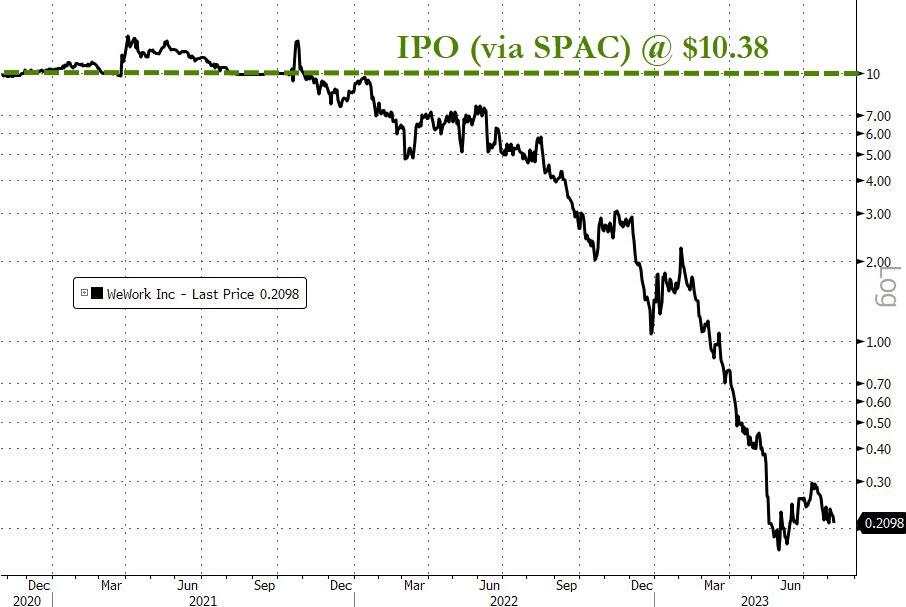
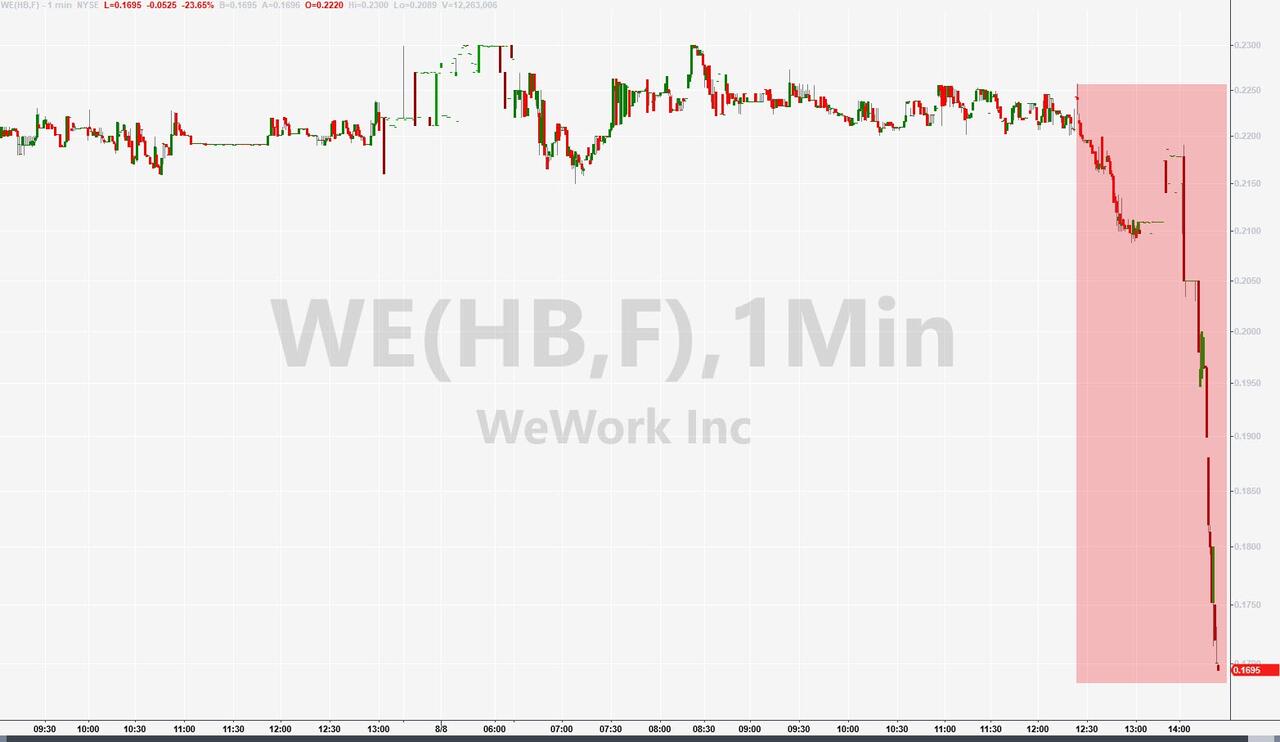
WeWork Shares Collapse After Company Warns "Substantial Doubt" Exists About Staying In Business

 It all started off positively as WeWork reported revenue for the second quarter that almost met the average analyst estimate (Revenue $844 million, +3.6% YoY, estimate $851 million).

“In a difficult operating environment, we have delivered solid year-over-year revenue growth and dramatic profitability improvements,” David Tolley, Interim Chief Executive Officer, commented.

“Excess supply in commercial real estate, increasing competition in flexible space and macroeconomic volatility drove higher member churn and softer demand than we anticipated, resulting in a slight decline in memberships.

But then things started to go downhill...

Against expectations of a $2.68mm profit, the co-working company suffered an adjusted-EBITDA loss of $36mm.

The net loss was $397mm and cash levels are at $205mm (down 67% YoY).

And then it went off the cliff...

Later in the filing, the company added,

...as a result of the Company’s losses and projected cash needs, combined with increased member churn and current liquidity levels, substantial doubt exists about the Company’s ability to continue as a going concern.

The Company’s ability to continue as a going concern is contingent upon successful execution of management’s plan to improve liquidity and profitability over the next 12 months, which includes, without limitation:

  • Reducing rent and tenancy costs via restructuring actions and negotiation of more favorable lease terms;

  • Increasing revenue by reducing member churn and increasing new sales;

  • Controlling expenses and limiting capital expenditures; and

  • Seeking additional capital via issuance of debt or equity securities or asset sales.

“We are confident in our ability to meet the evolving workplace needs of businesses of all sizes across sectors and geographies, and our long term company vision remains unchanged,” continued Tolley.

“Although we have more work to do, the talent and energy of the WeWork team is extraordinary and we are resolutely focused on delivering for our members for the long term. The company’s transformation continues at pace, with a laser focus on member retention and growth, doubling down on our real estate portfolio optimization efforts, and maintaining a disciplined approach to reducing operating costs.”

Well, the market is not "confident" as WeWork plunged another 25% after hours...

Do you believe in miracles?

Meme-stock mania time?

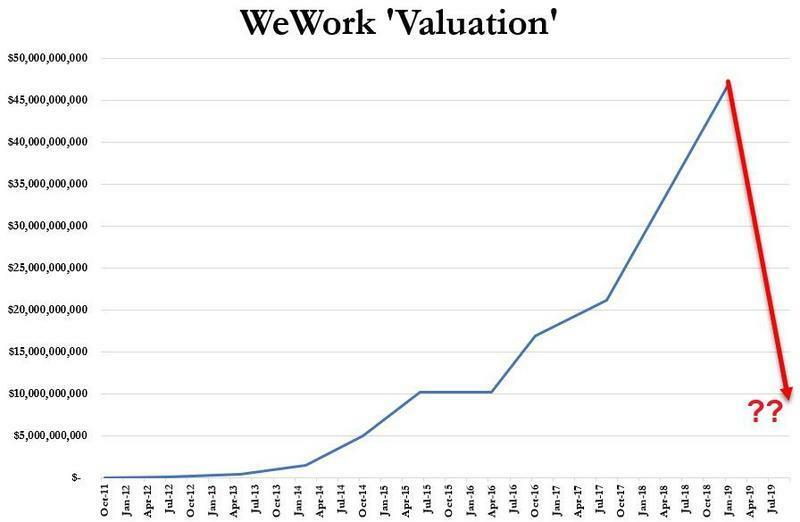
As a reminder, WeWork was 'valued' at $47 billion at its peak (when still private before the first failed IPO effort).

After tonight's 35% loss, WeWork is now valued at around $290 million (with an 'm').

UPS-Teamsters deal dents financials

 United Parcel Service (UPS) cut its financial outlook for the year amid negotiations with the Teamsters union to avoid a strike, the logistics company said on Tuesday. 

UPS reached a tentative, $30 billion, agreement with the International Brotherhood of Teamsters on July 25, 2023 to avoid a work stoppage, with the union voting to ratify the new agreement. Electronic voting began on Aug. 3, and will conclude on Aug. 22.

TickerSecurityLastChangeChange %
UPSUNITED PARCEL SERVICE INC.180.57-1.56-0.86%

UPS now predicts annual consolidated revenue at around $93 billion and adjusted operating margin of roughly 11.8%. Below the previous guidance of $97 billion and 12.8%.

The guidance change reflects "the volume impact from labor negotiations and the costs associated with the tentative agreement", UPS said.

In June, 97% of the UPS Teamsters union’s 340,000 members voted to authorize a strike for better pay and working conditions, including air conditioning in new models of the company’s brown delivery trucks.

Meanwhile, the delivery company also posted a 10.9% drop to $22.1 billion in consolidated revenue for the second quarter.

"UPS is stronger than ever. Looking ahead, we will stay on strategy to capture growth in the most attractive parts of the market and make our global integrated network even more efficient" UPS chief executive Carol Tomé said despite the revenue decrease. 

Tomé also thanked UPS customers for remaining with the company throughout the labor negotiations.

UPS consolidated operating profits for the second quarter reached $2.8 billion, down 21.4% compared to the second quarter of 2022, and down 18.4% on an adjusted basis. 

Diluted earnings per share peaked at $2.42, 22.8% below the year $2.54 from the year-ago period.  

https://www.foxbusiness.com/markets/ups-teamsters-deal-dents-financials

Hims & Hers plans to launch weight loss business by year-end

 Hims & Hers saw its top line jump 83% in the second quarter, driven by strong growth of its online health and wellness business.

The company, which went public two years ago and sells hair loss and sexual health products, boosted the lower end of its revenue guidance by $20 million to between $830 million and $850 million for the year and also announced it was jumping into the booming weight loss market.

The company had been slower to enter the weight management space compared to its peers. The offering has been in research and development for over a year, Andrew Dudum, CEO and co-founder of Hims & Hers, said during the company's second-quarter earnings call Monday.

"Our weight management category will leverage all of the strengths of our platform. This means access to personalized treatments customized for customers' clinical needs, powered by our enhanced pharmacy capabilities," he told investors during the call.

The weight management offering will include access to treatment formulations that are affordable, he noted, and that can combine and leverage the active ingredients in proven prescription medications and supplements as well as behavioral and nutritional-focused plans.

While the business is being built to support both existing GLP-1s and future medications, these products likely will not be available at launch given the instability of the current supply chain, Dudum said.

"I think what we're going to start with is a wide range of likely generic options and personalized treatments that are going after some of the underlying factors of weight gain. So this could be metabolic resistance, hormonal issues, could be underlying mental health concerns such as depression or unhealthy eating habits," he told investors during a Q&A after his prepared remarks.

The multispecialty telehealth platform connects consumers to medical care for numerous conditions related to mental health, sexual health, dermatology and primary care and brought in revenue of $208 million in the second quarter of 2023, up from $113 million a year ago, according to its second-quarter financial results.

Online revenue increased 87% year over year to $201 million in the second quarter, driven by strong subscriber growth. The number of subscribers on the platform increased 74% year over year to 1.3 million subscribers,

Hims & Hers also narrowed its losses in the second quarter to a loss of $7.2 million, or a loss of 3 cents a share, compared with a loss of $19.7 million, or 10 cents a share, in the same period a year ago.

Hims & Hers' top and bottom lines beat Wall Street analysts' estimates for the quarter.

The company's shares rallied nearly 13% in the aftermarket Monday, according to MarketWatch.

The company posted another EBITDA-adjusted profitable quarter, bringing in $10.6 million compared to a loss of $7.5 million a year ago.

Hims & Hers sells prescription and over-the-counter drugs online as well as personal care products. Its core products include solutions for men for dermatology issues, hair loss and sexual health. The company's women’s health business, called Hers, focuses on birth control, sexual health and skin and hair care products.

The second quarter marked a significant turning point for Hims & Hers, Dudum said, as the company evolves from being an access-oriented company toward offering personalized treatments for consumers.

"From the earliest years, Hims & Hers delivered on in its simplest form access. Access to a provider, access to clinically appropriate generic treatment and access to solutions for singular issue that patients were challenged with," Dudum told investors. "Today, that story has become wildly more exciting as initiatives have been in development for years are beginning to come to the market. Our story is no longer one of simple access, but a story of bolstered capabilities in diagnostics, treatment and care that we believe can deliver truly better outcomes."

The company also is focused on developing what Dudum referred to as "multi-action capabilities" to enable providers to customize single-pill treatments for multicategory conditions. 

To this end, last week, Hims & Hers took its first step into cardiovascular health with the launch of Heart Health by Hims. The offering enables providers to personalize a treatment that combines ingredients found in clinically proven ED medications and statins, according to the company.

The company is partnering with Labcorp to offer lab-based heart health testing. Lab results will then be integrated directly into the Hims & Hers proprietary electronic medical record, enabling providers to further personalize care, executives said.

Hims & Hers also is building its analytics and artificial intelligence capabilities to leverage data to support precision treatments and plans to trademark an AI tool called MedMatch, Dudum told investors. That technology helps predict diagnoses and appropriate treatment to help providers make more informed and clinically appropriate decisions, he noted.

The company's growth has helped it reduce prices for some products and services, Dudum said. This pricing rollout will make personalized subscriptions even more mass-market accessible, he said.

At the end of the second quarter, over 20% of total subscribers were on a personalized solution, Yemi Okupe, chief financial officer, said during the second-quarter earnings call.

"This is a clear signal that consumers are drawn to and appreciate personalized solutions that our providers can prescribe. We believe offering unique solutions at attractive price points is a powerful combination that positions us for significant market share gains," he said.

Hims & Hers raised its full-year 2023 revenue guidance to a range of between $830 million and $850 million and adjusted EBITDA guidance to a range of $35 million to $40 million.

For the third quarter, the company projects revenue between $217 million and $222 million and adjusted EBITDA of $10 million to $13 million.

https://www.fiercehealthcare.com/health-tech/hims-hers-plans-launch-weight-loss-business-year-revenue-jumps-83-q2

UAW Contract Demands Would Add $80 Billion to US Automaker Costs

  • Internal calculations see labor costs rising to $150 an hour
  • UAW President Fain has called automakers’ demands ‘an insult’


New contract demands made by the United Auto Workers union would add more than $80 billion to each of the biggest US automakers’ labor costs, according to people familiar with the companies’ estimates.

That large an increase to labor costs over the contract’s four-year term could wipe out profits and threaten the carmakers’ futures, according to the people, who asked not to be named because the analysis has not been made public.

It would increase hourly labor costs to more than $150 per hour at Ford Motor Co. and General Motors Co., including wages and benefits, up from the $64 an hour GM, Ford and Stellantis NV workers make currently, the people said.

The calculation is based on the UAW’s request for a 46% wage increase, restoration of traditional pensions, cost-of-living increases, reducing the work week to 32 hours from 40 and increasing retiree benefits, according to the people.

A UAW spokesperson declined to comment on the cost estimates but referred to Fain’s previous statement that “record profits mean record contracts.”

The biggest US automakers are mired in tense contract negotiations with their largest union. UAW President Shawn Fain has declared “war” on the corporations and warned the union’s demands would be “the most audacious list of proposals they have seen in decades.” The union’s current contract with all of the Detroit legacy automakers expires Sept. 14.

Fain contends the roughly 150,000 UAW-represented workers at GM, Ford and Stellantis are due a payback for helping the companies recover from the Great Recession a decade ago, which set them up for record profits. The carmakers have pushed back on many of the demands.

The current $64 per hour labor costs at Ford, GM and Stellantis are already higher than the $55 per hour cost at non-union US assembly plants of Asian and European automakers, an estimated labor cost gap of about $900 million, according to people familiar with Ford’s costs. Labor costs at EV leader Tesla Inc. are even lower, at $45 an hour to $50 an hour, the people said.

Ford Chief Executive Officer Jim Farley last month noted that the company has added thousands of union jobs and is spending $1 billion to upgrade working conditions at plants. He argued that spending some amount more on labor would pay off in the market place.

“For us, this is not simply a number crunching exercise,” Farley told analysts during the automaker’s second quarter earnings call. “We believe over time customers will appreciate and reward our approach and our workforce will be more committed.”

Stellantis hasn’t yet finished calculating the cost of the union’s demands, a spokeswoman said. A GM spokesman declined to comment.

‘A Slap in the Face’

The negotiations come as US automakers are pouring tens of billions into designing and building EVs, while trying boost profits on conventional gas-fuel vehicles to pay for it. Fain has accused them of engaging in a “race to the bottom” in the transition to electric vehicles, with factories that will employ fewer workers making lower wages.

On Tuesday, Fain lashed out against Stellantis for its starting proposal in labor negotiations, calling it a “slap in the face” during a livestream on Facebook and accusing the owner of the Jeep and Ram brands of lying to its workers about how aggressive its asks are. Stellantis didn’t respond to a request for comment about Fain’s speech.

The Amsterdam-based automaker is proposing to cut existing medical coverage, create additional wage tiers, eliminate caps on the use of lower-paid temporary workers and change the profit-sharing formula, Fain alleged. He also claimed Stellantis has not offered to build any new product at its assembly plant in Belvidere, Illinois, which has been idled since February, laying off about 1,350 workers.

The company has said it isn’t pursuing concessions, but “I want to tell you, UAW family, that just isn’t true,” Fain said during the Facebook Live stream.

“Stellantis’ proposals are a slap in the face,” Fain said. “They’re an insult to our members’ work over the past four years.” He then threw the proposal from Stellantis into a trash bin.

https://www.bloomberg.com/news/articles/2023-08-08/uaw-contract-demands-would-add-80-billion-to-us-automaker-costs