Search This Blog

Monday, September 18, 2023

Kinnate Pipeline Updates, Strategic Reprioritization


  • Promising exarafenib combination data in NRAS mutant melanoma; intend to select two doses in the fourth quarter of 2023 for further development

  • Plan to file KIN-8741 c-MET inhibitor Investigational New Drug application and nominate a drug candidate for brain-penetrant CDK4 selective program in the fourth quarter of 2023

  • Completed exarafenib monotherapy dose expansion enrollment and cleared efficacious dose for KIN-3248, FGFR inhibitor; exploring strategic alternatives for both programs

  • Paused KIN-7136 MEK inhibitor development and implementing a workforce restructuring, aligned with reprioritization plan

  • Cash, cash equivalents and investments of $204.3 million as of June 30, 2023, anticipated to fund operations into at least the second quarter of 2026

Rand Paul Leads Letter for Info on CIA Whistleblower Allegations on COVID Origins Investigation

 U.S. Senators Rand Paul (R-KY), Lindsey Graham (R-SC), Ron Johnson (R-WI) and Rick Scott (R-FL), sent a letter to the Director of the Central Intelligence Agency (CIA), William J. Burns, requesting information on the recent whistleblower allegations related to the CIA’s investigation into the origins of COVID-19.

According to a letter from the House Select Subcommittee on the Coronavirus Pandemic (Select Subcommittee) and House Permanent Select Committee on Intelligence (HPSCI), a recent whistleblower testimony made by a senior-level CIA Officer contends that the Agency paid off six analysts that determined COVID-19 likely originated from a lab leak. The letter states that the CIA assigned seven officers with significant scientific expertise to a COVID Discovery Team. After their review, six of the seven members believed the intelligence and science available were sufficient to make a low confidence assessment that COVID-19 originated from a laboratory in Wuhan, China. The letter asserts that the six members were given a significant monetary incentive to change their position, leading to the CIA’s public determination of uncertainty on COVID-19 origins.

“These allegations are deeply concerning and raise serious questions about the Agency’s investigation into the origins of the COVID-19 pandemic,” the Senators wrote. “For this reason, we request you provide our offices with the following information no later than September 25, 2023.” 

The Senators requested the following information in response to their letter:

    1. All documents and communications regarding the establishment of all iterations of the COVID Discovery Team(s);
    2. All documents and communications between or among the members of all iterations of the COVID Discovery Team(s) regarding the origins of COVID-19;
    3. All documents and communications between or among members of all iterations of the COVID Discovery Team(s) and other employees or contractors of the Agency regarding the origins of COVID-19;
    4. All documents and communications between or among members of all iterations of the COVID Discovery Team(s) and employees or contractors of other federal government agencies, including but not limited to the U.S. Department of State, the Federal Bureau of Investigation, the U.S. Department of Health and Human Services (to include the National Institutes of Health and the National Institute of Allergy and Infectious Diseases), and the U.S. Department of Energy regarding the origins of COVID-19; and
    5. All documents and communications regarding the pay history, to include the awarding of any type of financial or performance-based incentive/financial bonus to members of all iterations of the COVID Discovery Team(s).      

The full text of this letter is available HERE.

https://www.paul.senate.gov/dr-rand-paul-leads-letter-requesting-information-on-cia-whistleblower-allegations-concerning-covid-19-origins-investigation/

Ligand Spins Out and Merges Pelican Subsidiary with Primordial Genetics to Form Primrose Bio

 Ligand retains all Pelican commercial royalties and will own 49.9% of Primrose Bio, Inc. as a stand-alone private company with leading technologies in synthetic biology

Ligand contributes $15 million in exchange for economic interest in select Primrose programs

Ligand improves cash expense outlook and raises EPS guidance

Ligand Pharmaceuticals Incorporated (NASDAQ: LGND) ("Ligand," the "Company" or "we") announced that it has entered into a merger agreement, pursuant to which its subsidiary, Pelican Technology Holdings, Inc., ("Pelican") has become a wholly owned subsidiary of Primrose Bio, Inc. ("Primrose Bio", formerly known as Primordial Genetics, Inc.). Primrose Bio is a stand-alone private company focused on synthetic biology. As part of the transaction, Ligand retains the existing commercial royalties related to the Pelican Expression Technology® and will own 49.9% of Primrose Bio. Simultaneous with the merger, Ligand entered into a Purchase and Sale Agreement with Primrose Bio and contributed $15 million in exchange for a portion of the economic rights from two contracts previously entered into by Primordial Genetics and an economic interest in potential future revenues generated from PeliCRM197®.

Primrose Bio combines the Primordial Genetics’ Function Generator™ and Ligand’s Pelican Expression Technology® platform (formerly known as Pfenex Expression Technology®) to create a revolutionary way of enhancing biological productivity to enable the next generation of therapeutics. Function Generator is designed to systematically generate tens of millions of novel genes in an ultra-high-throughput fashion, to enable the discovery of enzymes and microbes with improved function. The Pelican Expression Technology is a robust and scalable production platform used in five approved medicines that is especially well-suited for large-scale protein production of complex proteins. These proprietary technologies have been leveraged to create Prima RNApols™ and PeliCRM197, two manufacturing and formulation solutions licensed to biopharma companies to develop mRNA therapeutics and conjugate vaccines, respectively.

Autoimmune diseases: Protein discovered as potential new target for therapies

 Autoimmune diseases are complex illnesses, the causes of which are diverse and have not yet been fully explained. A research team at MedUni Vienna has now discovered an immunoregulatory protein that could be linked to the development of autoimmune diseases such as rheumatoid arthritis. The identified component of the immune system is called "Rinl," which could provide a new target for the development of immunomodulatory therapies. The study results were recently published in the Journal of Experimental Medicine.

In the course of their research, the team led by Nicole and Ruth Herbst (Centre for Pathophysiology, Infectiology and Immunology at MedUni Vienna) found particularly high levels of Rinl in special immune cells, the T cells. Rinl, like its siblings Rin 1-3, is a member of the Ras interaction protein (Rin) family and is a comparatively young object of research. While a deficiency or excess of Rin 1-3 proteins has already been linked in recent years in international studies, for example, to cancer, Alzheimer's disease or the spinal disease scoliosis, Rinl has so far been little researched.

Mechanism in the immune system deciphered

The function of this protein in the immune system has been clarified by the scientific team as part of the current study. "By analysing mouse models and cultures of human T cells, we have discovered that Rinl controls the development of follicular T helper cells, the Tfh," say study leaders Nicole Boucheron and Ruth Herbst. Tfh are a subset of T cells and support the maturation of other essential components of the immune system, the B cells. Mature B cells, in turn, produce highly effective antibodies and thus play a major role in the body's immune response: in vaccinations, a large amount of such antibodies is desired, but in autoimmune diseases such as rheumatoid arthritis (RA), they turn against the body's own body and damage it. "Our study reveals the previously unknown mechanism of how Rinl controls the development of Tfh cells in various immunological reactions, such as during a viral infection or during a vaccination," explains first author Lisa Sandner.

As the researchers' investigations of patient data from public databases also showed, there is a low concentration of Rinl proteins in the T cells of rheumatoid arthritis (RA). Based on these results, the protein may represent a new target for the development of immunomodulatory therapies for RA: "Pharmacotherapies that control Rinl and Rinl-dependent signalling pathways could help alleviate the symptoms of RA," Nicole Boucheron looks to the future. Conversely, interventions that inhibit Rinl could be used in immunodeficiency to help the body fight disease. Further research should confirm the results and show whether the Rinl protein can also open up new therapy options for other diseases that are associated with a disturbed immune response, particularly in the regulation of Tfh cells.

Journal Reference:

  1. Lisa Sandner, Marlis Alteneder, Ramona Rica, Barbara Woller, Eleonora Sala, Tobias Frey, Anela Tosevska, Ci Zhu, Moritz Madern, Matarr Khan, Pol Hoffmann, Alexandra Schebesta, Ichiro Taniuchi, Michael Bonelli, Klaus Schmetterer, Matteo Iannacone, Mirela Kuka, Wilfried Ellmeier, Shinya Sakaguchi, Ruth Herbst, Nicole Boucheron. The guanine nucleotide exchange factor Rin-like controls Tfh cell differentiation via CD28 signalingJournal of Experimental Medicine, 2023; 220 (11) DOI: 10.1084/jem.20221466

Surprising origin of C. diff

 Hospital staff spend a significant amount of time working to protect patients from acquiring infections while they are being cared for in the hospital. They employ various methods from hand hygiene to isolation rooms to rigorous environmental sanitation. Despite these efforts, hospital-onset infections still occur -- the most common of which is caused by the bacterium Clostridioides difficile, or C. diff, the culprit of almost half a million infections in the U.S. each year.

Surprising findings from a new study in Nature Medicine suggest that the burden of C. diff infection may be less a matter of hospital transmission and more a result of characteristics associated with the patients themselves.

The study team, led by Evan Snitkin, Ph.D. and Vincent Young, M.D., Ph.D., both members of the Departments of Microbiology & Immunology and Internal Medicine/Infectious Diseases at University of Michigan Medical School and Mary Hayden, M.D. of Rush University Medical Center, leveraged ongoing epidemiological studies focused on hospital-acquired infections that enabled them to analyze daily fecal samples from every patient within the intensive care unit at Rush University Medical Center over a nine-month period.

Arianna Miles-Jay, a postdoctoral fellow in Dr. Snitkin's lab, analyzed the over 1,100 patients in the study, and found that a little over 9% were colonized with C. diff. Using whole genome sequencing at U-M of 425 C. difficile strains isolated from nearly 4000 fecal specimens, she compared the strains to each other to analyze spread.

"By systematically culturing every patient, we thought we could understand how transmission was happening. The surprise was that, based on the genomics, there was very little transmission."

Essentially, there was very little evidence that the strains of C. diff from one patient to the next were the same, which would imply in-hospital acquisition. In fact, there were only six genomically supported transmissions over the study period. Instead, people who were already colonized were at greater risk of transitioning to infection.

"Something happened to these patients that we still don't understand to trigger the transition from C. diff hanging out in the gut to the organism causing diarrhea and the other complications resulting from infection," said Snitkin.

Hayden notes this doesn't mean hospital infection prevention measures are not needed. In fact, the measures in place in the Rush ICU at the time of the study -- high rates of compliance with hand hygiene among healthcare personnel, routine environmental disinfection with an agent active against C diff, and single patient rooms -- were likely responsible for the low transmission rate. The current study highlights, though that more steps are needed to identify patients who are colonized and try to prevent infection in them.

Where did the C. diff come from? "They are sort of all around us," said Young. "C. diff creates spores, which are quite resistant to environmental stresses including exposure to oxygen and dehydration…for example, they are impervious to alcohol-based hand sanitizer."

However, only about 5% of the population outside of a healthcare setting has C. diff in their gut -- where it typically causes no issues.

"We need to figure out ways to prevent patients from developing an infection when we give them tube feedings, antibiotics, proton pump inhibitors -- all things which predispose people to getting an actual infection with C. diff that causes damage to the intestines or worse," said Young.

The team next hopes to build on work investigating the use of A.I. models to predict patients at risk of C. diff infection to identify patients who are likely to be colonized and who could benefit from more focused intervention.

Said Snitkin, "A lot of resources are put into gaining further improvements in preventing the spread of infections, when there is increasing support to redirect some of these resources to optimize the use of antibiotics and identify other triggers that lead patients harboring C diff and other healthcare pathogens to develop serious infections."

Additional authors include Arianna Miles-Jay, Michael Y. Lin, Teppei Shimasaki, Michael Schoeny, Christine Fukuda, Thelma Dangana, Nicholas Moore, Sarah E. Sansom, Rachel D. Yelin, Pamela Bell, Krishna Rao, Micah Keidan, Alexandra Standke, and Christine Bassis.

Journal Reference:

  1. Arianna Miles-Jay, Evan S. Snitkin, Michael Y. Lin, Teppei Shimasaki, Michael Schoeny, Christine Fukuda, Thelma Dangana, Nicholas Moore, Sarah E. Sansom, Rachel D. Yelin, Pamela Bell, Krishna Rao, Micah Keidan, Alexandra Standke, Christine Bassis, Mary K. Hayden, Vincent B. Young. Longitudinal genomic surveillance of carriage and transmission of Clostridioides difficile in an intensive care unitNature Medicine, 2023; DOI: 10.1038/s41591-023-02549-4

US national debt tracker: See how much the government obligations cost

 The U.S. national debt exceeded $33 trillion for the first time ever on Monday, crossing a critical milestone at a time when government spending is already under scrutiny.

The national debt — which measures what the U.S. owes its creditors — surged to roughly $33.04 trillion as of Monday afternoon, according to the latest numbers published by the Treasury Department. By comparison, just four decades ago, the national debt hovered around $907 billion.

"The United States has hit a new milestone that no one will be proud of: our gross national debt just surpassed $33 trillion," said Maya MacGuineas, the president of CRFB. "Debt held by the public, meanwhile, recently surpassed $26 trillion. We are becoming numb to these huge numbers, but it doesn’t make them any less dangerous."

The unrelenting increase is what prompted Fitch Ratings to issue a surprise downgrade of the nation's long-term credit score in early August. The agency cut the U.S. debt by one notch, snatching away its pristine AAA rating in exchange for an AA+ grade. In making the decision, Fitch cited alarm over the country's deteriorating finances and expressed concerns over the government's ability to address the ballooning debt burden amid sharp political divisions. 

"This is a warning shot across the U.S. government's bow that it needs to right its fiscal ship," Sean Snaith, an economist at the University of Central Florida, told FOX Business. "You can't just spend trillions of dollars more than you have in revenue every year and expect no ill consequences."

The outlook for the federal debt level is bleak, with economists increasingly sounding the alarm over the torrid pace of spending by Congress and the White House

placeholder

The latest findings from the Congressional Budget Office indicate that the national debt will nearly double in size over the next three decades. At the end of 2022, the national debt grew to about 97% of gross domestic product. Under current law, that figure is expected to skyrocket to 181% at the end of 2053 — a debt burden that will far exceed any previous level. 

Should that debt materialize, it could risk America's economic standing in the world.

"America’s fiscal outlook is more dangerous and daunting than ever, threatening our economy and the next generation," said Michael Peterson, the CEO of the Peter G. Peterson Foundation that advocates for reducing the federal deficit. "This is not the future any of us want, and it’s no way to run a great nation like ours."

The spike in the national debt comes after a burst of spending by President Biden and Democratic lawmakers. As of September 2022, Biden had already approved roughly $4.8 trillion in borrowing, including $1.85 trillion for a COVID relief measure dubbed the American Rescue Plan and $370 billion for the bipartisan infrastructure bill, according to the Committee for a Responsible Federal Budget (CRFB), a group that advocates for reducing the deficit.

While that is about half of the $7.5 trillion that former President Donald Trump added to the deficit while he was in office, it's far more than the $2.5 trillion Trump had approved at that same point during his term. 

Biden has repeatedly defended the spending by his administration and boasted about cutting the deficit by $1.7 trillion. 

"I might note parenthetically: In my first two years, I reduced the debt by $1.7 trillion. No President has ever done that," Biden said recently. 

However, that figure refers to a reduction in the national deficit between fiscal years 2020 and 2022; while the deficit did shrink during that time period, that is largely because emergency measures put into place during the COVID-19 pandemic expired.

The White House did not immediately respond to a FOX Business request for comment.

Even more worrisome is that the spike in interest rates over the past year and a half has made the cost of servicing the national debt more expensive.

That is because as interest rates rise, the federal government's borrowing costs on its debt will also increase. In fact, interest payments on the national debt are projected to be the fastest-growing part of the federal budget over the next three decades, according to the CRFB.

Payments are expected to triple from nearly $475 billion in fiscal year 2022 to a stunning $1.4 trillion in 2032. By 2053, the interest payments are projected to surge to $5.4 trillion. To put that into perspective, that will be more than the U.S. spends on Social Security, Medicare, Medicaid and all other mandatory and discretionary spending programs.

"We are clearly on an unsustainable fiscal path," MacGuineas said. "We need to do better."

https://www.foxbusiness.com/economy/us-national-debt-tracker

Illinois, Chicago Set To Become More Dangerous As Cash Bail Ends

 by Ted Dabrowski and John Klingner via Wirepoints.org,

Illinois’ new “no-cash bail” provision – the most extreme cash bail abolition in the country – goes into effect September 18, continuing Illinois leaders’ long-running move to decriminalize and decarcerate the criminal justice system. 

The SAFE-T Act, originally passed in Feb. 2021, increases public safety risks for Illinoisans – Chicagoans, in particular – by increasing the number of criminal defendants on pretrial release. Chicago is already well on its way to hitting a post-2019 high in major crimes, as we reported recently.

The criminal justice system is also likely to end up less equitable than before, despite “equity” being the core justification for bail reforms. The end of cash bail could mean more minority defendants being detained pretrial and even more minorities ending up as victims.

The implementation of the no-cash-bail system is the culmination of more than two years of legislative and judicial conflicts over the SAFE-T Act. The act made major changes to law enforcement regulations and court procedures, but the elimination of cash bail was its most contentious provision. The law was halted for a time, but the Illinois Supreme Court ultimately upheld the law.

The original 2021 law was even more radical than what’s now going into effect, to the point where it had to be amended three times after its initial passage. Prior to the amendments, it was nearly impossible to detain many potentially dangerous felony defendants. The law was changed only after lawmakers faced intense pressure from 100 of Illinois’ 102 county prosecutors.

But though the law is now much better than its original, it still opens the door to more lawlessness in a state already experiencing a crime crisis – of shopliftingrobberiesmob actionslow arrest ratesunanswered 911 calls – and with no plan to deal with it. 

Here’s why the SAFE-T should eventually be unwound:

1. More defendants out before trial means more risk to Illinoisans 

Under the previous cash bail system, all felonies were potentially detainable by a judge. That is no longer the case under the SAFE-T Act. Defendants accused of many low level “Class 4” felonies, like criminal damage to property, are simply non-detainable now.

More defendants out before trial will, necessarily, increase the risk to ordinary Illinoisans. It’s simple: more defendants on the street equals more potential for crime. 

Proponents of the SAFE-T Act will argue they’re simply trying to keep “nonviolent” offenders out of jail before trial, but as the City Journal’s Rafael Mangual argues, “Nonviolent Crime” Is a Myth. “[There’s an] important reality that progressives working to ease up on supposedly nonviolent crimes don’t seem to appreciate: even ‘minor’ offenses like retail theft, open-air drug use, and smoking on subway platforms are frequently backed by a threat of violence.”

In other words, “what progressives seem not to understand is that “minor offenses” are often manifestations of the broadly antisocial dispositions of individuals who likely have a much greater propensity for violence than the law-abiding.”

CWB Chicago has compiled a long list of cases where felony defendants awaiting trial committed additional crimes. In 2022 alone, there were 82 victims of murder and attempted murder by defendants already awaiting trial for a felony in Chicago.
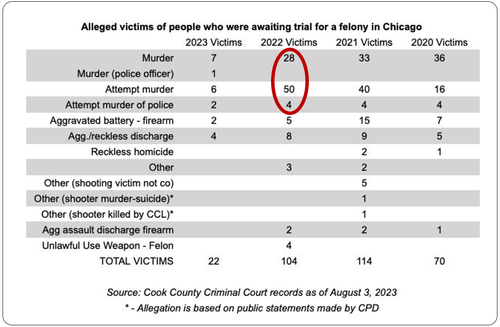
There’s far more evidence than that. The ongoing impact of Cook County’s 2017 bail “reforms” (which resulted in no or low cash bail in the county) offers a glimpse of what the rest of Illinois may face under no-cash bail: a growing number of pretrial defendants out on bond who end up charged with new crimes. As we wrote last year:

Quarterly reports from [Cook County Chief Judge Tim] Evans’ office show that by halfway through 2020 nearly 9,500 defendants released before trial had been charged with new offenses. By mid-2022 that number had grown to 15,086. That was 18 percent of defendants set loose before trial. 

Of those 15,000-plus alleged crimes by pretrial defendants freed from late 2017 through mid-2022, 2,841 were classified as violent offenses, or “person offenses” such as battery, assault, or child neglect. Another 1,594 crimes were weapons offenses.

2. Judges have less discretion

The press is saying judges under the safety act will have more discretion than before. That’s not true. Illinois judges now have less discretion. Here’s why.

Before the end of cash bail, Illinois had a three-pronged pre-trial hearing system where a judge could (1) detain a defendant due to a “threat to the community,” (2) release the defendant on his own recognizance, or (3) a middle ground option requiring a defendant to post cash bail.

The middle ground is key. It let a judge release a defendant prior to trial while imposing a financial incentive to ensure good behavior – whether it was the defendant paying or somebody else posting bail. Without cash bail and the control it grants, judges no longer have such middle ground. 

But that’s precisely where the new law leaves judges today: just two options: (1) detain or (2) release. Discretion is gone.

3. The loss of bail is a threat to “equity”

The loss of discretion may actually do more harm to “equity” in criminal justice. With cash-bail gone, judges could: 

(1) Decide to err on the side of caution and detain “on-the-fence” risky defendants – locking up those who otherwise could have been out on cash bail. That means more minority defendants locked up instead of out on cash bail.

(2) Release potentially violent defendants who, without cash bail, have no financial incentive to behave. And that increases the risk to the general public.

And by general public, we mean minorities. They are the overwhelming victims of crime. Over 95 percent of homicides in Chicago are inflicted on minorities: 80 percent black and 15 percent Hispanic victims.

For overall violent crimes, black and Hispanic minorities are the victims 80 percent of the time. 

The SAFE-T is anything but safe

Chicago has led the nation in homicides for 11 years running. We’ve recently reported that 60 percent of urgent 911 calls in 2022 had no police to respond. Arrest rates for major crimes have fallen to a pathetic 5 percent.

And yet, there’s no plan to address the crisis. Instead, Gov. J.B. Pritzker, Chicago Mayor Johnson, Cook County State’s Attorney Kim Fox and Cook County Chief Judge Tim Evans have all decided to pursue decriminalization and decarceration. The SAFE-T Act is a key part of that agenda.

https://www.zerohedge.com/political/illinois-chicago-set-become-more-dangerous-cash-bail-ends