Target $615 from $408
Friday, October 6, 2023

'Downsize Me': BofA Reveals Weight-Loss Drug Users Could Unleash Apparel Spending Spree
America's anti-obesity craze, courtesy of GLP-1-based weight-loss drugs such as Wegovy and Mounjaro, produced by Novo Nordisk and Eli Lilly, is in the early innings of unleashing a "food revolution" that could spark devastating consequences for the junk-food industrial complex - as their obese customers eat less Big Macs and carby candy bars.
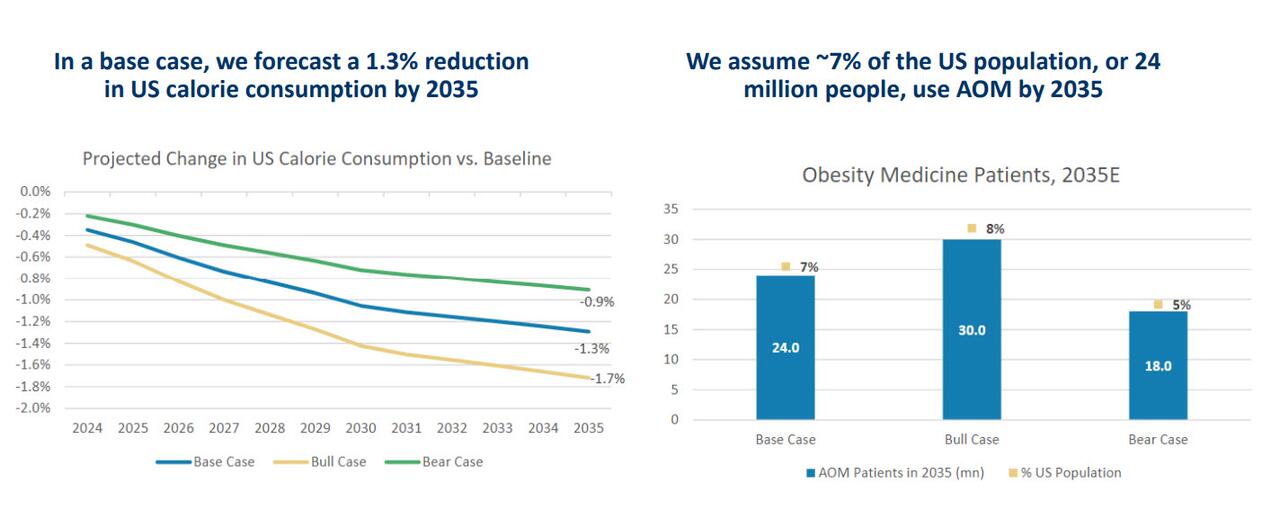
To highlight the potential impact of the growing use of GLP-1 drugs, we linked to a Morgan Stanley presentation (available to pro subs) on Thursday that shows a likely 1.7% reduction (vs baseline) in calories consumed.
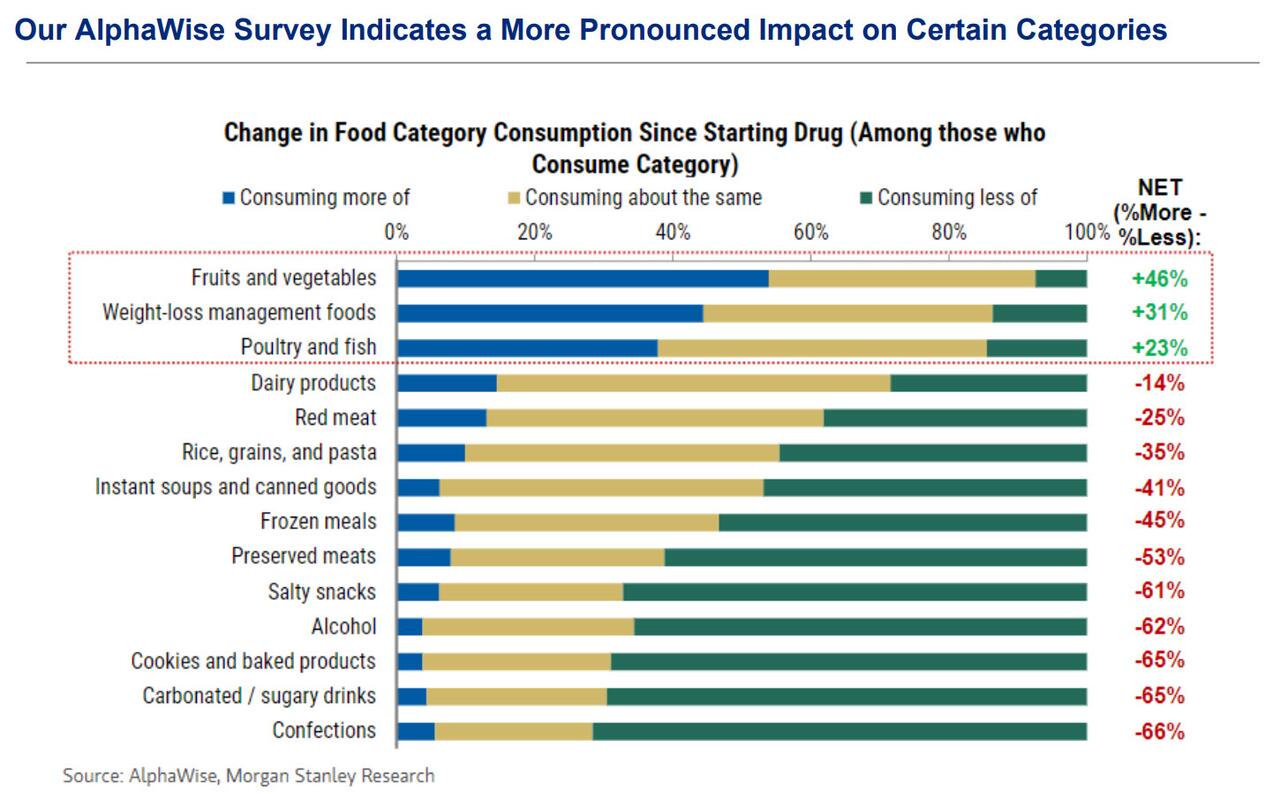
Not surprisingly, MS found a more pronounced impact on certain food categories among those on the weight-loss drugs.
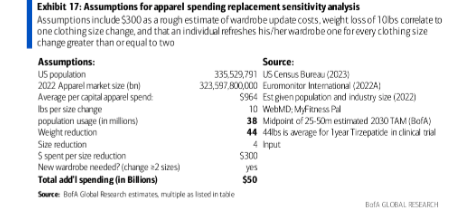
Expanding on MS' report is Bank of America analyst Geoff Meacham (available to pro subs), who reveals the downstream effects of the obesity drug will impact the apparel industry as "eventual weight loss in the broader population could spur a wardrobe replacement cycle."
Meacham said that an adoption rate of 38 million individuals using weight-loss drugs (midpoint of BofA's estimated 2030 TAM) combined with the assumption of buying new clothing could result in $50 billion of new apparel spending.
"The average US womenswear size is 16 - 18 (XL - XXL), according to the US Department of Health and Human Services, which is up from a size 14 a decade earlier. Weight loss could aid demand for the offerings from traditional retailers (who often carry sizes up to 14), and less demand for plus size retailers like Torrid (CURV)," the analyst said, adding, "athletic apparel brands like Lulu Lemon and Deckers (LULU, DECK) to benefit given the healthier lifestyles shown to be supported by GLP - 1 drug."
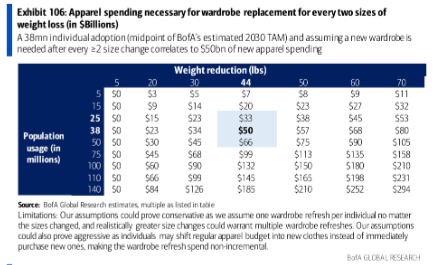
However, the analyst pointed out a key assumption that depends on whether the heavily indebted consumer can afford new clothes:
"If individuals using GLP - 1 save money through lifestyle changes, they could use this money to fund the clothing spending. As adoption moves towards lower income consumers, this added growth looks less likely and we would expect the customer to trade down to lower priced items to fund spending on new clothes."
In a separate report, John Furner, the chief executive officer of Walmart's sprawling US operation, said they've been comparing shoppers who pick up appetite-suppressing medications at its pharmacies to shoppers who are otherwise similar but aren't filling those scripts at Walmart and noticed those using anti-fat drugs are spending less on food.
"We still expect food, consumables, and health and wellness primarily due to the popularity of some GLP-1 drugs to grow as a percent of total in the back half," Walmart CEO Doug McMillon said on a call with analysts in August.
The BofA analyst adds, "The impact of these downstream effects is much less clear to the market but could change consumer behavior over the longer - term with some industries benefitting while others having higher risk. To this end, we've evaluated the impact that broad adoption of GLP-1 drugs could have on consumer-focused sectors, including 1) snacks and beverages, 2) restaurants, 3) tobacco, 4) gaming, 5) apparel, and 6) food retail."
Jobs Report: 885,000 Full-Time Jobs Lost, 1.127 Million Part-Time Jobs Added, Record Multiple Jobholders
After last month's stunning payrolls report, when in our post-mortem we revealed not only a year full of monthly downward data revisions, but also collapse in tull-time jobs and surge in part-time jobs, as well asalso the worst unadjusted August payrolls since the great recession, we thought that nothing could shock us any more. And then we got the September jobs report.
We won't spend too much time dissecting the report since regular readers are all too aware of the same old "upward goalseeking" tactics used by the BLS, so here are the highlights.
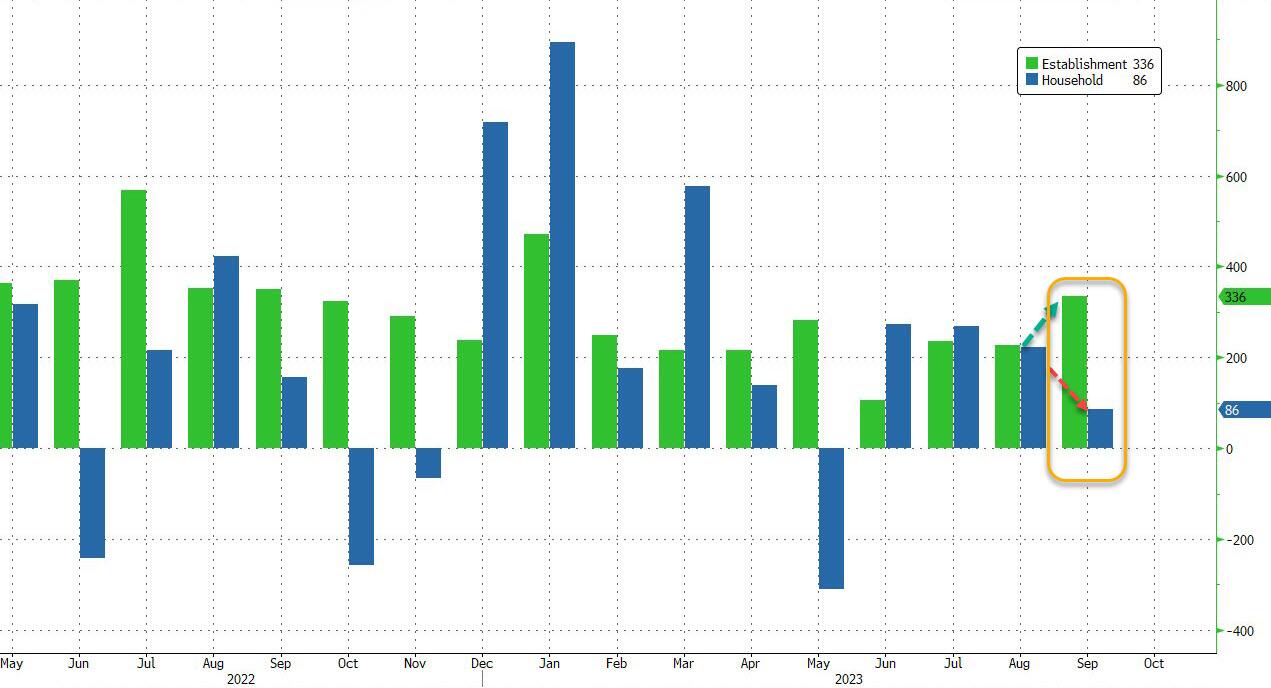
First, the 336K jump in headline payrolls - the biggest since January - was stunning when considering that it was not only above the highest Wall Street estimate but was a 6-sigma beat to expectations.
How is it possible to get such an outlier print to not only trends but expectations? Let's try to answer that question.
If, as the BLS claims, in September the jobs market suddenly reversed a year of declines, surely there will be some qualitative validations to this quantitative outlier, right? Unfortunately, looking through the supporting evidence we don't find any justification to the BLS exuberance.
Let's start with the Household survey: here instead of a number anywhere close to the 336K jobs gained (as the far less accurate Establishment survey reports), the number of newly employed workers was just 86K, the lowest since May, and the second lowest of 2023!
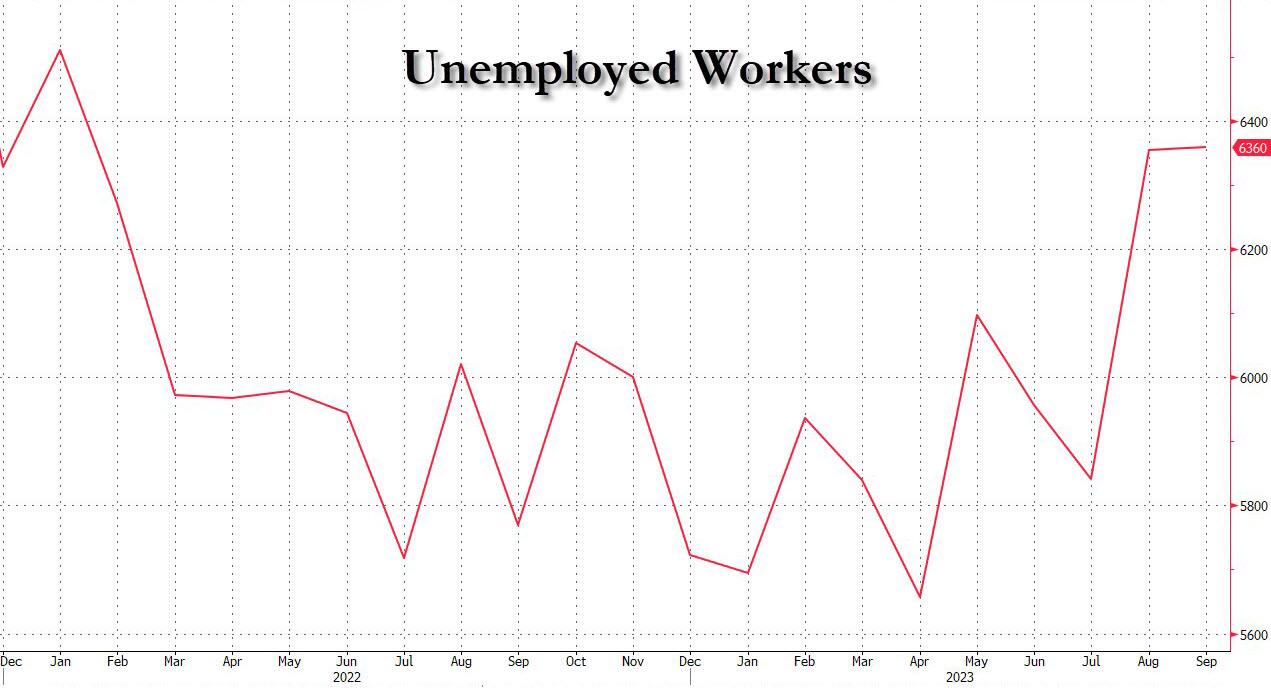
And since the number of unemployed workers also rose to 6.360 million, the highest number since January 2022, the unemployment rate was sticky at 3.8%, and refused to drop to 3.7% as consensus had expected.
How about the Establishment survey? Well, here too, things stink. Yes, the headline surge was great, but the question here is how much of that was purely seasonals.
Consider what Vanda Research FX trader Viraj Patel noted earlier: the official adjusted data showed this Leisure and Hospitality added a whopping +96k jobs. But unadjusted data showed that the sector lost 466k jobs in Sep. This means that the unadjusted private sector payrolls was -399!
Wait, if unadjusted total payrolls rose by 585K and yet private payrolls dropped by 399K, that means that... you got it: in September, all of the unadjusted jobs came from - drumroll - the government, which added a whopping 984K jobs (mostly teachers).
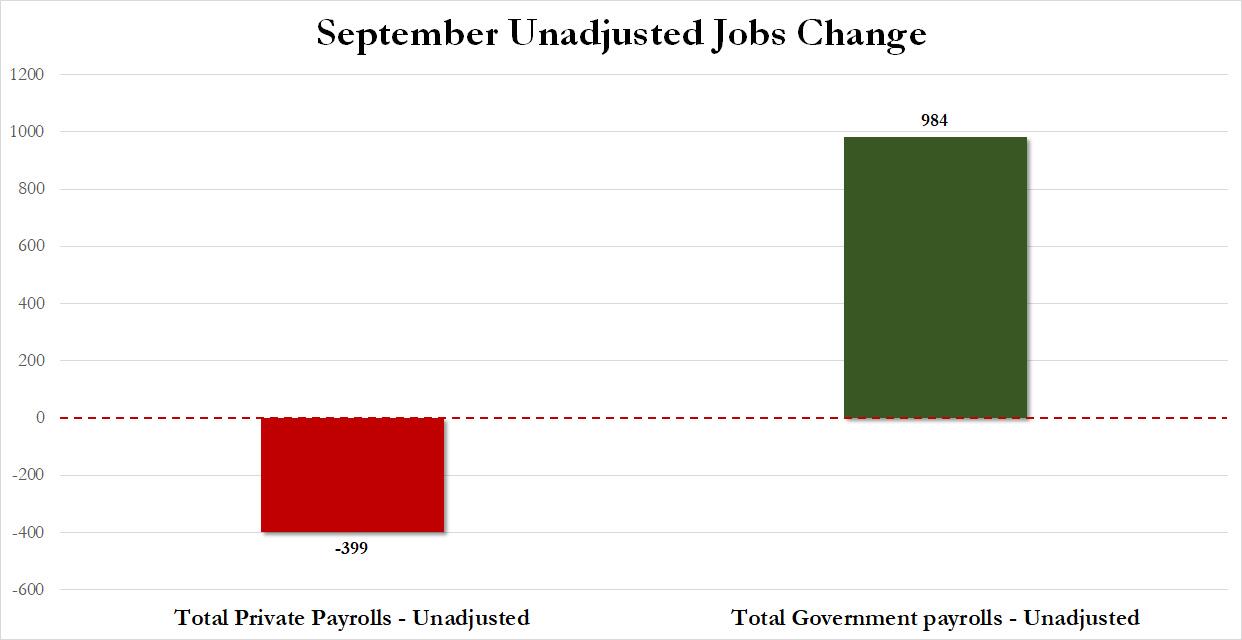
Translation: for yet another month all the strength in the Establishment was thanks to seasonals and various plugs that made the total number much stronger.
And now, let's turn again to the much more detailed and accurate Household Survey, where we find the BLS back to its old tricks again.
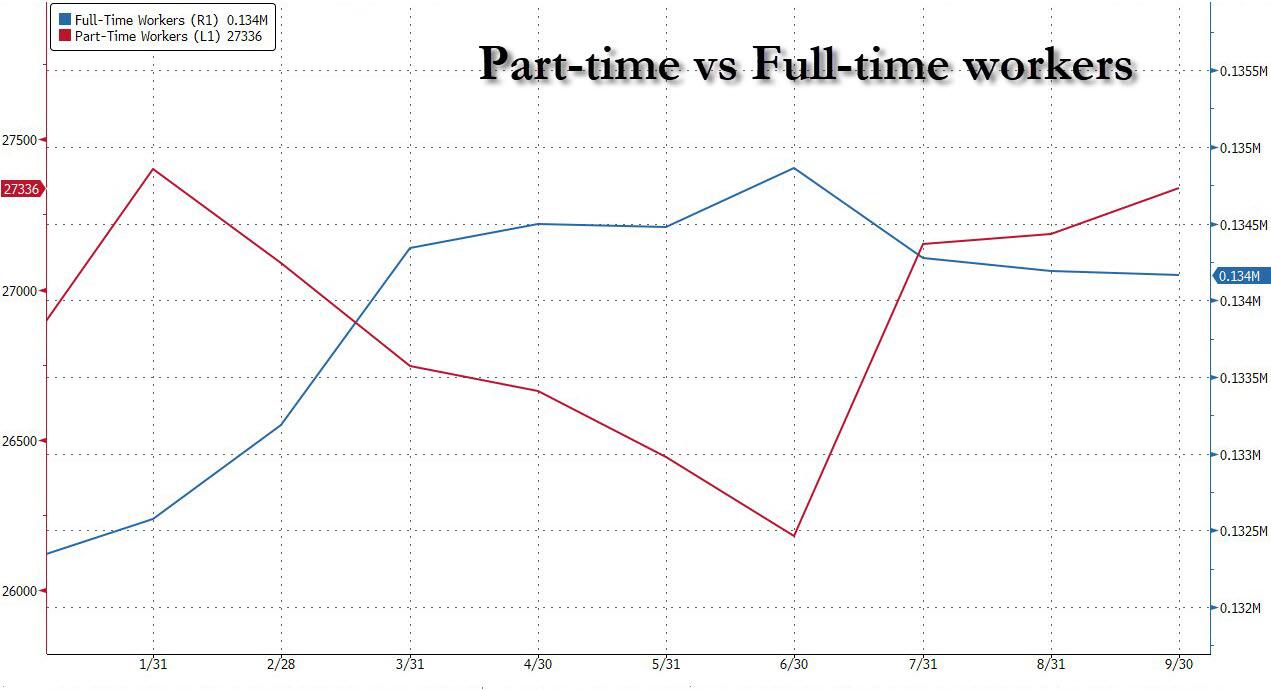
First, as we pointed out earlier, despite the alleged quantitative surge, the quality of the jobs was anything but good. In fact, looking at the infamous table A-9 of the employment report, reveals that in September, a seasonally adjusted breakdown of jobs shows that part-time workers accounted for the entire increase, rising by 151K; as for full-time workers? Well, for yet another month, this number dropped, sliding by 22K in September.
Indeed, as shown in the chart below, while part-time workers rose for the third consecutive month to 27.336 million,and the highest since January, full-time workers have decline for three straight months, and at 134.167 million, this was the lowest number going back to February!
But hold on, you say, why use Seasonally Adjusted number when we already noted above that there continue to be chronic issues with the BLS' seasonal adjustments in the post-covid era. True, so let's use unadjusted numbers instead. What do we get?
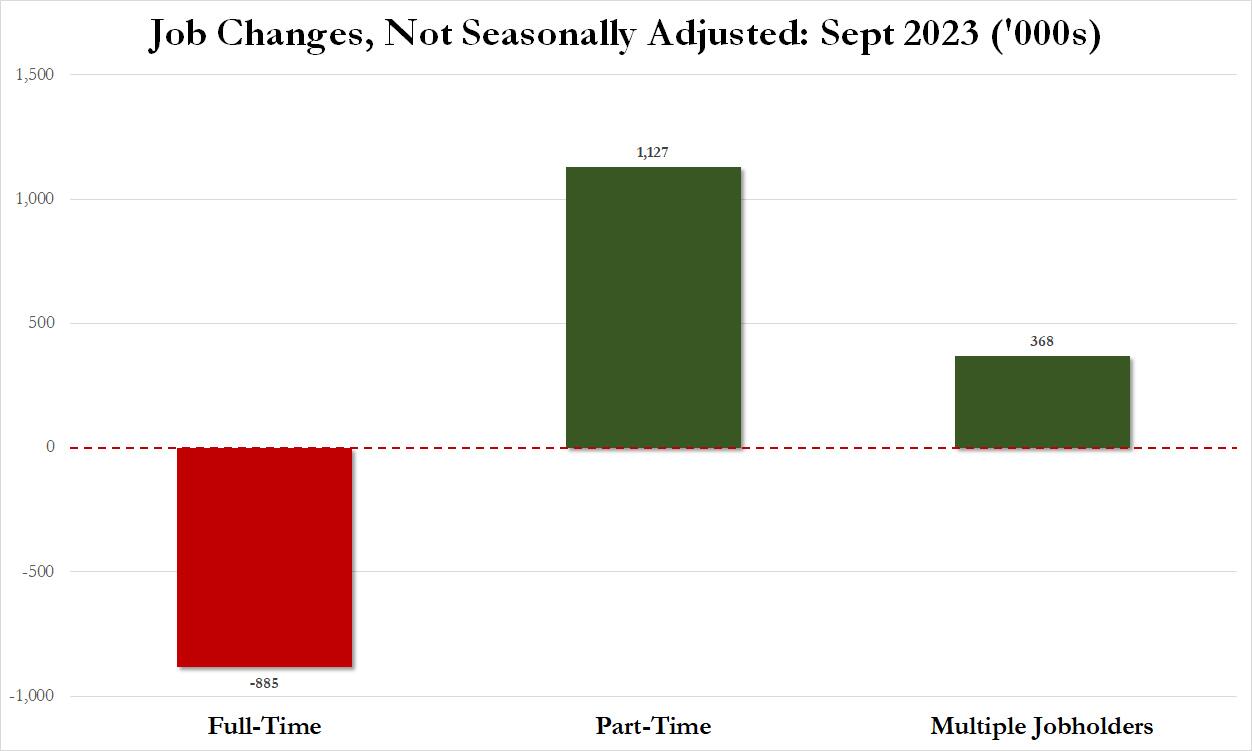
Well, we get the following whopper: in September, the number of unadjusted full-time workers collapsed by 885K. This was the biggest monthly drop since - drumroll- April 2020 when the economy was shut down!
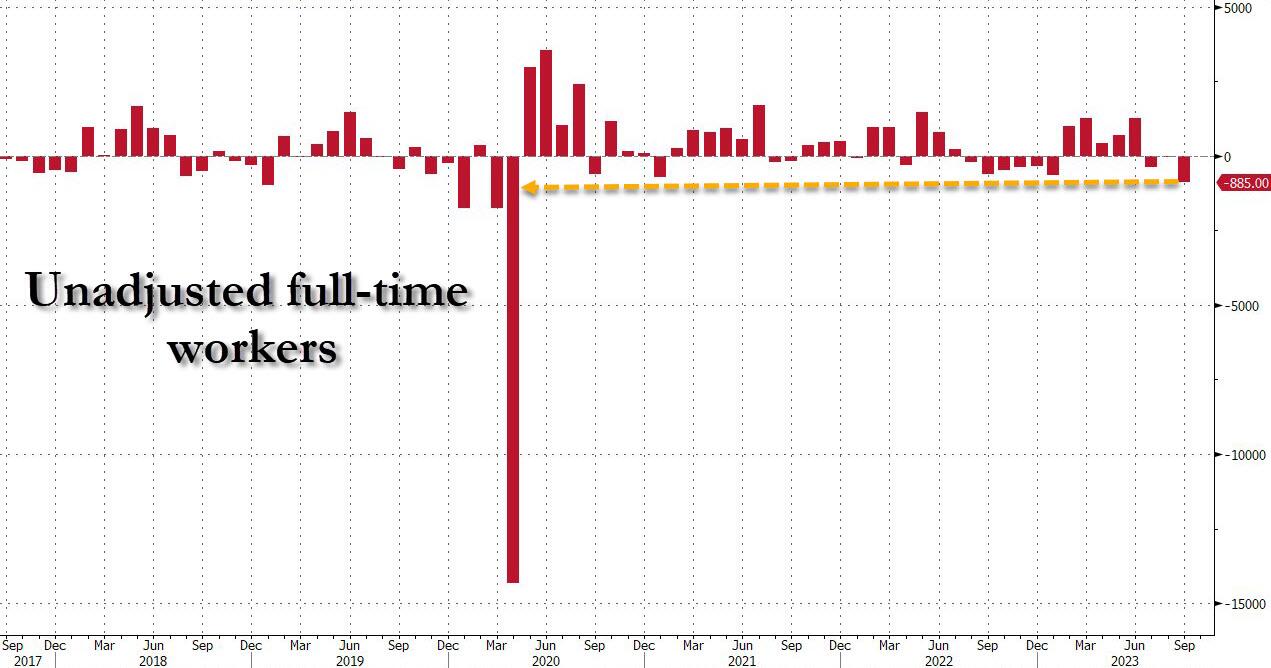
And if full-time workers plunged, that must mean that part-timers exploded, right? Why yes, they did: by 1.127 million in one month to be precise, and at 27.109 million the number of part-time workers was the highest since April.
Finally, let's not forget the number of multiple jobholders: those unlucky souls which have to work not one but two (or more) jobs to make ends meet under Bidenomics. Also, multiple jobholders (which are measured by the Household Survey) are double, and triple- counted when it comes to the Establishment Survey. So how did thy do in September? Well, on a seasonally adjusted basis, the number increased by 123K to 8.151 million, the highest since January 2020. As for the much more accurate, unadjusted number, well that soared from 7.778 million to 8.146 million, an increase of 368K, or more than all the 336K payrolls reported by the establishment survey.
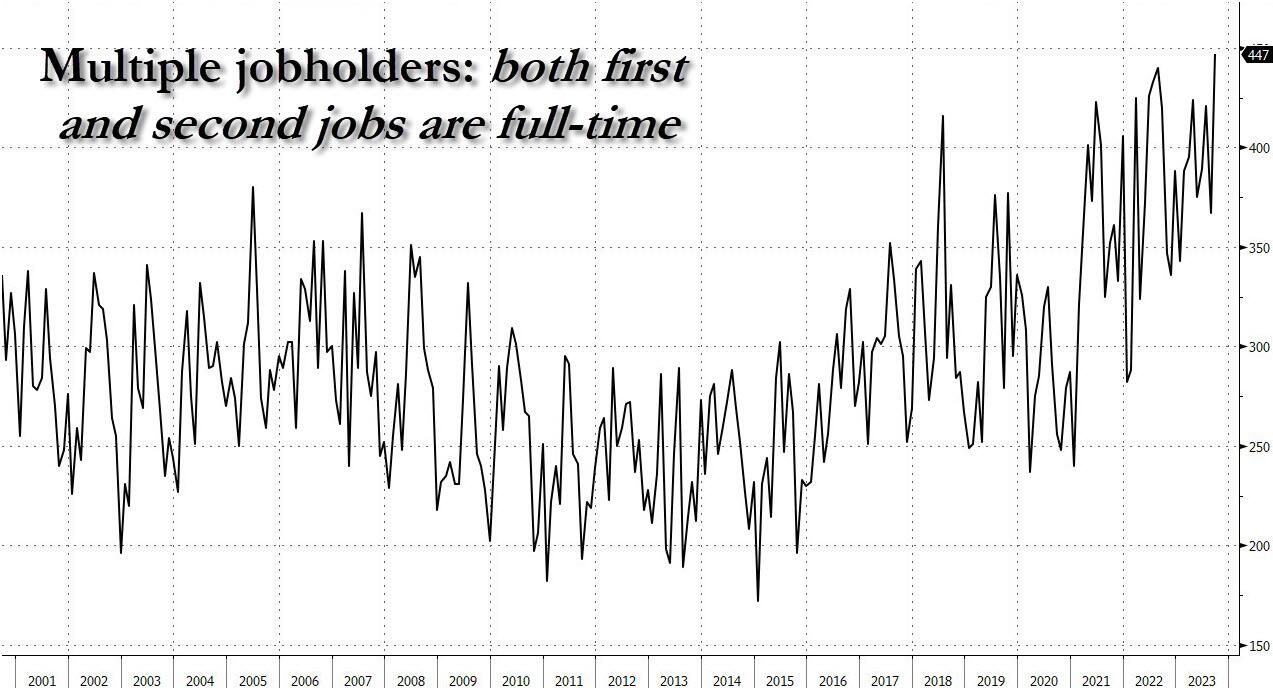
In other words, all of the job gains in September were either from part-time workers or multiple jobholders forced to get another job in addition to their current one, and thus be counted by the BLS as two distinct jobs (or more). One final observation on the multiple jobholders: in September, the subset of multiple jobholders who held both a primary and secondary full-time job just hit an all time high.
Visually, this is what September's "stunning" jobs report really looked like.
Source for everything: BLS, but one needs to do some actual work to get a sense of what is really going on.
Government Jobs Rose by Nearly 1 Million Unadjusted in Sept, What Going On?
On an unadjusted basis government jobs rose by 984,000. The BLS says jobs rose by 73,000. A reader asked about this.

Seasonal Adjustments
“Govt +984k adjusted to +73k How does this make any sense? Aren’t “seasonal adjustments” seasonal?“
Government Jobs Are Highly Seasonal

Many people mock seasonal adjustments but without them, employment would have risen by well over a million in September vs the reported 336,000 without those adjustments (excluding the private adjustment).
Private went the other way. The net of private and government seasonal adjustments was +582,000 turned into 336,000.
Looking at unadjusted numbers month-over-month is simply wrong.
A focus on unadjusted numbers makes sense only compared to the same month in prior years.
Change in Government Employment From Year Ago

From a year ago, the wild swings are gone. Economists use seasonal adjustments for reasons that should now be clear.
That does not mean the underlying data is any good, but there is nothing inherently wrong with adjusting numbers. In fact, they need to be.
Jobs Unexpectedly Surge by 336,000 But Employment Only Rises by 86,000

I do a detailed look every month at the jobs report.
For September of 2023, please see Jobs Unexpectedly Surge by 336,000 But Employment Only Rises by 86,000
‘Something Is Likely to Break’ After Jobs Data, El-Erian Says
- Nonfarm payrolls data for September handily beat forecasts
- It’s good news for economy, bad news for markets, Fed, he says
“Something is likely to break” as Friday’s US jobs report pushes the Federal Reserve to hold interest rates higher for longer, said Mohamed El-Erian, the chief economic adviser at Allianz SE and a Bloomberg Opinion columnist.
The data is “good news for the economy right now,” El-Erian said on Bloomberg Television, but it’s “bad news for the markets and for the Fed. The Fed is not going to welcome this report. Over the long term this may end up being bad news for the economy as well.”
Why Is Neurocrine Biosciences Shares Trading Higher
Neurocrine Biosciences Inc
released topline data from the Phase 3 CAHtalyst Pediatric Study of crinecerfont in children and adolescents with classic congenital adrenal hyperplasia (CAH) due to 21-hydroxylase deficiency.
CAH is an inherited condition that affects the body's adrenal glands, the cone-shaped organs on top of the kidneys. In a person with CAH, the adrenal glands are very large and cannot produce certain chemicals, including cortisol, which helps protect the body during stress or illness and helps the body regulate the amount of sugar in the blood.
The Phase 3 Pediatric study met its primary endpoint, demonstrating that treatment with crinecerfont resulted in a statistically significant decrease in serum androstenedione from baseline at Week 4 versus placebo following a glucocorticoid (GC) stable period.
Approximately 30% of participants receiving crinecerfont achieved a reduction to a physiologic GC dose while maintaining androgen control compared to 0% of participants receiving a placebo.
The study also met the other key secondary endpoint, demonstrating a statistically significant decrease in serum 17-hydroxyprogesterone from baseline at Week 4 versus placebo.
Crinecerfont was generally well tolerated.
Subscribe to:
Posts (Atom)