Search This Blog

Wednesday, January 17, 2024

MiMedx Warned Over Human Placenta Product

 The FDA has warned MiMedx that its wound-healing product derived from human placentas needs agency approval before it can be sold to doctors and hospitals.

In its warning letteropens in a new tab or window to CEO Joseph Capper, FDA said the company's Axiofill product isn't regulated solely under the more lax "361" human cell, tissue, or cellular or tissue-based product (HCT/P) pathway. Instead, it's a biological product regulated under the stricter section "351" of the Public Health Service Act.

Therefore, it would need either a biologics licensing application to be on the market, or an investigational new drug application (IND) to be given to people in clinical trials, FDA said, noting that it has neither.

Axiofill is indicated for wound healing, including "trauma wounds" and "diabetic foot ulcers," according to product labeling. It fails to meet "minimal manipulation" criteria, FDA said, "because your processing alters the original relevant characteristics of the placenta related to its utility for reconstruction, repair, or replacement."

Paul Knoepfler, PhD, a stem cell biologist at the University of California Davis who has long been tracking stem cell and birth tissue companies, said the warning letter's focus on placenta-derived material is novel.

"Many of the other firms that get letters in this perinatal space market umbilical cord products, but the MiMedx product is placental," Knoepfler told MedPage Today. "The FDA is reinforcing that placental materials can be biological drugs as well."

The letter came after visits by FDA officials to two MiMedx sites in Georgia last year. Along with the product classification issues, the letter also mentioned "significant deviations" from current good manufacturing practices.

FDA acknowledged replies from MiMedx, dated March and October of last year, but said these were "inadequate to address the deficiencies."

MiMedx did not return a request for comment from MedPage Today, but it said in a press releaseopens in a new tab or window that it "does not agree" with the FDA's position that the product doesn't meet "minimal manipulation" criteria.

"Axiofill's product characteristics can be reasonably considered directly comparable to at least one other commercially available HCT/P on the market that the FDA regulates under section 361 and, as a result, the company believes FDA is not consistently applying the rules for permitted use," the company stated in the press release.

MiMedx said Axiofill has been on the market since September 2022 and is expected to generate less than 5% of the company's total net sales for 2023.

The company has faced its share of controversy, including charges involving its marketingopens in a new tab or window and accounting practicesopens in a new tab or window, and allegations that it shipped more product than had been orderedopens in a new tab or window and booked that as sales.

Then, in 2020, MiMedx Group agreed to pay $6.5 millionopens in a new tab or window to resolve allegations that it knowingly submitted false commercial pricing disclosures to the Department of Veterans Affairs, enabling the company to charge inflated prices for its human tissue graft products.

Earlier reporting by MedPage Today on placenta donation programsopens in a new tab or window -- where companies partner with hospitals to collect birth-related tissues -- showed MiMedx had such a program. It also runs the website, placentadonation.comopens in a new tab or window.

The FDA has been trying to crack down on so-called "birth tissue" companies -- those that purport to create products using stem cells gathered from afterbirth including the placenta and umbilical cord.

In 2023 alone, the FDA issued warning letters to Signature Biologics over its injectable umbilical cord productopens in a new tab or window; Stratus Biosystems for its amniotic membrane and fluid productsopens in a new tab or window; and Regenative Labs over its "Wharton's jelly" productsopens in a new tab or window. The agency also issued a safety communication about amniotic fluid eye dropsopens in a new tab or window last year.

The U.S. Department of Justice also turned its attention to birth tissue products last year, charging a Texas-based physician assistant with healthcare fraudopens in a new tab or window for allegedly injecting patients with amniotic fluid in a so-called "dubious attempt at pain management."

In 2022, experts told MedPage Today it appeared that FDA may be getting tougher on birth tissue companiesopens in a new tab or window, as a warning letter to Re-Gen Active Lab stated outright that its product for "orthopedic diseases or conditions" would not be considered homologous use of human tissue and would need to be regulated as biologics. Experts said the agency hadn't previously been that clear about what didn't classify as homologous use.

The FDA has long been trying to put a lid on unapproved stem cell therapies. In 2017, the agency issued guidance on regenerative medicine products, with a November 2020 deadline for full compliance. That deadline was extended due to the pandemic and went into effect in June 2021opens in a new tab or window. Now, manufacturers must meet FDA's premarket approval or IND requirements for certain products before promoting them to patients.

Knoepfler questioned whether FDA would "do more" in the birth-tissue space.

"Perinatal supplier firms often argue that their products are not drugs and so should not be subject to the regulations that come along with that classification. The FDA does not seem to be budging on this classification though," Knoepfler said. "At the same time, we haven't seen the FDA go beyond issuing warning letters to take any further steps in the birth-related biologics arena."

He noted that "by contrast, in the adipose cell sphere, the agency did pursue two injunctions, winning oneopens in a new tab or window and losing the other caseopens in a new tab or window, which is pending appeal."

"Do most firms in this [birth tissue] area come into compliance after receiving letters, whereas in the adipose space that didn't happen?" Knoepfler asked. "Could the FDA end up in court with a perinatal firm over the drug classification question?"

https://www.medpagetoday.com/special-reports/features/108287

'Jordan Demands Answers As Biden Admin Flags "MAGA", "Trump" To Track Pol Foes' Fin Transactions

 Jim Jordan, Chairman of the House Select Subcommittee on the Weaponization of the Federal Government on Wednesday, announced that it had obtained documents revealing that federal agencies have flagged financial transactions for financial institutions for people using politically sensitive words such as "MAGA" and Trump."

In a letter to Noah Bishoff - who was a former FinCEN Director (Financial Crimes Enforcement Network) - and now an Anti Money Laundering (AML) officer at fintech company Plaid, Inc. Jordan described situations in which Americans buying bibles or shopping at sporting good stores might find their transactions flagged.

New documents obtained by the Select Subcommittee on the Weaponization of the Federal Government reveal that the federal government flagged terms like "MAGA" and "TRUMP" for financial institutions if Americans used those phrases when completing transactions. Individuals who shopped at stores like Cabela's or Dick's Sporting Goods, or purchased religious texts like a bible, may also have had their transactions flagged. This kind of pervasive financial surveillance, carried out in coordination with and at the request of federal law enforcement, into Americans' private transactions is alarming and raises serious concerns about the FBI's respect for fundamental civil liberties. -Judiciary.house.gov

"The Committee and Select Subcommittee have obtained documents indicating that following January 6, 2021, FinCEN distributed materials to financial institutions that, among other things, outline the 'typologies' of various persons of interest and provide financial institutions with suggested search terms and Merchant Category Codes (MCCs) for identifying transactions on behalf of federal law enforcement," reads the letter.

"These materials included a document recommending the use of generic terms like 'TRUMP' and 'MAGA' to 'search Zelle payment messages' as well as a 'prior FinCEN analysis' of 'Lone Actor/Homegrown Violent Extremism Indicators," the letter continues. "According to this analysis, FinCEN warned financial institutions of 'extremism' indicators that include 'transportation charges, such as bus tickets, rental cars, or plane tickets, for travel to areas with no apparent purpose,' or 'the purchase of books (including religious texts) and subscriptions to other media containing extremist views.' In other words, FinCEN urged large financial institutions to comb through the private transactions of their customers for suspicious charges on the basis of protected political and religious expression."

The Committee announced that it's seeking interviews with senior intelligence officials, including Bishoff.

https://www.zerohedge.com/political/jim-jordan-demands-answers-after-biden-admin-caught-flagging-maga-and-trump-track

Iran, Pakistan On Brink Of Military Conflict Following Missile Strike - China Urges Calm

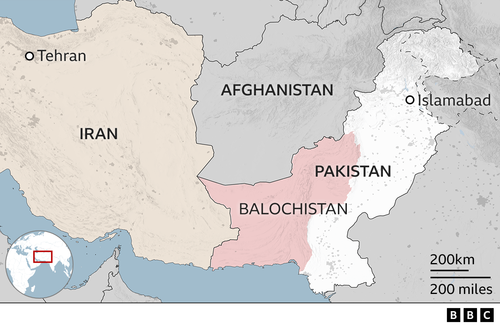
 Iran's Tuesday missile and drone strikes targeting Sunni jihadists in Pakistan's southwestern Balochistan province have as expected unleashed a diplomatic war between Tehran and Islamabad.

Pakistan started its response by recalling its ambassador from the Iranian capital Wednesday, while also booting the Iranian ambassador from Pakistan. Pakistani officials say that two children were killed in what Iran said was a response to the January 3rd suicide bombings of Kerman city, which killed over 100 people.

"Last night's unprovoked and blatant breach of Pakistan's sovereignty by Iran is a violation of international law and the purposes and principles of the Charter of the United Nations," Pakistan Foreign Ministry spokeswoman Mumtaz Zahra Baloch has stated. "It is even more concerning that this illegal act has taken place despite the existence of several channels of communication between Pakistan and Iran."

"Pakistan reserves the right to respond to this illegal act. The responsibility for the consequences will lie squarely with Iran," the spokeswoman added. "We have conveyed this message to the Iranian Government. We have also informed them that Pakistan has decided to recall its ambassador from Iran and that the Iranian Ambassador to Pakistan who is currently visiting Iran may not return for the time being."

Iranian state media has said the attack destroyed two sites belonging to the terrorist organization Jaish al-Adl. It is a region that Tehran authorities have long viewed as a hotbed of terrorism and the source of frequent cross-border attacks

Authorities in Balochistan province told CNN two girls had died and at least four people were injured. The girls, aged eight and 12, were killed in houses that were damaged in the attack in the village of Koh-e-Sabz in Kulag, about 60 kilometers (37 miles) from Panjgur district, on Tuesday evening, according to the district’s deputy commissioner Mumtaz Khetran. Khetran also said a mosque near the homes was targeted and hit in the strikes.

Koh-e-Sabz — about 50 kilometers (31 miles) from Pakistan’s border with Iran — is known to be the home of Jaish al-Adl’s former second-in-command Mullah Hashim, who was killed in clashes with Iranian forces in Sarawan, an Iranian region adjacent to Panjgur, in 2018.

Interestingly, China has intervened diplomatically, urging both sides to react with calm and restraint. The Chinese Foreign Ministry Wednesday urged for both sides to "avoid actions that would lead to an escalation of tension and work together to maintain peace and stability in the region."

Map source: BBC

To review of fast-moving events Wednesday, according to a regional correspondent:

  • Pakistan recalls ambassador in Tehran, kicks out Iran ambassador
  • Iranian reports on border clashes
  • IRGC commander killed 
  • China mediation failed: local media 
  • Unconfirmed reports that border shut 
  • Saudi mediating 
  • India statement backs Iran

The United States was among those countries that condemned Iran's attack which was deep into Pakistani territory. The situation remains dangerous also because Pakistan is a nuclear power

https://www.zerohedge.com/geopolitical/china-attempts-intervene-amid-iran-pakistan-diplomatic-war-following-missile-strike

Parents Are Winning The Battle For School Choice

 by Jackson Elliott via The Epoch Times (emphasis ours),

Florida mother of five Nicole Andrews puts it bluntly when asked why she sends her children to a charter school instead of the assigned public school for their community.

She “absolutely, desperately” wants her youngsters in charter school because it has “a different culture,” she told The Epoch Times. Other parents feel the same way.

“There is a different level of expectation and rigor” at St. Johns Classical Academy, Ms. Andrews said.

There is a different value set. There is a different mindset as to the value of education.

There’s also a waiting list for slots at both of the school’s campuses, in Fleming Island and Orange Park, in the northeastern area of the state. The school opened in August 2017 and is free to attend.

Ms. Andrews is among hundreds of thousands of parents across America who are making the switch from public schooling to some other form of education as part of a nationwide rallying cry for “school choice.”

In general, school choice allows parents to request that the taxpayer dollars assigned to their child for education be used for other options. That could mean transferring the money to a charter school, using it for tuition for a private school, or taking it as reimbursement for homeschooling expenses.

Recently, many states have adopted legislation to put into place some form of school choice program.

Presently, 10 states have what’s known as universal school choice, meaning it’s open to any child. Those states are Arizona, Arkansas, Florida, Iowa, Ohio, Oklahoma, Utah, West Virginia, Indiana, and North Carolina.

Many other states have a school-choice program for at least some children, with a range of criteria to qualify. Some serve children in a low socio-economic demographic. Others offer assistance to children with learning disabilities or other special needs.

In some states, programs allow public dollars set aside for each child’s education to follow a child leaving public school. Then, that money can be used for tuition for private schools. Or the money may be transferred to fund that child’s slot at a charter school.

Charter schools are publicly funded, but operate independently from the public school system.

In some states, school choice means that even parents who choose to homeschool can use public dollars allotted to educate their children on things like curriculum and tutoring.

The options vary from state to state. And the amount of public money set aside for each child usually ranges from between $5,000 to $8,000, depending on the state.

The Department of Education reports that the government spent an average of $14,295 per student in public schools from elementary through 12th grade in the 2020–2021 school year.

Many conservatives support the idea of school choice, saying it will force failing public schools to improve or lose students. And more importantly, they say, those failing schools will lose the funding they receive to educate the children who leave.

Some parents who’ve previously paid for their children’s private school tuition or homeschooling expenses on their own, with no government assistance, say school-choice programs bring about much-needed fairness.

That’s because—by paying taxes—those parents contribute to the public money used to pay for public education. But they’ve received none of the benefit, and still have to cover the costs of their children’s education.

There’s also a strong lobby movement that’s against school choice.

Public schools are deeply connected to some of the most potent activist groups in American society—the teachers’ unions.

And though polls show parents strongly favor school choice, unions are adamant in their opposition.

“Vouchers take scarce funding from students in public schools and give those resources to unaccountable private schools,” the National Education Association (NEA) states on its website.

The NEA also say that vouchers, used in school choice programs, don’t support disabled students, don’t protect the human and civil rights of students, and “exacerbate segregation.”

The American Federation of Teachers (AFT) states on its website that evidence “does not support the argument that vouchers and other methods to establish a market system of schools will improve school or student performance.”

The NEA and AFT are two of America’s largest unions, with a combined total of more than 4.7 million members.

The Epoch Times contacted both unions but received no response by publication time.

Parents told The Epoch Times they hope school choice and the competition it creates will eventually make education better for everyone.

“I think that once you take an institution, and make it a public institution, and have large governmental control over it, you’re going to lose some quality,” Ms. Andrews said.

“Lord willing, public institutions will have to change their game a bit, and everyone will benefit.”

School Choice Options

School-choice programs vary widely.

Some states, such as Indiana, Iowa, and West Virginia, offer the use of an education savings account (ESA). An ESA gives money to parents in a bank account, and funds can be spent on educational expenses, such as school tuition, textbooks, private tutoring, and school supplies.

Other states, such as Florida, Arkansas, and Wisconsin, offer vouchers, which take the money set aside to educate children in public schools and allow parents to spend it on tuition for private schools. Voucher money also can be transferred to a charter school.

Aisha Thomas (R) is learning teaching skills with the teacher Alexxa Martinez, in her classroom in Nevitt Elementary School, in Phoenix, Ariz., on Oct. 26, 2022. (Olivier Touron/AFP via Getty Images)

Still others offer tax-credit scholarships. These allow taxpayers to receive tax credits when they donate to nonprofits that provide scholarships to private schools. Parents can apply for these scholarships for their children.

In other states—including Alabama, Illinois, and Louisiana—qualifying parents receive tax credits for paying for their children’s private schooling.

Alaska offers state funding for some private schooling through “correspondence study programs.” These programs allow a student to receive an individualized learning program and options normally unavailable in public schools, such as resources from religious groups or private tutoring.

Many states allow families to open college savings investment accounts to help with educational expenses. These accounts allow families to deposit pre-tax money into investment accounts. Recently, some states have changed the rules on these accounts so parents can spend some of this money on childhood education expenses.

In 1990, school-choice options like these were practically nonexistent.

As of 2023, America had about 700,000 school-choice programs, according to statistics from EdChoice, an Indiana nonprofit that promotes school choice.

With so many Americans increasingly taking advantage of school-choice options, this may be just the beginning of a movement that would fundamentally reshape American public education, EdChoice president Robert Enlow told The Epoch Times.

“This year has been the year of universal choice, where we now have 10 states that basically allow every single student in the state to attend whatever setting works best with them—public, private, charter, at home, or online,” Mr. Enlow said. “We’re really excited about that growth.”

For homeschooling parents, receiving state money can make a huge difference, homeschooling mother Kimberly Ebbers told The Epoch Times.

She quit her job to give her three sons an education at home. She’s been teaching them for 22 years.

In the beginning, we didn’t take vacations and buy new clothes and eat out,” said Ms. Ebbers, who lives in Florida. “We sacrificed so that I could stay home.

“It was just important to us to be with our children and for our children to be with each other.”

In 2023, Florida passed legislation allowing for universal school choice, which means even homeschooling children are eligible for funding from the state for educational expenses.

But surprisingly, the Ebbers family isn’t interested in using the state’s money.

State money can mean state control over education to some degree, Ms. Ebbers said.

In the future, it may lead to them choosing our curriculum or other choices like that,” she said.

However, money from the state could be a blessing to families with children with disabilities, she said.

“I do have friends that have kids with special needs that have to have services, like speech pathology, or physical therapy, or occupational therapy. And it’s expensive, going every week to those appointments and paying out-of-pocket costs.”

Florida homeschooling mother of five Michelle Jernigan told The Epoch Times she greatly appreciates new laws that give homeschoolers aid in educating their children.

“I’m very grateful to the state for making it so we’re able to afford things we were never able to afford before for my kids,” Ms. Jernigan said. “And it has made a big difference in their education.”

https://www.zerohedge.com/political/parents-are-winning-battle-school-choice

Cold Blast Takes Half Of North Dakota's Oil Production Offline

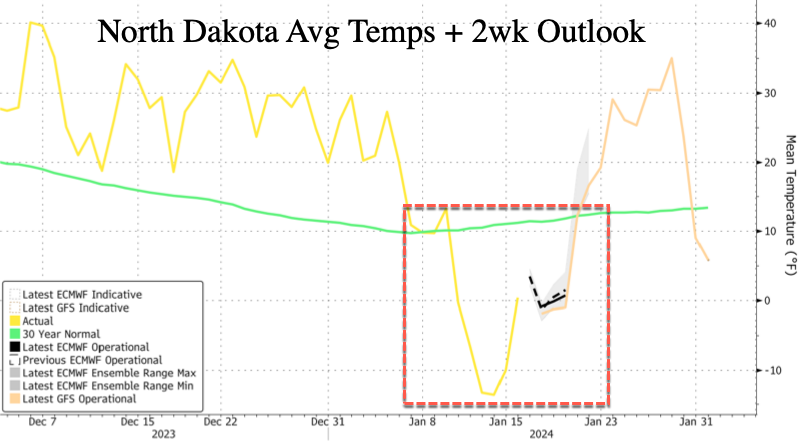
 Bone-chilling temperatures in the US Midwest have forced oil and gas producers in North Dakota to curb output because of operational disruptions stemming from freeze-offs and shut-ins. 

Bloomberg reports 650,000 to 700,000 barrels of oil output a day have been taken offline. The state, home to the Bakken shale formation, produced 1.2 million barrels a day on average in October.

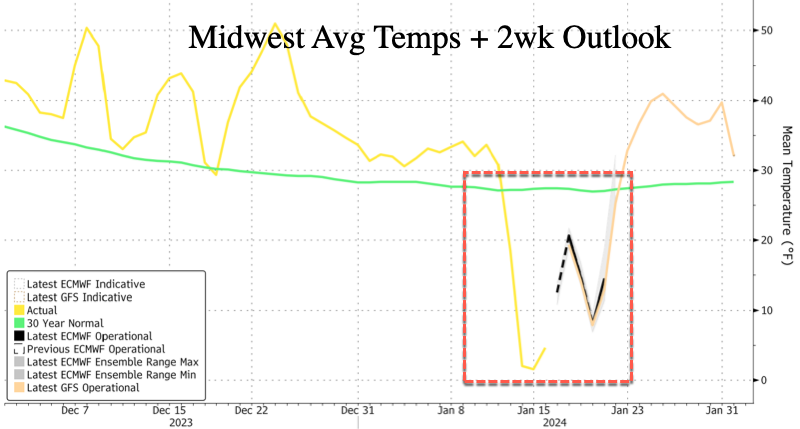
Average temperatures across the state have averaged below zero for nearly a week. The good news: Temps are expected to rise to 30-year norms by the end of the month, but forecasts at the moment show another possible cold blast slated for early Feb. 

Average temps across the Midwest region are expected to rise from about zero to the 30-year trend of around 30F by next week. 

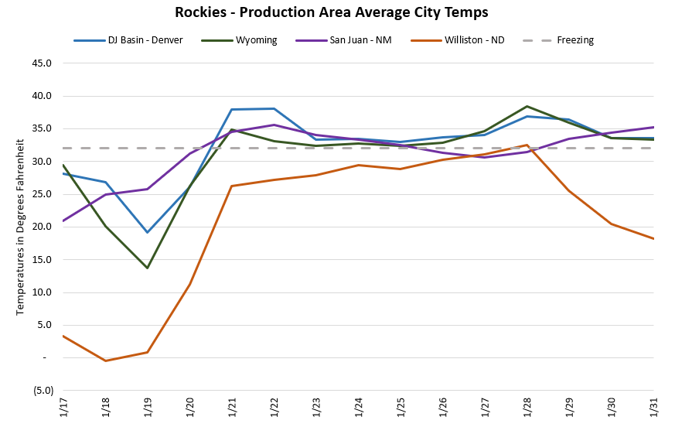
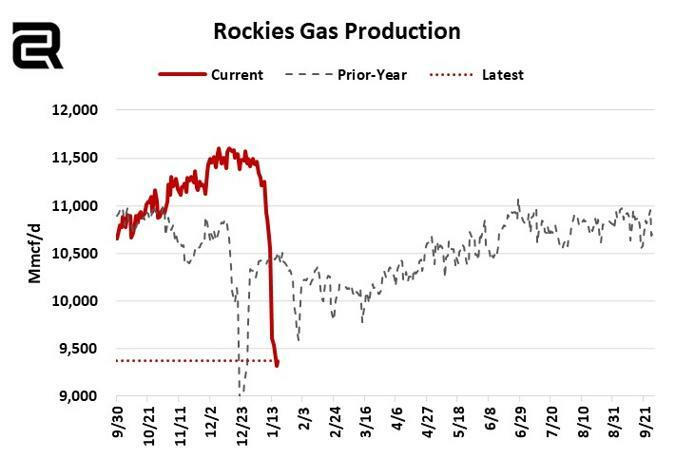
In natural gas markets, energy research firm Criterion Research said Rockies NatGas production is set to return to normal levels following operational disruptions.  

Within the Rockies production areas, temperatures remain brutally cold in the Williston Basin for the next three days. The DJ Basin (Colorado/Wyoming) will see a return to the 15-20F range as well by the end of the week, whereas San Juan/New Mexico temps gradually warm into the weekend.

As of today, Rockies supply levels remain at lows of 9.36 Bcf/d.

Besides disruptions to oil and NatGas production, several power grids have been under strain because cold weather has boosted heating demand to record highs. Texas's power grid had issues earlier this week, while the Tennessee Valley Authority asked customers Wednesday morning to conserve power.

Also, in Texas, critical energy export terminals in the Gulf were disrupted earlier this week due to the cold. 

News today: Motiva Enterprises' Port Arthur Refinery, the largest oil refinery in North America, with a capacity of 630,000 barrels per day, in Port Arthur, Texas, suffered disruptions due to cold weather. 

Someone needs to tell the unelected officials at WEF that folks in the Western Hemisphere would like more global warming ASAP.  

https://www.zerohedge.com/commodities/cold-blast-takes-half-north-dakotas-oil-production-offline

DNA Contaminants In COVID Vaccines Are 'Beyond The Pale': Florida Surgeon General

 by Marina Zhang and Jan Jekielek via The Epoch Times (emphasis ours),

On Jan. 3, the office of Florida Surgeon General Dr. Joseph Ladapo issued a statement calling for the halt in the use of COVID-19 mRNA vaccines, citing the recent discovery of DNA contaminants in the vaccine vials.

On the Jan. 12 episode of EpochTV’s “American Thought Leaders,“ Dr. Ladapo explained why he called for a halt, saying that while there are also safety concerns with the COVID mRNA vaccines linking them to a multitude of adverse events, the recent discovery is ”beyond the pale.”

DNA is a common contaminant of many biological products,” he told the show’s host, Jan Jekielek. “We can use DNA to produce different drugs like insulin, other biologics—and that’s a wonderful innovation, and normally, that DNA doesn’t pose a problem.”

Human cells are resistant to DNA entry, and this prevents harming the integrity of the cell’s DNA.

However, since the mRNA vaccines use lipid nanoparticles, which deliver mRNA into the cells directly, DNA contaminants could also be able to enter the cells. Some scientists, like Dr. Ladapo, are concerned that the DNA from the vaccine may integrate with the human genome.

Prominent officials at the U.S. Food and Drug Administration (FDA) disagree.

On Dec. 6, Dr. Ladapo sent a letter to FDA commissioner Dr. Robert Califf and the U.S. Centers for Disease Control and Prevention (CDC) director, Dr. Mandy Cohen.

In his letter, he asked if there have been risk assessments of the vaccine DNA integrating into human DNA, especially regarding the controversial SV40 promoter/enhancer region found in Pfizer’s vaccine.

Other questions included whether risk assessments have been done on DNA integration in reproductive cells and if the current levels of DNA residuals are acceptable under the FDA’s standards.

Dr. Peter Marks, director of the FDA’s Center for Biologics Evaluation and Research, replied to Dr. Ladapo on Dec. 14.

We’ve gotten ... lengthy responses that don’t answer the question,” Dr. Ladapo said.

In his response, Dr. Marks wrote that DNA integration “is quite implausible,” adding that animal studies show “no evidence indicative for genotoxicity.”

No tests were mentioned that would assess if DNA integration is occurring.

Dr. Ladapo believes it would be reckless not to test for DNA integration, a potential risk once DNA enters the cell.

“Their position is, oh, no, it’s fine. Everything’s fine; safe and effective. That’s not only not good enough, but it’s completely unacceptable,” Dr. Ladapo said. “And that’s why I made that determination, and it’s absolutely the correct call.”

DNA Contamination: The SV40 Promoter Controversy

Both Moderna and Pfizer mRNA vaccines contain DNA contaminants, but only the Pfizer vaccines have also been found to contain SV40 promoter/enhancer DNA, which has since become a topic of debate.

SV40, or simian vacuolating virus 40, is a DNA virus that sometimes causes cancer in animals.

However, the SV40 promoter/enhancer found in the vaccines is only a tiny section of the DNA; it is not equivalent to the entire SV40 virus or its protein.

Promoter-enhancers are sections of DNA that can control the activity of other DNA.

“With DNA, there are different regions that tell other parts of DNA whether to be active or not,” Dr. Ladapo said. “This type of control process is very important ... The absence of control can, for example, lead to cancer ... [and] other metabolic abnormalities.”

In his letter to the FDA, Dr. Ladapo asked about the additional risk of the SV40 promoter/enhancer region’s DNA integration.

Dr. Marks answered that there were no genes for SV40 proteins nor SV40 proteins themselves present in the vaccine.

But Dr. Ladapo believes Dr. Marks is intentionally not answering the question.

No one’s talking about SV40 protein ... we talked about the promoter/enhancer region. They have to be doing it intentionally,” Dr. Ladapo said.

The Risks of DNA Integration

It is currently unknown whether DNA introduced into the body is being integrated into the cell’s human genome; and if it’s integrated, what impact will it have.

Only around 1 percent of the human DNA produces protein; the job of the other 99 percent of DNA is mostly unknown.

“There’s ... a lot of uncertainty about our genome—what it does, how it supports life and creates life, and creates the miracle of each individual human being,” Dr. Ladapo said. “What we do understand is that some of the potential risks of DNA integration include development of cancers, because ... of the regulation of different aspects of DNA and cell growth.

“Other possibilities include the disruption of the normal expression of some proteins, which then subsequently could lead to disruption of normal human function.

Since biodistribution studies in rats have shown that the mRNA vaccines can accumulate in the reproductive organs, Dr. Ladapo’s letter expressed concern that there may also be DNA integration of reproductive cells.

“We are the most complex beings—the most complex machines, if you will—living machines that exist on this Earth. So I do believe that our genome is part of our connection to God. So that is to say that there’s quite a lot at risk in terms of not taking proper precautions and sensible precautions, with maintaining the integrity to the best that we can—life ain’t perfect, but to the best that we can with our human genome.”

Note: Lapado appeared with Tucker Carlson as well this week

Fitbit and Quest Diagnostics Collaborate on Wearable Devices to Improve Metabolic Health

 Fitbit and Quest Diagnostics (NYSE: DGX), the world's leading provider of diagnostic information services, today announced a collaboration to study the potential of wearable devices to improve metabolic health, which influences risk of developing several diseases, including diabetes and heart disease.

The Wearables for Metabolic Health (WEAR-ME) pilot study will pair behavioral and biometric data from Fitbit devices with health insights from Quest Diagnostics' laboratory tests to explore ways data can be combined and analyzed to improve the assessment and management of metabolic health and help to inform the prevention of disease.

The study aims to evaluate the effect of wearables on users' behaviors as assessed based on objective laboratory test results. While data shows wearables can favorably influence users' modifiable behaviors, such as diet, exercise and sleep, research on health outcomes by objective measures is less established.

"This study aligns with our goal at Quest to empower people to take control of their health, with convenient access to more than 75 lab tests with physician oversight, but without the doctor visit," said Richard Adams, Vice President and General Manager of Consumer-Initiated Testing at Quest, which includes the company's consumer-initiated testing platform at questhealth.com. "By teaming up, Quest and Fitbit will harness laboratory testing to better understand the type of information that motivates people to make healthy choices that ultimately improve their health."

The IRB approved study will invite approximately 1,500 existing Fitbit users to join and consent to share three months of their Fitbit data. They will also be given the opportunity to receive laboratory testing at no cost using a panel of blood tests specifically designed to assess metabolic health, including blood sugar, cholesterol and triglycerides. Study participants will sign up through the Google Health Studies App, where they will be prompted to schedule an appointment for a blood draw at a Quest patient service center. A third-party physician will order tests for participants. In addition, participants will have direct access to their lab test results through the Google app and through Quest's free mobile app, MyQuest.

Poor metabolic health is a major risk factor for chronic diseases and serious health conditions including heart disease, diabetes and stroke. Metabolic health is assessed using several benchmarks including blood sugar, cholesterol, and triglycerides. In a recent study that explored the prevalence and risk factors of metabolic health, prevalence of metabolic syndrome among participants was 63 percent.1 Physical activity, a healthful diet and quality sleep can help reduce the risk of developing these conditions.

"Improving metabolic health is essential to prolong the time we stay healthy and disease free," said Javier L. Prieto, Ph.D., Principal Investigator and Senior Staff Research Scientist, Google. "Metabolic health is influenced by many factors. We think this study will help us uncover how biometrics measured by wearables can help you understand your metabolic health. With that understanding you will be able to improve your health through better activity, sleep and dietary habits."

This study is an important step in our efforts to understand the potential of wearable devices to improve metabolic health and develop new strategies for managing chronic diseases. The WEAR-ME pilot study is expected to be completed in 2024.

https://www.biospace.com/article/releases/fitbit-and-quest-diagnostics-collaborate-to-advance-research-on-the-use-of-wearable-devices-to-improve-metabolic-health/