Search This Blog

Thursday, January 18, 2024

WHO Head: 'Global Compliance' Needed For Next Pandemic

 by Steve Watson via Modernity.news,

In an appearance at the globalist World Economic Forum in Davos, the Director General of the World Health Organisation urged that global cooperation will be needed during the next pandemic, and that “national interests” hinder compliance.

In a session titled “Disease X,” Tedros Adhanom Ghebreyesus stated that in order to be “better prepared” and “to understand disease X,” the WHO’s ‘Pandemic Agreement’ needs to be adopted globally.

“This is about a common enemy,” Tedros continued, adding “without a shared response, we will face the same problem as COVID.”

He explained that the decline for the legislation is May of this year and member states are negotiating between countries to implement it.

“This is a common global interest, and very narrow national interests should not come in the way,” he continued, adding “of course national interests are natural, but they could be difficult and affect the negotiations.”

Tedros also declared that COVID was “the first disease X, and it could happen again.”

Here is the full exchange:

Before the cosy chat, Rebel news reporter Avi Yemini confronted Tedros and asked for his opinion on global lockdowns and vaccination mandates.

He had nothing to say.

Meanwhile, how the hell did they allow this guy to speak at Davos...

https://www.zerohedge.com/geopolitical/who-head-global-compliance-needed-next-pandemic

Celularity CEO letter, updates, outlook

 Celularity as you know is a novel combination of two commercial-stage, revenue-producing businesses — one manufacturing and selling advanced biomaterial products and the other providing specialized biobanking services — and a clinical-stage cellular medicine business focused on the treatment of immunological and degenerative disorders as well as diseases associated with aging. All three businesses leverage a common technology platform that we built around the postpartum placenta and the international patent estate developed over the course of two decades.

Within the last few weeks, we announced net sales expectations for the fourth quarter 2023 and the full year 2023, respectively. As disclosed in that announcement, we expect our advanced biomaterial products and biobanking businesses to achieve net sales percentage growth in the range of 176.1% to 193.0% for the fourth quarter 2023 compared to the fourth quarter 2022. For the full year 2023, we expect net sales percentage growth in the range of 22.7% to 26.6% compared to the full year 2022.

We anticipate shortly that we will announce our expectations for net sales in the first quarter 2024 and the full year 2024, respectively, reflecting three core focuses:

  • First, maintain and build the sales momentum we achieved in the fourth quarter 2023, for which we expect to report triple-digit percentage growth in net sales by our advanced biomaterial products and biobanking businesses.
  • Second, advance novel product candidates to meet market demand like we did with the introduction of Biovance®3L, which led our fourth quarter 2023 triple-digit percentage net sales growth.
  • Third, expand opportunistically outside our core wound care and surgical applications like, for example, the commercialization agreement we announced early this month around dental and oral healthcare applications in periodontology, implant dentistry, and oral surgery.

We are laser focused on opportunities to grow revenue from the sale of our advanced biomaterial products and biobanking services, with a goal of moving over time to being a cashflow positive enterprise.

Recently, we took steps to improve our balance sheet and support the growth of our businesses. On Wednesday, 17 January, we announced the closing of two separate financing transactions in which Celularity received combined total gross proceeds of $21 million from a $6 million private placement transaction with our largest single shareholder and a $15 million loan agreement amendment with an existing lender, respectively.

Celularity entered 2024 deeply engaged in the launch of the multi-year Research Collaboration Services Agreement in cell therapy with Regeneron Pharmaceuticals, Inc., which we announced in August. As previously disclosed, the collaboration’s initial focus is research on a targeted allogeneic gamma delta chimeric antigen receptor (CAR) T-cell therapy owned by Regeneron, which is designed to enhance proliferation and potency against solid tumors. This important work will take place at Celularity’s Florham Park headquarters, which incorporates state-of-the-art research and manufacturing infrastructure. I see the Regeneron collaboration as an important validator of our cell therapy expertise, technical infrastructure, and capabilities as well as, I believe, potentially paving the way for future industry collaborations.

Our cell therapy platform includes clinical- and development-stage, off-the-shelf allogeneic cell therapy candidates, some of these employ mechanisms such as recognition of expressed stress antigens thought to potentially target aging processes which contribute to many degenerative disorders and diseases. It is increasingly recognized that the emerging longevity market represents one of the most exciting opportunities in the next decade. Recently, I addressed the HLTH 2023 conference as part of a panel focused on “moonshot thinking” about emergent technologies, treatments, and discoveries to create a healthier future. This aligns with the mission to democratize regenerative medicine that I discussed in the book I coauthored with Tony Robbins and Peter Diamandis and which has been a Celularity lodestar since inception. I believe Celularity’s clinical-stage assets in cell therapy and advanced biomaterials, including placental NK cells, placental pluripotent stem cells and biomaterials like Interfyl can play a role in age-related diseases. Obviously, there is work to be done but the scalability and affordability inherent to our use of the postpartum placenta as a source of newborn cells and biomaterials is what we believe positions Celularity as a regenerative medicine innovator in the emerging science of aging and longevity. I want to stress, our work over the last decade has focused on the biology of placental cells and I believe this has taught us that many of the mechanisms responsible for cancer, serious immunological and degenerative diseases have common denominators which may be addressed with our technology. By one estimate the longevity and anti-senescence therapy market was valued at $26.12 billion in 2022 and is predicted to reach $44.92 billion by the year 2031, growing at a 6.8% CAGR during the forecast period.

There is no doubt, the last two years have been particularly challenging for companies in biotechnology and cell therapy specifically. As you have all witnessed, Celularity has struggled to keep Celularity operating through this period and our valuation has been severely impacted by market conditions. As you all know, I have personally continued to invest heavily in Celularity because my commitment is unwavering. However, I believe our ability to continue our work, build our revenues, and manage our finances with the loyal support of our long-term investors will help navigate 2024. I deeply appreciate each of you who, like me, have maintained your belief in Celularity’s fundamental value proposition despite recent choppy waters for the biotechnology sector as a whole. Thanks to each of you for your continued support and I look forward to providing future updates about our progress.

Sincerely,

Robert J. Hariri, M.D., Ph.D.
Chairman, CEO and Founder

https://www.globenewswire.com/news-release/2024/01/18/2811877/0/en/Celularity-Releases-CEO-Letter-to-Shareholders.html

Humana higher costs drag down other Medicare Advantage providers

 Humana reported the preliminary 2023 fourth quarter numbers — 91.4% medical loss ratio, compared to an 89.5% expected — ahead of its fourth quarter earnings on Jan. 25.

Medical loss ratio (MLR) is the delta of medical premiums an insurer collects and the amount paid out in claims. The Affordable Care Act mandates that companies have an MLR of at least 80-85% each year.

The report from Humana is pressuring its stock and other Medicare Advantage insurers Thursday, including CVS (CVS) and United Healthcare (UNH), which have yet to report earnings.

Mizuho healthcare sector specialist Jared Holz said in a note Thursday that Humana's numbers are extending a post-pandemic trend that many expected would have waned by now.

"This is the most significant negative variance we can recall and speaks to the still higher than usual healthcare utilization environment particularly among the older population(s) across the country," Holz said.

"Headed into FY23 (last year) many believed that procedures that had been deferred/delayed as a result of the pandemic would come back slowly, but eventually this activity would dissipate," Holz added.

On the flip side, the news should boost medical devices stocks, as the utilization rates mean more surgeries and other medical procedures, Holz said.

JPM analysts said in a note Thursday they expect that other Medicare Advantage players like Cigna (CI) and Centene (CNC) won't be impacted as much, based on their lower market share.

Humana also indicated it would grow more slowly than expected, with an increase of only 1.8% in membership for the year. JPM views this as a positive as it will help curb cost pressures from the higher utilization rates.

https://finance.yahoo.com/news/humana-stock-falls-after-reporting-higher-costs-dragging-down-other-medicare-advantage-providers-171150916.html

FedEx Express revamp hangs on fate of USPS, pilot talks

 FedEx Corp is waging financial battles on two fronts.

The delivery giant wants a more profitable contract with the U.S. Postal Service and is seeking an elusive labor deal with its pilots. How both efforts shake out will be key to improving profit at its largest business, overnight-delivery provider FedEx Express.

If the domestic contract with USPS, Express' largest customer, lapses later this year, it would erase nearly $2 billion in annual business that funds hundreds of pilot jobs. A failure to reach an agreement with pilots could further delay retirements and buyouts that could reduce operating costs at Express. That lack of expense relief could increase the risk that FedEx will have to furlough pilots for the first time in its 52-year history.

The pilot talks have been ongoing since May 2021 and there is no set deadline. In the midst of softening global demand, dwindling USPS revenue and some pilots postponing their retirements in hopes of more lucrative contract terms, FedEx executives have said the company's 5,800 pilots are 700 too many. Margins in the company's Express business remain stubbornly low and investors want CEO Raj Subramaniam be bolder in slashing costs.

"FedEx has too many planes and too many pilots," said Trip Miller, founder of Memphis-based hedge fund Gullane Capital Partners, which has a small stake in the company. He wants FedEx to cut Express capacity by 15% to 20%.

FEDEX POSTAL REVENUE LOSES ALTITUDE

FedEx is the No. 1 USPS domestic air contractor, supplying the speed for the agency's Priority Mail and other quick services under a contract that will expire on Sept. 29.

USPS payments to FedEx reached $2.4 billion during the postal service's fiscal year ended September 2020. That shrank to $1.7 billion in fiscal 2023 after the postal service shifted letters and packages from planes to trucks. The switch appears to be starving the daytime air operation that FedEx created for USPS of the volume it needs to keep planes about 70% full and generating profit.

"It's a big contract and it was very profitable for a very long time. I'm not sure it is anymore," TD Cowen analyst Helane Becker said.

USPS now provides about 4% of Express' annual revenue, according to a Reuters calculation. FedEx has vowed to walk away from its 22-year relationship with the postal service if financial terms do not improve.

"We are focused on ensuring it continues to make good business sense for both parties," FedEx said in a statement this week.

USPS, meanwhile, is reorganizing its own operations to accommodate customers who are adopting Amazon.com's strategy of moving distribution centers closer to people who buy their products. That proximity means that fast deliveries have less need for air services.

"There is no reason for the USPS to pay more" for domestic air transport, said Satish Jindel, who helped found a company purchased by FedEx. Jindel analyzed for Reuters almost 1 billion packages shipped in the United States and found a significant increase since 2008 in parcels traveling less than 300 miles (483 km) - a distance easily handled by trucks.

USPS declined to comment. In its 10-year plan released in 2021, the agency said it sees opportunities in "diversifying the mix of air carriers and enhancing carrier contract management." Its other air service providers include FedEx rival United Parcel Service, which had $308 million in USPS business in fiscal 2023.

PILOT DEAL UP IN THE AIR

As many as 300 pilots at FedEx could be out of work if the company loses the USPS contract this year, news provider FreightWaves said earlier this month, citing a recording of a meeting between a FedEx executive and pilot evaluators. FedEx also hopes to convince 400 tenured pilots to take early retirement, the executive said.

That message landed as FedEx and the Air Line Pilots Association (ALPA) gathered for the first negotiations of 2024.

FedEx said the recorded comments represented that executive's "personal speculation" and that the company is committed to reaching a fair contract agreement.

Asked if pilots were willing to make concessions to avoid furloughs, Captain Billy Wilson, chair of the FedEx ALPA Master Executive Council, said its members "remain steadfast in their resolve."

A group dominated by newer pilots rejected a tentative deal last July, which some analysts saw as a risky move because it paused the departures of senior pilots who are last in line for cuts.

"The problem is that when you furlough, you furlough from the bottom. You can't furlough from the top," TD Cowen's Becker said, referring to pilot seniority. "If I was a younger pilot at FedEx, I'd be kicking myself that I rejected the contract."

https://www.marketscreener.com/quote/stock/FEDEX-CORPORATION-12585/news/FedEx-Express-revamp-hangs-on-fate-of-USPS-pilot-talks-45765518/

Trump Vows To "Never Allow" A Central Bank Digital Currency

 Former President Donald Trump on Wednesday vowed to never allow the use of a Central Bank Digital Currency (CBDC), as it would "give the government absolute control over your money."

"This would be a dangerous threat to freedom – and I will stop it from coming to America. We are also going to put in place strong protections to stop banks and regulators from trying to de-bank you for your political beliefs. That will never happen while I am your president," Trump told a crowd in Portsmouth, New Hampshire - as first reported by The National Pulse.

Trump's comments come hours after Rep. Jim Jordan (R-OH) revealed that federal agencies have been flagging financial transactions using politically sensitive words such as "MAGA" and "Trump" in yet another egregious example of the establishment targeting political rivals.

As we've reported for years, CBDCs - touted by globalists such as French Central Bank deputy governor Denis Beau as "the catalyst for improving cross-border payments by enabling the build-up of a new international monetary system" are in fact the ultimate tools of oppression.

Even Fed Governors know 'this way lies danger':

"In thinking about the implications of CBDC and privacy, we must also consider the central role that money plays in our daily lives, and the risk that a CBDC would provide not only a window into, but potentially an impediment to, the freedom Americans enjoy in choosing how money and resources are used and invested,Federal Reserve Governor Michelle Bowman told a Harvard Law School Program on International Financial Systems last year.

Central bank digital currencies are part of a broader "war on cash."

A cashless society is sold on the promise of providing a safe, convenient, and more secure alternative to physical cash. We’re also told it will help stop dangerous criminals who like the intractability of cash.

But there is a darker side – the promise of control.

The elimination of cash creates the potential for the government to track and control consumer spending. Digital economies would also make it even easier for central banks to engage in manipulative monetary policies such as negative interest rates.

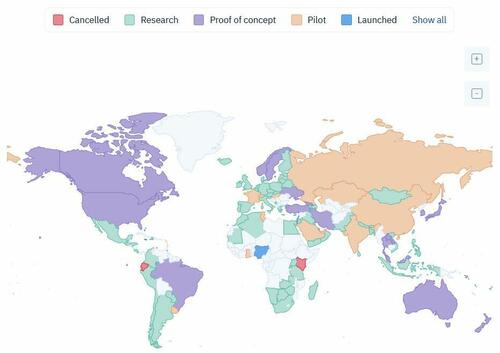
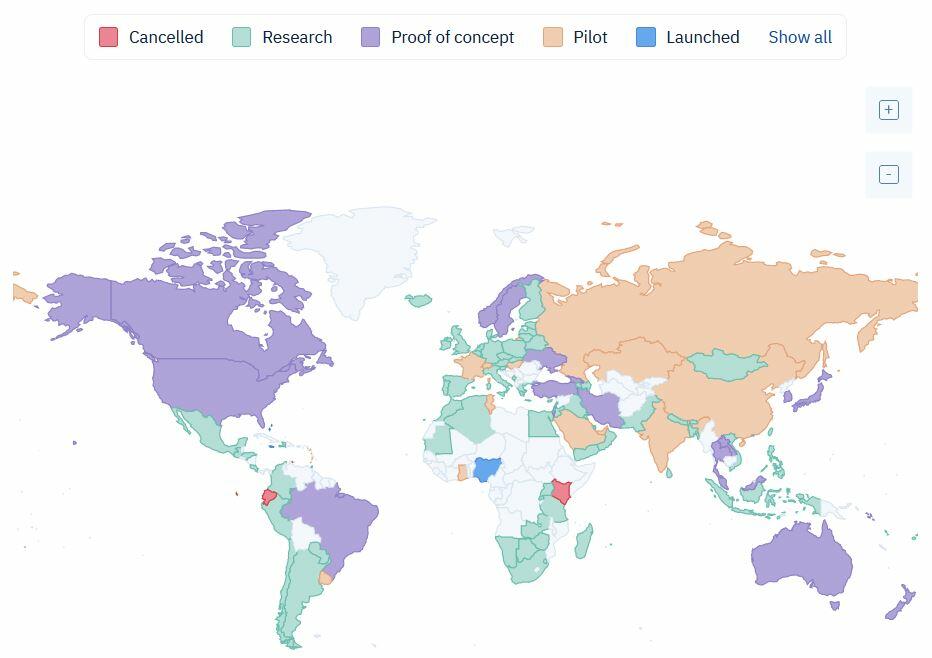
But they seem to be an inevitability, as according to data from the Atlantic Council CBDC Tracker, 130 countries - representing over 98% of global gross domestic product - are exploring or developing CBDCs, marking an outsized increase from just a few years ago.

Via cbdctracker.org

They're even starting to experiment with them for international settlement... In November, Zurich issued a CHF 100 million ($113m) digital bond via the SIX Digital Exchange - the most distinctive aspect of which is that it settles using a wholesale central bank digital currency (wholesale CBDC) issued by the Swiss National Bank (SNB).

Resistance!

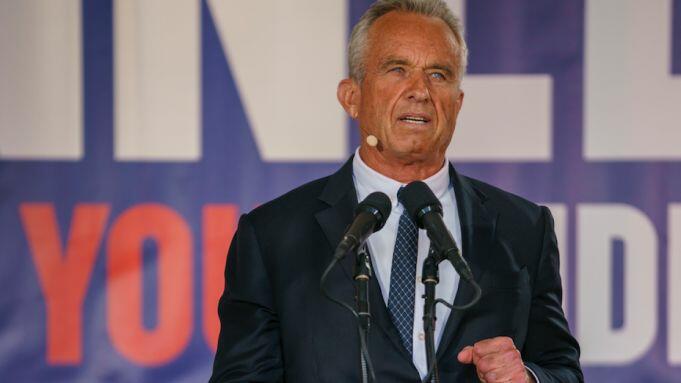
Last April, Democratic Presidential candidate Robert F. Kennedy Jr. (who is now working to create a new political party to qualify for the ballot in various states), vehemently opposed the Fed's announcement of a "FedNow" CBDC, calling it a "slippery slope to financial slavery and political tyranny."

"While cash transactions are anonymous, a #CBDC will allow the government to surveil all our private financial affairs. The central bank will have the power to enforce dollar limits on our transactions restricting where you can send money, where you can spend it, and when money expires," he wrote on X. "A CBDC tied to digital ID and social credit score will allow the government to freeze your assets or limit your spending to approved vendors if you fail to comply with arbitrary diktats, i.e. vaccine mandates."

In July, Kennedy promised to back the US Dollar with Bitcoin if he's elected president.

Also in July, Florida Governor Ron DeSantis (R) vowed to kill FedCoin on "day one" of his presidency, telling Tucker Carlson at the Family Leadership Summit in Iowa, "If I am the president, on day one, we will nix central bank digital currency. Done. Dead. Not happening in this country," adding "They want to get rid of cash. They want no cryptocurrency. They want [CBDCs] to be the sole form of legal tender. It will allow them to prohibit 'undesirable purchases' like fuel and ammunition."

More recently, several states opposed to CBDC have launched bills which would prohibit classifying digital currency as money.

If successful, Utah, South Carolina, South Dakota and Tennessee would become the first states to exclude CBDC as a medium exchange - potentially creating significant roadblocks to CBDC in the United States.

Finally, for those still unsure, we don’t need to look as far as China to understand the implications here in the West. As Laura Dodsworth wrote in October of the dystopian nature of CBDCs, via The Brownstone Institute:

In 2019, Mastercard and Doconomy launched a credit card with a carbon footprint calculator that can switch off your spending when you reach your carbon max. This functionality is voluntary, but it could be an automatic aspect of a CBDC.

Tom Mutton, a director at the Bank of England, said that the Government would be required to make the final decision on whether a UK CBDC should be programmable. Sir Jon Cunliffe, a deputy Governor at the Bank, said:

"You could think of giving your children pocket money, but programming the money so that it couldn’t be used for sweets. There is a whole range of things that money could do, programmable money, which we cannot do with the current technology."

As this quote reveals, CBDCs won’t just alter our relationship with money but with government. Governments around the world have shown increasingly authoritarian tendencies during the management of the Covid pandemic, and more recently to discourage driving in cities. Behavioural science has been leveraged to manipulate, incentivise and coerce us into behaving as model citizens. Do we want to negotiate with Daddy State to be allowed to spend our ‘pocket money’ as we wish?

An account-based CBDC would give the government enormous power over your money as your identity is connected to the money. A 2020 Bank of England discussion paper gave examples of programmability, for example that smart cars could automatically pay for fuel directly at the dispensing pump, with automated taxation and charitable donations at point of sale.

That all sounds very convenient. But politicians pushing Net Zero goals on an unwilling population could choose to go a step further. If you insist on keeping your private car, despite the inconvenient 20 MPH speed limits, the ULEZ and congestion charges, and the Low Traffic Neighbourhood barriers, they could simply dictate a maximum fuel spend in a given time period. Just ten of your Britcoins on petrol this month, Sir, no more driving for you.

Interestingly, we have not heard from the Biden administration with regard their support (or lack thereof) of CDBCs. Given their recent authoritarian over-steps, it shouldn't be too hard to guess which side of the 'more centralized power and control' vs 'freedom and personal sovereignty' fence they might come down on.

https://www.zerohedge.com/crypto/trump-vows-never-allow-central-bank-digital-currency

argenx OKd on Injection for Subcutaneous Use in Japan for Generalized Myasthenia Gravis

  argenx SE (Euronext & Nasdaq: ARGX), a global immunology company committed to improving the lives of people suffering from severe autoimmune diseases, today announced that Japan’s Ministry of Health, Labour and Welfare (MHLW) approved VYVDURA® (efgartigimod alfa and hyaluronidase-qvfc) injection for subcutaneous (SC) use for the treatment of adult patients with generalized myasthenia gravis (gMG), who do not have sufficient response to steroids or non-steroidal immunosuppressive therapies (ISTs). Following this decision, VYVGART is now approved in Japan for both intravenous (IV) and self-administered SC use.

https://www.biospace.com/article/releases/argenx-announces-approval-of-vyvdura-efgartigimod-alfa-and-hyaluronidase-qvfc-injection-for-subcutaneous-use-in-japan-for-generalized-myasthenia-gravis-/

Pakistan launches retaliatory strikes into Iran, with reports of nine killed

 Pakistan has launched missile strikes into Iran, reportedly killing nine people, after Iran carried out strikes in Pakistan late on Tuesday.

Pakistan said its strikes had hit "terrorist hideouts" in Iran's south-eastern Sistan-Baluchestan province.

Three women, two men and four children were killed, Iran's state TV said.

The reciprocal air strikes come as tensions in the Middle East are high with several overlapping crises.

Israel is fighting the Palestinian group Hamas in Gaza and exchanging fire with Iran-backed Hezbollah in Lebanon, Iran-backed groups in Iraq and Syria are targeting US forces, and the US and UK have struck the Iran-backed Houthis in Yemen, who have been attacking shipping.

Pakistan and Iran have long accused each other of harbouring militant groups that carry out attacks from regions along their shared border.

On Thursday, Pakistan's foreign ministry confirmed its strikes, which Iranian media said took place around the city of Saravan.

The ministry said it had acted in light of "credible intelligence of impending large-scale terrorist activities" and said a number of "terrorists" were killed. It added that it "fully respects" Iran's "sovereignty and territorial integrity".

In its own statement, Pakistan's army said the "precision strikes" were conducted with drones, rockets and long-range missiles.

It said they were targeting "terrorist organisations", namely the Balochistan Liberation Army and the Balochistan Liberation Front.

Both groups are part of a decades-long struggle for greater autonomy in Balochistan, a remote region in south-western Pakistan.

Pakistan had fiercely condemned Iran's strike on Tuesday, which struck an area of Pakistan's Balochistan province near the Iranian border and which Islamabad said killed two children.

Iran insisted its strikes were aimed only at Jaish al-Adl, an ethnic Baloch Sunni Muslim group that has carried out attacks inside Iran, and not Pakistan's citizens.

Earlier in the week Iran also attacked targets in Iraq and Syria. It said it had hit Islamic State and Israel's Mossad spy agency, both of which it said had been involved in a bomb attack in the Iranian city of Kerman earlier this month which killed 84 people.

Analysts said Pakistan's response was not surprising and matched Iran's in being presented as a specific attack on insurgents.

"Pakistan's retaliation does raise the risk of escalation, but it also provides an opportunity to step back from the brink. In effect, the two sides are even now," said Michael Kugelman, the South Asia director at the Wilson Center.

"Islamabad had a strong incentive to try to restore deterrence, especially with Iran on the offensive around the wider region deploying direct strikes and proxies to hit out at threats and rivals. In effect, if Pakistan had held back, it would have faced the risk of additional strikes."

Others suggested that the government in Islamabad was under domestic pressure to respond. The country, which saw its former leader Imran Khan removed nearly two years ago, is holding an election next month.

"There was a lot of public pressure on the government to do something and so they have done this just to prove that they are not less than [Iran], this act of sabre-rattling," said retired Lt General Asif Yaseen, a former Pakistani defence secretary.

But he said he had a "gut feeling that this will stop here for both the countries" and Pakistan could now be in a position to restart dialogue with Iran.

Some commentators have suggested Iran's strikes on Iraq, Syria and Pakistan this week were also driven by the current turbulent dynamics in the Middle East.

Tehran has said it does not want to get involved in the wider Israel-Gaza conflict, but groups that it backs have been targeting Israel and its allies to show solidarity with the Palestinians.

However Shashank Joshi, defence editor at The Economist, says he does not believe the strikes are an outcome of the 7 October Hamas attacks on Israel, which killed about 1,300 people and triggered Israeli retaliation against Hamas in Gaza, which officials from the Hamas-run health ministry there say has killed about 24,000 people.

"The story here is about Iran flexing its muscles, perhaps outraged by what it saw as a grievous assault on its country [in Kerman on 3 Jan, which is] the worst terrorist attack in Iran since the revolution of 1979 ... Iran is wounded and is lashing out. I don't think there's any compelling reason to say the bombing was caused by, or is an outcome of 7 October," Mr Joshi told the BBC's Today programme.

He adds that this is "not the first time there have been border tensions, but it is by far and away the most serious escalation in tensions that I can remember".

China, a strong ally of both nations, has called for both sides to show restraint and avoid an escalation.

https://news.yahoo.com/pakistan-launches-strikes-iran-two-051724721.html