Ownership of almost all small businesses has always been private. If their stock isn’t publicly traded, most companies haven’t needed to disclose the identify of owners anywhere.
That’s over for most U.S. companies.
The Corporate Transparency Act (CTA) went into effect January 1, requiring most businesses to identify their beneficial owners (someone who owns at least 25% of the company or who has “substantial control” over it) to the U.S. Treasury Department’s Financial Crimes Enforcement Network (FinCEN).And there’s certainly a high risk of political abuse.
Just yesterday, news came of evidence that the FinCen is flagging for attention transactions that include words like “MAGA” or Trump. And who trusts the federal government not to leak what are supposed to be confidential reports? Even Trumps tax returns were leaked.
The new law applies to U.S. corporations, limited liability companies and any other entities created by the filing of a document with a secretary of state or any similar office in the U.S. It also applies to companies formed under the law of a foreign country that have registered to do business in the U.S.
Exemptions are described here, but they generally are narrow. Also, the law does not apply to companies (a) with at least 20 full-time employees in the U.S.; (b) that file a U.S. federal income tax or information return showing more than $5,000,000 in U.S. gross receipts or sales for the prior fiscal year; and (c) have an operating presence at a physical office in the U.S.
It’s a dramatic change and will be a headache for many small companies. An estimated 30 million U.S. businesses will now have to file. The filed disclosures do not become public but may be used for law enforcement and national security. The law is intended to help stop and prosecute things like money laundering, tax fraud, terrorist funding and other illegal activities.
Penalties for non-compliance can be harsh. The CTA establishes civil penalties ($500 per day, up to a total of $10,000) and criminal penalties (up to two years of imprisonment) for individuals who willfully fail to file
The Illinois Secretary of State office will be taking on the task of notifying Illinois businesses about the law and developing materials to help explain it, which the Chicago Sun-Times wrote about here. Salute to both of them for that. Secretary of State Giannoulias and the state are not responsible for the new federal law in any way, so his office’s assistance will no doubt welcome to many unaware or perplexed small business owners.
The law enforcement reasoning behind the CTA is no doubt valid, but it’s also true that many law-abiding businesses and their owners have valid reasons for privacy. They won’t be happy with the new law.
Based on over thirty years earlier practicing corporate law and making venture capital investments, I can attest to many instances where privacy of ownership was important for a variety of business or personal reasons. I am not now a practicing lawyer, so please obtain your own legal advice.
The law passed in 2021 as part of related legislation with bipartisan support, overriding a veto by President Trump. It also had substantial support in the financial community and with some business groups, such as the U.S. Chamber of Commerce.
You won’t find many news reports on the CTA but plenty of good law firms have published advisories about the new law, which you can find by searching “Corporate Transparency Act.” Filing is done online at FinCEN’s website, which also links to FAQs and further information.
BridgeBio Pharma has agreed to sell future royalties on an experimental rare disease drug in exchange for $500 million if the medicine, called acoramidis, receives Food and Drug Administration approval.
The financing was extended by asset manager Blue Owl Capital and the investment board that manages the Canada Pension Plan, which together would receive 5% royalties on any future net sales of acoramidis, up to a certain cap.
Notably the agreement, which BridgeBio announced Thursday, provides for a “change of control” in the company, whereby prior to an FDA approval decision the funding agreement could be terminated. The provision could help preserve BridgeBio’s attractiveness to a potential acquirer, analysts at Mizuho Securities and Leerink Partners noted.
Additionally, BridgeBio restructured a debt agreement it held with Blue Owl, extending the maturity of a $450 million credit facility from 2026 to 2029. If needed, BridgeBio could access an additional loan of up to $300 million more.
Acoramidis, the drug at the center of Thursday’s deal, is BridgeBio’s chief asset. A small molecule, acoramidis is designed to treat a cardiac form of the rare disease transthyretin amyloidosis. A Phase 3 study of the drug read out positive results last summer and BridgeBio submitted it in December for FDA approval. If the agency accepts the company’s application, a decision would likely come near the end of the year.
The new funds would help support a commercial launch of acoramidis, if approved, BridgeBio said.
According to Mizuho analyst Salim Syed, the $500 million payment upon approval is indicative of a higher peak sales estimate for acoramidis than Wall Street currently forecasts. The difference, Syed wrote in a note to clients, suggests Blue Owl and CPP investments — the name of the entity managing the Canada Pension Plan — envision a longer-lasting market for acoramidis, with sales rising into the early 2030s.
Adams wavers on congestion pricing plan as MTA set to formally recommend $15 toll
0:23
Teachers union files federal lawsuit to block congestion pricing | amNewYork
1:12
MTA retains high-powered attorney Roberta Kaplan to defend congestion pricing from NJ suit | amNewYork
1:19
CAR CITY: MTA and Port Authority data shows record traffic on NYC crossings as congestion pricing nears | amNewYork
1:14
New Jersey files federal lawsuit to block NYC's congestion pricing plan; Staten Island sets up legal action
1:46
Congestion pricing board recommends $15 toll to drive into Manhattan | amNewYork
1:15
Adams wavers on congestion pricing plan as MTA set to formally recommend $15 toll | amNewYork
1:31
MTA formally recommends $15 congestion pricing toll with eye toward late spring debut | amNewYork
1:07
Congestion pricing toll will be paid by riders, not drivers, of taxis and for-hire vehicles | amNewYork
1:17
'Please leave us alone': East Village homeless say surprise encampment sweeps are becoming more violent
0:28
arrow_back_ios_new
arrow_forward_ios
The City Council’s Common Sense Caucus, a bipartisan group of conservative lawmakers, plus Queens Assemblymember David Weprin and a cadre of New Yorkers, mainly from the Lower East Side, filed the lawsuit in Manhattan federal court Thursday, naming the MTA and Federal Highway Administration as defendants.
Like the federal complaints previously filed by New Jersey and the United Federation of Teachers, the Common Sense Caucus argues that the MTA and FHWA conducted a half-baked environmental assessment of the program and should be made to undertake a much longer environmental impact statement.
“The city, the state, and the federal government did not do the proper review to protect the very citizens that were supposed to be protected by the environmental law of this nation,” said Jack Lester, the plaintiffs’ attorney, at a press conference outside City Hall on Thursday. “So that’s why we bring this case as a class action, so that we can resolve those issues that are negatively affecting so many New Yorkers. Emergency workers, police officers, nurses, firefighters, that will be taxed in a way that has not been evaluated.”
A suite of congestion pricing cameras on Third Avenue near 60th Street.Photo by Aidan Graham
The MTA is set to finally implement its congestion pricing program, charging most motorists $15 per day for entering Manhattan south of 60th Street, this spring, aiming to reduce traffic in Manhattan and raise money for the city’s transit infrastructure.
‘It’s time to move forward’
The agency has previously defended its lengthy environmental assessment and is currently in talks to settle the case with New Jersey, but officials have said the lawsuits threaten to forestall the program’s timeline.
“This issue has been exhaustively studied in the 4,000-plus page environmental assessment, and will be re-evaluated for the adopted tolling structure before tolling commences,” said John McCarthy, the MTA’s chief of external relations. “It’s time to move forward and deal with the congestion that’s clogging roads and slowing down emergency vehicles, buses and commerce while also polluting the air we breathe.”
The vast majority of commuters in the tri-state area arrive in Manhattan on mass transit, and the MTA argues that the $15 billion they expect to generate from the program will greatly enhance its network, including making the subway system accessible and upgrading its ancient signal system.
But like their counterparts in New Jersey and the teachers union, the plaintiffs in the new case say the plan will have significant negative impacts on them financially.
A ‘severe financial burden’
Danny Buzzetta, an East Village funeral home director, says congestion pricing will make him lose his business, as he must drive to cemeteries and crematories outside the central business district multiple times per day. Lower East Sider Meredith LeVande is a music teacher at a Bronx preschool and says she cannot take mass transit, as she hauls heavy and expensive musical equipment to school each day. Chinatown ice cream entrepreneur Ricky Yang says the congestion charge will lead to increase prices for their supplies.
Queens Councilmember Bob Holden, co-chair of the Common Sense Caucus.Photo by Ben Brachfeld
Meanwhile, plaintiff Rita Sue Siegel says she will face a “severe financial burden” driving from her second home upstate in Cold Spring to Manhattan for medical appointments.
“It’s insane that we have to pay to move around our city,” said Queens Council Member Bob Holden, one of the plaintiffs. “As a senior citizen, I don’t want to pay a tax to go to the hospital.”
Others who live near the FDR Drive, which will not be subject to the charge, say they fear more vehicles will pile onto the highway, causing increased air pollution, noise, and traffic in their neighborhood.
“This is an insult to our dignity and our right to a healthy environment,” said Trevor Holland, a Two Bridges resident and plaintiff, who said residents in the area suffer increased rates of asthma and cardiovascular disease due to FDR traffic and city agency depots near their homes. “The MTA’s plan will only worsen our health and our quality of life. To add insult to injury, the MTA offers absolutely no financial mitigation whatsoever.”
An MTA spokesperson responded to the plaintiffs’ contentions of increased traffic and pollution on the FDR corridor by noting they were based on hypothetical “tolling scenarios” that assumed a large number of discounts and exemptions, which would have raised the base toll and possibly led to increased “toll shopping.” The plan ultimately recommended by the MTA adopted almost none of the requested carve-outs.
To secure approval of the environmental assessment, the MTA committed to invest in mitigation efforts in some of the areas projected to see increases in traffic attempting to avoid the CBD, such as the South Bronx. The agency will invest tens of millions of dollars to electrify refrigeration trucks at the Hunts Point Market and add charging stations for trucks, as well as installing air filtration at local schools and planting roadside vegetation.
Lower East Side plaintiffs say congestion pricing would increase traffic and pollution on the FDR Drive.File Photo by Gabriele Holtermann
The preliminary fee structure approved by the MTA Board last year would charge higher rates for trucks and provide significant discounts overnight to encourage off-hours deliveries. Low-income drivers would be eligible for discounts after 10 trips into the CBD each month, while low-income Manhattan residents would be able to claim state tax credits to offset the cost of tolls.
The proposal is subject to public comment and hearings scheduled for February and March, ahead of a final vote by the MTA Board.
An MTA spokesperson said that despite now having three lawsuits to defend, the program is still on schedule to go into effect in the spring, and the agency is well underway installing gantries to automatically collect tolls. The mass transit upgrades congestion pricing would fund, however, are starting to see delays, most notably an effort to modernize signals on the A/C/E Fulton Street Line in Brooklyn.
Transit rider advocates seethed at the new lawsuit.
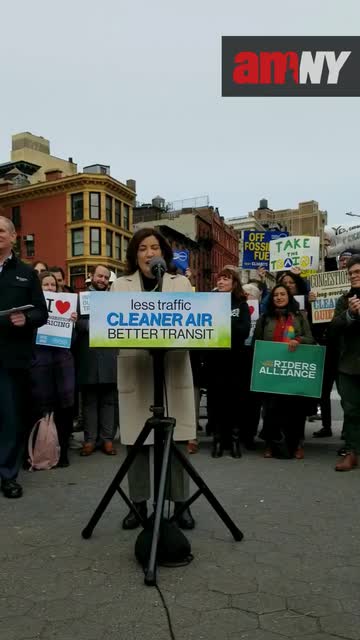
“Today, a handful of cynics with second homes filed yet another frivolous lawsuit in a parade of privileged objections to a fairer New York with modern, reliable, accessible public transit and cleaner air,” said Danny Pearlstein, policy director at the Riders Alliance. “What nerve to imagine that millions of subway and bus riders have similar recourse to expensive litigation and bucolic escapes from the pollution they leave in their wake each weekend and extended holiday.”
The Permanent Citizens Advisory Committee to the MTA, an in-house rider advocacy group, called the new suit “baseless” and “petty.”
“Yet another petty lawsuit aimed at delaying congestion pricing does not change the fact that the MTA conducted one of the most thorough Environmental Assessments in NEPA history,” said Lisa Daglian, PCAC’s executive director. “Congestion pricing’s benefits for our region have been exhaustively studied— and by this time should be widely understood: cleaner air, less traffic, and better transit for New Yorkers.”
Last week, the White House announced that the Federal Highway Administration (FHWA) would issue $623 million in grants for states to build chargers for electric vehicles (E.V.s). The money comes from the Charging and Fuel Infrastructure Discretionary Grant Program, a $2.5 billion fund established as part of the 2021 Infrastructure Investment and Jobs Act. According to the announcement, the project "will fund 47 EV charging and alternative-fueling infrastructure projects in 22 states and Puerto Rico, including construction of approximately 7,500 EV charging ports."
Unfortunately, that money is unlikely to go as far as it would have in private hands. "The CFI Program advances President Biden's Justice40 Initiative, which set a goal that 40% of the overall benefits of federal investments flow to disadvantaged communities that are marginalized by underinvestment and overburdened by pollution," bragged the FHWA press release. "More than 70% of the CFI funding announced today will support project sites in disadvantaged communities."
As an example, it notes "$1.4 million to the Chilkoot Indian Association, an Alaska Native Tribe, to build an EV charging station in Haines, a rural and disadvantaged community where there are no publicly available EV charging stations."
Haines is in Haines Borough, Alaska, which has a population of just over 2,000 people.
It's hard to imagine that "disadvantaged" communities would buy E.V.s if only there were public charging stations available. A November survey from S&P Global Mobility showed that potential buyers cite high E.V. prices as their primary concern, higher than concerns about range or charging infrastructure. And while E.V. prices have declined in recent years, the average new electric vehicle still costs around $50,000.
Not that this is the first instance of poorly planned government spending on E.V. infrastructure. Last month, Reasonreported that even though the federal government had dispensed $2 billion out of the $7.5 billion apportioned by the Infrastructure Investment and Jobs Act to build public charging stations, no chargers funded by the cash had come online. Speaking to Politico's James Bikales, state and E.V. industry officials blamed "the difficulties state agencies and charging companies face in meeting a complex set of contracting requirements and minimum operating standards for the federally-funded chargers."
"The barrier isn't technological," The Wall Street Journal's editorial board noted this week. "It took Tesla less time to install 80 chargers at its Harris Ranch station in northern California." Rather, "the bureaucrats are getting in their own way."
"The FHWA issued a rule requiring that workers for most projects be certified by the electricians union, or another government-approved training program," the Journal continued. "The Electric Vehicle Charging Association warned that the restrictions 'risk creating a bottleneck by limiting the available workforce.' The agency charged ahead anyway, decreasing the odds of a workable contract."
"In a better Washington, there would be no subsidies for EV chargers," noted the Journal. "The market would meet demand, as it did with gasoline stations. But we live in the age of subsidy," meaning bureaucrats are all too happy to give out your money and mine, with little hope of achieving their intended goals.