Search This Blog

Thursday, January 18, 2024

Key takeaways from the federal report on the Uvalde massacre

 The U.S. Justice Department on Thursday released its report on the 2022 Robb Elementary school shooting in Uvalde, Texas, that saw 19 young students and two teachers killed.

Here are some of its key findings:

ACTIVE SHOOTER

The report found that "the most significant failure was that responding officers should have immediately recognized the

incident as an active shooter situation" and not treat it as a "barricaded subject" scenario.

Ever since the 1999 Columbine High Shooting in Colorado, officers have been taught that "the first priority must be to immediately neutralize the subject," the report stated.

"This did not occur during the Robb Elementary shooting response, where there was a 77-minute gap between when officers first arrived on the scene and when they finally confronted and killed the subject," the report read.

The report says the gunman fired off 45 shots in the presence of officers - making it clear that he was an ongoing and active threat.

LEADERSHIP FAILURE

The report found there to be "cascading failures of leadership" on the scene, as at least 380 law enforcement officers from 24 local, county, state and federal agencies arrived.

Despite the size of that force, "none of the law enforcement leaders at the scene established an incident command structure to provide timely direction, control, and coordination to the overwhelming number of responders who arrived on the scene."

That meant arriving officers didn't know what was actually happening inside the school, the report found.

Many arriving officers incorrectly believed the shooter had been killed by the time they got there, based on "inaccurate information on the scene and shared over the radio or from observing the lack of urgency toward entering classrooms."

'WEAK COMMUNICATION'

Families of the victims have long complained over what they say has been a lack of transparency on the part of local, county and state officials about what took place during the shooting.

The report rebuked authorities for inaccurate information, weak communication, and conflicting messages that led to "misinformation, rumors, and a lack of trust and confidence in the relevant authorities."

FALSE HOPES, SCATTERED HELP

The report also found that after the shooting, some families "received incorrect information suggesting their family members had survived when they had not."

"In the days, weeks, and months following the tragedy, survivors, families, and responders received varying levels of support services," the report found.

A flood of organizations arrived immediately after the shooting to help Uvalde.

But since that initial response, help has been waning, and "difficulties with tracking victims and transitioning service providers have meant that some victims, family members, and community members have not received services."

https://www.marketscreener.com/news/latest/Factbox-Key-takeaways-from-the-federal-report-on-the-Uvalde-massacre-45770700/

China to track developments in Red Sea, provide support to foreign trade enterprises

  China's Ministry of Commerce said it was closely tracking developments in the Red Sea in response to the escalating situation there and the country would provide support and assistance to foreign trade enterprises.

"It is hoped that all parties concerned will restore and ensure the security of shipping lanes in the Red Sea waters," a spokesperson for the ministry said in a statement late Thursday.

The ministry said it hopes all parties jointly safeguard the smooth flow of global production and supply chains and the normal order of international trade.

https://www.marketscreener.com/news/latest/China-to-track-developments-in-Red-Sea-provide-support-to-foreign-trade-enterprises-45770688/

Axogen: Positive Topline Results from Trial of Axoguard Nerve Cap

 REPOSE trial met its primary endpoint of non-inferiority between the pain visual analog scale outcomes for neurectomy with Axoguard Nerve Cap® vs. standard-of-care neurectomy at Month 12.

Axoguard Nerve Cap demonstrated statistical superiority vs. standard-of-care neurectomy in the reduction of total pain reported by participants over the course of follow-up.

Axogen, Inc.,  (NASDAQ: AXGN), a global leader in developing and marketing innovative surgical solutions for peripheral nerve injuries, today announced positive topline results from its REPOSE clinical study comparing standard-of-care neurectomy of symptomatic neuroma to neurectomy and protection of the terminated nerve end with Axoguard Nerve Cap. The post-marketing study met its primary endpoint for reduction in pain as measured by visual analog scale (p-value <0.05).

Additional data analysis found that over the 12-month course of follow-up, the Axoguard Nerve Cap group demonstrated statistical superiority for reduction in the total pain reported by participants compared to the standard-of-care neurectomy group (p-value <0.05).

https://www.biospace.com/article/releases/axogen-inc-announces-positive-topline-results-from-repose-a-prospective-randomized-clinical-trial-of-axoguard-nerve-cap/


CG Oncology Sets IPO Target, Looks to Raise Up to $209M

 Cancer-focused biotech CG Oncology is looking to pull in over $180 million when it launches its initial public offering later this year. According to Thursday's filing with the SEC, the company estimates it will net around $181.1 million if the IPO sells at $17 per share.

CG Oncology plans to offer over 11 million shares of its common stock priced between $16 and $18 per share. The company also intends to offer up another 1.7 million shares to underwriters, which could bring the company a total of up to $209 million from the offering if the pricing is set at $17 per share.

Earlier this month, CG Oncology revealed that it planned to launch an IPO but no details were given at the time as to how much it was looking to net. The company plans to list on the Nasdaq under the name CGON.

The SEC filing states that if CG Oncology nets $181.1 million from the IPO, combined with its cash, cash equivalents and marketable securities, it will give the company around $368.7 million in capital.

The company plans to use around $155 million from the offering and what it has on hand to fund research and development of its bladder cancer candidate cretostimogene. This includes putting funds into “certain manufacturing activities,” with the remainder going to working capital and pre-commercial activities.

“We expect the net proceeds from this offering and our existing cash, cash equivalents and marketable securities will allow us to complete the ongoing BOND-003 and CORE-001 clinical trials, complete enrollment for the PIVOT-006 clinical trial, and initiate and report topline data for our planned CORE-008 clinical trial,” the company said in the document. 

CG Oncology may also use the funds to acquire, in-license, or invest in “complementary” businesses, tech or assets, but there have been no commitments. Ultimately, the company is expected to have a cash runway that extends into the second half of 2027 following the IPO. 

The IPO is not the only positive momentum CG Oncology has gained over the past few months. Its lead asset, cretostimogene, was given a Fast Track and Breakthrough Therapy designation in December 2023 for high-risk, BCG-unresponsive, non-muscle invasive bladder cancer. 

The IPO market in 2023 was anemic. However, CG Oncology and a handful of  biotech companies are looking to move into the public market early in 2024. Alto Neuroscience and CAR-T company Kyverna Therapeutics both kicked off their IPO processes this month. 

https://www.biospace.com/article/cg-oncology-sets-ipo-target-looks-to-raise-up-to-209m/

Novartis Ends Phase III Peanut Allergy Trial in Another Flop for Potential Xolair Successor

 Novartis appears to be throwing in the towel on its Xolair-successor hopeful. The Swiss pharma’s Phase III peanut allergy trial for ligelizumab has been terminated, according to a ClinicalTrials.gov update Tuesday. 

The clinical trials listing does not indicate the reason behind the peanut allergy study termination and the company has yet to make a statement as of this writing. Novartis’ pipeline still lists the asset for food allergy, marked as a lead indication. The pharma had previously projected a market size of greater than $1 billion for its food allergy antibody, according to Endpoints News

Ligelizumab, a subcutaneous biologic injection, was being tested in both peanut allergy and chronic forms of the skin disease urticaria. In January 2023, a 39-patient Phase III study in chronic inducible urticaria was axed. Two years prior, Phase III flops had the company cutting its intended indication of the drug for chronic spontaneous urticaria (CSU). 

Xolair, Novartis’ popular Genentech-partnered treatment for allergic asthma, chronic rhinosinusitis and CSU, has patents set to expire in 2024 and 2025. The companies are potentially closing in on a new indication, which could help stave off the looming patent cliff. 

In December 2023, the FDA accepted a supplemental biologics license application and granted priority review to Xolair for food allergies. If approved, it would be the first treatment on the market for allergic reactions to multiple foods due to accidental exposure in patients one year and older. A decision is expected during the first quarter of 2024.  

Novartis announced positive Phase III results for its BTK inhibitor in CSU in August 2023. Remibrutinib met its primary endpoint and demonstrated a rapid onset, improving patients’ symptoms in as little as two weeks. The company is anticipating a regulatory submission this year.  

Rounding out its immunological portfolio is a priority for Novartis with the impending patent expiration. In 2022, Xolair generated $4 billion in worldwide sales. In the first half of 2023, sales of the drug generated $716 million for Novartis. 

https://www.biospace.com/article/novartis-nixes-phase-iii-peanut-allergy-trial-in-another-late-stage-flop-for-potential-xolair-successor-/

Satsuma Fails to Secure FDA Approval for Nasal Powder Migraine Drug

 The FDA has rejected Satsuma Pharmaceuticals’ investigational dihydroergotamine nasal powder product STS101 for the treatment of acute migraine, according to parent company Shin Nippon Biomedical Laboratories‘ press release posted Thursday.

The regulator’s Complete Response Letter (CRL) pointed to problems with STS101’s chemistry, manufacturing and controls. Satsuma will discuss the rejection with the FDA, building toward a resubmission for the nasal drug.

SNBL’s Japan-listed stock dropped around 12% Thursday in response to the news, according to Reuters.

The CRL did not identify safety issues with STS101, nor did it ask Shin Nippon Biomedical Laboratories  (SNBL) to conduct additional studies, according to an Endpoints News.

STS101 is a reformulated version of dihydroergotamine mesylate (DHE), a well-established migraine medication for nasal-route administration. The drug candidate also utilizes Satsuma’s proprietary device for delivery.

Compared with existing acute migraine treatments, STS101 is designed to be more convenient and allows for self-administration, according to Satsuma’s website. It also has more rapid absorption and more quickly reaches peak DHE plasma levels as compared with liquid nasal spray formulations, which in turn could translate to better efficacy, the company contends.

Satsuma backed its New Drug Application for STS101, which the FDA accepted in May 2023, with data from the Phase III ASCEND study, which gave more than 10,500 doses of STS101 over 18 months to 446 enrolled patients.

In September 2022, long-term data from ASCEND demonstrated that at two hours after treatment, STS101 could elicit freedom from pain and from the most bothersome symptom in 34.2% and 53.4% of all treated migraine attacks, respectively. The drug candidate also eliminated the need for rescue medications in 94% of treated attacks.

In terms of safety, ASCEND found no clinically relevant systemic findings or unexpected treatment-related serious adverse events. Most toxicities were mild and transient.

Also included in Satsuma’s data package for STS101 is the Phase III SUMMIT trial, which failed its primary efficacy bar. The company reported in November 2022 that in SUMMIT, STS101 could not significantly distinguish itself from placebo in terms of freedom from pain and from the most bothersome symptom two hours post-treatment.

At the time, the company announced that it had no plans to independently commercialize STS101 and would instead look for alternatives that would “maximize value for shareholders, while minimizing cash expenditures.”

Satsuma began in 2016 and STS101 is its only asset so far. In March 2023, following the rocky development road for STS101 and in order to cut back on costs, Satsuma announced that it would lay off approximately 36% of its staff. A few weeks later, SNBL announced that it would acquire Satsuma.

https://www.biospace.com/article/satsuma-fails-to-secure-fda-approval-for-nasal-powder-migraine-drug-/

World's Coal-Fired Power-Generation Hit A Record High In 2023

 By Charles Kennedy of OilPrice.com

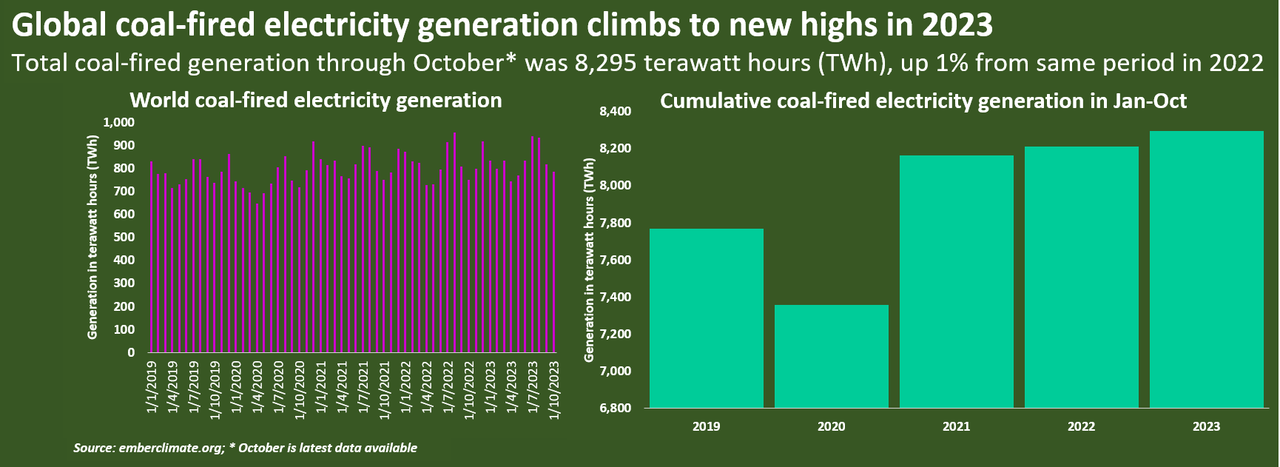
Global coal-fired power generation reached a record-high level in 2023, per data from environmental think tank Ember reported by Reuters columnist Gavin Maguire.

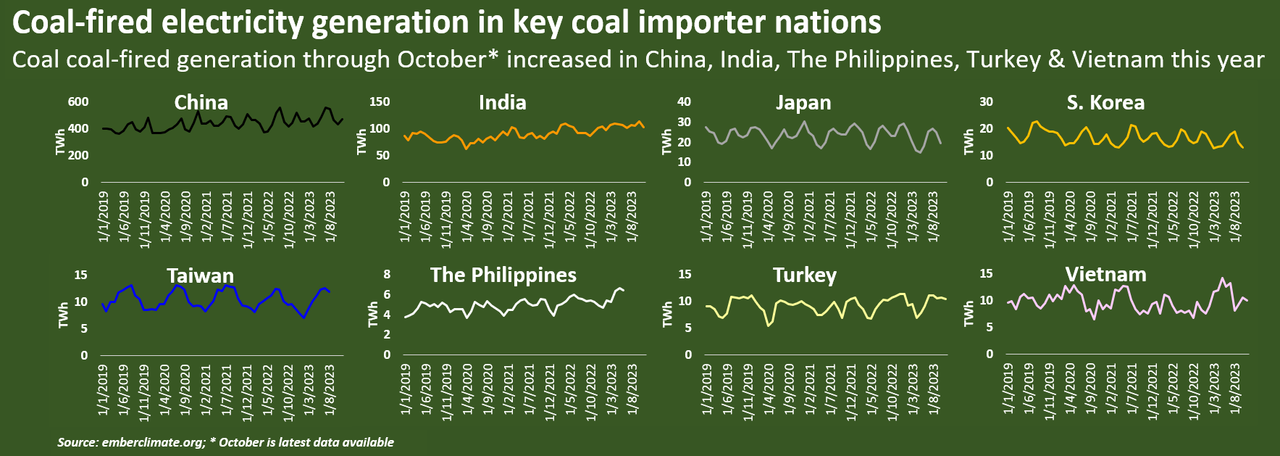
As countries, especially in Asia, looked to meet growing electricity demand and ensure their energy security, coal use in power generation hit record highs.

Per Ember data, global electricity generation from coal was 8,295 terawatt hours (TWh) between January and October, up by 1% compared to the same period in 2022.

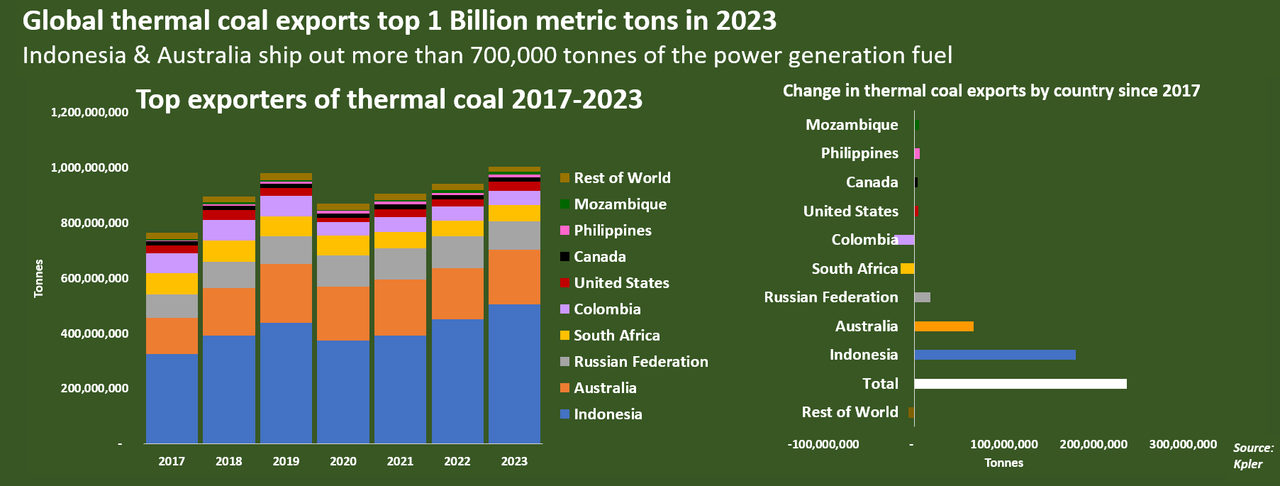
Meanwhile, global coal exports also rose last year to more than 1 billion metric tons for the first time ever, per cargo tracking data by Kpler, cited by Reuters’s Maguire. In 2023, worldwide thermal coal exports hit 1.004 billion metric tons, rising by 6.6% from the prior year.

Global coal demand likely rose by 1.4% in 2023 and surpassed a record-high level of 8.5 billion tons for the first time, the International Energy Agency (IEA) said in a report in December.

Moreover, the three top coal producers in the world – China, India, and Indonesia – are boosting production, which is reaching new highs, the IEA said in its Coal 2023 annual report.

While coal demand in the United States and the EU was set for a 20% record decline in 2023, coal use in emerging economies “remains very strong, increasing by 8% in India and by 5% in China in 2023 due to rising demand for electricity and weak hydropower output,” the IEA said.

China’s coal demand is expected to drop in 2024 and plateau through 2026, and global demand is set to decline to 2026, “but China will have the last word,” the IEA noted.

The outlook for coal in China will be significantly affected in the coming years by the pace of its clean energy deployment, weather conditions, and structural shifts in the Chinese economy, according to the agency.

https://www.zerohedge.com/markets/worlds-coal-fired-power-generation-hit-record-high-2023