Search This Blog

Monday, April 15, 2024

Over 250 Websites Selling Fake Weight-loss Drugs Reported by Anti-counterfeit Firm

 The cybersecurity firm BrandShield has taken down more than 250 websites selling fake versions of popular weight-loss and diabetes drugs in the GLP-1 class, the company’s CEO Yoav Keren told Reuters.

BrandShield, which shared this information exclusively with Reuters, said that out of the 279 pharmacy websites the company closed last year for selling drugs intended to treat metabolic conditions, more than 90% were related to GLP-1 medicines, according to Keren.

Novo Nordisk’s Ozempic and Wegovy and Eli Lilly’s Mounjaro and Zepbound are GLP-1 drugs, which were developed for type 2 diabetes but also reduce food cravings and cause the stomach to empty more slowly.

The drugs have been shown to help patients lose on average as much as 20% of their weight, fueling explosive demand and a burgeoning global market for fake versions.

Cases of harm linked to fake versions of Ozempic and other GLP-1s have been reported in at least nine countries, including Belgium, Britain, Switzerland and the United States.

"I wouldn't be surprised to see criminals try to use the growing popularity of these drugs to sell more counterfeits," said Keren.

Websites taken down for selling bogus GLP-1s represented just over 15% of the 1,655 websites BrandShield reported last year for peddling counterfeit drugs in areas, including hormone-related drugs, central nervous system medicines and cancer treatments.

Websites selling counterfeit GLP-1s were less common in 2022 when the company identified 34 such sites to be closed, although it was not targeting all of the GLP-1 drugs that year as it did in 2023, said Keren.

He said his firm last year did not find the same concentration of a particular class of drug in any treatment category as it did for GLP-1s as metabolic treatments.

BrandShield worked with the Pharmaceutical Security Institute (PSI), an industry-backed organization, to take down these websites. PSI's members, which include Lilly and Novo, chose which drugs to target, according to Keren.

The CEO said his company gets these websites taken down by collecting evidence that their products are counterfeit and submitting that to the service providers hosting the site.

When permitted or requested by its drugmaker customers, BrandShield will share that intelligence with law enforcement agencies. The U.S. Food and Drug Administration said in December it was investigating counterfeit Ozempic in the legitimate U.S. supply chain.

BrandShield also took down 3,968 listings on social media platforms for fake drugs in all categories last year, almost 60% of which were found on Facebook, according to a new report from the company.

The company removed more than 6,900 illegal drug listings across social media platforms and marketplaces in total, including 992 marketplaces in India, 544 in Indonesia, 364 in China and 114 in Brazil.

Keren said the company did not have data on how many of these social media listings and marketplaces were selling fake versions of GLP-1s.


https://www.medscape.com/s/viewarticle/more-than-250-websites-selling-fake-weight-loss-drugs-2024a100074l

One-Minute Speech Test Could Help Assess Dementia Risk

 Analyzing temporal changes in people's speech could be a simple way of detecting mild cognitive impairment to see whether there is a risk of developing dementia in the future, suggests research.

János Kálmán, MD, PhD, and colleagues at the University of Szeged in Hungary have developed an automated speech analysis approach called the Speech-Gap Test (S-GAP Test) that is unique because it focuses on the temporal changes made when someone talks. This means it does not overcomplicate matters by also assessing the phonetics and semantics of speech, Kálmán told Medscape Medical News. 

Kálmán presented his findings at the 32nd European Congress of Psychiatry. 

Temporal Speech Parameters

The test analyzes parameters such as how quickly someone speaks, whether they hesitate when they talk, how long the hesitation lasts, and how many silent pauses they make. This can be done with a mere 60-second sample of speech, Kálmán said, noting that other automated speech and language tools currently in development need much longer audio samples. 

"We tried different approaches and we finally ended up with the temporal speech parameters because these are not culture-dependent, not education-dependent, and could be more reliable than the semantic parts of [speech] analysis," he explained.

The analysis of temporal speech parameters is also not language-dependent. Although the S-GAP Test was developed using audio samples from native Hungarian speakers, Kálmán and his collaborators have shown that it works just as well with samples from native English and German speakers. They now plan to validate the test further using samples from native Spanish speakers. 

For Screening, Not Diagnosis

Currently, "the only purpose of this tool would be initial screening," Kálmán said at the congress. It is not for diagnosis, and there is no intention to get it registered as a medical device. 

A national survey of primary care physicians conducted by Kálmán and collaborators showed that there was little time for performing standard cognitive tests during the average consultation. Thus, the original idea was that the S-GAP Test would be an aid to help primary care physicians quickly flag whether a patient might have cognitive problems that needed further assessment at a memory clinic or by more specialist neurology services. 

The goalposts have since been moved, from developing a pure telemedicine solution to a more widespread application that perhaps anyone could buy and download from the internet or using a smartphone. 

Kálmán doesn't discount developing a more sophisticated version of the S-GAP Test in the future that combines temporal speech parameters with biomarkers for mild cognitive impairment or Alzheimer's disease and could be used in memory clinics and by neurologists for the purpose of diagnosis.

Detect to Prevent?

The big question is: What happens to all the people that could be flagged as needing further assessment using tools such as the S-GAP Test? 

Tackling risk factors for dementia will probably be key, said Robert Perneckzy, MD, MBA, professor of translational dementia research at Ludwig Maximilian University of Munich, Imperial College London, and the University of Sheffield.

According to the Lancet Commission on dementia, there are 12 potentially modifiable risk factors for dementia. Their influence varies throughout the life course, but certain early events, such as the level of education attained, can't be modified in an older patient. 

That said, there are many risk factors that might still be influenced later in life, such as adequately treating comorbid conditions such as diabetes, and addressing alcohol consumption and smoking practices. 

"We can do things in terms of personal risk, risk mitigation, which have a huge effect on dementia risk much later in life," said Perneckzy.

"The speech-based assessments are another opportunity to save our time as doctors to do assessments before someone comes to the memory clinic," he said.

The S-GAP Test is under development by the University of Szeged. Kálmán is a co-inventor. Perneckzy had no relevant conflicts of interest but has helped validate the S-GAP Test in the German language. 

https://www.medscape.com/viewarticle/one-minute-speech-test-could-help-assess-dementia-risk-2024a1000755

Meat Isn't Manly When It Comes to Erectile Function

 Rachel S. Rubin, MD: Welcome to another episode of Sex Matters. I'm Dr Rachel Rubin. I'm a urologist and sexual medicine specialist based in the Washington, DC area, and I interview amazingly cool people doing research in sexual medicine.


I heard an incredible lecture while I was at the Mayo Clinic urology conference by Dr Stacy Loeb, who is a wonderful researcher of all things prostate cancer and men's health, who is now talking more plant-based diets. Her lecture was so good, I begged her to join me for this discussion. Dr Loeb, I would love for you to introduce yourself.

Stacy Loeb, MD

Stacy Loeb, MD: I'm Stacy Loeb. I'm a urologist at New York University in the Manhattan VA, and I recently became board certified in lifestyle medicine because it's so important for sexual health and, really, everything that we do.

Rubin: You recently became very interested in studying plant-based diets. How did that start, and how has the research evolved over time?

Loeb: It's really amazing. For one thing, more of our patients with prostate cancer die of heart disease than of prostate cancer. And erectile dysfunction is really an early warning sign of cardiovascular disease. We felt like it was incumbent upon us, even within urology and sexual medicine, to better understand the basis for lifestyle modification that can help with these issues. We started doing some research on it, looking at men who follow more plant-based diets, and we found that they have a lower risk for fatal prostate cancer and are less likely to have erectile dysfunction.

Rubin: Tell us more about what you found for erectile dysfunction. How much benefit do people get by switching to a plant-based diet?

Loeb: First we looked at erectile function in men without prostate cancer in the health professionals follow-up study, a very large cohort study out of Harvard University. We found that among omnivorous people, those who ate more plant-based and less animal-based food were less likely to have incident erectile dysfunction. Then, we published a new paper looking at patients with prostate cancer. These men have extra challenges for sexual function because in addition to the standard cardiovascular changes with aging, prostate cancer treatment can affect the nerves that are involved in erections. But amazingly, even in that population, we found that the men who ate more plant-based and less animal-based food had better scores for erectile function.

That was really good news, and it's a win-win. There is no reason not to counsel our patients to eat more plant-based foods. Meat is not masculine. Meat is associated with a higher risk for erectile dysfunction and is considered carcinogenic. It's just something that we should try to stay away from.

Rubin: How do you counsel patients who might not be ready to go fully plant-based? Is a little better than nothing? How do you even start these conversations with people? Do you have any tips for primary care doctors?

Loeb: Great question. A little bit is very much better than nothing. In fact, in the health professionals follow-up study, we actually looked at quintiles of people who ate the most meat and animal-based foods and the least plant-based foods all the way up to the most plant-based and the least animal-based diets. Along that spectrum, it really does make a big difference. Anywhere that patients can start from is definitely better than nothing.

Simple things such as Meatless Monday or choosing a few days that they will give up animal-based foods will help. For some people, trying new things is easier than cutting things out, for example, trying a milk substitute such as oat, almond, or soy milk instead of dairy milk. That could be a great first step, or trying some dishes that don't include meat — maybe a tofu stir fry or a taco or burrito without the meat.

There are many great options out there. In terms of resources for doctors, the Physicians Committee for Responsible Medicine has a great website. They have fact sheets for a lot of the common questions that people ask such as how can I get enough protein or calcium on a plant-based diet? This isn't a problem at all. In fact, Novak Djokovic and many other elite athletes eat plant-based diets, and they get enough protein with a much higher requirement than most of us who are not elite athletes. These fact sheets explain which plant foods are the best

I also like Nutritionfacts.org. They also have all kinds of great videos and resources. Both of these websites have recipes that were created by doctors and nutritionists.

We can suggest that our patients work with a nutritionist or join a virtual program. For example, Plant Powered here in New York has virtual plant-based jumpstart programs. People around the country can get in on programs that have nutritionists and health coaches — for people who want a boost.

Rubin: The data are really compelling. When you were speaking, not a person in the room was interested in having a steak that night for dinner, even with a steakhouse in the hotel.

What do you say to men who have prostate cancer or suffer from erectile dysfunction? Do any data show that by going plant-based you may show improvements? We have recent studies that show that regular exercise might be as good as Viagra.

Loeb: It's definitely not too late, even if you've already been diagnosed with these conditions. In my own practice, I have seen changes in patients. In fact, one of the case scenarios that I submitted for the lifestyle medicine boards was a patient who adopted a whole food, plant-based diet and no longer uses Viagra. This is definitely something that's possible to do with intensive lifestyle modification.

Rubin: Maybe vegetables are the new sexual health aide. How can people find out more? I know you have a Sirius XM radio show.

Loeb: It's the Men's Health Show on Sirius XM channel 110. It's on Wednesdays from 6:00 to 8:00 PM ET, or you can listen to it on demand anytime through the Sirius XM app.

Rubin: You have done an enormous amount of research in prostate cancer and sexual medicine. You are an all-star in the field. Thank you for sharing all of your knowledge about plant-based diets. You've given us all a lot to think about today.

https://www.medscape.com/viewarticle/1000338

American Airlines' pilots union sounds alarm about 'problematic trends' in air safety

 Though United Airlines made headlines last month for its industry-leading number of Federal Aviation Administration-noted incidents, it seems like it’s not the only airline having trouble maintaining high safety standards.

Bloomberg reports that the Allied Pilots Association, the union that represents pilots for American Airlines, issued a memo to members Friday warning them to remain “vigilant” amid a “spike” in safety problems.

“While United Airlines is currently under public and government scrutiny, it could just as easily be American Airlines,” the union said, according to a copy of the memo provided to Quartz.

Among the “problematic trends” identified by the union were tools being left in plane wheel wells, a reduction in quantity and quality of maintenance checks, and pressure to quickly return planes to service despite fewer aircraft inspections.

“Remember: Don’t rush, don’t be intimidated, and don’t be pressured into doing something that doesn’t pass the ‘smell test,’” the memo reads. “Just because it’s legal doesn’t make it safe.”

In the wake of mid-flight door plug blowout aboard an Alaska Airlines-operated Boeing 737 Max 9, the airline industry has come in for a lot more scrutiny regarding operational safeguards. Boeing has been the biggest focal point, but it hasn’t been the only one. After its bumpy March, United executives told their workforce that the FAA would be supervising the company more closely.

American Airlines did not immediately respond to a request for comment. At its Investor Day last month, the company trumpeted its safety record.

“We’re running an operation that delivers on the capacity we guided to what our customers, our shareholders and our team can trust,” COO David Seymour told attendees. “It’s an operation built on a strong safety foundation that is bolstered by our industry-leading safety management systems.”

https://qz.com/american-airlines-pilots-safety-problems-1851410712

4D Molecular started at Overweight by Barclays

 Target $45

https://finviz.com/quote.ashx?t=FDMT&p=d

"Operation Praying Man Tis" Shows The US In Geopolitical Retreat

By Michael Every of Rabobank

If all you focus on is Brent oil, 10-year US Treasury yields, and the US dollar, relax: they are roughly where they were at the close on Friday before Iran unleashed over 300 suicide drones, cruise missiles, and ballistic missiles at Israel: the geopolitical shock in markets today is aluminium up 6% after the London Metal Exchange banned Russian metals. However, if you think financial metrics tell you what’s going to happen in the Middle East, you don’t have a prayer.

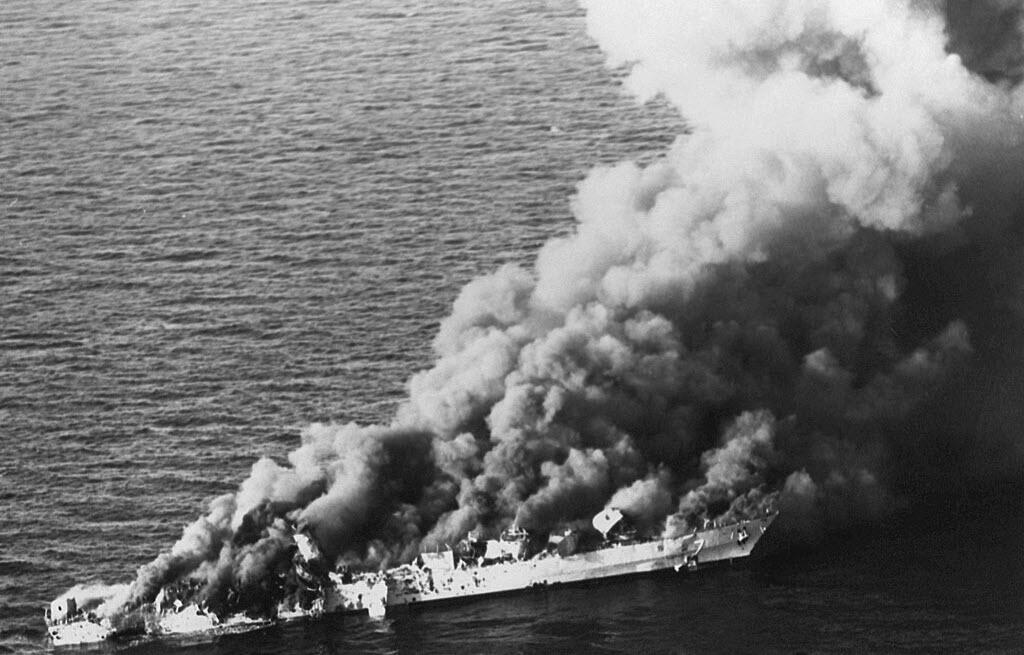
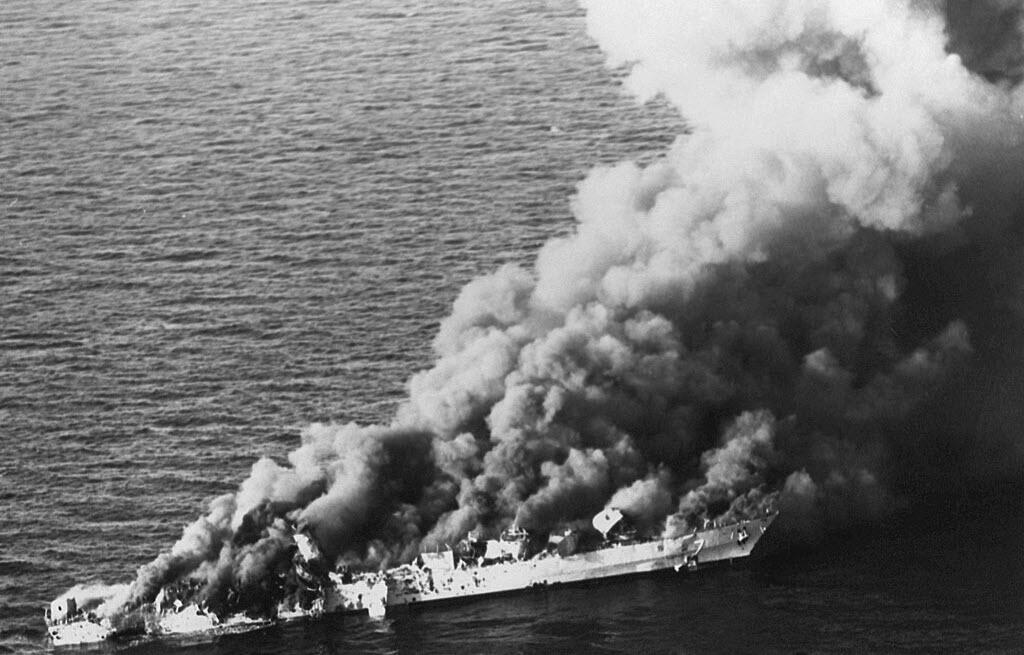
On 14 April 1988, a US Navy vessel struck an Iranian mine in the Strait of Hormuz. The US then launched Operation Praying Mantis, and in eight hours, sank two Iranian oil platforms, three warships, several armed boats, and two fighter jets, a blow that helped end the long Iran-Iraq War. That US was the emerging global hyperpower, as the Soviet bloc and USSR slid towards collapse; “geopolitics” meant US muscle opening the way for global US-style capitalism.

The Iranian frigate Sahand burning from bow to stern on 18 April 1988 after being attacked

On 15 April 2024, Operation Praying Man tis, with the US far weaker militarily and unwilling to use full force against the combined challenge of Iran, Russia, China, and North Korea; “geopolitics” means a US retreat, as elite American youth rejects both capitalism and America.

What just happened between Iran and Israel was not the start of WW3. However, neither was it “geopolitical theatre" with fake violence, like a WWF match. It was deadly serious, has huge implications for markets, and is likely not over yet.

We saw the extent and limits of US/Western/Israeli power:

  • Shooting down 99% of the drones/missiles fired at Israel was a remarkable military achievement that will prove a (pricey) template for others (as Ukraine suffers without such a shield). However, this was only a small fraction of the arsenal Iran and Iranian-proxy Hezbollah hold, and they will have now learned how to recalibrate to try to overwhelm Israel’s defences next time.
  • As remarkable was a defence alliance of Jordan, the Saudis, the UK, France, and the US, helping shoot down Iranian attacks. However, this may not hold up to regional political pressures.
  • The economic cost of the defence was staggering - $1.3bn for one night. The attackers paid far less. As with Ukrainian drones vs. the Russian Black Sea Fleet and the Houthis vs. the West’s Operation Prosperity Guardian, which is not guarding anyone’s prosperity, if military attack is now multiple times cheaper than defence, the inverse of the past, then we can expect a lot more global attacking to be done.
  • A clear loss of US deterrence is evident given President Biden told Iran’s Khameneni "Don't!" – and he did anyway, as Putin did before him. Biden is also telling China’s Xi “Don’t!” on Taiwan and the Philippines. It’s not clear if Biden told Israel’s Netanyahu “Don’t!” on striking back against Iran, which the Israeli media says its war cabinet had decided to do on Saturday night but delayed after a phone call with the US. But the US clearly looks weak on many fronts.

Israel has apparently decided to counterattack – just not yet when, where, and how. However, Iran’s new redline is any strike on Iranians anywhere will see it hit Israel directly, and escalate; and a shocked post-10/7 Israel needs to show Iran that when it uses proxies to hurt it, Iranian territory will feel the pain too. Regardless of any talk about “de-escalation”, or the fact the US and Iran don’t want full-blown war, that escalation-ladder geopolitical dynamic should be clear.

Iran has said it will attack US forces in the Middle East (again) if the US helps Israel hit it. The US has said it will not join in any attack, as rumors swirl Qatar and the UAE forbade the US from using its military bases in their countries for strikes on Iran this weekend. However, this does not mean the US won’t help defend Israel (again), or that it will necessarily oppose an Israeli strike: it just wants to be informed in advance this time.

Israel faces a choice between responding to what Iran did (little damage), and what it tried to do (over 300 times the Israeli strike on Damascus). Both carry huge risks.

Israel can keep its new-found support and regional alliance, and the US happy, but it will lose crucial deterrence at a very dangerous time. It would also mean repeating what its public sees as the failed "high tech defences and hope" strategy employed in the past vs. Hamas.

Iran is meanwhile winning the regional long game of a slow-grind, proxy-based “War Between Wars”, and is moving closer to a nuclear weapon: Jerusalem may see this as its last window to act on that existential threat given the ADHD West --briefly-- views it with sympathy again. Traditionally cautious PM Netanyahu, slumping in the polls, has always been fixated on Iran, and heads a far-right coalition calling for a counterstrike; there may even be a presumption the US would be forced to step in if things escalate. Yet an Israeli attack risks opening Pandora's Box: it could fail; and there is no ‘one and done’ - what if Iran then got help from Russia and China? (As China is accused of playing a large role in Russian military rebuilding.)

One “de-escalatory” way out might be for Israel to accept strong G7 sanctions against Iranian energy and ballistic missile production. Yet while the G7 has unequivocally condemned in the strongest terms Iran’s attack on Israel, expressed full solidarity and support to Israel, reaffirmed its commitment towards its security, and “stands ready to take further measures now and in response to further destabilizing initiatives”, nothing concrete has been proposed. What would be required to hurt Iran would push energy prices higher, which none of the G7 will accept. After all, we already see the West won’t impose tough secondary sanctions on Central Asia or China because it won’t face the pain needed for a real economic war.

So, with or without sanctions on Iran, over time the geopolitical risks lean towards further upside for energy prices, as we flagged immediately after the 10/7 Hamas attack on Israel (along with saying that the Suez Canal might be closed).

Relatedly, lost in all this noise is last week’s Iranian hijacking of an Israel-linked container vessel in the Strait of Hormuz and the kidnapping of its Filipino/Indian crew: that suggests the need for a larger US Navy presence in Hormuz as well as the Red Sea. In which case, where are the vessels needed for the Indo-Pacific as tensions rise there?

This is the unstable global security architecture markets sit atop while making their torch-on-a-wall forecasts: one wrong move --as predictable moves keep being made-- and oil prices can surge, and all economic projections are wrong. So, Operation Praying Man tis:

And markets are praying they can pretend deteriorating geopolitics matter far less than their little models or pretty chartsLike the one showing USD/JPY at 153.42, proof the global geoeconomic and financial architecture was already at risk of breaking down even before Iran attacked Israel directly

https://www.zerohedge.com/markets/operation-praying-man-tis-where-geopolitics-shows-us-full-retreat

'Biden to meet with Iraqi PM amid tension over troops, renewed ISIS threats'

 President Biden will meet with Iraqi Prime Minister Mohammed Shia al-Sudani at the White House on Monday with the future of American troops in Iraq is in flux, and as the Islamic terror group ISIS has re-emerged amid mounting tensions in the Middle East.

At the meeting, al-Sudani and Biden will focus on private sector and business investment in Iraq, a priority for Baghdad, and other more cooperative areas like energy security, according to a senior State Department official.

But an important part of the discussions will be on the future of the American presence in Iraq, where around 2,500 U.S. troops are stationed. The U.S. and Iraq are engaged in ongoing talks on whether those troops are still needed to counter ISIS.

“It is not the primary focus of the visit,” the State Department official said in a call with reporters, referring to the troops. “But it is almost certainly going to come up.”

Biden’s meeting with al-Sudani will be closely watched as the leaders are meeting during an extremely tense time in the Middle East that has strained U.S.-Iraq relations.

Israel is waging a war against Palestinian militant group Hamas in Gaza, where more than 33,000 people have died in more than six months of war. The conflict has sparked regional escalation between U.S. forces and Israel and Iranian-backed proxies.

The Houthi rebels in Yemen are still regularly launching strikes on merchant ships in the Red Sea, where they are battling U.S. forces defending the commercial route.

Iraq was also a battleground in the regional conflict until a couple months ago, when the last Iranian-backed proxy groups in Iraq and Syria launched an attack on a U.S. base. Those Iran-backed militia groups have paused attacks since deadly U.S. retaliatory strikes in February.

Still, al-Sudani and Iraqi officials expressed anger at both Iran and the U.S. for using Iraq as a battleground in the proxy war.

At the heart of the ongoing discussions between Washington and Baghdad on the future of American troops are whether the Iraqi security forces trained by American troops are capable now of fending off the threat from ISIS.

The U.S. invaded Iraq in 2003 to dismantle the regime of Saddam Hussein and returned in 2014 at the invitation of Iraq to defeat ISIS, a continuing mission.

ISIS remains largely defeated after losing key swaths of territory in Iraq and Syria between 2014 and 2017.

However, the Afghanistan branch of the widely condemned terror group, ISIS-K, has since re-emerged, attacking and killing dozens of people in both Iran and Russia this year. ISIS-K was also responsible for the bombing at the Kabul airport in 2021 that killed 13 American servicemembers during the chaotic U.S. withdrawal from Afghanistan.

Al-Sudani said in an opinion piece in Foreign Affairs magazine that stakeholders in the ongoing meetings have agreed to withdraw the international coalition in a gradual manner, with a road map toward that end still under discussion.

He said the U.S. and Iraq need a “new phase of partnership, based on cooperation that goes beyond just security and military affairs” because the ISIS threat is diminished.

“Little by little, as security and stability are restored, the need for weapons outside the control of the state and its institutions will disappear. We are working concertedly toward that end,” he wrote, instead calling for greater U.S.-Iraq cooperation on diplomacy, economy, education and technology, among other areas.

Al-Sudani also cited the violence in his country involving American forces and Iranian-backed groups, and argued the “decision to make war and peace must be an exclusive matter for the state, and no other party can claim this right.”

“We approach every country on equal terms, so that Iraq does not become an arena for any outside actor to settle scores,” he wrote. “Iraq must be dealt with on the basis of sovereignty and mutual respect, not as a proxy for other conflicts.”

The State Department official said the “ability of the Iraqis to make their own decisions and to build their sovereignty and to respect that is something that is very important.”

The official also stressed that discussions are ongoing about the future of American troops, but after 10 years, they “see an opportunity” to “transition to a stronger bilateral relationship and partnership.”

“Whether that ends up as adjusting our forces there, ” the official said, “all of that is being discussed.”

Another issue likely to come up is a hostage held by an Iran-backed militia in Iraq. Rep. Mike Waltz (R-Fla.) sent a letter to Biden ahead of the meeting with al-Sudani expressing concern about the Iraqi government’s close ties with Iran-backed militias, including Kataib Hezbollah, according to Politico.

Waltz pressed Biden to “condition the meeting” with al-Sudani on the Iraqi leader pushing Kataib Hezbollah to release a kidnapped U.S.-base doctoral student, Elizabeth Tsurkov, who is a Russian-Israeli citizen. She has been held since March 2023 after being detained on a visit to Baghdad.

https://thehill.com/policy/defense/4590389-biden-to-meet-with-iraqi-pm-amid-tension-over-troops-renewed-isis-threats/