Search This Blog

Monday, April 15, 2024

New mechanism uncovered in early stages of Alzheimer's

 Alzheimer's disease (AD) remains one of the most challenging and prevalent neurodegenerative disorders, affecting millions of individuals worldwide. In a new study published in Developmental Cell, researchers from the lab of Wim Annaert (VIB-KU Leuven) have identified a novel mechanism potentially connected to the early stages of AD. They demonstrated that a fragment of the amyloid precursor protein (APP), called APP-CTF, disrupts communication between cellular compartments crucial for calcium storage and waste disposal, which could be an early event preceding neuronal cell death.

These findings, with potential implications for the development of new AD treatments, suggest that preventing APP-CTF accumulation needs to be taken into account to develop more effective treatments.

Alzheimer's disease is characterized by the progressive loss of cognitive function, memory impairment, and behavioral changes. One of the visible features in the brains of people with Alzheimer's disease is the formation of amyloid plaques—clumps of β-amyloid (Aβ) peptides, which are degraded products of amyloid precursor protein (APP). These Aβ-fragments accumulate in neurons early in the disease, even before cognitive decline is observed.

The new research, however, suggests that there might even be earlier events happening in the AD brain before plaque formation and that the APP protein plays a role in these early stages. The mechanism behind this remained a mystery until now.

In their latest study, the lab of Annaert at the VIB-KU Leuven Center for Brain & Disease Research identified a mechanism explaining how APP may contribute to these early stages of AD. This discovery could lead to a new direction in AD research and treatment approaches.

Disrupting cellular communication

APP is found in the cell membranes of brain cells. The brain constantly produces new APP molecules while breaking down and removing old ones. This process involves enzymatic scissors, with gamma-secretase being the final one that generates the well-known and well-studied Aβ peptides in AD.
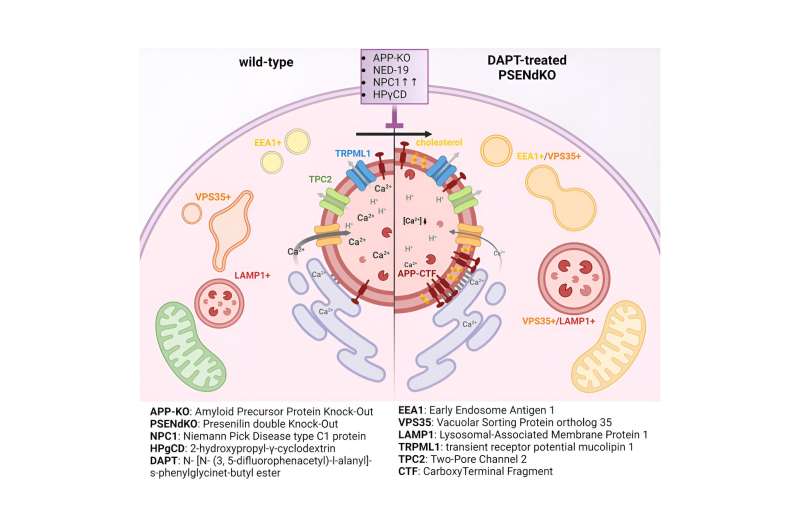
New mechanism uncovered in early stages of Alzheimer's disease
Graphical abstract. Credit: Developmental Cell (2024). DOI: 10.1016/j.devcel.2024.03.030

For a long time, it was thought that blocking gamma-secretase would be the logical step to prevent the production of toxic Aβ fragments. However, this leads to the accumulation of their precursor, the APP-C-Terminal Fragments, or APP-CTFs. Now, the researchers have discovered that these fragments are also toxic to neurons. They appear to accumulate between the  (ER), the compartment that is crucial for lipid synthesis and calcium storage, and the lysosomes, the so-called 'waste bins' of neurons, which are critical for degrading the cell's waste products.

"By doing so, APP-CTFs disrupt the delicate balance of calcium within lysosomes," explains Dr. Marine Bretou, first author of the study. "This disruption triggers a cascade of events. The ER can no longer effectively refill lysosomes with calcium, leading to a buildup of cholesterol and a decline in their ability to break down cellular waste. This results in the collapse of the entire endolysosomal system, a crucial pathway for maintaining healthy neurons."

The new study further supports that the APP-CTFs resulting from suppressing gamma-secretase might actually be the culprit behind endolysosomal dysfunction, as observed in the very early stages of AD.

This research significantly advances our comprehension of the potential causes of disease in the early stages of AD. A remarkable outcome of this study is that these early stages could be caused by another fragment of the same APP molecule rather than Aβ.

This has significant implications for the current therapeutic approaches that aim to clear the AD brain from amyloid plaques, as they tend to ignore the toxic effects of other fragments. Other attempts focus on tau proteins or neuroinflammation, which are other hallmarks of AD progression that target later events. However, early intervention is likely the key to stopping or even preventing AD.

"The failure of clinical trials using gamma-secretase inhibitors may be explained by the fact that we were focusing on only one culprit and at a too late stage in the disease," explains Prof. Annaert, senior author of the study.

"Our research findings suggest that  modulators, which can help promote clearance of toxic APP-CTFs without blocking the enzyme completely, may be a more relevant target for  in AD. The key might be finding the right balance between APP-CTF clearance and plaque prevention."

Looking ahead, the scientists are joining efforts with colleagues to develop these modulators based on these novel insights and will continue exploring cellular homeostasis in the early stages of AD.

More information: Marine Bretou et al, Accumulation of APP C-terminal fragments causes endolysosomal dysfunction through the dysregulation of late endosome to lysosome-ER contact sites, Developmental Cell (2024). DOI: 10.1016/j.devcel.2024.03.030


https://medicalxpress.com/news/2024-04-mechanism-uncovered-early-stages-alzheimer.html

'New vaccine strategy may mean the end of the line for endless boosters'

 Scientists at UC Riverside have demonstrated a new, RNA-based vaccine strategy that is effective against any strain of a virus and can be used safely even by babies or the immunocompromised.

Every year, researchers try to predict the four influenza strains that are most likely to be prevalent during the upcoming flu season. And every year, people line up to get their updated vaccine, hoping the researchers formulated the shot correctly.

The same is true of COVID vaccines, which have been reformulated to target sub-variants of the most prevalent strains circulating in the U.S.

This new strategy would eliminate the need to create all these different shots because it targets a part of the viral genome that is common to all strains of a virus. The vaccine, how it works, and a demonstration of its efficacy in mice is described in a paper published in the Proceedings of the National Academy of Sciences.

"What I want to emphasize about this vaccine strategy is that it is broad," said UCR virologist and paper author Rong Hai. "It is broadly applicable to any number of viruses, broadly effective against any variant of a virus, and safe for a broad spectrum of people. This could be the universal vaccine that we have been looking for."

Traditionally, vaccines contain either a dead or modified, live version of a virus. The body's immune system recognizes a protein in the virus and mounts an immune response. This response produces T-cells that attack the virus and stop it from spreading. It also produces "memory" B-cells that train your immune system to protect you from future attacks.

The new vaccine also uses a live, modified version of a virus. However, it does not rely on the vaccinated body having this traditional immune response or immune active proteins—which is the reason it can be used by babies whose immune systems are underdeveloped, or people suffering from a disease that overtaxes their immune system. Instead, this relies on small, silencing RNA molecules.

"A host—a person, a mouse, anyone infected—will produce small interfering RNAs as an  to viral infection. These RNAi then knock down the virus," said Shouwei Ding, distinguished professor of microbiology at UCR, and lead paper author.

The reason viruses successfully cause disease is because they produce proteins that block a host's RNAi response. "If we make a mutant virus that cannot produce the protein to suppress our RNAi, we can weaken the virus. It can replicate to some level, but then loses the battle to the host RNAi response," Ding said. "A virus weakened in this way can be used as a vaccine for boosting our RNAi immune system."

When the researchers tested this strategy with a mouse virus called Nodamura, they did it with  lacking T and B cells. With one vaccine injection, they found the mice were protected from a lethal dose of the unmodified virus for at least 90 days. Note that some studies show nine mouse days are roughly equivalent to one human year.

There are few vaccines suitable for use in babies younger than six months old. However, even newborn mice produce small RNAi molecules, which is why the vaccine protected them as well. UC Riverside has now been issued a US patent on this RNAi vaccine technology.

In 2013, the same research team published a paper showing that flu infections also induce us to produce RNAi molecules. "That's why our next step is to use this same concept to generate a , so infants can be protected. If we are successful, they'll no longer have to depend on their mothers' antibodies," Ding said.

Their flu vaccine will also likely be delivered in the form of a spray, as many people have an aversion to needles. "Respiratory infections move through the nose, so a spray might be an easier delivery system," Hai said.

Additionally, the researchers say there is little chance of a  mutating to avoid this vaccination strategy. "Viruses may mutate in regions not targeted by traditional vaccines. However, we are targeting their whole genome with thousands of small RNAs. They cannot escape this," Hai said.

Ultimately, the researchers believe they can 'cut and paste' this strategy to make a one-and-done vaccine for any number of viruses.

"There are several well-known human pathogens; dengue, SARS, COVID. They all have similar viral functions," Ding said. "This should be applicable to these viruses in an easy transfer of knowledge."

More information: Hai, Rong et al, Live-attenuated virus vaccine defective in RNAi suppression induces rapid protection in neonatal and adult mice lacking mature B and T cells, Proceedings of the National Academy of Sciences (2024). DOI: 10.1073/pnas.2321170121doi.org/10.1073/pnas.2321170121


https://medicalxpress.com/news/2024-04-vaccine-strategy-line-endless-boosters.html

Who Is Funding Pro-Palestinian Chaos at O'Hare, Golden Gate Bridge

Hours after pro-Palestinian protesters sparked chaos at Terminal 1 at Chicago O'Hare International Airport, another likely unit of the group has shuttered part of the Golden Gate Bridge. 

X account "Collin Rugg" says:

Pro-Palestine protesters have blocked the Golden Gate Bridge just hours after another group shut down lanes at Chicago O'Hare airport. 

The protest reportedly started in Oakland where they blocked lanes and chained themselves to barrels. 

Now, all southbound direction lanes of the Golden Gate Bridge are blocked causing miles of traffic. 

Protesters say the protests are a part of a "worldwide economic blockade in solidarity with Palestine." 

These pro-Palestinian groups are running around the country, causing chaos and disruption to critical infrastructure, such as airports and bridges. This reminds us of when the communist group Black Lives Matter sparked chaos during Covid. 

Who are these pro-Palestinian protesters? And who are they being funded by? 

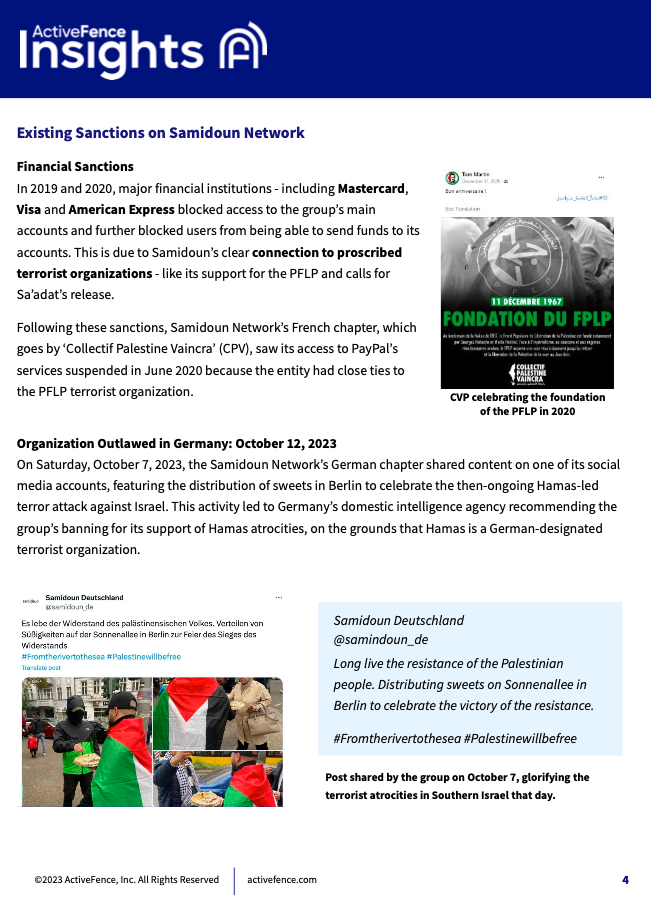
Well, there are concerns that a little-known international organization called Samidoun could be behind the latest demonstrations shutting down American infrastructure. The Israeli government declared Samidoun a terrorist organization in 2021.

"They support terrorism, and they want to gain public opinion — support — for terrorism," Yossi Kuperwasser, the former chief of the research division in the Israel Defense Forces' military intelligence unit, recently said. 

ActiveFence Research sheds more color on Samidoun: 

Meanwhile, some X users are asking why the US and or Canadian governments are ignoring these 'pro-Hamas' groups running around causing economic disruptions to critical infrastructure. 

 *   *  *  

Pro-Palestinian protesters are blocking Terminal 1 at Chicago O'Hare International Airport on Monday morning, causing chaos for travelers trying to catch flights. 

Local media outlet ABC7 reports that "all lanes were blocked on I-190 west between Bessie Coleman Drive and the airport." 

CBS News says "Organizers were seeking to disrupt Boeing's operations, because the company sells weapons to Israel, and to demand an end to the US government's arming of Israel." 

Earlier this month, a pro-Palestinian group attacked at least one Western defense company in the UK that makes critical components for F-35 stealth fighter jets.

It's Monday morning. Don't these protesters have jobs? Unless they are paid by shadowy groups or NGOs to create chaos. 

https://www.zerohedge.com/markets/pro-palestinian-protesters-spark-chaos-ohare-international-airport

'You May Be Entitled to Compensation’

By now, virtually everyone has heard the words: “If you lost a loved one to an illness from the drinking water at Camp Lejeune … ,” you may be entitled to compensation because of polyfluoroalkyl substances (PFAS). It’s the largest mass tort TV ad campaign in history. “Dark Waters,” the 2019 legal drama about a PFAS case, evoked similar emotions with these words: “The system is rigged. They want us to believe that it'll protect us, but that's a lie. We protect us. We do. Nobody else. Not the companies, not the scientists, not the government. Us.”

What you may not know is there are an estimated 20,000 PFAS compounds in overwhelmingly safe consumer products and they are ubiquitous in humans and the environment. Regulatory and lawsuit decisions to control all PFAS chemicals are likely to result in the largest environmental costs in United States history, even as current science shows that the health benefits of those decisions are, at best, questionable.

PFAS were discovered in the 1930s by the German company IG Farben and commercialized in later decades. Today, in addition to large companies, there are “thousands of entities in scores of industries” facing large payouts or even bankruptcy, and the lawsuits could continue for decades.

Litigation targets include PFAS manufacturers, importers, transporters, restaurants, semiconductors, building materials, electronics, medical devices, electronic components. seafood, 5G networks, food, clothing, carpeting, cosmeticscleaning supplies, firefighting foam, cookware, tire seal, and dog treats.

Already, 13 state attorneys general have filed lawsuits but thousands more are coming. In the past six years, 27 lawsuits have been filed against the U.S. government (among the thousands of cases just for firefighting foams), which is claiming immunity.

In fact, with an estimated 97% of Americans having traces of PFAS in their bodies, and with 332 million of us and hundreds of thousands of manufacturers and retailers, the number of potential lawsuits runs into the millions. The costs, which will be passed on to consumers or taxpayers in some form, will be billions.

EPA regulations are also going to be very costly. The agency has set a maximum contaminant allowable level (MCL) of four parts per trillion (like four drops in an Olympic swimming pool) for drinking water. Unlike other authorities, the EPA claims just one type of PFAS, PFOA, could cause cancer, and its MCL is more than 100 times lower than the safe health level set for Australia. One estimate by the American Water Works Company suggests that just the cost of drinking water cleanup could exceed $47 billion.

But that pales in comparison to one estimate of removing PFAS from the world’s environment that would exceed the global GDP: $106 trillion (more than four years of U.S. GDP). If we sue and regulate all of these products to get down to infinitesimal traces of PFAS chemicals, it could essentially destroy the American economy. Is it worth it

There are other illnesses linked to PFAS, but according to EPA (and perhaps only EPA), cancer may be the most important. Eighteen epidemiologic studies showed some statistically significant positive associations with cancer but were offset by negative findings that did not find an exposure-response relationship. They also didn’t find the same tumors found in studies of animals or more highly exposed workers. Unfortunately, the high doses of PFAS some groups have fed to animals cannot always show what low doses do to humans. For a number of reasons, humans are often more resilient, which has been necessary for us to survive and evolve.

It’s impossible to have an honest debate without acknowledging that exposure to small amounts of toxins occurs routinely and is essential for life’s evolution. Each of our 30 trillion cells “receives tens of thousands of DNA lesions from both our own metabolism and the environment every single day that must be repaired by the body.” This means tiny amounts of PFAS or many other chemicals are not likely to cause harm.

Yet, some would prefer we simply be precautionary. Perhaps. But the enormous amounts of resources being spent by either governments or consumers would almost certainly be better spent on reducing more serious killers such as heart disease and diabetes. It could also be better spent addressing climate risks, crime, terrorism or poverty.

While “Dark Waters” made for great drama, it’s just that, and perhaps another source of alarmism. Some PFAS chemicals may present harm at high enough doses, as all chemicals do (including water), but it’s way too early to try and bankrupt the country. At some point, Congress must step in to limit the damage that can occur through courts or regulatory agencies.

—Richard Williams is Board Chair of Center for Truth in Science and former FDA official. Michael Dourson is Director for Science at Toxicology Excellence for Risk Assessment and a former EPA official.

https://www.realclearhealth.com/blog/2024/04/15/you_may_be_entitled_to_compensation_1025028.html

Unproven healthcare will bankrupt America

 Last week, the US FDA held a meeting to decide if a new surrogate endpoint (Minimal Residual Disease or MRD negativity) could be used to give more & faster drug approvals for patients with newly diagnosed multiple myeloma.

Multiple myeloma drugs can cost $600,000 per year of treatment, but if MRD is permitted for drug approval, I suspect we will see a deluge of uncertain drugs added to the roster, and the costs per year per patient will swell to a million dollars or more. Let’s be clear: that is not sustainable.

Yet, most present at the meeting cheered on the changes. Including:

In fact, there were so few critical comments at the meeting, and it was so one-sided that I wondered why the FDA held the meeting at all. Why not just push through the change clandestinely?

My biggest concern with the change wasn’t the cost however, but the safety risk. It can take several years for the full safety profile of drugs to be known. For instance, CAR-T was given to myeloma patients in 2014, but we only learned it can cause Parkinsonism in 2021. Another drug— teclistimab— causes bad infections, but these most often come 18-24 months after starting the drug.

Faster approvals means that many harms will be unknown when drugs are debuted to tens of thousands of people. Since myeloma patients can live 15 years or more— any neurologic damage or parkinsonism or blindness— is a catastrophic risk.

I was given 5 minutes to speak at the committee and these are a version of my remarks. Take a listen. I make 5 points why this is a bad idea.

Unfortunately, my comments were largely ignored at the meeting, and tired talking points in favor were offered. One speaker suggested that the change might lower drug prices because companies would have longer patent lives to earn back their losses. This is economically illiterate thinking. Of course, the companies will earn much more money if the change goes through— the market share is colossal— that’s why they support it!

Another speaker said that a good initial response does predict a longer life with myeloma. That’s also incorrect. The FDA’s own analysis showed that, across trials, MRD negativity was a poor surrogate for overall survival, failing to meet the pre-specified bar. Some observers got it:

Some speakers at the FDA meeting talked about the change as important as it grants access to new drugs, but that is also not true. I am not aware of any drug being tested in the frontline of myeloma that is not already on the US market for relapsed disease. Doctors are already allowed to prescribe these drugs (off-label) in the front line. In fact, the FDA’s accelerated approval won’t grant access to new drugs, but rather, I fear, is a grand strategy to force insurers and Medicare to pay for these uncertain drugs.

Some speakers represented patient advocacy organizations and later lashed out at me on twitter. Curious, I looked to see who supported the organizations. Guess who?

Not only is this new change a risk to patient safety, it is yet another straw on the back of American health care. We spend ~20% of our GDP on health care, and that number is rising each year. This is often money that is not voluntarily spent, but coercively taken in the form of taxes and employer-based insurance subsidies. As a result, the real take home wage of Americans has stagnated since the 1970s leading to palpable anger, and this is money we don’t spend on preventive care or better nutrition and education for children.

What am I to think when the FDA holds a meeting where the conclusion seems pre-ordained? Where many of the presenters consult for pharma? Where many FDA employees will soon work for pharma? Where patient groups are funded by pharma? And all this— where meeting materials are only given to the public 2 days before— not enough time to scrutinize? Critics given only 5 minutes to speak?

What’s certain is the decision will enrich pharma. What’s uncertain is if patients will be better off. The sad part is we won’t ever know, as the FDA has largely absolved itself of the duty to ensure these drugs improve overall survival (see video), and will settle for progression free survival— another surrogate— to convert to regular approval.

While I am sure most doctors and patient advocates are good people; good people can do bad things in a broken system. The current system is broken. It will bankrupt us, and exposes sick and vulnerable people to considerable risk. Medicine has become a financial commodity with the rare adverse event of better health outcomes.

It is a shame that many do not see how they are complicit with one of the biggest threats to America. We will go bankrupt spending money on drugs that change laboratory values, but which we have no clue if they make people better off. A few companies will get rich doing this, and many well-intentioned people will be cheering us over the cliff.


Vinay Prasad, Hematology Oncology Medicine Health Policy Epidemiology Professor


https://www.sensible-med.com/p/unproven-healthcare-will-bankrupt

Biohaven provides update for its inflammatory disease drug; stock falls

 ** Drug developer Biohaven's BHVN.N shares fall 12.9% to $46.24

** Company provides update on ongoing early stage study of its experimental inflammatory disease drug called BHV-1300

** TD Cowen analyst Tyler Van Buren says the drug's starting dose of 10 milligrams is lower than anticipated

** Higher doses than what is being tested in first two cohorts will be required to achieve reductions of 70% or higher in levels of disease causing antibodies called IgG - Buren

** Drug showed IgG reductions of about 80%, seen about two days after a single dose, company says

** BTIG analyst Thomas Shrader says most troublesome issue with BHV-1300 is 5 gram to 20 gram equivalent doses

** "If these doses are required going forward, toxicity readouts will be of great interest" - Shrader

** Drug is safe and well tolerated with no serious adverse events reported, company says

** Including session moves, stock up 5% YTD

https://www.xm.com/research/markets/allNews/reuters/biohaven-provides-update-for-its-inflammatory-disease-drug-stock-falls-53813182

Israel Says Readying 'Imminent' Attack On Iran As Airlines Cancel Flights To Region


Summary:

  • Middle East braces for Israeli 'retaliation' attack on Iran after Israel War Cabinet meets

  • Israeli Air Force says it has completed 'preparation' and that an attack is 'imminent'

  • US officials tell WSJ they believe Israel will launch an anti-Iran operation today

  • IDF Chief of Staff Lt. Gen. Herzi Halevi: Iranian missile and drone attack on Israel “will be met with a response.”

  • Netanyahu orders military: draw up a list of targets

  • Several major airlines canceling flights to Tel Aviv and whole region.

  • State Dept spox: “commitment to Israel’s security is sacrosanct”.

  • G7 working on measures against Iran as China, Russia signal weekend attack won't hurt relations with Tehran

  • European allies urge Israel against military response

  • Tehran warns that it's ready to hit back harder.