Search This Blog

Sunday, August 24, 2025

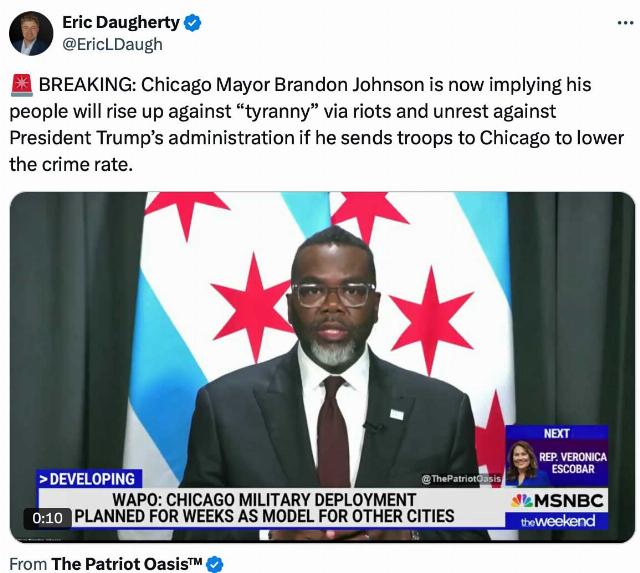
Brandon Johnson dares Trump


Chicago Mayor Brandon Johnson has gone and done it: he’s gone full stupid. That’s saying something from a Mayor known for constantly going so close to full stupid as to be indistinguishable from full stupid.

Never go full stupid:  

Graphic: X Post

There's dumb, and then there's whatever the Hell this is. We thought that JB Pritzker admitting that Chicago crime was a problem he hadn't been able to tackle was bad, but Chicago Mayor Brandon Johnson absolutely out-stupided Pritzker.

That’s no small feat.

Not only does Johnson not want help with his violent city, where roughly 78 people are victims of a violent crime EVERY DAY, but he claims he and his people will RIOT if Trump tries to help his citizens.

No, really.

And Democrats wonder why their approval rating sits at 19%.


Graphic: X Post

Perhaps Johnson’s handling of Chicago’s budget has something to do with it? 

Comments from Chicago Mayor Brandon Johnson are raising concerns about the state of city finances ahead of contentious budget hearings. 

At a question-and-answer session with reporters on Tuesday, Johnson said we have reached “a point of no return," and that the city is going to have to be creative to help address looming shortfalls. 

Johnson said many key systems people rely upon, like education, health care. housing and transportation are “woefully underfunded.”

Currently, Chicago is facing a $1.1 billion budget gap for 2026.

And that’s going to get much worse.  Governor J.B. Pritzger recently signed a pension bill that is adding more than $11 billion to Chicago’s pension obligations. Johnson’s “soak the rich” intentions have already driven tax-paying businesses out of Chicago and Illinois:

“I am committed to ensure that the ultra-rich and those with means put more skin in the game,” he said. “That is the pathway forward.”

Chicago’s budget shortfall for 2025 is already at $982 million. A hundred million here, a hundred million there and pretty soon you’re talking real money.

Johnson and the usual Democrat suspects are, in the face of a federal takeover of Chicago policing, claiming violent crime, particularly homicide, is down. If one can believe Chicago’s statistics, which would be foolish indeed, that might be so. We know DC’s supposedly falling crime rates are almost certainly due to purposeful police manipulation of statistics and the on-the-spot reclassification of murder and other felonies to misdemeanors. It’s highly likely that time-honored Democrat tactic is standard operating procedure in Chicago, the city that has made it virtually impossible for the police to pursue fleeing criminals. 
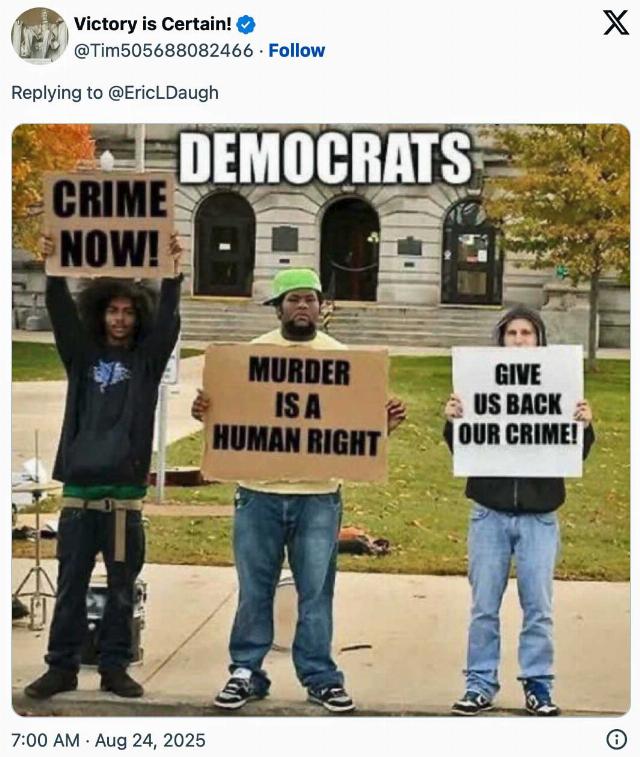
Graphic: X Post

Even better, the Chicago PD, like most blue city agencies, is badly understaffed: 

Chicago Mayor Brandon Johnson, who was elected in 2023, cut down the size of the CPD during his administration, removing 833 police jobs in his first year in office and having 1,600 fewer officers than at the start of former Mayor Lori Lightfoot’s administration, according to the Illinois Policy Institute in May. He also recently let the city’s contract for ShotSpotter, a gunshot tracking device, expire despite most of the Chicago aldermen voting to keep it, according to ABC 7 on Sept. 23.

Those cuts have led to a massive increase in police overtime, which has contributed to Chicago’s budgeting woes.  The CPD, which circa August of 2025 is down 2,103 officers, claims to have a ten-year low in homicides, which still amounted to 573 murders in 2024. That’s about 45 a month and about 1.6 per day. Factor in the reality the CPD arrest rate has dramatically declined, and Chicago and DC’s claims appear to be equally representative of the reality of crime in their representative cities.

Brandon Johnson, whose approval rate languishes at 26%, has a view of crime in Chicago not shared by most Chicagoans. Like the mayors of all blue cities, he fears Trump revealing in ways that can’t be hidden that out-of-control crime is a Democrat choice rather than an unchangeable destiny. He would also be wise to understand he’s facing a DOJ that actually enforces the law, even when the street thug threatening riot and insurrection is Chicago’s mayor.


Mike McDaniel is a USAF veteran, classically trained musician, Japanese and European fencer, life-long athlete, firearm instructor, retired police officer and high school and college English teacher. He is a published author and blogger. His home blog is Stately McDaniel Manor. 

https://www.americanthinker.com/blog/2025/08/brandon_johnson_dares_trump.html

Medicare Enrollees Left Acute-Care Hospitals Against Medical Advice at Increasing Rates


Key Takeaways

  • The rates at which enrollees leave acute-care hospitals against medical advice (AMA)have steadily increased since 2006 across most demographics we analyzed and spiked during the COVID-19 public health emergency.
  • Enrollees who left AMA were more likely to have poor health outcomes than enrollees discharged to their homes.
  • The rates at which enrollees have left AMA appear inversely correlated to the quality-of-care ratings of the associated hospitals—the lower the rating, the higher the rates.
  • Enrollees eligible for both Medicare and Medicaid (dual enrollees) and enrollees with a mental health diagnosis were more likely to leave AMA than Medicare-only enrollees and enrollees without a mental health diagnosis, respectively.
  • This data brief may be beneficial in the development of future guidance to address this growth, which could improve enrollee health outcomes and save taxpayer dollars.

Purpose of this Data Brief

After being admitted as acute-care hospital inpatients, Medicare enrollees with decision-making capacity, or their surrogates, can discharge themselves and leave against medical advice (AMA) Acute-care hospitals record an enrollee’s discharge status using a code on the claim. For example, they use a specific code if they discharge an enrollee to their home (01) and another if they transfer the enrollee to a different acute-care hospital(02). Hospitals designate that an enrollee left AMA using code 07.

Our objectives were to 1) analyze rates and outcomes for Medicare enrollees at acute-care hospitals who leave AMA and 2) provide the Centers for Medicare &Medicaid Services (CMS) and other stakeholders with information that can be used to improve enrollee outcomes.

https://oig.hhs.gov/reports/all/2025/medicare-enrollees-left-acute-care-hospitals-against-medical-advice-at-increasing-rates/

'RFK Jr. Warns Docs of Liability if They Stray From CDC on Vaccines'

 The American Academy of Pediatrics' (AAP) recent pediatric COVID-19 vaccine recommendations

opens in a new tab or window, which differ from those of the CDC, have raised concerns from HHS Secretary Robert F. Kennedy Jr., who responded with an oblique warning to any physicians who might follow the AAP's advice.

"AAP should ... be candid with doctors and hospitals that recommendations that diverge from the CDC's official list are not shielded from liability under the 1986 Vaccine Injury Act," Kennedy posted this week on Xopens in a new tab or window.

The AAP recommendationsopens in a new tab or window, released on Tuesday, included a strong endorsement of COVID-19 shots for children ages 6 months to under 2 years. The group also recommended COVID shots for older children if the parents want to do that. Those recommendations differ from guidance issued by the CDCopens in a new tab or window, which has said the vaccines are not specifically recommended for children although they can still get them if parents and providers agree.

Was Kennedy correct about the liability issue? "As has become common for Secretary Kennedy, this is misleading," Dorit Reiss, PhD, a law professor at the University of California San Francisco, said in a Facebook postopens in a new tab or window on Wednesday. "Whether a vaccine falls under VICP [the Vaccine Injury Compensation Program, the part of the Vaccine Injury Act that deals with liability issues] has nothing to do with whether AAP recommends it, and the liability protections are not removed by this."

"If a vaccine is covered by VICP, liability protections apply to manufacturers and administrators: anyone claiming a vaccine harm from a childhood vaccine that is under VICP has to go through the program first," she said. "ACIP has not actually changed the current recommendations in ways that affect VICP." Furthermore, "COVID-19 vaccines for children are not under VICP, but that's not because of anything AAP did or the secretary, even, did -- it's because Congress has not yet legislated to create an excise tax for COVID-19 vaccines, and until Congress does that, they're not within VICP."

Anna Kirkland, PhD, JD, professor of health management and policy at the University of Michigan, in Ann Arbor, agreed with Reiss that the COVID vaccine doesn't fall within the VICP and so is not affected by the CDC's new recommendation. However, "it could hint at future changes if Kennedy plans to withdraw recommendations from other childhood vaccines that are currently covered under the Vaccine Injury Act, which would mean that they no longer meet the statutory definition for coverage in the compensation program," she said in an email.

"This development should not change doctors' willingness to recommend pediatric vaccines, which still have all the safety and compensation protections that they had prior to Kennedy taking office," she added. "There do seem to be changes in the Vaccine Injury Compensation Programopens in a new tab or window on the way, though it's hard to know from Kennedy's remarks exactly what he has planned. Removing childhood vaccines from the compensation program could upend vaccine markets and leave the small number of people who suffer an adverse reaction without a plausible path to compensation."

In her Facebook post, Reiss reminded readers that "in spite of [his] implied threat, Secretary Kennedy would not be bringing any cases" to court related to vaccine injuries. Instead, "parents who think their children were harmed by COVID-19 vaccines are the relevant ones here."

If Kennedy did want to remove another vaccine from the VICP, she noted, "ACIP would have to completely not recommend it for children and pregnant women" instead of just saying it had to be administered after shared decision making between parents and providers. "And then," she added, "the secretary would have to open a rulemaking process -- publish the change in the Federal Register, solicit comments, and publish a final decision. And a company making that vaccine, or someone denied a vaccine because of removal of liability protections, could sue."

In his tweet, Kennedy also called the AAP recommendations "corporate-friendly" and said that "The Trump administration believes in free speech and AAP has a right to make its case to the American people. But AAP should follow the lead of HHS and disclose conflicts of interest, including its corporate entanglements and those of its journal -- Pediatrics -- so that Americans may ask whether the AAP's recommendations reflect public health interest, or are, perhaps, just a pay-to-play scheme to promote commercial ambitions of AAP's Big Pharma benefactors."

The AAP fired back. "This attack on the integrity of pediatricians is unfortunate, but it does not change the facts," AAP President Susan Kressly, MD, said in a statement sent to MedPage Today.​ "Our immunization recommendations are rooted in decades of peer-reviewed science by the nation's leading health experts. We are transparent about our funders​, follow rigorous conflict-of-interest disclosures, and maintain safeguards to ensure the integrity and independence of our guidance. We welcome an opportunity to sit down with the secretary to review our recommendations and restore our seat at the table."

The last sentence in AAP's statement referred to some changes that Kennedy has made to vaccine policymaking at the CDC. In June, he fired all 17 membersopens in a new tab or window of the CDC's Advisory Committee on Immunization Practices (ACIP) -- which advises the CDC on its immunization recommendations -- and replaced them with eight peopleopens in a new tab or window, including known vaccine skeptics; some of the new members reportedly have their own conflicts of interest related to serving as expert witnesses in legal proceedings targeted at vaccine manufacturers.

In addition, the AAP, the American Medical Association, and other healthcare groups were told at the end of Julyopens in a new tab or window that they could no longer participate in ACIP work groups, which convene in between ACIP meetings to develop recommendation options for ACIP.

https://www.medpagetoday.com/pediatrics/vaccines/117132

Amazon expands jobs and services in rural America

 by Salena Zito

Few outside of those who live there understand what the county of Erie’s future holds for its economic future. Is it rural? A port? A city? A College town? A beach town? A faded Rust Belt hub for industrialization?

Drive around the county and you’ll soon find that it is all those things. And while the bulk of the population (80%) lives in more urbanized areas, the 38 municipalities of Erie County comprise two cities, 22 townships, and 14 boroughs. There is still a significant number of people in the rural landmass of the county, which makes up 93% of the county’s total land area. They still need the same services as their urban cousins, including what they can get from retailers.

Amazon, the largest online retailer in the country, recognized this gap across thousands of other rural zip codes nationwide. Its $4 billion investment in rural America was first announced in April, not only expanding its delivery networks in rural areas, but ensuring those deliveries are made faster.

It also created 100,000 new jobs across the country in total.

In the Millcreek suburb of the city of Erie, a brand new delivery station is bustling with individual delivery stations — think of them as small businesses inside a larger business — where workers are loading a fleet of Amazon trucks for delivery across the rolling hills where few brick-and-mortar retailers are located.

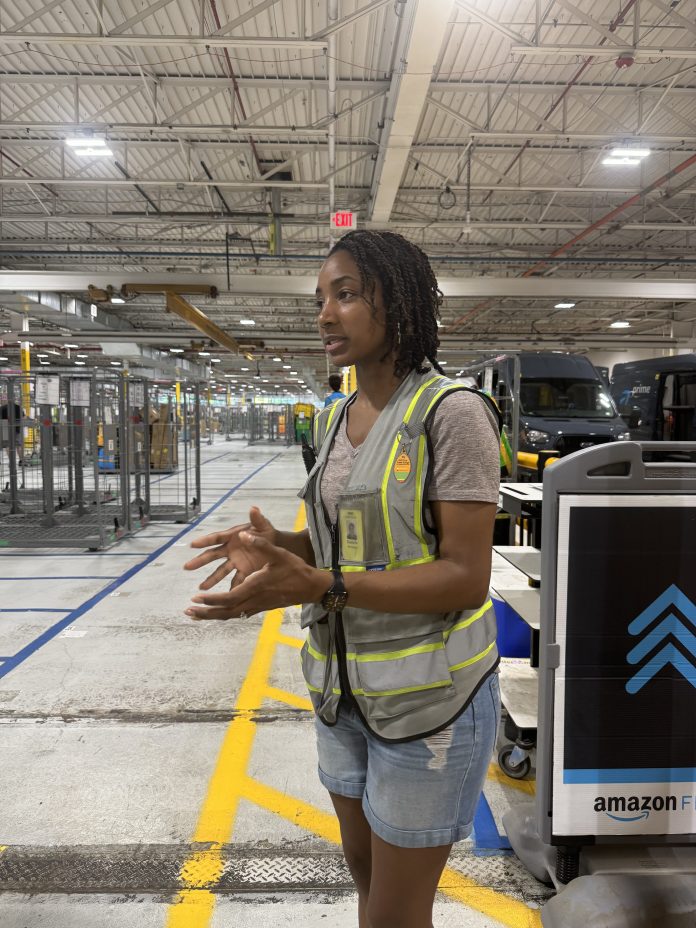
Holly Sullivan is visiting the facility from Amazon’s Nashville headquarters. She’s the vice president of worldwide economic development at Amazon and led the development of Amazon’s Tennessee headquarters. It’s no accident that the location is in the middle of the country — Sullivan says it’s important to have that kind of connection with customers and employees.

Sullivan calls facilities like the one in Erie their last and most important mile.

“Let me work backwards from the customer, which is what we do. We have within our fulfillment network our larger Amazon robotics, which is our smaller items. We have sortation centers, which is our middle mile, and then we have our last mile, which is our delivery stations,” she explained of the logistics.

“We started our delivery stations primarily in more urban areas where the larger fulfillment centers were, but we kept hearing from our customers and our drivers of the distance having to be driven to some of the rural areas,” she explained, adding it was a problem they wanted to solve which led to the rural delivery stations like the one in Millcreek.

The building is not new, per se; it is a retrofit placed inside a former industrial site that produced chemicals. It was 2020, and the company wanted to see if the plan would work.

“We tweaked some things,” she explained, “learned as we went, and by 2026, we plan on having over 200 rural delivery stations and in total a $4 billion investment in rural America.”

Sullivan pulled up a map showing they will be in all 50 states, with Vermont finally making it over the threshold after permitting challenges.

ERIE-Danielle Whitlock, along with our husband, Victor, who is in the army reserves, are delivery service partners within Amazon, who are part of expanding the online giants rural capabilities announced this summer. (photo Salena Zito)
Danielle Whitlock and her husband, Victor, who is in the Army Reserves, are delivery service partners within Amazon and are part of expanding the online giant’s rural capabilities, announced this summer. (photo Salena Zito)

“It’s fine. We like to follow the rules, and this goes into part of our bigger network,” she explained.

Underscoring her point, a recent economics study showed that when an Amazon fulfillment center or delivery station is located in a community, it increases the median income by $1,200 a month, according to Oxford Economics.

The small businesses within Amazon are the delivery service partners, small businesses that operate their own delivery businesses within Amazon, explains Danielle Whitlock, who, along with her husband, Army Reservist Victor, operates their logistics business across rural Erie.

“We’ve been here since July of 2021, and it has grown a lot. We started with a total of seven routes, and now we constantly run around the 40 range in a day, and it is a pretty wide rural territory that runs to the Ohio border,” she explained, adding they started with a handful of employees and are now over 100.

What is great about the program is that it creates small businesses within Amazon, which in turn creates good-paying jobs for people in rural areas, said Whitlock.

“But it also provides an overnight service that people in high population areas take for granted, but had been considered a luxury in retail deserts in rural America. Pull it all together, and it is a very good thing for everyone.”

https://www.washingtonexaminer.com/opinion/columnists/3779325/amazon-rural-america-expands-jobs-and-services/

OBBB Act is one of the most significant shifts in education in decades

 by Bethany Mandel

Hardly anyone is talking about it, but Congress has just passed one of the most consequential education reforms in history.

Tucked into the One Big Beautiful Bill Act is a provision that could transform how families access education, reshape the politics of schooling, and finally give parents the power to direct their children’s learning. The legislation establishes a first-of-its-kind federal tax credit scholarship program, open to all types of educational settings. Beginning in 2027, people will be able to claim a dollar-for-dollar federal tax credit, up to $1,700 annually, for donations to educational nonprofit groups that fund K–12 scholarships for low- and middle-income students. The scholarships are designed to be flexible, meeting the wide-ranging needs of modern families. Parents can use them for tuition, tutoring, books, uniforms, transportation, educational technology, or special-needs services. And because they are classified as tax-free for recipients, the scholarships will provide real, immediate support rather than burdensome paperwork.

It is not a small pilot program or a symbolic gesture but a structural shift. Federal law now recognizes that parents, not bureaucrats, should hold the reins of their children’s education. Remarkably, this sweeping change has been barely discussed in the media, as if the country doesn’t realize a quiet revolution has already begun.

The path to passage has been a long one. For nearly a decade, the American Federation for Children, the nation’s leading school choice advocacy group, has been pushing for such a measure. Tommy Schultz, AFC’s CEO, reflected on the journey: “AFC played the lead role in the advocacy efforts of the federal tax credit scholarship for the last 8 years. Once President-elect Donald J. Trump selected AFC’s board chair, Betsy DeVos, to be Secretary of Education in 2017, the dream of advancing a federal school choice bill was finally possible. AFC deployed millions each year to advance the legislative efforts with lawmakers and staff, and they managed the key partnerships and coalition supporters across nonprofits, schools, faith leaders, and scholarship organizations.”

Schultz went on, “AFC also won hundreds of policy and elections victories at the state level, which gave massive political credibility with federal lawmakers in the post-COVID era. They intend to use all of their state-level implementation expertise to make the federal rollout as successful as possible: maximizing donations and maximizing the number of lower-income families accessing the scholarships.” 

In other words, this was not a lightning strike. It was the product of years of groundwork, coalition-building, and patient persistence. The bill’s champions, Sens. Ted Cruz (R-TX), Bill Cassidy (R-LA), Tim Scott (R-SC), as well as DeVos explained the more profound philosophy behind it in a recent Fox News op-ed: “Quality education is foundational to success; it is the key to unlocking the American dream, and as Tim Scott rightly says, the closest thing to magic in America. For too long, however, parents have been forced to accept a one-size-fits-all approach to education that often does not work, and which has failed millions of students across decades. Those failures disproportionately affect low-income and minority families, whose children are frequently trapped in failing schools with no alternatives.” 

That sentiment captures the bill’s significance: This isn’t about dismantling public education but about finally acknowledging that children are not all the same and that families should be empowered to make the best possible choices for their children. 

If the legislation had been proposed in 2010, it might have died in committee. But COVID-19 changed everything. School closures lasted for months, sometimes even years, while other nations reopened more quickly. Remote “learning” left many children staring blankly at screens, disengaged and falling behind. Parents suddenly had a front-row seat to what their children were — or weren’t — being taught. What they saw was often alarming: thin academics, politicized lessons, and wasted time. 

By 2022, national test scores told the story plainly. Reading and math achievement had fallen to record-low levels. In some states, the majority of students are unable to perform at grade level. Meanwhile, school violence, bullying, and chronic absenteeism surged, leaving families desperate for alternatives. In Virginia, parents’ frustration boiled over politically. Glenn Youngkin made schools the centerpiece of his 2021 gubernatorial campaign, and in a purple state, he won. His victory was a clear warning shot to both parties: Parents matter, and education can swing elections. The school choice component of the “big, beautiful bill” is a direct outgrowth of that political awakening.

But passing the law is only the beginning. For families to benefit, governors must decide whether to opt their states into the program. That has already become a flashpoint. Every single Democrat in Congress voted against the bill, and some blue-state governors are signaling resistance. Gov. Wes Moore (D-MD) has yet to commit. His spokesman, Carter Elliott, issued a cautious statement: “The Governor is committed to ensuring that every student in Maryland has the best education possible. The Trump Administration’s approach on this issue has never been tried before. We are evaluating all of the options to ensure Maryland students have the best opportunities to succeed.” 

In other words: Maybe, maybe not. 

Nathan J. Diament, executive director of the Orthodox Union Advocacy Center, called such hesitation short-sighted: “The enactment of this federal school choice program is nothing short of historic. It can unleash many millions of dollars to be directed by parents, as opposed to bureaucracies, to support their children’s education. But to have this impact, one crucial element will be for all Governors to have their states opt-in to the program, as the legislation requires. There is some skepticism about ‘blue state’ governors doing this, because the teachers unions are against it. But that would be bad policy and bad politics for those governors.”

Diament is right: Governors who refuse to opt in will not stop the program. They will simply deprive their own residents while watching money flow to other states. For Democrats, opposition to school choice is increasingly risky. Teachers unions remain a robust base of support, but parents are becoming an even more powerful constituency. Parents don’t forget what happened to their children during the pandemic. They don’t ignore crime in their schools, low test scores, or graduates who are unprepared for adult life. Republicans, meanwhile, now have the political advantage of being the party that delivered school choice on a national scale. Once families begin using the scholarships and parents see for themselves that their donations or tax credits translate into real options, the politics will shift even further. What’s coming is not just a policy change but a cultural one. Parents who once felt trapped will discover freedom. Families who never thought private education could be within reach will suddenly have options. Communities that struggled to provide enrichment will be able to fund tutoring and after-school programs. And when that happens, it will be challenging for opponents of the program to argue that parents should be stripped of those opportunities.

Beneath the surface, this school choice legislation represents one of the most significant shifts in education in decades. It empowers parents. It prioritizes children. It bypasses bureaucracy. It offers hope at a time when faith in public education is at an all-time low. 

School choice is no longer a state-by-state experiment. It is national policy. And as more people learn what has quietly passed, the political landscape will tilt dramatically. For Republicans, the political dividends may be enormous. For Democrats, the decision to stand with unions over parents may prove disastrous.

But most importantly, for millions of families, the future just got brighter. School choice is coming nationwide. The only question now is whether governors will allow their residents to take part in what may prove to be the most “beautiful” reform in modern education.

https://www.washingtonexaminer.com/opinion/3759077/big-beautiful-bill-significant-shift-education-school-choice/

The Collapse of the Democratic Party and Their Deep State Forces

 by Larry Kudlow

If you take a careful look at the decision of a New York appellate court today to throw out the unconstitutional and disgraceful $500 million penalty on President Trump and his businesses…

And then you keep your nose in the newspapers and watch New York’s attorney general, Letitia James, getting busted for mortgage fraud…

And then you go back a bit and look at all the declassified documents released by Tulsi Gabbard and John Ratcliffe and Kash Patel that show the entire Russiagate hoax was quarterbacked by President Obama and Senator Hillary Clinton…

And then you just think about this whole rotten sequence — what you see is the collapse of the legal and Deep State forces against Mr. Trump.

In many ways, you could argue it’s the collapse of the Democratic Party.

Not only because the Deep State couldn’t bust Mr. Trump, and the forces of treachery and sedition couldn’t break Mr. Trump, and the prominent liars are themselves now facing criminal indictment, and making it all worse for that crowd — Mr. Trump himself was re-elected.

Which was the Obama-Clinton Deep State’s worst nightmare.

And as far as the Deep State goes, it appears that all of those people who participated in the Russian hoax and various other phony trials — well, they’re getting fired from their jobs. And they’re all lawyering up.

And on top of all that, here’s Mr. Trump running a vastly successful administration — in terms of economic policy, domestic policy, foreign policy, you name it.

Wait a minute, though, don’t forget the president is going to inspect Washington, D.C., this evening — so let’s add law and order to that list.

And he closed the wide open border.

So that adds to the Deep State’s nightmare.

Not only could they not put him in jail for 750 years… Or bust his businesses… Or throw him off the ballot… Or tie him to the so-called Russia hoax…

The worst thing of all for the lawyered up Deep State crowd, though, is that Mr. Trump is succeeding in virtually every initiative he’s put forward.

And, not to rub it in, but I want to quote Mr. Trump’s Truth Social post today: “a great win for America” — which describes his victory in the New York appellate court.

It’s a great win for America for many different reasons.

What comes to mind to me, though, is that it shows that eventually, the American judicial system works.

As bad, inept, and corrupt as some of these judges and spies have been, with all of their political biases and weaponization and lawfare against Mr. Trump…

As bad as they are — as the cases moved up the judicial totem pole, Mr. Trump has won them all.

https://www.realclearpolitics.com/articles/2025/08/24/the_collapse_of_the_democratic_party_and_their_deep_state_forces_153213.html

https://www.zerohedge.com/political/dirt-bike-gangs-terrorize-streets-dc-baltimore