Search This Blog

Saturday, January 3, 2026

It killed Cuba; maybe NYC is next

 by Silvio Canto, Jr.

History repeats itself, or so they say. We remember this time of the year when a young man leading a so-called revolution with alleged good intentions ended up destroying Cuba. This message coming from New York City will remind many Cubans of my parents' generation about similar speeches and promises they heard decades ago.

This is from New York City:

The New York City Council has passed what has been called the Community Opportunity to Purchase Act (COPA) that will force private building owners to offer up their property to nonprofits and government entities before they make any private sale, effectively causing massive delays in property sales and other regulatory hurdles in the Big Apple’s housing industry.

In the scenario that it is passed, NYC will have the largest COPA program in the country. The act forces landlords to offer their property to the city as well as nonprofits before the building can be sold on the public market. The lawmaker who sponsored the law, Council Member Sandy Nurse, claims that it will be a win for New Yorkers.

“Corporate interests and big real estate tried their hardest to block the Community Opportunity to Purchase Act with a misinformation and fear-mongering campaign, and they failed,” Nurse said about the law’s passage, per Pix 11. “Today marks the beginning of a new social housing era in New York City… COPA levels the playing field and makes it possible to preserve and create thousands of permanently affordable homes across our city.”

The act dictates that landlords must first tip off the government entities and nonprofits that qualify, and “may not take any action that will result in the sale of such covered property to a person other than” those entities. Then the owner must sit on that property for 25 days as it is up for sale to the nonprofits, which can submit a statement of interest.

“Corporate interests and big real estate tried their hardest to block the Community Opportunity to Purchase Act with a misinformation and fear-mongering campaign, and they failed,” Nurse said about the law’s passage, per Pix 11. “Today marks the beginning of a new social housing era in New York City… COPA levels the playing field and makes it possible to preserve and create thousands of permanently affordable homes across our city.”


The act dictates that landlords must first tip off the government entities and nonprofits that qualify, and “may not take any action that will result in the sale of such covered property to a person other than” those entities. Then the owner must sit on that property for 25 days as it is up for sale to the nonprofits, which can submit a statement of interest.

A big win for New Yorkers, someone said? Well, talk about lying to people.

Let me tell you what will happen by having you look at a current picture of Havana. It was, before Castro, one of the most beautiful cities in the world. 

Look at Havana today. Please look at the real Havana, not the sections available to tourists who pay dollars for everything.

What happened in Cuba? The landlords left their properties and moved to Miami. The once beautiful skyline of Havana now looks like crap with garbage on the streets and families sharing apartments. The lights go out constantly unless you are a staying in a tourist hotel or you dad has a prominent position in the party.

Our family lived in a residential portion of Havana with clean streets and garbage did not sit around for weeks. Batista may have been a jerk but he also understood that a clean city was good for tourists and to promote a business climate.

What happened in Cuba? The regime punished landlords and then suddenly everyone was poor, houses were literally falling apart, and small business owners, the backbone of Cuba's entrepreneurial economy, were on their way to Miami.

New York landlords will probably find their way to Miami or South Carolina soon. And then the mayor will blame it on Trump, just like Castro blamed everything on the embargo.

Watch out, New York City. Listen to the Cubans because we saw this movie before, the film of socialist good intentions, that ends up making everyone poor. As my late mother used to say: I didn't take economics in school but I have a PhD in communism. Trust me -- it doesn't work no matter how much you want to help the poor or tell people about affordable housing.

https://www.americanthinker.com/blog/2025/12/it_killed_cuba_maybe_nyc_is_next.html

Somali Corruption and the Mainstream Media

 It is the season for New Year’s Resolutions, always an exciting time. Diets begin and exercise regimens commence; people commit to look for new jobs, new relationships, new hobbies... addicts try to give up their demons, from candy to alcohol, from television to video games. Everything begins anew.

And if you look closely, you can even see it in the news coverage. 

Look, for example, at the mainstream media coverage of Minnesota’s massive Somali corruption, with attitudes being wholly transformed in real time. There’s a clear process for the media to follow: 

  1. The mainstream media hides the story, hoping it will go away. 
  1. Eventually, after enough video exposure, enough press conferences by federal investigators, and enough arrests, the media covers both sides, acknowledging the corruption while also giving equal time to the accused, trying to give the impression that it might just be a witch hunt, or an undue focus on a tiny corrupt sample that doesn’t really reflect badly on the entire group, and it can only be racism/sexism/bigotry/partisanship to claim it is. 
  1. Then, finally, they have to admit it. They cover the story that they should have discovered years ago, to defend their honor as journalists, while still praying it will go away quickly so it doesn’t reflect badly on them, on their issues, or on their party. 
  1. And now that they have an article or two to point to, showing that they did indeed cover the undeniable story, they never mention it again, and they return to their normal process of denying that there’s any real substantial corruption in their beloved Democrat Party or in any of its corrupt subsidiaries, programs, and acolytes. 

It’s really quite fascinating to watch. 

What causes the rest of us to reform our own lives? We get blackout drunk at a party and realize we need to quit the booze, or we weigh in at a shocking twenty or thirty or forty pounds overweight and realize we need to quit the pizzas and ice cream.

Does that happen to the mainstream media at all?

Do the reporters for CBS, ABC, NBC, CNN, MSNOW, AP and Reuters actually look at a news story like the Somali-connected fraud of Minnesota and feel that same shellshock punch, like seeing a scary number on a scale or waking up in one’s car in a ditch, and have that powerful Road to Damascus awakening that they’ve been carrying the water for the wrong side all these years, and it must be time to reform? 

It could -- conceivably -- be a similar impact. There’s no reason it shouldn’t be. 

Conservatives said for years that the massive importation of hundreds of thousands of Somali refugees was a corruption of our immigration process, that they were brought here to shore up Minnesota’s voting patterns, that they were an NGO project to funnel tax dollars into ill-considered social spending and likely corrupt programs. 

And the Democrat Party and their media puppets looked the other way as crime rose, as tax dollars were burned up, as the standard of living of one of the Midwest’s once-great communities fell at a record rate. They didn’t acknowledge what was happening right in front of their eyes; they just stopped watching the crime reports, the economic statistics, the climbing welfare state, and plummeting test scores in the schools.

Until, in December 2025, they just couldn’t avert their eyes anymore. 

Nick Shirley’s viral videos and Kash Patel’s press conferences made it an unavoidable news story, and the mainstream media finally must cover the truth: that the Somali invasion of the Twin Cities was fraught with crime and corruption, that they’ve burned through billions of tax dollars and destroyed once-safe American working-class communities, and that, to at least some extent, the Democrat party and their most recent vice-presidential nominee were complicit. 

It’s getting coverage. 

But will it stick? Will this coverage last? Will it be a transformational moment for America’s mainstream media reporters? 

It could be. But let’s look at the most recent examples of similar revelations. 

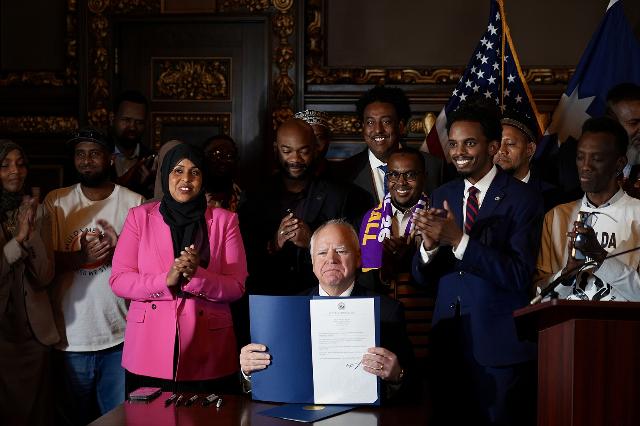
Office of Governor Tim Walz & Lt. Governor Peggy Flanagan, Public domain, via Wikimedia CommonsIn the summer and fall of 2025, as the Trump administration voided the 2009 Climate Endangerment Finding, forcing federal law to return to sanity at last, investors and manufacturers alike abandoned the lunacy of their imagined fear of carbon dioxide, changing manufacturing and funding patterns, retreating from the climate cult and returning to some degree of acceptance of real science. Even such true believers as Bill Gates and Ford Motor Company publicly announced their newfound embrace of common sense. 

The press announced it, but was there a long-term change in their attitude? 

Of course not. They covered the stories so nobody could say they didn’t, but then they stubbornly refused to learn anything, and the attitude and underlying philosophy with which they cover other stories remained the same. 

Or look earlier, at the winter and spring of 2025, when the press suddenly discovered that Joe Biden had indeed been mentally incompetent for years, that their pals in the DNC and the Biden administration had willfully, dangerously, treasonously hidden the extraordinary measures necessary to hide Joe Biden’s senility, from the 2020 campaign throughout his four-year reign of error. 

They covered that story too. They wrung their hands and cried real tears as they “admitted” how they’d been conned by the Biden inner circle into believing that Old Joe was sharper than he’d ever been, and that the Republican reports of his senility were just partisan spin. They published exposes like Jake Tapper’s Original Sin and swore they’d never be hornswoggled that way again. 

The press insisted that they’d learned their lesson, this time, for sure. 

Have they? 

Or did the press drop that hot potato the second they realized that this admission would call into question every bill, every executive order, and every appointment that their precious doddering fool of a puppet president had signed for four years? 

For whatever reason -- ideology, education, on-the-job training, the newsroom culture, bribery, the cocktail party circuit, or some mix of the above -- the mainstream media isn’t good at learning lessons and reforming their own behavior. 

They will cover the Somali Medicare and Medicaid fraud, the Somali daycare fraud, the Somali foodservice fraud, maybe even a little of the Somali vote fraud. They will cover it when they are forced to, when it becomes so overwhelming that they can’t bury it anymore.

But will they learn a lesson from it? Will they learn to listen when conservatives see the same patterns repeat in the future? Will they cover news conferences about other corrupt public services, other corrupt sanctuary cities, other massive wastes of taxpayer dollars and the utter destruction of other cities in exactly the same way, time and time again? 

Or will it just be like a thousand other New Year’s Resolutions, a commitment made under fire, driven by a date on the calendar or a pressured moment on a talk show, to be abandoned after a few weeks, as soon as the pressure is off? 

Personally, I’m hoping it’s real this time, and the mainstream media really will reform itself this year. I’m hoping that the major newsrooms will finally appreciate the constitutional duty of a free press, and cover the news as honestly and robustly as the First Amendment intended. I’m hoping that this year, finally, will be the year. 

But then I must also admit that I have a weakness of my own. One of my annual New Year’s Resolutions is to have optimism in the fundamental decency of the American mass media. 

And just like most of the crash diets and exercise regimens that people start every year at this time, my attempts at optimism about the mainstream press tend to fall apart in the face of reality all too soon. 

John F. Di Leo is a Chicagoland-based international transportation manager, trade compliance trainer, and speaker. Read his book on the surprisingly numerous varieties of vote fraud (The Tales of Little Pavel), his biting political satires on the Biden-Harris years (Evening Soup with Basement Joe, Volumes III, and III), and his 2024 collection of public policy essays, Current Events and the Issues of Our Age, all available in eBook or paperback, exclusively on Amazon.

https://www.americanthinker.com/articles/2026/01/somali_corruption_and_the_mainstream_media.html

Insanity Isn’t What You Think: A Forensic Primer

 Public attention to violent acts involving mental illness has surged, and television dramas like Law & Order: SVU and Criminal Minds often blur the line between entertainment and reality. Before diving into specific diagnoses, it’s essential to understand the foundational forensic psychiatry concepts that shape how these cases are evaluated.

At its core, forensic simply means “related to the law.” In criminal forensic psychiatry, two concepts dominate: competency to stand trial (CST) and criminal responsibility (CR). They answer two very different questions.

  • CST asks about the defendant’s mental state now, at the time of trial.
  • CR asks about the defendant’s mental state then, at the time of the offense.

A finding of lack of criminal responsibility can lead to a verdict of Not Guilty by Reason of Insanity (NGRI) — or in some states, Guilty But Mentally Ill (GBMI). These determinations have been shaped over time by constitutional law and evolving statutory standards.

Competency to Stand Trial

Regardless of the defendant’s mental state at the time of the crime, at the time of trial they must be able to participate in their defense. The modern standard comes from Dusky v. United States (1960), which requires that a defendant have both a rational and factual understanding of the proceedings and the ability to consult with counsel.

Competency does not require high intelligence or full symptom resolution. A defendant may have active symptoms and still be competent if those symptoms do not interfere with participation in their defense. Conversely, someone with disorganized, incoherent thinking may be unable to meet the Dusky standard.

When a defendant is found incompetent, the court must decide whether to dismiss charges or attempt restoration. For serious charges, most defendants are remanded to a forensic hospital for treatment.

It is ethically permissible to involuntarily medicate a defendant for two parallel reasons — one grounded in the state’s obligations, and one grounded in the defendant’s rights. The state has a compelling interest in public safety and in ensuring that serious criminal charges can be adjudicated fairly. A trial cannot proceed if the defendant cannot understand the proceedings or assist counsel, and the state has a legitimate duty to resolve criminal allegations rather than leave them in limbo.

For the defendant, involuntary medication is equally protective. An incompetent defendant is effectively voiceless: unable to participate in their defense, unable to challenge the state’s evidence, and unable to exercise the presumption of innocence in any meaningful way. Restoring competency returns agency — the ability to understand what is happening, to work with counsel, and to make informed decisions about one’s own case. In that sense, treatment is not punitive; it is restorative, rights‑preserving, and essential to a fair process.

Competency is fluid. A defendant may be incompetent at one hearing, restored at the next, and decompensate again later. But competency has nothing to do with an insanity defense. Insanity — a legal determination, not a psychiatric one — refers exclusively to the defendant’s state of mind at the time of the crime, and it is ultimately decided by the trier of fact — whether judges or juries — not by expert witnesses. Expert testimony can guide the court, but judges and juries may give it great weight, little weight, or treat conflicting experts as essentially canceling each other out.

Standards and Burden of Proof

The burden of proof always begins with the state, which must prove guilt beyond a reasonable doubt — the highest standard in criminal cases and often described in legal education as requiring near‑certainty, about 95% or higher. This makes sense, because a person’s liberty is at stake. However, if the defense raises insanity, the burden of proof shifts to them. That’s known as an affirmative defense, meaning the defendant must prove it rather than the state. Most states require proof by a preponderance of the evidence — just over 50% — while a smaller number require clear and convincing evidence, often explained as roughly 70–75% certainty.

Criminal Responsibility and NGRI/GBMI

Criminal responsibility focuses exclusively on the defendant’s mental state at the time of the offense. Most states ask whether a mental disease or defect impaired the defendant’s ability to understand the wrongfulness of their act. Some also ask whether the defendant could conform their behavior to the law.

Importantly, mental illness alone is not enough. As Rex v. Arnold (1724) cautioned, “Not every kind of frantic humour or something unaccountable in a man’s actions will show him to be such a madman as to exempt him from punishment.”

The backbone of modern insanity law is the 1843 M’Naghten rule, which requires that the defendant either did not understand the nature and quality of the act or did not know it was wrong. Many states still use this strict right-wrong test.

The American Law Institute (ALI) standard, developed in the 1960s, broadened this approach by adding a volitional prong — whether the defendant lacked substantial capacity to conform their conduct to the law. Some states adopted this; others, like South Carolina, split the volitional prong into a separate verdict: Guilty But Mentally Ill, which is still a conviction and does not shield a defendant from prison or even the death penalty.

Forensic Psychiatry in Action: A Recent Example

In August 2025, 23‑year‑old Iryna Zarutska was fatally stabbed on a Charlotte light‑rail train. Police arrested 34‑year‑old Decarlos Brown Jr., whose family reports a history of mental illness and a diagnosis of schizophrenia.

How might this play out under North Carolina law?

North Carolina uses a strict M’Naghten standard with no volitional prong. If evidence suggests Brown planned the attack, targeted a victim, or attempted to evade capture, those behaviors point toward an understanding of right and wrong — and therefore toward criminal responsibility.

However, at the time of arrest and initial hearings, he may have been actively psychotic and unable to communicate meaningfully with counsel. That raises competency, not criminal responsibility. He could be incompetent now but still legally criminally responsible then. With treatment, competency is often restored, allowing the case to proceed — protecting both the defendant’s rights and the state’s interest in public safety.

The Broader Landscape

Mental illness exists along a spectrum, but legal insanity is a narrow and rarely met legal standard. Most defendants with psychiatric symptoms remain fully criminally responsible under the law’s rigorous criteria. And this case represents only one doorway into a much larger discussion. There is far more to explore about how different psychiatric conditions affect judgment, risk, and behavior — and how the legal system interprets those effects, sometimes wisely and sometimes imperfectly. The relationship between mental illness and criminal law is layered and complex, and understanding the rules is only the beginning of understanding the world behind them.

RenĂ©e S. Kohanski, MD, is a board‑certified psychiatrist with fellowship training in forensic psychiatry. Her work spans clinical practice, expert testimony, and public commentary. She writes about the intersection of mental health, ethics, and culture, bringing a psychodynamically informed lens to contemporary debates.

https://www.americanthinker.com/articles/2026/01/insanity_isn_t_what_you_think_a_forensic_primer.html

USDA: Undercover Investigators To Make Sure Retailers Comply With New Food Stamp Restrictions

 by Zachary Stieber via The Epoch Times (emphasis ours),

Undercover investigators with the U.S. Department of Agriculture (USDA) are going to check whether stores are complying with new restrictions on food stamps, the department said in a new notice to state and regional officials.

A woman walks by a sign advertising the acceptance of food stamps, in Miami, Fla., on Oct. 31, 2025. Joe Raedle/Getty Images

The USDA’s Office of Retailer Operations and Compliance carries out federal oversight of retailers that accept funds from the Supplemental Nutrition Assistance Program (SNAP), colloquially known as food stamps. The office “initiates and conducts undercover investigations to determine if a retailer is complying with program requirements,” the USDA said in the Dec. 30, 2025, notice.

Once new SNAP restrictions take effect in states, investigators “will incorporate attempts to purchase restricted items according to the state’s SNAP Food Restriction policy, beginning 90 days after the implementation date,” the notice states.

Retailers that are not in compliance will initially receive a warning letter advising corrective action. If retailers are found to be out of compliance again, then officials will revoke their authorization to keep accepting SNAP.

USDA Secretary Brooke Rollins in 2025 approved requests from 18 states to diverge from normal SNAP operations and impose various restrictions on which items participants can buy.

The first five states—Indiana, Iowa, Nebraska, Utah, and West Virginia—began restricting purchases on Jan. 1. The next restrictions take effect in Idaho, Louisiana, and Oklahoma in February. Restrictions in other states may not start until as late as Oct. 1.

Many of the states have targeted soda and other soft drinks. Some have barred SNAP funds from being used for energy drinks, candy, and prepared desserts.

Some 42 million Americans participate in SNAP. Eligibility is primarily based on household income.

Federal law says SNAP’s main purpose is to “safeguard the health and well-being of the Nation’s population by raising levels of nutrition among low-income households.”

The waivers “further that purpose, as part of broader state and federal government efforts to fight the obesity epidemic and Make America Healthy Again,” Patrick Penn, a USDA official, told state and regional officials in the new notice.

Each waiver has definitions of restricted items. Due to the varying definitions and implementation dates, close coordination between state agencies and retailers is needed, Penn said. Retailers have to take steps such as updating equipment and training employees.

Penn also said that the USDA plans to approve additional waivers in the future.

The Food Industry Association, whose members include retailers, said in a statement it appreciated that USDA clarified there is a 90-day grace period before the agency will enforce the new restrictions, and guidance from federal and state officials.

“While receiving this guidance and assurance of a 90-day grace period is critical, our members have additional questions and need assurance that ‘involuntary withdrawal’ following a second offense mentioned in the guidance will be limited to retailers knowingly and intentionally not following the restriction, not an accidental error on one of 21,000 or more products that must be coded as restricted in each state,” Jennifer Hatcher, an association officer, said.

The National Grocers Association, a trade group representing independent supermarkets, said in a statement on Dec. 22, 2025, that the waivers present challenges because they mean that SNAP funds can no longer be spent on tens of thousands or even hundreds of thousands of items.

That will force grocers to reprogram systems, track items, retrain workers, and talk to customers, the group said.

“These regulatory burdens have the potential to disrupt store operations and slow checkout lines as retailers work in good faith to implement and enforce the new rules,” the association said. “For SNAP reforms to Make America Healthy Again, policymakers must provide clear, consistent definitions and a realistic implementation timeline. Independent grocers are proud economic drivers, creating local jobs and generating tax revenue, but they need certainty and common sense, not more costly red tape handed down by bureaucrats.”

https://www.zerohedge.com/political/usda-undercover-investigators-make-sure-retailers-comply-new-food-stamp-restrictions

'Canada stands by Venezuelan people's right to decide their future, says PM Carney'

 Prime Minister Mark Carney says Canada stands by the Venezuelan people's "right to decide and build their own future in a peaceful and democratic society" after U.S. President Donald Trump announced American forces captured Venezuela's president early Saturday morning.

"Canada has not recognised the illegitimate regime of [NicolĂ¡s] Maduro since it stole the 2018 election," Carney said on social media Saturday evening. "The Canadian government therefore welcomes the opportunity for freedom, democracy, peace, and prosperity for the Venezuelan people.

The prime minister added that Canada has "long-supported a peaceful, negotiated, and Venezuelan-led transition process that respects the democratic will of the Venezuelan people" and it calls on all parties to respect international law.

https://www.cbc.ca/news/politics/canada-political-leaders-venezuela-maduro-9.7032642

FT Exposes The Literal Definition Of Ponzi-Scheming In Private Equity

 In what can only be described as the financial industry's most brazen act of self-dealing since the last crisis, private equity giants are now openly selling assets to themselves at record pace, propping up their crumbling empire with a tactic that reeks of pure Ponzi desperation.

According to the Financial Times, roughly one-fifth of all private equity exits this year involved firms raising fresh cash from new suckers investors to buy portfolio companies from their own aging funds.

That's a sharp jump from the 12-13% seen in prior years, with Raymond James' Sunaina Sinha Haldea predicting a staggering $107 billion in these incestuous transactions for 2025, blowing past last year's $70 billion.

These so-called "continuation vehicles" let PE barons hand money back to restless limited partners in older funds while keeping control of the assets - and, crucially, resetting the clock on lucrative management fees and carried interest.

It's the ultimate have-your-cake-and-eat-it-too scam: cash out the old money, lock in the new money, and keep milking the same cow indefinitely.

"This year is set to break all records," Sinha Haldea crowed, calling it a "popular and effective win-win-win liquidity solution" in a market where real exits remain frozen.

Translation: when you can't find a greater fool outside your own circle, just invent a new fund and pass the hot potato internally.

Jefferies' Skip Fahrholz chimed in that global volume will hit close to $100 billion, confirming the feeding frenzy.

The FT reports the roster of perpetrators reads like a who's-who of the buyout racket: PAI Partners flipped part of its stake in ice cream giant Froneri (think Häagen-Dazs) to a continuation vehicle for the second time in a €15 billion-valued deal. Vista Equity, New Mountain Capital, and Inflexion all deployed multibillion-dollar continuation funds to cling to their crown-jewel investments rather than face the harsh light of public markets or genuine third-party buyers.

Even EQT's CEO Per Franzén, who hasn't yet dipped into this particular trough, recently admitted he wants in - purely to generate extra fees on existing holdings, naturally.

But beneath the sanitized industry spin lie the glaring conflicts: the same PE firm sits on both sides of the trade, deciding the price at which assets move from one of its pockets to another.

Pension funds and other LPs are rightly furious, fearing managers low-ball valuations to screw departing investors while setting themselves up for fat future carry on the "new" fund.

The Abu Dhabi Investment Council just sued U.S. firm Energy & Minerals Group over exactly this alleged grift: EMG tried to undervalue gas driller Ascent Resources in a self-sale that would have boosted its ownership and restarted fee collection.

The deal collapsed amid the lawsuit, and now outside bidders are circling.

What was once a last-resort lifeboat for dogs nobody wanted has morphed into a preferred tool for hoarding winning assets, all while the broader exit environment remains a graveyard.

Bain & Co's latest survey found nearly two-thirds of LPs still prefer old-fashioned exits—actual sales to outsiders or IPOs—over this circular money-shuffling charade.

Yet with no real buyers in sight, expect continuation vehicles to become the new normal: a glorified Ponzi mechanism dressed up in GP-LP alignment jargon, keeping the private equity bubble inflated just a little longer - until the music finally stops.

https://www.zerohedge.com/markets/ft-exposes-literal-definition-ponzi-scheming-private-equity

Trump administration informed Gang of Eight of Venezuela operation after it started

 The Trump administration informed the “Gang of Eight,” the top Republican and Democratic leaders of the Senate and House and the chairmen and ranking members of the Senate and House Intelligence Committees, of the operation against Venezuelan President NicolĂ¡s Maduro only after it started, according to a source familiar with the matter.

The administration didn’t give key leaders on Capitol Hill any advanced notice, seeking to maintain the element of surprise while U.S. aircraft and special operators were en route to Caracas.

Sen. Tom Cotton (R-Ark.), the chairman of the Senate Intelligence Committee, on Saturday defended the administration for not providing Congress with an earlier notification of the operation.

“That’s probably one reason it didn’t leak over these four days as they were waiting for the right weather,” Cotton told Fox News, confirming that key congressional panels were not notified beforehand of the operation.

“Congress isn’t notified when the FBI is going to arrest a drug trafficker or cyber criminal here in the United States, nor should Congress be notified when the executive branch is executing arrests on indicted persons,” he added.

The Arkansas Republican added, “Congress doesn’t need to be notified every time the executive branch is making an arrest.”

Sen. Mark Warner (D-Va.), the vice chairman of the Senate Intelligence panel, said Congress should have had primary authority to approve the military action against Maduro, warning the attack could embolden China and Russia to act aggressively against regional neighbors.

“Our Constitution places the gravest decisions about the use of military force in the hands of Congress for a reason. Using military force to enact regime change demands the closest scrutiny, precisely because the consequences do not end with the initial strike,” he warned.

He said the unilateral action could give justification for China to attack Taiwan or Russia to strike at Ukrainian President Volodymyr Zelensky.

“If the United States asserts the right to use military force to invade and capture foreign leaders it accuses of criminal conduct, what prevents China from claiming the same authority over Taiwan’s leadership?” he said.

“What stops Vladimir Putin from asserting similar justification to abduct Ukraine’s president?” he asked.

Secretary of State Marco Rubio said key members of Congress were notified “immediately after” the mission and argued that advanced notice would have put the operation in jeopardy.

“We called members of Congress immediately after. This was not the kind of mission that you can do congressional notification on,” he said.

The secretary noted that military leaders didn’t know the precise timing of the action because of unpredictable weather conditions.

“It was a trigger-based mission in which conditions had to be met,” Rubio told reporters at a briefing with President Trump in Florida. “Night after night we watched and monitored that for a number of days. So, it’s just simply not the kind of mission you can call people and say, ‘Hey, we may do this at some point in the next 15 days.'”

“At its core, this was an arrest of two indicted fugitives of American justice,” he continued. “It’s just not the kind of mission that you can pre-notify because it endangers the mission.”

Trump told reporters that Congress has a tendency to leak sensitive information provided by defense and intelligence officials.

“Congress has a tendency leak. This would not be good,” the president said.

https://thehill.com/homenews/senate/5671149-surprise-operation-maduro-arrest/