Search This Blog

Sunday, March 1, 2026

IDF urges evacuation across southern Lebanon

 The Israel Defense Forces (IDF) issued a major evacuation order for 53 villages across southern Lebanon, in the wake of renewed hostilities with Hezbollah.

The military's spokesman in Arabic, Avichay Adraee, warned residents near Hezbollah facilities to leave immediately and stay at least one kilometer away from their villages.

Earlier during the night, airstrikes were launched against several areas and the Lebanese capital, Beirut, after Hezbollah confirmed it had attacked Haifa in northern Israel with rockets and drones.

https://breakingthenews.net/Article/IDF-urges-evacuation-across-southern-Lebanon/65770867

Lebanon PM warns Hezbollah rockets risk wider war

 Lebanese Prime Minister Nawaf Salam condemned rocket fire from southern Lebanon into Israel, calling it "a reckless and suspicious act" that endangers Lebanon's security.

Salam said his government would "take all necessary measures to stop those responsible and protect the Lebanese people," as Israel carried out strikes on Hezbollah targets after projectiles were launched from Lebanon.

The flare-up risks opening another front as the wider regional conflict intensifies after US and Israeli strikes on Iran and Tehran's retaliation.

https://breakingthenews.net/Article/Lebanon-PM-warns-Hezbollah-rockets-risk-wider-war/65770832

Israel hits Beirut, south Lebanon with airstrikes

 Israel launched airstrikes against Lebanon's capital, Beirut, shortly after Hezbollah struck near Haifa in northern Israel. Meanwhile, the Lebanon-based militant group has officially claimed responsibility, declaring it retaliation for the assassination of Iran's Supreme Leader Ayatollah Ali Khamenei.

In addition, areas across southern Lebanon, including Nabatiyeh El Faouqa, Qaaqaaiyet El Jisr, and Yaroun were also struck.

Several explosions thundered in southern Beirut and the Dahiye neighborhood, a Hezbollah stronghold. Concurrently, preliminary reports are emerging of explosions in central Israel, without alarms being activated. The Israeli army said rockets from Lebanon were launched, but fell in open areas.

https://breakingthenews.net/Article/Israel-hits-Beirut-south-Lebanon-with-airstrikes/65770724

Trump hints at three options to lead Iran

 US President Donald Trump told The New York Times he has "three very good choices" for who could lead Iran after the killing of Supreme Leader Ayatollah Ali Khamenei.

In an interview, Trump also said the United States intended to keep up the attack for "four or five weeks" if necessary, while offering shifting scenarios for political change in Tehran. Trump declined to name his choices during the roughly six-minute phone interview.

https://breakingthenews.net/Article/Trump-hints-at-three-options-to-lead-Iran/65770718

Trump says Iran wants to talk but who will lead after Khamenei?

 As the White House confirmed on Sunday, the Islamic Republic of Iran's leadership has contacted the U.S. asking for talks. The list of potential successors to replace Ayatollah Ali Khamenei, who was killed on Saturday by an Israeli airstrike, includes his son and former advisers. 

Since the establishment in 1979 of the Islamic Republic, led by the fiery anti-American Ayatollah Ruhollah Khomeini, this will be only the second time that a new supreme leader has been selected. 

The potential successors to Khamenei include a list of hard-line anti-Western extremists who, like Khamenei, are set on the destruction of Israel and the continued export of the Islamic revolution.

Ali Larijani

Ali Larijani warned Trump that US interference would 'destroy America's interests' after president's protest comments. (Str/Xinhua via Getty Images)

Ali Larijani

One possible successor is regime loyalist Ali Larijani, the secretary of the Supreme National Security Council, who reportedly implemented Khamenei’s plan to massacre over 30,000 Iranians who protested against his regime in January.

On Saturday, he threatened a response in a statement on X on Saturday, writing, "We will make the Zionist criminals and the vile Americans regret it," adding, "The brave soldiers and the great nation of Iran will deliver an unforgettable lesson to the hell-bound oppressors of the international order."

In January, the U.S. Department of the Treasury’s Office of Foreign Assets Control (OFAC) sanctioned Larijani as one of "the architects of the Iranian regime’s brutal crackdown on peaceful demonstrators." The statement added, "Larijani was one of the first Iranian leaders to call for violence in response to the legitimate demands of the Iranian people."

Ali Larijani

Ali Larijani, addresses a press conference in Tehran, Iran. (Henghameh Fahimi/AFP via Getty Images)

Larijani was the president of the Islamic Republic’s parliament and, like Khamenei, has engaged in Holocaust denial. Larijani was also a commander for the Islamic Revolutionary Guard Corps (IRGC), a U.S. and EU-designated terrorist organization.

Beni Sabti, an Iran expert at the Institute of National Security Studies in Israel, questioned reports claiming that Larijani is favorite to be the next supreme leader. He told Fox News Digital, "Larijani is not a cleric, but he can help some of the candidates who are clerics behind the curtains, such as his brother, Mohammad-Javad Larijani, who was head of the judiciary." 

Mohammad-Javad Larijani

Mohammad-Javad Larijani

The secretary general of the High Council for Human Rights of the Islamic Republic of Iran, Mohammad-Javad Larijani, attends a meeting with foreign ambassadors in Iran, on June 24, 2019, in the capital Tehran.  (Atta Kenare/AFP via Getty Images)


Mohammad-Javad Larijani has called for the destruction of Israel and denied the Holocaust. He was previously secretary general of Iran's high council for human rights. 


As a close adviser to the late supreme leader, he has defended stoning for adultery, declaring it protects "family values" as part of Islamic law. 

Mojataba Khamenei

Mojataba Khamenei

File photo shows Mojtaba Khamenei, son of Iran's late Supreme Leader Ayatollah Ali Khamenei, attending a demonstration to mark Jerusalem day in Tehran.  (Morteza Nikoubazl/NurPhoto via Getty Images)

Another replacement for Khamenei might be his second son, Mojtaba, who works closely with IRGC. The first Trump administration sanctioned him in 2019. 

According to the Treasury Department sanction designation, "The Supreme Leader has delegated a part of his leadership responsibilities to Mojataba Khamenei, who worked closely with the commander of the Islamic Revolutionary Guard Corps-Qods Force (IRGC-QF) and also the Basij Resistance Force (Basij) to advance his father’s destabilizing regional ambitions and oppressive domestic objectives." 

Iran International reported that the IRGC seeks a rapid-fire replacement for Khamenei. The Islamic system in Iran prescribes an elected body of 88 senior clerics—the Assembly of Experts—to select the next leader.

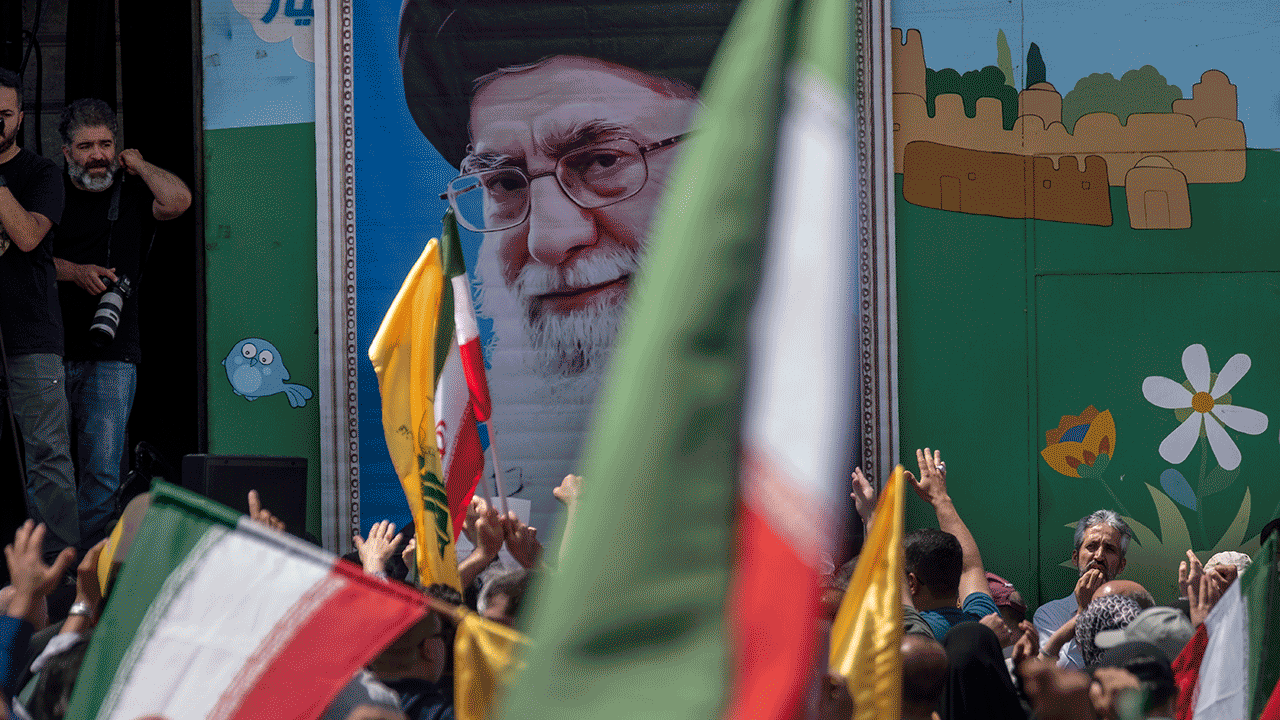
Supreme Leader Ayatollah Ali Khamenei image on the wall during a pro-Iran demonstration

Iranian worshippers hold up their hands as signs of unity with Iran's Supreme Leader, Ayatollah Ali Khamenei, during an anti-Israeli rally to condemn Israel's attacks on Iran, in downtown Tehran, Iran, on June 20, 2025.  (Morteza Nikoubazl/NurPhoto via Getty Images)

Alireza Arafi

The cleric and jurist Alireza Arafi, 67, who is part of a three-person temporary leadership council to run Iran might also be the successor to Khamenei.

According to the U.S.group United Against a Nuclear Iran, Arafi promised "death" to protesters who knock over the turbans of Iranian Islamic clerics. "Those who attack the turbans of the clergy should know that the turban will become their shroud," Arafi said. 

Ayatollah Mohammad-Mehdi Mirbagheri 

The extremist Ayatollah Mohammad-Mehdi Mirbagheri is also a contender to replace Khamenei. Mirbagheri argues for fighting and overcoming "infidels." 

Mirbagheri has quoted Iran's first Supreme Leader, Ruhollah Khomeini, declaring that a "new culture based on Islam in the world" would mean "hardship, martyrdom and hunger" and that Iranian people had "voluntarily chosen" to embrace this activity, according to Iran International. Mirbagheri’s theological credentials position him as a natural replacement for Khamenei.

Other names

Another clerical successor to Khamenei being discussed is Hassan Khomeini, the grandson of Ayatollah Ruhollah Khomeini. He is the custodian of the Khomeini mausoleum and, at 53 is young by the Islamic Republic’s standards for leadership.

United Against a Nuclear Iran ranked Ayatollah Seyyed Hashem Hosseini Bushehri, who was born in 1956 in Bardkhun, Bushehr, a second tier candidate to replace Khamenei.

Burning cars line a street in Tehran as thick smoke rises during unrest.

Cars burn in a street during a protest over the collapse of the currency’s value in Tehran, Iran, Jan. 8, 2026. (Stringer/WANA (West Asia News Agency) via REUTERS)

"Bushehr, is a powerful figure in Iran's religious and academic spheres. He embarked on his theological education in Bushehr before moving to Qom to further his studies. 

According to UANI, In 2024, Bushehri urged Iranian women to "address issues such as the status of women's rights in Western societies and the flaws that exist in this area in the West," which would prevent the "enemy [the West]" to "not even have a chance to challenges us [Iran]."

Iran analyst, Sabti, who was born in Tehran, said, "I don’t think that Israel and the U.S. should allow them to choose the next leader." He compared the successor system to Hamas when Israel eliminates a Hamas terrorist leader, and he is swiftly replaced with a new leader. 

Smoke rising over Tehran

TEHRAN, IRAN - FEBRUARY 28: Smoke rises over the city center after an Israeli army launches 2nd wave of airstrikes on Iran on Feb. 28, 2026.  (Fatemeh Bahrami/Anadolu via Getty Images)

"There is a need to "prevent the next leader from being chosen," he said. "Maybe we can eliminate the next one even before he is chosen." 

He said it is important to "break the system" to prevent the continuation of terrorism. "It is bad for Arab countries and Israel if the regime remains the same" in Iran.  


Sabti said the regime can continue to build its illicit nuclear weapons program, ballistic missiles and sponsor terrorism, adding it is better to dissolve the regime and "bring in a new system. 

He concluded that regime change requires "talking to the people," and, "maybe it is time for them to come out and make the good revolution." 

https://www.foxnews.com/world/trump-says-iran-wants-talk-who-lead-after-khamenei

CMMI Starts Testing New Prior Authorization Model for Traditional Medicare 


The Centers for Medicare & Medicaid Services Center for Medicare and Medicaid Innovation (CMMI) on June 27 announced details for the new Wasteful and Inappropriate Service Reduction (WISeR) Model

The WISeR Model will run for six years, beginning in 2026, and will test prior authorization for additional Part B services in traditional Medicare for providers in the following states: New Jersey, Ohio, Oklahoma, Texas, Arizona, and Washington. 
Under the model, providers in those states will have a choice of whether to submit a prior authorization request or undergo a post-service prepayment medical review for specific items and services. Providers who choose the prior authorization option may either submit the request directly to a model participant or submit the request to their Medicare Administrative Contractor that will forward the request to the model participant. Model participants are companies “with expertise managing the prior authorization process for other payers using enhanced technology like AI” and are required to have clinicians with expertise to conduct medical reviews to validate determinations. Companies hired to manage the initiative will be paid based on how much money they save the federal government by stopping payment for unnecessary or noncovered items and services. 

The initial list of planned items and services for the first performance year of the model includes deep brain stimulation for Parkinson’s disease, epidural steroid injection for pain management, cervical fusion, skin and tissue substitutes, and knee arthroscopy for osteoarthritis. The model excludes inpatient-only services, emergency services, and services that, if substantially delayed by a prior authorization, would pose a risk to patients. 


https://www.aamc.org/advocacy-policy/washington-highlights/cmmi-releases-new-prior-authorization-model-medicare

Beyond Phishing: The New 'Deepfake' And QR Code Credit Card Scams Of 2026

 by Adam H. Douglas via The Epoch Times (emphasis ours),

The newest credit card scam warning signs look different from old-school phishing emails. In 2026, face-tampered QR codes (“quishing”) in public places are a growing trend. Or an urgent phone call from what sounds exactly like your bank, but is actually an AI-generated voice clone.

Man holds credit card upside down for shutterstock pic

Some important scam warning signs are:

  • QR codes placed on stickers or layered over original signs
  • Payment links that redirect you to unfamiliar web addresses
  • Calls demanding immediate action to “prevent account suspension”
  • Requests for one-time passcodes or full card numbers over the phone
  • Pressure to act before you can independently verify the request

One of the best pieces of advice is: If something feels urgent, slow down and verify through official channels. You may think you’re too tech-savvy to fall for a scam. That confidence is exactly what modern fraud tactics target.

Traditional phishing emails, full of easy-to-spot spelling errors, are giving way to more sophisticated threats. Today’s scams rely on artificial intelligence, realistic voice cloning, and everyday tools like QR codes that often feel legitimate, personal, and time-sensitive.

Here’s what you need to know to avoid the newest credit card scams.

The Rise of ‘Quishing’: QR Code Credit Card Scams

QR codes spread rapidly during the pandemic. Today, they’re commonly found in restaurants, parking meters, and even utility bills. Scammers, not surprisingly, have caught on.

“Quishing” refers to phishing done through QR codes. Instead of clicking a suspicious link in an email, you scan a code in the real world.

Common Quishing Scenarios

  • A parking meter with a QR code sticker placed over the original code
  • A restaurant table tent that redirects to a fake payment portal
  • A public event sign offering “fast checkout” through a QR link
  • A mailed flyer with a QR code for “account verification”

Once scanned, you may land on a cloned website that looks nearly identical to your bank or payment processor.

Credit Card Scam Warning Signs With QR Codes

Look for:

  • Stickers placed on top of printed codes
  • Codes that appear misaligned, bubbled, or recently added
  • Web addresses that don’t match the official company domain
  • Requests for full card numbers, CVV codes, or Social Security numbers
  • Payment pages that lack a secure “https” connection

Important: If you’re asked to enter sensitive financial data after scanning a public code, pause. When possible, manually type the official website into your browser instead.

AI Voice Clones: When Your ‘Bank’ Calls You

Voice cloning is a rapidly improving technology, with scammers now able to replicate a bank representative’s tone, accent, and cadence. Some can even mimic someone you know personally.

You might receive a call saying: “We’ve detected suspicious charges on your credit card. To prevent account suspension, we need to verify your information immediately.”

The caller ID may even show your bank’s name because scammers can spoof phone numbers.

Red Flags of a Deepfake Bank Call

  • Urgent threats of account closure or frozen funds
  • Requests for your full card number or online banking password
  • Pressure to share a one-time passcode sent to your phone
  • Instructions to move money “temporarily” for security reasons
  • Refusal to let you hang up and call back independently

Legitimate banks will not ask for your password or full card number over the phone. If you receive a suspicious call, hang up and dial the number printed on the back of your card.

Urgency Is the Common Thread

Whether it’s a QR code or a voice clone, modern scams rely on emotion.

Scammers use:

  • Fear (“Your account will be closed.”)
  • Scarcity (“This must be resolved in 10 minutes.”)
  • Authority (“I’m calling from the fraud department.”)
  • Familiarity (“We spoke last week about your card.”)

The goal is to bypass your rational thinking.

The most important defense? Slow down. Fraud loses power when you verify.

What to Do If You Suspect Credit Card Fraud

If you think you scanned a malicious QR code or spoke with a scammer, act quickly:

  • Call the number on the back of your card.
  • Lock or freeze the card through your banking app.
  • Review recent transactions for unauthorized charges.
  • Dispute any suspicious charges immediately.
  • Change your online banking password.
  • Place a fraud alert via one of the three major credit bureaus.
  • Monitor your credit reports for new accounts.

Under the Fair Credit Billing Act (or FCBA), your liability for unauthorized credit card charges is limited, especially if you report them promptly. Many issuers offer zero liability policies, but timing matters.

A Modern Prevention Checklist

To protect yourself from evolving scams:

  • Enable real-time transaction alerts.
  • Use your bank’s official app instead of scanning public codes.
  • Avoid entering card details after scanning QR codes in public.
  • Never share one-time passcodes with callers.
  • Let unknown calls go to voicemail.
  • Keep your phone and banking apps updated.

Technology improves, but so does all types of deepfake fraud. Staying informed is your advantage.

Frequently Asked Questions: Credit Card Scam Warning Signs

How Can I Tell If a Phone Call From My Bank Is Fake?

A legitimate bank won’t ask for your full password, personal identification number (PIN), or one-time passcodes over the phone. If a caller pressures you to act immediately, threatens account suspension, or refuses to let you hang up and call back, treat it as suspicious. Caller ID can be spoofed, so don’t rely on the displayed number. The safest approach is to hang up and dial the number printed on the back of your credit card. Your bank will confirm if the call was real.

Are QR Codes Safe to Scan for Payments?

QR codes themselves are not inherently unsafe, but public codes can be replaced or tampered with. Scammers may place stickers over legitimate codes or redirect you to cloned websites designed to steal card details. Before entering payment information, confirm that the web address matches the official company domain and uses a secure connection. When possible, navigate directly to the company’s website or use its official mobile app instead of scanning a public code.

What Should I Do If I Gave My Credit Card Number to a Scammer?

Immediately call your card issuer using the number on the back of your card. Ask to freeze or cancel the card and request a replacement. Review recent transactions and dispute any unauthorized charges. Change your online banking passwords and enable transaction alerts. Consider placing a fraud alert with a credit bureau to monitor for identity theft. Acting quickly limits financial damage and protects your credit score from long-term harm.

Can Scammers Really Clone a Bank Employee’s Voice?

Yes. AI voice-cloning technology can replicate speech patterns using short audio samples. Combined with caller ID spoofing, scammers can create convincing impersonations of bank representatives or even people you know. However, cloned voices cannot bypass secure verification steps without your participation. Never share passwords, PINs, or one-time passcodes. If in doubt, hang up and call your bank directly to confirm whether the request is legitimate.

Modern scams no longer look sloppy. They look polished, personal, and urgent. Your best defense isn’t technical expertise. It’s skepticism, verification, and a refusal to rush.

https://www.zerohedge.com/political/beyond-phishing-new-deepfake-and-qr-code-credit-card-scams-2026