Search This Blog

Sunday, April 12, 2026

Iran brings unusually broad team to US talks to blunt future blame

 Iran has sent a negotiating team to the Islamabad talks with the United States spanning an unusually broad political spectrum—suggesting a possibly calculated effort to pre-empt future hardline backlash while pursuing negotiations.

The delegation which held lengthy talks with the US team in Islamabad on Saturday includes not only Parliament Speaker Mohammad-Bagher Ghalibaf and his political allies but also Ali-Akbar Ahmadian, Secretary of the Defence Council, and more moderate technocrats such as Central Bank of Iran Governor Abdolnaser Hemmati.

However, the presence of Mahmoud Nabavian—a hardline parliamentarian known for his staunch opposition to negotiations with the West—has generated particular surprise.

Nabavian, a cleric affiliated with the ultra-conservative Paydari (Steadfastness) Party, has for years denounced figures like Mohammad-Javad Zarif and the relatively moderate government of Hassan Rouhani as “traitors” for pursuing the 2015 nuclear deal, formally known as the Joint Comprehensive Plan of Action.

His inclusion in the delegation appears to be interpreted as a calculated move by Ghalibaf. By bringing a vocal critic of negotiations into the process, he may be attempting to share responsibility for the outcome and pre-empt future criticism from hardline factions that wield significant influence within Iran’s political and military structures.

With figures like Nabavian involved, any eventual agreement—or failure to reach one— is less easily attributed to a single political camp.

According to political activist Hossein Shirzad, the delegation’s structure suggests a broader objective beyond traditional diplomacy. “The composition of the delegation … indicates that negotiations are aimed at presenting a ‘political business plan’ to Donald Trump’s representatives for Iran’s future,” he wrote on X. He added that “the discussions are likely about the quality of an agreement, not the agreement itself.”

Shirzad also claimed that “the issue has already been resolved behind the scenes. Ghalibaf wants to prove that he has the expertise and executive capability to manage Iran and control the remaining structure. He is seeking personal and factional guarantees.”

Mojtaba's green light

Despite the significance of the negotiations, Iran’s new supreme leader has not issued an explicit public endorsement.

However, in a written message marking the fortieth day after his father’s death, Mojtaba Khamenei referred to the “announcement of the decision to negotiate with the enemy” and called for public mobilization to influence the outcome, remarks that many interpret as implicit approval of the negotiation process.

He also referenced verses from Surah Al-Fath in the Quran, alluding to the Treaty of Hudaybiyyah—a peace agreement between Prophet Muhammad and his adversaries in Mecca. In Islamic tradition, this treaty is seen as a strategic move that reduced conflict and ultimately strengthened Muslims despite their weaker position at the time.

Such symbolic references carry strong weight among the Islamic Republic’s ideological base.

Ghalibaf and his rivals in the conservative camp

Divisions and rivalry within Iran's conservative camp remain pronounced. On one side stands Ghalibaf and his pragmatic allies—often described as technocratic conservatives—who advocate negotiation from a position of strength. They reject ultimatums but view diplomacy as a rational tool for managing tensions and reducing external pressure, with indirect talks seen as the most viable path under current conditions.

For Ghalibaf, success in these talks could significantly bolster his political standing after multiple failed bids for the presidency over the past two decades. A diplomatic breakthrough could help secure his position as a leading figure in Iran’s future political landscape.

On the other side are more radical conservatives, including Saeed Jalili and factions such as the Paydari Party, who have consistently opposed any engagement with the United States. These groups have framed past agreements as “surrender” and continue to adopt a hardline stance.

Jalili has remained notably silent in recent days, fueling speculation in political circles that under the new leadership he may have been replaced in his role at the Supreme National Security Council by Ali Bagheri-Kani, also present alongside the delegation.

Hardline opposition beyond political elites

Hardline opposition extends beyond political elites into public discourse. In street protests and on social media, critics have condemned any potential agreement as a sign of “humiliation” and “betrayal of the leader’s blood.”

In one widely circulated video, a speaker denounced Ghalibaf’s trip to Pakistan for talks with JD Vance, prompting crowds to chant “Hayhat Min al-Dhilla” (“Never accept humiliation”)—a phrase historically attributed to Imam Hussain on the Day of Ashura.

State media also reflects this tension. While negotiations are widely understood to require leadership approval, some broadcasters have continued to voice dissent.

For instance, a presenter on IRGC-affiliated Ofogh TV questioned the rationale for talks, asking: “If the Zionist regime has violated the ceasefire, based on which commitment should we remain silent and go negotiate? Three of Iran’s ten conditions for negotiation have been violated.”

Even so, other voices within state media have pointed to historical precedents, noting that several Shia Imams engaged in dialogue or cooperation with their adversaries, suggesting that negotiation, in itself, is not incompatible with ideological principles.

https://www.iranintl.com/en/202604115814

'CIA used Pegasus in deception op to rescue downed US airman in Iran - Times'


The CIA used Pegasus spyware to carry out a deception campaign in Iran during an effort to rescue a downed US airman in Iran after his F-15E Strike Eagle was shot down by an Iranian shoulder-launched missile, The Times of London reported.

According to the report, the agency used the Israeli-made software to send fake messages to Iranian leadership and Islamic Revolutionary Guard Corps (IRGC) operatives claiming the missing officer had already been found.

Pegasus, developed by the Israeli-founded NSO Group, is widely known for enabling operators to infiltrate mobile devices to eavesdrop on communications and harvest data. It can also send messages via platforms such as WhatsApp or Signal that appear to originate from the compromised device, the report said.

https://www.iranintl.com/en/liveblog/202604067622

'Iran Eyes Swift Recovery of Oil Facilities'


Iran aims to restore its damaged refining and distribution facilities to 70-80% capacity within one to two months. According to Deputy Minister of Oil Mohammad Sadeq Azimifar, part of the Lavan refinery is expected to resume operations within approximately 10 days, with other units following gradually.

Trump threatens 50% tariff on China if it helps Iran

 United States President Donald Trump threatened to impose a 50% tariff on China if it sends weapons to Iran. In an interview with Fox News on Sunday, he reiterated what he said earlier about slapping new levies on nations that supply arms to Tehran.

However, when asked whether he thinks China will provide MANPAD (Man-Portable Air Defense Systems) to the Middle Eastern country, Trump said he doubts it. Nevertheless, he repeated that he has a good relationship with Chinese President Xi Jinping and spoke positively about bilateral relations between the two countries. "As far as China's concerned, China can send their ships to us, China can send their ships to Venezuela... we have a lot of overcapacity, and we'll probably sell [oil] for even less money," he declared.

Trump is set to visit China and meet with Xi in Beijing in May. His trip to the country was previously delayed after the US and Israel launched an attack against Iran.

https://breakingthenews.net/Article/Trump-threatens-50-tariff-on-China-if-it-helps-Iran/66050571

'Sick Behavior From Financial Psychopaths'

 by QTR's Fringe Finance

I’ve been saying this for months: despite “experts” just sounding the alarm moments ago: the private credit unwind that started months ago and has now spiraled into a very real liability for the economy wasn’t some unknowable tail risk lurking in the shadows.

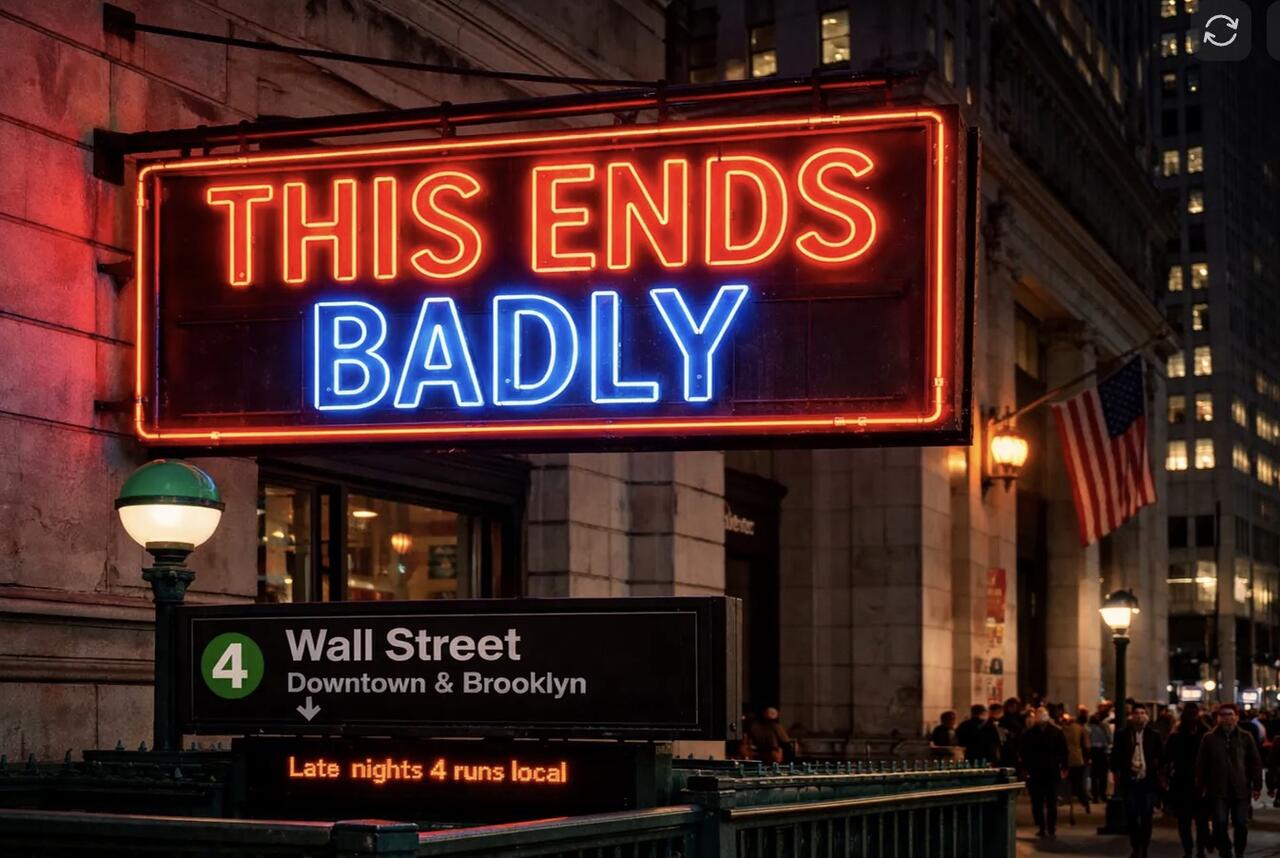
It couldn’t have been clearer if it was a fucking neon sign blinking THIS ENDS BADLY hanging outside of the 4 train station on Wall Street so industry workers were forced to see it on their way into work every morning.

Not only did I call the private credit collapse, I also argued that it would experience a sharp downturn before the Fed stepped in to bail it out or provide a backstop, despite, once again, the widespread misconduct of mismarking positions and carrying opaque, low-quality assets on the books of the companies managing these funds.

And here we are, right on schedule, watching that script unfold with all the subtlety of Eric Swalwell on a date after 9 whiskey cocktails.

In the last two days alone, Bloomberg reports that the Federal Reserve has gone from politely observing to actively interrogating. Not in a press-release, “we’re monitoring conditions” sort of way, but boots-on-the-ground examiners asking major banks to cough up details about their exposure to private credit.

Translation: they’re not trying to understand the industry, they’re trying to figure out how bad the damage could get and who’s going to be holding the bag when it does.

And what are they likely finding? Exactly what anyone paying attention already knew. Private credit funds didn’t just lend money, they borrowed it, too. Because in good times, leverage makes returns look smooth and irresistible. It turns middling loans into “high-yield opportunities.” It creates the illusion of stability. But in bad times? That same leverage becomes a transmission mechanism, turning localized stress into systemic risk. It’s not a bug, it’s the design.

Meanwhile, the Treasury is now poking around insurers, because of course this nuclear dogshit being peddled as a financial opportunity didn’t stay neatly contained in some alternative-assets sandbox. It likely spread. Into insurance portfolios, retirement products, retail funds…basically anywhere someone was desperate enough for yield to believe the pitch. The industry ballooned to roughly $1.8 trillion (and depending on how you count it, more), all built on the comforting fiction that because it wasn’t traditional banking, it somehow wasn’t subject to traditional banking problems.

Just like we’re seeing with “magically” successful subprime lenders like Carvana, of course they’re still subject to reality. The better question is how they can avoid the assumption they have to face reality at some point. I think we know how Carvana has been doing it: f*cking with the numbers. And private credit is doing the same. Just with worse transparency.

And now suddenly regulators are “assessing spillover risk,” which is the bureaucratic equivalent of checking where the fire exits are while the building is already filling with smoke.

Let’s not pretend we don’t know where this goes. When the Fed starts mapping exposures like this, it’s not because they’re writing a research paper. It’s because they’re quietly preparing the intervention. Maybe it’s a backstop. Maybe it’s liquidity support. Maybe it’s some creatively named facility that sounds temporary but lingers for years (something like the “Assessment of Systemic Stress by Head Office Liquidity & Economic Support” plan, or A.S.S.H.O.L.E.S. for short).

Whatever form it takes, the direction is obvious: if this thing threatens the broader system, it will be contained and we will print our way out of it. Which is to say, the everyday worker, already suffering from inflation and unable to buy a box of Triscuits or a Domino’s Pizza, will now be responsible for bailing out private credit with their purchasing power.

And right on cue—this is where the story stops being predictable and starts being grotesque. Because while regulators are measuring the crater, Wall Street is building a gift shop next to it.

The Wall Street Journal wrote yesterday that banks like JPMorgan Chase, working with S&P Global, are rolling out a brand-new shiny instrument: a credit-default swap index tied to private credit exposure. A clean, tradable, scalable way to bet against the very ecosystem they spent the last decade inflating. They’re packaging up the risk, labeling it, and selling access to its failure.

You really have to admire the efficiency, right?

The index pulls in names like Apollo Global Management, Ares Management, and Blackstone, the giants of the space, the architects and beneficiaries of the private credit boom. As sentiment turns and defaults rise, the index goes up. In other words, the worse things get for the underlying system, the better things get for anyone positioned against it.

If this is giving you déjà vu, congratulations, you were alive in 2008.

Back then, the game was subprime mortgages. Banks originated garbage, distributed it widely, then quietly built instruments to short it when the cracks appeared. Today, it’s private credit wearing a slightly more sophisticated suit, but the choreography is identical. Manufacture the asset. Scale it. Normalize it. Then monetize its collapse from every conceivable angle.

And of course, the official justification is “risk management.” Banks say they need these tools to hedge exposure, to protect themselves from potential losses tied to private credit funds. Which, sure, fine. But let’s not insult anyone’s intelligence. This isn’t just about hedging. This is about creating a liquid, standardized market for betting on distress. It’s about turning systemic fragility into a profit center.

Hedge funds are already circling, because until now, shorting private credit was messy. You had to pick off individual securities, make indirect bets, deal with illiquidity. It was cumbersome. Inefficient. Now? They get a big, convenient index…a one-click way to express the view that the whole structure is wobbling.

So step back and look at the full picture, because it’s almost too on-the-nose to be real.

Wall Street spends years constructing a massive, opaque, leveraged lending machine and sells it as safe, stable income. It pulls in institutions, then pensions, then retail investors. always expanding the circle of exposure. Stress builds quietly, then not-so-quietly. Defaults tick up. Liquidity tightens. Investors panic. Douchebags in bowties warn about it after it is too late.

Regulators step in…not to dismantle the system that created the risk, but to understand how big the rescue might need to be. And at the exact same moment, the financial industry engineers new ways to bet against the collapse it set in motion.

This is moral hazard elevated to an art form. The downside is cushioned, implicitly or explicitly, by the expectation of intervention. The upside is captured privately, twice: once on the way up through fees and leverage, and again on the way down through shorts and derivatives. It’s not just asymmetric anymore, it’s circular. A closed loop of profit extracted from creation, expansion, and destruction alike.

And the most absurd part is how little effort is made to hide it. The Fed’s questions aren’t secret. The new derivatives aren’t backroom deals. This is all happening out in the open, narrated in real time by headlines that read like satire but aren’t.

And don’t be fooled. None of this bullshit is innovation. Not resilience. Not sophisticated risk transfer, or any other fancy sounding term they give it.

Nah. It’s just a deeply, structurally, almost impressively sick and psychotic ecosystem, where the same people who built the toxic dump of deals are now lining up to profit from its collapse, all while the adults in the room quietly prepare to make sure the fallout doesn’t inconvenience them too much.

And the everyman, honest hardworking plumber or mailman who can’t afford a box of cereal or a cup of coffee anymore because his purchasing power has been decimated by the same money printing that’ll inevitably be coming? Oh, well, fuck that guy. He has had his boot on the neck of Wall Street for just too damn long.

--

QTR’s Disclaimer: Please read my full legal disclaimer on my About page hereThis post represents my opinions only. In addition, please understand I am an idiot and often get things wrong and lose money. I may own or transact in any names mentioned in this piece at any time without warning. Contributor posts and aggregated posts have been hand selected by me, have not been fact checked and are the opinions of their authors. They are either submitted to QTR by their author, reprinted under a Creative Commons license with my best effort to uphold what the license asks, or with the permission of the author.

This is not a recommendation to buy or sell any stocks or securities, just my opinions. I often lose money on positions I trade/invest in. I may add any name mentioned in this article and sell any name mentioned in this piece at any time, without further warning. None of this is a solicitation to buy or sell securities. I may or may not own names I write about and are watching. Sometimes I’m bullish without owning things, sometimes I’m bearish and do own things. Just assume my positions could be exactly the opposite of what you think they are just in case. If I’m long I could quickly be short and vice versa. I won’t update my positions. All positions can change immediately as soon as I publish this, with or without notice and at any point I can be long, short or neutral on any position. You are on your own. Do not make decisions based on my blog. I exist on the fringe. If you see numbers and calculations of any sort, assume they are wrong and double check them. I failed Algebra in 8th grade and topped off my high school math accolades by getting a D- in remedial Calculus my senior year, before becoming an English major in college so I could bullshit my way through things easier.

The publisher does not guarantee the accuracy or completeness of the information provided in this page. These are not the opinions of any of my employers, partners, or associates. I did my best to be honest about my disclosures but can’t guarantee I am right; I write these posts after a couple beers sometimes. I edit after my posts are published because I’m impatient and lazy, so if you see a typo, check back in a half hour. Also, I just straight up get shit wrong a lot. I mention it twice because it’s that important.

https://www.zerohedge.com/markets/sick-behavior-financial-psychopaths

As AI pushes students to reconsider majors, universities struggle to adapt

 A recent poll shows AI’s increasing role in how students decide on college majors, creating a rapidly developing situation for universities that are still struggling to determine how the technology will shape higher education. 

The Lumina Foundation-Gallup 2026 State of Higher Education survey found 47 percent of currently enrolled college students have thought about switching majors “a great deal” or a “fair amount” over AI concerns.  

Around 16 percent pointed to AI as the reason they changed their field of study. 

“We’re getting to a point where it’s almost unacceptable, right, that we’re having all of these conferences and all of these roundtable discussions, and we are failing to provide students with some just meaningful advice and helping them to feel like they’re prepared,” said Alex Kotran, CEO of the AI Education Project.  

“If students were adequately prepared, you wouldn’t see as many of them change their major, or you would see that happening in a way that schools are driving but they’re not doing that,” he added. 

The survey found men and those going for associate degrees were more likely to consider a field change due to AI, along with those in technology, vocational and humanities majors. Those least likely to have considered switching majors include students in fields such as health care and natural sciences.  

The fright of how AI will impact jobs students are looking for is not unfounded as messages of job declines due to the technology have only ramped up since its increased use in the past few years. 

In February, the AI chief for Microsoft told the Financial Times he believes AI will take over all white collar work in the next 18 months.  

Researchers at Tufts University predict over the next 2 to 5 years 6 percent of jobs will be at risk from AI, with the highest concerns in sectors such as information at 18 percent, finance and insurance at 16 percent and professional, scientific and technical services at 16 percent.  

Forty percent of the AI job losses will occur in Texas, California, New York, Florida and Illinois, the researchers predict.  

And young people are predicted to take the biggest hits from AI since experts say it could largely take over entry level work. 

“One recent piece of research suggests that in jobs that are considered highly exposed to AI, employment for 22- to 25-year-old workers suffered relative declines of about 16% between 2022 and 2025 compared with their older peers in those same jobs,” the Gallup poll noted.  

Some contend the hit entry level jobs could take from AI may cause a change in conversations between young people and potential employers. 

“Have conversations with folks who are more senior to you, 5, 10, 15 years, and sort of ask the question, ‘What is it that humans can do and need to be here for, and how do I sort of fill that role?’” said Stephen Aguilar, director of the University of Southern California’s Center for Generative AI & Society. 

“There are some baseline tasks that can be offloaded, but we can’t just, you know, undercut all of the entry level positions, because then there won’t be people who develop the experience to really understand what happens when AI fails,” he added. 

While students are recognizing how AI is changing the job market, universities are struggling to keep up with the rapid changes and challenges AI presents.  

“Every occupation that and every field of inquiry that a student is preparing for is going to be shaped and altered by AI. So, I think it’s quite important for not just students, but professors and educational institutions to keep an eye on what AI is doing to the knowledge industry,” said Roosevelt Montas, the John and Margaret Bard Professor in Liberal Education and Civic Life at Bard College. 

The poll found 57 percent of students who AI weekly for coursework and 1 in 5 use it daily while 42 percent said their universities are discouraging AI use and 11 percent banned the technology altogether. 

Thirty-two percent of those with bachelor’s degrees say universities do not give enough instructions around AI while 56 percent said it is the right amount.  

“Schools are simultaneously telling students AI is going to reshape your career, but they’re also saying, don’t use any AI, and that’s incoherent,” Kotran said. 

When AI first blew up among students between 2022 and 2023, many K-12 schools and college classrooms tried completely banning the technology. While many have backed off complete bans, educators have struggled to determine the role of AI in learning. 

The biggest shift for universities may be the type of education they need to give students to prepare them for an AI workforce.  

“What’s happening with the environment and universities and at USC [University of Southern California], specifically, we’re doing what we can to make sure that students who come to us leave not just sort of specialists, but become more generalist in the sense of they get the education that lets them interact with whatever AI they’re going to experience,” said Aguilar. 

https://thehill.com/homenews/education/5826091-ai-college-majors-job-market/

GSK sees blockbuster potential in targeted cancer therapy after promising early data


British drugmaker GSK's experimental targeted cancer drug Mo-rez has blockbuster potential, its head of oncology ‌research has told reporters, after early data showed the drug ‌helped shrink tumors in patients with advanced, hard-to-treat cancers.

"This is one of our priority assets ​at this stage," GSK's Hesham Abdullah said on a call with journalists discussing the early data, which is being presented at a medical conference in Puerto Rico on Sunday.

"Do we think it would be a blockbuster? Yes, absolutely," ‌GSK's Hesham Abdullah said on ⁠the call.

Initial results measured the proportion of patients who achieved a meaningful reduction in tumor size, defined as at ⁠least a 30% shrinkage. In platinum-resistant ovarian cancer, 62% of patients met that threshold, while 67% did so in endometrial cancer.

DATA GIVE MOMENTUM TO GSK'S ​ONCOLOGY BUSINESS

Analysts ​have not yet projected future sales ​for mo-rez given early trial ‌data.

The data give momentum to GSK's fast-growing oncology business. CEO Luke Miels, who started in the role in January, has said the company will speed up work on new medicines, a shift Abdullah said is already being reflected in its product development.

"I think it has been reflected in the ‌type of pace that you are seeing ​and the type of conviction that we ​have in our programmes moving ​forward," he added.

GSK is testing Mo-rez in two late-stage ‌trials in ovarian and endometrial cancers and ​plans to start ​three additional studies in coming months.

Mo-rez, an antibody‑drug conjugate, targets the B7H4 protein found on gynaecological cancer cells but is largely absent ​from healthy tissue. The ‌market for ADC treatments is projected to reach $31 billion by 2030.

GSK ​licensed the drug from China's Hansoh Pharma in 2023.

https://uk.finance.yahoo.com/news/gsk-sees-blockbuster-potential-targeted-141147395.html