The United States Central Command (CENTCOM) said on Sunday that, as of July 19, its forces had redirected six commercial vessels and disabled one "to ensure full compliance" in its naval blockade of Iran.
In its previous update, CENTCOM said that a US service member was killed in northern Iraq "during a controlled detonation of unexploded ordnance from a downed Iranian one-way attack drone" while a second service member was wounded. This came a day after it announced that two US service members were killed.
CENTCOM also said in that earlier social media post that it had located unidentified remains in Jordan, where one US service member was classified as missing. "An examination process to verify the remains is ongoing," it added.
The United States Central Command announced thattwo more soldiers were killedamid the escalating war against Iran in the Middle East.
"Yesterday, US Central Command (CENTCOM) announced the passing of two US service members and the missing status of one in Jordan following an Iranian attack on July 17. After a thorough search, US military personnel found unidentified remains at the location earlier today. An examination process to verify the remains is ongoing," the command said in a statement. A second soldier was killed in action in northern Iraq, "during a controlled detonation of unexploded ordnance from a downed Iranian one-way attack drone," leaving another soldier wounded.
CENTCOM stressed that the identities of soldiers who had been killed or missing were being withheld out of respect for their families.
The backlash against the AI data-center build-out- which we've been tracking since it was asmatteringof county fights across 28 states -staged its first coordinated day of action on Saturday: 142 protests across 42 states, from Wasilla, Alaska to Naples, Florida,organized by Humans First, the nonprofit that Tea Party veteran Amy Kremer co-founded and chairs. The crowds spanned both sides of the aisle...uniting a MAGA stalwart in a 'faith, family, freedom' T-shirt in New Jersey, a first-time activist in Texas, and a left-leaning organizer in California's Imperial Valley.
The fight looked like Kenilworth, New Jersey. Residents of the 8,500-person borough gathered outside the municipal court at mid-morning with drums, plastic horns, and sidewalk chalk to protest the $1.8 billion CoreWeave AI data center their planning board approved in May 2025 on the former Merck campus - a project that has since drawn more than 12,000 petition signatures against it, several thousand more names than the town has people. The woman in the "faith, family, freedom" T-shirt marched beside neighbors holding "Build community, not data centers" signs. When heavy rain arrived later in the day, they pulled on ponchos, shared umbrellas, and kept marching. One sign, caught by Business Insider's photographer on the scene: "You think this is pressure? Wait 'til there's no water pressure."
Texas, the country's hottest data-center market, hosted the most rallies - 18 - with Georgia at 11, California at eight, and Pennsylvania, Florida, and Indiana at seven apiece. In Imperial Valley, where a proposed facility could pull 260 million gallons a year from the Colorado River, Ivan DelSol, 54, told Reuters that around 50 people turned out in 100-degree heat. "It's dystopian that you would use this much fresh water for AI," he said. Organizers released no headcounts; turnout ran below expectations in some rural areas and in Atlanta, where about a dozen showed - most of them, a volunteer there said, driving in from the smaller Georgia towns where the biggest data centers are going up.
Kremer is a founding figure of the Tea Party movement who went on to found Women for Trump, and an organizer of the January 6, 2021 rally that preceded the Capitol riot (she neither planned nor took part in the riot itself). She has spent months calling data centers the defining fight of her lifetime, warning the technology could threaten humanity itself, and she is open about running the old playbook: grassroots pressure, town by town, aimed at both parties.
Her crowds bear that out. One of Saturday's Texas rallies, in Tyler, was organized by Eva Cardona, a 31-year-old self-described political nomad and first-time activist who told Reuters she wanted something more hands-on than posting on Facebook; about a dozen people came. And in Imperial Valley, the man who helped lead the rally leans left. The polling explains why a coalition that broad holds. A June Reuters/Ipsos survey found only 14 percent of Americans would support a data center in their own community.Gallup polling fielded in March found 71 percent oppose building an AI data center in their area - 48 percent strongly - a worse number than a local nuclear plant gets. And Morgan Stanley told clients in a July 14 note that support for local data-center bans runs strongest among Republican, higher-income, and urban voters, while Morning Consult's national tracker crossed a line of its own in May: "stop building" (about 45 percent) overtook "keep building while expanding energy supply" (about 38 percent) for the first time since last October.
For all the movement's reputation, Kremer's demands stop well short of a shutdown. She opposes a national moratorium and statewide moratoriums alike, telling Business Insider that each community should choose what gets built inside it, and that too many of those choices are made behind closed doors. Humans First's platform runs to transparent approval processes, environmental review before permits are granted, union construction jobs, and binding developer commitments of the kind lawyers call community benefits agreements. She has aimed as much fire at her own side, accusing Republicans of giving Big Tech a free pass and predicting the industry will cozy up to Democrats the moment the majority flips. The fix, she argues, belongs to Congress.
The organization is a narrower thing than the crowds it convened. Humans First announced in April that its non-conservative team members would spin off into a separate group, with Kremer promising "a topflight team of conservatives" to fight Big AI and its lobbyists. The banner over Saturday's rallies, in other words, was a conservative one - which makes the mix of people who marched beneath it all the more striking.
Official Backlash
The rallies capped a fast-moving week. On Tuesday, New York Governor Kathy Hochul signed an executive order imposing the nation's first statewide moratorium on new hyperscale data centers - an immediate pause of up to a year on state environmental permits for projects of 50 megawatts or more while regulators draft standards covering energy demand, water use, and air quality. Her office promised localities community-benefit guidance within 60 days, and Hochul will pursue repeal of the state's sales-tax exemptions for massive data centers. A tougher bill passed by the legislature, with a 20-megawatt threshold, remains unsigned on her desk; her office has called it complicated, and Hochul said the state wants to be "the first to get it right."
New York was not alone. Virginia's new tax on data-center electricity - 1.1 cents per kilowatt-hour - took effect July 1. Pennsylvania's House passed a ban on non-disclosure agreements in data-center deals by a 171-31 vote, and separately voted 197-5 to repeal the industry's sales-tax exemption, a break worth roughly $517 million a year by 2030. Arizona's governor signed a three-year moratorium on new data-center tax breaks in June. Legislators have filed more than 300 data-center bills this year; local pauses have passed at the county, city, and tribal level in at least 15 states.
Meanwhile In China
Nothing comparable is happening on the other side of the Pacific. Two days before the marches, Beijing-based Moonshot AI released Kimi K3, a 2.8-trillion-parameter system billed as the largest open-weight model ever built and claimed to perform level with America's best frontier models. Bloomberg has reported that Beijing plans to spend roughly $295 billion over five years on a nationwide network of AI computing hubs - and none of it will face a zoning board. Under the state's "Eastern Data, Western Computing" program, the buildout is steered into the arid, sparsely populated west; provincial governments compete to attract data centers with tax holidays, cheap land, and compute vouchers, and the state absorbs up to half of operators' energy costs, so the strain never shows up on a household bill. No Chinese county has passed a moratorium, because no Chinese county gets a vote.
The financial toll is no longer hypothetical. Third-party trackers cited by Morgan Stanley in its July 14 note put the value of cancelled or delayed projects at roughly $156 billion in 2025 and another $130 billion in the first quarter of 2026 alone - about $286 billion in all - set against the bank's own estimate of $877 billion in AI capital spending this year. The underlying quarterly count comes from Data Center Watch, a tracker run by 10a Labs, an intelligence firm whose client list includes AI companies, which logged at least 75 projects blocked or delayed from January through March - matching in one quarter the number of projects derailed in all of 2025 - as active opposition groups more than doubled from 396 to 833 and spread to 49 states.
Saturday itself stayed peaceful - chalk, chants, drums, umbrellas - though the wider fight has had harder edges: developers of the Piedmont transmission line into Northern Virginia's data-center corridor asked a federal court last summer for U.S. Marshals to escort survey crews after landowners threatened workers, an episode we covered at the time.
The industry answered forcefully. The Data Center Coalition warned that New York's moratorium tells investors the state is "closed for business" and will push jobs and tax revenue to neighboring states. Seven major AI and cloud companies - Amazon, Google, Meta, Microsoft, OpenAI, Oracle, and xAI - point to the Ratepayer Protection Pledge they signed at the White House in March, a voluntary commitment to cover the grid costs their facilities create. And White House AI czar David Sacks went after Hochul's case point by point on the All-In podcast, calling data centers "the scapegoat for all of the angst that people have about AI." His answer to the utility-bill complaint: let developers build their own generation behind the meter instead of competing with households for grid power.
Some industry allies go further, pointing to OpenAI's June disclosure that it banned a China-linked network using ChatGPT to mass-produce comics and comments blaming data centers for rising power bills. OpenAI itself found the operation gained almost no authentic traction - and the crowds in Kenilworth and Imperial County were unambiguously homegrown.
Kremer spent Saturday evening thanking volunteers and looking past the weekend. "America is not for sale, and our communities are not collateral," she wrote on X. She expects data centers on the ballot in November, and again in 2028. The midterms are less than four months away.
Dozens of American refueling aircraftwill be deployed across IDF bases and the Ramon Airport in southern Israel, another security official, who is familiar with the details of the talks with the US Defense Department, said on Sunday.
Coordination between the IDF and US military will naturally tighten, “with the goal of shortening the time it takes to move from routine to emergency readiness,” as the hours pass and more American forces arrive in the Middle East, another senior security official said.
If the Americans intensify the strikes and expand the operational posture against Iran in a way that would require the transfer of an additional force package of refueling aircraft, they may land at Ben-Gurion Airport despite the agreement reached so far between the two nations.
Meanwhile, an Israel Air Force source told Walla on Sunday that 14 American military refueling aircraft arrived in Israel over the weekend against the backdrop of the escalation in the war with Iran.
As part of the buildup of American forces in the Middle East and Israel, the US military is redeploying F-35 aircraft from Britain and F-15 aircraft from Germany, including aircraft specialized in suppressing enemy air defenses and radars.
US operating over 20 warships, hundreds of aircraft to maintain naval blockade
The move is intended to “blind” the Islamic Revolutionary Guard Corps (IRGC), which has been working around the clock to recover its decimated abilities, including accelerating the renewal of production lines for surface-to-air and surface-to-surface missiles.
This is in addition to dozens of aerial refueling aircraft that support long operations against and over Iran.
It should be noted that, in order to enforce its naval blockade on Iranian ports and beaches, including the Strait of Hormuz, CENTCOM is operating more than 20 US Navy warships, along with hundreds of aircraft that are already dispersed among different bases across the Middle East.
Meanwhile, the US military and US Department of Defense are keeping the location of US special forces completely opaque, since their operations are defined as “highly secret.”
The National Hurricane Center has raised the probability of tropical development for Invest 91L to 80% over the next two to seven days.
The broad area of low pressure off Florida's west coast in the Gulf of America should be tracked into the new week, as early Sunday model guidance suggests it could eventually threaten offshore oil and gas rigs and coastal refineries.
NHC's latest Invest 91L update:
A area of low pressure located over the northeastern Gulf of America continues to become better defined and the associated shower and thunderstorm activity is gradually increasing.
Continued gradual development is expected, and a tropical depression is likely to form later today or on Monday as the system moves slowly northward or northwestward.
Interests along the northern Gulf coast from Florida, Alabama, Mississippi, and Louisiana should monitor the progress of this system, as tropical storm watches or warnings could be required for portions of the area later today.
In addition, this system is expected to bring heavy rains to portions of the northern Gulf coast during the next several days. An Air Force Reserve reconnaissance aircraft is scheduled to investigate the low pressure area later today.
Formation odds:
Formation chance through 48 hours...high...80 percent.
Formation chance through 7 days...high...80 percent.
Model Track:
Refinery Map:
Regardless of Invest 91L's development, the broad area of low pressure will traverse northwest, away from Southwest Florida and towards the New Orleans area.
The Atlantic Hurricane season is beginning to move into an active phase.
Notably, El Niño generally suppresses Atlantic hurricane activity by increasing upper-level westerly winds and vertical wind shear across the Caribbean and tropics, which disrupt tropical systems before they organize or intensify.
You've likely seen it if you've the nearby Hell's Kitchen entrance to the Lincoln Tunnel...
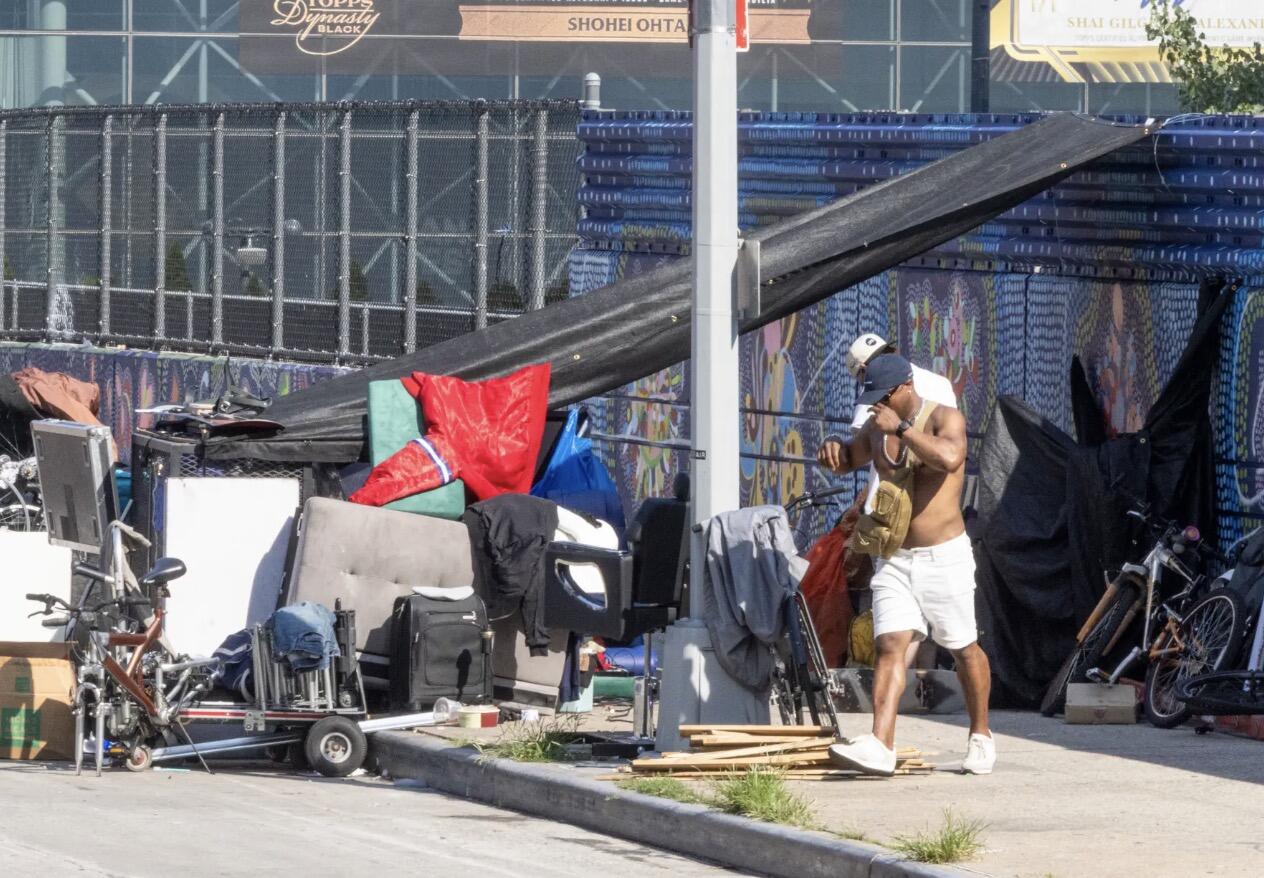
What began as a growing homeless encampment on Manhattan's West Side has now escalated to alleged utility theft, according to the NY Post.
According to reports, one resident of the sprawling encampment was seen Tuesday tapping into city electrical lines to power a makeshift shelter near West 34th Street between 11th and 12th Avenue. The camp now stretches roughly a dozen blocks, from 34th Street to 46th Street near the Intrepid Museum, and has become an increasingly visible flashpoint for residents, commuters, and tourists.
The NY Post writes that bus drivers and local workers say the encampment has continued to expand over the past several weeks, with tents multiplying and sidewalks becoming increasingly obstructed.
"It's been almost a month now and it gets a little bigger every time I come back," one FlixBus driver told the New York Post. He said garbage piled along the sidewalk forces passengers waiting for buses into the street, while some people living in the encampment have reportedly approached travelers asking for money. He added that complaints to city officials have produced little visible response.
Police officers were seen Tuesday ordering the individual accused of siphoning electricity to disconnect from the utility line. Elsewhere along the encampment, officers reportedly seized extension cords and power strips from another makeshift shelter. Despite those actions, there appears to be little expectation that the enforcement will significantly reduce the camp's size.
Mayor Zohran Mamdani has defended the city's broader approach, saying the priority is moving homeless individuals into shelters and ultimately permanent housing rather than simply dispersing encampments from one neighborhood to another. Asked specifically about the West Side encampment, he said the city would review the situation.
Despite growing attention, reports indicate that no sanitation crews or homeless outreach teams had been seen at the site in the days following news coverage of the encampment.
The camp itself has reportedly continued to grow, with additional tents appearing over the weekend. Reports also claim that the area has attracted people struggling with addiction, along with sex workers, adding to concerns from nearby businesses and residents who say conditions continue to deteriorate.