AI-powered geospatial data platform xMap's data scientist, Dana Harrison, asked in a LinkedIn post: "Can Mobility Data Spot Commodity Supply Risk Before the Market Does?"
Harrison used location data from points of interest and human mobility data to focus on what she says are "changes in human movement" over recent months along Pakistan's Chagai copper-gold corridor, home to Saindak and the massive Reko Diq development, which is located near the Iranian border.
Harrison continued:
On this episode of The Reckless Rabithole, I noodled around with xMap mobility data along Pakistan's Chagai copper-gold corridor, home to Saindak and the massive Reko Diq development.
During a period of growing security and logistics disruptions, mobility in Nushki and Dalbandin began to diverge materially from comparable locations elsewhere in Balochistan, with both ending July roughly 20 index points below the regional benchmark.
Not suggesting mobility caused or predicted the disruption. But it raises a question I find much more interesting:
Could changes in human movement provide an early signal of operational stress around critical-mineral supply chains?
The data does not directly track copper shipments and/or mine production. It merely shows overall human movement is declining, and sharp declines may suggest road restrictions, security operations, reduced commercial activity, telecommunications outages, or population displacement along the N-40 Highway, the main artery connecting Quetta with Nushki, Dalbandin, Saindak, and Pakistan's border with Iran.
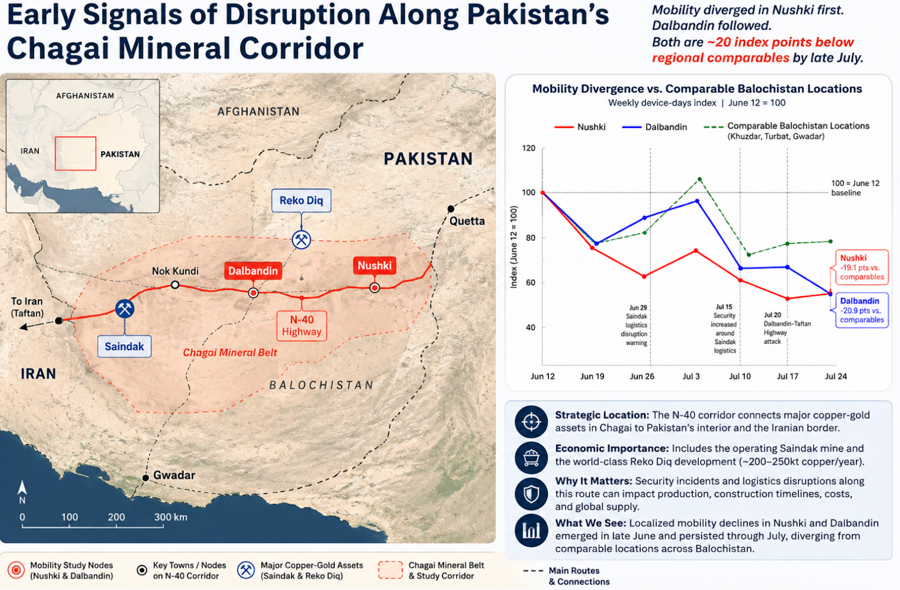
For context, the Chagai copper-gold corridor lies largely along the N-40 Highway near both Iran and Afghanistan and contains two strategically important mining assets:

Given President Trump's "ECONOMIC D-DAY" statement against Iran earlier this week, in which he warned that any country working with Iran would suffer "severe economic consequences," it remains an open-ended question why mobility is declining in Pakistan's critical-mineral corridor (near Iran). However, this type of data may hint at potential future supply disruptions emerging from the region.

No comments:
Post a Comment
Note: Only a member of this blog may post a comment.