Baylor Scott & White Health and Select Medical today announced the opening of a fourth inpatient rehabilitation hospital as part of their newly expanded joint venture. The 36-bed inpatient rehabilitation hospital is located in Lakeway, Texas, and will operate under the name Baylor Scott & White Institute for Rehabilitation – Lakeway; the hospital transaction closed June 26. The expansion also includes 16 Select Medical outpatient rehabilitation clinics and six Baylor Scott & White Health outpatient rehabilitation clinics that were acquired by the joint venture on July 1, and will now operate as outpatient departments of Baylor Scott & White Institute for Rehabilitation – Lakeway.
The joint venture was originally formed in 2011 in North Texas and now includes 88 outpatient rehabilitation clinics, four inpatient rehabilitation hospitals, and home health rehabilitation services, collectively staffed by more than 1,900 employees.
“We’re excited to expand our joint venture and take our first step into the Austin area caring for more patients with the addition of Baylor Scott & White Institute for Rehabilitation – Lakeway,” said Select Medical Inpatient Rehabilitation Hospital Division President Jeffrey Ruskan. “This opening also increases our national footprint as SelectMedical’s twenty sixth inpatient rehabilitation hospital.”
“These two organizations, each with deep expertise, together will elevate the rehabilitation services offered in the Austin area,” said Jay Fox, president, Baylor Scott & White Health – Austin/Round Rock region. “We continue to grow our footprint for those we serve.”
Baylor Scott & White Health has a long-standing history of providing quality medical care to residents and families in Central Texas, including four medical centers and more than 20 clinics in Travis and Williamson counties. Baylor Scott & White Health most recently expanded into Hays County with a primary care clinic, and its newest medical centers are currently being built in Pflugerville and Buda.
Select Medical is one of the nation’s largest providers of specialized post-acute care with a network that supports more than 100 hospitals and 1,600 outpatient rehabilitation clinics with 42,000 employees.
GSK declined to “comment on legal matters faced by another company”.
Purdue said it “vigorously” denied the allegations.
“The Attorney General claims Purdue acted improperly by communicating with prescribers about scientific and medical information that FDA [the US Food and Drug Administration] has expressly considered and continues to approve,” it said.
“We believe it is inappropriate for the Commonwealth [of Massachusetts] to substitute its judgement for the judgement of the regulatory, scientific and medical experts at FDA.”
It added that it shared “the Attorney General’s concern about the opioid crisis” and that its “opioid medications account for less than 2% of total opioid prescriptions”.
The US is in the grip of an opioid addiction crisis.
Opioids are drugs in a group ranging from codeine to heroin.
Prescription opioids are supposed to be used for pain relief.
The Massachusetts lawsuit alleges that Purdue Pharma, the company behind the drug OxyContin, “created the [opioid] epidemic and profited from it through a web of illegal deceit”.
Ms Lewent was named in the lawsuit as one of those “who oversaw and engaged in a deadly, deceptive scheme to sell opioids in Massachusetts.”
Half of the people named in the lawsuit are Sackler family members.
According to Forbes, in 2016 the Sackler family was worth $13bn, helped by sales of OxyContin, a powerful narcotic.
Purdue has paid out millions of dollars to settle charges from federal prosecutors over OxyContin marketing, and makes billions from the sale of the drug, Forbes said.
According to US reports, Minnesota this week launched a lawsuit against Purdue Pharma over the marketing of OxyContin.
Ms Lewent would not be making a comment, a GSK spokesperson said.
GSK said: “It is not appropriate for GSK to comment on legal matters faced by another company”.
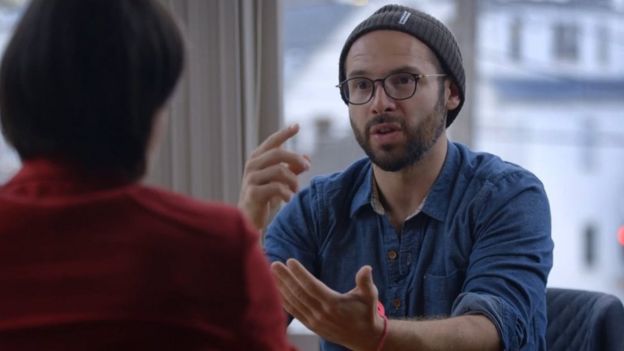
Social media companies are deliberately addicting users to their products for financial gain, Silicon Valley insiders have told the BBC’s Panorama programme.
“It’s as if they’re taking behavioural cocaine and just sprinkling it all over your interface And that’s the thing that keeps you like coming back and back and back”, said former Mozilla and Jawbone employee Aza Raskin.
“Behind every screen on your phone, there are generally like literally a thousand engineers that have worked on this thing to try to make it maximally addicting” he added.
In 2006 Mr Raskin, a leading technology engineer himself, designed infinite scroll, one of the features of many apps that is now seen as highly habit forming. At the time, he was working for Humanized – a computer user-interface consultancy.
Aza Raskin says he did not recognise how addictive infinite scroll could be
Infinite scroll allows users to endlessly swipe down through content without clicking.
“If you don’t give your brain time to catch up with your impulses,” Mr Raskin said, “you just keep scrolling.”
He said the innovation kept users looking at their phones far longer than necessary.
Mr Raskin said he had not set out to addict people and now felt guilty about it.
But many designers were driven to create addictive app features by the business models of the big companies that employed them.
“In order to get the next round of funding, in order to get your stock price up, the amount of time that people spend on your app has to go up,” he said.
“So, when you put that much pressure on that one number, you’re going to start trying to invent new ways of getting people to stay hooked.”
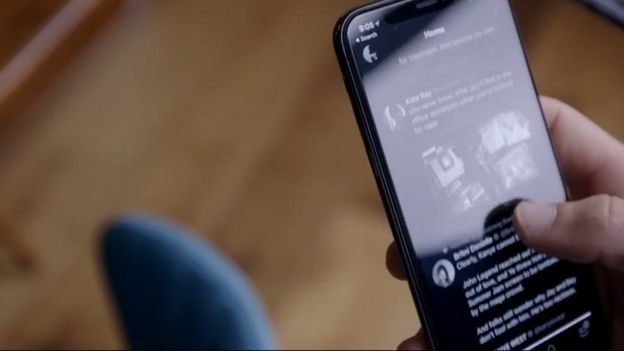
Raskin has set his handset to work in a monochrome mode to minimise its apps’ addictive powers
Lost time
A former Facebook employee made a related point.
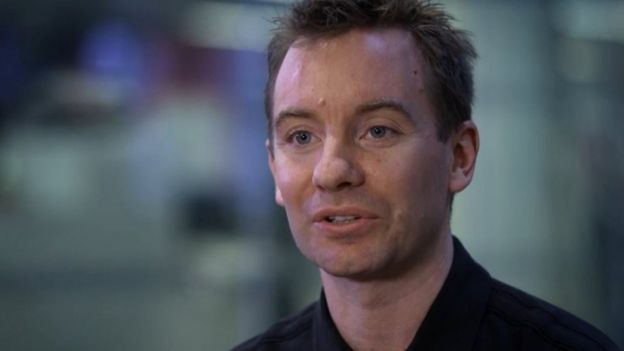
“Social media is very similar to a slot machine,” said Sandy Parakilas, who tried to stop using the service after he left the company in 2012.
“It literally felt like I was quitting cigarettes.”
During his year and five months at Facebook, he said, others had also recognised this risk.
Parakilas made headlines when he wrote a newspaper column in 2017, saying that Facebook could not be trusted to regulate itself
“There was definitely an awareness of the fact that the product was habit-forming and addictive,” he said.
“You have a business model designed to engage you and get you to basically suck as much time out of your life as possible and then selling that attention to advertisers.”
Facebook told the BBC that its products were designed “to bring people closer to their friends, family, and the things they care about”.
It said that “at no stage does wanting something to be addictive factor into that process”.
Like’s legacy
One of the most alluring aspects of social media for users is “likes”, which can come in the form of the thumbs-up sign, hearts, or retweets.
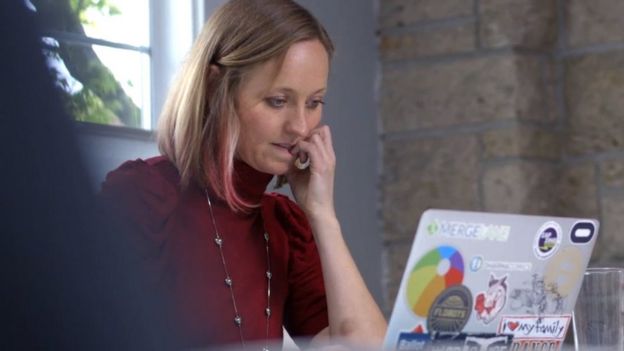
Leah Pearlman, co-inventor of Facebook’s Like button, said she had become hooked on Facebook because she had begun basing her sense of self-worth on the number of “likes” she had.
Leah Pearlman worked at Facebook between 2006 and 2010
“When I need validation – I go to check Facebook,” she said.
“I’m feeling lonely, ‘Let me check my phone.’ I’m feeling insecure, ‘Let me check my phone.'”
Ms Pearlman said she had tried to stop using Facebook after leaving the company.
“I noticed that I would post something that I used to post and the ‘like’ count would be way lower than it used to be.
“Suddenly, I thought I’m actually also kind of addicted to the feedback.”
Vulnerable teens
Studies indicate there are links between overusing social media and depression, loneliness and a host of other mental problems.
In Britain, teenagers now spend about an average of 18 hours a week on their phones, much of it using social media.
Ms Pearlman believes youngsters who recognise that social media is problematic for them should also consider steering clear of such apps.
“The first things I would say is for those teenagers to step into a different way of being because with a few leaders, it can help others follow,” she said.
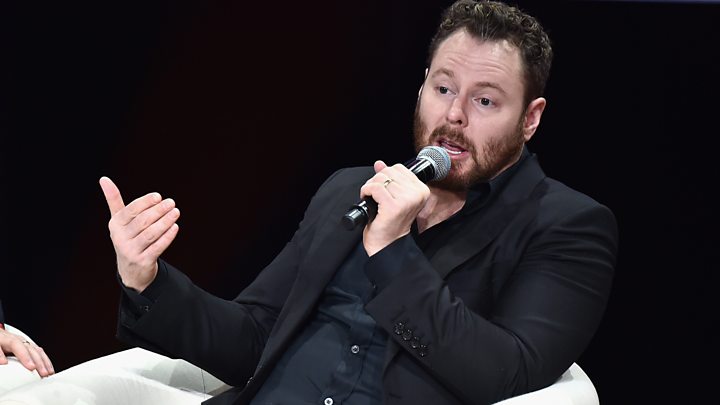
Last year Facebook’s founding president, Sean Parker, said publicly that the company set out to consume as much user time as possible.
He claimed it was “exploiting a vulnerability in human psychology”.
Sean Parker shared his worries about social media last November
“The inventors”, he said, “understood this consciously and we did it anyway.”
But Ms Pearlman said she had not intended the Like button to be addictive.
She also believes that social media use has many benefits for lots of people.
When confronted with Mr Parker’s allegation that the company had effectively sought to hook people from the outset, senior Facebook official Ime Archibong told the BBC it was still looking into the issue.
“We’re working with third-party folks that are looking at habit-forming behaviours – whether it’s on our platform or the internet writ large – and trying to understanding if there are elements that we do believe are bringing harm to people,” he said, “so that we can shore those up and we can invest in making sure those folks are safe over time.”
Recent reports indicate Facebook is working on features to let users see how much time they have spent on its app over the previous seven days and to set daily time limits.
The Panorama programme also explores the use of colour, sounds and unexpected rewards to drive compulsive behaviour.
Twitter declined to comment.
Snap said it was happy to support frequent creative use of its app, Snapchat. But it denied using visual tricks to achieve this and added that it had no desire to increase empty engagement of the product.
The U.S. Department of Health and Human Services’National Institutes of Health has issued a pre-solicitation (NIAID-NOI-18-1914401) for a MiSeq next-generation sequencer system. The NIH intends to award on a sole source basis to Illumina Inc., San Diego, California.
Abcam, a global innovator in life science reagents and tools today announced the commercial launch of the new anti-PD-L1 antibody clone MKP1A07310 (clone 73-10) developed in collaboration with Merck KGaA, Darmstadt, Germany.
Developed by Abcam for use by Merck as an analytical antibody to support Mercks therapeutic program several years ago, this new clone has been created by Abcams in-house antibody engineers, who specialize in the discovery and development of challenging antibodies. The antibody is important in assessing the expression of PD-L1 in tumors from patients who might be able to benefit from PD-1/PD-L1 checkpoint immunotherapy.
John Baker, SVP Portfolio and Business Development, Abcam said:
Collaborations with industry partners are an important part of Abcams strategy to provide the best tools to all researchers world-wide. By working with Merck we are able to make available this important antibody at scale to help scientists accelerate their research, and expand understanding of the role of immune checkpoint inhibitors as cancer therapeutics.”
Clone 73-10 is an important addition to Abcams range of PD-1/PD-L1 immune checkpoint antibodies and is available via the Abcam website.
Sorrento Therapeutics, Inc.(NASDAQ:SRNE) (“Sorrento”) announced today that it acquired the Sofusa™ lymphatic delivery technology platform from Kimberly-Clark Corporation for targeted biopharmaceuticals, particularly, the immune checkpoint inhibitors (such as anti-PD-1, CTLA4, CD47 antibodies) and other I-O antibodies.
Pioneered by inventor Dr. Russell F. Ross and the innovation team at Kimberly-Clark, the Sofusa technology consists of proprietary nano-structured microneedles designed to access the lymphatic capillaries just below the epidermis. In a recent Phase I human study, the Sofusa system has successfully demonstrated the ability to precisely tune the pharmacokinetic profile of sumatriptan to give both rapid onset and an extended treatment duration for the acute treatment of migraine.
“Sofusa technology allows pharmacological targeting of the lymphatics allowing new treatment strategies for cancer and chronic inflammatory conditions,” said Dr. Eva Sevick-Muraca, Ph.D., Professor and the Nancy and Rich Kinder Distinguished Chair of Cardiovascular Disease Research at the University of Texas Health Science Center’sInstitute of Molecular Medicine (IMM). She is a biomedical engineer who has pioneered lymphatic imaging in humans and preclinical models of human disease and has been an advisor to Sofusa. Recently, her group presented preclinical work at AACR delivering an anti-CTLA4 mAb using the Sofusa device in a mouse model of metastatic breast cancer1.
“Delivering higher drug concentrations via the lymphatics could provide more direct and sustained exposure to therapeutic targets known to modulate immune responses. We believe this has the potential to result in an improved safety and efficacy profile for checkpoint inhibitors and anti-inflammatory agents. Sorrento is now well positioned to becoming a leader in the immunotherapy field and fulfill our mission to develop best-in-class antibodies for patients,” said Dr. Jerry Zeldis, Chief Medical Officer for Sorrento.
“We are impressed with Sofusa’s data, where in preclinical models using immunomodulatory antibodies, the Sofusa system consistently demonstrated significantly higher lymphatic levels compared to other delivery routes while exhibiting equipotent or better therapeutic activity. We believe that the Sofusa technology could be a game changer for the delivery of our immunotherapies, including checkpoint inhibitors, biobetter antibodies, and other I-O antibodies,” said Dr. Henry Ji, President and CEO.
Markets closed early (1 p.m. EDT) in the United States on Tuesday as part of the celebration of the Independence Day holiday on Wednesday, but that didn’t stop Anavex Life Sciences (NASDAQ:AVXL) from having a booming volume day and spike in share value.
Shares of the New York-based biopharmaceutical company roared ahead 43.6% with nine million shares changing hands in the 3-1/2 hour session following news that the company received approval from the Australian Human Research Ethics Committee to initiate its Phase 2b/3 of ANAVEX2-73 for the treatment of early Alzheimer’s disease.
ANAVEX2-73 acts upon the Sigma-1 receptor protein, for which activation has been shown to decrease key pathophysiological signs of Alzheimer’s, including beta amyloid, hyperphosphorylated tau and increased inflammation. According to Alzheimer’s Disease International, nearly 44 million people worldwide suffer from Alzheimer’s or a related dementia.
The double-blind, randomized (1:1:1), placebo-controlled, 48-week safety and efficacy trial is scheduled to enroll about 450 patients, evaluating two different doses of the drug versus placebo. With the green light in hand, enrollment is expected to be initiated this month.
The trial is an international study, including sites in North America. Primary endpoints will be for safety and cognitive and functional efficacy of ANAVEX2-73. The trial is building upon positive data collected on the therapy during a successfully completed phase 2a study that demonstrated dose-dependent responses in cognition and function in Alzheimer’s patients.