Search This Blog

Thursday, March 12, 2020

Pandemic ‘could be over by June’ if countries act – China med adviser

The global coronavirus pandemic could be over by June if countries mobilize to fight it, a senior Chinese medical adviser said on Thursday, as China declared the peak had passed there and new cases in Hubei fell to single digits for the first time.
Around two-thirds of global cases of the coronavirus have been recorded in China’s central Hubei province, where the virus first emerged in December. But in recent weeks the vast majority of new cases have been outside China.
Chinese authorities credit strict measures they have taken, including placing Hubei under near total lockdown, with preventing big outbreaks in other cities, and say other countries should learn from their efforts.
“Broadly speaking, the peak of the epidemic has passed for China,” said Mi Feng, a spokesman for the National Health Commission. “The increase of new cases is falling.”
Zhong Nanshan, the government’s senior medical adviser, told reporters that as long as countries take the outbreak seriously and are prepared to take firm measures, it could be over worldwide in a matter of months.
“My advice is calling for all countries to follow WHO instructions and intervene on a national scale,” he said. “If all countries could get mobilized, it could be over by June.”
Speaking to U.N. Secretary-General Antonio Guterres, President Xi Jinping similarly expressed confidence, state television reported.
“After hard work, China has shown a trend of continuous improvement in epidemic prevention and control,” the report cited Xi as saying.
“I am confident that the Chinese people will be able to overcome this epidemic and achieve their intended economic and social development goals.”
Zhong, an 83-year-old epidemiologist renowned for helping combat the SARS outbreak in 2003, said viruses in the same family typically became less active in warm months.
“My estimate of June is based on scenarios that all countries take positive measures.”
Later on Thursday, Zhong held a teleconference with a group of U.S. medical experts, including from Harvard University, state television reported.
Zhong and his team shared their experiences of quickly testing and containing the virus, difficulties in treatment, and cooperation in clinical research, the report added.

The United States is now facing its own virus crisis as the number of infected people rises.

BUSINESSES REOPEN

With the marked slowdown of the spread of the virus in China, more businesses have reopened, with authorities cautiously easing strict containment measures.
Hubei province announced a further loosening of travel restrictions and will also allow some industries to resume production.
Hubei’s economy, driven by manufacturing and trade, including a sizable auto sector in the provincial capital, Wuhan, had been virtually shut down since Jan. 23.
While the virus is spreading quickly globally, its progress in China has slowed markedly in the past seven days. In all, 15 new cases were recorded in mainland China on Wednesday, down from 24 the day before. Seven of the new cases were outside Hubei, including six imported from abroad.
While only 85 of the cases in China have come from abroad, the rising number of such incidences has prompted authorities to shift their focus on containing the risk of imported cases.
The total number of cases recorded in mainland China was 80,793. As of Tuesday, 62,793 people had recovered and been discharged from hospital, or nearly 80% of the infections.
In Wuhan, the epicenter of the outbreak, 34,094 patients had been discharged from hospitals, but over half were still under observation at so-called “recovery stops” – quarantine venues repurposed from hotels and student dormitories.
Hubei’s health authority said the post-discharge quarantine was a precautionary measure, after a few discharged patients tested positive again.
As of the end of Wednesday, the death toll in mainland China had reached 3,169, up by 11 from the previous day. Hubei accounted for 10 of the new deaths, including seven in Wuhan.
China is focusing on restarting factories and businesses hit by the containment policies. Factory activity plunged to its worst level on record in February, and while more businesses have reopened in recent weeks as containment measures have been eased, analysts do not expect activity to return to normal until April.
Airlines have been hit particularly hard. China’s airlines reported total losses of 20.96 billion yuan ($3 billion) in February. The total number of airline passengers fell 84.5% year-on-year last month, China’s aviation regulator said.
https://www.reuters.com/article/us-health-coronavirus-china/coronavirus-pandemic-could-be-over-by-june-if-countries-act-says-chinese-adviser-idUSKBN20Z046

Insurers face double whammy from coronavirus crisis

Having initially brushed off the potential impact from coronavirus-linked claims, global insurers are waking up to the prospect of a double whammy – a sharp rise in payouts at a time of big investment losses.

Because epidemics are excluded from many business insurance policies, the early prognosis was for a low levels of claims. But as recession threatens the global economy along with rising insolvencies, all sorts of companies with trade credit insurance, from airlines to retailers are coming under strain.
Meanwhile, insurers’ investments are coming under pressure.
They manage more than $20 trillion in assets globally but their big government bond holdings are becoming problematic as the threat of recession grows and central banks’ interest rate cuts have sent yields plunging.
COMPANIES STRUGGLE TO PAY BILLS
The $11 billion trade credit insurance market covers the risk that a company’s customers cannot pay for goods or services bought on credit. There was already a rising trend in 2019 in big corporate insolvencies, according to figures from insurer Euler Hermes at the end of the year.
Moody’s expects rising claims to hit three of the world’s biggest trade credit insurers Atradius, Coface and Euler Hermes. The ratings agency cited data from Atradius and Coface showing that for each, nearly 15% of their total net potential exposure is in Asia and Australia, two of the worst hit regions.
The insurers declined to comment, but Atradius said recently it expected corporate insolvencies to grow 2.4% globally in 2020, “largely resulting from the coronavirus outbreak”.
Coface chief executive Xavier Durand told analysts two weeks ago that hotels and airlines in Asia would feel the worst impact, while Euler Hermes saw coronavirus costing $320 billion of trade losses every quarter this year.
The stress could spiral as governments lock down regions or whole countries and if major events such as the Olympics are postponed.
“It’s not a good time for anyone in the credit world,” said Jeremy Shallow, head of specialty at insurer Argo Global.
He added that a possible recession was factored into the firm’s underwriting of trade credit insurance.
The coronavirus outbreak is likely to have a bigger effect on the world economy than the outbreak of Severe Acute Respiratory Syndrome (SARS) some 20 years ago, European Central Bank governing council member Klaas Knot said last month, adding that SARS wiped $40 billion off world equity markets.
The prospect of a global recession was reflected in an index of European insurance shares which has tumbled to 3-1/2-year lows, losing 30% from peaks hit on Feb 19 before concern about the potential of the deadly virus took hold.

NO FUN OR GAMES AS EVENTS AXED
Trade credit insurers would be most cautious about sectors such as travel and entertainment, according to Bernie de Haldevang, head of credit, political risk and crisis management at Lloyd’s of London insurer Canopius.
Airlines have suffered badly with Norwegian Air laying off staff and cutting thousands of flights and Britain’s Flybe forced to throw in the towel. Hotel groups such as Hyatt, cruise operators like Carnival Corp and holiday companies including TUI will also see their cash flow crushed.
Travel restrictions to countries such as Italy and Israel will lead to further insurance payouts, while the cancellation of major events like the South by Southwest music and film festival in Texas will add to claims.
Analysts at Barclays warned last week that coronavirus losses for Munich Re were “potentially more material than we thought” after the global reinsurer flagged a 500 million-euro exposure if all the major events it covered this year were cancelled.
Munich Re also flagged losses on life insurance policies as the death toll climbs.
In China, where the coronavirus first took hold, a few insurers have taken drastic action by withdrawing credit insurance coverage, insurance broker Marsh said.


INVESTMENT LOSSES
Meanwhile, the investments insurers rely on to pay the claims are unravelling.
U.S. 10-year bond yields have more than halved since the end of 2019. At least half of insurers’ $20 trillion in assets under management will be invested in government bonds, analysts say.
Falling yields require insurers to set aside more capital now for future payments to policyholders, puncturing their solvency levels.
Years of rock-bottom bond yields persuaded insurers to foray into riskier corporate debt – U.S. life insurers had more than 34% of their portfolios in triple-B rated debt in 2018, according to insurance ratings agency AM Best, one level away from being rated “junk”.
Yields on this kind of debt have ballooned as default worries grow.
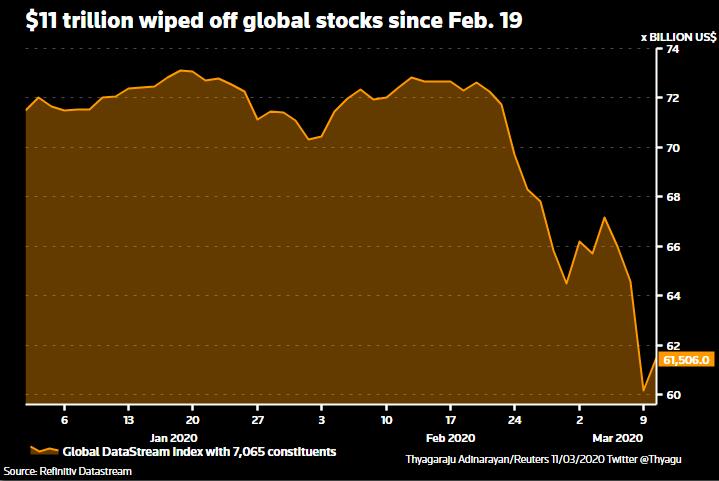
Increased equity exposure adds to vulnerability — since the sell-off started in earnest on Feb 19, some $11 trillion has been wiped off global stocks’ value, according to Refinitiv Datastream.
Legal & General and M&G are among insurers which have highlighted the dent to solvency ratios.
“The market moves already seen are giving insurers a lot to think about ? in particular how their market risk models are coping with the current market stress,” said Colin Tipping, head of insurance investment management – international region at Mercer.
Insurers are generally long-term investors who do not make hasty investment decisions but the next few weeks will be a nail-biting ride.
“If the economic situation deteriorates, they will no doubt be reassessing their portfolios and exposures,? said Ferdia Byrne, insurance partner at KPMG.
https://www.marketscreener.com/LEGAL-GENERAL-4002140/news/Insurers-face-double-whammy-from-coronavirus-crisis-30148080/?countview=0

DNC chairman ‘not contemplating’ move to online convention

Democratic National Committee (DNC) Chairman Tom Perez said in a new interview that he is “not contemplating” moving the party’s convention online due to the growing coronavirus concerns.
Perez told Axios that the July convention in Milwaukee is set to continue as planned.
“We are working with our state and local partners, and I’m confident that we work a plan that will enable us to have our convention,” he said in the interview, which is set to air in full on Sunday.
Perez added that the DNC remains in communication with health officials and monitors the situation “every single day.”
He also noted that “we’d have to change the rules” to move the convention online.
“We’d have to change the rules,” Perez said. “We’re not contemplating rule changes.”
“We are very confident we’re going to be able to carry it out, and I’m equally confident in the competence of our team,” he added.
The current rules in the DNC’s charter and bylaws say “voting by proxy shall not be permitted at the National Convention,” Axios noted.
President Trump late Wednesday announced travel restrictions from Europe to fight the coronavirus, while elderly people are being instructed to stay at home and avoid crowds and the presidential candidates are canceling rallies.
Several large events across the country, including all NBA games, the South by Southwest festival and others have been suspended or canceled to avoid large crowds from gathering and spreading the virus.
The U.S. has recorded more than 1,300 cases and at least 38 deaths from the virus, while eight people have recovered thus far. Worldwide, more than 68,000 people have recovered, with more than 126,000 cases reported, according to data from Johns Hopkins University.
https://thehill.com/homenews/campaign/487171-dnc-chairman-not-contemplating-moving-convention-online

Research suggests coronavirus patients may be infectious for weeks

A study published in The Lancet, a British medical journal, indicates patients with the novel coronavirus could remain infectious for as long as 37 days.
Experts have recommended an isolation period of 14 days after exposure, but the new research indicates the virus’s RNA was detectable in respiratory samples from survivors for a median length of 20 days after infection, according to the study.
These results carry “important implications for both patient isolation decision-making and guidance around the length of antiviral treatment,” wrote co-author Fei Zhou of the Chinese Academy of Medical Sciences.
“To the best of our knowledge, this is the largest retrospective cohort study among patients with COVID-19 who have experienced a definite outcome,” the authors wrote.
“We found that older age, higher SOFA [Sequential Organ Failure Assessment] score, and elevated d-dimer [fibrin degradation product] at admission were risk factors for death of adult patients with COVID-19,” they added. “The prolonged viral shedding provides the rationale for testing novel coronavirus antiviral interventions in efforts to improve outcomes.”
The virus has spread to 118 countries in recent months, with about 125,000 cases confirmed.
The publication of the study comes a day after tests still awaiting peer review indicated the virus may also survive in the air for several hours and remain on surfaces for up to three days.
https://thehill.com/policy/healthcare/487186-research-suggests-coronavirus-patients-may-be-infectious-for-weeks

Neogen ramps up production of disinfectants to fight COVID-19

Neogen (NASDAQ:NEOG) reports that it is building its inventory of hand sanitizers, disinfectant wipes, nitrile gloves and disinfectants to help in the global effort to corral the coronavirus outbreak.
On a similar front, thinly traded nano cap Ovation Science (OTCPK:OVATF) reports worldwide interest in its DermSafe hand sanitizer lotion after shipping 25K bottles to China. It has shipped “thousands” of bottles to the UK and has received “multiple orders” from Canada.
https://seekingalpha.com/news/3551037-neogen-ramps-up-production-of-disinfectants-to-fight-covidminus-19

Stocks resume trade after circuit breaker; S&P -7.5%

Stocks opened with a 15-minute circuit breaker after the S&P 500 fell 7% and joined the Dow and Nasdaq in bear market territory; after an initial 7.5% drop, S&P 500 now -7.9%, Dow -8.5%, Nasdaq -7.7%.
Pres. Trump suspended travel from Europe excluding the U.K. for 30 days in an effort to mitigate the spread of the coronavirus and promised financial relief for workers who are ill or caring for others, but the moves were not specific enough to satisfy investors.
Also exacerbating recession fears are the NBA’s suspension of its basketball season, Carnival halting operations for Princess Cruises for 60 days, and many more businesses taking actions to protect employees and/or preserve their balance sheets.
Update: The U.S. Capitol, House and Senate office buildings will be closed to the public until APril 1.
“Markets simply don’t know what the next steps are in terms of the virus spread,” says Edward Park, deputy chief investment officer at Brooks Macdonald. “We will see a dip in global growth in Q1 and Q2 and all the fiscal stimulus out there can’t avoid that.”
The U.S. travel ban and the European Central Bank’s decision not to cut interest rates have sent European bourses reeling, with France’s CAC -9.3%, Germany’s DAX -8.7% and U.K.’s FTSE -8.2%; in Asia, Japan’s Nikkei -4.4% and China’s Shanghai Composite -1.5%.
In the U.S., S&P sector opening losses ranged from -4.6% for consumer staples to -7.7% for utilities.
U.S. Treasury prices are back on the rise after two days of selling, sending the 10-year yield down 16 bps to 0.67% and the two-year yield 12 bps lower to 0.39%; U.S. Dollar Index +0.6% to 97.09
WTI crude oil -8.4% to $30.19/bbl, below Monday’s four-year low settlement price.
https://seekingalpha.com/news/3551060-stocks-resume-trade-after-circuit-breaker-s-and-pminus-7_5

Centene announces extended coverage for COVID-19

Centene (NYSE:CNC), in partnership with other major insurers, has implemented enhanced coverage for COVID-19 for members. Key points:
Out-of-pocket costs waived for COVID-19 tests and treatments in doctors’ offices and emergency rooms and telehealth services.
Pre-authorization requirements waived.
Prescription refill limits waived.
Restrictions relaxed on home or mail delivery of prescription drugs.
Access expanded for certain telehealth services.
The company says it is working closely with local, state and federal authorities to serve and protect patients during the COVID-19 outbreak.
Related tickers: UNH, CI, CVS, MOH, ANTM
https://seekingalpha.com/news/3550932-centene-announces-extended-coverage-for-covidminus-19