Search This Blog

Saturday, May 9, 2020

Pfizer to outsource some drug production, focus on coronavirus vaccine

Pfizer Inc (PFE.N) said on Friday it is in talks to shift more of its medicine production to outside contractors as it prepares for large-scale production of an experimental vaccine to prevent COVID-19, should it prove safe and effective.
The U.S. drugmaker is tapping its network of around 200 outside contractors, which includes Catalent Inc (CTLT.N), Lonza Group AG (LONN.S), and Thermo Fisher Scientific Inc (TMO.N), to play a bigger role in producing some of its existing medicines, Mike McDermott, president of global supply at Pfizer, told Reuters in an interview.
Pfizer did not specify which companies within its network it is in active discussions with about shifting production.
That will help Pfizer shift a portion of production at four of its vaccine manufacturing facilities, including one of its largest U.S. factories, toward the coronavirus vaccine while preventing disruptions in supply of its other products, he said.
“They have been hugely helpful in the past and will help us through this,” McDermott said.
Pfizer and German partner BioNTech SE (22UAy.F) said on Tuesday they have begun delivering doses of their coronavirus vaccine candidates for initial human testing in the United States. Trials in Germany had already begun.
If successful, Pfizer said it hopes to receive emergency use authorization from the U.S. Food and Drug Administration as early as October. It could distribute up to 20 million doses by the end of 2020, and potentially hundreds of millions next year, it said.
The shift to outside production of other medicines will primarily effect vaccines and intravenous drugs. Pfizer currently produces around 1.5 billion doses of intravenously injected vaccines and drugs each year.
McDermott said Pfizer will also add additional shifts to its own factories, hire more workers to take advantage of its unused production capacity, and stockpile current products in preparation for the shift to COVID-19 vaccine production.

Pfizer said earlier this week it was preparing four of its manufacturing sites – three in the United States and one in Belgium – to produce the vaccine, even before clinical trials shows which, if any, of the four potential candidates being tested demonstrates efficacy in preventing infection with the novel coronavirus.
It will cost Pfizer at least $150 million to gear up its facilities for the new vaccine, McDermott said.
Pfizer and BioNTech’s vaccine candidates use messenger RNA (mRNA) technology, which has long been talked about but has yet to produce an approved product. The mRNA technology instructs cells in the body to make specific coronavirus proteins that then produce an immune response.
It has the potential to be among the first vaccines against the virus that has infected more than 1 million people in the United States and killed over 77,000.
Producing vast quantities of vaccines requires that Pfizer and BioNTech work to rapidly scale up their suppliers’ ability to make raw materials for mRNA vaccines, McDermott said, adding that many are small biotechs.
It could also face potential shortages of more basic materials, he added, such as the vials and syringes used to contain and administer vaccines.
Those materials “could become stressed in this environment, where you are trying to produce your … existing products and add in vaccines needed for hundreds of millions or billions of people,” McDermott said.
Contract manufacturers Lonza and Catalent are also working with other drugmakers to help produce potential treatments and vaccines for the coronavirus.
Last week, Lonza said it was working with Moderna Inc (MRNA.O) to help it produce its experimental mRNA vaccine being developed with U.S. government backing.

Catalent agreed last month to help Johnson & Johnson (JNJ.N) manufacture its coronavirus vaccine candidate.
Lonza, Catalent and Thermo Fisher did not immediately respond to requests for comment about their work with Pfizer.
Pfizer also operates its own contract manufacturer, CenterOne, which provides raw materials to other drugmakers.
https://www.reuters.com/article/us-health-coronavirus-pfizer-vaccine/pfizer-to-outsource-some-drug-production-focus-on-coronavirus-vaccine-idUSKBN22K2ZS

Friday, May 8, 2020

6 Ways to Maintain Social Distancing, New Normal in Work Settings

Nearly half of the United States may have eased its stay-at-home mandates in recent weeks, but steep challenges still remain for manufacturing and distribution centers, noted commercial real estate services provider Cushman & Wakefield.
The contagious coronavirus places a new emphasis on social distancing in warehouse environments originally designed for employees to work in close proximity. However, processes can be adjusted and suggestions were compiled from various logistics, industrial and production experts and specialists, according to Cushman & Wakefield.
From encouraging remote working to readjusting work breaks and shift changes, Cushman & Wakefield outlined six recommendations for creating social distancing measures and adjusting to the “new normal” in warehouses.
New measures shouldn’t begin as the employees return, Cushman & Wakefield noted. First, the company should implement disinfecting procedures in accordance with governing authorities and/or best practices before employees return. Along with cleaning, mechanical, HVAC, fire and other “life safety” systems should be available, and municipal occupational health and safety guidelines should be reviewed for updated procedures.
The company should also consider workers’ shift patterns and remind workers of protocols for starting and ending their shift to avoid productivity bottlenecks. Vendors and drivers should also be informed of any new protocols, Cushman & Wakefield added. The checklist also noted companies could consider if office-based workers can work remotely to reduce on-site employees.
For employees that must work on-site, experts suggested developing clear plans for entering and exiting the facility. The checklist included banning visitors to the building and possibly creating restrooms/washrooms for temporary external drivers. Experts also recommended considering temperature checks and/or requiring workers to self-monitor for symptoms and adjusting stay-at-home sick policies when employees have symptoms.
With no vaccine in sight, social distancing has become the go-to answer for combating the virus and warehouses should adjust their work environments to continue that measure, Cushman & Wakefield argued. Industry specialists recommendations included leveraging a mobile app for clocking in/out, staggering break times, increasing space between production stations and leveraging electronics instead of in-person meetings .
Companies should also be prepared to disinfect shared equipment between shifts, experts said. Likewise, organizations should provide additional sanitizers/disinfectant and removable touch screen film at shared touch points, including work equipment and vending machines, experts recommended.
Lastly, companies need to confidently communicate to their employees, Cushman & Wakefield wrote. Companies can project confidence by being unified as employees return to the warehouse. The company should also establish two-way communication, clearly set employee expectations with an emphasis on making them feel secure and ensure a trusting and transparent culture.
https://www.globest.com/2020/05/08/6-ways-to-maintain-social-distancing-new-normal-in-warehouses/

Emergent BioSolutions Virtual Recruiting Aims to Draw Top Biomanufacture Talent

Emergent Biosolutions, with multiple facilities in the BioHealth Capital Region, is hiring for dozens of full-time biomanufacturing positions to propel its existing pipeline forward while also playing a leading role in the global fight against the coronavirus.
The company’s Talent Acquisition team is holding a virtual recruiting event through BioBuzz to spotlight their career opportunities and engage top talent, even in the times of COVID-19. During this event, you can learn more about open positions and work culture at the company’s Emergent Bayview facility in Baltimore, which is designated as a Center for Innovation in Advanced Development and Manufacturing (CIADM) by BARDA and the U.S. Department of Health and Human Services (HHS).
Emergent BioSolutions: Virtual BioManufacturing Recruiting Event
Site Manufacturing leadership, including BJ Hull, Vice President/GM Maryland Sites, will participate in the virtual recruiting event to discuss Emergent’s technology, manufacturing capabilities, and its culture of innovation.
Emergent is looking to hire top talent for a variety of biomanufacturing positions, including:
With over 20 years experience, Emergent is a leading vaccine and therapeutic development and manufacturing company at the forefront of public health threat solutions and preparedness. The company’s leading-edge biomanufacturing capabilities enable rapid, agile and robust development, manufacture and delivery responses to public health emergencies like the coronavirus pandemic, as well threats from anthrax, smallpox, botulism and chemical agents.
You can read more about Emergent’s history and capabilities in the ‘In Conversation’ interview with their Executive Vice President, Manufacturing and Technical Operations, Sean Kirk.
The company has also made numerous headlines recently after its announcement of a partnership with Johnson & Johnson to provide contract development and manufacturing services in support of J&J’s potential COVID-19 vaccine. That announcement comes closely on the heels of Emergent announcing partnerships with Novavax to manufacture the company’s potential COVID-19 vaccine and its novel influenza vaccine, NanoFlu, Vaxart for their experimental Oral Vaccine candidate for COVID-19 and with the U.S. Government for Comprehensive Response to Expedite Development of Plasma-Derived Therapy for COVID-19.
You can read more about each of these collaborations in the press releases and stories below.
Maryland Vaccine Leader Emergent BioSolutions Creates Virtual Recruiting Event to Attract Top Biomanufacturing Talent

FDA approves Eli Lilly drug to treat three types of tumors

Eli Lilly’s (NYSE:LLY) Retevmo treatment is approved by the Food and Drug Administration for three types of tumors: non-small cell lung cancer, medullary thyroid cancer and other types of thyroid cancers.
The FDA calls Retevmo (selpercatinib) “the first therapy approved specifically for cancer patients with RET gene alterations,” a mutation that occurs in ~2% of lung cancers and 10%-20% of papillary thyroid cancers.
Lilly’s drug is part of a trend of treating cancer based on a patient’s genetics rather than the location in the body where the disease originated.
Lilly will price the drug at $20,600 for 30 days of treatment, the head of the company’s oncology division tells Reuters.
https://seekingalpha.com/news/3572368-fda-approves-eli-lilly-drug-to-treat-three-types-of-tumors

Acceptability of app-based Covid-19 contact tracing: Cross-country survey

Samuel Altmann, Luke Milsom, Hannah Zillessen, Raffaele Blasone, Frederic Gerdon, Ruben Bach, Frauke Kreuter, Daniele Nosenzo, Severine Toussaert, Johannes Abeler

Abstract

Background: The COVID-19 pandemic is the greatest public health crisis of the last 100 years. Countries have responded with various levels of lockdown to save lives and stop health systems from being overwhelmed. At the same time, lockdowns entail large socio-economic costs. One exit strategy under consideration is a mobile phone app that traces close contacts of those infected with COVID- 19. Recent research has demonstrated the theoretical effectiveness of this solution in different disease settings. However, concerns have been raised about such apps because of the potential privacy implications. This could limit the acceptability of app-based contact tracing among the general population. As the effectiveness of this approach increases strongly with app take-up, it is crucial to understand public support for this intervention. Objectives: The objective of this study is to investigate user acceptability of a contact-tracing app in five countries hit by the pandemic. Methods We conducted a multi-country, large-scale (N = 5995) study to measure public support for digital contact tracing of COVID-19 infections. We ran anonymous online surveys in France, Germany, Italy, the UK and the US. We measured intentions to use a contact-tracing app across different installation regimes (voluntary installation vs. automatic installation by mobile phone providers), and studied how these intentions vary across individuals and countries. Results: We found strong support for the app under both regimes, in all countries, across all sub-groups of the population, and irrespective of regional-level COVID-19 mortality rates. We inves- tigated the main factors that may hinder or facilitate take-up and found that concerns about cyber security and privacy, together with lack of trust in government, are the main barriers to adoption. Conclusions: Epidemiological evidence shows that app-based contact-tracing can suppress the spread of COVID-19 if a high enough proportion of the population uses the app and that it can still reduce the number of infections if take-up is moderate. Our findings show that the willingness to install the app is very high. The available evidence suggests that app-based contact tracing may be a viable approach to control the diffusion of COVID-19.

Competing Interest Statement

The authors have declared no competing interest.

Funding Statement

We acknowledge funding from the Economic and Social Research Council (grant ES/R011710/1), the University of Oxford and Volkswagen Foundation (grant “Consequences of Artificial Intelligence for Urban Societies”).

Preview PDF
https://www.medrxiv.org/content/10.1101/2020.05.05.20091587v1

Hydroxychloroquine and azithromycin plus zinc in hospitalized Covid-19 patients

Philip Carlucci, Tania Ahuja, Christopher M Petrilli, Harish Rajagopalan, Simon Jones, Joseph Rahimian

Abstract

Background: COVID-19 has rapidly emerged as a pandemic infection that has caused significant mortality and economic losses. Potential therapies and means of prophylaxis against COVID-19 are urgently needed to combat this novel infection. As a result of in vitro evidence suggesting zinc sulfate may be efficacious against COVID-19, our hospitals began using zinc sulfate as add-on therapy to hydroxychloroquine and azithromycin. We performed a retrospective observational study to compare hospital outcomes among patients who received hydroxychloroquine and azithromycin plus zinc versus hydroxychloroquine and azithromycin alone. Methods: Data was collected from electronic medical records for all patients being treated with admission dates ranging from March 2, 2020 through April 5, 2020. Initial clinical characteristics on presentation, medications given during the hospitalization, and hospital outcomes were recorded. Patients in the study were excluded if they were treated with other investigational medications. Results: The addition of zinc sulfate did not impact the length of hospitalization, duration of ventilation, or ICU duration. In univariate analyses, zinc sulfate increased the frequency of patients being discharged home, and decreased the need for ventilation, admission to the ICU, and mortality or transfer to hospice for patients who were never admitted to the ICU. After adjusting for the time at which zinc sulfate was added to our protocol, an increased frequency of being discharged home (OR 1.53, 95% CI 1.12-2.09) reduction in mortality or transfer to hospice remained significant (OR 0.449, 95% CI 0.271-0.744). Conclusion: This study provides the first in vivo evidence that zinc sulfate in combination with hydroxychloroquine may play a role in therapeutic management for COVID-19.

Competing Interest Statement

The authors have declared no competing interest.

Clinical Trial

this is a retrospective observational study and therefor not a clinical trial

Funding Statement

No funding was provided for this work.

Preview PDF
https://www.medrxiv.org/content/10.1101/2020.05.02.20080036v1

Kids without computers left behind with schools closed by coronavirus


Not all kids have computers – and they're being left behind with schools closed by the coronavirus
Since 2014, the Dornsife Center for Economic and Social Research, located at the University of Southern California, has been tracking trends in health economic well-being, attitudes and behaviors through a nationwide survey for its Understanding America Study, asking the same individuals questions over time.
The nationally representative survey is now assessing how COVID-19 is affecting U.S. families. This includes their health, economic status and, for the first time, educational experiences. With two other education researchers Amie Rapaport and Marshall Garland, we analyzed the educational experience data that have recently been added to the study.
What we did
We worked with the broader Understanding America Study team to ask Americans about the effects the pandemic is having on students and their families.
About 1,450 families with children answered these questions between April 1 and April 15.
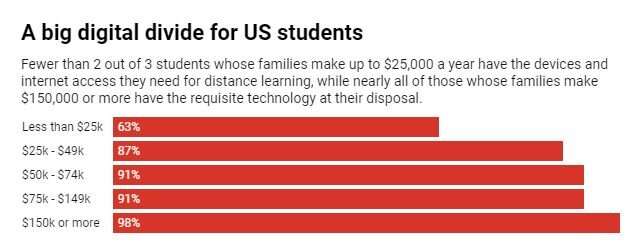
We found that nearly all—about 85% – of families with at least one child between kindergarten and their senior year of high have and a computer they can use for distance learning while school buildings are shuttered.
However, we found large disparities in technology access based on income. Among the 20% of American households who make US$25,000 or less a year, just 63% of schoolchildren have access to a computer and the internet. In comparison, essentially all students from the most affluent families—those whose parents make $150,000 annually or more—do.
To be sure, that doesn’t mean a third of poor kids are being locked out of getting an online education. Many of those students are also using tablets and smartphones to participate in educational activities. However, the types of educational activities a can easily engage in with a computer and wireless internet –such as writing long essays—are broader than the types possible on a tablet or an even smaller screen and with just a cellular connection.
These inequities can leave low-income families scrambling for wireless access. Some of the limited options available can include include working from a car parked outside a local library or a McDonald’s parking lot.
Why it matters
There’s a big gap between how much access rich and poor children have to technology. This is known as the “digital divide.”
This disparity contributes to the achievement gaps between students based largely on their .
These findings show that the digital divide is playing out in real time during this pandemic in ways that are sure to lead to unequal negative effects on already disadvantaged students.
What’s next?
Most schools in the country are likely to remain closed for months – long after we collected this initial data. We believe that it’s possible that this divide will narrow once more districts distribute computers, tablets and other hardware, more communities take steps to expand broadband access to those who can’t afford it and teachers get better at educating kids online.
There’s a chance that federal help could arrive, should Congress pass the Emergency Educational Connections Act of 2020, a measure authored and backed by House Democrats aimed at narrowing the . It would normally be states—which provide the largest share of funding for —that would address issues like technology in schools, but with states facing mounting budget constraints that’s going to be a big challenge. A similar bill is pending in the Senate.
https://phys.org/news/2020-05-kids-left-schools-coronavirus.html#