With Science Under Siege: How to Fight the Five Most Powerful Forces that Threaten Our World, climatologist Michael E. Mann and virologist Peter J. Hotez have written an important book. When future historians look back at the early twenty-first century and document the causes and consequences of the intense politicization of the U.S. scientific community, Science Under Siege (SUS) will be a core reading.
The central argument of the book is apocalyptic.
“The future of humankind and the health of our planet now depend on surmounting the dark forces of antiscience” (p. 3)
“Unless we find a way to overcome antiscience, humankind will face its gravest threat yet – the collapse of civilization as we know it.” (p. 27)
“Antiscience,” they tell us, is “politically and ideologically motivated opposition to any science that threatens powerful special interests and their political agenda” (p. 2).
Mann and Hotez define opposition specifically—Republicans:
The fact that antiscience has been embraced so fully by one of the two major parties is a grave concern. Today’s Republican Party is an authoritarian, anti-democratic political entity . . . we face a stark realty (sic): the Republican Party now represents a very real threat to human civilization itself.
More granularly, Mann and Hotez identify the threat to human civilization as coming from a Republican “antiscience ecosystem” that they sub-group into five alliterative categories, shown in the nonsensical figure below:
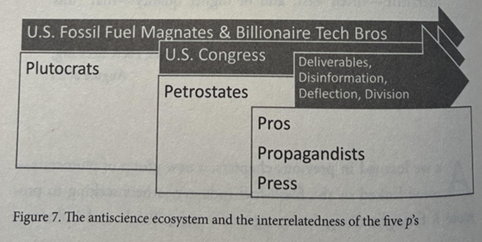
Page from Science Under Siege
Much of the book is spent denigrating those the authors see as enemies within these five categories. I counted 137 people who they namecheck as part of the antiscience cabal threatening the world. Many on the enemies list are not Republicans, or even on the political right. That seeming incoherence can be quickly resolved by recognizing that the list is simply people Mann and Hotez don’t like for one reason or another.
Full disclosure: I’m listed as enemy #136, oddly, in their enemies sub-category “The Press.” They explain that I am on the list because of my book, The Honest Broker, which argues that scientists should fully engage in democratic processes and discusses the different ways this might occur.
Their enemies list includes many of the authors’ critics and political opponents. Mann repeats his longstanding beefs with Bjorn Lomborg (#70) and Judy Curry (#92) over climate. Hotez does the same on COVID-19 origins, criticizing Alina Chan and Matt Ridley (#133 and #134), co-authors of Viral: The Search for the Origin of COVID-19.
For a book supposedly about threats to science, it is not strong on scientific accuracy in the rare places that it actually discusses science. For instance, the book claims, contrary to the evidence, that: “Deadly weather extremes exacerbated by human-caused warming – floods, storms, droughts, wildfire and extreme heat – lead to many millions more lives lost per year” (p. 13).
Even the source they cite does not support that claim. The actual number of lives lost annually related to extreme weather events is in the thousands or tens of thousands. Similarly, the book repeatedly dismisses the possibility that COVID-19 resulted from a research-related incident as a conspiracy theory, even though that remains a plausible origin.
Bizarrely, they recount numerous perceived slights from their ample time spent on X and Bluesky, retelling social media blow-by-blows with randos like “Scottie the Kid” (#95) and “QAnon John” (#96).
The authors have reserved some of their harshest criticism for longstanding climate advocates such as climate scientists Kevin Anderson (#105) and James Hansen (#106), and journalist David Wallace-Wells (#132), who, despite their climate advocacy bona fides, apparently got crosswise with Mann.
In particular, I laughed when I read SUS complain that climate scientist Jim Hansen’s “rhetoric has grown increasingly heated and conspiratorial” (p.161), since Mann and Hotez offer a suite of bizarre conspiracy theories of their own.
For instance, they reference the 2009 leak—or theft, or hack—of emails from climate scientists at the University of East Anglia, known as Climategate. The emails revealed climate scientists, including Mann, engaging in conduct that many observers found troubling or unprofessional, though multiple subsequent investigations cleared the scientists of research misconduct. Mann and Hotez claim that “Climategate may well have indeed constituted a test run for Russia’s influence campaign in 2016 to elect Donald Trump.” Um, sure.
Mann and Hotez often display a lack of self-awareness. They criticize Marjorie Taylor Greene, then a Republican representative from Georgia, for “using a Nazi analogy” (p.90). Later in SUS, they write, “We must treat the rising tide of scientific disinformation with the same urgency as the rise of Nazi Germany” p. 221.
Interestingly, some Republicans are off the hook.
Specifically, the Texas oilmen who funded the remarkable medical infrastructure in Texas that helped to launch and sustain Hotez’s career. Similarly, Saudi Arabia is presented as a “paradox”: it is both a “petrostate” in the authors’ vernacular and thus contributing to the possible end of humanity, yet also has longstanding and positive connections with Hotez, so apparently, actually good guys.
Mann and Hotez spend a lot of time telling us who has praised them on social media and who has not, with the latter—obviously—part of the axis of antiscience evil. For Mann and Hotez, social media is where these civilization-defining battles play out, explaining of X and other platforms: “One’s following – the number of followers one has—is crucial currency in the social media world.” Mann has about 211,000 X followers, Hotez has about 403,000.
Despite their large social media presence, Mann and Hotez ultimately see themselves as lonely warriors. Democrats may be the only alternative to evil Republicans, but even so, the authors lament that “the leadership of the Democratic Party has not prioritized standing up to the antiscience machine of the GOP and their malevolent plutocrat allies” (p. 97). Journalists are apparently too dumb to wage this fight: “They are poorly equipped to litigate the contentious, often technical, debates about the science.” The public, who barely appear in the book, are similarly ignorant: “The public does not have a deep understanding of what it is we actually do as ‘working scientists’” (p. 225).
Because the world is comprised of antiscience Republicans, spineless politicians, dumb journalists, and ignorant citizens, Mann and Hotez argue that it is therefore up to scientists to fight the battles necessary to win the war to save the world—and Mann and Hotez in particular: “[T]his unfortunate reality means that the defense of science in America falls upon the scientists themselves. Some scientists, the two of us included, are willing to take this on” (p. 97).
Mann and Hotez analogize the war they are waging to that of J. R. R. Tolkien’s The Lord of the Rings, characterizing it as “an existential quest to achieve victory over evil.”
They explain that the dark Lord Sauron represents “the polluter-petrostate juggernaut;” the “old friend turned foe,” Saruman, represents the media, and the “Uruk-hai and Orcs” are politicians and propagandists.
What role do Mann and Hotez play in the literary analogy?
They are obviously the diminutive hobbits, Frodo and Sam, who they quote at length as they close the book. If the war is lost, they explain, just like in the existential battle waged by the hobbits, “there won’t be an Earth.” (p. 259).
Apart from a self-inflated sense of their own role in their imagined global war for the future of humanity, Mann and Hotez do offer a few real-world policy recommendations: Specifically, eliminating the filibuster in the U.S. Senate and expanding the U.S. Supreme Court from nine to 13, but only after Democrats have won the presidency and the House and Senate.
Ultimately, Mann and Hotez are calling for the scientific community to join their war and to organize itself in opposition to Republicans, to become even more partisan.
They explain:
Science — as an enterprise — strives to be nonpartisan. Historically, this has served its interest, leading to steady support and funding even as the balance of power in the US government has shifted back and forth between Democratic and Republic (sic) regimes. But such neutrality is no longer possible at a time when one of the two major parties in the United States — the Republican Party — has an agenda that is so clearly committed to antiscience (p. 247).
The extreme partisan emphasis of SUS is not particularly notable on its own. Mann and Hotez have filled their days for years, tweeting and posting highly partisan comments online.
Scientists are like everyone else: some have intense political views, and some like to express them in public. That is perfectly normal, and expressing those views is the right of anyone in a free, democratic society. More power to them.
What is notable is the degree to which Mann and Hotez have come to represent and speak for the broader scientific community. From this perspective, they are simply a symptom—an extreme one, no doubt—of a broader trend of intense politicization within the scientific community, and particularly the leadership of authoritative scientific institutions.
There is no doubt that some Republicans have sought to use climate change and the COVID-19 pandemic as wedge issues for political gain. Similarly, Democrats, including many scientists, have welcomed this framing as an opportunity to use a supposed “war on science” as a wedge issue of their own.
Most notable is that the scientific community has chosen to participate in polarization by increasingly aligning its institutions with those on the political left. Scientific organizations—like journals, scientific societies, and the National Academy of Sciences—have become more overtly political, both in support of Democrats and in opposition to Republicans, and often against centrists as well. From this perspective, for much of the scientific community, the intense and angry partisanship of Mann and Hotez is a feature, not a flaw.
For instance, Nature, one of the world’s most influential scientific journals, selected the President of the Union of Concerned Scientists (UCS) to review SUS. UCS is not just a partisan progressive advocacy group, but has long collaborated with and promoted Mann’s partisan attacks on Republicans. Similarly, Science, another of the world’s most prestigious journals, selected Yale University’s Megan Ranney to review SUS. Earlier that year, Ranney awarded Hotez the Winslow Medal at Yale University.
These are reviewers apparently selected to give positive and friendly reviews, and they delivered:
- Nature: “Science under Siege offers a solid frame for understanding the forces that scientists are up against and the challenges at hand.”
- Science: “I recommend Science Under Siegeto anyone seeking new insights into how we arrived at this moment. And I am grateful to Mann and Hotez for their advocacy, public voices, and fearlessness.”
The explicit endorsement of Mann and Hotez’s dark partisanship sends a powerful message about how leaders in the scientific community see their role in broader society.
Future historians seeking to understand how science became so hyper-partisan in the early twenty-first century will certainly want to explore the broader atmosphere of polarization that has enveloped American culture. But they will also want to explore how the scientific community went along with the politicization, not just willingly, but enthusiastically.
An important part of that story is the scientific community’s warm embrace and promotion of the book’s divisive message: that scientists are in an existential war against their fellow citizens, a war that can only be won by vanquishing the enemy.
Roger Pielke Jr. is a Senior Fellow at the American Enterprise Institute and a professor emeritus at the University of Colorado Boulder.
https://mindingthecampus.org/2026/03/09/the-scientists-who-declared-war-on-half-of-america/

No comments:
Post a Comment
Note: Only a member of this blog may post a comment.