Search This Blog

Thursday, June 25, 2020

Toll Of Coronavirus On India, The World’s 2nd-Most Populated Country

It’s one thing to have 2.4 million infected people and 126,000 deaths across a land mass of 3.5 million square miles (all bad in and of itself).
Now, shrink that area down by two-thirds then quadruple the population. Add poverty and an already-strained healthcare system, then you might have some idea of the devastation facing the government of India. When the country first initiated lockdown on March 25th, 606 Covid-19 cases and 10 deaths were reported. In an effort to revive its economy, the government loosened restrictions in mid-May. Today, three months after its first lockdown, India has confirmed over 491,000 cases and over 15,000 deaths – 4th in the world after the United States, Brazil and Russia. One New Delhi-based physician described the situation as “frightening.”

Massive Surge in Cases

New Delhi reported 4300 cases in one day. To put this into perspective, the entire European Union has recorded about 4000 daily cases. Total cases and deaths in India’s capital are now over 70,000 and 2300, respectively, surpassing Mumbai which previously held the title of the nation’s worst-hit city. Government officials estimate that cases will rise to 500,000 in New Delhi alone by the end of July.
Easing of social restrictions in the nation of 1.38 billion people has clearly contributed to the rise in infections. But there’s another explanation for the tsunami of cases. Chronic illness, a known risk factor for Covid-19, is no stranger to India.

“People of South Asian origin are affected by a high burden of noncommunicable diseases such as diabetes and heart disease,” explains Bhavna Lall, MD, MPH, MPA, an internal medicine physician with expertise in global health and public administration. “This disease burden is likely contributing to worsening outcomes in patients in India with Covid-19.”

The REAL Numbers May Be Much Higher

As troubling as the growing number of infections and deaths are, they may not be painting an accurate picture of the scope of the pandemic. According to reports by The Telegraph, the Indian government may be under-reporting cases of Covid-19. Doctors in West Bengal – India’s 4th-most populated state at 91 million – and other regions apparently were told not to report Covid-19 in death certificates of people who died by the infection.
To further complicate matters, the government might have used a flawed database, maintained by the Indian Council of Medical Research, to relax lockdown measures.
Another grim measure of the true toll of coronavirus-induced death: cremations. The Times of India described one Kolkata crematorium worker’s unsettling change in workflow, from cremating 15-20 bodies per week to that same number per day.

Some Good News

Not all updates are negative: fewer people are becoming critically ill. A recent story noted a decrease in the percentage of Covid-19-infected patients requiring ICU-level care including mechanical ventilation over the past month. In other words, fewer people with moderate symptoms are progressing to organ failure. Some factors associated with this positive turnaround include earlier presentation by patients; improved familiarity of the disease by physicians; and the use of antiviral medications. Doctors are now more confident with Covid-19 protocols including the use of noninvasive ventilation and different treatments such as anticoagulants.
In addition, some parts of the country are tackling the pandemic head-on, according to Nili Majumder, a Kolkata-based sociologist and gender equity advocate. “Kerala is very serious about making their area COVID-free by adopting a scientific way: testing, isolating, treating,” described Ms. Majumder. “They are respecting human dignity.”
In addition, the Delhi Corona App, launched by city government officials in early June, shows real-time data on bed and ventilator availability at public and private hospitals.

Trains and Other Ad Hoc Hospitals

In response to the impending hospital bed shortage, government officials ordered the conversion of trains and hotels into makeshift medical facilities. Train cars will create 8000 additional beds to support New Delhi’s inundated healthcare system.
The surging outbreak has also prompted city officials to transform multiple hotels and banquet halls into temporary hospitals, as well as construct a massive 10,000-bed hospital, just outside New Delhi. The brand new medical complex is expected to be the size of 22 football fields.
The rate-limiting step, however, will be staffing. Some locals report taking their sick loved ones to over five hospitals. Then there’s the tragic case of Ms. Neelam Kumari Gautam, nine months pregnant, experiencing complications, taken via rickshaw to – and declined by – eight different hospitals. We’re full, her pleading husband was told by every hospital. Ultimately, the baby survived; the mother died.

Looking Ahead

The only way to curtail the onslaught of infections is implementation of established, evidence-based public health strategies, including active engagement of local community members.
“The idea that poor and marginalized communities will get excluded from testing, treatment and vaccines is the story of every pandemic throughout humanity,” states Raj Panjabi, MD, MPH, assistant professor of medicine at Harvard Medical School and CEO of Last Mile Health, which has enrolled thousands across India in online courses covering COVID and community health.
Dr. Panjabi adds: “Community health workers across India, including Anganwadi workers and Accredited Social Health Activists, engaged in COVID screening and contact tracing in their own communities, play an essential role in closing inequities in the COVID response and reducing under-reporting.” Unfortunately, many of them, he points out, lack the PPE, recognition and fair pay they need to do this work. “This needs to change.”
Despite the dire trends, Dr. Lall expressed optimism. “India is one of the most innovative and resourceful countries in the world; once all sectors collaborate, they’ll make a great impact in fighting the pandemic.”

There’s nothing like a pandemic to remind us that we live in a world with other people. When the SARS-CoV-2 virus was rampaging through Wuhan, China last November, very few people in the western hemisphere paid attention. We can’t afford to make that same mistake again. The west needs nations like India to not only survive but thrive. The world’s largest democracy possessing the world’s 2nd-largest military has had a longstanding partnership with the U.S., rooted in common values, economic prosperity, technological innovation and rich cultural traditions. Right now, both countries are suffering. We must find a way to lift each other up. I’m reminded of my father’s favorite expression: A friend in need is a friend indeed.

Rite Aid’s Coronavirus Safety Costs Overshadow Big Jump In Sales

Rite Aid saw a big jump in overall sales as cases of the coronavirus strain Covid-19 surged this spring, but costs of protecting employees and customers hit profits in the drugstore chain’s first quarter, the company said Thursday.
Like other retail pharmacies, Rite Aid saw a surge of customers stocking up on medicines and personal care items early in the pandemic, but have also incurred additional expenses to keep employees and customers safe by hiring additional staff, intensifying store cleaning, sanitation and other measures.
Meanwhile, Rite Aid’s bottom line suffered thanks to a “reduction in acute scripts” as physician offices closed and elective surgeries were cancelled as hospitals paved the way for Covid-19 patients. Rite Aid said the total net impact of COVID-19 on its first quarter was “a headwind of $30 million.”
Rite Aid reported a fiscal first quarter operating loss of $72.7 million. Revenues jumped more than 12% to $6.03 billion to $5.37 billion in the prior year’s quarter.

“There are certainly challenges brought about by Covid-19, including the decline in acute prescriptions and increased costs incurred to assure the safety of our associates and customers,” Rite Aid chief executive office Heyward Donigan said. “No matter the challenge, we can execute our strategy and deliver day-to-day operational excellence in the face of a pandemic.”
Rite Aid has more than 2,400 stores in 18 states including Washington, California, New York and Pennsylvania where the virus spiked during the company’s fiscal first quarter, which ended May 30.
Rite Aid’s efforts to serve their customers amid the Coronavirus outbreak also come amid an effort to turnaround the drugstore chain and a coming rebrand of stores across the country by the end of the year.
Rite Aid and rival pharmacies owned by CVS Health, Walgreens and Walmart have been dedicating parking lots and other temporary areas outside of their drugstores across the country to test for the Coronavirus strain COVID-19. Rite Aid Thursday said it launched “97 sites with the capacity to conduct more than 48,000 tests each week.”

Value of out-of-state quarantines unknown, CDC chief says

It is unclear whether out-of-state quarantines help contain the spread of COVID-19, CDC Director Robert Redfield, MD, said during a June 25 media briefing, according to CNBC.
New York, New Jersey and Connecticut are implementing a mandated self-quarantine for travelers returning from any state where COVID-19 cases pass a certain threshold. As of June 24, nine states met this threshold, most of which are in the South and West.
Many states in the Northeast have significantly reduced transmission rates since March. New York Gov. Andrew Cuomo noted the region is a large travel hub and said the quarantines are meant to help maintain this progress.
But Dr. Redfield said the CDC does not have clear evidence of the benefits of mandated self-quarantines.
“We don’t have any evidence-based data to support the public health value of that decision,” he said during the media briefing. “The individual states are making their individual decisions.”

Many People Lack Protective Antibodies After COVID-19 Infection

Welcome to Impact Factor, your weekly dose of commentary on a new medical study. I’m Dr. F. Perry Wilson.
In what seems like 10 years ago but was actually just 6 weeks ago, on this very website, I said this:
“This is the COVID that allows us to open up more quickly, assuming that antibodies are protective, which — let’s be honest — if they aren’t, we’re sort of screwed no matter what.”
Cut to a couple of days ago, when I came across this article in Nature — the first deep dive attempting to answer the question of just how protective those coronavirus antibodies are.
And, at first blush at least, the news isn’t great.
Researchers recruited patients who had recovered from COVID-19 from the Rockefeller University Hospital in New York. The 111 individuals enrolled had to have been asymptomatic for at least 14 days. They also recruited 46 asymptomatic household contacts and some controls who had never had COVID-19.
Now, a brief refresher on antibodies. There are several different types, but we broadly think about immunoglobulin M as the acute antibody, generated in the throes of the illness, and immunoglobulin G as the long-term antibody. But here’s the thing: The mere presence of antibodies does not mean that those antibodies are protective. The researchers tease this apart for us.

They zeroed in on two types of anti-coronavirus antibodies: a group that binds to the spike protein (that’s the crown part of the corona), and more specifically, antibodies that bind to the receptor binding domain of the spike protein. This is the key, if you will, that opens the door of your cells (a receptor called ACE2) to infection. It’s a good bet that if there is an antibody that will shut down the virus, it’s one that will block the receptor binding domain.
Should we start with the good news?
Source: Robbiani DF, et al. Nature. Epub 18 June 2020.
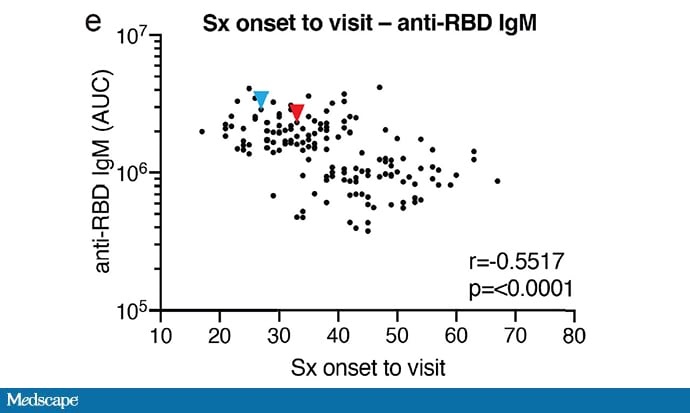
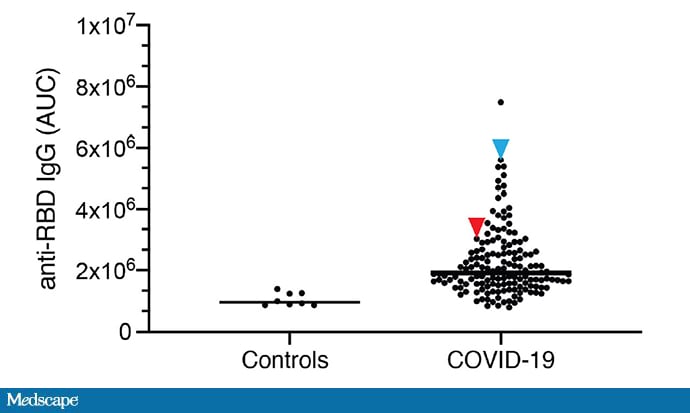
Compared with controls, IgG and IgM levels were higher among those who had recovered from COVID-19. As expected in this convalescent group, a bigger difference was seen in IgG compared with IgM. You can see in this graph that IgM levels seem to go down a bit over time.
Source: Robbiani DF, et al. Nature. Epub 18 June 2020.
And, I’ll note, about 20%-30% of people didn’t have antibody titers significantly above controls. But broadly, okay — the majority of people made antibodies.
But that’s not the key thing here. Were these neutralizing antibodies? Do they stop viral replication?
To figure this out, the researchers genetically engineered a SARS-CoV-2 pseudovirus which expressed the spike protein and let it run amok infecting ACE2-expressing cells in culture.
Source: Robbiani DF, et al. Nature. Epub 18 June 2020.
They then added varying dilutions of patient plasma to the petri dishes to determine how much plasma you would need to shut the virus down by 50%, the so-called “neutralizing titer” 50 (NT50).
The results here were not so encouraging.
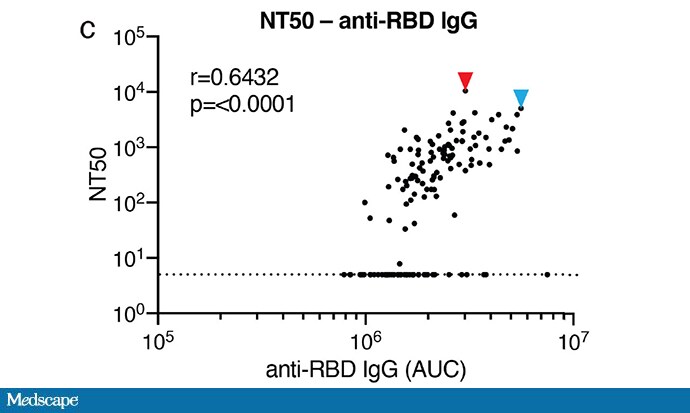
Thirty-three percent of the individuals tested had an NT50 of less than 50, which implies essentially no immunity to repeat infection; 79% had an NT50 less than 1000 — they may have partial immunity. Only two people tested had an NT50 greater than 5000.
Higher overall antibody titers were associated with neutralizing ability, as might be expected.
Source: Robbiani DF, et al. Nature. Epub 18 June 2020.
Individuals who had been hospitalized for COVID-19 were more likely to have neutralizing antibodies than those who hadn’t been hospitalized, suggesting that those with more severe illness are more likely to be immune in the future.
Overall, this is fairly concerning. Without neutralizing antibodies, an end to coronavirus transmission seems unlikely. But let’s also remember the empiric data: We don’t yet have any significant numbers of individuals who have been documented to have cleared COVID-19 and then become reinfected. And even without high levels of neutralizing antibodies, a second infection is likely not to be as bad as the first.
There’s another nugget of hope in this study. The researchers didn’t stop by simply measuring how many people had neutralizing antibodies. They actually sequenced 89 different anti-COVID antibodies to determine which specific antibodies were highly neutralizing. They identified 52 that had neutralizing ability and several that had potent neutralizing ability, targeted to specific amino acids on the receptor binding domain.
And here’s the thing: Most of the people in the study had those highly neutralizing antibodies; they just weren’t the main antibodies they were producing. Why is this good news? Because it suggests a pathway for a successful vaccine. We can make these potent neutralizing antibodies; it’s just that many of us don’t. But a vaccine designed to promote that particular antibody response could be highly successful.
All in all, this was a study that suggested that the tunnel we are in now may be a bit longer than we had hoped, but it also shows a light at the end.
F. Perry Wilson, MD, MSCE, is an associate professor of medicine and director of Yale’s Program of Applied Translational Research. His science communication work can be found in the Huffington Post, on NPR, and here on Medscape. He tweets @methodsmanmd and hosts a repository of his communication work at www.methodsman.com.