Search This Blog

Wednesday, July 15, 2020

New antiplatelet drug shows promise for treating heart attack

Researchers at the University of Illinois at Chicago have developed a new drug that prevents blood clots without causing an increased risk of bleeding, a common side effect of all antiplatelet medications currently available.
A new study published in the journal Science Translational Medicine describes the drug and its delivery mechanisms and shows that the drug is also an effective treatment for heart attack in animal models.
Xiaoping Du, UIC professor of pharmacology and regenerative medicine at the College of Medicine, led the research.
“Unfortunately, current antiplatelet medications prevent the blood clotting that cause heart attack and stroke but also disrupt platelets’ ability to stop bleeding if a blood vessel is torn,” Du said. “In some cases, severe bleeding can be life-threatening. The magic of this new drug is it prevents clots but does not make people prone to bleeding, which other drugs have failed to do.”
In a previous study, Du and his colleagues identified a signaling mechanism that is important in the blood clotting process but not required for platelets’ ability to adhere to a wound and prevent bleeding. Based on this finding, the researchers derived a peptide to target the signaling mechanism and designed a nanoparticle that successfully delivered the peptide into platelets.
The peptide-derived nanoparticle drug — called M3mP6 high-loading peptide nanoparticle, of HLPN — was then tested in mice as a possible treatment for heart attacks.
Du said a heart attack can cause heart failure and death in two different ways. One, from the initial damage caused by the clot, which blocks blood flow and reduces oxygen supply. This typically is treated by a procedure called angioplasty and a stent to open the artery, combined with antiplatelet drugs to prevent it from clotting again. However, fresh blood flowing into the damaged heart tissue following the reopening of the artery can trigger inflammation, causing leaks and clots in small blood vessels and further damage to the heart, Du said.
“This is called reperfusion injury and this is the second way a heart attack can lead to heart failure or death,” Du said. “We were hopeful that this new drug, which does not cause blood vessel leaks, would help limit reperfusion injury and reduce the chance of heart failure and death, and our hypothesis was proved correct — we saw very promising results from our study.”
In the study, among mice that received the treatment, administered as an injection, there was reduced damage to the heart, reduced clotting and reduced inflammation. There also was improved heart function and improved survival.
“It is very exciting to see such promising results in the lab and we hope to one day test this in humans,” Du said.
###
Co-authors on the paper are Aiming Pang, Ni Cheng, Yujie Cui, Yanyan Bai, Zhigang Hong, Yaping Zhang, Claire Chang, Can Wang, Alexander Zakharov, Kasim Kabirov, Jalees Rehman, Asrar Malik and Aleksander Lyubimov from the Department of Pharmacology and Regenerative Medicine at UIC; Chang Liu, Paola Leon Plata and Ying Liu from the Department of Chemical Engineering at UIC; and M. Keegan Delaney, Randal Skidgel and Minyi Gu from Dupage Medical Technology Inc.
This work is partially supported by the National Heart, Lung and Blood Institute (HHSN268201400007C, HHSN268201700002C, RO1HL080264, RO1HL062350, RO1HL125356, R43 HL142396, R01HL045638, P01HL060678, P01HL077806).

Prediabetes – a window of opportunity to reduce healthcare burden?

While the health risks associated with diabetes – including heart attacks and strokes – are well established, these risks could be present well before someone is even diagnosed with the condition, according to new research by The George Institute for Global Health published in the British Medical Journal.
The study found that prediabetes, defined by having higher than normal blood glucose levels but not enough to be classified as having diabetes, is associated with an increased risk of cardiovascular disease (CVD) and death.
Lead author Professor Yuli Huang, Honorary Fellow, Food Policy, at The George Institute for Global Health says the study showed there was a significant opportunity to prevent CVD by identifying and treating people earlier.
“The prevalence of prediabetes and diabetes is rising rapidly in epidemic proportions, especially in low- and middle-income countries. Early detection and proper treatment can have enormous benefits, but left unaddressed, the life-long complications and health impacts can be devastating,” he said.
Researchers from The George Institute and Shunde Hospital, Southern Medical University, China analysed 129 studies involving over 10 million people – the majority being from Europe, Asia and North America – who had prediabetes with and without existing CVD.
They looked at whether prediabetes was linked to higher rates of death and cardiovascular disease in people with and without a history of CVD and whether the criteria used to define prediabetes made a difference.
They found that compared with people who had normal blood glucose levels, those with prediabetes according to American Diabetes Association or World Health Organization criteria were at increased risk of CVD and more likely to die from any cause. Different definitions of prediabetes were associated with a similar outlook in patients who already had a history of CVD.
Professor Huang explained that prediabetes was controversial, and the term has been much debated.
“Some argue that describing people as having prediabetes creates more problems than benefits in terms of prevention and treatment and would put an unsustainable burden on health-care systems,” he said.
“But considering the high prevalence of prediabetes, as well as its strong link to health risks seen in our study, successful intervention in this large population could have a major public health impact.”
The prevalence of prediabetes is increasing worldwide. It is estimated that more than 470 million people will have prediabetes by 2030 and according to an American Diabetes Association up to 70 percent of these will go on to develop diabetes.
“What is especially concerning is the many millions of people who are unaware they have either condition and don’t act early enough,” says Professor Huang.
“Early detection and proper treatment can have enormous benefits, but left unaddressed, the life-long complications and health impacts can be devastating,” he says.
The researchers hope the results of this study will turn prediabetes from a controversial term into a useful trigger for preventive care that will help address an escalating global health burden.

Immune response to Covid-19 spike protein: secret to successful vaccine?

Scientists have uncovered how a crucial component of the immune system responds to the spike protein of SARS-CoV-2, the virus that causes COVID-19—important information for future validation of vaccine candidates.
Coronavirus particles have a corona (crown) of proteins that resemble spikes, which enable the virus to attach and enter in humans. The spike protein is crucial in inducing neutralizing antibodies to protect from re-infection.
Neutralizing antibodies not only bind to the viral spike protein, but prevent it from being able to attach to and enter . Generating a strong neutralizing antibody response is an important goal for SARS-CoV-2 vaccines.
The spike protein is the target for most of the current COVID-19 human clinical trials and so a team from the Peter Doherty Institute for Infection and Immunity (Doherty Institute) was keen to investigate how the immune system, particularly B and T cells, responds to the spike.
B cells are responsible for producing the antibodies that recognize SARS-CoV-2, while T cells play an important role in supporting the development of the B cell response.
University of Melbourne Dr. Jennifer Juno, a postdoctoral researcher at the Doherty Institute, said they looked at people who had recovered from COVID-19 who had mostly experienced mild or no symptoms, as that kind of immune response mimics what a vaccine might induce.
“We found that those who showed strong neutralizing antibody activity had a robust B cell response, but most surprisingly, we also found that a particular subset of T cells, called T-follicular helper cells, was a great predictor of an effective immune response,” Dr. Juno said.
“We have previously demonstrated through influenza research that B cells are key to mounting an effective immune response to influenza, and we also know that T-follicular helper cells specifically help B cells to make antibodies.”
The research team hopes the ‘immune parameters’ they’ve identified and published today in Nature Medicine can be applied to clinical vaccine trials to assess whether or not a vaccine might induce a strong or weak neutralizing antibody response.
“Now we know how the responds to the spike , and we have these biomarkers, or predictors of what elicits a good or poor immune response to COVID-19, we can look at the vaccine candidates and see what will offer the best protection,” Dr. Juno explained.
In addition to COVID-19, the researchers also looked at circulating coronaviruses that cause the common cold in an effort to understand what would predict the neutralizing response to SARS-CoV-2.
These findings were consistent with what was described in the immune responses of other people who had recovered from COVID-19.

Explore further

More information: Jennifer A. Juno et al. Humoral and circulating follicular helper T cell responses in recovered patients with COVID-19, Nature Medicine (2020). DOI: 10.1038/s41591-020-0995-0

3 distinct immune responses found for sicker COVID-19 patients

Researchers from the Penn Institute of Immunology discovered three distinct immune responses to the SARS-CoV2 infection that could help predict the trajectory of disease in severe COVID-19 patients and may ultimately inform how to best treat them.
The findings were published in Science.
“For patients who are hospitalized with COVID-19, there isn’t just one way for the immune system to respond. There’s a lot of heterogeneity, which we’ve distilled down into what we’re calling three ‘immunotypes,’ said senior author E. John Wherry, Ph.D., chair of the department of Systems Pharmacology and Translational Therapeutics and director of the Penn Institute of Immunology in the Perelman School of Medicine at the University of Pennsylvania. “We’re hopeful we may actually be able to predict, or at least infer, the different immune patterns a patient has based on clinical data. This would allow us to start thinking about enrolling patients to different types of clinical trials investigating treatments.”
The coronavirus triggers different immune responses and symptoms in critically ill patients, but how those two correspond has remained poorly understood, making treatment decisions more difficult.
While recent studies reveal details on the immune’s to the virus, most have been single-case reports or focused on a small group of individuals. This is the first study, to the author’s knowledge, to offer up a comprehensive immune profile of a large number of hospitalized patients.
The researchers applied deep immune profiling to capture individual responses of 163 patients during the course of their infections. The study included 90 hospitalized patients treated at the Hospital of the University of Pennsylvania, 29 non-hospitalized patients, and 44 healthy donors with no COVID-19 infection. The immune responses varied among the group, but there were patterns that hold clinical promise.
The first immunotype had robust CD4+ T cell activity, with modest activation of CD8+ T and peripheral blood lymphocytes. CD4+ and CD8+ act as the main inflammatory immune cells that work to clear viruses. The second immunotype was characterized mainly by a subset of CD8+ T cells known as EM and EMRA and a modest activation of CD8+ T cells, memory B cells, and peripheral blood lymphocytes. The third immunotype showed little to no evidence of an immune response to the infection.
Next, researchers combined the profiling with clinical data to understand the relationships between immune responses and disease. The first immunotype was tied to more severe disease that included inflammation, organ failure, and acute kidney disease. The second correlated not with disease severity but instead pre-existing immunosuppression and mortality. The third type, which had no immune activation, was not associated with specific symptoms or clinical features, though they varied.
The immunotypes developed by Wherry and team represent adaptive immune responses. A second study from researchers at Penn, published in Science Immunology, uncovered new details about the innate, or initial, response to SARS-CoV2.
“T and B cell activity are informed by innate immune responses,” said senior author Michael R. Betts, Ph.D., a professor of Microbiology and program leader in the Penn Institute of Immunology, who is also a co-author on the first study. “We believe what’s happening with the innate response of the immune system might be what’s leading to these three immune phenotypes Dr. Wherry’s lab identified.”
Profiling the blood samples of 42 infected patients (with moderate and severe disease) and 12 healthy donors, the researchers found a similar heterogeneity in immune adaptive responses: robust activation of CD4+ and CD8+ T cells, B cells, along with peripheral blood cells, like neutrophils, monocytes, and “natural killer,” or NK, cells.
While the innate responses were also heterogenous, the researchers observed a decrease of CD15 and CD16 molecules on neutrophils and CD16 on NK cells, immature granulocytes, and monocytes, in patients with more severe disease. These two molecules are known players in the immune’s response to viral infections that also represent a potential target for immunotherapy. How they are driving and exacerbating the adaptive responses in the three immunotypes is an important question the labs are working to better understand.
COVID-19 studies have been moving at an unprecedented speed as researchers band together to find answers. Among its many efforts, Penn formed lab and clinical research teams from diverse backgrounds to strengthen its focus on the immune system, along with the COVID Processing Unit to manage specimens to profile.
“Understanding the power of the to regulate responses to disease is one of the major advances in medicine in the last decade, and Penn has been at the center leading that discovery. We are now applying the broad expertise and experience of our more than 200-person immunology community toward the research and treatment of COVID-19,” said Jonathan A. Epstein, MD, executive vice dean, chief scientific officer, and a professor of Cardiovascular Research at Penn. “The deep immuno-profiling work the investigators applied here is likely to be useful not only now, for this disease, but into the future for many others.”

Explore further

More information: Mathew Divij et al, Deep immune profiling of COVID-19 patients reveals distinct immunotypes with therapeutic implications,Science 15 Jul 2020 DOI: 10.1126/science.abc8511

Acutus Medical files for IPO

Acutus Medical Inc. has filed for an initial public offering, seeking to sell $75 million worth of shares to grow its medical-devices business. The Carlsbad, Calif., company makes imaging and other products and therapies related to heart rhythm disorders. J.P. Morgan, BofA Securities, and William Blair are among the underwriters. The company hopes to list its shares on the Nasdaq under the ticker AFIB. Acutus said its first-quarter sales rose to $1.6 million, from $787,000 in the first quarter of 2019. It lost $18.1 million, or $2.66 a share, in the quarter, compared with a loss of $14.7 million, or $2.30 a share, in the year-ago period, according to a filing on Wednesday.

Record-Breaking Biotech Funding Tsunami Of 1H2020

We’re half way through one of the craziest years in recent memory, with a raging viral pandemic, civil unrest and protests, staggering unemployment and economic woes, and invasive murder hornets. And yet, like the indefatigable Energizer bunny, the biotech market just keeps marching onwards and upwards.
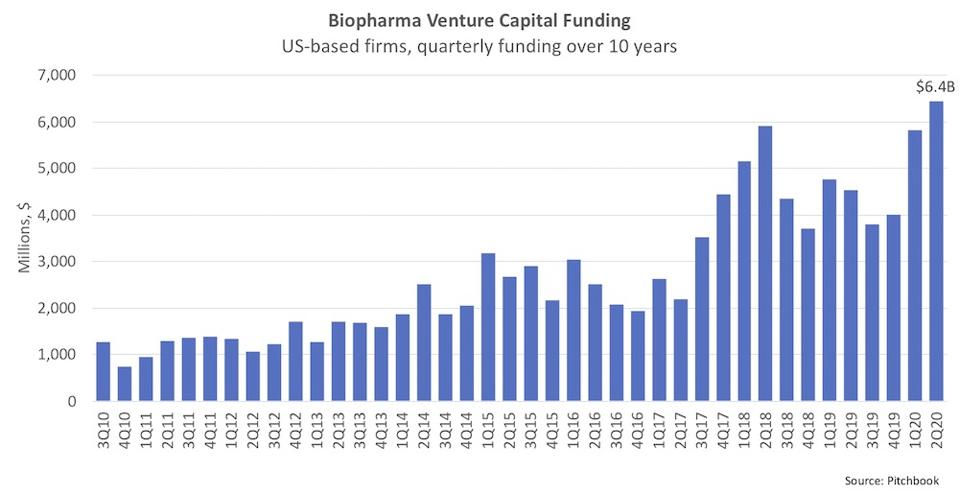
Recent 2Q 2020 data from Pitchbook shows that venture capital funding into US-based biopharma companies was the largest quarter in the history of the industry – topping over $6.4B. In the midst of the crazy macro backdrop, private biotechs raised more in the last three months than the annual totals in every year prior to 2014.
 This strength has surprised many market participants, including me: in April, I had forecast that 2Q 2020 would soften a bit from the “record-setting” 1Q performance due to social distancing… but that’s obviously not what happened. It was another record-setting quarter.

Beyond private venture capital funding, the public markets for biotech are also swimming in capital. With stellar 2020 returns in the biotech equity markets relative to other sectors, investor interest and inflows have been strong. And with biotech IPOs performing incredibly well in 2020, investors have been eager to participate in these offerings – oversubscription, upsizing, and going above the range seem strangely commonplace in this market.
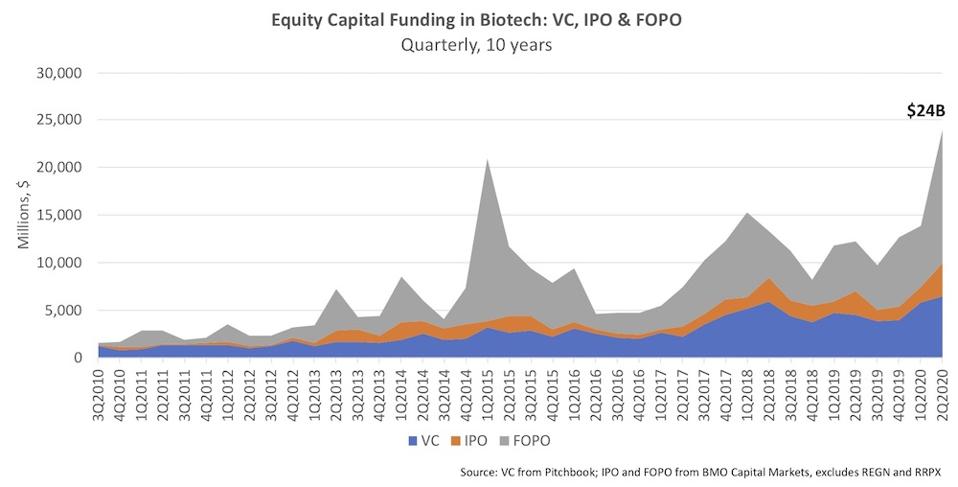
According to data from BMO Capital Markets, in aggregate, we’ve seen over $17.6B in equity funding in 2Q2020 into biopharma across both IPOs and follow-on’s (excluding offerings from Regeneron and Royalty Pharma). The biotech IPO fundraising level, in terms of capital raised, is the largest ever witnessed in a quarter, and the follow-on number is only beaten by 1Q 2015.
This tidal wave of funding is well illustrated by this combined public and private funding chart, highlighting the record-breaking $24B in total equity funding:
I’ve opined previously on the reasons why biotech is an unusual sector relative to broader economy during a pandemic or recession (here). The current financing market has been further buoyed by the strong sentiment that science will lead us out of this pandemic crisis, and the muted political rhetoric about drug pricing this election cycle.
In light of these funding levels, it’s fair to say the cost of capital for biotech companies has probably never been this low – allowing many companies to scale their platforms and programs faster.
But the multi-billion-dollar question is will more capital translate into more drugs and thus more value for patients and shareholders? I think (and hope) so. It’s likely there will be more drugs in the long run, reflecting the simple math that more programs are getting funded – and that’s a good thing.
But more capital also means the average “health of the herd” will go down: without a meaningful constraint on the supply of capital, less robust ideas and weaker therapeutic concepts will also get funded alongside the smarter bets. Companies will advance larger portfolios of R&D projects, where the incremental programs might not be as strong or validated as the lead ones. In short, the diligence “bar” goes down for both investors and management teams in a world awash in capital. In addition, a largely unconstrained supply of capital chasing a relatively stable number of deals means that valuations will go up – and could be at risk of over-heating in certain cases. These concerns are especially true in over-hyped areas, like I/O a few years ago, or like the number of COVID-related programs now being funded.
Only in hindsight will we know whether this tidal wave of capital hitting the sector was put to good use or not; financial market bubbles themselves are only widely recognized after the fact. Whether biotech is rationally allocating capital, or is in an irrational funding bubble, largely depends on what the sector does with the capital – and if it can be productively deployed to drive innovative R&D.
Hopefully, history will look favorably on this period – where this plethora of funding delivers a huge spike in the number of compelling new medicines reaching the market in the next 5-10 years. Only time will tell.