Search This Blog

Tuesday, February 9, 2021

India backs AstraZeneca shot despite South Africa halt

 India said on Tuesday it had no concerns over the efficacy of the AstraZeneca COVID-19 vaccine despite South Africa putting it on hold, and ordered 10 million more doses of the shot for its own huge immunisation campaign.

South Africa delayed use of the vaccine after researchers found it offered minimal protection against mild-to-moderate COVID-19 disease caused by the country’s dominant coronavirus variant.

India, with the highest number of infections after the United States, has yet to detect the South African variant and will continue to use the vaccine in an inoculation drive that has covered 6.3 million front-line workers since Jan. 16.

“Our vaccination programme is robust and valid, and I assure you that we are going ahead with it, not worried at the moment,” Vinod Kumar Paul, a top Indian vaccine official, told a news conference.

“We will intensify our surveillance and we will be watching other developments in due course.”

The Serum Institute of India (SII), the world’s biggest vaccine maker, has licenced the vaccine from AstraZeneca and Oxford University and markets it as COVISHIELD for low-and middle-income countries.

India has ordered 10 million more doses of COVISHIELD on top of 11 million supplied earlier, an SII spokesman told Reuters on Tuesday. SII has agreed to sell at least 100 million doses to the government at a discounted price of 200 rupees ($2.74) each, though the government says firm orders will be staggered based on its needs, and also on vaccine shelf-life.

COVISHIELD is about 72% effective, based on late-stage trials done abroad, India’s drug regulator says.

The country is also using the COVAXIN shot developed at home by Bharat Biotech with the state-run Indian Council of Medical Research. Bharat Biotech has supplied 5.5 million doses to the government and is selling 4.5 million more, a company spokeswoman told Reuters.

The government wants to cover 300 million people by August, reaching the elderly and those with existing conditions by March.

India has reported 10.85 million infections and more than 155,000 deaths - though cases have fallen sharply since September.

Paul said Johnson & Johnson could manufacture its shot in India. He also said many more vaccines, including Russia’s Sputnik V, Cadila Healthcare’s ZyCov-D and a Novavax product, were in the queue.

“India is fortunate to have two great made-in-India vaccines, and as many as six-seven vaccines in the pipeline and perhaps many more,” he said, days after Pfizer Inc pulled an application seeking emergency-use authorisation in the country.

The U.S. company had declined to immediately do a small local safety study for its shot and produce it in India, unlike the other vaccine developers.

New Delhi, meanwhile, is aggressively pushing the SII and Bharat Biotech vaccines abroad as part of a diplomatic campaign to recoup ground lost to China.

Bharat Biotech told Reuters it could export its vaccine to Brazil and the United Arab Emirates this week, a major success for the shot approved at home for emergency use without efficacy data from a late-stage trial.

The company expects results from an ongoing trial involving 25,800 participants in India only by March, though the country’s drug regulator has called the vaccine safe and effective amid criticism from doctors and health experts. A study on 26 participants has found COVAXIN effective against the UK strain of the coronavirus.

Bharat Biotech has also applied to conduct a Phase III trial for COVAXIN in Brazil, which plans to import 8 million doses in February and another 12 million in March.

Bharat Biotech has also sought emergency use authorisation in the Philippines.

https://www.reuters.com/article/us-health-coronavirus-india-vaccine/india-backs-astrazeneca-shot-despite-south-africa-halt-idUSKBN2A90RW

Does the world need new COVID vaccines? 'Jury is out': Oxford's Pollard

 It is not yet clear whether the world needs a new set of vaccines to fight different variants of the novel coronavirus but scientists are working on new ones so there is no reason for alarm, the head of the Oxford Vaccine Group said on Tuesday.

South Africa has paused a planned rollout of AstraZeneca’s vaccines after data showed it gave minimal protection against mild infection among young people from the dominant variant there, stoking fears of a much longer battle with the pathogen.

AstraZeneca and Oxford University aim to produce a next generation of vaccines that will protect against variants as soon as the autumn before the Northern Hemisphere winter, AstraZeneca’s research chief said this month.

“There are definitely new questions about variants that we’re going to be addressing. And one of those is: do we need new vaccines?,” Andrew Pollard, Chief Investigator on the Oxford vaccine trial, told BBC radio.

“I think the jury is out on that at the moment, but all developers are preparing new vaccines so if we do need them, we’ll have them available to be able to protect people.”

Vaccines are seen as the swiftest path out of the COVID-19 crisis which has killed 2.33 million people and turned normal life upside down for billions.

Researchers from the University of Witwatersrand and the University of Oxford said in a prior-to-peer analysis that the AstraZeneca vaccine provided minimal protection against mild or moderate infection from the South African variant among young people.

TARGET POPULATION

Protection against moderate-severe disease, hospitalisation or death could not be assessed in the study of around 2,000 volunteers who had a median age of 31 as the target population were at such low risk, the researchers said.

“I think there’s clearly a risk of confidence in the way that people may perceive you. But as I say I don’t think that there is any reason for alarm today,” Pollard said.

“The really important question is about severe disease and we didn’t study that in South Africa, because that wasn’t the point of that study, we were specifically asking questions about young adults.”

The so called South African variant, known by scientists as 20I/501Y.V2 or B.1.351, is the dominant one in South Africa and is circulating in 41 countries around the world including the United States.

Other major variants include the so-called UK variant, or 20I/501Y.V1, and the Brazilian variant known as P.1.

An analysis of infections by the South African variant showed there was only a 22% lower risk of developing mild-to-moderate COVID-19 if vaccinated with the AstraZeneca shot versus those given a placebo.

If vaccines do not work as effectively as hoped against new and emerging variants, the world could be facing a much longer - and more expensive - battle against the virus than previously thought.

“As long as we have enough immunity to prevent severe disease, hospitalisations and death then we’re going to be fine in the future in the pandemic,” Pollard said.

Pollard said the South African government was right to look at how it deployed the AstraZeneca vaccine because the original plan was to use it in young adults - particularly healthcare workers - who were not expected to get severe disease.

“It needs a relook at how best to deploy the vaccine,” Pollard said.

https://www.reuters.com/article/us-health-coronavirus-vaccine/does-the-world-need-new-covid-vaccines-jury-is-out-oxfords-pollard-says-idUSKBN2A90Y7

COVID may have taken 'convoluted path' to Wuhan: WHO team leader

 The head of a World Health Organization-led team probing the origins of COVID-19 said bats remain a likely source and that transmission of the virus via frozen food is a possibility that warrants further investigation, but he ruled out a lab leak.

Peter Ben Embarek, who led the team of independent experts in its nearly month-long visit to the Chinese city of Wuhan, where the outbreak first emerged at a seafood market in late 2019, said the team’s work had uncovered new information but had not dramatically changed their picture of the outbreak.

“The possible path from whatever original animal species all the way through to the Huanan market could have taken a very long and convoluted path involving also movements across borders,” Embarek told a nearly three-hour media briefing.

Embarek said work to identify the coronavirus’s origins points to a natural reservoir in bats, but it is unlikely that they were in Wuhan.

Investigators were also looking for Chinese blood samples that could indicate that the virus was circulating earlier than first thought, he said.

“In trying to understand the picture of December 2019 we embarked on a very detailed and profound search for other cases that may have been missed, cases earlier on in 2019,” he said.

“And the conclusion was we did not find evidence of large outbreaks that could be related to cases of COVID-19 prior to December 2019 in Wuhan or elsewhere.”

The possibility the virus leaked from a lab - which has been the subject of conspiracy theories - was extremely unlikely and did not require further study, Embarek said.

Liang Wannian, head of China’s expert panel on the outbreak, said there was evidence of coronavirus infections that could have preceded the first detected case by “several weeks”.

“This suggests that we cannot rule out that it was circulating in other regions and the circulation was unreported,” he told the briefing.

Embarek said the team had identified market vendors selling frozen animal products including farmed wild animals.

“So there is the potential to continue to follow this lead and further look at the supply chain and animals that were supplied to the market,” he said.

China has pushed the idea that the virus can be transmitted by frozen food and has repeatedly announced findings of coronavirus traces on imported food packaging.

“We know the virus can survive in conditions that are found in these cold, frozen environments, but we don’t really understand if the virus can transmit to humans” or under which conditions, Embarek told the briefing.

The team arrived in Wuhan on Jan. 14 and after two weeks of quarantine, visited key sites including the Huanan seafood market, the location of the first known cluster of infections, as well as the Wuhan Institute of Virology, which has been involved in coronavirus research.

Members of the team sought to rein in expectations for the mission, with infectious disease expert Dominic Dwyer saying it would probably take years to fully understand the origins of COVID-19.

The United States said China needed to be more open when it comes to sharing data and samples as well as allowing access to patients, medical staff and lab workers. Beijing subsequently accused Washington of politicising a scientific mission.

https://www.reuters.com/article/us-health-coronavirus-who-china/covid-may-have-taken-convoluted-path-to-wuhan-who-team-leader-says-idUSKBN2A90BW

Outlook Therapeutics: Notable Insider Buys


  • Insider buying can be an encouraging signal for potential investors, especially when markets face uncertainty.
  • Some insiders have been taking advantage of secondary offerings recently.
  • Others have been adding to their stakes in the wake of earnings reports.

Conventional wisdom says that insiders and 10% owners really only buy shares of a company for one reason — they believe the stock price will rise and want to profit from it. So insider buying can be an encouraging signal for potential investors, particularly when there is uncertainty in the markets. Note that with earnings reporting season in full swing, buy windows for many insiders are closed.

Here are some of the most noteworthy insider purchases that were reported in the past week.

Outlook Therapeutics Inc OTLK had a 10% owner and a director both increase their stakes last week. They acquired 11.36 million shares altogether, at a secondary offering price of $1 per share.

https://www.benzinga.com/news/21/02/19524828/notable-insider-buys-of-the-past-week-harley-davidson-texas-instruments-and-more

J&J Erleada + Zytiga + Prednisone Combo Benefits In Prostate Cancer Study


  • Johnson & Johnson’s (NYSE: JNJ) unit Janssen Pharmaceutical has announced results from Phase 3 ACIS study, evaluating the efficacy and safety of Erleada (apalutamide) and Zytiga (abiraterone) plus prednisone (treatment arm) compared to placebo and Zytiga plus prednisone (control arm) in prostate cancer patients with chemotherapy-naïve disease who received androgen deprivation therapy. JNJ will present the results at the American Society of Clinical Oncology’s Genitourinary Cancers Symposium.
  • The study met the primary endpoint of radiographic progression-free survival (rPFS) with a 31% reduction in radiographic progression or death risk. Primary efficacy analysis showed median rPFS was extended by six months in patients treated in the treatment combination arm compared with patients in the control arm (22.6 vs. 16.6 months; hazard ratio 0.69 ).
  • Updated analysis at a median follow-up of 54.8 months showed a 30 percent reduction in the risk of radiographic progression or death in the treatment arm than the control arm (median time to rPFS 24 vs. 16.6 months: HR 0.70).
  • No statistically significant difference was demonstrated for overall survival, time to initiation of cytotoxic chemotherapy, chronic opioid use, and pain progression between treatment arms.
  • Erleada is FDA approved treatment for non-metastatic castration-resistant prostate cancer and metastatic castration-sensitive prostate cancer.
  • Zytiga in combination with prednisone is indicated for the treatment of patients with metastatic castration-resistant prostate cancer.

Monday, February 8, 2021

Asthma treatment reduces need for hospitalisation in COVID-19

 Early treatment with a medication commonly used to treat asthma appears to significantly reduce the need for urgent care and hospitalisation in people with COVID-19, researchers at the University of Oxford have found.

The STOIC study found that inhaled budesonide given to patients with COVID-19 within seven days of the onset of symptoms also reduced recovery time. Budesonide is a corticosteroid used in the long-term management of asthma and chronic obstructive pulmonary disease (COPD).

Findings from the phase 2 randomised study, which was supported by the NIHR Oxford Biomedical Research Centre (BRC), were published on the medRxiv pre-print server.

The findings from 146 people – of whom half took 800 micrograms of the medication twice a day and half were on usual care – suggests that inhaled budesonide reduced the relative risk of requiring urgent care or hospitalisation by 90% in the 28-day study period. Participants allocated the budesonide inhaler also had a quicker resolution of fever, symptoms and fewer persistent symptoms after 28 days.

Professor Mona Bafadhel of the University’s Nuffield Department of Medicine, who led the trial, said: “There have been important breakthroughs in hospitalised COVID-19 patients, but equally important is treating early disease to prevent clinical deterioration and the need for urgent care and hospitalisation, especially to the billions of people worldwide who have limited access to hospital care.

“The vaccine programmes are really exciting, but we know that these will take some time to reach everyone across the world. I am heartened that a relatively safe, widely available and well studied medicine such as an inhaled steroid could have an impact on the pressures we are experiencing during the pandemic.”

The study also demonstrated that there was a reduction in persistent symptoms in those who received budesonide. Prof Bafadhel, a Respiratory Consultant also working at the Oxford University Hospitals NHS Foundation Trust, said: “Although not the primary outcome of study, this is an important finding.

“I am encouraged to see the reduction in persistent symptoms at 14 and 28 days after treatment with budesonide. Persistent symptoms after the initial COVID-19 illness have emerged as a long-term problem. Any intervention which could address this would be a major step forward.”  

The trial was inspired by the fact that, in the early days of the pandemic, patients with chronic respiratory disease, who are often prescribed inhaled steroids, were significantly under-represented among those admitted to hospital with COVID-19.

As well as the Oxford BRC, the STOIC trial was supported by AstraZeneca.

https://oxfordbrc.nihr.ac.uk/common-asthma-treatment-reduces-need-for-hospitalisation-in-covid-19-patients-study-suggests/

Moderna's COVID-9 vaccine effective against emerging variants

 Researchers in the United States have conducted a study showing that the Moderna mRNA-1273 vaccine effectively protects against recently emerged variants of severe acute respiratory syndrome coronavirus 2 – the agent that causes coronavirus disease 2019 (COVID-19).

The team compared the neutralization activity of blood taken from infected and vaccinated individuals against a panel of SARS-CoV-2 variants, including the B.1.1.7 that emerged in the UK.

The team – from Emory University School of Medicine in Atlanta, the University of Texas Medical Branch, and the COVID-19 Neutralization Study Group – found that antibodies generated by both infected and vaccinated individuals effectively neutralized all of the variants.

“These findings support the notion that in the context of the UK variant, vaccine-induced immunity can provide protection against COVID-19,” says Mehul Suthar and colleagues.

However, as further variants continue to emerge, it will be essential to assess their impact on the potency of neutralizing responses following both infection and vaccination, warns the team.

A pre-print version of the research paper is available on the medRxiv* server, while the article undergoes peer review.

The SARS-CoV-2 infection process

In order to infect cells, SARS-CoV-2 uses a surface viral structure called the spike protein to bind to the host cell receptor angiotensin-converting enzyme 2 (ACE2).

The spike protein is the primary target of neutralizing antibodies and levels of these antibodies correlate with protection against COVID-19.

Neutralizing antibodies are generated within 10 days of symptom onset and studies have shown that they are maintained for at least 8 months.

Similarly, Moderna’s mRNA-1273 vaccine generates neutralizing antibodies that are detectable for at least 119 days.

However, the recent emergence of SARS-CoV-2 variants, including the B.1.1.7 strain that has arisen in the UK, has sparked concerns regarding the breadth of these neutralizing antibody responses.

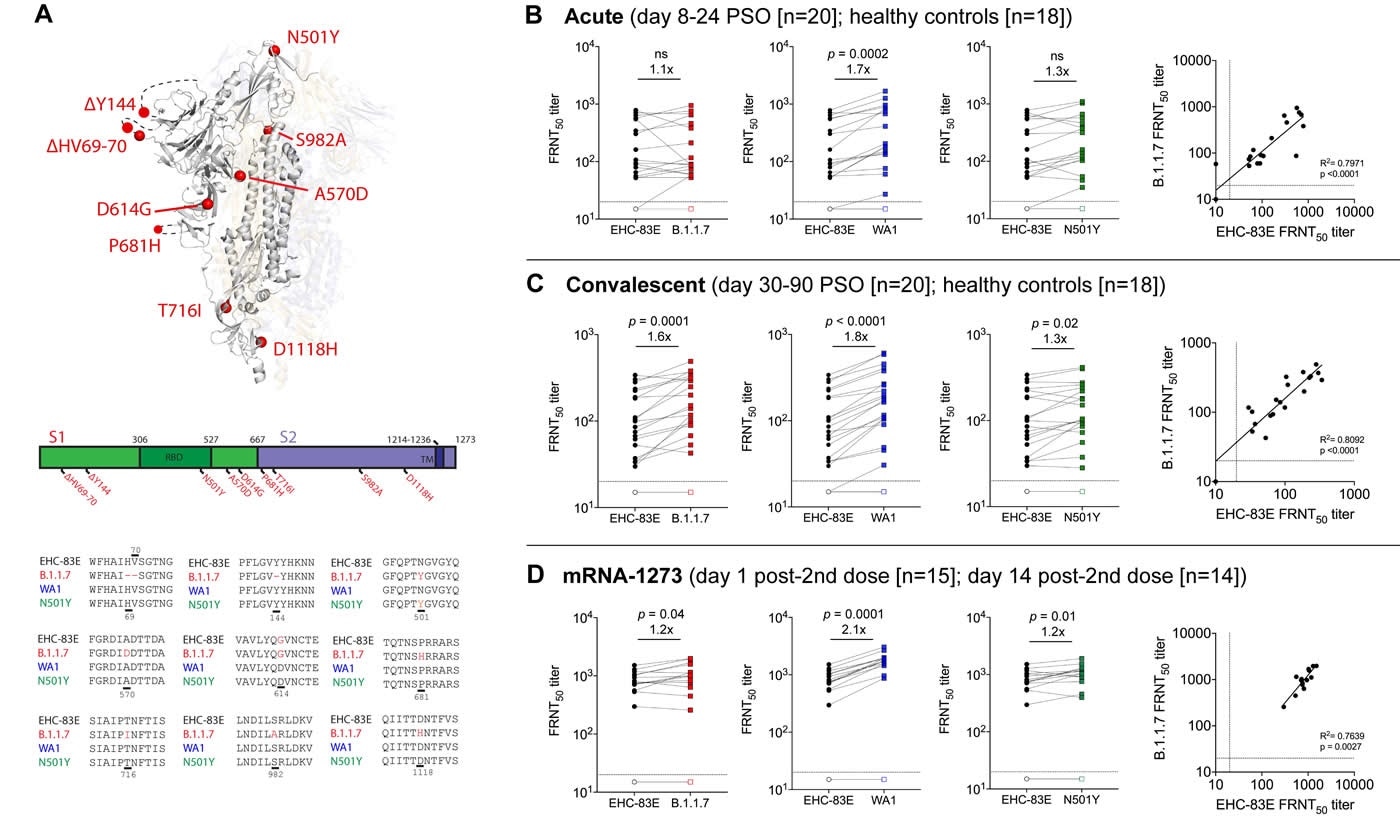
Neutralizing antibody responses against the SARS-CoV-2 B.1.1.7 viral variant. Shown are data from the following cohorts based on natural infection: 20 acutely infected COVID-19 patients (8-24 days PSO; closed symbols), 20 convalescent COVID-19 individuals (30-90 days PSO, closed symbols) 18 healthy controls (open symbols); and individuals that received 100 ug of mRNA-1273 (18 to 55 years old) on day 1 post-2nd dose (15 participants; open symbols) and day 15 post-2nd dose (14 participants; closed symbols). A schematic of the amino acid changes within the spike protein are shown between the SARS-CoV-2 variants (Panel A); The 50% inhibitory titer (FRNT50) on the focus reduction neutralization (FRNT) assay for the EHC-83E (black), B.1.1.7 (red), WA1 (blue) and N501Y (green) SARS-CoV-2 variants and correlation plots between EHC-83E and B.1.1.7 viruses are shown for the acutely infected COVID-19 patients (Panel B), convalescent COVID-19 individuals (Panel C), and mRNA-1273 vaccinated individuals (Panel D). Statistical significance was determined using a Wilcoxon paired t-test. The GMT fold change for the respective isolates relative to EHC-83E is shown in each of the plots.

What did the researchers do?

Suthar and colleagues compared the neutralization potency of sera from 20 patients with acute infection, 20 recovered individuals, and 14 healthy vaccinees, against a panel of SARS-CoV-2 variants.

Symptom onset had occurred between 8 and 24 days previously among the 20 acutely infected patients and between 30 and 90 days previously among the convalescent patients.

The immunized participants (aged between 18 and 55 years) had received two injections of Moderna’s mRNA-1273 vaccine at a dose of 100µg, with the second dose administered 14 days previously.

The panel of SARS-CoV-2 variants included an early variant isolated from an individual in Washington (WA1); a later D614G variant isolated from a patient in Georgia in March 2020 (EHC-083E), and a B.1.1.7 variant isolated from a patient in California.

The team also included a recombinant SARS-CoV-2 virus containing a single point mutation within the spike protein at position 501 (N501Y).

Levels of neutralizing antibodies were measured using a live-virus Focus Reduction Neutralization Test.

What did they find?

The findings showed that antibodies were effective at neutralizing all variants, whether they were generated following natural infection or vaccination.  

The team observed no significant reduction in levels of neutralizing antibodies against any of the variants.

“These results show that neutralizing antibody titers following natural infection or vaccination are effective against the UK variant (B.1.1.7) and viral strains containing single point mutations at positions 501 and 614 within the spike protein,” writes the team.

The researchers say the findings suggest that in the context of the UK variant, vaccine-induced immunity can provide protection against COVID-19.

“As additional SARS-CoV-2 viral variants continue to emerge, it is crucial to monitor their impact on neutralizing antibody responses following infection and vaccination,” they conclude.


https://www.news-medical.net/news/20210208/Modernas-COVID-9-vaccine-effective-against-emerging-variants.aspx