This is not a final ruling, and the judge could still choose to side with the state after hearing more arguments. Judge Lora Livingston said she wanted more time for each side to make their case. She set another hearing for March 26.
But this means Austin and Travis County will be able to enforce its mask mandate through spring break, which starts this weekend. Travis County Judge Andy Brown tweeted shortly after the judge’s ruling.
Attorney General Ken Paxton then sued to uphold the conservative governor’s executive order in the liberal-led Texas capital.
Paxton has not commented on the case to the media but has commented a few times on Twitter, saying Thursday, “I told Travis County & The City of Austin to comply with state mask law. They blew me off. So, once again, I’m dragging them to court.”
As of noon Thursday, he had not tweeted following the judge’s ruling.
In Bexar County, which includes San Antonio, Judge Nelson Wolff said he’s closely watching the result of Austin’s lawsuit.
Bexar County avoided conflict with the state by instead requiring businesses to clearly post COVID-19 precautions for customers.
Should Austin win the lawsuit against Paxton, Wolff said Bexar County won’t be far behind.
“Yeah, if it becomes really clear that we can do that, we’d do that,” Wolff told KXAN.
Russia’s true death toll from the novel coronavirus pandemic is not about 57 000, as official figures claim, but more than 180 000, the country’s deputy prime minister, Tatiana Golikova, conceded at a press conference.
Russia’s claims of an extraordinarily low mortality have been widely dismissed as implausible for months by foreign observers and Russian doctors alike. Every other indicator, from packed hospitals with long lines of ambulances to mortality among health workers documented by their own associations, has painted a picture of a country hit hard by the pandemic, not one miraculously spared.
These suspicions were confirmed when the Rosstat statistics agency said on 28 December that the number of deaths from all causes recorded between January and November was 229 700 higher than in 2019. “More than 81% of this increase in mortality over this period is due to covid,” said Golikova. That would mean that more than 186 000 Russians have died from covid-19.
The figures mean Russia ranks third in the world in terms of deaths from covid-19, behind only the US and Brazil. It would also give Russia the fourth highest per capita death rate, about 1273 deaths per million population, behind only San Marino, Belgium, and Slovenia.
But the higher figures, which are estimated from numbers of excess deaths, may never find their way into official statistics of the pandemic. The director of Mexico’s National Centre for Preventive Programs and Disease Control made a similar announcement in October, telling a press conference that the country had undercounted deaths by more than 50 000. In that case the new estimate was based on individual review of death certificates—yet the extra deaths have never been added to Mexico’s official count.1
A wide discrepancy between Russian cities’ accurate counts of deaths from all causes and the official national covid-19 mortality figures has been evident since the beginning of the pandemic.2 The low official figure was generated by only reporting deaths in which novel coronavirus infection was identified on autopsy.
From the beginning the official numbers drew widespread scorn from Russian doctors, who on social media painted a far grimmer picture, often mourning deaths in their own ranks from lack of personal protective equipment. A privately maintained list of Russian medical staff who lost their lives fighting the pandemic now stands at over 1000 names.3
Three doctors who raised concerns about the country’s response mysteriously fell from windows in the early months of the pandemic.4 Anastasia Vasilyeva, the head of the doctors’ union Alyans Vrachei (Doctors’ Alliance), an opposition linked group that has criticised pandemic preparations, was arrested and beaten by police when she attempted to deliver PPE to a hospital near Novgorod.5
The deputy prime minister’s admission will embarrass President Vladimir Putin, who has favourably compared Russia’s response to those of other countries, on the basis of its supposed low death rate. Putin later appeared somewhat chastened, telling regional governors in one televised meeting in May that “we don’t have much to brag about.”
But the imminent prospect of mass immunisation with Russia’s Sputnik vaccine has recently seen Putin again touting his country’s response, even as he personally adopts a wary attitude to the virus. He has spent much of the past year secluded at his dacha outside Moscow, and visitors to the president must first walk through a specially constructed corridor in which they are sprayed from all sides with disinfectant.
A pivotal event for AI happened when IBM’s Watson beat two all-time champions ofJeopardy!in 2011. This showed that the technology was far from being experimental.
IBM would soon go on to make Watson the centerpiece of its AI strategy. And a big part of this was to focus on healthcare. To this end, the company made several major acquisitions and boosted the headcount of data scientists.
But despite all this, the effort ultimately proved to be a disappointment. Keep in mind that IBM is now exploring the sale of the Watson healthcare business, according to a report in the Wall Street Journal.
The Difficulties With Healthcare And AI
When it comes to commercializing cutting-edge technology, it’s important to set forth concrete goals that are achievable and that have ROI targets. Trying to “boil the ocean” is often a recipe for failure.
In the case of IBM, it does look like it was overly ambitious, as the company was looking at making significant strides in fighting cancer and other chronic diseases.
“AI can work incredibly well when it’s applied to specific use cases,” said Nirav R. Shah, who is an MD and the Chief Medical Officer at Sharecare. “With regards to cancer, we’re talking about a constellation of thousands of diseases, even if the focus is on one type of cancer. What we call ‘breast cancer,’ for example, can be caused by many different underlying genetic mutations and shouldn’t really be lumped together under one heading. AI can work well when there is uniformity and large data sets around a simple correlation or association. By having many data points around a single question, neural networks can ‘learn.’ With cancer, we’re breaking several of these principles.”
The irony for IBM is that it likely would have been more successful by pursuing more mundane applications of AI, such as providing efficiency and better workflows for healthcare systems. After all, the company has a long history with such efforts.
The Data Challenge
Data is the fuel for AI. But in the context of healthcare, the data can be difficult to obtain—say because of privacy issues—and is often messy and complex. The “noise” can easily skew results.
But AI models for healthcare also require strong domain expertise. Advanced approaches like deep learning may not be enough.
“In general, medical applications are immensely complex and contain biological complexity and many compounding factors such as genetics, epigenetics and the environmental factors,” said Oliver Schacht, who is the CEO of OpGen. “This complexity and non-linearity which is often still only partially understood at all makes it inherently difficult to train an AI. But that said, applications are coming of age and we see a lot of AI- and ML-powered tools being deployed, e.g. in the areas of antimicrobial resistance and susceptibility prediction.”
Conclusion
The opportunity for AI in healthcare is certainly massive. In the years ahead, there will be major breakthroughs. And yes, they will impact millions of lives.
But to be successful, there must be a long-term approach and a focus on close partnerships. This will help to build trust.
“Today’s AI systems are great in beating you at chess or Jeopardy,” said Kumar Srinivas, who is the Health Plan Chief Technology Officer at NTT DATA Services. “But there are major challenges when addressing practical clinical issues that need a bit of explanation as to ‘why.’ Doctors aren't going to defer to AI-decisions or respond clinically to a list of potential cancer cases if it’s generated from a black box.”
India will carry out a deeper review of post-vaccination side effects from the AstraZeneca shot next week although no cases of blood clots have been reported so far, an official told AFP Saturday.
New Delhi decided to conduct the review after several countries suspended rollout over blood clot fears even as the World Health Organization said there was no reason to stop using AstraZeneca's Covid-19 jab.
Denmark, Norway and Iceland paused use of the drugmaker's shot as a precaution after isolated reports of recipients developing blood clots.
"We are looking at all the adverse events, particularly serious adverse events like deaths and hospitalisation. We will come back if we find anything of concern," N.K. Arora, a member of India's national task force on Covid-19, told AFP.
India has given at least 28 million shots in its vast vaccination programme, most of them AstraZeneca's which are produced at the Serum Institute of India.
New Delhi has also gifted and allowed exports of millions of these jabs to around 70 countries over the last few weeks as a part of its vaccine diplomacy.
Arora said there was "no immediate issue of concern as number of adverse events (in India) is very, very low. We are relooking at (adverse events that were reported) to see if there was any issue of blood clotting."
"As of yesterday there were 59 or 60 deaths, and they were all coincidental," the doctor said, adding hospitalisation cases were being re-examined.
"In fact there is a real effort from our side that once complete investigation is done, to put its results in public domain, on the ministry of health website," Arora added.
India has been using AstraZeneca and indigenous vaccine giant Bharat Biotech's Covaxin in its rapidly expanding vaccination drive at home.
At least two million people were vaccinated on Friday alone, and this ramp up comes at a time when Covid-19 cases are rising across different Indian states after weeks of decline.
The western state of Maharashtra has announced fresh restrictions and a week-long lockdown in one of its big cities, Nagpur, after the recent spike across the region.
Fresh restrictions including curbs on movement and public gatherings were also reintroduced in some pockets of the state, which is also expected to impact the economic recovery in its industrial belt.
"Some states in the country have been reporting very high number of daily new Covid cases. Maharashtra, Kerala, Punjab, Karnataka, Gujarat and Tamil Nadu continue to report a surge in Covid daily cases," the health ministry said in a statement on Friday.
India had registered 23,285 new cases in the last 24 hours, with the six states accounting for 85.6 percent of the new infections, it added.
Cancer cells can dodge chemotherapy by entering a state that bears similarity to certain kinds of senescence, a type of "active hibernation" that enables them to weather the stress induced by aggressive treatments aimed at destroying them, according to a new study by scientists at Weill Cornell Medicine. These findings have implications for developing new drug combinations that could block senescence and make chemotherapy more effective.
In a study published Jan. 26 inCancer Discovery, a journal of the American Association for Cancer Research, the investigators reported that this biologic process could help explain why cancers so often recur after treatment. The research was done in both organoids and mouse models made from patients' samples of acute myeloid leukemia (AML) tumors. The findings were also verified by looking at samples from AML patients that were collected throughout the course of treatment and relapse.
"Acute myeloid leukemia can be put into remission with chemotherapy, but it almost always comes back, and when it does it's incurable," said senior author Dr. Ari M. Melnick, the Gebroe Family Professor of Hematology and Medical Oncology and a member of the Sandra and Edward Meyer Cancer Center at Weill Cornell Medicine. "A longstanding question in the field has been, 'Why can't you get rid of all the cancer cells?' A similar question can be posed for many other types of aggressive cancer in addition to AML."
For years, cancer researchers have studied how tumors are able to rebound after they appear to be completely wiped out by chemotherapy. One theory has been that because not all cells within a tumor are the same at the genetic level—a condition called tumor heterogeneity—a small subset of cells are able to resist treatment and begin growing again. Another theory involves the idea of tumor stem cells—that some of the cells within a tumor have special properties that allow them to re-form a tumor after chemotherapy has been given.
The idea that senescence is involved does not replace these other theories. In fact, it could provide new insight into explaining these other processes, Dr. Melnick said.
In the study, the researchers found that when AML cells were exposed to chemotherapy, a subset of the cells went into a state of hibernation, or senescence, while at the same time assuming a condition that looked very much like inflammation. They looked similar to cells that have undergone an injury and need to promote wound healing—shutting down the majority of their functions while recruiting immune cells to nurse them back to health.
"These characteristics are also commonly seen in developing embryos that temporarily shut down their growth due to lack of nutrition, a state called embryonic diapause," Dr. Melnick explained. "It's not a special process, but normal biological activity that's playing out in the context of tumors."
Further research revealed that this inflammatory senescent state was induced by a protein called ATR, suggesting that blocking ATR could be a way to prevent cancer cells from adopting this condition. The investigators tested this hypothesis in the lab and confirmed that giving leukemia cells an ATR inhibitor before chemotherapy prevented them from entering senescence, thereby allowing chemotherapy to kill all of the cells.
Importantly, studies published at the same time from two other groups reported that the role of senescence is important not just for AML, but for recurrent cases of breast cancer, prostate cancer and gastrointestinal cancers as well. Dr. Melnick was a contributor to one of those other studies.
Dr. Melnick and his colleagues are now working with companies that make ATR inhibitors to find a way to translate these findings to the clinic. However, much more research is needed, because many questions remain about when and how ATR inhibitors would need to be given.
"Timing will be very critical," he said. "We still have a lot to work out in the laboratory before we can study this in patients."
More information: Cihangir Duy et al. Chemotherapy induces senescence-like resilient cells capable of initiating AML recurrence, Cancer Discovery (2021). DOI: 10.1158/2159-8290.CD-20-1375
A study from an international team of researchers from the Helmholtz Diabetes Center at Helmholtz Zentrum Munich, the Institute of Biomedical and Clinical Science at University of Exeter Medical School, and the Department of Medicine at the University of Tennessee has uncovered the role of interferon responses to viral infections and in insulin production and inflammation in people with type 1 diabetes. Understanding this mechanism is the first step toward developing preventive therapies or medical interventions for those at risk of type 1 diabetes. The findings have been published inScience Advances.
Type 1diabetes(T1D) is often referred to as "juvenile diabetes." It is an autoimmune disorder in which the body'simmune responseattacks the insulin-producing cells of the pancreas, the result of which is a lifelong dependence on insulin replacement therapies. Certain gene markers are indicated in a predisposition to T1D, but whether the disease is a response to an environmental cause or genetic remains unclear. Insulin injections and finger-stick or continuous blood glucose monitoring devices are used in conjunction to supply the body with adequate insulin. However, this treatment is often complicated and insufficient to maintain normal blood glucose levels, requires strict dietary regulation to work reliably, and there is no cure or preventive therapy.
Interferons are a protein released in response to viral attack and play a central role in the body's immune response. While interferons have long been associated with T1D, the nature of this relationship is not fully understood.
Dr. Teresa Rodriguez-Calvo, corresponding author of the study and Junior Group Leader of the Type 1 Diabetes Pathology Research Unit at the Institute of Diabetes Research, Helmholtz Zentrum München, discussed the research with Medical Xpress: "The objective of our study was to investigate interferon responses in the pancreas of people with type 1 diabetes. To do this, we studied samples from the pancreas obtained through the Network from Pancreatic Organ Donors with Diabetes (nPOD)," an organization that provides human pancreatic and related tissues for medical research.
With nPOD's cadaveric pancreas samples, the team were able to test organs from people with T1D and without—a total of 280 samples—for the presence or absence of an interferon response, and simultaneously, the relationship of an interferon response to the presence or absence of viral infection.
Dr. Rodriguez-Calvo explained the findings: "We observed that several interferon sensors are expressed in the islets of Langerhans," small areas of hormone-producing tissues scattered through the pancreas; a human adult has about a million islets of Langerhans. "An interesting observation was that in diabetic individuals, these interferon sensors were predominantly observed in islets where insulin producing cells were still present. However, the detection of these interferon response molecules was associated with a low expression of genes important for insulin secretion, which indicates an alteration in insulin production."
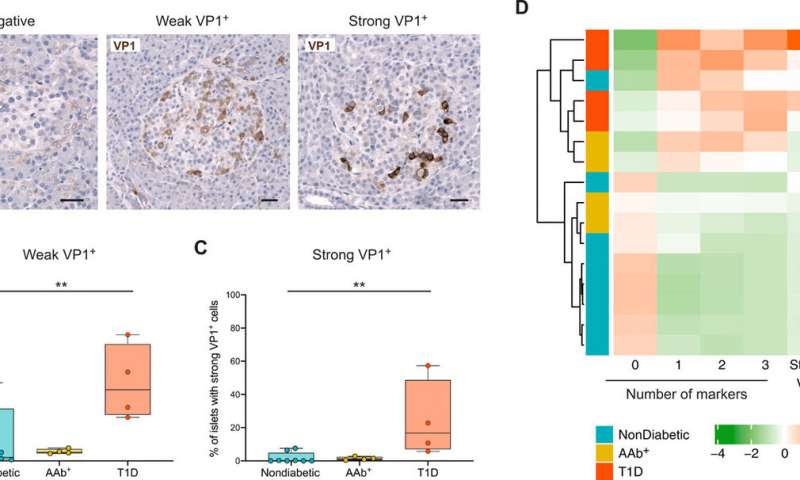
Viral footprints can be found in the islets of T1D donors and are correlated with the expression of IFN response markers. (A) Representative immunohistochemistry images of negative, weak, and strong VP1+ islets. Scale bars, 25 μm. (B and C) Box plots (median, first and third quartile, and range) for the percentage of islets with weak (B) and strong (C) VP1+ cells in each donor group. (D) Heatmap and hierarchical clustering for the percentage of islets expressing none or one, two, or three markers and weak and strong VP1. **P < 0.01. Credit: DOI: 10.1126/sciadv.abd6527
"These interferon sensors were also more abundant in islets that contained a high number of immune cells, suggesting that they induce inflammation," says Dr. Rodriguez Calvo. "We also observed an association of these molecules with a protein from the capsid of enteroviruses, which indicates that they are induced in response to viral infections, as we would expect for interferon responses."
In short, explains Dr. Rodriguez Calvo, "We found in the pancreas of people with type 1 diabetes that several molecules produced in response to interferons have a negative impact in insulin production and they induce inflammation, attracting immune cells with capacity to kill insulin producing beta cells. Our data also suggest that the detection of these molecules in the pancreas is associated to viral infections."
At current, there are no preventive measures to guard against T1D. That's what Dr. Rodriguez Calvo and her team hope to change. "Our study shows the potential importance of interventions that prevent or eliminate viral infections in people at risk of developing type 1 diabetes and also in those that already have the disease. It also supports the use of therapeutic strategies that could diminish interferon-induced inflammation in individuals with type 1 diabetes."
"Our current goal is to further characterize these immune responses and to investigate how they could be controlled. We also want to study how the immune system recognizes viral proteins as well as self-proteins during the course of type 1 diabetes," she explains, "to be able to stop the immune attack to beta cells." That intervention, theoretically, could prevent developing T1D in those who are at risk. Developing such a therapy will require much more work in the lab, but identifying this mechanism of self-destructive immune response and its relationship to T1D and viral infection is a giant leap forward in developing preventive or curative drugs.
Dr. Rodriguez Calvo is grateful to be able to perform this study on human tissues, a step that eliminates some uncertainty between small animal models and human immune response. "This research would not have been possible without the donation of the pancreas by the families of the organ donors, and without the help and support of the Juvenile Diabetes Foundation (JDRF) and the Network for Pancreatic Organ donors with Diabetes (nPOD)."
More information: Paola S. Apaolaza et al. Islet expression of type I interferon response sensors is associated with immune infiltration and viral infection in type 1 diabetes, Science Advances (2021). DOI: 10.1126/sciadv.abd6527
To learn more about nPOD, volunteer with the organization, become a partner, sign the organ donor registry or read additional T1D research results made possible by nPOD's network of donors and labs, visit www.jdrfnpod.org/
A large team of researchers affiliated with a host of institutions across the U.K. has found that most SARS-CoV-2 variants rarely persist through secondary transmissions. In their paper published in the journalScience, the group the RNA sequencing of nearly 1,400 nasal swabs from patients between March and June of last year, and what they found by doing so.
As the global pandemic has progressed, attention has turned to variants of the virus that infect people with COVID-19. A growing fear is that some of the new variants will prove to be immune to the vaccines that are being given to combat the original form of the virus, setting off a whole new pandemic. This new effort was conducted late last year, before most of the new variants had made their way into news headlines. The researchers sought to better understand the danger posed by these SARS-CoV-2 variants. More specifically, they wanted to know more about how frequently they arise and how easily they can spread.
The work by the team involved obtaining 1,313 nasal swabs collected from infected people in the U.K. between March and June of last year—most of whom exhibited symptoms of COVID-19. Each of the samples was then subjected to RNA sequencing to identify variants.
The researchers found that most of the infected people had only one or two variants, most of which were not able to survive transmission to other people. They did find that a few of those infected had variants that could survive transmission, though they found very few instances of them transmitted between households.
The researchers suggest their findings indicate that, at least during early infection, mutations that are able to survive attacks by antibodies are quite rare. That being said, they did find evidence of variants whose mutations gave them a better chance of surviving an immune response. Such mutations, they note, would be more likely to spread as vaccine use becomes more widespread. They suggest that monitoring will have to be stepped up to quickly identify variants that may not be weakened by current vaccines.
More information:Katrina A. Lythgoe et al. SARS-CoV-2 within-host diversity and transmission,Science(2021).DOI: 10.1126/science.abg0821