Search This Blog

Monday, March 22, 2021

Pennsylvania eases mask mandate for vaccinated people

 Pennsylvania has eased its mask mandate to allow people who are fully vaccinated against COVID-19 to gather with other vaccinated people without masks or social distancing, state health officials said Monday.

The new rules also apply to vaccinated people gathering with people from a single household who have not been vaccinated but who are considered at low risk of severe disease from the coronavirus — such as vaccinated grandparents visiting with healthy grandchildren.

Vaccinated people also no longer have to quarantine following an exposure to someone with COVID-19, as long as they do not develop symptoms, state health officials said.

Acting Secretary of Health Alison Beam revised the state’s existing masking order to align with recent guidance from the U.S. Centers for Disease Control and Prevention.

The state said vaccinated people should continue wearing masks and socially distance in public, and when visiting with people in multiple households or with those who are at higher risk of serious illness from COVID-19.

All other aspects of the state’s current masking order remain in force.

Pennsylvania sharpened its mask mandate in November in response to a surge in coronavirus cases. The state required masks indoors wherever people from different households are gathered, including in private homes, though officials relied on voluntary compliance rather than on enforcement.

Pennsylvania had seen sharp decreases in cases, hospitalizations and deaths after a winter peak, but cases have been rising again — from about 2,500 a day two weeks ago to 2,900 a day as of this weekend. The decline in hospitalizations has stalled, state officials said.

The state is approaching 1 million confirmed cases of the coronavirus, and nearly 24,800 deaths have been attributed to COVID-19.

https://whyy.org/articles/pennsylvania-eases-mask-mandate-for-vaccinated-people/

Newly reported coronavirus cases decline in Texas

 The number of newly reported coronavirus virus cases in Texas declined Sunday and the rolling average of cases in the state is down 36.1%.

There were a reported 1,905 new virus cases Sunday, according to the Texas health department, compared to 3,673 new cases on Saturday. The seven-day rolling average of new cases in Texas dropped during the past two weeks from 6,189.7 per day on March 5 to 3,953.1 daily on March 19, according to data from Johns Hopkins University.

The Johns Hopkins data showed 47,346 deaths due to COVID-19, the illness caused by the virus, since the pandemic began, the third highest death toll in the United States.

The seven-day rolling average of deaths in the state, however, has fallen from 247.1 per day on March 5 to 133.1 on March 19, according to the Johns Hopkins data.

https://www.newsobserver.com/news/article250108864.html

Arizona Expands COVID-19 Vaccination Eligibility to All March 24

 Registration at Arizona’s state-operated COVID-19 vaccination sites in Maricopa, Pima and Yuma counties will be open to all Arizonans 16 and older beginning at 8 a.m. Wednesday, March 24, Governor Doug Ducey and the Arizona Department of Health Services announced today.

“Our goal has been and remains to get vaccine into the community as quickly, widely and equitably as possible,” said Governor Ducey. “Given a thorough review of vaccination data, anticipated vaccine supply, and current demand among prioritized groups, now is the time to take this critical next step.” 

As of this morning, Arizona has administered 2,904,159 doses of COVID-19 vaccine to 1,831,456 individuals, including 1,136,413 who are fully vaccinated. As of Monday morning, there were over 58,000 appointments still available from Friday’s release.

The change announced today advances a hybrid approach that had been based on age and also has had counties vaccinating frontline essential workers. It applies to appointments still available for this week at state sites in Maricopa and Pima counties. 

“We anticipate more and more vaccine reaching Arizona heading into April, making it possible now to expand prioritization,” said Dr. Cara Christ, director of the Arizona Department of Health Services. “We have been flexible and nimble throughout, while expanding the availability of state sites to vaccinate large numbers of people rapidly.” 

ADHS now opens appointments at 11 a.m. each Friday for State Farm Stadium in Glendale, Arizona State University’s Phoenix Municipal Stadium in Tempe, Chandler-Gilbert Community College, the University of Arizona in central Tucson, and, as of this Friday, Yuma Civic Center in Yuma County. 

State sites complement county vaccination programs and the growing availability of vaccine at pharmacies and federally qualified health centers participating in federal vaccination programs. Sites using the Pfizer vaccine, including those run by the state, can vaccinate those 16 and older. The Moderna and Johnson & Johnson/Janssen vaccines, which are allocated to counties, are approved for those 18 and older.

Information about all vaccination sites across Arizona can be found at azhealth.gov/findvaccine. Those without computer access or needing extra help registering can call 1-844-542-8201 to be connected with someone who can assist. Note: You can use the patient portal at podvaccine.azdhs.gov to make an appointment for a relative.

To learn more about COVID-19 vaccines and vaccination, please visit azdhs.gov/COVID19Vaccines.

https://content.govdelivery.com/accounts/AZDHS/bulletins/2c8e6fb

Ohioans 16+ can now schedule for COVID-19 vaccine if slots are available

 As Ohio continues to take part in what he has described as a "race" against the coronavirus (COVID-19) pandemic, Ohio Governor Mike DeWine has taken a significant step toward making the COVID-19 vaccine available to everyone in the state.

Speaking in Youngstown, Ohio, on Monday, DeWine revealed that he has authorized providers to distribute the coronavirus vaccine to everyone in the state age 16 and older if the provider still has appointments available. People 16-years-old and older and without qualifying health and professional circumstances were previously eligible to begin receiving the vaccine on Monday, March 29.

“I authorized all of the [local] health departments in the state and any other of the [COVID-19 vaccine] locations  -- we have about 1,300 locations around the state of Ohio -- so we have now authorized them that if they cannot fill slots this week or next week, we authorized them this morning to go ahead and offer them to 16 years of age and older," DeWine said. "If the department has not been able to fill the slot this week, they can go ahead and take anybody 16 years of age and older."


Prior to Monday's announcement, adults 40-years-old and older, as well as those with certain medical conditions and qualifying professions were eligible to schedule appointments to receive the COVID-19 vaccine. DeWine said he will make an official announcement regarding his authorization during a press briefing at 2 p.m. on Monday to discuss the state's response to the COVID-19 pandemic.

DeWine's announcement comes at a time in which he says previously declining COVID-19 trends in the state have plateaued.


https://www.wkyc.com/article/news/health/coronavirus/ohio-gov-mike-dewine-authorizes-covid-19-vaccines-for-16-plus/95-eb2ed26a-5fec-499b-8e6b-57ad51e5f2bb

Nose spray that kills 99.9% of viruses begins production in Israel

A nasal spray that will be marketed as capable of killing 99.9 percent of virus particles has started rolling off production lines in an Israeli factory.

The spray could have prevented much of the world’s COVID-19 infection, its inventor, Dr. Gilly Regev, told The Times of Israel.

“We are hoping that our nasal spray will now save many lives of people in countries that are waiting for the vaccine,” said Regev, an Israeli-raised biochemist who co-founded the company SaNOtize and developed the spray in Canada. “This will be affordable and can be used for prevention, to protect from any respiratory viral infection.”

She said that it has been shown to be effective in the lab against a wide range of viruses, and said that new variants of the coronavirus won’t interfere with its effectiveness, emphasizing: “It contains a broad spectrum antiviral which kills all viruses and all variants.”

Regev called Enovid a “hand sanitizer equivalent for the nose,” and said that it creates a physical barrier in the nasal passages to stop viruses along with a “chemical barrier” of nitric oxide, which is known for its antimicrobial qualities. “The nitric oxide means this is a special spray that doesn’t just block viruses but actually kills them,” she said.

Israel will become the first country where the spray is sold. The Health Ministry has given interim approval for its sale as a medical device suitable for people age 12 and up — meaning it could be used by many who aren’t yet approved for coronavirus vaccines — with packaging stating: “Scientifically tested to kill 99.9% of viruses within 2 minutes.”
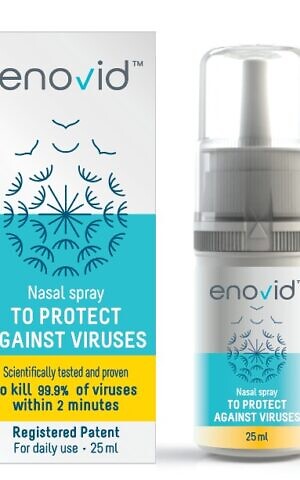
A bottle of Enovid, a new antiviral nose spray that is being produced in Israel (courtesy of SaNOtize)

It has also been approved for sale in New Zealand, and approval is being sought in other countries, including the UK.

Regev said that the factory, in Ness Ziona near Tel Aviv, is working to produce a stock of 200,000 to 500,000 bottles by May. “After this we’re hoping to get to capacity of a million bottles a month,” the Hebrew University graduate said, adding: “I hope this product will bring pride and jobs to Israel.”

The claim on the packaging is based on testing in labs, during which a range of live viruses, including influenza and SARS-CoV-2, were subjected to the spray. She acknowledged that the experiments took place outside the human body, in test tubes, and do not provide definitive proof of how effective the spray will prove in nasal passages — though she said they are very encouraging.

Separate research, which isn’t referenced on the packaging, has suggested that the spray can lessen the impact of COVID-19 among those who are infected.

Last week, SaNOtize and Ashford and St Peter’s Hospitals NHS Foundation Trust in Surrey, UK, announced results of clinical trials indicating that the spray could prevent the transmission of COVID-19, shorten its course, and reduce the severity of symptoms and damage in those already infected. The study has been submitted to a leading medical journal for review and publication.

The spray was fully developed by the time the pandemic struck, as it was invented mainly to fight influenza. Its innovation is the dosing procedure for nitric oxide. “It normally comes in gas cylinders and normally gets delivered to hospitals, but we wanted a practical way to deliver it as a liquid antimicrobial and have spent the last 12 years developing this,” said Regev.

Ingredients of the spray mix together when it is administered to form nitric oxide, she said, noting: “All components are used widely in the food industry and have a very strong safety profile.” Each bottle contains a month’s supply for one person to spray twice a day for protection against viruses.

She said: “Theoretically we could have distributed it a year ago, but we needed to negotiate regulatory approval. That’s the biggest frustration, that we’ve been trying 24/7 for a year to bring it to the market, and it could have saved a lot of lives. I believe it would’ve prevented infections and therefore reduced deaths.”

https://www.timesofisrael.com/life-saving-nose-spray-that-kills-99-9-of-viruses-begins-production-in-israel/

AstraZeneca’s US Vaccine Trial Data

By Derek Lowe

This morning brings news of new trial results of the AZ/Oxford vaccine, with results from the US, Chile, and Peru. This one has been a much more complicated and difficult story than it really should have been – at least, I think that’s how it’s going to look years from now. As you’ll likely remember, the initial trial results (from the trials in the UK, South Africa, and Brazil) were. . .well, they were a mess, and a good part of that mess was the way that they were presented to the world. Later results in a smaller group that had a longer dosing interval cleared things up a bit, but in recent weeks the focus (rightly or wrongly) has shifted from the efficacy numbers to the safety ones.

Now the new trial has shown 79% efficacy against symptomatic disease, and says that the vaccines showed 100% efficacy against severe disease and hospitalization. There’s always room to argue about that latter number, because the number of such cases is not large and the statistical power involved is invariably going to throw up a wide confidence interval on that 100% number. There were over 32,000 participants, with one-third of them in the placebo group. In this case, the press release mentioned 141 total symptomatic cases, and it’s come out this morning that there were 5 severe cases in the 10,000+ placebo group, versus zero in the roughly 21,000-patient treatment group. It’s worth remembering that the 95% confidence interval for the both-doses-completed group in the original trial data was 41% to 75% efficacy, so these new numbers are higher than people were expected based on that. But as mentioned, I would be careful about trumpeting a solid 100% protection in severe disease, for this or for the other vaccine trials – that said, that protection is obviously very strong, and that of course is good news.

What about safety? The review board specifically looked for thrombotic events of all kinds (as well they might after the recent reports from Europe), and saw no vaccine-related signals. But remember, this was about 21,000 people, so you’re not going to pick up something that’s real but happens at a very low level. And that’s where the arguing is, how many such events there have been in the vaccinated population, what different sorts of cardiovascular problems have been seen, whether they are above the levels you would expect to see in a general unvaccinated population, and (finally) just what those background levels really are. The dust is still in the air about all this, but I would not have expected this trial to help resolve these issues, which are down in the per-million-patients level.

If only the original trial data could have been as clear a readout as this one has been! Instead we had questions about overall efficacy, questions about subgroup analysis, about single doses versus two, half-doses versus full, intervals between doses, etc. All that is on AZ and Oxford. Now, they’ve had help muddying things since then, for sure. For example, a German bureaucrat misread the trial data and based on that a newspaper report spread the idea that the vaccine was only 8% effective in patients over 65, which was completely wrong. The latest arguments about safety have not always been conducted at the most honorable level, either, with accusations of nationalism and favoritism flying around. And back out in the world of real data, it appears that the vaccine is significantly less effective against the B.1.351 variant (although to be sure, the other vaccines are also less effective to some degree against it as well).

No, the going never would have been smooth, but it didn’t have to be like this. There will be books about the way vaccines were developed and launched during this pandemic, and there’s enough material for one just on this vaccine in particular. But the latter chapters are still being formed: this vaccine should continue having a big role in knocking down this pandemic around the world. Today’s data give more confidence that it can do so.

https://blogs.sciencemag.org/pipeline/archives/2021/03/22/astrazenecas-us-vaccine-trial-data

Recursion Pharma files for $100M IPO

 Recursion Pharmaceuticals Inc. has filed for an initial public offering, seeking to sell $100 million worth of shares although that figure is often a placeholder used to calculate filing fees. Recursion, based in Salt Lake City, combines lab work with machine learning and engineering. The company reported a net loss of $2.4 million, or $5.99 a share, on revenue of $4 million in 2020, compared with a net loss of $4.30 a share on revenue of $2.3 million in 2019. The company would list shares on the Nasdaq under the symbol RXRX. Underwriters include Goldman Sachs and J.P. Morgan.

https://www.marketwatch.com/story/recursion-pharma-files-for-ipo-2021-03-22