Search This Blog

Monday, March 22, 2021

Vaccine Fight Between EU and U.K. Threatens to Escalate

 A fight between the European Union and the U.K. over vaccine supplies is demonstrating how securing national access to doses can generate conflict among U.S. allies and underlining the vulnerability of successful Covid-19 vaccine rollouts to the breakdown of international supply chains.

Tensions have been rising for months between the EU, where governments have stumbled in their vaccine campaigns, and the U.K., which left the bloc last year. The U.K. has delivered at least one shot of Covid-19 vaccine to more than 40% of its population in one of the world's speediest inoculation rollouts.

This week, senior EU and U.K. officials are in talks to try to prevent a further escalation of a fight over vaccine supplies from a Dutch factory that officials say could quickly develop into mutual bans on exports of vaccines and vaccine supplies between the two sides.

British Prime Minister Boris Johnson called EU leaders including French President Emmanuel Macron and German Chancellor Angela Merkel this weekend and "reiterated the importance of countries not placing export restrictions on vaccines," according to a U.K. spokeswoman.

The Dutch plant is a manufacturing site for the vaccine developed in the U.K. by AstraZeneca PLC and the University of Oxford, from which both the U.K. and EU hoped to source vaccines.

The EU has complained that AstraZeneca has fallen short of its pledges to deliver vaccines to the EU by tens of millions of doses. AstraZeneca says it has made best efforts but has been unable to meet the EU's expectations because of production problems and export curbs.

EU leaders are meeting on Thursday to discuss tightening a vaccine export ban that could be used against the U.K., with some of them facing intense domestic political pressure over their handling of the pandemic. Governments in Germany and France are imposing new economic restrictions to slow rising infections, which faltering vaccine rollouts show no signs of curbing.

European Commission President Ursula von der Leyen heightened tensions last week, singling out the U.K. in warning that the EU could block vaccines to countries that were refusing to export vaccines to the bloc. In recent weeks, London called in EU officials to protest EU claims the U.K. had a vaccine export ban in place. Some EU leaders have also, without evidence, questioned the effectiveness of the U.K.-developed AstraZeneca vaccine.

Since late January, the U.K. has imported around 10 million doses from the EU, mostly of the vaccine developed by Pfizer Inc. and BioNTech SE produced in Belgium and Germany, according to European Commission data. The U.K. has ordered a total of 40 million Pfizer doses. Meanwhile, the U.K. has exported no vaccine to the EU.

The export ban, which EU leaders will discuss Thursday, permits member states to block vaccine exports with the support of the European Commission, the EU's executive body. It has only been used once since its introduction in late January.

EU diplomats have said that failing an agreement, leaders are expected to agree to effectively ban AstraZeneca exports to the U.K. on Thursday. The fear among officials on both sides is that could push Britain to retaliate by restricting vaccine ingredient supplies vital to European production, which in turn could put at risk Pfizer exports to the U.K.

EU diplomats say that some governments, including Italy, are already pushing for the bloc to stop Pfizer vaccine exports to the U.K. and officials on both sides have said the EU has so far given no guarantees that further Pfizer exports will be permitted.

The Dutch site, operated by Halix BV, is a small piece of AstraZeneca's global supply chain which has been sitting on a growing stockpile of vaccine products since January, people familiar with discussions say. The company would give no figures on the amount.

Both sides claim they have a contract that commits the factory to supply them with that vaccine and the talks this week are over whether they can find a formula to share Halix's vaccines to allow them to be delivered to "fill and finish" sites in the U.K. and the EU.

The Halix site was primarily used to produce vaccines for clinical trials before moving into manufacturing for mass rollouts, AstraZeneca executives said Monday. The factory doesn't yet have approval from the European Medicines Agency to send vaccines elsewhere in the EU. AstraZeneca said Monday it expects to get that approval in coming weeks.

Vaccine manufacturers are relying on complex supply networks during a time of fierce competition for raw ingredients, packaging and other components that has led to shortages and bottlenecks.

Raw vaccine substance in some cases is manufactured in one country and shipped to another for packing into vials even before it is sent to yet another country for use. Any hiccup along the way can impede the process, slowing production and deliveries and costing lives.

The EU has already entered discussions with the U.S. aimed at preventing any interruption to the others' vaccine supply chains. EU officials have signaled they wouldn't block exports to the U.S. even though the bloc has exported around a million doses across the Atlantic without receiving vaccines back.

"We are highly dependent on our global supply network," AstraZeneca's Ruud Dobber told reporters in a briefing Monday about the results of large-scale U.S. human trials of the vaccine.

https://www.marketscreener.com/news/latest/Vaccine-Fight-Between-EU-and-U-K-Threatens-to-Escalate--32757633/

Hormone drugs may disarm COVID-19 spike protein and stop disease progression

 Hormone drugs that reduce androgen levels may help disarm the coronavirus spike protein used to infect cells and stop the progression of severe COVID-19 disease, suggests a new preclinical study from researchers in the Abramson Cancer Center at the University of Pennsylvania and published online in Cell Press's iScience.

Researchers show how two receptors—known as ACE2 and TMPRSS2—are regulated by the androgen hormone and used by SARS-CoV-2 to gain entry into host cells. Blocking the receptors with the clinically proven inhibitor Camostat and other anti-androgen therapies prevented viral entry and replication, they also showed in lab studies.

The findings provide more insight into the molecular mechanisms of the virus but also support the use of anti-androgen therapies to treat COVID-19 infections, which are currently being investigated in  and have produced promising results. They also support data showing increased mortality and severity of disease among men compared to women, who have much lower levels of androgen.

"We provide the first evidence that not only TMPRSS2, which is known to be regulated by androgen, but ACE2 can also be directly regulated by this hormone," said senior author Irfan A. Asangani, Ph.D., an assistant professor of Cancer Biology in the Perelman School of Medicine at the University of Pennsylvania. "We also show that the SARS-CoV-2 spike relies on these two receptors to impale and enter cells, and that they can be blocked with existing drugs. That's important because if you stop viral entry, you reduce the viral load and disease progression."

Camostat is a drug approved for use in Japan to treat pancreatitis that inhibits TMPRSS2. Other anti-androgen therapies, including androgen deprivation  used to treat prostate cancer, serve similar functions.

Driven by the disparity in COVID-19 rates between men and women, the cancer researchers sought to better understand the role androgen and its receptors played in infections, which has long been known to be a driver of prostate cancer.

The researchers performed experiments with a pseudotype SARS-CoV-2, which carries the spike proteins of the virus but not its genome.

In mice with significantly reduced  and cells treated with anti-androgen treatments, the researchers found little to no expression of TMPRSS2 and ACE2, suggesting both are regulated by the hormone. They also observed how inhibiting TMPRSS2 with Camostat blocked priming of the spike for entry into cells. That drug, as well as enzalutamide, an anti-androgen therapy used to treat , also blocked the virus' entry into lung and prostate cells. Combining these therapies, they found, significantly reduced virus entry into .

"Together, our data provide a strong rationale for clinical evaluations of TMPRSS2 inhibitors, androgen-deprivation therapy / androgen receptor antagonists alone or in combination with  as early as clinically possible to prevent COVID-19 progression," the authors wrote.

In March, researchers from Brazil reported preliminary results of 600 hospitalized patients in a clinical trial investigating proxalutamide, a new anti-androgen therapy, for the treatment of COVID-19. The drug reduced mortality risk by 92 percent and shortened the median hospital stay by nine days versus the standard of care, the researchers reported.

Next, Asangani and his colleagues will partner with Susan R. Weiss, Ph.D., a professor of Microbiology and co-director of the Penn Center for Research on Coronaviruses and Other Emerging Pathogens, to investigate the findings further using live SARS-CoV-2, as well as anti- therapies' ability to block different variants of the virus, which continue to emerge and are often differentiated by their spike proteins.


Explore further

Prostate cancer regulator plays role in COVID-19, providing a promising treatment lead

More information: Qu Deng et al. Targeting androgen regulation of TMPRSS2 and ACE2 as a therapeutic strategy to combat COVID-19, iScience (2021). DOI: 10.1016/j.isci.2021.102254
https://phys.org/news/2021-03-hormone-drugs-covid-spike-protein.html

COVID-19-related cyberattacks leveraged government announcements

 COVID-19-related cyber-attacks leveraged government announcements

Credit: University of Warwick

There has been a remarkable surge in cyber-security crime experienced during the global COVID-19 pandemic, with a particular significance between governmental policy announcements and cyber-crime campaigns. A consortium of researchers, including WMG, University of Warwick report that some days as many as 3 to 4 new cyber-attacks were being reported.

The COVID-19 pandemic created a new normal for billions of people around the world, with people working from home, ordering shopping and socializing online as shops and businesses were closed. However, with an increased amount of people being online, an increase in cyber-attacks has also been found.

Researchers from WMG, University of Warwick, Abertay University, University of Kent, University of Oxford and University of Strathclyde worked in collaboration in the study, "Cyber Security in the Age of COVID-19: A Timeline and Analysis of Cyber-Crime and Cyber-Attacks during the Pandemic," published in the journal Computers & Security.

By using the UK as a , the paper reveals the explicit connection between governmental policy announcements and cyber-crime campaigns. Although this is a pattern that's been suspected for a while, this is the first analysis from 100s of cases around the world which makes this connection clear.

Since the outbreak of the pandemic in 2019 there have been reports of scams impersonating public authorities such as the World Health Organisation, and organizations such as supermarkets and airlines targeting support platforms such as PPE and offering COVID-19 cures. They often target the public, who are now socializing and spending more time online in general, as well as the increased population of people who are working from home.

Such scams can be sent by text or e-mail, and in most cases a URL pointed to a fake institutional website which requests debit/credit card details.

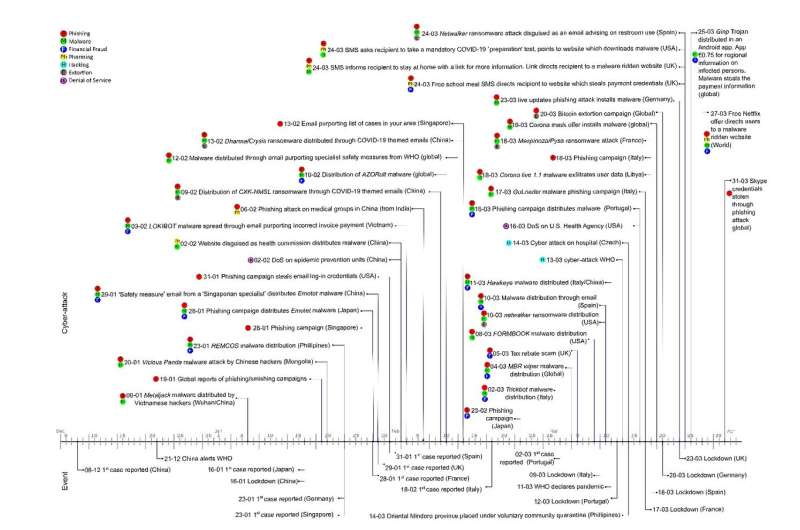
In order to support ongoing research, the researchers have proposed a novel timeline of 43 cyber-attacks related to the COVID-19 pandemic. This timeline and the subsequent analysis can assist in understanding those attacks and how they are crafted, and as a result, to better prepare to confront them if ever seen again.

They found that from the point that the first case was announced in China (8/12/19) the first reported cyber-attack was 14 days later. From this point onwards the timeframe between events and cyber-attacks reduced dramatically.

The cyber –attacks were categorised, and it was found:

  • 86% involved phishing and/or smishing
  • 65% involved malware,
  • 34% involved financial fraud
  • 15% involved extortion
  • 13% involved pharming
  • 5% involved hacking
  • 5% involved denial of service

Dr. Harjinder Lallie, from WMG, University of Warwick said, "The analysis presented in this paper has highlighted a common modus-operandi of many cyber-attacks during the coronavirus period.

"Many of the cyber-attacks begin with a phishing campaign which directs victims to download a file or access a URL. The file or the URL act as the carrier of malware which, when installed, acts as the vehicle for financial fraud. The analysis has also shown that to increase the likelihood of success, the phishing campaign leverages media and governmental announcements. In fact some days we recorded as many as 3-4 new scams."

Dr. Xavier Bellekens from the University of Strathclyde, said: "Over the last year we have seen a surge in cyber-attacks targeting critical infrastructures, governments, organizations and end-users, influenced by governmental announcements. These have ranged from targeted attacks to selling counterfeited respirators to hospitals, denying of essential services through ransomware, selling fake online COVID-19 testing equipment as well as more recently, generating fake COVID travel tests. "These techniques, while common, had never been observed in relation to an event of this magnitude, making this study unique."

Dr. Lynsay Shepherd of Abertay's Division of Cybersecurity said, "Cybercrime is a highly sophisticated and organized activity and it did not come as a surprise to anyone in the cybersecurity industry that these individuals and groups used the COVID-19 pandemic as a vehicle to launch attacks.

"It is unlikely there will ever be a time when we can eradicate cybercrime. Therefore we must continue to educate everyone from as early a stage as possible, train our graduates to understand the mindset of cybercriminals as we do at Abertay, and to continue to invest in research, development, innovation and infrastructure."

Dr. Jason Nurse from the Institute of Cyber Security for Society (iCSS) at the University of Kent said, "COVID-19 has had a substantial negative impact on society, and this impact, as we show in our new research, has also meant a notable increase in cybercrime globally.

"There are several significant novel findings emerging from our analysis, but the one I found most salient was the targeted use of threats, scare tactics and fake incentives within attacks. Cybercriminals clearly understood that many people would be anxious, worried, distracted and away from their support networks (personal or work-related), and sought to exploit this as much as possible. I hope our research can provide a pathway for future work into faster reaction to these cyberattacks, and also increase society's awareness of their prevalence."

Dr. Arnau Erola, from the Department of Computer Science at the University of Oxford adds:

"Cybercriminals take any opportunity to their advantage. By getting insights on their modus operandi, polices to tackle cybercrime can become more effective. This is not only deterring cybercriminals from their unlawful activities but also educating the society about improper and unethical actions."


Explore further

Home working to boost cyber-attack insurance: Munich Re

More information: Harjinder Singh Lallie et al. Cyber Security in the Age of COVID-19: A Timeline and Analysis of Cyber-Crime and Cyber-Attacks during the Pandemic, Computers & Security (2021). DOI: 10.1016/j.cose.2021.102248
https://techxplore.com/news/2021-03-covid-related-cyberattacks-leveraged.html

Existing vaccines may protect against the Brazilian coronavirus variant

 Scientists at the University of Oxford have released pre-print data measuring the level of antibodies that can neutralize—or stop infection from—variants that are circulating in South Africa, Brazil and elsewhere.

These data suggest that natural- and -induced antibodies can still neutralize these variants, but at lower levels. Importantly, the P1 "Brazilian' strain may be less resistant to these antibodies than first feared.

Professor Gavin Screaton, lead scientist on the study, said:

"This study extends our understanding the role of changes in the spike protein in escape from the human immune response, measured as neutralizing antibody levels. The results suggest that P1 might be less resistant to vaccine and convalescent immune responses than B1351, and similar to B117."

In the pre-print publication, available on bioRxiv, the authors report on the neutralization of these strains when using  from both people who have natural antibodies generated from a COVID-19 infection and from those with antibodies generated from the ChAdOx1 nCoV-19 Oxford-AstraZeneca and BNT162b2 Pfizer-BioNTech vaccines.

These data show a nearly three-fold reduction in the level of virus neutralization by the antibodies generated by the ChAdOx1 nCoV-19 and BNT162b2 vaccines for the B.1.1.7 (Kent) and P.1 (Brazil) variants when compared to the original "Victoria' strain, and a 9-fold and 7.6-fold reduction respectively against the B.1.351 "South Africa' strain

Professor Andrew Pollard, Chief Investigation on the Oxford University vaccine trial, said: "These further efforts to investigate the relationship between changes in the virus and human immunity provide new insights that help us be prepared to respond to further challenges to our health from the pandemic virus, if we need to do so."

The authors comment that as P.1 and B.1.351 contain very similar changes in the receptor binding domain, it was assumed that the neutralizing  would be similarly affected, meaning that vaccination will likely still provide some protection against P.1. They believe that the drop in vaccine efficacy against mild to moderate disease against B.1.351 is likely a reflection of the mutations occurring outside the receptor binding domain.

They further highlight that given the large reductions in neutralization tires, developing vaccine constructs to B.1.351 should be the greatest priority for vaccine developers globally.


Explore further

Vaccine-induced antibodies may be less effective against several new SARS-CoV-2 variants: study

More information: Wanwisa - Dejnirattisai et al. Antibody evasion by the Brazilian P.1 strain of SARS-CoV-2, bioRxiv (2021). DOI: 10.1101/2021.03.12.435194
https://medicalxpress.com/news/2021-03-vaccines-brazilian-coronavirus-variant.html

Evidence mounting that COVID-19 can cause diabetes type II

 A team of researchers from King's College London and Monash University has created a database of information that relates COVID-19 and type II diabetes. The team has created the database for two reasons—the first is that research to date has shown people with type II diabetes are more likely to suffer severe symptoms of the disease and to die from it than the general populace. The second is because of mounting evidence suggesting that COVID-19 could actually cause people to become diabetic.

The new database is called the COVIDIAB registry and has been specifically designed to help  better understand the link between COVID-19 and diabetes. The data was collected from  regarding their circumstances, including whether they were new-onset. The developers suggest the amount of  will grow as more is learned about the impact of COVID-19 on . Some  have reported that the database already catalogs information provided by 350 clinicians.

It is still not clear why people with diabetes suffer more when infected with COVID-19 or why some suffer more than others. Also unclear is whether COVID-19 can cause diabetes. Since the onset of the pandemic, doctors have been reporting patients developing diabetes soon after contracting COVID-19. The researchers hope that establishment of the database will help to discover whether COVID-19 complications can lead to the onset of diabetes. Doctors need to know if such patients were going to develop diabetes anyway, if they were prediabetic and COVID-19 set it off, or if it is possible for people with no inclination to becoming diabetic to develop the disease soon after developing COVID-19.

Notably, some medical researchers have reported to the press that there are two possible ways that COVID-19 could cause a person to develop diabetes type II. The first is from an attack on the pancreas, reducing its ability to produce and regulate insulin levels. The second could come about as COVID-19 induces an inflammatory reaction in the body impacting blood sugar regulation due to the release of stress hormones. They have also noted that it is possible that some patients may have developed  after being given steroids to treat their COVID-19.

More information: covidiab.e-dendrite.com/index.html

https://medicalxpress.com/news/2021-03-evidence-mounting-covid-diabetes-ii.html

Antibody injections could become more affordable with new production method

 Antibody injections are a highly desirable treatment for people with chronic diseases such as cancer, psoriasis, Crohn's disease and arthritis. And recently, antibodies have been in the news as a promising treatment for severe cases of COVID-19.

But the costly, time-consuming manufacturing process to produce antibodies prevents these treatments from being accessible to most patients.

Andrew Zydney, Bayard D. Kunkle Chair and professor of chemical engineering at Penn State, has identified a new method to manufacture antibodies, which could drive down the production cost. His research results were recently published in Biotechnology Progress.

"If you look at the top 10 best-selling medications, by annual sales, eight are in the category of monoclonal antibodies," Zydney said. "And every year, individuals and insurance companies spend upwards of $100 billion on antibodies, with costs to treat a single patient often exceeding $50,000. There remains a huge unmet need for these products in treating a growing range of diseases."

Known as precipitation, Zydney's new protein purification process involves adding zinc chloride and polyethylene glycol, a water-soluble polymer, to a solution containing the antibody. This causes the antibody to precipitate so that the impurities can be washed away.

Though the precipitation process has been used for 70 years in blood plasma processing, it has never been used for the commercial production of antibodies, according to Zydney.

"To precipitate means 'to come out' of a solution in a solid form," he said. "For example, when you put salt in warm water, it dissolves. But if you put a lot of salt into cold water, some of that salt will remain as solid crystals. In the same way, proteins would normally dissolve in a solution, but you can find certain conditions where they come out as solid."

Zydney explained that the zinc chloride used in precipitation is a simple salt, making it much cheaper than other purification methods. It also saves time, as it is possible to yield large quantities of proteins in short periods of time.

Currently, antibodies are produced using a process called Protein A affinity chromatography, where the antibody binds to Protein A, which is immobilized in a chromatography column. The impurities can be washed away from the bound antibody, after which the pH level is adjusted to recover the purified antibody product. A single Protein A chromatography column can cost more than $10 million.

"That is just one step in the current manufacturing process, and it is what makes antibody manufacturing so expensive," Zydney said. "All of the major biotechnology companies are big players in this space."

The precipitation process eliminates the need for the costly chromatography process, as antibodies are purified directly from the solution by filtration through hollow fiber membranes.

"What we do in our research group is relatively small scale," He said. "But the precipitation process has the potential to be easily scaled up, potentially enabling biopharmaceutical companies to produce lower-cost antibodies for the patients who need them."

https://www.eurekalert.org/pub_releases/2021-03/ps-aic032221.php

Inflammatory bowel disease biologic blunts immune response to COVID-19

 Careful monitoring of patients treated with infliximab needed after COVID jab

Infliximab, a powerful biologic that is used to treat inflammatory bowel disease (IBD), blunts the body's immune response to COVID-19 infection, indicates research published online in the journal Gut.

This impaired response may boost susceptibility to recurrent COVID-19 and help drive the evolution of new variants of SARS-CoV-2, the virus responsible for the infection, warn the researchers.

Careful monitoring of IBD patients treated with infliximab will be needed after vaccination against COVD-19 to ensure they mount a strong enough antibody response to ward off the infection, they advise.

Infliximab belongs to a class of medicines called anti-tumour necrosis factor (anti-TNF) drugs. These drugs suppress the production of an inflammatory protein involved in the development of several conditions, including ulcerative colitis and Crohn's disease which are types of inflammatory bowel disease.

Around 2 million people worldwide are treated with anti-TNF drugs, which are known to impair protective immunity following vaccination against pneumonia, flu, and viral hepatitis, as well as increasing the risk of serious infection, particularly respiratory infections.

Because of these risks, patients taking these drugs have been advised to shield during the coronavirus pandemic and/or take extra precautions to minimise their risk of catching COVID-19.

With these issues in mind, the researchers wanted to find out if anti-TNF drugs might blunt the body's immune response to SARS-CoV-2 as well. They therefore compared the antibody responses to SARS-CoV-2 in IBD patients treated with infliximab or another biologic called vedolizumab.

Vedolizumab is a gut monoclonal antibody that has a dosing schedule similar to that of infliximab. But it isn't associated with increased susceptibility to systemic infection or blunted immune responses to vaccination.

In all, 6935 IBD patients (average age 39) were recruited from 92 UK hospitals between September and December 2020 for the CLARITY IBD study: around two thirds (4685) of them were being treated with infliximab and around a third (2250) with vedolizumab.

Nearly 40% (2589 out of 6935) had been swab (PRC) tested for SARS-CoV-2. And rates of symptomatic and confirmed SARS CoV-2 infection were similar in both treatment groups.

Some 389 (8%) of the infliximab group and 201(9%) of the vedolizumab group had symptoms indicative of COVID-19 infection; 89 out of 1712 of those taking infliximab tested positive for the virus (just over 5%) as did 38 out of 877 (just over 4%) of those taking vedolizumab.

But fewer patients treated with infliximab had detectable antibodies to the virus in their blood than those treated with vedolizumab: 3.4% (161/4685) vs 6% (134/2250).

And only around half (48%; 39/81) of the patients treated with infliximab whose COVID-19 infection was confirmed by a swab test subsequently developed antibodies compared to 83% (30/36) of those treated with vedolizumab.

And the addition of other commonly used drugs to dampen down the inflammatory response, such as thiopurine or methotrexate, further blunted the antibody response to SARS-CoV-2 in patients treated with infliximab, only a third of whom had detectable antibodies to SARS-CoV-2.

An increase in antibodies to SARS-CoV-2 was observed 4 weeks after a positive swab test in patients taking vedolizumab, but not in those treated with infliximab.

"Similar rates of symptomatic and proven SARS-CoV-2 infection and hospitalisations between infliximab-treated and vedolizumab-treated patients suggest that our findings cannot be explained by differences in acquisition or severity of infection alone. Rather, infliximab seems to be directly influencing the serological response to infection," explain the researchers.

"Infliximab may directly impede the immune mechanisms responsible for generating antibody responses," they suggest.

This is an observational study, and so can't establish cause. And the researchers acknowledge certain limitations to their study, including that weakened immune responses in patients treated with infliximab don't automatically translate into a heightened risk of infection.

Protective immunity after vaccination involves more than just antibodies. And the only anti-TNF drug studied was infliximab.

Nevertheless, they suggest that a weakened antibody response has potentially far reaching implications.

It may increase susceptibility to recurrent COVID-19 in patients treated with infliximab, which might then lead to chronic colonisation of the virus in the nose and throat. This "may act as a reservoir to drive persistent transmission and the evolution of new SARS-CoV-2 variants," they warn.

And they conclude: "Serological testing and virus surveillance should be considered to detect suboptimal vaccine responses, persistent infection, and viral evolution to inform public health policy.

"If attenuated serological responses following vaccination are also observed, then modified immunisation strategies will need to be designed for millions of patients worldwide."

https://www.eurekalert.org/pub_releases/2021-03/b-ibd031821.php