Search This Blog

Saturday, May 15, 2021

Heart study: Low- and regular-dose aspirin safe, effective

 An unusual study that had thousands of heart disease patients enroll themselves and track their health online as they took low- or regular-strength aspirin concludes that both doses seem equally safe and effective for preventing additional heart problems and strokes.

But there’s a big caveat: People had such a strong preference for the lower dose that it’s unclear if the results can establish that the treatments are truly equivalent, some independent experts said. Half who were told to take the higher dose took the lower one instead or quit using aspirin altogether.

“Patients basically decided for themselves” what they wanted to take because they bought the aspirin on their own, said Dr. Salim Virani, a cardiologist at Baylor College of Medicine in Houston who had no role in the study.

Still, the results show there’s little reason to take the higher dose, 325 milligrams, which many doctors assumed would work better than 81-milligram “baby aspirin,” he said.

Results were published Saturday by the New England Journal of Medicine and discussed at an American College of Cardiology conference.

Aspirin helps prevent blood clots, but it’s not recommended for healthy people who have not yet developed heart disease because it carries a risk of bleeding. Its benefits are clear, though, for folks who already have had a heart attack, bypass surgery or clogged arteries requiring a stent.

But the best dose isn’t known, and the study aimed to compare them in a real-world setting. It was the first experiment funded by the Patient-Centered Outcomes Research Institute, created under the 2010 Patient Protection and Affordable Care Act to help patients make informed decisions about health care.

About 15,000 people received invitations to join through the mail, email or a phone call and enrolled on a website where they returned every three to six months for follow-up. A network of participating health centers supplied medical information on participants from their electronic records and insurance claims.

The participants were randomly assigned to take low- or regular-dose aspirin, which they bought over the counter. Nearly all were taking aspirin before the study began and 85% were already on a low dose, so “it was an uphill task right from the get-go” to get people to use the dose they were told, Virani said.

After roughly two years, about 7% of each group had died or been hospitalized for a heart attack or a stroke. Safety results also were similar — less than 1% had major bleeding requiring hospitalization and a transfusion.

Nearly 41% of those assigned to take the higher dose switched at some point to the lower one, and that high rate “could have obscured a true difference” in safety or effectiveness, Colin Baigent, a medical scientist at the University of Oxford in the United Kingdom, wrote in a commentary in the medical journal.

One study leader, Dr. Schuyler Jones of Duke University, said the study still provides valuable guidance. If patients are taking low-dose aspirin now, “staying on that dose instead of switching is the right choice,” he said. People doing well on 325 milligrams now may want to continue on that and should talk with their doctors if they have any concerns.

For new patients, “in general, we’re going to recommend starting the low dose,” Jones said.

Virani said people must remember that aspirin is a medicine and that even though it’s sold over the counter, patients shouldn’t make decisions on its use by themselves.

“Don’t change the dose or stop without talking to someone,” he warned. “This is important, especially for a therapy like aspirin.”

https://apnews.com/article/science-health-9460cd0ec2247565d8932a2a1c275af9

5 questions about the New York Yankees’ breakthrough Covid-19 infections

 Eight members of the New York Yankees organization who were fully vaccinated against Covid-19 tested positive for the coronavirus this week. And that news has led to a lot of people saying, wait, what?

Below, STAT outlines what we know about the cases and some of the factors that might have contributed to the cluster.

What do we know so far?

On Sunday, third base coach Phil Nevin reported feeling some symptoms and tested positive for Covid-19. (He had recovered as of Thursday, General Manager Brian Cashman said.)

The team quarantined people who’d had close contact with Nevin and expanded its testing program, which turned up another seven asymptomatic cases by Thursday, when shortstop Gleyber Torres became the eighth person — and first player (the other seven were coaches and support staff) — to test positive.

All eight people had received the Johnson & Johnson Covid-19 vaccine and were considered fully vaccinated.

What does this mean about breakthrough infections and vaccines?

The Covid-19 vaccines have been shown to be overall highly effective at preventing illness, and even more so at staving off the worst outcomes, like serious disease and death. But even the best vaccines can’t block all infections, and those that still occur after immunization are called breakthroughs.

The clinical trials that led to the authorization of the different Covid-19 vaccines generally measured how effective they were at preventing symptomatic cases, and in its trial, the one-dose J&J shot proved to be 66% efficacious at blocking moderate and severe Covid-19. And while studies have shown the vaccines also prevent asymptomatic infections in many cases, researchers don’t have firm conclusions at just how effectively they do so. The assumption is that many asymptomatic cases go unreported in the absence of broad and frequent testing.

Which brings us to the Yankees. Eight breakthrough infections seem like a lot, and something odd could be at play here. But it’s notable that only Nevin had some symptoms. It’s possible that at least some, if not all, of the other seven other infections would have been missed if they didn’t occur on a team that’s undergoing regular testing.

And while it can’t be known for sure, it’s possible that without vaccines, this cluster could have been worse, both in terms of the number of infections and how sick certain people got. The Yankees travel with some 50 people.

Overall, the Centers for Disease Control and Prevention has received reports of 9,245 breakthrough cases, a tiny fraction of which resulted in hospitalization or death. More than 118 million people in the United States have been fully vaccinated. The low number of breakthrough infections has been touted as a testament to the power of vaccines, which are providing both protection for individuals and helping drive down transmission.

But experts also point out two caveats with the number of breakthrough infections. For one, some large number of the people who’ve been fully vaccinated haven’t since been exposed to the coronavirus, so it’s not known how many infections there would have been without that vaccine coverage. The tally of breakthroughs is also certainly an undercount because many asymptomatic cases go undetected — unless, of course, they occur in a setting with widespread and frequent testing, like on a professional sports team.

Two extra points: Starting Friday, the CDC will only report breakthrough infections that lead to hospitalization or death because those have the “greatest clinical and public health importance.” The Yankees cases, of course, didn’t rise to that level.

And Torres, the shortstop, had Covid-19 last year, indicating that his case is both a breakthrough infection and a reinfection. Scientists think reinfections remain rare, though given that second infections are generally thought to be mild or asymptomatic (akin to breakthrough infections), experts similarly don’t have great estimates for how often they occur. But considering Torres was asymptomatic, his case fit with what experts expect from most reinfections.

How did this happen?

The team has said it’s conducting contact tracing, and officials from both the New York state health department and CDC are in touch with the team. So far, it’s not clear how this transmission occurred.

Two of the most pressing questions we can think of:

Where did the spread initiate?

Essentially, was this a superspreading event during which someone — likely an unvaccinated person — passed the virus to the eight people? That is one probable explanation. The SARS-CoV-2 coronavirus is particularly adept at transmitting in crowded, indoor settings, so perhaps someone who was shedding lots of virus came into contact with the team, and that’s how this outbreak occurred. The Yankees have surpassed the threshold of 85% players and personnel vaccinated that allowed them under league and union rules to relax some distancing and masking requirements.

It’s also possible that some of the transmission occurred among the eight people who’ve tested positive, though that would seem to be a rarer event. Even if a vaccinated person contracts the coronavirus, it seems they’re generally less infectious to others than an unvaccinated person with Covid-19 — especially if they’re asymptomatic. That might be because the vaccine reduces the amount of virus these people can shed, and also shrinks the window during which they’re contagious.

Was there a variant involved?

Certain coronavirus variants — most notably B.1.351, which first emerged in South Africa but has circulated at low levels in the United States — cause breakthrough infections at higher rates than other forms of the pathogen. The vaccines still prevent many cases, and retain their overall protection against severe illness and death. But the shots do seem to lose some of their potency in staving off mild or asymptomatic infections, and may not be as powerful at preventing people who have breakthrough infections from passing on the virus.

Major League Baseball is working with a Salt Lake City lab for its testing and sequencing efforts, so we could eventually get more information about this question. The sequencing data could also provide insights into whether the eight people were infected during the same event or independently of each other.

Does this mean the CDC was shortsighted in its recommendation Thursday that fully vaccinated people don’t have to wear masks in most settings?

Depending on the type of mask, face coverings have generally been more about protecting others than yourselves, meaning they’re more of a tool to stop you from spewing virus out into the world than blocking virus headed your way.

There was also some nuance in the CDC’s updated recommendations. The data indicate that the chances of an asymptomatically infected person who’s been vaccinated spreading the virus are extremely low. But CDC Director Rochelle Walensky noted Thursday that if someone starts feeling sick, they should start wearing a mask again and get tested.

Still, critics of the CDC decision could point to the Yankees cluster as a sign that prudence is merited. While many experts celebrated the CDC announcement, others argued that the agency was premature or that it should have tied the guidance to hitting thresholds like a further reduction in new cases per capita or reaching a certain level of vaccination coverage. (Given the variability of infection and vaccination rates around the country, some places have achieved these milestones.) The concern is that with transmission still at the rate it is, and with vaccination rates as low as they still are, people who are unvaccinated or who haven’t mounted a strong immune response to vaccines (like some people with cancer are experiencing) will be more vulnerable to contracting the coronavirus than if the CDC had just waited a few more weeks.

Was this a fluke?

Not every member of the Yankees organization who tested positive this week was vaccinated at the same time, so the outbreak can’t be attributed to one bad batch of vaccine or an error in keeping the shots at the proper temperature. Still, in a pandemic in which hundreds of millions of people have been infected and amid a global vaccine campaign, there are going to be some weird outlier situations. Simply put, perhaps something bizarre happened with the Yankees.

It underscores how important it is to avoid drawing conclusions from one case involving fewer than a dozen people. The clinical trials that established the vaccines’ efficacy involved tens of thousands of people, and real-world data that have backed up what the clinical trials concluded: the vaccines are immensely powerful against Covid-19. 

https://www.statnews.com/2021/05/14/5-questions-new-york-yankees-covid-19-infections/

Restaurateurs Begin To Automate Amid Labor Shortage

 Restaurant owners are blaming generous unemployment benefits for the current labor shortage. Ahead of the busy summer season, some restaurateurs are warning they might have no other choice but to use robots. 

According to Andrew Gruel, founder and CEO of Slapfish seafood, with 11 locations in the Southwestern US and new ones quickly opening up across the country, if the labor shortage persists, significant changes to the restaurant industry are coming in the form of automation.

"What I fear in terms of the long-term effects of this is that we start to automate and robotize our industry," Gruel told Fox News. "That's the only option if a lot of these businesses are going to continue to try and survive, especially when there's a lack of labor or if the cost of labor is so high that it's prohibitive for anybody to grow."

"It's is a really, really tough and tight labor market," said Gruel. "I've talked to restaurants who are not even opening because they don't have the staff to be able to hit a certain amount of hours."

Slapfish is so desperate for workers that it's offering dishwashers with no experience for $20-$25 per hour. The chain is even offering $500 signing bonuses. 

"We've had to alter our operations. We're limiting hours. My wife, myself, my kids we're in 12, 14, 16 hours a day," he said. "That's really what it's come down to. It's a lot of owner-operators stepping in, scaling back on growth, and getting down in the weeds themselves."

Gruel believes one primary reason for the labor shortage is President Biden's unemployment benefits that disincentivize people to work because they make more money collecting stimulus checks.

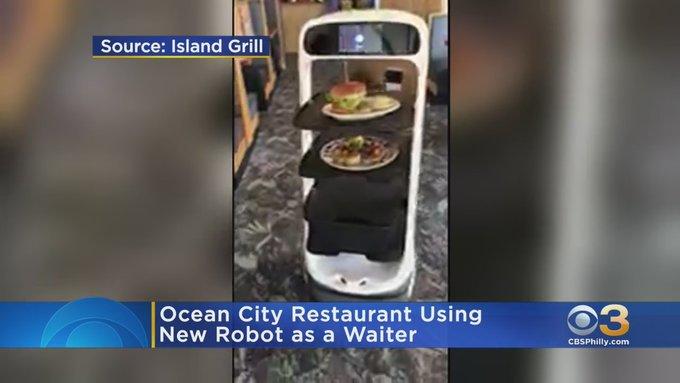
In one Jersey Shore restaurant, called Island Grill, the labor shortage is getting so ridiculous that they have already turned to robotic servers. 

"Once we realized that we may not have any servers this summer, we were like, 'Well, we may need to look into this a little more,'" Island Grill owner Andrew Yoa told News12

 Yoa said his restaurant is currently leasing the robot, known as "Little Peanut." The robot serves as a food runner and busboy to support server staff.

"It's basically extra arms for them so that they could be getting a drink order for someone and the meals for another table could be coming out or an appetizer could be coming out," he said. "It can do multiple stops so it can stop at one station, drop off an appetizer and go to drop someone's meal off."

A full-blown labor shortage is underway thanks to trillions in Biden stimulus are now incentivizing potential workers not to seek gainful employment, but to sit back and collect the next stimmy check for doing absolutely nothing in what is becoming the world's greatest "under the radar" experiment in Universal Basic Income.

The National Owners Association (NOA), an independent, self-funded advocacy group of McDonald's franchisees, warned earlier this week that an "inflationary time bomb" is being triggered by labor shortages. 

NOA went on to warn that higher wages, signing bonuses, and paid interviews are no longer working as fast-food workers sit at home collecting stimulus checks. 

NOA said franchisees must increase pay and benefits to attract workers. These additional labor costs will be passed onto the consumer in the form of higher Big Mac prices. 

The Federal Reserve's narrative that inflation is "transitory" is a load of crap. Prepare for much higher costs at fast-food joints. 

Bank of America recently warned clients: "Buckle up! Inflation is here." 

As for now, technological unemployment is set to soar as workers are sidelined, showered by free money from the federal government that disincentivizes them from working. By the end of this decade, hundreds of thousands, if not millions, of fast-food workers will be displaced by automation and artificial intelligence. Now is the time to boost automation, get these workers out of crappy jobs and retrain them for the new economy. Or, in Biden's world, keep these people at home on UBI.

https://www.zerohedge.com/technology/restaurateurs-begin-automate-amid-labor-shortage

Retailers scramble in wake of CDC’s ‘confusing’ new mask policy

 Welcome to “maskageddon.”

The CDC’s new mask policy — allowing vaccinated people to largely ditch their masks — is putting retailers in a tough spot.

Labor unions are now demanding large retail chains go against the CDC’s advice and continue to insist all customers wear masks to protect employees.

But retailers say they don’t want to act as the mask police, a practice that resulted in violent altercations even when the CDC recommended masks in all public settings.

“We are not a police force and can’t ask customers for proof of vaccinations,” said Avi Kaner, owner of Big Apple supermarket chain Morton Williams. 

Ditto for employees, Kaner said.

In fact, the Morton Williams chief recently asked the union that represents his employees, Local 338, whether the chain could require its employees to be vaccinated in order to work in its stores. “The union said absolutely not,” he said.

Grocery shopper wearing a mask
A woman wearing a mask shops for groceries at a Trader Joe’s in Brooklyn.
Getty Images

“As soon as the governor lifts the mandate, we will leave it up to the discretion or our employees and customers, giving them the freedom to do what they want to do,” Kaner said.

Adding to the confusion, the federal government’s guidance does not supersede state and local laws. New York Gov. Andrew Cuomo has not yet lifted the state’s mask mandate as he reviews the CDC’s new guidelines.

A hodgepodge of approaches are being rolled out in the wake of the CDC’s new guidelines, which say fully vaccinated people can forgo masks indoors and outdoors except in certain circumstances, such as crowded indoor settings.

Macy’s, Target, CVS and Kroger are all reviewing the new guidance, while Walmart, the nation’s largest retailer, said it will no longer require vaccinated workers and shoppers to wear masks in municipalities that allow it.

Trader’s Joe’s has also reportedly said on its website that fully vaccinated customers will no longer be required to wear masks.

The supermarket’s “COVID 19 update” lifting the mask mandate no longer appears to be available, however. Trader Joe’s didn’t immediately return a request for comment.

Labor unions, meanwhile, have made it clear that they are not happy about the development.

Grocery shoppers wearing masks
Masked shoppers at a BJ’s pushing carts on Long Island.
Newsday via Getty Images

“People who work in public facing jobs — such as in supermarkets and other retail establishments — will still need to be protected,” Stuart Appelbaum, president of the Retail, Wholesale and Department Store Union, said in a statement. “They have no way of knowing whether customers who are not wearing masks have been vaccinated. These workers, many of whom are essential, may be exposed both to the virus and to unnecessary stress. We must encourage customers in high trafficked areas to continue wearing masks.” 

Applebaum also blasted the CDC for requiring masks in crowded places, a concept that can be left open to interpretation. “We don’t know what constitutes a congested area. A supermarket or a concert?,” he said.

“We need more information from the CDC about why … it’s safe for someone in a supermarket to be exposed to people carrying the virus and it’s not safe on trains and airplanes.”

The sentiment was echoed by the United Food and Commercial Workers International union head, Marc Perrone, who said Thursday, “Today’s CDC guidance is confusing and fails to consider how it will impact essential workers who face frequent exposure to individuals who are not vaccinated and refuse to wear masks.” 

The restaurant industry is also struggling with how to respond to the new federal guidelines.

“Because restaurants welcome people who are both vaccinated and not fully vaccinated, operators will still need to work with their state and local regulators to ensure they are in line with all other mandates,” the National Restaurant Association’s senior vice president, Larry Lynch, said in a statement. “For this reason, the association won’t be immediately updating its COVID-19 operating guidance.”

https://nypost.com/2021/05/14/retailers-stuck-in-the-middle-of-cdcs-new-mask-guidance/

DIsney World drops outdoor mask requirement

 The only people required to wear masks outside at Disney World will be the costumed characters.

The Orlando, Fla., park will only require customers to wear masks in indoor areas and on public transportation beginning Saturday, Blog Mickey reported.

The Friday announcement comes a day after Disney chief executive Bob Chapek touted the Centers for Disease Control and Prevention decision to lift mask requirements as “very big news,” that will cause an attendance spike at theme parks.

A relaxed mask policy, Chapek added, will be a relief to Disney World customers, “particularly if anybody’s been in Florida in the middle of summer with a mask on. That could be quite daunting.”

 Disneyland in California is still subject to the state’s mask order. 

https://nypost.com/2021/05/14/disney-world-drops-outdoor-mask-requirement/

Friday, May 14, 2021

Trudeau Begins Planning To Reopen US-Canada Border After More Than A Year

 For months now, as most US states have largely reopened their economies (with even hard-hit NYC preparing to be "fully reopened" by July1), Canada has lagged behind, leaving restrictions on travel and businesses in place, while the pace of the country's vaccination campaign has lagged the US.

But apparently all the pressure is finally getting to PM Justin Trudeau, because Bloomberg reported Friday that Trudeau's government has begun preliminary internal discussions about reopening the border with the US, even as COVID cases have been more stubborn up north.

Senior officials have begun to formally talk about options for how to proceed, three people familiar with the matter said, speaking on the condition that they not be identified. One question under consideration is whether to employ a two-track system in which quarantine and testing requirements would be relaxed for vaccinated travelers.

The world’s longest international border has been shuttered since March 2020 to most non-essential travel, dramatically reducing land and air traffic between the two countries. The restrictions have hit the nation’s tourism and airline sectors particularly hard -- one estimate says the measures cost those industries about C$20 billion ($16.5 billion) in revenue last year.

“In the end, it’s a political decision, and at what point does the Canadian side -- and it’s the Canadian side at this point that’s the slowpoke -- decide that they’re ready to receive and what categories of people that they’ll open up to,” Michael Kergin, a former Canadian ambassador to the U.S., said in a phone interview. “A staged reopening would be the logical approach.”

Any reopening of the border would be gradual and contingent on cases continuing to decline in both the US and Canada. The third wave of the pandemic has hit the northern nation harder because of a vaccine rollout that’s been slowed by supply issues and shipment delays.

Many Canadian provinces remain in extended lockdowns even as the country has ramped up its vaccination campaign. Though the pace of new cases has slowed in April and May, the slowdown hasn't been as extreme as what's being seen in the US.

One issue is that the two sides need to agree on a common approach. For example, they would need to agree on a system for verifying vaccine passports, something Trudeau has said Canada is open to doing to help restore cross-border travel, even as President Biden has said he doesn't favor "vaccine passports" .

"It would make sense for us to align with partners around the world on some sort of proof of vaccination or vaccine certification," Trudeau said at a May 4 news conference. "We are looking very carefully at it, hoping to align with allied countries, but I can’t speak for the United States and the choices they might make around who to welcome into their country."

Trudeau is also working with the EU on a bilateral plan. The European bloc has already embraced vaccine passports and will soon begin allowing vaccinated tourists from the US, Canada and elsewhere to start returning to Europe for the summer holidays. As for whether Americans will be able to visit Toronto this summer, that remains unclear.

https://www.zerohedge.com/geopolitical/trudeau-begins-planning-reopen-us-canada-border-after-more-year

Altered Cholesterol and Lipid Synthesis Mediates Hyperinflammation in COVID-19


PDF: https://www.cell.com/action/showPdf?pii=S1043-2760%2821%2900001-1

Recent data have revealed that fructose-rich diet triggers inflammation and lipid synthesis. Furthermore, lipid metabolism, cholesterol synthesis and sterol regulatory element binding protein-2 (SREBP-2) activation correlates with coronavirus disease 2019 (COVID-19)-induced cytokine storm. High fructose consumption result in SREBPs activation, altered cholesterol and lipid synthesis and may establish an innate immune memory in the cells, leading to severe COVID-19 in patients with obesity.