Search This Blog

Friday, August 27, 2021

Common pesticide may contribute to global obesity crisis


 A commonly-used pesticide could be partially responsible for the global obesity epidemic, says a study led by McMaster University scientists.

Researchers discovered that chlorpyrifos, which is banned for use on foods in Canada but widely sprayed on fruits and vegetables in many other parts of the world, slows down the burning of calories in the brown adipose tissue of mice. Reducing this burning of calories, a process known as diet-induced thermogenesis, causes the body to store these extra calories, promoting obesity.

Scientists made the discovery after studying 34 commonly used pesticides and herbicides in  and testing the effects of chlorpyrifos in mice fed high calorie diets. Their findings were published in Nature Communications and could have important implications for .

"Brown fat is the metabolic furnace in our body, burning calories, unlike normal fat that is used to store them. This generates heat and prevents calories from being deposited on our bodies as normal white fat. We know brown fat is activated during cold and when we eat," said senior author Gregory Steinberg, professor of medicine and co-director of the Centre for Metabolism, Obesity, and Diabetes Research at McMaster.

"Lifestyle changes around diet and exercise rarely lead to sustained . We think part of the problem may be this intrinsic dialling back of the metabolic furnace by chlorpyrifos."

Steinberg said chlorpyrifos would only need to inhibit energy use in brown fat by 40 calories every day to trigger obesity in adults, which would translate to an extra five lbs of weight gain per year.

He said that while several environmental toxins including chlorpyrifos have been linked to rising  rates in both humans and animals, most of these studies have attributed weight gain to increases in  and not the burning of calories.

While the use of chlorpyrifos on foods is banned in Canada, imported produce may still be treated with it.

"Although the findings have yet to be confirmed in humans, an important consideration, is that whenever possible consume fruits and vegetables from local Canadian sources and if consuming imported produce, make sure it is thoroughly washed," said Steinberg.


Explore further

Common pesticide to be banned over links to problems in children

More information: Bo Wang et al, The pesticide chlorpyrifos promotes obesity by inhibiting diet-induced thermogenesis in brown adipose tissue, Nature Communications (2021). DOI: 10.1038/s41467-021-25384-y
https://medicalxpress.com/news/2021-08-common-pesticide-contribute-global-obesity.html

‘Tired of worrying’: Parents press for vaccines off-label

 Just hours after the Food and Drug Administration announced full approval for the Pfizer/BioNTech Covid-19 vaccine on Monday, the American Academy of Pediatrics issued a warning: Physicians should not vaccinate any children under the age of 12 “off-label.”

But by that time, parents had already started calling their pediatricians. Full FDA approval of a drug or vaccine opens the door for off-label use, when doctors can use their discretion to provide a treatment in a way other than what it’s specifically approved for — in this case, people age 16 or older. In Raleigh, North Carolina, Patti Mulligan spoke to an administrative employee and easily made a Wednesday appointment for her 9-year-old daughter. When they showed up, they were turned away because the practice had decided not to provide off-label vaccinations.

“​​She was really looking forward to getting the shot,” Mulligan said of her daughter. “She’s tired of worrying about it.”

Pediatricians across the country are heeding the recommendations to wait, echoed by the FDA and Centers for Disease Control and Prevention. They’re concerned about attempting to find the right dosage on their own, given that kids will likely need a different dose, or facing potential liability issues. The CDC says providers who vaccinate off-label may be violating the agreement they signed to provide Covid-19 vaccines and also says providers who vaccinate off-label may also lose immunity under the PREP Declaration, which protects health care providers from liability claims in emergencies like the pandemic.

“I know parents are anxious to protect their children, but we want to make sure children have the full benefit of ongoing clinical trials,” said Yvonne Maldonado, chair of the AAP Committee on Infectious Diseases. “We should do this based on all of the evidence for each age group, and for that we need the trials to be completed.”

Pfizer vaccine trials for children under 12 are ongoing, and experts urged clinicians to wait for the data, which is expected to be reported this fall. Pfizer has said it plans to submit a request to extend its emergency use authorization for kids 5 to 11 by the end of September. Currently, children ages 12 to 15 can get a shot under the vaccine’s emergency use authorization.

The recommendation to continue waiting frustrates parents who worry about their children’s lack of protection against the virus, especially as school is getting back in swing. In the district Mulligan lives in, there were 140 positive cases in just the first two days of classes.

“I feel like we’re just playing Russian roulette,” Mulligan said.

Brian Kendall, an emergency room physician at University Medical Center in Lubbock, Texas, has been waiting anxiously for his  two kids, ages 3 and 9, to be able to get a vaccine. To protect them from his own potential exposure at the hospital, he still doesn’t let them hug him when he comes home from work until after he’s changed his clothes.

When he called the pediatrician on Monday to ask about off-label vaccination, the office said they weren’t ready to provide them. He later read the AAP recommendation.

“I thought, you know what? That makes a lot of sense,” he said. Still, if his pediatrician was willing to do it and considered the dosage carefully, “I think we may have still gone through with it.”

Other parents online have lamented a lack of nuance in the guidance; what’s the difference between a small 12-year-old and a taller, heavier 11-year-old that allows one to be vaccinated and not the other?

“I think that a blanket statement that no doctors should be doing this is actually incredibly irresponsible,” Mulligan said.

Pediatricians say they understand the frustration and fear among parents.

“The Delta variant surge obviously is a tremendous concern for parents,” said Flor Munoz-Rivas, an infectious disease physician at Texas Children’s Hospital in Houston and site principal investigator for the Pfizer trial in children under 12.

She splits her time between administering and observing the vaccine in young children in the trial, then treating patients who have been infected with Covid-19. Her hospital has seen soaring numbers of children coming in with Covid-19. While the data is still being collected on vaccinations in younger kids, she said, there are other safety measures — such as masking and vaccination of anyone who is already eligible — that should be taken.

“It’s not justifiable to rush to offer a vaccine off-label at this point,” she said.

Few pediatricians seem willing to consider exceptions to the recommendation. Mark Schleiss, who runs a pediatric infectious diseases and immunology lab at the University of Minnesota tweeted days before the FDA approval that he supports off-label use of the vaccine for children, though he later clarified in an interview that he supports the AAP’s position that the vaccine should not be given off-label to kids.

“Having said that, I definitely support the continued dialogue thinking about the off-label indications. And I would be empathic and supportive of clinicians who, under exceptional circumstances, might want to use the drug off-label,” he said.

If there are pediatricians vaccinating children off-label, they may not be advertising it. Still, Jacob Sherkow, a bioethicist and law professor at the University of Illinois, said it’s highly likely at least some doctors are offering the vaccine to younger children already.

“One thing the pandemic has taught me is that there are rogue physicians everywhere,” he said.

Until there’s more data to support extending the emergency authorization to kids, families will need to continue to protect themselves as best they can. Kendall said his 3-year-old daughter has already been exposed to the virus at school. All he can do is continue the same precautions he’s taken for a year and a half.

“It’s sad when I walk in the door and my daughter squeals ‘Daddy,’ and starts running towards me,” he said. “I do miss the ability to have them run towards me and then throw them up in the air and give them a big hug.”

https://www.statnews.com/2021/08/27/covid19-vaccine-off-label-kids/

CDC warns docs off prescribing ivermectin for covid


Rapid Increase in Ivermectin Prescriptions and Reports of Severe Illness Associated with Use of Products Containing Ivermectin to Prevent or Treat COVID-19

Distributed via the CDC Health Alert Network
August 26, 2021, 11:40 AM ET
CDCHAN-00449

Summary
Ivermectin is a U.S. Food and Drug Administration (FDA)-approved prescription medication used to treat certain infections caused by internal and external parasites. When used as prescribed for approved indications, it is generally safe and well tolerated.

During the COVID-19 pandemic, ivermectin dispensing by retail pharmacies has increased, as has use of veterinary formulations available over the counter but not intended for human use. FDA has cautioned about the potential risks of use for prevention or treatment of COVID-19.

Ivermectin is not authorized or approved by FDA for prevention or treatment of COVID-19. The National Institutes of Health’s (NIH) COVID-19 Treatment Guidelines Panel has also determined that there are currently insufficient data to recommend ivermectin for treatment of COVID-19. ClinicalTrials.govexternal icon has listings of ongoing clinical trials that might provide more information about these hypothesized uses in the future.

Adverse effects associated with ivermectin misuse and overdose are increasing, as shown by a rise in calls to poison control centers reporting overdoses and more people experiencing adverse effects.

Background
The Centers for Disease Control and Prevention (CDC) confirmed with the American Association of Poison Control Centers (AAPCC) that human exposures and adverse effects associated with ivermectin reported to poison control centers have increased in 2021 compared to the pre-pandemic baseline. These reports include increased use of veterinary products not meant for human consumption.

Ivermectin is a medication that is approved by FDA in oral formulations to treat onchocerciasis (river blindness) and intestinal strongyloidiasis. Topical formulations are used to treat head lice and rosacea. Ivermectin is also used in veterinary applications to prevent or treat internal and external parasitic infections in animals. When used in appropriate doses for approved indications, ivermectin is generally well tolerated.

Clinical trials and observational studies to evaluate the use of ivermectin to prevent and treat COVID-19 in humans have yielded insufficient evidence for the NIH COVID-19 Treatment Guidelines Panel to recommend its use. Data from adequately sized, well-designed, and well-conducted clinical trials are needed to provide more specific, evidence-based guidance on the role of ivermectin in the treatment of COVID-19.

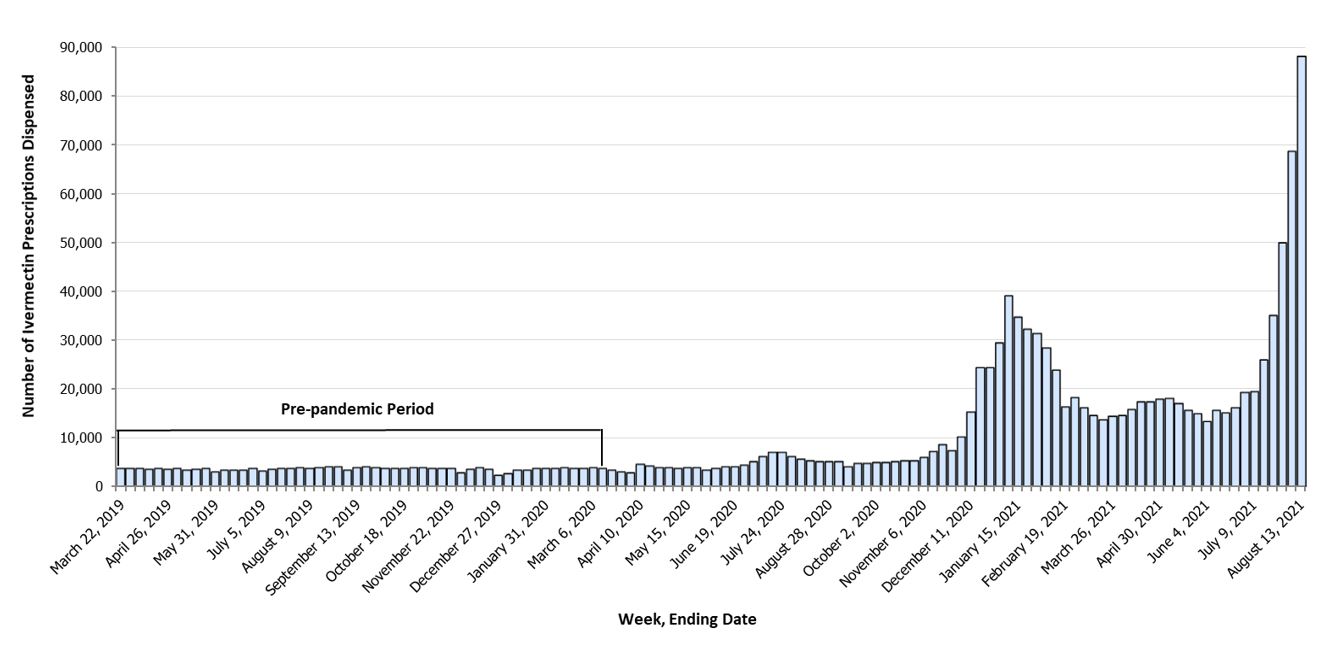
A recent study examining trends in ivermectin dispensing from outpatient retail pharmacies in the United States during the COVID-19 pandemic showed an increase from an average of 3,600 prescriptions per week at the pre-pandemic baseline (March 16, 2019–March 13, 2020) to a peak of 39,000 prescriptions in the week ending on January 8, 2021.Since early July 2021, outpatient ivermectin dispensing has again begun to rapidly increase, reaching more than 88,000 prescriptions in the week ending August 13, 2021. This represents a 24-fold increase from the pre-pandemic baseline. (Figure)

Figure: Estimated number of outpatient ivermectin prescriptions dispensed from retail pharmacies — United States, March 16, 2019–August 13, 2021*

*Data are from the IQVIA National Prescription Audit Weekly (NPA Weekly) database. NPA Weekly collects data from a sample of approximately 48,900 U.S. retail pharmacies, representing 92% of all retail prescription activity. Ivermectin dispensed by mail order and long-term care pharmacies, prescriptions by veterinarians, and non-oral formulations were not included.
Number of Ivermectin Prescriptions Dispensedimage icon

In 2021, poison control centers across the U.S. received a three-fold increase in the number of calls for human exposures to ivermectin in January 2021 compared to the pre-pandemic baseline.
In July 2021, ivermectin calls have continued to sharply increase, to a five-fold increase from baseline. These reports are also associated with increased frequency of adverse effects and emergency department/hospital visits.

In some cases, people have ingested ivermectin-containing products purchased without a prescription, including topical formulations and veterinary products. Veterinary formulations intended for use in large animals such as horses, sheep, and cattle (e.g., “sheep drench,” injection formulations, and “pour-on” products for cattle) can be highly concentrated and result in overdoses when used by humans. Animal products may also contain inactive ingredients that have not been evaluated for use in humans. People who take inappropriately high doses of ivermectin above FDA-recommended dosing may experience toxic effects.

Clinical effects of ivermectin overdose include gastrointestinal symptoms such as nausea, vomiting, and diarrhea. Overdoses are associated with hypotension and neurologic effects such as decreased consciousness, confusion, hallucinations, seizures, coma, and death. Ivermectin may potentiate the effects of other drugs that cause central nervous system depression such as benzodiazepines and barbiturates.

Examples of recent significant adverse effects reported to U.S. poison control centers include the following:

  • An adult drank an injectable ivermectin formulation intended for use in cattle in an attempt to prevent COVID-19 infection. This patient presented to a hospital with confusion, drowsiness,  visual hallucinations, tachypnea, and tremors. The patient recovered after being hospitalized for nine days.
  • An adult patient presented with altered mental status after taking ivermectin tablets of unknown strength purchased on the internet. The patient reportedly took five tablets a day for five days to treat COVID-19. The patient was disoriented and had difficulty answering questions and following commands. Symptoms improved with discontinuation of ivermectin after hospital admission.

Recommendations for Clinicians and Public Health Practitioners

  • Be aware that ivermectin is not currently authorized or approved by FDA for treatment of COVID-19. NIH has also determined that there are currently insufficient data to recommend ivermectin for treatment of COVID-19.
  • Educate patients about the risks of using ivermectin without a prescription, or ingesting ivermectin formulations that are meant for external use or ivermectin-containing products formulated for veterinary use.
  • Advise patients to immediately seek medical treatment if they have taken any ivermectin or ivermectin-containing products and are experiencing symptoms. Signs and symptoms of ivermectin toxicity include gastrointestinal effects (nausea, vomiting, abdominal pain, and diarrhea), headache, blurred vision, dizziness, tachycardia, hypotension, visual hallucinations, altered mental status, confusion, loss of coordination and balance, central nervous system depression, and seizures. Ivermectin may increase sedative effects of other medications such as benzodiazepines and barbiturates. Call the poison control center hotline (1-800-222-1222) for medical management advice.
  • Educate patients and the public to get vaccinated against COVID-19. COVID-19 vaccination is safe and the most effective means to prevent infection and protect against severe disease and death from SARS-CoV-2, the virus that causes COVID-19, including the Delta variant.
  • Educate patients and the public to use COVID-19 prevention measures including wearing masks in indoor public places, physical distancing by staying at least six feet from other people who don’t live in the same household, avoiding crowds and poorly ventilated spaces, and frequent handwashing and use of hand sanitizer that contains at least 60 percent alcohol.
References
1 Lind JN, Lovegrove MC, Geller AI, Uyeki TM, Datta SD, Budnitz DS. Increase in Outpatient Ivermectin Dispensing in the US During the COVID-19 Pandemic: A Cross-Sectional Analysis J Gen Intern Med. 2021 Jun 18:1–3. doi: 10.1007/s11606-021-06948-6.

Novel Stroke Rehab Treatment Wins FDA Approval


FDA APPROVED MicroTransponder Vivistim Paired VNS System (Vivistim System) over a photo and computer rendering of the device

A novel therapy involving vagus nerve stimulation (VNS) paired with rehabilitation was approved to treat chronic moderate to severe upper extremity motor deficits after ischemic stroke, the FDA announced Friday.

"Today's approval of the Vivistim Paired VNS System offers the first stroke rehabilitation option using vagus nerve stimulation," said Christopher Loftus, MD, acting director of the FDA's Center for Devices and Radiological Health's Office of Neurological and Physical Medicine Devices. "Used alongside rehabilitative exercise, this device may offer benefit to those who have lost function in their upper limbs due to ischemic stroke."

Vivistim is the first system of its kind approved to help stroke patients move their arms and hands. It stimulates the vagus nerve through an implantable pulse generator placed just under the skin in the chest. Attached to the pulse generator is a wire that leads to electrodes placed on the left side of the neck.

The FDA's decision was based on the pivotal VNS-REHAB trial of 108 patients with moderate-to-severe arm weakness at least 9 months after ischemic stroke. Participants were randomized into a study (53 patients) or control (55 patients) group; each was asked to complete 300-400 physical therapy exercises for 90 minutes a day, three times a week for 6 weeks.

The control group received a very low level of VNS for the first five of the 300-400 exercises and no stimulation for the rest of each session. The treatment group received the appropriate amount of VNS throughout all 90-minute sessions.

At 6 weeks, the treatment group showed a mean score increase of 5 points on the Upper Extremity Fugl-Meyer Assessment (FMA-UE), a stroke-specific measure of motor impairment. The control group had an average score increase of 2.4 points. At 90 days after in-clinic therapy, 47.2% of the treatment group saw an improvement of 6 or more points on the FMA-UE, compared with 23.6% of controls.

Adverse events included dysphonia, bruising, falling, general hoarseness, general pain, hoarseness after surgery, low mood, muscle pain, fracture, headache, rash, dizziness, throat irritation, urinary tract infection, and fatigue, the FDA said.

Patients should discuss any prior medical history of the following with their health provider: other concurrent forms of brain stimulation; current diathermy treatment, depression or suicidality; schizophrenia, schizoaffective disorder, or delusional disorders; rapid cycling bipolar disorder; previous brain surgery or central nervous system injury; progressive neurological diseases other than stroke; cardiac abnormalities; respiratory diseases or disorders; ulcers; vasovagal syncope; and pre-existing hoarseness.

Accompanying the implantable components of the Vivistim system are clinician software preloaded onto a laptop and a wireless transmitter to be used by a healthcare provider only. The system also may be used at home with a magnet that can be passed over an implanted pulse generator.

Vivistim, a prescription device, is not approved for other use, the FDA added, and should not be used in patients with vagotomy. The system is manufactured by MicroTransponder.


https://www.medpagetoday.com/neurology/strokes/94253

White House Flip-Flops Again On Timeline For Booster Jabs

 President Joe Biden said U.S. regulators are looking at administering Covid-19 booster shots five months after people finish their primary immunizations, moving up the expected timetable for a third shot by about three months. President Biden, who was speaking with Israeli Prime Minister Naftali Bennett on Friday, said that after consulting with Dr. Anthony Fauci and his other health advisers, he was considering moving up the timeline for booster shots to 5 months after the second shot, up from 8 months.

"We're considering the advice you've given that we should start earlier," Biden said, adding that officials are debating whether the timeline should be shorter. "Should it be as little as five months...that's being discussed."

NIH Director Dr. Francis Collins said last week that the efficacy of COVID vaccines had prompted health leaders to rethink their position on vaccine booster shots. But Twitter users immediately jumped on the announcement, blasting the administration for moving the goalposts once again, and ignoring "the science."


The negative reaction clearly prompted a rethink, as the White House quickly flip-flopped back to its original position, with the administration insisting there was "no change" in the timeline.

"We are going to start the booster program in mid-September. There's no change in our timeline.according to a press release," a senior Biden Admin official told Axios.

Before they can start doling out the booster jabs, the FDA and CDC's advisory panel, known as ACIP, must approve the third jabs, according to senior Biden administration official told Axios.

However, White House press secretary Jen Psaki clarified Friday that the accelerated timeline for booster jabs likely wouldn't happen.

"For people watching at home, for you all who are reporting out this, nothing has changed about the eight-month timeline as it relates to the boosters," Psaki said Friday.

Biden's talk with the Israeli PM occurred just hours after Israel released new trial data showing that the Pfizer jab is less effective at combating the delta variant than the immunity produced by natural infection.

Scientists have also started to speak out against President Biden's booster jab plans, arguing that the vaccines would be put to better use by doling them out to emerging economies with far lower vaccination rates before Americans are offered yet another jab.

https://www.zerohedge.com/political/nothing-has-changed-white-house-flip-flops-again-timeline-booster-jabs

COVID shot drives CanSinoBIO's first six-month profit since at least 2019


Chinese vaccine maker CanSino Biologics Inc (CanSinoBIO) said on Friday it had returned to operating profit of 802.3 million yuan ($123.79 million) in the first six months of 2021, driven by use of its COVID-19 shot. That compared with 123.0 million yuan of operating loss in the same period a year ago, CanSinoBIO said in a filing in the Hong Kong stock exchange. It marks the first six-month profit since at least 2019. The firm is yet to achieve full-year profits since it went public in 2018 in Hong Kong.

It reported 937.1 million yuan profit and total comprehensive income for the first six months of 2021. Its single-dose COVID-19 shot, named Ad5-nCoV, has been approved for use in countries including China, Mexico, Pakistan and Chile. The vaccine approvals were one of the major drivers for the sixth-month profit, CanSinoBIO said.

https://www.marketscreener.com/quote/stock/CANSINO-BIOLOGICS-INC-59318312/news/CanSino-Biologics-COVID-shot-drives-CanSinoBIO-s-first-six-month-profit-since-at-least-2019-36266624/

Half of US kids ages 12 - 17 got at least one COVID shot: Zients

 Biden administration officials say that half of U.S. adolescents ages 12 to 17 have gotten at least their first COVID-19 vaccine.

“We have now hit a major milestone,” White House coronavirus coordinator Jeff Zients told reporters at a Friday briefing. “This is critical progress as millions of kids head back to school.”


The vaccination rate among teenagers is growing faster than among any other age group, he added.


Among Americans of all age groups, 61% or nearly 203 million people, have received at least one shot. Vaccines are not yet authorized for children younger than 12.

Dr. Rochelle Walensky, director of the Centers for Disease Control and Prevention, said the best way to protect the youngest children until they become eligible to get their shots is for the people around them to be vaccinated, “to effectively shield them.”


https://www.10tv.com/article/news/health/coronavirus/us-adolescents-covid-vaccine/507-eca270fa-7fde-455c-bc2e-360d928e6b09