Search This Blog

Thursday, January 6, 2022

CMS proposes Part D price concessions applied at point-of-sale, new requirements for MA plans

 The Biden administration wants Medicare Part D plans to apply any price concessions they get from drugmakers to the point-of-sale and require Medicare Advantage plans to be more transparent in how they spend money on supplemental benefits.

The Centers for Medicare and Medicaid Services released a proposed rule on late Thursday that outlined major regulatory changes for MA and Part D starting in 2023. The rule covers a swath of major areas that include new changes for dual-eligible special needs beneficiaries and updates to calculations of star ratings, which can affect quality bonuses delivered to plans.

“Today’s proposed actions follow our guiding principles by improving health equity and enhancing access to prescription medications,” said CMS Administrator Chiquita Brooks-LaSure in a statement.

The proposal takes a major aim at price concessions that Part D plans extract from drug makers. Under the concessions, the plan pays less money to a pharmacy if it doesn’t meet several metrics. CMS is concerned, however, that the end-user doesn’t know about the arrangement and the lower prices are not passed on at the point-of-sale.

The proposed rule also said that the negotiated prices “typically do not reflect any performance-based pharmacy price concessions that lower the price a sponsor ultimately pays for the drug.”

The proposed rule wants to require all Part D plans to apply the concessions at the pharmacy counter.

“CMS is proposing to redefine the negotiated price at the baseline, or lowest possible, payment to a pharmacy, effective January 1, 2023,” a fact sheet on the regulation said. “This policy would reduce beneficiary out-of-pocket costs and improve price transparency and market competition in the Part D program.”

Since the changes are coming next year, Part D plans should account for them in their bids for the coming contract year, the rule said.

CMS is also proposing several policies that affect how MA plans are evaluated.

The agency is proposing that plan applicants must show they have a sufficient network of contracted providers before the agency approves an application for any new or expanded MA plan. The agency also hopes to provide MA insurers with information on their network adequacy before they submit a bid, giving them time to make any changes.

But CMS said it recognizes that it may be hard for plans to meet the network adequacy requirements within one year in advance of a contract year. It is therefore proposing to allow a “10-percentage point credit toward the percentage of beneficiaries residing within published time and distance standards for new or expanding service area applicants,” the fact sheet said. “Once the coverage year start (Jan. 1), the 10-percentage point credit would no longer apply and plans would need to meet full compliance.”

The agency is also calling for greater transparency in the reporting of medical loss ratios (MLRs), which require insurers to spend a certain percentage of their premium dollars on medical claims and the rest on administrative costs.

Currently, MA and Part D plans must meet an MLR of 85% of a premium dollar going to medical claims.

“Our proposal would require MA organizations and Part D sponsors to report the underlying cost and revenue information needed to calculate and verify the MLR percentage and remittance amount, if any,” the fact sheet said.

MA plans must also report the amount spent on supplemental benefits that aren’t offered by traditional Medicare, such as dental or vision. These benefits are major marketing tools for plans to Medicare beneficiaries.

CMS also wants to tighten oversight of third-party marketing organizations to prevent any deceptive tactics in marketing to seniors.

Improving care for dual-eligibles

CMS included several policies aimed at dual-eligible beneficiaries in both Medicare and Medicaid, part of a greater shift by the agency and Biden administration to tackle health equity.

A major proposal aims to better reflect plan performance on dual eligibles in star ratings, which can help beneficiaries to comparison shop for plans and are used to calculate quality bonuses to insurers.

Most of the time a plan contract could contain dual-eligible beneficiary and non-special needs MA plans. This can make it hard to fully assesses how a plan performs care for a dual-eligible beneficiary, a fact sheet on the rule said.

“CMS is proposing a pathway to allow certain states with integrated care programs to require that MA organizations establish a contract that only includes one or more [dual-eligible special needs plans], which would allow for star ratings for that contract to reflect the [dual-eligible] local performance,” the fact sheet added.

The agency also is proposing that dual-eligible plans use new integrated materials that make it easier for such beneficiaries to understand the scope of the Medicare and Medicaid benefits available to them.

https://www.fiercehealthcare.com/payer/cms-proposes-part-d-price-concessions-be-applied-at-point-sale-new-requirements-for-ma-plans

Kaufman Hall: Consumers may again be avoiding care as hospital margins stay depressed

 Hospital volumes softened in November overall as operating margins remain depressed, signaling that once again consumers could be delaying or avoiding care due to the pandemic, a new report from consulting firm Kaufman Hall found.

The firm released Tuesday its latest hospital flash report detailing revenues and volumes for November before the omicron-fueled surge of COVID-19 took hold. The report found hospitals are still facing major pressures from rising expenses and labor shortages.

“Hospitals are grappling with higher labor costs despite lower staffing levels, due to intense competition for qualified healthcare workers,” said Erik Swanson, Kaufman’s senior vice president of data and analytics, in a statement. “In addition, the highly contagious omicron variant could put more pressure on hospitals in the months to come.”

Kaufman found that hospital volumes softened in November, with discharges dropping nearly 5% and adjusted discharges by 3.9% compared to the month before. Discharges were also down 6.1% compared with pre-pandemic levels.

Meanwhile, the average length of stay at hospitals increased by 0.8% compared to October and 8.6% compared with November 2019.

The report estimates consumers could be postponing non-COVID-19 care.  

“The potential impact of the omicron variant in future months may influence this trend further,” Kaufman’s analysis said.

The volume fluctuation helped contribute to a month-to-month decline in total revenues. The report found gross operating revenues that did not includes CARES Act relief funding declined 0.6% from October to November.

Inpatient revenue dropped down to 2.6%, and outpatient revenue was only down by 0.7%.

However, net patient service revenue per adjusted discharge rose 2.5% thanks in part to payments for higher acuity patients.

Expenses continued to be a drain on hospital operating margins.

“Total expense per adjusted discharge increased 24.7%, labor expense per adjusted discharge rose 26.4%,” the report said.

Labor expenses were particularly vexing for hospitals; even though expenses rose 2.7% month to month, there was a 1% decline in full-time equivalent staff per adjusted occupied bed.

“Hospitals in the west had the biggest increase in labor expenses for the month, with labor expense per adjusted discharge up 28.8% [year-over-year],” Kaufman Hall added.

The flash report relies on data from more than 900 hospitals across the country.

https://www.fiercehealthcare.com/hospitals/kaufman-hall-consumers-may-again-be-avoiding-getting-care-as-hospital-margins-remain

Fed Judge Rejects FDA's 75 Year Delay On Vax Data, Cuts To Just 8 Months

 A federal judge has rejected a request by the FDA to produce just 500 pages per month of the data submitted by Pfizer to license its Covid-19 vaccine - and has ordered them to produce 55,000 pages per month. Assuming there are roughly 450,000 pages, that means it will take just over eight months for the world to see what's under the hood.

Attorney Aaron Siri, who represents the plaintiff in the case, has provided this stunning update via his blog, Injecting Freedom:

On behalf of a client, my firm requested that the FDA produce all the data submitted by Pfizer to license its Covid-19 vaccine.  The FDA asked the Court for permission to only be required to produce at a rate of 500 pages per month, which would have taken over 75 years to produce all the documents. 

I am pleased to report that a federal judge soundly rejected the FDA’s request and ordered the FDA to produce all the data at a clip of 55,000 pages per month!

This is a great win for transparency and removes one of the strangleholds federal “health” authorities have had on the data needed for independent scientists to offer solutions and address serious issues with the current vaccine program – issues which include waning immunity, variants evading vaccine immunity, and, as the CDC has confirmed, that the vaccines do not prevent transmission.

No person should ever be coerced to engage in an unwanted medical procedure.  And while it is bad enough the government violated this basic liberty right by mandating the Covid-19 vaccine, the government also wanted to hide the data by waiting to fully produce what it relied upon to license this product until almost every American alive today is dead.  That form of governance is destructive to liberty and antithetical to the openness required in a democratic society. 

In ordering the release of the documents in a timely manner, the Judge recognized that the release of this data is of paramount public importance and should be one of the FDA’s highest priorities.  He then aptly quoted James Madison as saying a “popular Government, without popular information, or the means of acquiring it, is but a Prologue to a Farce or a Tragedy” and John F. Kennedy as explaining that a “nation that is afraid to let its people judge the truth and falsehood in an open market is a nation that is afraid of its people.” 

The following is the full text of the Judge’s order, a copy of which is also available here.

UNITED STATES DISTRICT COURT

PHMPT, Plaintiff v. FDA, Defendant, No. 4:21-cv-1058-P

ORDER

This case involves the Freedom of Information Act (“FOIA”). Specifically, at issue is Plaintiff’s FOIA request seeking “[a]ll data and information for the Pfizer Vaccine enumerated in 21 C.F.R. § 601.51(e) with the exception of publicly available reports on the Vaccine Adverse Events Reporting System” from the Food and Drug Administration (“FDA”). See ECF No. 1. As has become standard, the Parties failed to agree to a mutually acceptable production schedule; instead, they submitted dueling production schedules for this Court’s consideration. Accordingly, the Court held a conference with the Parties to determine an appropriate production schedule.[1] See ECF Nos. 21, 34.

“Open government is fundamentally an American issue” – it is neither a Republican nor a Democrat issue.[2] As James Madison wrote, “[a] popular Government, without popular information, or the means of acquiring it, is but a Prologue to a Farce or a Tragedy; or, perhaps, both. Knowledge will forever govern ignorance: And a people who mean to be their own Governors, must arm themselves with the power which knowledge gives.”[3] John F. Kennedy likewise recognized that “a nation that is afraid to let its people judge the truth and falsehood in an open market is a nation that is afraid of its people.”[4] And, particularly appropriate in this case, John McCain (correctly) noted that “[e]xcessive administrative secrecy . . . feeds conspiracy theories and reduces the public’s confidence in the government.”[5]

Echoing these sentiments, “[t]he basic purpose of FOIA is to ensure an informed citizenry, [which is] vital to the functioning of a democratic society.” NLRB v. Robbins Tire & Rubber Co., 437 U.S. 214, 242 (1977). “FOIA was [therefore] enacted to ‘pierce the veil of administrative secrecy and to open agency action to the light of public scrutiny.’” Batton v. Evers, 598 F.3d 169, 175 (5th Cir. 2010) (quoting Dep’t of the Air Force v. Rose, 425 U.S. 352, 361 (1976)). And “Congress has long recognized that ‘information is often useful only if it is timely’ and that, therefore ‘excessive delay by the agency in its response is often tantamount to denial.’” Open Soc’y Just. Initiative v. CIA, 399 F. Supp. 3d 161, 165 (S.D.N.Y. 2019) (quoting H.R. REP. NO. 93-876, at 6271 (1974)). When needed, a court “may use its equitable powers to require an agency to process documents according to a court-imposed timeline.” Clemente v. FBI, 71 F. Supp. 3d 262, 269 (D.D.C. 2014).

Here, the Court recognizes the “unduly burdensome” challenges that this FOIA request may present to the FDA. See generally ECF Nos. 23, 30, 34. But, as expressed at the scheduling conference, there may not be a “more important issue at the Food and Drug Administration . . . than the pandemic, the Pfizer vaccine, getting every American vaccinated, [and] making sure that the American public is assured that this was not [] rush[ed] on behalf of the United States . . . .” ECF No. 34 at 46. Accordingly, the Court concludes that this FOIA request is of paramount public importance.

“[S]tale information is of little value.” Payne Enters., Inc. v. United States, 837 F.2d 486, 494 (D.C. Cir. 1988). The Court, agreeing with this truism, therefore concludes that the expeditious completion of Plaintiff’s request is not only practicable, but necessary. See Bloomberg, L.P. v. FDA, 500 F. Supp. 2d 371, 378 (S.D.N.Y. Aug. 15, 2007) (“[I]t is the compelling need for such public understanding that drives the urgency of the request.”). To that end, the Court further concludes that the production rate, as detailed below, appropriately balances the need for unprecedented urgency in processing this request with the FDA’s concerns regarding the burdens of production. See Halpern v. FBI, 181 F.3d 279, 284–85 (2nd Cir. 1991) (“[FOIA] emphasizes a preference for the fullest possible agency disclosure of such information consistent with a responsible balancing of competing concerns . . . .”).

Accordingly, having considered the Parties’ arguments, filings in support, and the applicable law, the Court ORDERS that:

1. The FDA shall produce the “more than 12,000 pages” articulated in its own proposal, see ECF No. 29 at 24, on or before January 31, 2022.

2. The FDA shall produce the remaining documents at a rate of 55,000 pages every 30 days, with the first production being due on or before March 1, 2022, until production is complete.

3. To the extent the FDA asserts any privilege, exemption, or exclusion as to any responsive record or portion thereof, FDA shall, concurrent with each production required by this Order, produce a redacted version of the record, redacting only those portions as to which privilege, exemption, or exclusion is asserted.

4. The Parties shall submit a Joint Status Report detailing the progress of the rolling production by April 1, 2022, and every 90 days thereafter.[6]

SO ORDERED on this 6th day of January, 2022.


[1] Surprisingly, the FDA did not send an agency representative to the scheduling conference.

[2] 151 CONG. REC. S1521 (daily ed. Feb. 16, 2005) (statement of Sen. John Cornyn).

[3] Letter from James Madison to W.T. Barry (August 4, 1822), in 9 WRITINGS OF JAMES MADISON 103 (S. Hunt ed., 1910).

[4] John F. Kennedy, Remarks on the 20th Anniversary of the Voice of America (Feb. 26, 1962).

[5] America After 9/11: Freedom Preserved or Freedom Lost?: Hearing Before the S. Comm. on the Judiciary, 108th Cong. 302 (2003).

[6] Although the Court does not decide whether the FDA correctly denied Plaintiff’s request for expedited processing, the issue is not moot. Should the Parties seek to file motions for summary judgment, the Court will take up the issue then.


*  *  *

'Bad Since Christmas' - Subway Service Slows Dramatically As Worker Shortages Cause Mass Delays

 One day after New York's Gov. Kathy Hochul delivered her state of the state address - her first major address since taking over from her former boss Gov. Andrew Cuomo this past summer - the NYT and the rest of the media gallery praised her performance. But despite her alluring promises about ending "unproductive" rivalries between the elected leaders of NYC and the Empire State.

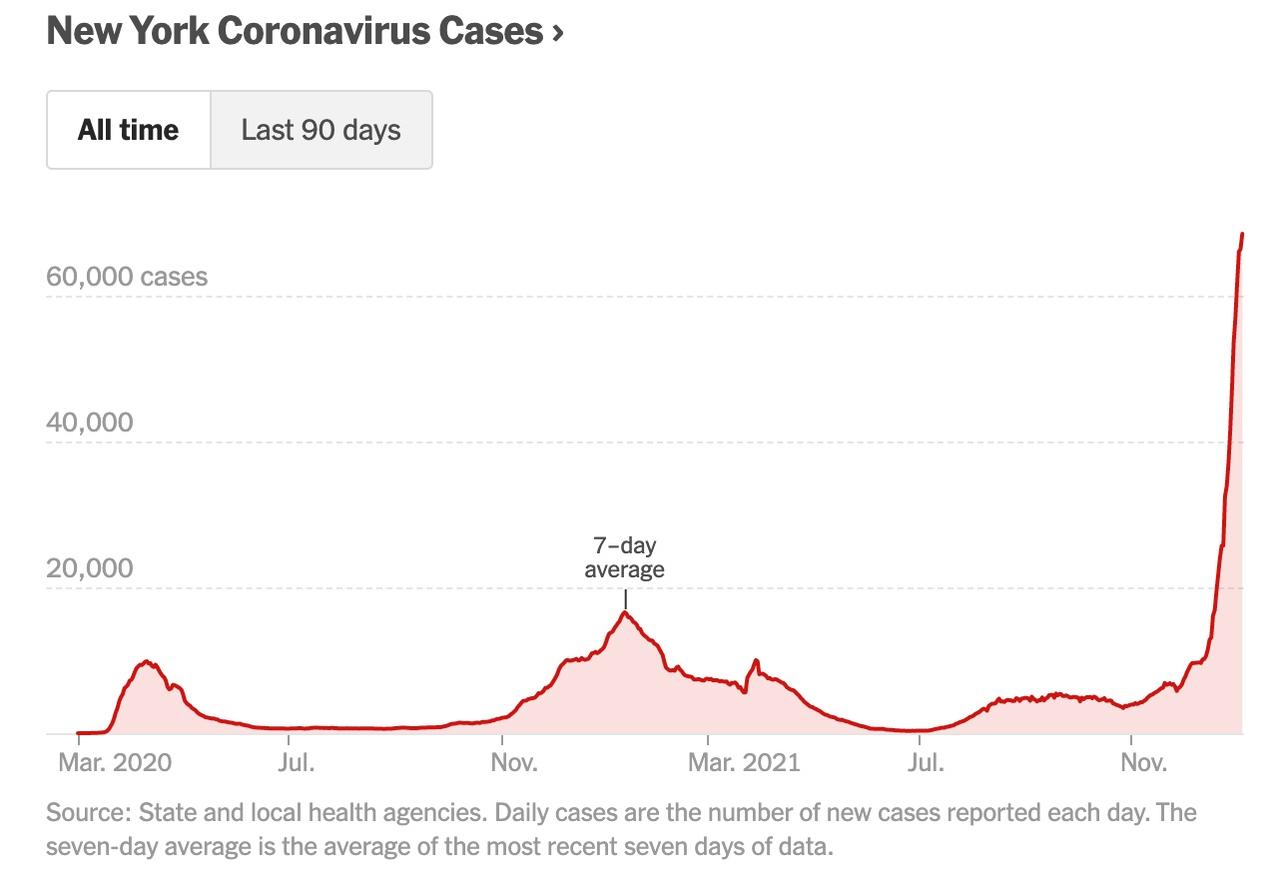
Unfortunately, she still has one major, economy-wrecking problem to solve, and it's this: on any day this week, some 1,300 people out of a work force of 6.3K (roughly 1/5th) have been absent from work from the MTA due the ongoing crush of omicron case.

The soaring jump in absenteeism, which the transportation authority attributes to the virus, has meant a lack of workers to keep up with the regular train schedules, leading officials to suspend service this week on three of the system’s 22 subway lines and reduce schedules on many others, leading to longer wait times.

NYC's shortage of workers has made it the most critically underserved public transit system in the country, the NYT reports.

"I feel like it’s been bad since Christmas," Jennifer Hall, 41, said Wednesday morning as she waited with her son for a D train in the Bronx.

The news comes as New York State confirmed 85K new cases on Thursday, a new daily record for the Empire State.

Source: NYT

The surge in worker absences comes as the transportation authority has already been contending with a smaller work force after a rush of retirements and a pandemic-related hiring freeze was lifted last February.

Unlike other public workers, MTA employees are not restricted by the vaccine mandate (although if they aren't vaccinated they must submit to a test every week).

The MTA's troubles are hardly unique; they're part of a wider issue of staffing shortages that has lead to thousands of flights being cancelled, along with train delays across the country.

In particular, sick calls have soared in recent weeks: "We have seen increased sick calls, more than we have seen in the past," said Craig Cipriano, the interim president of the division of the transportation authority. The number swelled through the end of the year, with unplanned absences currently more than three times higher than their typical levels before the pandemic.

The number of subway riders in NYC has fluctuated dramatically, often following the COVID case numbers in an inverse pattern. Unsurprisingly, this has forced the MTA to make some exceptions to its virus-related worker absences.

Subway ridership this week stood at about 40 percent of prepandemic numbers, transit officials said. That is a drop from levels that climbed above 50 percent in November, but still represents millions of passengers.

For now, at least, the MTA's leaders expect the worker shortages to get better, not worse.

Still, Mr. Cipriano said there was reason to believe that the suspensions and delays caused by virus-related worker absences would soon ease, though he would not specify when. Already this week, he said, the absentee numbers showed signs they may be reversing. Transit employees who test positive for the virus get up to two weeks of sick leave beyond their standard sick time, which is 12 days per year. In the transit authority’s guidance to employees, which mirrors recent guidance from the federal Centers for Disease Control and Prevention, it suggests that vaccinated workers who test positive for Covid-19 must isolate for at least five days and can return to work only if they have been without a fever for three days, have no runny nose and a “minimal cough."

Unvaccinated workers who have tested positive or been exposed to the virus must isolate for 10 days before returning to work. Transit officials have said that about 80 percent of its roughly 67,000 employees were vaccinated, and that they were unlikely to impose a stricter vaccine requirement out of concern that it might further disrupt service at a time when the system can scarcely afford it.

Fortunately, Cipriano and the rest of the MTA leadership don't expect to halt round-the-clock service any time soon. At the very least, they feel they would be able to run fewer trains per hour before they're stuck with having to dial back service, forcing passengers who keep odd hours to pay for cab fare after leaving work late at night or early in the morning.

https://www.zerohedge.com/covid-19/its-been-bad-christmas-subway-service-slows-dramatically-worker-shortages-cause-mass

Gritstone bio trumpets first data for ‘multivariant’ COVID jab

 A COVID-19 vaccine that could work against multiple variants of the coronavirus – developed by US biotech Gritstone bio – has generated encouraging immune response data in its first clinical trial.

The new vaccine differs from the currently approved shots because it delivers antigens for both the spike protein and other proteins found in SARS-CoV-2.

That could mean it is less susceptible to the loss of efficacy to vaccines that can occur when there are changes in the spoke protein – as witnessed with the new Omicron variant.

The results of the CORAL-BOOST are only in a few patients, but showed strong increases in neutralising antibody levels when Gritstone’s shot given as a booster after two doses of AstraZeneca’s Vaxzevria given as a primary course.

It also stimulated broad CD8+ T cell responses against the non-spike proteins, and boosted pre-existing responses against spike generated by AZ’s jab.

The focus on non-spike proteins is important “because the other proteins differ much less between the variants of SARS-CoV-2 than the spike protein, so we would expect a better degree of cross-protection against different variants,” commented Prof Charles Bangham, an immunology specialist at Imperial College London, who wasn’t involved in the trial.

Gritstone’s candidate is a self-amplifying messenger RNA vaccine (samRNA), which uses a slightly different technology to the mRNA-based jabs from Pfizer/BioNTech and Moderna.

samRNA vaccines instruct the body to make large amounts of mRNA, which in turn generates the protein antigens, and that means only a small dose is necessary, stretching supplies further.

It will now move into a larger 120-patient stage of the study, with the hope of advancing quickly into pivotal trials and getting a green light for use in booster campaigns.

The study in 20 people aged over 60 was run by the National Institute of Health Research Manchester Clinical Research Facility (NIHR Manchester CRF). Lead investigator Prof Andrew Ustianowski said the results are important because it is increasingly apparent that T cell immunity is an important factor in generating durable immunity with COVID-19 vaccines.

“We believe this vaccine, as a booster, will elicit strong, durable, and broad immune responses, which may well be likely to be critical in maintaining protection of this vulnerable elderly population who are particularly at risk of hospitalisation and death,” he said.

Another commentator, retired consultant in communicable disease control Dr Peter English, said while it is hard to gauge the significance of the results yet, they are encouraging.

“With new variants – like Omicron and B.1.640.2 – constantly evolving, vaccines that can more effectively prevent illness caused by variants of the virus may well have a place in our future armoury,” he added.

“Whether this particular vaccine will be such a vaccine – or will make it to market, be approved by regulators, and be widely used – will not become clear for some time,” continued English.

“But it may be; and if it doesn’t other novel vaccines with similar benefits may well take on this role.”

https://pharmaphorum.com/news/gritstone-bio-trumpets-first-data-for-multivariant-covid-jab/

UK: Confirmatory PCR tests temporarily suspended for positive lateral flow test results

 From 11 January in England, people who receive positive lateral flow device (LFD) test results for coronavirus (COVID-19) will be required to self-isolate immediately and won’t be required to take a confirmatory PCR test.

This is a temporary measure while COVID-19 rates remain high across the UK. Whilst levels of COVID-19 are high, the vast majority of people with positive LFD results can be confident that they have COVID-19.

Lateral flow tests are taken by people who do not have COVID-19 symptoms. Anyone who develops 1 of the 3 main COVID-19 symptoms should stay at home and self-isolate and take a PCR test. They must self-isolate if they get a positive test result, even if they have had a recent negative lateral flow test – these rules have not changed.

The new approach reflects similar changes made this time last year in January 2021, when there was also a high prevalence of infection meaning it was highly likely that a positive LFD COVID-19 result was a true positive. This meant confirmatory PCRs were temporarily paused and reintroduced in March 2021 following a reduction in prevalence.

The UK’s testing programme is the biggest in Europe with over 400 million tests carried out since the start of the pandemic. Since mid-December, 100,000 more PCR booking slots have been made available per day and capacity continues to be rapidly expanded, with delivery capacity doubled to 900,000 PCR and LFD test kits a day.

Under this new approach, anyone who receives a positive LFD test result should report their result on GOV.UK and must self-isolate immediately but will not need to take a follow-up PCR test.

After reporting a positive LFD test result, they will be contacted by NHS Test and Trace so that their contacts can be traced and must continue to self-isolate.

There are a few exceptions to this revised approach.

First, people who are eligible for the £500 Test and Trace Support Payment (TTSP) will still be asked to take a confirmatory PCR if they receive a positive LFD result, to enable them to access financial support.

Second, people participating in research or surveillance programmes may still be asked to take a follow-up PCR test, according to the research or surveillance protocol.

Finally, around one million people in England who are at particular risk of becoming seriously ill from COVID-19 have been identified by the NHS as being potentially eligible for new treatments. They will be receiving a PCR test kit at home by mid-January to use if they develop symptoms or if they get a positive LFD result, as they may be eligible for new treatments if they receive a positive PCR result. This group should use these priority PCR tests when they have symptoms as it will enable prioritised laboratory handling.

In line with the reduced self-isolation approach announced on 22 December, anyone who tests positive will be able to leave self-isolation 7 days after the date of their initial positive test if they receive 2 negative LFD results, 24 hours apart, on days 6 and 7.

Rapid lateral flow tests are most useful at identifying COVID-19 in people without any symptoms. The tests are over 80% effective at finding people with high viral loads who are most infectious and most likely to transmit the virus to others.

Analysis by NHS Test and Trace shows LFD tests to have an estimated specificity of at least 99.97% when used in the community. This means that for every 10,000 lateral flow tests carried out, there are likely to be fewer than 3 false positive results. LFD tests identify the most infectious people. These people tend to spread the virus to many people and so identifying them remains important.

Secretary of State for Health and Social Care Sajid Javid said:

We have built a world-leading testing system and our testing capacity is the largest in Europe. This has helped save lives and protect millions of people from COVID-19. It forms a crucial line of defence alongside vaccines and antivirals.

As Omicron cases continue to rise the demand for tests has grown rapidly across the globe. We’re putting plans in place to manage the demand for PCR tests in the UK so we can ensure that those who most need tests can continue to access them.

Chief Executive of UKHSA, Dr Jenny Harries, said:

While cases of COVID-19 continue to rise, this tried-and-tested approach means that LFDs can be used confidently to indicate COVID-19 infection without the need for PCR confirmation.

It remains really important that anyone who experiences COVID-19 symptoms self-isolates immediately.  They should also order a PCR test on GOV.UK or by phoning 119.

I’m really grateful to the public and all of our critical workers who continue to test regularly and self-isolate when necessary, along with other practical and important public health behaviours, as this is the most effective way of stopping the spread of the virus and keeping our friends, families and communities safe.

Yesterday the Prime Minister announced the government will provide 100,000 critical workers in England with free lateral flow tests to help keep essential services and supply chains running.

Critical workers will be able to take a test on every working day and the provision of precautionary testing will be for an initial 5 weeks.  This will help to isolate asymptomatic cases and limit the risk of outbreaks in workplaces, reducing transmission while COVID-19 cases remain high.

The full range of critical workers have been identified by the relevant departments and government will contact these organisations directly on the logistics of the scheme this week. Roll-out will start from Monday 10 January.

Tests will be separate from public sectors who already have a testing allocation with UKHSA, such as adult social care or education, and separate to those delivered to pharmacies and homes, so those channels will not be impacted by the new scheme.

We are now distributing around 600,000 packs of LFD tests (each containing 7 tests) on GOV.UK directly to homes every day (more than 50% higher than last week).

https://www.gov.uk/government/news/confirmatory-pcr-tests-to-be-temporarily-suspended-for-positive-lateral-flow-test-results

Mass Seattle Schools COVID tests show 4% positive rate

 Officials say around 4% of more than 14,000 Seattle Public Schools students and staff who participated in the district’s rapid testing clinics this week tested positive for COVID-19.

Volunteers and district staff administered the tests in pop-up clinics on Sunday and Monday after the state’s largest district received a shipment of 60,000 rapid tests from the state health department. Seattle has about 50,000 students and 7,800 staff.

Testing was intended to help build a forecast of how many staff might be out for quarantine periods and need substitutes, and to slow virus transmission in classrooms after winter break.

Carri Campbell, the district’s assistant deputy superintendent, said in-person instruction is the district’s priority and the primary reason for the pop-up test sites.

The district sent a message to families two weeks ago warning that if cases spiked after the holidays, classes could be moved online temporarily.

Officials were not able to provide a breakdown of the positive cases by staff and students on Tuesday, but Campbell noted that the staff absence rates on Tuesday, the first day of school in the new year, looked typical.

No other school district in Washington state has administered rapid tests in such a manner and scale.

https://www.q13fox.com/news/mass-seattle-schools-covid-tests-show-4-positive-rate