Search This Blog

Monday, January 10, 2022

R1 RCM (RCM) Acquires Cloudmed for $4.1B

 R1 RCM Inc. (NASDAQ: RCM) (“R1”), a leading provider of technology-driven solutions that transform the patient experience and financial performance of healthcare providers, today announced that it has entered into a definitive agreement to acquire Cloudmed, a leader in Revenue Intelligence™ solutions for healthcare providers, in an all-stock transaction. The transaction values Cloudmed at approximately $4.1 billion, including $857 million of net debt, based on R1’s closing stock price on January 7, 2022.

Based in Atlanta, Georgia, Cloudmed, a New Mountain Capital portfolio company, serves more than 400 of the largest health systems in the United States, including 47 of the top 50 hospital systems. Cloudmed’s industry-leading revenue intelligence platform combines cloud-based data architecture and deep domain expertise with intelligent automation to analyze large volumes of medical records, payment data, and complex medical insurance models to identify opportunities to deliver additional revenue to customers. In 2021, Cloudmed recovered more than $1.5 billion of underpaid or unidentified revenue for customers, delivering an average client ROI of 3-5x.

“This transaction accelerates our strategy to build the most scalable, flexible, and integrated platform for the revenue cycle and consumer engagement in healthcare,” said Joe Flanagan, president and chief executive officer of R1. “Our combined solutions, including enhanced automation capabilities, will further transform the patient experience and drive continued improvement in our customers’ financial results. I look forward to working with Cloudmed’s CEO, Lee Rivas, and the entire Cloudmed team whose additive talent and expertise will help us continue to optimize outcomes for healthcare systems and create value for all our stakeholders.”

“Cloudmed solves a critical problem in the healthcare system by helping healthcare providers get paid for the services they deliver,” said Lee Rivas, chief executive officer of Cloudmed. “By combining with R1, we will be creating a best-in-class platform with market-leading capabilities to drive improved outcomes for our customers, among the leading healthcare providers in the country. R1 shares our values and focus on innovation, which is why we are so excited about joining them to drive value for healthcare providers.”

"We believe the combination of Cloudmed and R1 creates a clear market leader for technology and data powered revenue management for healthcare providers,” said Matt Holt, managing director and president, private equity of New Mountain Capital. “We are excited to support the long-term vision of the combined company to modernize the U.S. healthcare sector. We look forward to working with Joe, Lee, and the management teams to fulfill this mission.”

Strategic and Financial Benefits

  • Advances Revenue Intelligence and Automation Capabilities: The combination creates a scaled leader across both end-to-end revenue cycle management and technology-driven revenue intelligence. Cloudmed brings market-leading capabilities in revenue integrity with a focus on the middle revenue cycle and the #1 KLAS rating in the Revenue Integrity/Underpayment Services Provider category in 2021. Together, R1 and Cloudmed will have enhanced offerings that unite decades of coding, charging, and reimbursement expertise to drive further client digitization through automation and AI.
  • Accelerates Value Proposition and Commercial Engine to Drive Growth: This transaction will enable R1 to further its ability to deliver transformative value to healthcare providers through a more fulsome platform of differentiated capabilities. With increased commercial capacity, R1 will drive growth in modular revenue at SaaS equivalent margins. In addition, the combined company will have a diversified customer base with well-established relationships across 50 states, including 47 of the top 50 healthcare systems.
  • Creates Significant Financial Benefits: The transaction is expected to be accretive to R1’s earnings per share in the first full year post-closing. R1 expects to unlock cost synergies of $85 million by the end of year three and $98 million at full run-rate, as well as significant revenue synergies over time. R1 expects to have approximately 2.7x net leverage upon closing of the transaction and anticipates strong cash flow generation post-close.

Transaction Details

Upon closing of the transaction, current R1 shareholders will own approximately 70% of the combined company on a fully diluted basis and Cloudmed equity holders will own approximately 30%. Cloudmed equity holders will enter into an 18-month lockup agreement, subject to partial early release after six months under certain circumstances.

The transaction, which has been unanimously approved by the Boards of Directors of both companies, is expected to close in the second quarter of 2022, subject to approval of the stock issuance by R1 shareholders, the effectiveness of a registration statement on Form S-4, receipt of regulatory approvals and the satisfaction of other customary closing conditions.

Joe Flanagan, CEO of R1, will serve as CEO of the combined company, and Lee Rivas, chief executive officer of Cloudmed, will serve as president of the combined company. Upon closing of the transaction, R1 will increase the size of its Board of Directors to include three new board members nominated by New Mountain Capital.

Conference Call

R1 will host a conference call today at 7:00 a.m. ET to discuss details of the transaction. To participate, please dial 888-330-2022 (646-960-0690 outside the U.S. and Canada) using conference code number 5681952. A live webcast and replay of the call will be available at the Investor Relations section of the Company’s website at ir.r1rcm.com.

https://www.streetinsider.com/Corporate+News/R1+RCM+%28RCM%29+Acquires+Cloudmed+for+%244.1B/19438658.html

JPM 2022: New J&J CEO Duato points out 5 pipeline meds that can generate $5B+

 Johnson & Johnson, preparing for a consumer health spinoff late next year, has big plans in pharmaceuticals for the coming decade.

By 2025, the company aims to generate $60 billion in pharma sales, leaning mostly on existing medicines for growth until then, new CEO Joaquin Duato said during the virtual J.P. Morgan Healthcare Conference on Monday. In the second half of the decade, the company expects a handful of new launches to contribute in a major way.

Among the healthcare giant's pipeline, Duato highlighted five programs that could generate $5 billion or more in peak sales. Those are the Legend Biotech-partnered CAR-T medicine Carvykti, the potential “pipeline in a product” drug nipocalimab, Rybrevant in lung cancer, a potential first-in-class oral Factor XIa inhibitor milvexian and a potential bladder cancer platform called Taris.

Carvykti is a "best-in-class" BCMA CAR-T drug for multiple myeloma that could change the "paradigm of treatment" through potential combinations, Duato said. That med is expected to launch this year after the FDA delayed its approval decision in November.

As for nipocalimab, that drug could treat 10 or more rare and prevalent diseases, J&J said during a November pharmaceutical business review. Moving down Duato's list, the CEO said its Bristol Myers-partnered oral Factor XIa inhibitor milvexian "could be a very big product." That drug recently turned in positive phase 2 data, and the partners are planning a phase 3 program.

Meanwhile, Rybrevant won an FDA approval last year to treat adults with non-small cell lung cancer whose tumors have epidermal growth factor receptor (EGFR) exon 20 insertion mutations. In combination with Yuhan Corp.'s Leclaza, the drug could transform treatment for certain patients with lung cancer, J&J said during the November business review. 

Lastly, the Taris bladder cancer platform could allow for localized drug delivery of cetrelimab and the already approved medicine Balversa, J&J said in November.

Duato highlighted the promising candidates during a one-on-one conversation with J.P. Morgan senior analyst Chris Schott. After taking the reins last week, the CEO said he'll continue to manage the healthcare giant as a “three-sector company” as J&J preps for its consumer healthcare spinoff late next year. Within the pharma business, J&J expects big-sellers such as cancer drug Darzalex and immunology med Tremfya to chip in most of the growth through the decade's halfway point. 

To reach its $60 billion goal for the pharma unit, the company is planning to file 36 applications for new indications, new line expansions or new formulations for 13 existing blockbuster products by 2025, Duato said. Those medicines will drive the majority of J&J’s growth through 2025, the CEO added.

J&J is counting on the growth to offset expected sales declines for megablockbuster immunology drug Stelara, which loses U.S. patent protections next year. The drug generated $6.8 billion during the first nine months of 2021 and is currently J&J's largest product by sales.

https://www.fiercepharma.com/pharma/johnson-johnson-ceo-duato-points-out-5-pipeline-meds-can-generate-5b

PTC R&D, Commercial Outlook

- $536 million unaudited 2021 total revenue representing impressive 41% year-over-year growth -

$700 - 750 million 2022 total revenue guidance -

- Results are expected in four registration-directed trials this year -

- Three additional registration-directed clinical trials expected to initiate in 2022

PTC Therapeutics, Inc. (NASDAQ: PTCT) will present an update on its commercial progress and R&D pipeline at the 40th Annual J.P. Morgan Healthcare Conference today, Monday Jan. 10th at 7:30am ESTStuart W. Peltz, Ph.D., Chief Executive Officer of PTC Therapeutics, will provide an update on 2021 accomplishments and highlight upcoming potential value-creating milestones. Preliminary 2021 unaudited financial results and 2022 financial guidance will also be provided. The presentation will be webcast live on the Events and Presentations page of the Investors section of PTC Therapeutics website at www.ptcbio.com.

Key 2021 Corporate Highlights:

  • Unaudited net product revenue of $429 million in 2021 representing 29% year-over-year growth.

  • Strong year-over-year growth for the Duchenne muscular dystrophy (DMD) franchise, with unaudited net product revenue of $424 million for Translarna (ataluren) and Emflaza® (deflazacort) in 2021. Cumulative net product revenue for Translarna exceeds $1 billion and Emflaza exceeds $500 million, since respective launches.

  • Evrysdi® (risdiplam) has shown continued rapid uptake in the United States and is now approved in all major markets including the European Union and Japan. Evrysdi is a product of the Spinal Muscular Atrophy (SMA) collaboration between PTC, the SMA Foundation and Roche.

  • Waylivra® (volanesorsen), the only treatment for familial chylomicronemia syndrome was approved by Brazilian Health Regulatory Agency, Agência Nacional de Vigilância Sanitária (ANVISA), and both Waylivra and Tegsedi® (inotersen) received Category 1 classification from Câmara de Regulação do Mercado de Medicamentos - CMED (Drug Market Regulation Chamber) in Brazil. Category 1 classification is given to innovative treatments that provide greater efficacy than the standard of care and allows for pricing in line with international markets.

  • PTC successfully advanced its clinical pipeline in 2021:

2022 Potential Key Value-Creating Milestones:

  • Results from Study 041 for Translarna are expected mid-year 2022 and if positive could support
    re-submission of a New Drug Application (NDA) to the Food and Drug Administration (FDA).

  • Results for MIT-E, the registration-directed study of vatiquinone in mitochondrial disease associated seizures, are expected in the fourth quarter of 2022.

  • Results are expected by year end 2022 for the Phase 3 registration-directed study, APHENITY, for PTC923 in patients with PKU.

  • From the splicing platform, the PIVOT-HD Phase 2 study of PTC518 in Huntington's disease patients is planned to initiate in the first quarter of 2022.

  • From the Bio-e platform, the registration-directed CardinALS study of PTC857 in amyotrophic lateral sclerosis (ALS) patients is expected to be initiated in the second quarter of 2022.

  • Progress in the gene therapy platform is anticipated in 2022:

Preliminary Unaudited 2021 Financial Results:

  • Total unaudited net revenue for full year 2021 was approximately $536 million.

  • Total unaudited net product revenue for full year 2021 was approximately $429 million.

  • DMD franchise revenue for year end 2021 included net product revenue for Translarna of approximately $236 million, with $70 million in revenue in the fourth quarter, and Emflaza of approximately $188 million, with $48 million in revenue in the fourth quarter.

  • PTC expects to report approximately $107 million in 2021 collaboration and royalty revenue associated with Evrysdi.

  • PTC expects to report 2021 year-end cash, cash equivalents and marketable securities of approximately $773 million.

PTC is currently in the process of finalizing its financial results for the 2021 fiscal year. The above information is based on preliminary unaudited information and management estimates for the full year 2021, subject to the completion of PTC's financial closing procedures.

2022 Financial Guidance:

  • PTC anticipates total revenues for the full year 2022 to be between $700 and $750 million.

  • PTC anticipates net product revenues for the DMD franchise for the full year 2022 to be between $475 and $495 million.

  • PTC anticipates GAAP R&D and SG&A expense for the full year 2022 to be between $915 and $965 million.

  • PTC anticipates Non-GAAP R&D and SG&A expense for the full year 2022 to be between $800 and $850 million, excluding estimated non-cash, stock-based compensation expense of $115 million.

Moderna CEO talks Omicron booster, 2022 COVID vaccine sales forecasts, global vaccination

Moderna CEO Stéphane Bancel joins Yahoo Finance’s Anjalee Khemlani to discuss the development of an Omicron-specific booster shot, global vaccination efforts, data on the effectiveness of the COVID-19 vaccine, and raised forecasts for vaccine sales and production in 2022.

ANJALEE KHEMLANI: I'm Anjalee Khemlani, and I am here to speak with a special guest, the CEO of Moderna, Stephane Bancel, about all things COVID and the vaccine as well as more tied to the JPM Annual Health Conference. Stephane, thanks again for joining us today. It's been a while since we've spoke, but we clearly have a lot of catching up to do.

Omicron is now here and has completely ruined our plans to have this chat in person, so let's talk about that first. The vaccine right now, we're looking at sort of starting the discussions of a fourth dose here in the US, but I know that you have been focused on an Omicron-specific booster as well. Talk to me about what you're thinking in terms of how we need to continue fighting this virus.

STEPHANE BANCEL: Well, good morning, and thank you for the invitation. I will start by saying, first, let's look at the short term. I think we need to make sure as many people can get the booster as possible. As you know through real-world evidence, there's very strong data coming, including from the UK, showing that people who get three Moderna doses are extremely well protected against the Omicron variant. We see very high efficacy against infection person-to-person in the short term, and we see very strong protection against hospitalization and deaths.

Actually, just Singapore just came out with very interesting data showing Moderna is the best weapon to protect against deaths against any other vaccines, so that's for where we are today. So people who don't have a booster, please go get your booster. If you know people who are not vaccinated, please make sure they get vaccinated.

So as we look forward, we need to be ready for whatever evolution gives us, and so we are working on a lot of different boosters in the clinic as we speak. We should get the Omicron-specific booster in the clinic in the coming weeks, but we also have an alpha, and beta, and the delta booster in the clinic. And we are also going to look at combinations and discussing with public health leaders, like in the US, UK, Europe, and around the world, to figure out what product do they want to be ready for fall of 2022.

We are very blessed that in '21 we just announced we shipped 807 million doses. 25% of those doses went to low-income and middle-income country, which is wonderful, and that translates into around $17.5 billion of sales for '21. One of the things we did this morning is actually increase our expectations for sales for '22. On November 4th quarter record, we had said we had already signed contracts. We've done payments for $17 billion for 2022, and we had options for up to $3 billion.

This morning we are upgrading those numbers. What we have now is signed APAs for $18.5 billion. Recently the UK, and Switzerland, and South Korea placed large orders for fall of 2022. And the options have now gone up to $3.5 billion.

But what is important to know is there are still a lot of discussions ongoing for the fall of 2022, and the numbers I gave is very heavily tilted toward the first half of the year. So many more discussions to come as governments get ready for '22, and already some countries have already signed orders for '23, like the UK and Taiwan, who want to make sure they get-- secure their supply.

ANJALEE KHEMLANI: Absolutely. And this definitely falls in line with what you've told us repeatedly, which is that 2022 was really where you're going to see that ramp up of supply. And I'm glad you brought up the low and middle-income countries because I feel like that's something that we haven't quite addressed as much. There have been discussions about either vaccine hesitancy on the ground or the inability to absorb specifically mRNA vaccines. What has been your experience, and what do you think Moderna can do to really help improve the situation as we've seen there still is a need to vaccinate the world?

STEPHANE BANCEL: Sure. So if you look at vaccinating low-income country, there's two pieces of the problem. There is the supply of vaccines, and then there is the ability to get doses in arms. So the supply of vaccines clearly in the first half to maybe up to September of 2021, there was a supply issue. Every country wanted vaccines put in the people, and there was not enough supply for the planet.

But this has changed drastically. In the fall, we really saw a total switch going from undersupply to oversupply of vaccines, including for low-income countries. In November, for example, in any given day of the week, we had between 50 and 100 million doses sitting in the warehouse waiting to be shipped to low-income country via COVAX. And we announced this morning in our press release that the African Union has announced to us last week that they do not want the Q2 reservation, which was for 60 million doses. They do not need it.

They informed us that between the COVAX supply, the Chinese donation, the US government donation, the EU donations, they have more vaccine than they need to get them in arms. But the challenge they have is getting them in arms. They don't have enough nurses, doctors, vaccination centers. As you know, transportation is an issue for people that are in remote areas, so I think we need to do much more as the world to help for the last mile, getting doses in arms. It is not anymore a problem of doses.

If you look at what the industry has done, it is really remarkable. We are now moving to a situation where we have more doses available than people wanting vaccines, which is a great place to be. And the amount of vaccines are really showing we are different for real-world evidence. Again, Singapore last week show that the vaccine that best protect against death is the Moderna vaccine. And if you look at the high-income country, it's mostly in the mRNA market.

ANJALEE KHEMLANI: Right. Absolutely. And to that point, you're also setting the stage for more absorption of mRNA products with the buildup that you've created now of mRNA manufacturing. So on that point, talk to us about what the outlook is, especially for '22 for Moderna. Beyond the COVID vaccine, you do have a number of other things in the pipeline. Do we see more of that come out because it seems like that's something that, specifically for a company like Moderna, that investors would be really interested in.

STEPHANE BANCEL: Sure. I mean, I always remind people that while the COVID-19 vaccine is very important for the pandemic, is very important in terms of sales-- $17.5 billion last year as I said already, 18.5 signed this year, plus the option, plus more discussions ongoing. This is a very important product no doubt. But mRNA is an information molecule. Moderna has built a platform.

For 10 years, we were capital constrained. Well, we finished 2021 with $17 billion of cash. And so if you think about it, we announced this morning that in terms of investment, for example, we invested in 2019 pre-pandemic $500 million in R&D.

Well, guess what? This year our plan is to invest $2.5 to $3 billion. That's five to six X more investment, and we have now 40 programs in development. And there are many more in the labs that are going to move into development from the labs. In CapEx, we invested less than $100 million in 2019.

Well, this year we're going to invest around $800 million, so it's kind of over eight X increase in capital investment in plant in Canada, our plant in Australia, our plant in Africa, more investment in the US. And so people, I think, don't appreciate where Moderna is going. We have a platform. In this industry, there has never been a platform. As you follow the field, you know when you have a company getting one product to market, everybody is scratching their heads, OK, what's our next product?

Well, Moderna has 40, 4-0, in development. Very excited about flu, flu combining with COVID. One single dose a year, you get your COVID booster adapted to a variant of the year. You get your flu booster adapted to also the strain of flu of that year, and then we will keep adding components.

There are around 10 viruses that cause hospitalization because of infecting people in their respiratory system, and we want us to stop that. We believe the world deserves a single annual shot that protects you against those 10 viruses so people don't get sick, don't get hospitalized, and don't die of respiratory virus. In 2022, people should not be dying of respiratory viruses. The technology exists, and Moderna will not stop until we have that broad protection for people around the world.

https://finance.yahoo.com/video/moderna-ceo-talks-omicron-booster-151816856.html

Novartis-Molecular Partners COVID drug could be on market in weeks

 Swiss drugmaker Novartis and partner Molecular Partners could have experimental drug Ensovibep on the market within weeks to treat COVID-19 patients, officials from the two companies said on Monday.

"The emergency marketing authorisation application can be filed now," Molecular Chief Executive Patrick Amstutz told Reuters. "That starts now. It won't happen overnight, it will take a couple of weeks."

The antibody therapy developed by Molecular has met its main target in a phase II trial. In the Novartis-supervised trial, Ensovibep led to a reduction in viral load in all viral variants, including Omicron.

Novartis will exercise an option to acquire the rights to the drug and assume responsibility for further development, manufacturing and distribution. In return, Molecular will receive a payment of 150 million Swiss francs plus a 22% share of sales.

A Novartis spokesperson said the group plans to apply to the U.S. Food and Drug Administration (FDA) for emergency approval of Ensovibep before the end of January.

Under the Emergency Use Authorisation protocol, approval is possible within weeks instead of months. 

https://news.yahoo.com/novartis-molecular-partners-covid-drug-121333611.html

Amazon Cuts COVID-19 Paid-Leave To 40 Hours For US Employees, Following Walmart

 by Allen Zhong via The Epoch Times (emphasis ours),

Another big private employer has cut COVID-19 paid leave for its workers in the United States following rule changes by the Centers for Disease Control and Prevention (CDC).

Amazon.com Inc., the second-largest U.S. private employer, said its COVID-19 paid leave has been reduced to a maximum of 40 hours in a Jan. 7 notification to employees. Before the announcement, the company’s COVID-19 paid leave for self-isolation was up to 10 days.

Quarantine periods for staff have also been adjusted in keeping with the new CDC guidelines.

“After reviewing the newly released guidance from the CDC, we are updating Amazon’s COVID-19 isolation and quarantine policy to one week (seven calendar days) from when you took the test, with up to 40 hours paid leave,” reads the notification, which was obtained by The Epoch Times. “This change is effective immediately and applies to all employees in the United States, regardless of vaccination status.

However, the company said that additional leave options would be available if individuals are still symptomatic after one week.

Walmart Inc., the nation’s largest private employer, announced that it was shortening its COVID-19 paid leave to one week from two weeks on Jan. 4, days before Amazon.

Walmart said in a memo to its workers that it’s cutting paid leave in half for those who test positive for the CCP (Chinese Communist Party) virus or who have quarantined themselves at home after exposure.

The retailer said the new leave regime would start from March 31.

Both companies’ decisions came after the CDC reduced its recommended days of isolation from 10 days to five days for Americans who contract COVID-19, regardless of vaccination status. The CDC also said that asymptomatic people should wear a mask for five days when around others after leaving isolation.

The agency also recommended five days of quarantine for those exposed to the virus who are unvaccinated or are over six months out from their second mRNA vaccine dose or more than two months out from their Johnson & Johnson vaccination and not yet boosted. The quarantine period should be followed by strict mask use for an additional five days.

Individuals who have received a booster shot don’t need to quarantine following exposure, but should wear a mask for 10 days, the CDC said.

“CDC’s updated recommendations for isolation and quarantine balance what we know about the spread of the virus and the protection provided by vaccination and booster doses,” CDC Director Dr. Rochelle Walensky said in a statement.

Reducing the CDC’s 10-day quarantine recommendation helps asymptomatic people return to work or school, with proper precautions, White House medical adviser Dr. Anthony Fauci told CNN last month.

Reuters contributed to the report.

https://www.zerohedge.com/political/amazon-cuts-covid-19-paid-leave-40-hours-us-employees-following-walmart

Biogen Touts Alzheimer's Drug Price-Cut As It Begs Wall Street To Give It Another Chance

 Looks like Biogen's "shot at redemption" maybe might work out - although the firm isn't out of the woods yet, not by a long shot.

Biogen shares memorably surged after the FDA approved Aduhelm, the company's "breakthrough" Alzheimer's drug, back in June.

But practically ever since, the drug has been dogged by controversy (for example, the Europeans have more or less rejected it, and three FDA advisors quit to protest the fact that it had won approval). The head of the FDA has since called an investigation, and it remains to be seen whether the drug's approval will ultimately be walked back.

Biogen cut its price for the drug in December, as a number of medical systems have declined to offer it, causing sales to dramatically disappoint Wall Street expecpectations.

But on Monday, the company got a shot at redemption when it delivered a presentation at a JP Morgan health-care conference that was one of the other major events on the day's agenda to distract from the worsening market rout.

First, Biogen CEO Michel Vounatsos acknowledged that the company was "wrong" to price Aduhelm at $56K/year. He contended that firm's decision to slash the cost nearly in half was "courageous."

Apparently, Biogen's mea culpa on its ambitious price-setting has worked out - well, at least for President Biden - in one important way: Department of Health and Human Services Secretary Xavier Beccerra ordered that the government "reassess" a historic price in Medicare Part B premiums thanks to the company's decision to cut the price. The Biden Administration has been trying to push drug makers to cut prices to help free up money for its massive spending programs, per Stat News.

Vounatsos also dismissed the disastrous Aduhelm rollout as a "short-term problem", acknowledging the impact on the company's revenue and earnings and insisting that the firm would turn things around.

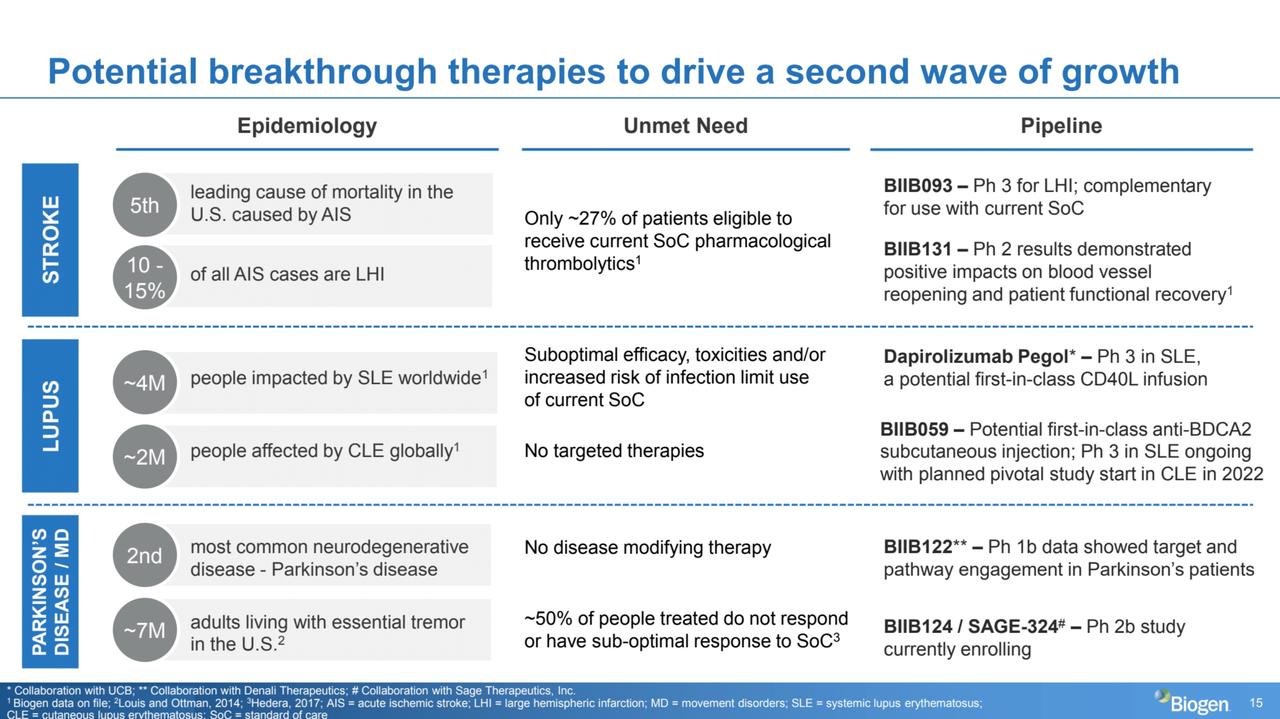
The company laid out its broader neuroscience portfolio, with drugs in development that the company hopes will treat brain disorders from Parkinson's Disease to Alzheimer's, and beyond.

Seeing as the fate of Abduhelm has held great sway over Biogen's stock price lately, the presentation unsurprisingly started with an update. The company pushed convincing-sounding research breakthroughs purporting to show a link between Abduhelm and a reduction in Alzheimer's-causing Amyloid plaques on the brain.

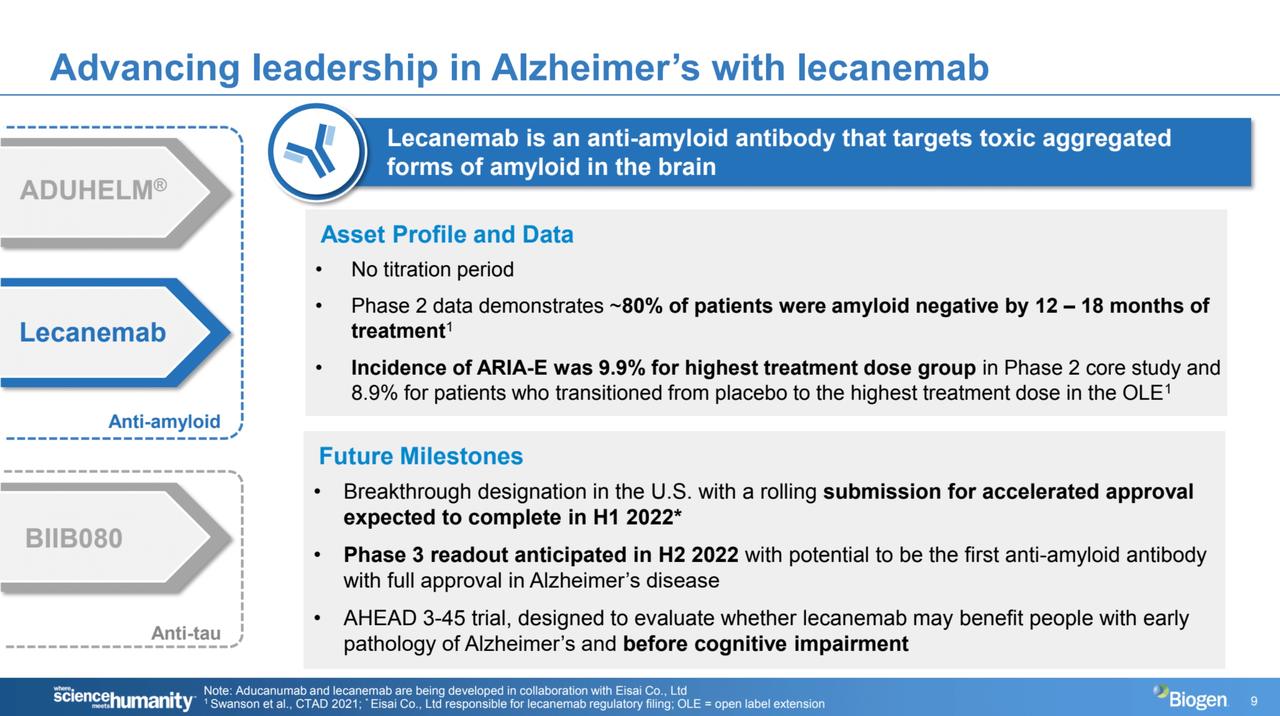
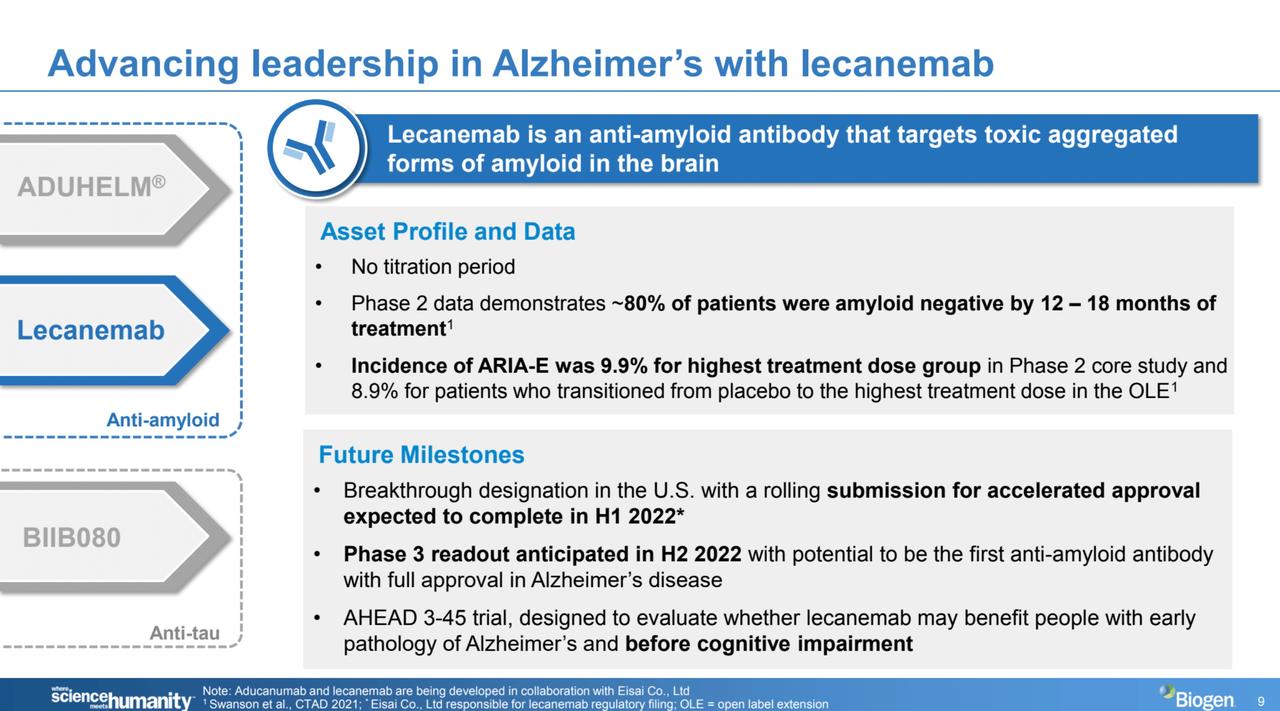
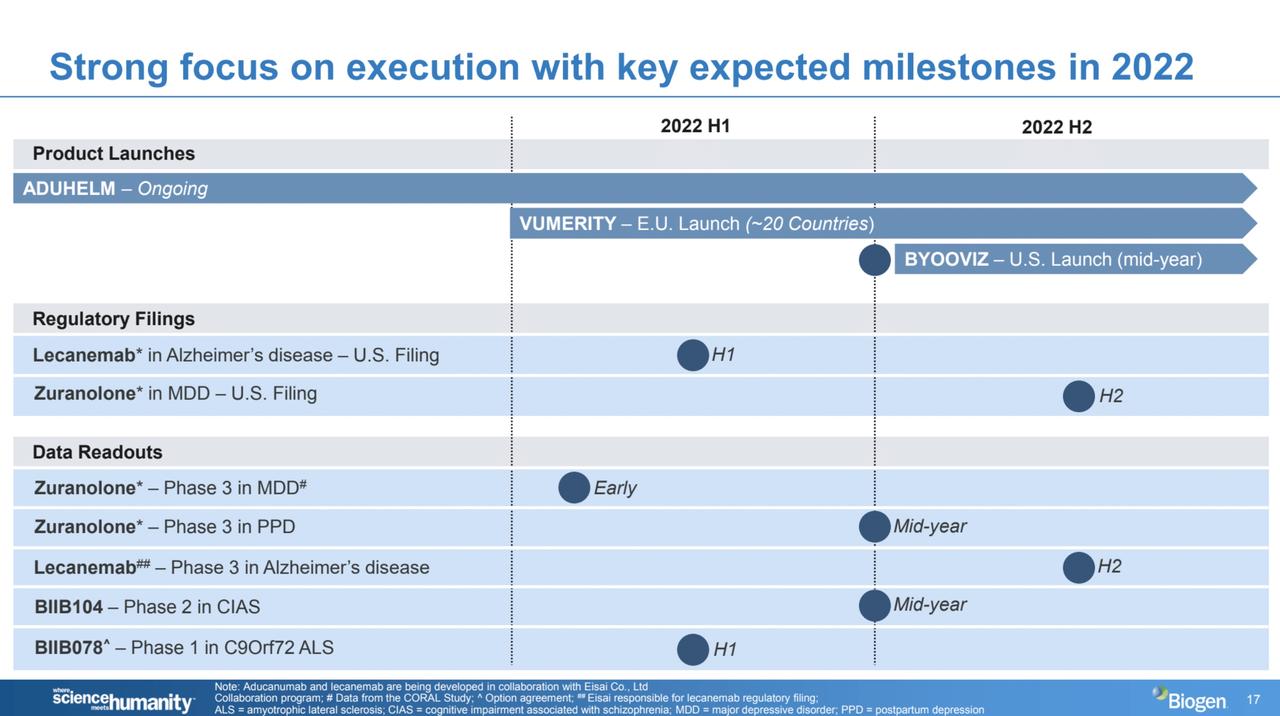
Additionally, the company laid out its case for a second Alzheimer's drug, Lecanemab...

...and a third, called BIIB080.

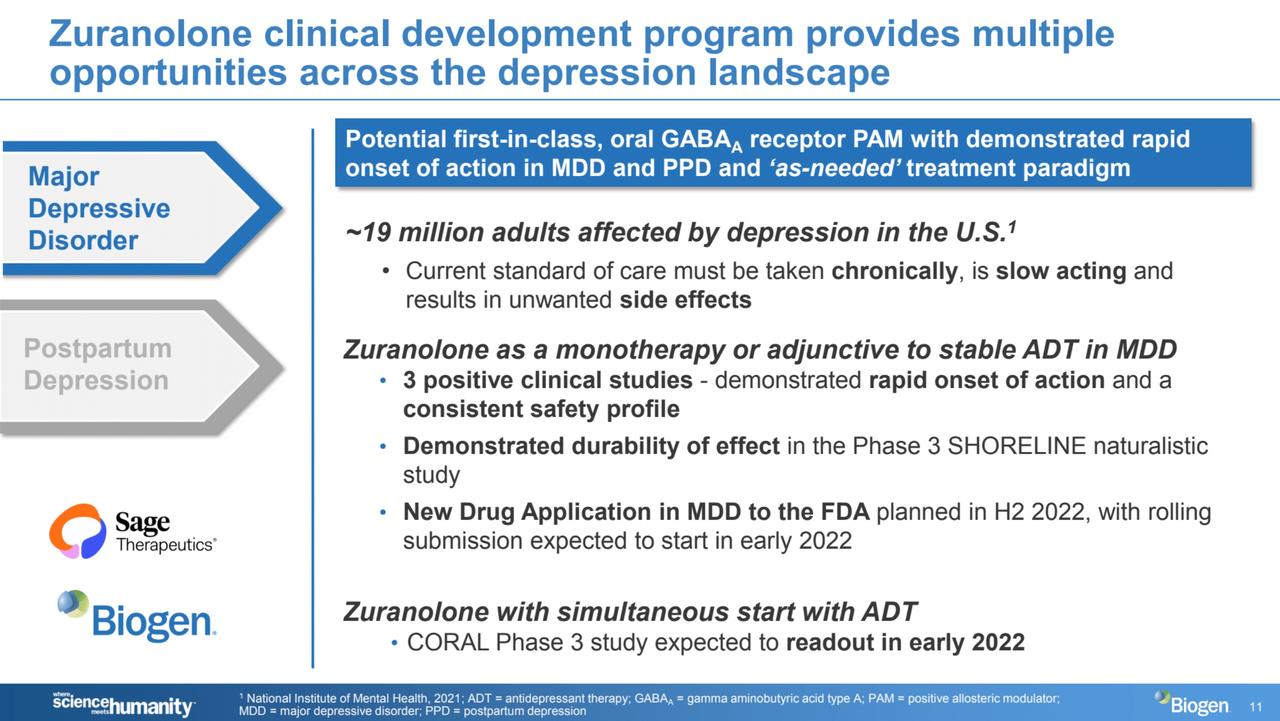
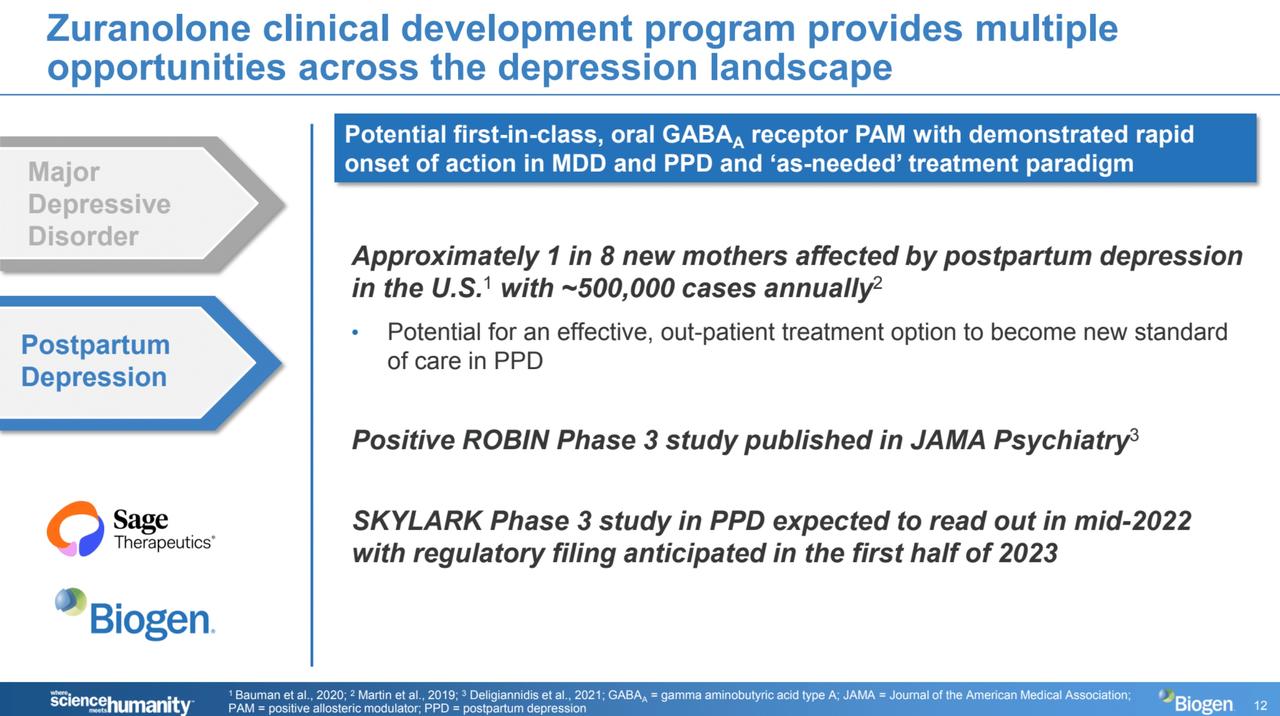
Additionally, Biogen shared some more data about its new anti-depressants (which are sure to be in high-demand given the mental health crisis unleashed by COVID lockdowns).

Those drugs are just part of a broader portfolio that Biogen continued to address piece by piece, while also laying out its broader vision for product rollouts over the next year or two.

Along with other "breakthrough" therapies that aren't as far down the pipeline that could drive revenue and EPS growth in the more distant future, since they're on an earlier stage of development.

Biogen shared what appeared to be a pretty optimistic timeline for the rollout of its various drugs, with many many projected to debut in Europe and/or the US later this year (assuming regulators comply).

Ultimately, the market seemed relatively impressed with the presentation, as Biogen shares turned positive for the day after the company's mid-morning presentation.

Interested readers can find the full slide show below:

Biogen at JPM 2022 Webcast by Joseph Adinolfi Jr. on Scribd