Search This Blog

Tuesday, January 11, 2022

Morgan Stanley Says US Omicron Wave Will Peak In 3 Weeks

 Morgan Stanley has called the top on Omicron, or at least offered a range of when the peak might arrive.

In their latest note to clients, a team led by equity analyst Matthew Harrison projected that the omicron wave in North America would likely peak within 3-6 weeks, which would place the peak of this wave at a slightly later point than last year's winter top in new cases identified.

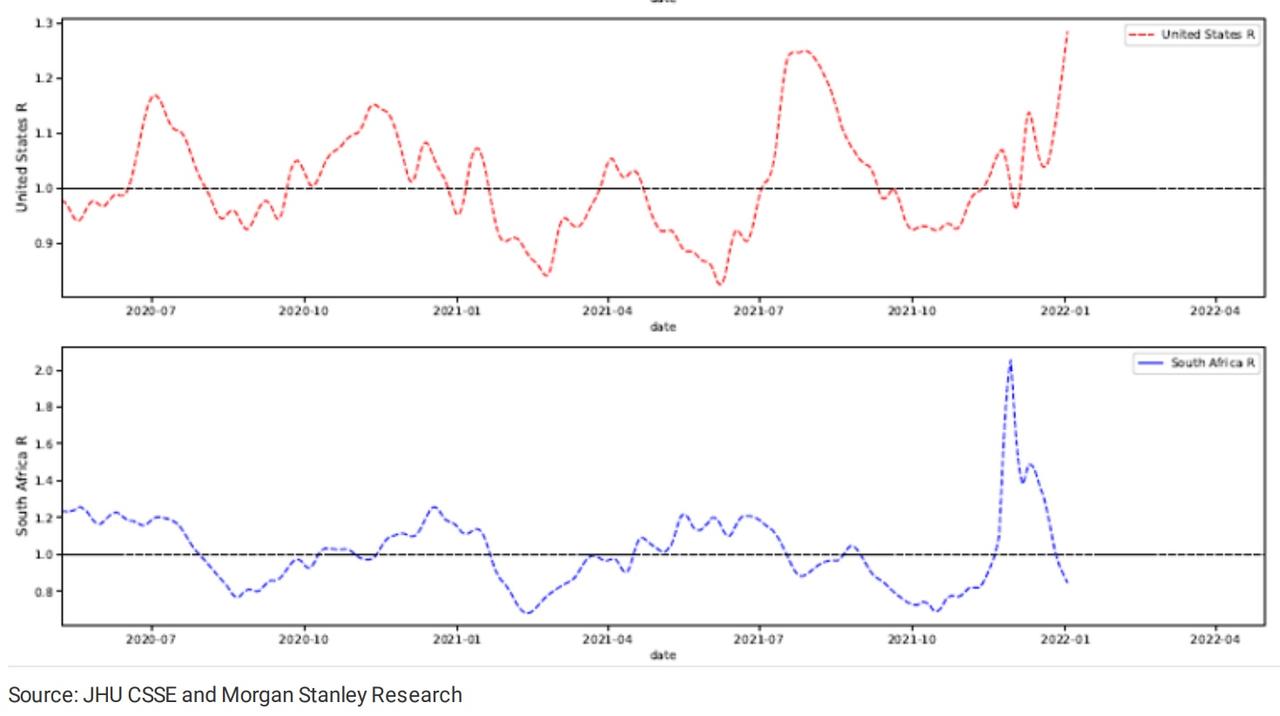
By using an "established relationship" between the virus's effective reproduction rate and the number of new case, the bank's analysts can look at the situation in South Africa, and help postulate what might happen in Europe and the US.

The case wave reaches a peak when R returns to 1. Currently in South Africa, R is below 1 and lower than last week, reflecting the steep decrease in cases. R is still growing (and thus cases are as well) in the US, UK,and EU, so, according to Morgan Stanley, the peak isn't in yet.

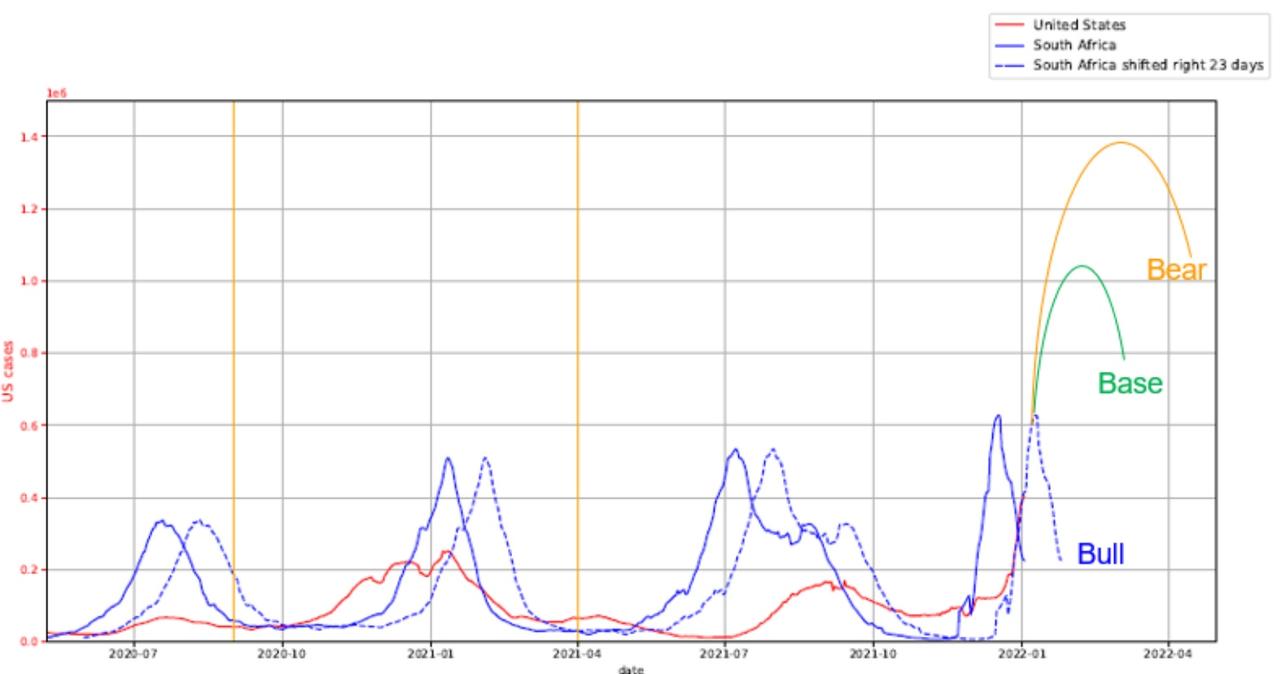
The bank used data from South Africa as a basis for its projections for the US and Europe. For example, it took South Africa 4-5 weeks to reach peak cases (mid-Nov to mid-Dec), which is faster than Delta (~9 weeks). And R peaked ~2-3 weeks ahead of the case peak and decreased from ~2 to ~1 in 20 days.

Assuming a similar trajectory in the US, Morgan Stanley laid out its bull base and bear cases for the omicron wave in the US.

And here's a comparison of the rate of viral reproduction in the US and South Africa.

The MS team explained that their bull case assumes a peak 1-2 weeks from now, while their bear case would mean the peak might be as many as 8 weeks distant.

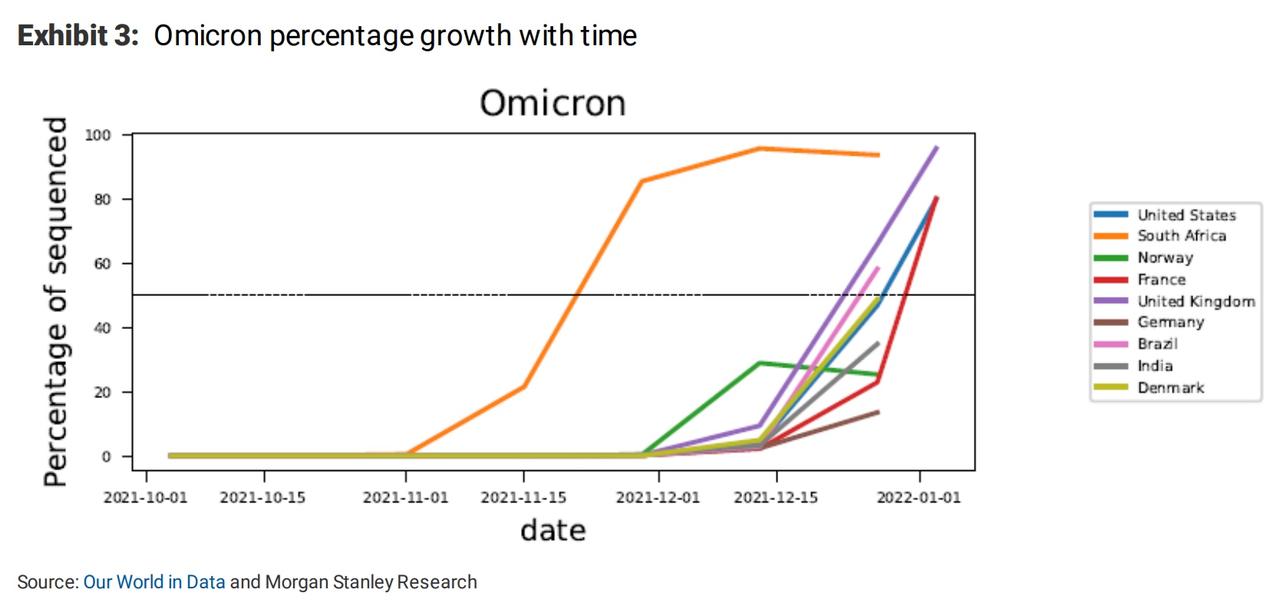
The note also included some insights about omicron's ability to crowd out the competition. Using the strain sequencing data from GISAID, the MS team was able to determine that omicron displaced delta as the dominant strain in under two weeks.

Finally, here's a comparison of the rate of transmission in various countries this week vs. last.

* * *
Source: Morgan Stanley

State of emergency declared in Virginia after record COVID-19 surge

 Gov. Ralph Northam (D) declared a limited state of emergency for Virginia on Monday to alleviate pressure on hospitals after the state has counted record COVID-19 cases and hospitalizations in recent days. 

The governor announced the emergency order that aims to boost hospital capacity and support “exhausted” health care workers after Virginia counted its highest daily COVID-19 hospital admissions on Friday.  

The order designed to provide flexibility to strained hospitals and staff is set to last 30 days because of modeling predicting a peak of cases “in the next few weeks” following the omicron variant surge, the announcement said. 

“It has been a roller coaster and we are not built for this kind of uncertainty for this long,” Northam said during a press briefing. “It has been hard on everyone.”

The order waives license requirements for hospitals to increase their bed capacity, permits out-of-state licensed providers to provide care in Virginia, grants physician assistants with at least two years experience to provide care without written agreements and gives some liability protections to physicians 

Northam is only in office for a few more days, as Gov.-elect Glenn Youngkin (R), who has the option of rescinding the order, prepares to be inaugurated on Saturday, although Northam anticipates Youngkin’s support.

The Governor has spoken to the Governor-elect, and is hopeful this order will remain in place for 30 days or until no longer necessary,” Northam spokesperson Alena Yarmosky said in an email. 

While the state points to the lowest case and death rates per capita, Virginia hospitals are still struggling with more than 3,500 COVID-19 patients statewide and rising flu and respiratory syncytial virus (RSV) patients. Most of those hospitalized for COVID-19 are unvaccinated, the governor said.

Virginia’s average daily case count has nearly tripled in two weeks, nearing 14,700 infections per day, and hospitalizations have doubled to almost 25,000, according to The New York Times tracker. But deaths have mostly decreased since the end of December. 

The highly transmissible omicron variant has sparked skyrocketing cases across the country, building pressure on hospitals nationwide. 

Maryland similarly ordered a 30-day state of emergency last week as its overwhelmed hospitals deal with the influx in patients. The D.C. Hospital Association has asked Mayor Muriel Bowser (D) to initiate a state of emergency, and the mayor said Monday that the administration is considering its petition.

https://thehill.com/policy/healthcare/589043-state-of-emergency-declared-in-virginia-after-record-covid-19-cases

Biden coronavirus vaccine-or-test mandate goes into effect

 Key components of the Biden administration’s COVID-19 vaccine or test mandate for more than 80 million workers went into effect Monday amid an ongoing Supreme Court battle that could ultimately doom the rule.   

The months-long legal battle over the requirement, which was previously blocked by a federal court before being reinstated, has created confusion among employers about how to move forward. While Supreme Court justices expressed skepticism about the rule on Friday, they did not block its implementation by Monday’s deadline.  

As of Monday, businesses with 100 or more employees were required to have a database of their workers’ vaccination status, post their company vaccine policy, provide paid leave to workers getting the vaccine and require unvaccinated employees to wear a mask at work.  

The Occupational Safety and Health Administration (OSHA), the agency tasked with enforcing the rule, has said it won’t issue penalties for noncompliance until Feb. 9. That’s the deadline for businesses to implement the weekly COVID-19 testing alternative for unvaccinated workers.   

“OSHA has been very careful to say that as long as employers are in good faith moving towards compliance, that they’re not going to issue any citations until Feb. 9,” said Domenique Camacho Moran, an employment attorney at New York-based law firm Farrell Fritz P.C.

“But if there’s an egregious violation, I don’t think employers can rely on the promise that there will not be a citation,” she added. “Employers need to take steps to immediately comply.” 

Simply collecting vaccination information has proven difficult for some businesses, particularly when it comes to getting unvaccinated workers to reveal their status. Business groups point out that federal agencies were unable to determine the vaccination status of hundreds of their own workers when they revealed agency-wide vaccination rates last month.

“Even the requirement of just figuring out who is vaccinated and who isn’t is a significant burden, and the confusion around court rulings and whether the rule is in effect hasn’t helped,” said Ed Egee, vice president of government relations and workforce development at the National Retail Federation, which asked the Supreme Court to halt the OSHA mandate.

The risks are high for employers that ignore the rule. Noncompliant employers could face fines of up to $14,000 per violation and potentially open themselves up to litigation from workers who contract COVID-19 in the workplace.   

Large businesses, particularly those in the manufacturing, retail and service industries, are most concerned about losing unvaccinated workers amid a tight labor market where 10 million jobs remain unfilled.   

Last week, the Postal Service asked OSHA for a 120-day extension to comply with the rule, stating that it would be “nearly impossible” to meet the deadlines in time and warning that the mandate would cause many employees to leave the already understaffed mail service.  

“Given the significant challenges that our nation’s supply chains are already experiencing, we respectfully suggest that the nation cannot afford the additional potential substantial harm that would be engendered if the ability of the Postal Service to deliver mail and packages is significantly negatively impacted,” Deputy Postmaster General Douglas Tulino wrote in a letter to OSHA officials.  

An October poll from the Kaiser Family Foundation found that 37 percent of unvaccinated adults would leave their job if they were forced to get vaccinated or submit to weekly testing, but only 5 percent of unvaccinated workers have actually left over vaccine mandates. Roughly 15 percent of U.S. adults remain unvaccinated.

While businesses initially cheered the OSHA mandate’s weekly testing alternative as a way to retain unvaccinated workers, they’re now confronting the challenge of finding millions of COVID-19 tests as the nation grapples with a severe testing shortage.   

Employers can opt to institute a strict vaccine mandate and ignore the testing alternative, but few have chosen to do so. When testing requirements go into effect on Feb. 9, businesses will have to compete with schools, hospitals and the general public for the limited supply of tests.  

“Employers can’t afford to scrap the testing option because they don’t have workers to replace these people,” Camacho Moran said. “And if unvaccinated employees can’t get tested, they can’t come to work.”

Business groups and labor lawyers are advising employers to purchase tests now, even at current sky-high prices, rather than wait for a Supreme Court ruling and risk being noncompliant come Feb. 9.   

“Our members are going out and trying to procure hundreds of thousands of tests for employees, and they don’t even know if this will go into effect,” Egee said.  

Employers are closely monitoring lawsuits from business groups and Republican-led states to defeat the rule. During oral arguments over the vaccine or test mandate on Friday, members of the Supreme Court’s conservative majority expressed skepticism about whether OSHA has the authority to issue the standard.   

The Biden administration argued that the rule will save the lives of more than 6,500 workers and prevent roughly 250,000 hospitalizations over the next six months. The U.S. is reporting record numbers of COVID-19 cases driven by the omicron variant, and vaccines drastically reduce death and hospitalizations caused by the virus.  

“Exposure to COVID-19 on the job is the biggest threat to workers in OSHA’s history,” Solicitor General Elizabeth Prelogar told justices Friday. “The court should reject the argument that the agency is powerless to address that grave danger.” 

https://thehill.com/policy/healthcare/589113-biden-coronavirus-vaccine-or-test-mandate-goes-into-effect

62K students, school staff in Los Angeles test positive for COVID-19

 Roughly 62,000 students and staff in the Los Angeles Unified School District have tested positive for COVID-19 ahead of the district's return to school on Tuesday.

As CNN reported, 414,000 test results have been recorded in the district, the nation's second largest. Of those tests, roughly 15 percent have tested positive.

This positivity rate is significantly below Los Angeles' overall positivity rate which is currently at 22 percent.

"We're all systems go," school district spokesperson Shannon Haber told CNN. According to Haber, about 4,000 credentialed staff members are prepared to jump in to teach if needed.

All students in the district are required to provide a negative COVID-19 test before returning to school this week.\

In a welcome-back message for students, Superintendent Megan Reilly said, "There may be a few lines at the start of the school day and longer wait times for buses. I wanna express my appreciation for your continued patience and partnership. Keeping our schools is a top priority and we truly thank you for doing your part."

Last week, the school district handed out free, at-home rapid COVID-19 test kits for students in preparation for the return to classes. The return to classes comes as many districts across the U.S. have begun shutting down schools in light of the highly-infectious COVID-19 omicron variant.

The Biden administration has placed its support behind in-person learning, pushing its "test to stay" policy for classrooms to reduce absences and quarantining among students.

https://thehill.com/homenews/state-watch/589131-62k-students-school-staff-in-los-angeles-test-positive-for-covid-19

Novavax CEO says its Covid vaccine could be cleared in multiple countries over next 90 days

 The Novavax coronavirus vaccine could be cleared by regulators for use in multiple countries, including the U.S., in the coming months, the vaccine maker’s CEO said Monday.

The company has filed for emergency approval with 10 different regulatory agencies, Stanley Erck told CNBC’s “Squawk on the Street.” It’s currently available for use in 170 countries, he said.

“I expect in the next 90 days we could have all 10 of them,” Erck said.

The company submitted its final data to the U.S. Food and Drug Administration on New Year’s Eve. It has yet to file the full application for emergency-use authorization, but will do so shortly and expects a decision from American regulators in February, he said.

Erck didn’t name the other regulatory agencies, but according to the company site, it has recently applied for approval in Japan, the United Arab Emirates, Singapore, New Zealand, Canada, Australia, South Africa and the United Kingdom.

Several other health agencies across the globe have already given their nod of approval to the vaccine.

Novavax recently shipped its first doses of the vaccine to Europe, Erck said, after receiving authorization from European Union regulators last month.

“Everything is coming together,” Erck told CNBC.

The vaccine could be in high demand. Novavax’s vaccine is protein based, using an alternative technology to the more widespread mRNA vaccines. Skeptics leery of the mRNA technology may be inclined to get the Novavax version, Erck said, which also has been seen to present fewer adverse side effects than other vaccines.

https://www.cnbc.com/2022/01/10/novavax-ceo-covid-vaccine-could-be-cleared-in-multiple-countries-soon.html

First transplant of a genetically altered pig heart into a person sparks ethics questions

 medical team at the University of Maryland Medical Center announced Monday that it had accomplished a world-first: its surgeons had transplanted a heart from a genetically engineered pig into a human. The doctors performed the eight-hour procedure Friday evening. As of Monday night, the man, 57-year-old David Bennett, is awake and breathing on his own, and his new heart is pumping away, according to his doctors.

Bennett had terminal heart failure and was too sick to qualify for a human heart transplant or a mechanical assist device, the lead surgeon said. The pig heart, from an animal created by a Virginia biotech company, was the only option to try to prolong his life. “It was either die or do this transplant,” Bennett said in a hospital news release. “I know it’s a shot in the dark, but it’s my last choice.”

The groundbreaking procedure raises hopes that animal organs might one day be routinely used for human transplants, which would shorten waiting lists — where thousands of seriously ill people languish and die every year. But it’s also raising a few eyebrows and a lot of questions from bioethicists.

“There’s still relatively little known about how safe this is to try in humans, so I’m viewing this with a little apprehension,” said Arthur Caplan, the founding director of New York University School of Medicine’s Division of Medical Ethics.

The transplant was not performed as part of a formal clinical trial, as generally required for experimental treatments. And the immunosuppressive drugs the patient was administered are also novel and have not yet been tested for this use in non-human primates.

It’s also renewing a debate about pigs and other animals as the source of human organs. Animal rights activists have condemned the surgery as dangerous and unethical. In a statement released Monday evening, PETA raised the potential for xenotransplantation to transmit animal viruses to humans and urged researchers to look elsewhere for solutions to organ shortages. “Animals aren’t toolsheds to be raided but complex, intelligent beings,” the organization said.

Scientists have been toying with animal-to-human tissue grafting and organ donation, collectively known as xenotransplantation, for centuries. Throughout the 1800s, doctors treated wounds with skin grafts from a variety of animals — most popularly, frogs. In the 1960s, 13 people received kidneys from chimpanzees. One lived an additional nine months, but the others died within weeks.

In a more controversial episode, doctors at Loma Linda University Medical Center in California transplanted a baboon heart into a premature baby born with a fatal cardiac defect in 1983. She lived for 21 days. It was later revealed that the surgical team had not sought out a human heart before opting for the riskier (and more headline-worthy) primate option.

After these and other failures, the medical community largely turned away from xenotransplantation. The human immune system was just too robust, too good at expelling alien intruders. But the arrival of new and better methods for altering DNA to create designer animals optimized for the purpose of producing human-compatible organs revived the dream. Now there are a handful of labs and companies chasing cross-species transplantation, including Harvard biologist George Church and eGenesis, a CRISPR-focused company that spun out of his lab.

The heart that Bennett received came from a pig created by Revivicor, a biotechnology company spun off in 2003 from PPL Therapeutics, the U.K. firm that produced Dolly the Sheep, the first mammal cloned from a cell from another animal. In 2011, Revivicor was acquired by United Therapeutics, the pharma company founded and helmed by xenotransplantation enthusiast and futurist Marthine Rothblatt.

In December, Revivicor won approval from the Food and Drug Administration for its GalSafe pigs, which have been genetically engineered not to produce a sugar that triggers organ rejection as well as an increasingly common meat allergy caused by a tick bite.

Revivicor is also raising a small herd of more extensively engineered pigs, containing 10 genetic changes intended to make their organs better suited to residing within a human body. The company has not disclosed what methods it has used to achieve these changes, which include inactivating a growth gene — so the porcine heart won’t continue to expand after transplantation — and other modifications to remove molecules most likely to provoke an immune attack.

It was an animal from this herd that was loaded into a van last week and driven five hours northeast to the University of Maryland Medical Center in downtown Baltimore. A few hours before the surgery began, surgeons removed the heart from the pig and placed it in a perfusion box — a mechanical device that pushed fluid through the organ to keep it preserved until the surgical team, led by Bartley Griffith, director of the cardiac transplant program at the medical center, could settle it into their patient’s open chest.

This dramatic bid to save Bennett’s life came after he had been in the hospital for more than a month, being kept alive by an artificial breathing machine, and his medical care team determined that he was too sick to be a candidate for either a human heart or an artificial ventricular assist device. Without either, he wouldn’t live long. “This was the only option available for an existing inpatient, already within UMMC hospital, who was facing near certain death from heart failure,” Griffith told STAT.

In December, Griffith contacted the FDA to obtain an emergency authorization through the agency’s expanded access, or compassionate use, pathway to use Revivicor’s pig heart. On New Year’s Eve, the FDA said yes. It also okayed the use of an experimental anti-rejection drug manufactured by Kiniksa Pharmaceuticals, and the perfusion device.

The medical team then notified the hospital’s institutional review board, which must sign off on all experimental treatments, which it did in this case. An informed consent was obtained from the patient after a thorough ethics review and psychiatric evaluation, Griffith said in written answers to STAT’s questions.

Caplan said that those would be the minimum conditions under which it might be ethically permissible to try something as new as putting an unapproved genetically engineered animal organ into a patient. But there are other things to consider. For example, what will the hospital team do if the patient’s immune system rejects the heart in the coming days and weeks? “You need to think hard about what you’re going to do if the patient is not succeeding and lay those options out during the consent process,” Caplan said.

In 1982, when another critically ill man named Barney Clark received the first artificial heart, no such options had been considered. Clark died a slow, torturous death, wracked by convulsions and kidney failure. His suffering may have advanced science, but bioethicists today consider it a lesson in what not to do.

Griffith did not say what sorts of options were discussed during the consent process with Bennett. “He was informed of the risks and that there were no proven benefits to this,” Griffith said via email. “He was told it was comparable to the care he was currently getting in terms of potential lifesaving benefits.”

There’s also the question of what exactly scientists can learn from a procedure like this one, taking place outside the framework of a clinical trial, and with a patient who is on his deathbed. Trials take months, sometimes years, to set up because they’re designed to gather a bevy of biochemical and physiological information to say conclusively whether or not a treatment is safe and effective. According to Griffith, Bennett, if he survives, will be closely monitored in the hospital for several weeks or even months, until he can be sent to a rehabilitation center. He did not provide specific details about what sorts of data they plan to collect.

Caplan has argued that before clinical trials of engineered animal parts can proceed, researchers need more information. At his home institution, New York University, which is also in the race to xenotransplant, he proposed testing these types of organs first in newly deceased humans — to gain preliminary insights about how to safely proceed. Beginning late last year, NYU Langone has done two experiments testing genetically modified pig kidneys in the donated bodies of people who had recently died and were being maintained on a ventilator. That research showed that organ rejection of a xenotransplant can be prevented during the first few days.

Griffith said that work gave his team more confidence in proceeding. But he acknowledged that the longer-term outcomes are unknown. “Rejection of the organ can occur any time after transplant,” he wrote. The surgeon added that while organ rejection, which can be life threatening, is the greatest risk Bennett faces, there are also risks from the drugs used to suppress the immune system to prevent rejection. “The intensity of immune system suppression required is higher with a xenotransplant than with a traditional transplant from a human donor,” he said.

It’s still unclear when a formal test of engineered pig organs might move forward. When asked about the company’s plans to test its pigs organs in a clinical trial, Dewey Steadman, a Revivicor spokesman, declined to share any details. “We are continuing to work with the FDA on a clinical and regulatory path forward,” he said via email.

https://www.statnews.com/2022/01/10/first-transplant-of-genetically-altered-pig-heart-into-person-sparks-ethics-questions/
Spain's PharmaMar says potential COVID-19 treatment shows efficacy against Omicron

 Spain’s PharmaMar said on Tuesday trials made in vitro and on animals showed its Plitidepsin drug had positive antiviral effects on the variants of COVID-19, including Omicron.

The results of Phase I trials have shown the drug, also known as Aplidin, had a powerful antiviral activity against all the variants in vitro and a distribution into the lungs of animals tested, resulting in a 99% reduction of viral load in the lungs, the company said.

The results of the trials were released in a paper published in the scientific journal Life Science Alliance, PharmaMar said.

The paper also reported positive effects of Phase I and II trials on patients.

“All data we have seen so far with Plitidepsin corroborate our initial hypothesis of its activity as antiviral,” PharmaMar’s Jose Maria Fernandez Sousa said in a statement.

The drug is being tested in final Phase III trials on patients.

https://leaderpost.com/pmn/business-pmn/spains-pharmamar-says-potential-covid-19-treatment-shows-efficacy-against-omicron