Search This Blog

Thursday, May 5, 2022

Why is U.S. national data so terrible?

 A week or two ago, I got an unexpected call on my cell phone. It was Rochelle Walensky. Yes, the Director of the CDC. Apparently she (and many others at the CDC) are big YLE fans! Which is… wild.

During our conversation, the topic of data came up. Why are we flying blind in the U.S.? She connected me with Caitlin Rivers. Dr. Rivers works at Johns Hopkins and was recruited by the CDC in 2021 to help open their new Center for Forecasting and Outbreak Analytics. I had so many questions for her, like: Why is our national data so abysmal? Why don’t we collect antigen tests to better understand community transmission? Why don’t we have real-time data, like the U.K. or Israel, to assess vaccine effectiveness? How can we fix all of this? She was kind enough to let me record our conversation. Thought you would appreciate the answers to these questions! The recording is above, the transcript below.

Love, YLE

P.S. I am not a Zoom whiz, so excuse the end! Also, you’ll notice the name Carol Williams on the recording. She was just listening as she is a new team member at the Center for Forecasting and Outbreak Analytics who is focusing on health communication!

Transcript

Dr. Jetelina: Hi YLE Universe, this is Katelyn, Your Local Epidemiologist. You finally have a face and a voice, although I do have a cold right now, but I’m really excited because this is obviously something very different than what I’ve been doing on this platform for the past two years. I’m actually going to be playing reporter for once and talking to one of my pandemic heroes. A week or two ago, Director Walensky put me in contact with the Caitlin Rivers. Dr. Rivers is an assistant professor at the Center for Health Security at Johns Hopkins School of Public Health, and she actually focuses on public health preparedness, which we obviously desperately need going forward. But in 2021, I believe, she was snatched by the CDC to serve in a temporary role as Associate Director to their new center, which is called the Center for Forecasting and Outbreak Analytics. It’s new, but the whole point is to improve outbreak response using data, using modeling, using analytics, and also, like I heard this morning, using communication, which I’m super excited about. And boy do we need it. So, I understand that she will return to Johns Hopkins once the center has gotten off the ground. So Caitlin, welcome! Thank you so much for taking time this morning. 

Dr. Rivers: Yeah, thanks for having me! I’m glad to be here with you. And we share a namesake, so that’s always exciting.

Dr. Jetelina: Yeah, I know! Katelyn, epidemiologist, is talking to Caitlin, epidemiologist. So, I guess I’ll just dive in. So throughout this pandemic we’ve been flying blind. It’s been [for] many reasons, but one of the biggest is we just don’t have national data to drive data-driven decisions proactively in real time. I think a classic example of this is vaccine effectiveness. We just don’t know how well our vaccines are working right now in the face of new variants, over time, and we constantly really have been looking to other countries like the U.K. or Israel to help guide our decisions in the United States, [and] we are a very different population than them. So, Dr. Rivers, what’s going on? Why are we in this position right now?

Dr. Rivers: Well, we’re not where we want to be with our public health data, and that’s something we’re working really hard on at CDC. Part of the reason that we have not had the insights that our colleagues from the U.K. or Israel have had, there’s a few reasons. The first that you’ll hear, and most often repeated, is that we don’t have a national health system, unlike those other two countries, and that is a struggle. Our public health is federated—our state and local jurisdictions are each kind of independent entities that collect and share data according to their priorities and their specifications. And that is different from places where everyone receives their medical and public health services from a national network. But there’s actually another issue, that doesn’t get as much attention, that I think is a bigger problem for how we collect and share data in the United States, and that’s that the CDC doesn’t actually have the authority to direct data collection. We get all of our data through individual data-use agreements with every jurisdiction on basically every public health issue. And you can imagine, it’s a pile of paperwork that is slow and cumbersome and particularly in a fast moving health emergency, that infrastructure is just not really well suited to collecting and sharing data. 

Dr. Jetelina: I guess that means, also, we are dependent on how they collect that data, so the rigor of it. And then also what they agree and don't agree to share. Is that right? I mean they can say no.

Dr. Rivers: They can say no, yeah. Luckily we have a good relationship with our public health partners, but it's a precarious situation, because if the DUA doesn't go through, if the various people who have to sign it are on leave, if there is some sort of point of friction, they can take their data and they can go home really, so that the CDC doesn't have the data that it needs to be able to understand what's happening in the communities across the country. But, I do want to highlight one thing you said at the beginning which is the different data elements. It's a little bit of a wonky thing that like epidemiologists care a great deal about, but the importance of it might not be immediately apparent, but if every jurisdiction is collecting different data or collecting it in different ways, it's really hard to aggregate that into a national picture that really gives us a sense of what's happening across the country. And I think race and ethnicity is one example that stands out to me. We were very late in the pandemic to recognize the disparities across race and ethnicity, the disparate impacts, and that's because many jurisdictions didn't collect race and ethnicity, or they collected it in ways that didn't make sense when you aggregated it to the national picture. And the CDC doesn't have the authority to really standardize that, and that's part of the reason why there are gaps in our understanding. 

Dr. Jetelina: Yeah, the other thing that I've noticed is—and I would be curious to hear your perspective—is age. So, for example, like with kid data, right? So, some, I feel like some jurisdictions report just all those under 18, some of them report in buckets and these are different buckets, and so when you start combining all of them, you don't know what basically the rate is for under fives compared to adolescents on a national level. And that seems, you know, that's important because we have such—even though some states are really rigorous in their data, we need it across the plane because we're so huge and we're so diverse that, people in Texas, for example, are very different and they're in a different environment, genetics, than those in New York, for example. So, yeah, I hear that and I've seen that too. Now what data are we talking about? Are we just talking about vaccine data or is this across the board?

Dr. Rivers: It's across the board. There are a few exceptions like the Nationally Notifiable Disease System, that is a compulsory report to CDC in a standardized way. But, for basically all other data, this is how it works. What many people don't realize is that the hospitalization data for Covid, for example, is tied to the public health emergency declaration. When the declaration goes away, which it will, our ability to require reporting of the Covid hospitalization data will go away. There are a few fixes in the works, like CMS, I think has recently extended the hospitalization data, but I'm using that as a window into a wider set of problems that our data flows are really precarious and it puts us in a tight spot.

Dr. Jetelina: In the same vein right now, I think it's really difficult because we know that we're severely under-reporting cases right now and this is problematic because we are asking people to make their individual decisions, based on metrics in their county and we just don't know the level of transmission. For example, one I saw was that for every 100 cases, only 7 are officially reported. And that's for a lot of reasons, but one of them is because of at-home antigen testing. Is that the same deal? Like I know some jurisdictions have put in systems for antigen testing, but not all of them, and so is that why we don't have a national picture?

Dr. Rivers: I think the antigen testing is also a technical problem since there are not great systems to be able to capture what results people are recording at home. But to the extent that we're thinking about cases, hospitalizations, and those metrics are subject to these limitations where we get what the states have voluntarily agreed to give us. 

Dr. Jetelina: Yeah, I would just feel like, maybe in the future I mean, can't we just put together a website on CDC and just throw out a campaign and be like, “Hey, can you guys just please report your antigen test?” so we have some understanding of that on a national level, or is that just not feasible?

Dr. Rivers: Well, that reminds me of like the Flu Near You work that Harvard Children's Hospital has been leading for years, and there's now a Covid Near You, and I think those kinds of projects can be interesting windows into what is happening in communities. It's just hard because it's subject to so many biases, like who is receiving the messages that they should be reporting? Who has access and time to be able to do that? And then without a denominator, it's also hard, like I have trouble making sense of what to do with that data, but I think these non-traditional approaches for doing surveillance are really interesting. And particularly for us, at the Center for Forecasting and Outbreak Analytics, modeling can be an interesting approach for weaving together these different data sources, sort of making them more than the individual parts.

Dr. Jetelina: Yeah, absolutely. So what I understand—we have this decentralized system in the United States, and the CDC asked for the national picture. That report, that data, gets collected at the local level and then reported up to the CDC. And so what that means is you guys are dependent on, or we are dependent on, local jurisdictions either being excited to share this data and really on the ground, or local jurisdictions being like, “No, we don't want to share this.” So what's the scoop? Are you allowed to share like which states or which local jurisdictions have been super helpful and others that haven't?

Dr. Rivers: Well, I'll just highlight that the status quo is not that great for states either. It's great that they're able to control their data and they are the ones at the front lines of the community. But for example, if you look at the cases of acute hepatitis that are kind of popping up, we're still really learning what's happening, where they're happening—it's the very beginning of the investigation. But the states are asking CDC, “What's going on with acute hepatitis?” But if we don't have—if we can't look across states, if we're waiting for the states to report voluntarily, it's slow. And so it's hard for the states too to understand what's happening with their neighbors, what's happening across the country, because the system is just a little bit gummed up. 

Dr. Jetelina: Yeah, that makes a lot of sense. And I would assume that, I mean, willingness to share over time changes with the normalization of a pandemic and people wanting, like some states or jurisdictions, wanting to move on and some others saying, “Hey, this is still a problem.” Have you seen that kind of change and willingness to share over time?

Dr. Rivers: I think the importance of public health data has changed, like it's more widely recognized now as like practically a national sport to check your local Covid levels. And so I think the importance of public health data has really changed over time. Willingness, I'm not sure we've seen any major differences just because Covid is not the first time that we’ve faced, that we've tried to manage public health surveillance in this way. It's a long-standing set of relationships, but I think that our collective understanding of why it's so important to have high quality, timely detailed public health data is at an all-time high.

Dr. Jetelina: Finally! Finally, we epidemiologists have been shouting from the rooftop, so I guess that's, I don't know, a silver lining to the pandemic. So one thing you actually mentioned briefly at the beginning—and I wanted to dive into this a little more—is that the importance of this emergency order and how we expect that will be lifted probably this summer through whispers. But what are the implications of that, I mean, what's going to change? Are we going to be flying blind even more?

Dr. Rivers: Hopefully not, but it's possible. There are a lot of data streams tied to the public health emergency declaration. Hospitalizations is always the first one that comes to my mind because it's so important for the community burden indicators that CDC is using to tell people what the risk is in their communities. Hospitalizations is tied to the public health emergency declaration. CMS, just this week, released a rule that I think is going to extend the reporting through 2024, so maybe we have a little bit longer of a runway for that, but there's also cases, there's electronic lab data, there's all sorts of data streams—and I don't have the full list but it's quite extensive—of what is tied to emergency declaration. And so I do think that there will be changes in our ability to understand what's happening with Covid.

Dr. Jetelina: And for everyone listening, can you describe what CMS is?

Dr. Rivers: CMS is the Centers for Medicaid and Medicare Services. It is the government agency that provides Medicare and Medicaid coverage to millions of Americans, and they have an enormous role in policy making because they provide so much coverage to just so many people. They are able to have great influence on data reporting, for example. 

Dr. Jetelina: So once the emergency order is lifted and, say, CMS continues to work their butts off to figure out a way about hospitalizations, but even that then is a biased sample. That's not a very good generalizable sample if we're just looking at Medicaid and Medicare, right? Because we have an entire population that's also insured through private insurance, no?

Dr. Rivers: A little bit over my skis here, but I think because CMS covers so many Americans, that when they set a policy like that, it generally is far reaching enough that we'll get data beyond the covered population. 

Dr. Jetelina: So at least some kind of general understanding of, like, how well our vaccines are working. The other thing that has been interesting is the “with Covid” and “for Covid” hospitalizations. And that seems to be very dependent on local jurisdiction as well, right? So that's why, for example, the CDC can't report that on a systematic level?

Dr. Rivers: That is tied to our inability to require reporting of certain data elements. It's up to jurisdictions to decide that they want to collect that data and to report it to us and because it's just not a priority everywhere, our picture is uneven. 

Dr. Jetelina: Yeah, okay, so my last question for you: how do we fix this? I mean, so the virus is going to continue to change. We know that, we expect it's going to continue to mutate and then, also, this isn't going to be the last virus. I mean like you said, we're seeing acute hepatitis, we are seeing Ebola over in Africa right now, we're seeing avian flu virus. I mean, how do we fix this? It seems pretty ingrained in our culture and systems in the United States.

Dr. Rivers: Yeah, so CDC, with support from Congress, is investing about 1 billion dollars in improving the public health data infrastructure at the state and local level. We want to make it as easy and as technologically modern as possible to collect and report public health data, and so we have a big project, investing a lot of money in making that possible at the state and local level. But there is still this authorities piece where we may make those investments and not necessarily receive that data, and so I think updating our authorities to be able to synchronize and standardize our data reporting would improve our ability at CDC to understand what's happening in communities across the country and improve the ability for state and local jurisdictions to understand what's happening with their neighbors and what do they need to be aware of across the country. So I think that was one outstanding piece that would really help us to improve our public health data picture.

Dr. Jetelina: Now, in the first thing you said was money, which is obviously incredibly important, but isn't—because the CDC is under Congress's authority, I mean can't that money leave too? Or, I mean, or is that kind of guaranteed support? I don't know how that works.

Dr. Rivers: The money that we are investing in the data modernization initiative has already been appropriated, so it’s going out.

Dr. Jetelina: Okay, awesome. But for future, it may or may not be there.

Dr. Rivers: That’s right.

Dr. Jetelina: Okay. Interesting, well that's slightly terrifying, but at least it's coming on the ground. Well, thank you so much, Caitlin, for providing your insights! Is there anything else that I missed that you want to share?

Dr. Rivers: Yeah, thanks for the opportunity. Any CMS experts out there, I’m sorry I bungled your important role that CMS policy plays in our public health and medical system, but I'm glad for the opportunity to share a little bit more about how public health data works. 

Dr. Jetelina: All right, thank you so much, Caitlin. Bye, everyone!


https://yourlocalepidemiologist.substack.com/p/why-is-us-national-data-so-terrible?s=r

New Covid XE variant 'makes people test positive for longer'

 A medical expert has warned that people who get the new Covid variant are testing positive for longer. Immunologist Denis Kinane says the emergence of the Omicron XE variant proves Covid-19 will continue to adapt, and that members of the public and health authorities need to remain vigilant as the virus evolve.

Professor Kinane, Leading Immunologist and Founding Scientist of Cignpost Diagnostics, told The Mirror that data is showing people testing positive for 10 or more days with this variant. He warned this means the virus has the ability to spread more widely - and said this coupled with the scrapping of free testing could leave vulnerable groups even more vulnerable.

He said: "One of the key differences with our current variants is that in some individuals they continue to be PCR positive at high levels, previously associated with being infectious, for much longer.

"Our current data is showing that many people are testing positive for 10 days or more rather than the 6 or 7 days we saw by frequent testing at the beginning of the Omicron wave, which means the virus has more opportunity to spread more widely and this may be BA-2 and XE’s transmissibility advantage.

"Since testing levels have decreased due to the Government’s lifting of regulations for travel etc. we are testing much less now and not sequencing the virus to any great extent. Thus we cannot be definitive on which variants are the ones that seem to be persisting.

"This is naturally leading us to question whether current regulations are able to combat the spread of a variant which appears to be transmissible for longer periods of time, namely the scrapping of self-isolation rules and the recent ending of free testing in England."

"I completely understand the Government’s desire to return to normal as soon as possible. However, the decision to end free tests will leave many vulnerable groups extremely vulnerable to Covid-19 including the immunocompromised, as people in their social circle will not be tested and may be asymptomatic carriers."

https://www.walesonline.co.uk/news/uk-news/new-covid-xe-variant-makes-23858633

Doctors probe reported rebound in symptoms after Paxlovid

 When Laura Martin tested positive for COVID-19 last month during an extended stay in California, she was prescribed Paxlovid, the highly touted antiviral drug created by Pfizer.


Just one day after her diagnosis, she started her five-day course of pills, which have been shown to dramatically reduce the risk of hospitalization and death.

Martin, a 63-year-old Boston native who now resides in Canada, said she was thrilled when her symptoms began to subside.

"By the end of [the treatment], on Day 5, I was negative and feeling completely normal like without any symptoms, so I thought, 'Wow, this is really great. What a great drug,'" Martin told ABC News.

Martin resumed her normal activities, but a week later, she began to feel ill again. When her symptoms worsened, she tested again.

"It came roaring back, and this round two has been much more severe than round one was," Martin said. "This is like four days of much more significant symptoms than round one."

Martin's case is part of a seemingly rare, but increasingly reported phenomenon of COVID-19 symptom recurrence after being treated with Paxlovid. While it is largely unknown what is causing the reported viral resurgence, scientists say they are investigating.

Pfizer says that it is taking the reported incidences of recurrence "very seriously," but that the rates mirror those who received a placebo in clinical trials. Experts urge that the benefits of the drug, in preventing hospitalization and death, outweigh the potential risk of a second positive test or symptom reemergence.

In additional analysis of the Paxlovid clinical trial data, the Food and Drug Administration (FDA) reported that most patients "did not have symptoms at the time of a positive PCR test after testing negative, and, most importantly, there was no increased occurrence of hospitalization or death or development of drug resistance."

Company executives also reported, this week, that the use of Paxlovid continues to expand rapidly, particularly as infection rates across the country rise again. In the U.S., use of the treatment has increased by nearly ten-fold in recent weeks.

The number of locations in the U.S. with Paxlovid supply has grown to more than 33,000 sites now available, a four-fold increase since late-February. In addition, the company reported that there are now more than 2,200 Test to Treat locations now open.

'Game-changer'


Long heralded as a "game-changer" in the fight against COVID-19, the push to make Paxlovid available to Americans has ramped up in recent weeks, with the White House looking to increase supply of the treatment.

The drug, which was granted emergency use authorization by the FDA in December 2021 for people with mild to moderate COVID-19 at high risk of disease progression, is also strongly recommended by the World Health Organization. It has been shown to be highly effective, estimated to provide an 89% reduction in virus-related hospitalizations and deaths.


However, in recent weeks, a number of patients, who have taken the treatment, have taken to social media to disclose what they say is a perplexing phenomenon of COVID-19 symptoms reemerging after they finished the prescribed five-day treatment course.

Some individuals claimed on Twitter that after their initial symptoms dissipated, leading to a negative test, they are once again testing positive.

"We're seeing people get better on Paxlovid," Dr. Shira Doron, an infectious disease physician and hospital epidemiologist at Tufts Medical Center, told ABC News. "But then, when they stop at the end of five days, we're hearing stories of symptoms coming back and even, tests becoming either more positive, i.e. a darker line, or tests that had gone negative turning positive."

Studies have found that a dark line can "indicates a strong positive with a high level of virus and is usually seen when people are at or near peak virus load."

Reports of these "rebound symptoms" are largely anecdotal so far but with an increasing number of questions about the puzzling viral recurrence, scientists across the country are trying to assess what may be happening in new research.

Pfizer takes reports of rebounds 'very seriously'


In February, a 71-year-old man in Massachusetts who had been vaccinated and boosted recovered after being treated for COVID-19 with Paxlovid, Dr. Michael Charness, chief of staff at the VA Boston Healthcare System, who has been researching the phenomenon and recently put out a preprint study last week, told ABC News.

However, around nine days after his initial positive test, Charness said his patient developed cold symptoms and tested positive again for the virus.

Molecular testing soon revealed that the patient's viral load had increased to an even higher point than when the diagnosis was first made, according to an analysis by Charness and his team.

"We were interested in whether this was a new infection or whether this was maybe an adaptation or mutation that somehow changed the variant," Charness said, adding that gene sequencing demonstrated that this second positive test demonstrated a recurrence of the original infection in an individual who had no symptoms for a week.


"We just were very struck by that," said Charness. "I heard from people all over the country and some from other parts of the world, who had had the same experience."

Representatives from the FDA, the Centers for Disease Control and Prevention and the National Institutes of Health, told ABC News that teams of scientists are investigating the surprising relapse reports, and they will provide further recommendations, if appropriate.

"The phenomenon of recrudescence reiterates the importance of following CDC's isolation guidance - anyone who develops symptoms of illness during or after isolation should remain isolated, masked, and seek out testing and clinical care," a representative from the CDC told ABC News in a statement. "Anyone who is concerned about having been exposed or who for any other reason wants to determine their infection status should test for COVID-19."

The FDA stressed that the reports "do not change the conclusions from the Paxlovid clinical trial which demonstrated a marked reduction in hospitalization and death."

The viral recurrence had been observed and reported in Pfizer's application to the FDA, last year, in which the company said several trial participants had appeared to "have a rebound" of COVID-19 around day 10 or day 14.

Pfizer executives said Tuesday that they are taking the reports "very seriously," but they do not believe that it is related to the drug, given that the same rate of rebound was observed in people who took the placebo. Further, no connection was noted between the viral load increase and subsequent severe illness.

"We've taken a preliminary look at our high-risk data, and so we've seen for example, that we have about an incidence about 2% of that viral load rebound, but we also see the same, or close to the same, percent in the placebo arm. So it's something that's not particularly associated with Paxlovid itself, but may have something to do with the virus itself," Dr. William Pao, Pfizer's executive vice president and chief development officer said during an investors call on Tuesday. "It's preliminary data so far, we again take it very seriously. But it's very current, and a very low incidence, and we continue to learn as we go."

A representative from Pfizer told ABC News that although it is too early to determine the cause, initial indications suggest an increased viral load is both uncommon and not uniquely associated with the Paxlovid treatment.

"We remain very confident in its clinical effectiveness at preventing severe outcomes from COVID-19 in high-risk patients," the representative said.

Reports uncommon but happen 'frequently enough'


Although official reports of these relapses still appear to be rare, such occurrences are happening "frequently enough" in those treated with Paxlovid that Charness said that it should be studied further.

"I think the first step in studying something is to know that it exists," he explained, adding that it is particularly important for clinicians to be informed about potential rebounds, and for the public to know, so that people do not become unduly alarmed.

Thus far, researchers know very little about the reason for the recurring symptoms.

Of critical importance in the investigations is whether an individual, in the midst of such a rebound, remains infectious, Charness said.

"We are sufficiently concerned about whether people can transmit, when they're on day 12 and 13 and 15, that we are essentially recommending that when people have a recurrence, a rebound, that they restart their isolation, and isolate until their antigen test is negative," Charness said. "We're seeing people whose antigen test stays positive for a week after they rebound, which means that they're well outside the CDC's 10-day guidance.

Should you experience a viral rebound, the FDA is now recommending that health care providers and patients refer to CDC guidance, wear a mask and isolate if they have any COVID-19 symptoms - regardless of whether or not they have been treated with an antiviral.

Charness and his team are also encouraging their patients to start their isolation period over again and stay away until their antigen test is negative.

"It's important to exercise caution until you clear the virus the second time," Charness said, further urging people to notify their provider.

In terms of further treatments, Charness noted it is still largely unclear what patients should do. While there are no limitations, within the authorized label, around additional usage of the drug for a subsequent COVID-19 infection, according to Pfizer, the FDA said "there is no evidence of benefit at this time for a longer course of treatment ... or repeating a treatment course of Paxlovid in patients with recurrent COVID-19 symptoms following completion of a treatment course."

Despite the reports of rebounding, health experts stress that Paxlovid is still largely achieving its original goal, to keep people out of the hospital, and severe disease at-bay.

"The bottom line is if it prevents hospitalization, if it keeps you from progressing to severe disease, hospitalization and death, the fact that you might have a recurrence of some of the symptoms and even the recurrence of a positive test is sort of secondary," said Doron. "The main thing is Paxlovid is to prevent progression to severe disease [and] hospitalization, and it does. So, it's still doing its job."

Most US kids have caught the coronavirus, antibody survey finds

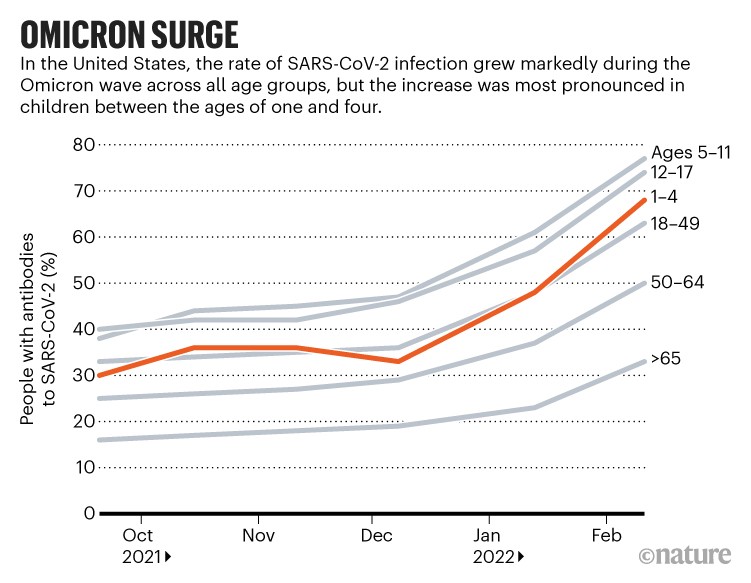
 Roughly two in every three children aged between one and four years old in the United States have been infected with SARS-CoV-2, according to a nationwide analysis1. Infections in that age group increased more than in any other during the Omicron wave, which researchers say demonstrates the variant’s high transmissibility.

Researchers looked for COVID-19 antibodies in blood samples from more than 86,000 children under 18 years old — including some 6,100 children aged between one and four. In the youngest children, the number of infections more than doubled, from 33% to 68% between December 2021 and February 2022.

Although the analysis involved a small number of very young children, the results are consistent with the rapid rise in documented infections in that age-group, says Pamela Davis, a physician and medical researcher at Case Western Reserve University in Cleveland, Ohio.

Overall, the researchers found that most children aged 1–17 had probably been infected by February this year. Infections in children aged 5 to 11 reached the highest level, 77%. Infection rates in children exceed those observed in adults (see ‘Omicron surge’).

Omicron surge: Line chart showing proportion of people with antibodies to SARS-CoV-2 by age range over time.

Source:

These are important findings, especially for low- and middle-income countries where vaccination rates are low in adult populations and where children probably won’t be vaccinated for some time, says Fiona Russell, a paediatrician and infectious-diseases epidemiologist at the University of Melbourne in Australia. The immunity generated from an infection could help to prevent future infections and serious illness in kids, but “the pandemic is not over until children worldwide are also offered vaccination”.

Missed infections

Reported cases of COVID-19 in the United States suggest that some 17% of children under age 18 have been infected. “That’s just the tip of the iceberg,” says Kristie Clarke, a medical epidemiologist at the US Centers for Disease Control and Prevention in Atlanta, Georgia, who led the study, which was posted online this week without peer review. Reported cases, based on PCR and antigen testing, grossly under-represent the true rate of infection, especially in children because many asymptomatic and mild infections probably didn’t get tested.

To assess the scale of unrecorded infections, Clarke and her colleagues looked for the presence of antibodies against SARS-CoV-2 in leftover blood samples taken during doctor visits between September 2021 and February 2022. The antibodies they looked for target a specific protein on the SARS-CoV-2 virus that is not present in the COVID-19 vaccines used in the United States — so they can tell that children gained immunity from infection, rather than vaccination.

The high rates of infection in children are reflected in US hospitalization data. The number of children under five admitted to hospital with COVID-19 during the peak of the Omicron wave was 5 times that at the peak of the Delta wave, and admissions to intensive care were 3.5 times higher.

Many factors could explain the increased infections in toddlers and preschoolers, says Clarke, including that children under five are not eligible for vaccination and might be less likely to wear masks or practice social distancing than older kids and adults.

The numbers are striking but not surprising, and “might well have underestimated the force of infection during the Omicron wave”, says Shabir Mahdi, a vaccinologist at the University of the Witwatersrand, South Africa. Antibody tests can’t tell whether someone has been infected multiple times, and could have missed some infections owing to waning numbers of antibodies over time, he says. The antibody test used in the study captured only about 80% of infections that could be detected using a different antibody test, says Madhi.

Sparing kids

Studies suggest that the risk of severe disease is lower in children infected with Omicron than with Delta. One US study2 by Davis and Rong Xu, a data scientist who is also at Case Western Reserve University, looked at more than 650,000 children under five and found that their risk of getting severe disease during the Omicron wave was about one-third of that during the Delta wave, measured by emergency visits to hospital between November 2021 and January 2022. Xu says it will be important to look at the long-term effects of the surge in kids.

So far, hospitalization rates in kids have been far lower than those observed in older age-groups, says Madhi. “Children have been spared,” he says. “We should be thankful for that.”

doi: https://doi.org/10.1038/d41586-022-01231-y

https://www.nature.com/articles/d41586-022-01231-y

Bausch + Lomb Misses Target With IPO Raising $630 Million

 Canada’s Bausch + Lomb Corp. priced its initial public offering below a marketed range to raise $630 million, dimming hopes that the biggest U.S. listing in almost four months will lead a market rebound.

Bausch + Lomb, the first of two businesses being spun out by Bausch Health Cos., was seen as a test of whether a stable, profitable business could help break the ice for dozens of startups considering IPOs. The companies went ahead with the IPO despite the Dow Jones Industrial Average experiencing its biggest one-day drop since 2020.

Some 35 million shares of the contact lens and eye-care company sold Thursday for $18 each after they were marketed for $21 to $24, according a statement. At the IPO price, Bausch + Lomb, which began as an optical goods shop in 1853, has a market value of $6.3 billion based on its filings with the U.S. Securities and Exchange Commission.

Bausch Health will get the proceeds from the IPO as the selling shareholder, according to the filings.

The offering is being led by Morgan Stanley and Goldman Sachs Group Inc. The company’s shares are expected to begin trading Friday on the New York Stock Exchange under the symbol BLCO. Bausch + Lomb will also trade on the Toronto stock exchange under the same ticker.

https://finance.yahoo.com/news/bausch-lomb-misses-target-raise-001146305.html