Search This Blog

Thursday, January 26, 2023

US To Increase Artillery Ammunition Production By 500% For Ukraine

 by Dave DeCamp via AntiWar.com,

The Pentagon is planning to boost its production of artillery ammunition by 500% over the next two years as the US is depleting its military stockpiles by sending millions of shells to Ukraine, The New York Times reported Tuesday.

Since Russia launched its invasion of Ukraine, the US has pledged to send Ukraine over one million 155mm artillery shells. Before the US Army began efforts to increase production, it produced 14,400 155mm shells a month, but under the new plans, the number could reach over 90,000 each month.

According to the Times, an Army report said the plan will involve expanding factories and bringing in new producers in an effort described as "the most aggressive modernization effort in nearly 40 years" of the US military-industrial complex.

The unguided 155mm shells that are fired out of Howitzers include parts produced by several arms manufacturers, including steel bodies made by General Dynamics and explosives mixed by BAE Systems. American Ordnance pours the explosives into the bodies, and several other contractors produce the fuzes that are screwed into the shells.

The US plans to dramatically ramp up ammunition production over the next two years show that the US is expecting to support Ukraine against Russia for years to come, and there is no sign that the fighting will end anytime soon.

What’s not clear is if the policy is sustainable, as US military officials have warned it may be hard to continue arming both the US and Ukraine as the war drags on. Ukrainian forces are estimated to be using about 90,000 rounds of artillery each month, which is more than double what the US and Europe can currently produce.

The US has had to dip into a little-known stockpile of weapons that it keeps in Israel to keep up with Ukraine’s artillery demand. The Pentagon also requested that US forces stationed in South Korea send equipment to Ukraine

https://www.zerohedge.com/military/pentagon-increase-artillery-ammunition-production-500-ukraine

"Directed Evolution"? Pfizer R&D Exec Says Covid-19 Created In Wuhan, Is 'Cash Cow' For Company

 A high-level Pfizer employee was caught on undercover camera by Project Veritas when he inadvertently dropped several bombshells which we're confident will be subject to extreme damage control over the coming weeks.

"One of the things we [Pfizer] are exploring is like, why don't we just mutate it [COVID] ourselves so we could create -- preemptively develop new vaccines, right? So, we have to do that. If we're gonna do that though, there's a risk of like, as you could imagine -- no one wants to be having a pharma company mutating f**king viruses," said Walker, adding that he believes Pfizer scientists are going about it slowly "because you obviously don’t want to advertise that you are figuring out future mutations."

(Entire interview below)

Walker claims that "directed evolution" is different from Gain-of-Function research.

"Don’t tell anyone. Promise you won’t tell anyone. The way it [the experiment] would work is that we put the virus in monkeys, and we successively cause them to keep infecting each other, and we collect serial samples from them," he said, before saying calling the Covid-19 natural origins theory bullshit:

"You have to be very controlled to make sure that this virus [COVID] that you mutate doesn’t create something that just goes everywhere. Which, I suspect, is the way that the virus started in Wuhan, to be honest. It makes no sense that this virus popped out of nowhere. It’s bullsh*t."

"You’re not supposed to do Gain-of-Function research with viruses. Regularly not. We can do these selected structure mutations to make them more potent. There is research ongoing about that. I don’t know how that is going to work. There better not be any more outbreaks because Jesus Christ," he continued.

Walker also admitted that Covid-19 mutations were going to be "a cash cow" for Pfizer.

Walker:Part of what they [Pfizer scientists] want to do is, to some extent, to try to figure out, you know, how there are all these new strains and variants that just pop up. So, it’s like trying to catch them before they pop up and we can develop a vaccine prophylactically, like, for new variants. So, that’s why they like, do it controlled in a lab, where they say this is a new epitope, and so if it comes out later on in the public, we already have a vaccine working.

Veritas Journalist:Oh my God. That’s perfect. Isn’t that the best business model though? Just control nature before nature even happens itself? Right?

Walker:Yeah. If it works.

Veritas Journalist:What do you mean if it works?

Walker:Because some of the times there are mutations that pop up that we are not prepared for. Like with Delta and Omicron. And things like that. Who knows? Either way, it’s going to be a cash cow. COVID is going to be a cash cow for us for a while going forward. Like obviously.

Veritas Journalist:Well, I think the whole research of the viruses and mutating it, like, would be the ultimate cash cow.

Walker:Yeah, it’d be perfect.

He also explained that Big Pharma and government agencies such as the FDA are not working in the best interests of Americans.

Walker:[Big Pharma] is a revolving door for all government officials.

Veritas Journalist:Wow.

Walker:In any industry though. So, in the pharma industry, all the people who review our drugs -- eventually most of them will come work for pharma companies. And in the military, defense government officials eventually work for defense companies afterwards.

Veritas Journalist:How do you feel about that revolving door?

Walker:It’s pretty good for the industry to be honest. It’s bad for everybody else in America.

Veritas Journalist:Why is it bad for everybody else?

Walker:Because when the regulators reviewing our drugs know that once they stop regulating, they are going to work for the company, they are not going to be as hard towards the company that’s going to give them a job.

Watch the entire video below: 

Pfizer A Buy Or A Sell With Covid Uncertainty Building?

 Pfizer stock is pulling back this month as analysts watch an expected pitfall this year from the company's Covid vaccine and antiviral pill.

Shares tumbled on Jan. 4 after a Bank of America Securities analyst downgraded shares of Pfizer (PFE). He expects overall sales to tumble $32 billion this year, bigger than the $23 billion decline called for by FactSet-polled analysts. A Wells Fargo analyst downgraded shares on Jan. 17, saying Pfizer needs a "Covid reset." Both downgrades came after the Food and Drug Administration authorized Pfizer's BioNTech (BNTX)-partnered booster shot for children under age 5.

But the benefits of the updated booster for younger people are still unclear. In people age 55 and older, the updated shot led to a four-fold increase in antibodies capable of handling the BA.4 and BA.5 strains of the omicron variant. But Pfizer and BioNTech didn't offer that comparison for younger people.

Other areas are looking up, though. Last month, the FDA granted a priority review for Pfizer's respiratory syncytial virus vaccine in older adults. RSV causes a respiratory illness that often impacts newborns and older adults. The FDA also recently granted Pfizer a priority review for its pneumococcal vaccine for infants and children. This would protect against respiratory viruses like pneumonia.

Pfizer is also collaborating with Clear Creek Bio on a Covid antiviral pill. If successful, it would build on Pfizer's efforts with Paxlovid. Paxlovid and Lagevrio are currently the only two authorized Covid pills. Merck (MRK) and Ridgeback Biotherapeutics make Lagevrio. Pfizer is navigating the switch from government purchasing for its existing Covid products to the commercial market.

Pfizer posted a beat-and-raise third quarter. For 2022, it expects the Covid vaccine to have brought in $34 billion, up by $2 billion from its prior outlook. The company reiterated expectations for $22 billion in Paxlovid sales. All of this came as Pfizer finished acquiring Global Blood Therapeutics and migraine assets from Biohaven Pharmaceutical (BHVN).

The company also announced plans to form a new company with Roivant Sciences (ROIV) to sell a drug currently in development for ulcerative colitis.

So, all in all, is PFE stock a buy or a sell right now?

Pfizer Stock Fundamentals: Earnings Strong

In the third quarter, Pfizer's adjusted earnings soared 40% to $1.78 per share and were well above forecasts. Sales fell 6% to $22.64 billion, but also beat expectations. The Covid vaccine, Comirnaty, and Paxlovid brought in a combined $11.92 billion in sales.

Sales of blood thinner Eliquis and pneumonia vaccine Prevnar climbed a respective 9% and 11%. But revenue from cancer treatment Ibrance fell 7% to $1.28 billion.

Overall, third-quarter sales didn't line up with CAN SLIM rules for investing. Investors are encouraged to seek stocks with 20%-25% recent sales and earnings growth. Big institutional investors — who account for up to 70% of all market trades — usually look for stocks with accelerating earnings and sales growth.

Sales are expected to rise about 3% to $24.57 billion for the fourth quarter. Analysts polled by FactSet also call for adjusted earnings of $1.06 per share, down 2 cents year over year.

Pharmaceutical Company's Annual Metrics

Pfizer's sales popped 95% to $81.29 billion in 2021. Top sellers included vaccines and its cancer treatment business. Overall, vaccine sales were $42.63 billion. Comirnaty brought in 86% of that. Cancer treatments generated $12.33 billion, up 13%.

But Pfizer's inflammation and immunology sales fell 3% to $4.43 billion. Revenue from Enbrel, an Amgen (AMGN)-partnered treatment for inflammatory conditions, tumbled 12% to $1.19 billion.

For 2022, analysts surveyed by FactSet call for Pfizer to report earnings of $6.49 a share, minus some items, up 47%. Analysts call for sales to pop roughly 24% to $100.45 billion.

Pfizer expects $99.5 billion to $102 billion in sales and adjusted earnings of $6.40-$6.50 a share. That includes $34 billion from Comirnaty and $22 billion from Paxlovid.

Pfizer Stock And Covid News

As the only company with a Covid shot and treatment, Pfizer stock is closely tied to the pandemic.

The company has adapted its original Covid vaccine to include an element targeting newer sub-variants of omicron dubbed BA.4 and BA.5. The updated booster still attempts to block the ancestral Covid strain. Recently, the FDA signed off on that booster for children as young as 6 months old.

But there are a couple of problems here. First, the authorizations were based on laboratory studies and human test data from an earlier iteration of the omicron-blocking booster.

Second, the new booster shot blocks a version of omicron that is now less dominant. According to the Centers for Disease Control and Prevention, a newer subvariant called XBB.1.5 is now dominant in the U.S., accounting for 49% of cases. BA.5 trails distantly at 2%. BA.4 no longer accounts for any cases in the country.

Pfizer and BioNTech say the updated booster has triggered antibodies against newer omicron iterations, but a recent study at the University of Texas Medical Branch didn't find a robust response against the BQ.1.1 strain, according to CNBC. That strain accounts for almost 27% of cases.

On the antiviral side, Pfizer tested Paxlovid in unvaccinated Covid patients at risk of developing severe disease. It cut down on hospitalizations by 89% when patients started treatment within three days of symptoms beginning. No Paxlovid recipients died.

The results were better than Merck and Ridgeback's Lagevrio, which reduced hospitalizations by 30%. One patient died.

Pfizer also is working with Clear Creek Bio on another oral antiviral.

Other PFE Stock News

Last month, Pfizer said its experimental multiple myeloma drug led to a 61% response rate in patients with relapsed cancer or cancer that didn't respond to other treatments. The drug also proved safe in heavily pretreated patients with advanced disease.

The RSV vaccine news also sent Pfizer stock higher. With the FDA's priority review, the vaccine could gain approval in May. It would protect against the respiratory illness in adults age 60 and older. Pfizer is also working on a maternal vaccine to prevent RSV in newborns.

In older adults, the RSV shot was almost 86% effective. Its maternal vaccine was also 81.8% effective in the first 90 days of a newborn's life.

Recently, Pfizer and Valneva (VALN) said participants who received their Lyme disease vaccine still had virus-blocking antibodies after six months. A three-dose series outperformed a two-dose series of shots.

Technical Analysis: PFE Stock Eyes Buy Point

Pfizer stock is trading below its 200-day and 50-day moving lines, according to MarketSmith.com.

Shares are now consolidating with a buy point at 61.81.

Shares of Pfizer have a Composite Rating of 63 out of a best-possible 99. The measure weighs a stock's key growth metrics against all other stocks. Leading stocks tend to have Composite Ratings of 95 or better, according to IBD Digital.

Pfizer stock has a Relative Strength Rating of 25 out of a best-possible 99. The RS Rating measures a stock's 12-month running performance against all other stocks. That RS Rating means Pfizer stock ranks in the bottom quarter of all stocks in terms of performance over the last year.

The pharmaceutical company's EPS Rating, a measure of profitability, is a 93 out of a best-possible 99. The EPS Rating compares a stock's recent and longer-term earnings growth against all other stocks.

So, Is PFE Stock A Buy Or A Sell?

Based on CAN SLIM rules of investing, PFE stock isn't a buy right now. By at least one measure, it was a sell when Pfizer stock dropped below its 50-day line. Shares haven't broken out of a new consolidation. Further, the company isn't expected to line up with CAN SLIM advice for the fourth quarter.

It will be important to keep tabs on how Pfizer stock performs as Covid moves into its endemic phase and as the company expands its pipeline. Investors are closely watching the RSV vaccine, which could hit the market at the same time as a rival from GSK (GSK).

https://www.investors.com/news/technology/pfizer-stock-buy-now/

Yuma Arizona 'On The Brink Of Collapse' Due To 'Unprecedented' Migrant Surge

 The border city of Yuma, Arizona is on the 'brink of collapse' as a flood of migrants have overloaded hospitals and food banks.

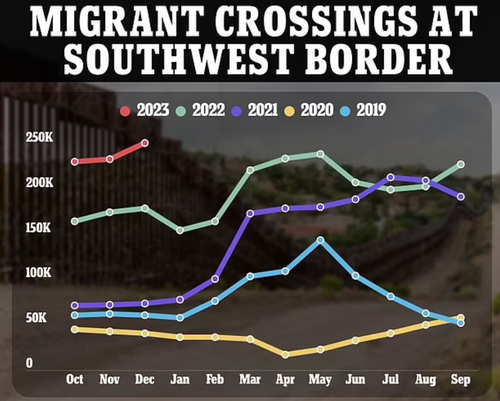
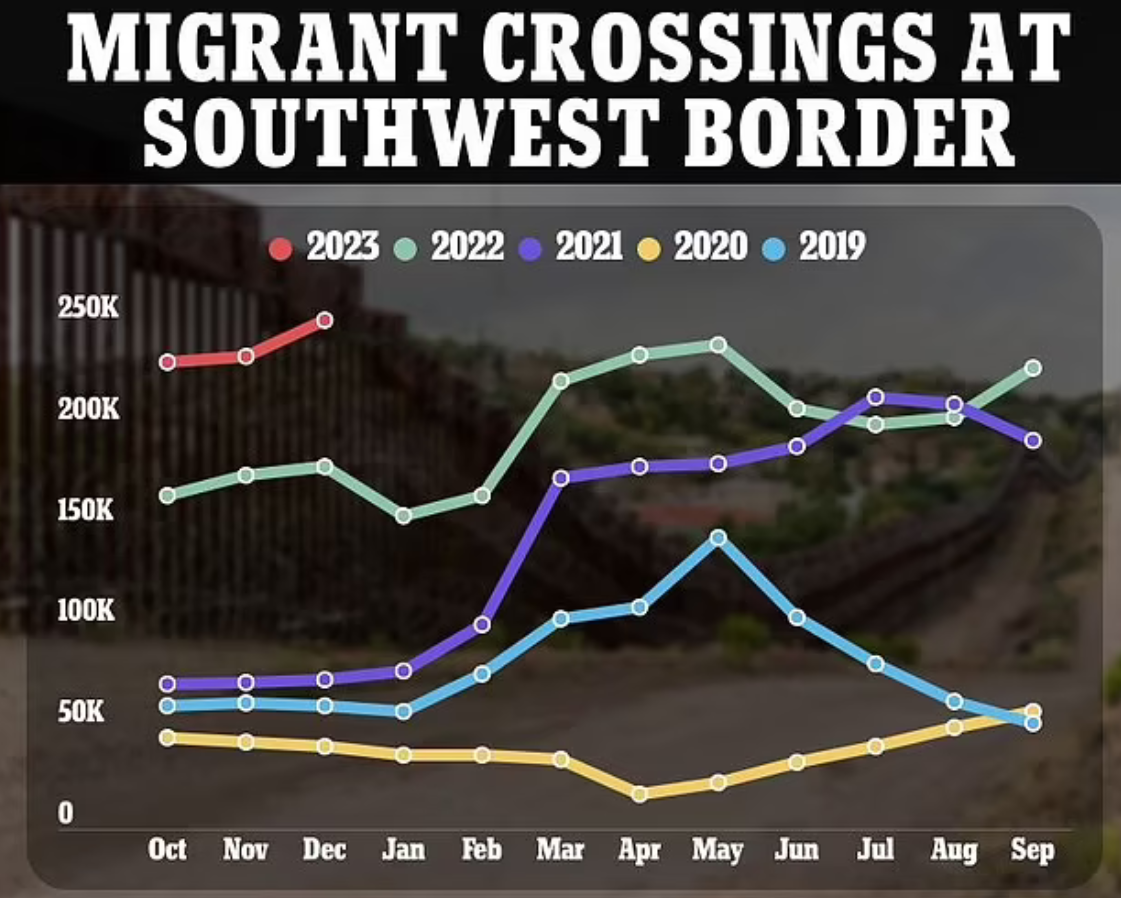
According to officials, some 5 million migrants have crossed into the US since President Biden took office in January 2021.

As a result, Yuma County's Border Patrol has seen a rise in migrant crossings of 171%. According to County Supervisor Jonathan Lines, the county will 'crumble' if it can't support the flow of migrants. Lines says that the situation will only get worse, according to the Fox News.

In a statement to Fox News, Lines said that "Policies need to be changed when you see an unprecedented amount of people coming across the border that even supersedes what we saw under any of the other presidents for the past 30 years," adding that the surge in crossings is "ridiculous."

"They're coming because they said that Biden told them to come, that we have an open border."

Graphic via the Daily Mail

According to fifth-generation Yuma resident and farmer, Hank Auza, "The problem that we're foreseeing right now is there's a couple of big waves coming," adding "Yuma can't support that. It will overwhelm the system here."

El Paso, Texas, another border town, declared a state of emergency as thousands of migrants camped in the streets during below-freezing temperatures in December. Many migrant shelters were over capacity, leading the city to use the local airport for temporary refuge. 

Lines, Auza and another Yuma farmer, Alex Muller, had shared concerns, starting with the fear around food security, since agricultural production makes up a large part of the town's economy. 

"Our fields are monitored and audited and tested for different pathogens," Muller, said. "You can't have people walking through the field." 

Auza said Yuma's fields, which produce 93% of the nation's leafy greens in the winter months, have faced a fair amount of migrant traffic, risking damage to their crops due to foodborne illness concerns. He also said many residents can't get into the city's only hospital.  -Fox News

"People have had a hard time getting into the hospital because the hospital has been so full of" migrants, said Auza.

https://www.zerohedge.com/political/yuma-arizona-brink-collapse-due-unprecedented-migrant-surge

Approval of fourth insect as a Novel Food Questions and answers

 \An official website of the European Union

Approval of fourth insect as a Novel Food

Questions and answers

A selection of questions and answers compiled through the approval process.

The Commission has authorised the placing on the market of a fourth insect, Alphitobius diaperionus (lesser mealworm), as a food.

The term ‘lesser mealworm’ refers to the larval form of Alphitobius diaperinus, an insect species that belongs to the family of Tenebrionidae (darkling beetles).

The novel food consists of the frozen, paste, dried and powder forms of house cricket. It is intended to be marketed as a food ingredient in a number of food products for the general population.

In addition, the Commission has authorised for the first time the placing on the market of partially defatted powder obtained from whole Acheta domesticus (house cricket)  as a novel food.

The authorisation of these two novel foods will allow the applicants to place this insect species on the EU market under certain conditions of use.

Novel Food is defined as food that had not been consumed to a significant degree by humans in the EU before 15 May 1997, when the first Regulation on novel food came into force. Although there is anecdotal evidence of insects consumed as food in the past, no Member State has confirmed human consumption to a significant degree prior to 15 May 1997 for any insect species.

The Novel Food Regulation requires an authorisation before a novel food product can be placed on the Union market.

The Novel Food Regulation is only about the approval of a product, following a stringent scientific assessment made by the European Food Safety Authority (EFSA). The Authority verifies, in light of the scientific evidence available, that the food does not pose a safety risk to human health.

What has happened today is one of the final steps in the procedure for authorising lesser mealworm and partially defatted powder obtained from house cricket as a novel food. Member States gave their green light for the Commission to allow a food business operator, which had requested these authorisations, to place the product on the EU market. The Commission will now adopt a legal act to that end. This has already happened to yellow mealworm, migratory locust and house cricket.

The Novel Food Regulation helps food businesses bringing innovative foods to the EU market, while guaranteeing their safety, and concerns any food, which was not consumed in the EU to a significant degree before 15 May 1997.

This legislation strikes the right balance between innovation and safety. The current regime divided by 2 the time needed for innovative foods to reach the EU market as compared to the previous legislation. It concerns foods as diverse as insects, algae, new plant proteins or traditional food from third countries, and will contribute to the objectives of the Green Deal and Farm to Fork strategy.

The principles underpinning the novel food regulation are that novel foods must be safe for consumers and properly labelled, so as not to mislead them, and if a novel food is intended to replace another food, it must not differ in a way that the consumption of the novel food would be nutritionally disadvantageous for the consumer.

It is up to consumers to decide whether they want to eat insects or not. The use of insects as an alternate source of protein is not new and insects are regularly eaten in many parts of the world.

Yes. Novel Foods can only be authorised if they do not pose any risk to human health otherwise its approval would not have been submitted by the Commission to the Member States.

Following an application by the company Ynsect NL B.V on lesser mealworm and by the company Cricket One Co, Ltd. on partially defatted powder obtained from house cricket, both novel foods went through stringent scientific assessments (lesser mealwormSearch for available translations of the preceding link and partially defatted powderSearch for available translations of the preceding link) by EFSA, which concluded that both novel foods are safe under the uses and use levels proposed by the applicant.

According to EFSA, food allergies represent an important public health problem, affecting approximately 2–4% of the adult population and up to 8–9% of children.

The EU rules on food labelling identify a list of 14 allergens that need to be labelled (e.g. eggs, milk, fish, crustaceans etc…). This is to allow people living with food allergies to be informed on whether products contain ingredients they are sensitive to.

EFSA concluded that the consumption of the evaluated insect proteins may potentially lead to allergic reactions. It may particularly be the case in subjects with pre-existing allergies to crustaceans, dust mites and in some cases molluscs. Additionally, allergens from the feed (e.g. gluten) may end up in the insect that is consumed.

Therefore, the authorisation of this novel food clarifies this issue and lays down specific labelling requirements regarding allergenicity.

This is true, for historical reasons, and there has been already three insects authorised (‘dried Tenebrio molitor larvaSearch for available translations of the preceding link’, ‘frozen, dried and powder form of Tenebrio molitor larva’, frozen, dried and powder forms of Locusta migratoria, and frozen, dried and powder forms of Acheta domesticus under the novel food regulation.

There has been doubts amongst the Member States on whether whole insects were covered by the former Novel Food Regulation. This uncertainty was clarified by the ruling of the European Court of Justice (1 October 2020) which concluded that whole insects did not fall within the scope of that regulation and could thus be placed on the market without a pre-market authorisation.

In turn, the current Novel Food Regulation, applicable since 1st January 2018, explicitly considers whole insects as novel foods, which must thus get an approval.

In order to alleviate the impact of this extension of the novel food regime on the food business operators (FBOs) of whole insects, the current Regulation provides for a transitional period, which allows FBOs to continue placing whole insects on the market subject to certain conditions. In particular, a request for an authorisation under the current novel food regulation had to be submitted to the Commission by 1 January 2019.This is why some insects are already on the market, while their scientific assessment under the Novel Food Regulation is still ongoing.

The draft legal act establishes labelling requirements for foodstuffs containing the Novel Food.

This applies in addition to the requirements of the labelling regulation.

Currently, there are 8 applications for insects intended to be marketed in different forms, which are subject to a safety evaluation by EFSA.

According to the FAO, insects as food emerge as an especially relevant issue in the twenty-first century due to the rising cost of animal protein, food insecurity, environmental pressures, population growth and increasing demand for protein among the middle classes. Thus, alternative solutions to conventional livestock need to be found. The consumption of insects therefore contributes positively to the environment and to health and livelihoods.

FAO also indicates that insects are a highly nutritious and healthy food source with high fat, protein, vitamin, fibre and mineral content. Therefore, they are an alternative protein source facilitating the shift towards healthy and sustainable diets.

Under Horizon Europe, which is a funding programme for research and innovation, insect-based proteins are considered one of key areas of research.

At present, insects as foods represent a very small niche market in the EU.

The environmental benefits of rearing insects for food are founded on the high feed conversion efficiency of insects, less greenhouse gas emissions, less use of water and arable lands, and the use of insect-based bioconversion as a marketable solution for reducing food waste.

https://food.ec.europa.eu/safety/novel-food/authorisations/approval-insect-novel-food_en

Evotec, Janssen to Develop Immune-Based Therapies

 Evotec SE (Frankfurt Stock Exchange:EVT, MDAX/TecDAX, ISIN: DE0005664809; NASDAQ:EVO) announced today that the Company has entered into a strategic collaboration and licence agreement with Janssen Biotech, Inc. ("Janssen"), one of the Janssen Pharmaceutical Companies of Johnson & Johnson. The collaboration focuses on the development of first-in-class targeted immune-based therapies for oncology, which will ultimately be commercialised by Janssen. The agreement was facilitated by Johnson & Johnson Innovation.

The collaboration leverages Evotec's integrated discovery and development capabilities and manufacturing optimisation processes, including an option for the GMP manufacture of the immune-based therapies. Evotec will collaborate closely with Janssen during the pre-clinical R&D phase while Janssen will assume full responsibility for the clinical development and commercialisation.

Besides research funding, Evotec is entitled to an undisclosed upfront payment, success-based research and commercial milestones exceeding US$ 350 m as well as tiered royalties on products resulting from the collaboration.

https://finance.yahoo.com/news/evotec-announces-agreement-janssen-develop-070000963.html