Search This Blog

Monday, January 30, 2023

Abandoning the pill over emerging health concerns?

 I started taking the birth control pill as a sophomore in high school to help with my acne. Most of my friends got prescriptions around then, too.

I never thought twice about birth control — let alone going off it — until the pandemic, when I had more time to consider the pill I popped every morning. I began wondering how taking artificial hormones every day was impacting how I think and feel.

Recently, after six years on it, I decided to stop taking the pill. But it isn’t just me. Many of my friends are independently doing the same, whether it’s driven by concern for their mental health, desire for something more natural — or curiosity about what the world looks like when you’re not in a hormonal fog.

For more and more Gen Z women, there’s an intuitive sense that hormonal birth control might be messing with us, and our brains. And research is backing it up, showing correlations between the pill and a decreased sex drive, as well as higher rates of depression and suicide, and even stress reactions similar to PTSD survivors.

Research psychologist Dr. Sarah Hill thinks so. In 2019, she published the book This is Your Brain on Birth Control: The Surprising Science of Women, Hormones, and the Law of Unintended Consequences after going off of the pill herself.

“It was going off of the pill and seeing how that changed me that inspired me to write the book,” Hill, who is a professor of social psychology at Texas Christian University, told The Post. “I had a lot more energy, and I was exercising and cooking again. Suddenly, I was interested in sex.”

Since she stopped taking the pill, 24-year-old Kennedie Khoury said,  “I’m not even attracted to the same people ... Men smell different to me.”
Since she stopped taking the pill, 24-year-old Kennedie Khoury said, “I’m not even attracted to the same people … Men smell different to me.”
Margot Judge for NY Post

Since then, Dr. Hill said, she’s noticed a “greater awareness of some of the side effects” of the pill that has potentially contributed to a slow but steady decline in prescriptions. Between 2002 and 2017, there was a 9% decrease in oral contraceptive use.

And, although more up to date numbers are yet to come in, doctors are anecdotally noting an increase in young women desiring a change.

“I have noticed that many patients prefer non-hormonal birth control,” Dr. Taraneh Shirazian, a gynecologist at NYU Langone Health and director of the Center for Fibroid Care, told The Post. “Many are keen on limiting their body’s exposure to outside hormones so that they can feel more natural and like themselves.”

According to studies,  women who picked their partners while on the pill are more likely to experience diminished satisfaction with their romantic relationships when they go off of it.
According to studies, women who picked their partners while on the pill are more likely to experience diminished satisfaction with their romantic relationships when they go off of it.
Getty Images

This trend may be partly inspired by viral TikTok and YouTube videos discussing the pill’s side effects — and the early days of COVID.

“The pandemic allowed us to focus attention on our health,” Dr. Hill explained. “For women who were not in relationships and weren’t sexually active, it was an opportunity to break up with their birth control …They wanted to find out how they would think and feel and experience the world without it.”

Komi Frey, 30 of Albuquerque, decided to go off of the pill in 2021 after about six years of taking it. “I went off the pill primarily because I didn’t like the idea of ingesting exogenous hormones on a daily basis,” she told The Post. “I just had an instinctive aversion to that idea.”

It’s a sentiment Dr. Hill has noticed more and more.

Dr. Sarah Hill, a professor and research psychologist, said her interest in sex was revived after going off birth control pills.
@sarahehillphd / Twitter

“We are moving, culturally, toward a place where we’re recognizing that putting a bunch of chemicals in our body isn’t necessarily a great idea,” she said. “People are looking for more natural approaches.”

Dr. Hill’s research is shedding light on just how profoundly the birth control pill can impact women beyond the classic side effects like weight gain, blood clots and even stroke.

One of the most commonly reported psychological side effects of the pill is decreased sex drive. That’s because women on the pill have artificially high levels of progesterone, which Dr. Hill dubs “sexual anti-venom.” Research has revealed that taking oral contraceptives is associated with a decreased enjoyment of sex, on top of an already lowered libido.

But the pill may also impact partner selection, too. Researchers found that women on oral contraceptives prefer less masculine faces in potential partners. Women off the pill, meanwhile, have been found to subconsciously prefer the scent of men with higher testosterone.

Lear, seen here with her husband, Jacob, now tracks her ovulatory cycles and depends on natural family planning.
Nathan Lindstrom for NY Post

It’s an experience Kennedie Khourie had herself. The 24-year-old Austin, Texas, resident decided to go off of the pill last spring after six years, she suspected her mental health was being adversely impacted.

Not only did Khourie feel “less hormonal and manic” after quitting, but she experienced entirely different feelings toward potential partners. “I’m not even attracted to the same people,” she told The Post. “People smell different to me. Men smell different to me.”

Amazingly, research reveals that the change in attraction is so pronounced that women who picked their partners while on the pill are more likely to experience diminished satisfaction with their romantic relationships when they go off of it.

But birth control’s impact on the brain goes beyond just sexual preferences. It’s impacting women’s experience of the world around them. According to Dr. Hill’s research, being on the pill may be associated with lower self-control and less perseverance.

Over the past generation, more girls went on the pill as young as 13 or 14, often to help with acne.
Shutterstock

It also affects the way women react to stress. While the body’s typical response to a stressful experience is the release of the hormone cortisol, women on the pill have a dulled — or completely absent — cortisol response.

As a result, they tend to have a diminished capacity to process negative emotions. In fact, this muted cortisol response looks a lot like that of someone suffering from PTSD.

According to Dr. Hill, “We should all be alarmed by the fact that the stress hormone profiles of women who are on the birth control pill look more like those belonging to trauma victims than they do like those belonging to otherwise healthy young women.”

Both Dr. Shirazian and Dr. Hill have noticed a generational change in attitudes about birth control, with Gen Z at the forefront of a new movement toward more natural, non-hormonal alternatives.

“I have noticed that many patients prefer non-hormonal birth control,” Dr. Taraneh Shirazian, a gynecologist at NYU Langone Health and director of the Center for Fibroid Care, told The Post.
Getty Images/iStockphoto

Dr. Shirazian thinks it is “part of a generational shift.” She said younger patients generally “want more natural products, less hormones and chemicals, and also want to use products that are environmentally friendly.”

“This generation of women is demanding they get information about what’s going into their body,” Dr. Hill said. “A younger generation of women are saying, ‘Hey, wait a minute. You can’t just tell me what to put in my body and expect me to blindly obey.’”

Laura Lear, 24 of Houston, Texas, went on the pill at the age of 20 — later than many of her friends — when her then-boyfriend and peers urged her to do so.

“I just fell into peer pressure,” she told The Post. “My friends were going on it, and I just decided, ‘Okay, if this is what everyone else is doing.’ It was so normal for kids at 13 or 14 to get on it because they had bad acne. It kind of became the cool thing to do, like, ‘Oh, I take my pill every day at 3 o’clock, let’s sync our timers together.’”

Khoury also said that going off the pill has made her feel less hormonal and manic.
Margot Judge for NY Post

But this generation of young women who went on the pill before they were even sexually active may be shouldering unintended consequences. Research has revealed that going through adolescence on the pill is associated with measurable density differences in brain regions involved with memory and emotions.

It’s a discovery that doesn’t surprise Dr. Hill: “To be honest with you, I don’t know how anyone could predict anything other than that, because the puberty transition is when your brain is remodeling itself from its childlike phenotype into its adult version of itself. It’s hard to believe that, by some miracle, it wouldn’t affect brain development.”

Researchers also found birth control use during adolescence is associated with a “small but robust” increase in the risk of major depressive disorder later in life. Girls who start the pill early are disproportionately likely to be prescribed antidepressants and diagnosed with depression. And a study of half a million women in Denmark revealed early hormonal contraceptive use may even be associated with a tripled risk of suicide.

This risk of lifelong mental health issues and even suicide is not only startling, it’s been largely underreported despite how many young women continue to be prescribed hormonal birth control with little to no warnings.

"Peer pressure" was one of the main reasons Lear first started taking birth control pills.
“Peer pressure” was one of the main reasons Lear first started taking birth control pills.
Nathan Lindstrom for NY Post

“It seems to me that there is this belief that birth control as an issue facing women has been solved: We have the pills, and so what’s all the whining and fussing about?” Dr. Hill said. “Drug companies and others who could be investing in trying to find something better for us are mistaking the fact that so many women are on it for the fact that we don’t need something better.”

In fact, only 2% of revenue from birth control pill sales goes back into research and development. And more young women are taking notice.

“We as a society are losing trust in knowledge-producing institutions, including the medical field,” Frey observed. “We’ve realized that they’re often prone to political and financial pressures, as well as human limitations. The incentive system is somewhat warped.”

None of this is to say that the birth control pill hasn’t been an enormous net-positive for women.

Dr. Shirazian said that her younger patients generally “want more natural products, less hormones and chemicals."
Dr. Shirazian said that her younger patients generally “want more natural products, less hormones and chemicals.”
NYU Langone

Providing liberation through family planning has afforded women flexibility and independence: Females now outnumber males in the college-educated labor force. That’s perhaps why there’s some resistance, especially among older generations, to talking about the pill’s shortfalls.

“A lot of women are very protective of the birth control pill just simply because they can remember a time when these types of options weren’t available,” Dr. Hill noted. “They’re trying to make sure that these options continue to be protected for the latest generation of women.”

That protectiveness is more consequential now than ever, in the wake of Roe v. Wade being overturned.

Dr. Hill, who wrote the book "This Is Your Brain on Birth Control," noted that many older women are "protective of the birth control pill just simply because they can remember a time when these types of options weren't available."
Dr. Hill, who wrote the book “This Is Your Brain on Birth Control,” noted that many older women are “protective of the birth control pill just simply because they can remember a time when these types of options weren’t available.”

“Going off the pill is especially scary because I cannot get pregnant,” Khourie, who lives in Texas where abortion is now banned, said. “The reversal of Roe just made it scarier, because I would have to jump through more hoops if something were to happen.”

Many women going off the pill are opting for non-hormonal options, like the copper IUD, diaphragms and — sharing the burden with men as well — condoms. Others, like Frey and Lear, who are both married, are tracking their ovulatory cycles and depending on natural family planning.

“I would like to see there be more normalization of women doing whatever is best for their own bodies,” Khourie said.

As Dr. Hill explained: “There’s no one size fits all answer for anything when it comes to something as complex as contraception.”

https://nypost.com/2023/01/30/young-women-abandoning-birth-control-pills-for-mental-health/

Unvaccinated Kidney, Heart Patients Denied Transplants Get Day In Court With Mich. Hospital

 by Steven Kovac via The Epoch Times (emphasis ours),

A group of activists join Ross Barranco to protest COVID-19 vaccination mandates in Rochester Hills, Mich. on Dec. 21, 2021. (Courtesy of Ross Barranco)

A Michigan judge will soon decide if 73-year-old Ross Barranco can be denied a donated kidney because he won’t take the COVID-19 vaccine.

“I just don’t see the logic of it,” stated Barranco in an interview with The Epoch Times. “Everybody knows an organ transplant procedure requires the nearly complete suppression of a recipient’s immune system so the body won’t reject it.

Then why do I need to be immunized against COVID before the operation?

When asked if he thought the vaccine would make any difference in his prognosis, he replied, “Yeah, the vax can kill me.

“To qualify for a transplant both of my kidneys have to be functioning at 20 percent or less. What if the vax destroys the remaining function before the operation? If it does, I’m done.

The jab does absolutely nothing beneficial for a transplant patient,” he said.

Given the current COVID-19 testing capability, it remains unclear why transplant patients cannot be tested for COVID-19 before the operation. A negative result could then green-light the procedure.

It is also unclear why, given the data showing numerous fully vaccinated people have come down with COVID-19 multiple times, the shot is still being regarded by some hospitals as an immunization.

Barranco’s legal team made reference to a 2021 survey of 200 transplant centers across the country.

Of the 140 that responded to the survey, only half required transplant candidates to take a COVID-19 vaccine regimen.

The vax can hardly be deemed medically necessary if half of the responding transplant centers are not requiring it,” said Deborah Catalono of the Liberty Counsel, a researcher tracking hospital transplant policies and a lawyer familiar with many similar cases to that of Barranco and Shier.

The Liberty Counsel is a non-profit, litigation, education, and policy organization dedicated to upholding religious liberty and Christian values.

Medical questions and safety concerns aside, Barranco, a Roman Catholic, actually refused the vaccine on religious grounds.

He said his faith and conscience do not permit him to receive a shot that he is convinced was developed using body parts obtained from aborted babies and has fetal tissue in its ingredients.

Vax-up or Else

On Feb. 1, 2022, Barranco received what he perceived as an “ultimatum” from the University of Michigan Health System in Ann Arbor.

“There’s an active list and a holding list for patients awaiting a transplant. At the time, I was on the holding list.

That’s when the hospital gave me three months to get three COVID shots, or they would throw me off the list entirely,” said Barranco.

“I refused, and they threw me off. That’s when I contacted an attorney.”

Mary Clare Fischer, a public relations representative with the University of Michigan Health Transplant Center in Ann Arbor, outlined the hospital’s position in an email to The Epoch Times.

Students walk across the University of Michigan campus in Ann Arbor, Michigan, on Jan. 17, 2003. (Bill Pugliano/Getty Images)

“[Our] policy aims to protect transplant recipients from complications of COVID-19 infection, which has had devastating effects in our patient population.

“Immunocompromised solid organ transplant recipients have among the highest risk of severe illness or death from COVID-19 infection.

At present, all of the nearly 1,000 adult patients active on our waiting list are vaccinated against COVID-19 infection.

“As is true of all of our Transplant Center policies and processes, this policy is a critical step in partnering with our patients to maximize the safety of our transplant recipients and provide them the best opportunity to regain their health and quality of life through the gift of transplantation,” she said.

Fischer stated that the transplant center is one of a “significant number” of American hospitals that require the COVID-19 vaccination for adult heart, lung, liver, pancreas, and kidney transplant patients on their active lists.

The University of Michigan Hospital policy exempts critically ill patients who may not have time to complete the three-phase vaccine protocol, as well as patients with prior vaccine allergies.

Why Not Katie?

Katie Shier, Barranco’s co-plaintiff in the case, is an unvaccinated 35-year-old mother of five who is a candidate for a heart transplant.

Katie and Ron Shier and family. (Courtesy of Katie Shier)

She is being kept alive by a ventricular assist device that has developed an infection, according to the plaintiffs’ attorney, David Peters of the Pacific Justice Institute.

The Pacific Justice Institute is a non-profit legal defense organization specializing in the defense of religious freedom, parental rights, and other civil liberties.

The Institute is representing Shier and Barannco free of charge.

Shier, a Roman Catholic, objects to taking the COVID-19 vaccination on religious grounds.

On June 29, 2021, Shier was granted placement on the transplant waiting list.

U of M Hospital’s subsequently adopted mandatory vaccination policy now precludes her from undergoing the heart transplant necessary to save her life.

Peters told The Epoch Times that, due to the low functioning of Shier’s heart, at any time she could slip into “imminent or immediate danger and be rushed to the hospital” and maybe qualify for a transplant under the hospital’s vaccination exemption for the critically ill.

Sadly, it looks like that is something the court will have to order. We have emergency motions ready to go,” said Peters.

Shier told The Epoch Times in a phone interview on Jan. 27, 2023, “I’ve been so busy, I haven’t had much time to think about my situation.

“It is in God’s hands. All I want to do is do God’s will. After much prayer, the Lord led me not to give in, but to file the lawsuit.

“I’m fighting for three things.

“The doctors said I have an infection that can only be cured by a heart transplant.

“I believe it’s wrong to require someone to take a dangerous vaccine, so I want to see an end to the mandates.

“And, most importantly, I do not want to take any vaccine or medication that has been tainted by abortion.

“Two of the major pharmaceutical companies making the vaccine developed it from the HEK-293 fetal cell line.

“Some vaccines are known to have fetal tissue in them, and some tests are being conducted on still-living fetuses without anesthesia,” she alleged.

“I’m fighting for a person’s right to refuse any vaccine that is associated with abortion,” she added.

Peters told The Epoch Times that some people misconstrue the case as a medical malpractice suit against U of M Hospital.

It is not about malpractice. It is about due process rights.

“Both Ross and Katie regard UMH as one of the best hospitals in the world.

“For that reason, Katie won’t go elsewhere. She wants her new heart to come from UMH.”

Barranco told The Epoch Times that he checked out another transplant center, but he prefers UMH.

A ‘Rollercoaster’ Ordeal

Barranco, a petroleum geological engineer for 46 six years, has battled high blood pressure and diabetes for decades—the things he says caused his kidney dysfunction.

In September 2020, he was told to start investigating the various types of dialysis.

“I began talking to U of M in 2021.

“Eventually, they called me in for an in-person exam. They found both of my kidneys were not working right.

“The doctors do not want to remove a partially functioning kidney while it is still contributing, so the plan was to add a third kidney.

“Soon, I was approved to be on their holding list,” Barranco said.

His hopes for relief plummeted when a blood test revealed he had contracted an autoimmune disease that attacked his lungs and kidneys.

His transplant was sidetracked, and Barranco was placed on chemotherapy.

The chemo worked, and he recovered.

“That happened before I could begin dialysis.

“My plan always has been to skip dialysis if I could, because when it fails, as it eventually always does, that’s the end of the line,” he said.

After his recovery, Barranco’s hopes soared again when U of M Hospital officially put him on its active list.

Concern for Others

When his kidneys amazingly began to improve in response to some lifestyle changes, Barranco requested that the hospital drop him back down to the holding list, “so others more in immediate need of a transplant could take my place on the active list,” he said.

He also insisted, against the hospital’s recommendation, that he wait for a cadaver donor rather than a living donor.

“I figured a living donor would be reduced to one good kidney. He or she could possibly die on the operating table or die from post-op complications. It is a risky operation.

“Or, what if later in life the living donor developed high blood pressure or diabetes with only one kidney?

“There I’d be, doing just fine, but the person that helped me would be suffering. What about him or her?” said Barranco.

Barranco told The Epoch Times his goal is to have no more COVID-19 vaccine mandates, “so that future patients won’t have to go through what I have gone through.”

Political or Medical?

President Joe Biden issued an order through the Occupational Health and Safety Administration in November 2021 that would eventually result in the denial of organ transplants to unvaccinated patients like Barranco and Shier.

The federal order mandating COVID-19 vaccinations for health care workers and those professionally associated with them was narrowly permitted to stand by the United States Supreme Court in late January 2022.

Just prior to that decision, on Jan. 13, 2022, the High Court struck down the Biden-ordered Occupational Safety and Health Administration Emergency Temporary Standard mandating that private employers with more than 100 employees require that their workers receive the COVID-19 vaccines.

It was that February that Barranco received notice from U of M Hospital that he had three months to get all three shots or be completely disqualified for a kidney transplant.

We jumped through all their hoops, and the hospital changed the rules in the middle of the game. They threw us off the active list.

“For people like Katie Shier and me, the message was clear—get vaccinated or die,” said Barranco.

https://www.zerohedge.com/medical/unvaccinated-kidney-and-heart-patients-denied-transplants-get-day-court-michigan-hospital

Strategy could remove metastatic traits and drug resistance from lung cancer cells

 A research team led by Professor Kwang-Hyun Cho from the Department of Bio and Brain Engineering at KAIST succeeded in using systems biology research to change the properties of carcinogenic cells in the lungs and eliminate both drug resistance and their ability to proliferate out to other areas of the body.

Incidences of cancer increase within aging populations. Fatality rates are especially high when early detection does not happen in time and metastasis has occurred in various organs. In order to resolve this problem, a series of attempts were made to remove or lower the ability of  to spread, but they resulted in cancer cells in the intermediate state becoming more unstable and even more malignant, which created serious treatment challenges.

Professor Kwang-Hyun Cho's research team simulated various cancer cell states in the Epithelial-to-Mesenchymal Transition (EMT) of lung cancer cells, between epithelial cells without metastatic ability and mesenchymal cells with metastatic ability. A  mathematical model was established, and key regulators that could reverse the state of the mesenchymal cells, which had acquired invasiveness and drug resistance, back to the epithelial cells were discovered through computer simulation analysis and molecular cell experiments.

In particular, this process succeeded in properly reverting the mesenchymal lung cancer cells to a state where they were sensitive to chemotherapy treatment while avoiding the unstable EMT hybrid cell state in the middle process, which had remained a difficult problem.

KAIST presents a fundamental technology to remove metastatic traits from lung cancer cells
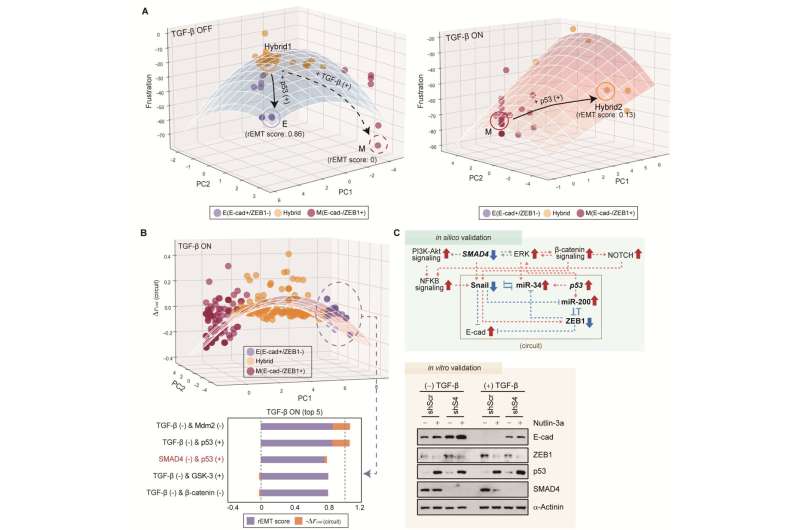
Figure 2. Understanding of various EMT phenotypes through large-scale computer simulation analysis and complex system network control technology.(A) Through computer simulation analysis and experiments, the research team found that complete control of EMT is impossible with single-molecule control alone. In particular, through comparison of the relative stability of attractors, it was revealed that the cell state exhibiting EMT hybrid characteristics has unstable properties. (B), (C) Based on these results, Prof. Cho’s team identified two feedbacks (positive feedback consisting of Snail-miR-34 and ZEB1-miR-200) that play an important role in avoiding the EMT hybrid state that appeared in the TGF-β-ON state. It was found through computer simulation analysis that the two feedbacks restore relatively high stability when the excavated p53 and SMAD4 are regulated. In addition, molecular cell experiments demonstrated that the expression levels of E-cad and ZEB1, which are representative phenotypic markers of EMT, changed similarly to the expression profile in the epithelial cell state, despite the TGF-β-ON state. Credit: Cancer Research (2023). DOI: 10.1158/0008-5472.CAN-22-1559

The results of this research, in which KAIST Ph.D. student Namhee Kim, Dr. Chae Young Hwang, Researcher Taeyoung Kim, and Ph.D. student Hyunjin Kim participated, have been published in the international journal Cancer Research on January 30th. The paper is titled "A cell fate reprogramming strategy reverses epithelial-to-mesenchymal transition of lung cancer cells while avoiding hybrid states."

Cells in an EMT hybrid state, which are caused by incomplete transitions during the EMT process in cancer cells, have the characteristics of both epithelial cells and mesenchymal cells and are known to have high drug resistance and metastatic potential by acquiring high stem cell capacity. In particular, EMT is further enhanced through factors such as transforming growth factor-beta (TGF-β) secreted from the tumor microenvironment (TME) and, as a result, various cell states with high plasticity appear.

Due to the complexity of EMT, it has been very difficult to completely reverse the transitional process of the mesenchymal cancer cells to an epithelial cell state in which metastatic ability and drug resistance are eliminated while avoiding the EMT hybrid cell state with high metastatic ability and drug resistance.

Professor Kwang-Hyun Cho's research team established a  of the gene regulation network that governs the complex process of EMT, and then applied large-scale computer simulation analysis and complex system network control technology to identify and verify "p53," "SMAD4," and "ERK1" and "ERK 2" (collectively ERKs) through molecular cell experiments as the three key molecular targets that can transform lung cancer cells in the mesenchymal cell state, reversed back to an epithelial cell state that no longer demonstrates the ability to metastasize, while avoiding the EMT hybrid cell state.

KAIST presents a fundamental technology to remove metastatic traits from lung cancer cells
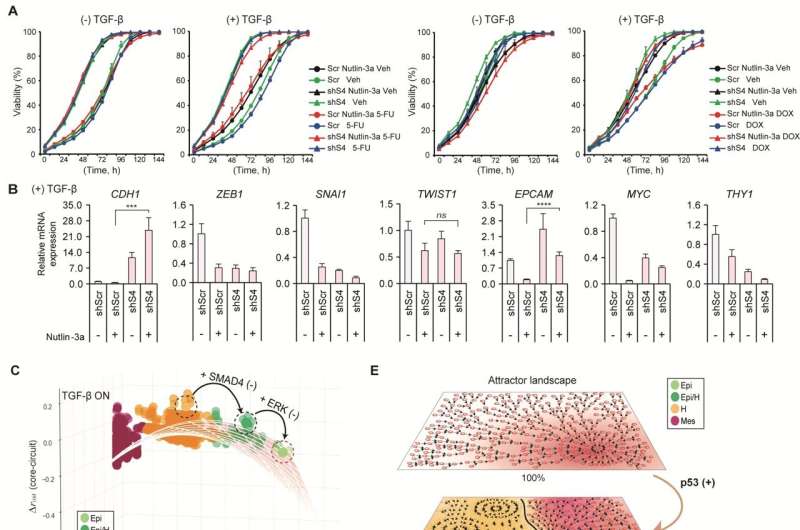
Figure 3. Complex molecular network analysis and discovery of reprogramming molecular targets for intact elimination of EMT hybrid features.(A) Controlling the expression of p53 and SMAD4 in lung cancer cell lines was expected to overcome drug resistance, but contrary to expectations, chemotherapy responsiveness was not restored. (B) Professor Kwang-Hyun Cho's research team additionally analyzed computer simulations, genome data, and experimental results and found that high expression levels of TWIST1 and EPCAM were related to drug resistance. (C) Prof. Cho’s team identified three key molecular targets: p53, SMAD4 and ERK1 & ERK2. (D), (E) Furthermore, they identified a key pathway that plays an important role in completely reversing into epithelial cells while avoiding EMT hybrid characteristics, and confirmed through network analysis and attractor analysis that high stability of the key pathway was restored when the proposed molecular target was controlled. Credit: Cancer Research (2023). DOI: 10.1158/0008-5472.CAN-22-1559

In particular, by analyzing the molecular regulatory mechanism of the complex EMT process at the system level, the key pathways were identified that were linked to the positive feedback that plays an important role in completely returning cancer cells to an epithelial cell state in which metastatic ability and  are removed.

This discovery is significant in that it proved that  can be reverted to the state of  under conditions where TGF-β stimulation are present, like they are in the actual environment where cancer tissue forms in the human body.

Abnormal EMT in cancer cells leads to various malignant traits such as the migration and invasion of cancer cells, changes in responsiveness to chemotherapy treatment, enhanced stem cell function, and the dissemination of cancer. In particular, the acquisition of the metastatic ability of cancer cells is a key determinant factor for the prognosis of cancer patients. The EMT reversal technology in lung cancer cells developed in this research is a new anti-cancer treatment strategy that reprograms cancer cells to eliminate their high plasticity and metastatic potential and increase their responsiveness to chemotherapy.

KAIST presents a fundamental technology to remove metastatic traits from lung cancer cells
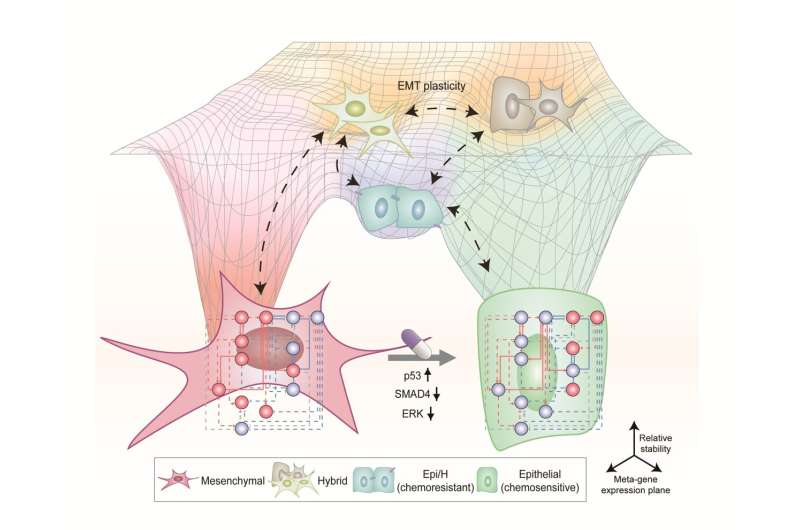
Figure 5. A schematic representation of the research results.Prof. Cho’s research team identified key molecular regulatory pathways to avoid high plasticity formed by abnormal EMT of cancer cells and reverse it to an epithelial cell state through systems biology research. From this analysis, a reprogramming molecular target that can reverse the state of mesenchymal cells with acquired invasiveness and drug resistance to the state of epithelial cells with restored drug responsiveness was discovered. For lung cancer cells, when a drug that enhances the expression of p53, one of the molecular targets discovered, and inhibits the expression of SMAD4 and ERK1 & ERK2 is administered, the molecular network of genes in the state of mesenchymal cells is modified, eventually eliminating metastatic ability and it is reprogrammed to turn into epithelial cells without the resistance to chemotherapy treatments. Credit: Cancer Research (2023). DOI: 10.1158/0008-5472.CAN-22-1559

Professor Kwang-Hyun Cho said, "By succeeding in reversing the state of lung cancer cells that acquired high metastatic traits and resistance to drugs and reverting them to a treatable epithelial cell state with renewed sensitivity to chemotherapy, the research findings propose a new strategy for treatments that can improve the prognosis of cancer patients."

Professor Kwang-Hyun Cho's research team was the first to present the principle of reversal treatment to revert cancer cells to , following through with the announcement of the results of their study that reverted colon cancer cells to normal colon cells in January of 2020, and also presenting successful re-programming research where the most malignant basal type breast cancer cells turned into less-malignant luminal type breast cancer cells that were treatable with hormonal therapies in January of 2022.

KAIST presents a fundamental technology to remove metastatic traits from lung cancer cells
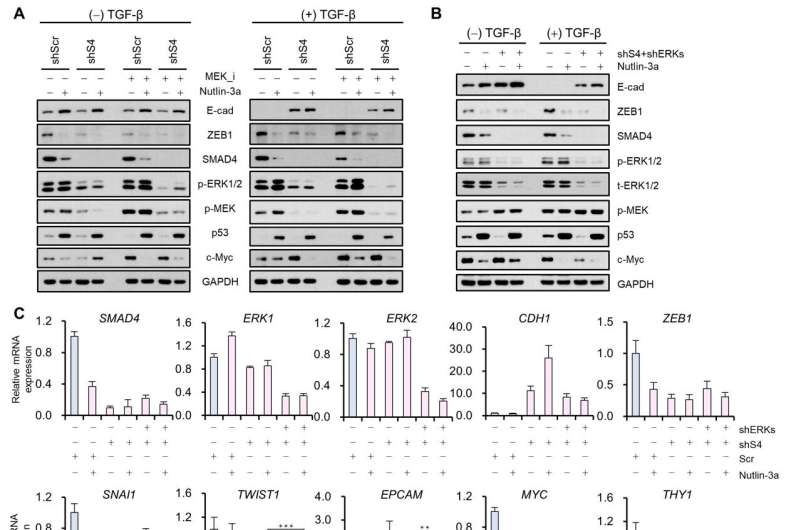
Figure 4. Verification through experiments with lung cancer cell lines.When p53 was activated and SMAD4 and ERK1/2 were inhibited in lung cancer cell lines, (A), (B) E-cad protein expression increased and ZEB1 protein expression decreased, and (C) mesenchymal cell status including TWIST1 and EPCAM and gene expression of markers related to stem cell potential characteristics were completely inhibited. In addition, (D) it was confirmed that resistance to chemotherapy treatment was also overcome as the cell state was reversed by the regulated target. Credit: Cancer Research (2023). DOI: 10.1158/0008-5472.CAN-22-1559

This latest research result is the third in the development of reversal technology where  that had acquired metastatic traits returned to a state in which their metastatic ability was removed and drug sensitivity was enhanced.

More information: Namhee Kim et al, A cell fate reprogramming strategy reverses epithelial-to-mesenchymal transition of lung cancer cells while avoiding hybrid states, Cancer Research (2023). DOI: 10.1158/0008-5472.CAN-22-1559


https://medicalxpress.com/news/2023-01-strategy-metastatic-traits-drug-resistance.html

Calcium channels regulate neuroinflammation and neuropathic pain

 Northwestern Medicine investigators have discovered that specific calcium channels help regulate sex differences in the functioning of immune cells for neuroinflammation and overall neuropathic pain, according to findings published in Science Advances.

"This study highlights the importance of microglial Orai1-mediated calcium signaling contributing to neuropathic pain. It provides a foundation for us to continue to investigate what role Orai1 plays in microglial reactivity," said Kaitlyn DeMeulenaere, a student in the Driskill Graduate Program in Life Sciences (DGP) and co-first author of the study.

Murali Prakriya, Ph.D., the Magerstadt Professor of Pharmacology and a professor of Medicine in the Division of Allergy and Immunology, was senior author of the study.

Microglia are the primary immune cells of the brain and resemble macrophages found in the peripheral immune system. Microglia detect and clear harmful pathogens and dying cells and stimulate other immune cells that ignite effective immune responses in the brain. In addition to their surveillance functions, in healthy brains, microglia also influence the formation of synapses, or connections, between neurons, that impact  and regulate overall cognitive functions.

On the other hand, microglia can also cause persistent neuroinflammation and neuropathic pain, including  caused by , and produce  that cause uncontrolled neuroinflammation. Microglia may also drive long-lasting changes in synaptic circuits in the central nervous system to enhance the sensation of pain, according to Prakriya.

"The signals in the spinal cord that normally do not activate pain circuits are altered in such way that after nerve injury, the same signals are relayed through the spinal cord to higher brain somatosensory brain structure. This change is mediated in part by , cytokines that spinal microglia produce," said Prakriya, who is also a member of the Robert H. Lurie Comprehensive Cancer Center of Northwestern University.

Prakriya's laboratory discovered a class of calcium channels called Orai1 channels more than a decade ago and since then has continued to investigate their critical role in activating immune cells.

In the current study, Prakriya's team aimed to determine what role Orai1 plays a role in microglial activation and neuropathic pain following nerve injury.

Using microglial Orai1 knockout mouse models, they found when Orai1 function was blocked or deleted, Orai1-mediated calcium signaling was lost, ultimately reducing the production of inflammatory cytokines.

"This an important finding because it implicates Orai1 as a checkpoint, if you will, in the cascade of events that leads to the production of inflammatory cytokines that drive pain hypersensitivity," Prakriya said.

Next, the investigators compared measures of pain hypersensitivity following sciatic nerve injury in mouse models. Surprisingly, they identified distinct differences in pain hypersensitivity in  versus in  that lacked Orai1.

Specifically, they found that loss of Orai1 mitigated pain hypersensitivity in male mice, but not in female mice. This prompted the investigators to further investigate the causes of the sexual dimorphism of pain perception.

Using spinal cord electrophysiology techniques, they found that in male microglial Orai1 knockout mice, the potentiation, or an increase in strength, of  that occurs following nerve injury was reduced. Male mice also showed reduced induction of inflammatory cytokines in  tissue in response to nerve injury, however this was not observed in female mice.

"There is no change in neuropathic pain perception in female mice because there's no change in the maladaptive synaptic potentiation that occurs downstream of the inflammatory cytokines produced by microglia. Because the maladaptive synaptic potentiation is likely the critical step that drives neuropathic pain, it explains why there is mitigation in male but not female mice," Prakriya said.

Using a microglial marking technique called IBA1 staining, the investigators found that although microglial activation was increased in both male and female mice equally, inhibited Orai1 function reduced the extent of microglial activation in male but not female mice.

They then gave both male and female mice a small-molecule Orai1 inhibitor compound called CM4620, which is currently being tested in clinical trials, and found that while the drug mitigated neuropathic pain in male mice, it had no effect in the female mice.

The findings demonstrate that Orai1 channels are key mediators of microglia-induced neuroinflammation and the sexually dimorphic role of  in , underscoring the importance of developing sex-specific targeted therapies in the future.

"This study points to striking sex differences in the underlying mechanisms mediating pain hypersensitivity between males and females. We are now working on identifying whether Orai1 signaling can be manipulated in other immune cells to provide pain relief in female mice," Prakriya said.

More information: Shogo Tsujikawa et al, Regulation of neuropathic pain by microglial Orai1 channels, Science Advances (2023). DOI: 10.1126/sciadv.ade7002


https://medicalxpress.com/news/2023-01-calcium-channels-neuroinflammation-neuropathic-pain.html

Biomaterial can be injected intravenously, has potential application in MI, TBI

 A new biomaterial, which can be injected intravenously, reduces inflammation in tissue and promotes cell and tissue repair. The biomaterial was tested and proven effective in treating tissue damage caused by heart attacks in both rodent and large animal models. Researchers also provided proof of concept in a rodent model that the biomaterial could be beneficial to patients with traumatic brain injury and pulmonary arterial hypertension.

"This  allows for treating damaged tissue from the inside out," said Karen Christman, a professor of bioengineering at the University of California San Diego, and the lead researcher on the team that developed the material. "It's a new approach to regenerative engineering."

A study on the safety and efficacy of the biomaterial in  could start within one to two years, Christman added. The team, which brings together bioengineers and physicians, presented their findings in the Dec. 29 issue of Nature Biomedical Engineering.

There are an estimated 785,000 new heart attack cases in the United States each year, and there is no established treatment for repairing the resulting damage to cardiac tissue. After a heart attack,  develops, which diminishes muscle function and can lead to .

"Coronary artery disease, , and congestive heart failure continue to be the most burdensome public health problems affecting our society today," said Dr. Ryan R. Reeves, a physician in the UC San Diego Division of Cardiovascular Medicine. "As an interventional cardiologist who treats patients with coronary artery disease and congestive heart failure on a daily basis, I would love to have another therapy to improve patient outcomes and reduce debilitating symptoms."

In previous studies, the team led by Christman developed a hydrogel made from the natural scaffolding of cardiac muscle tissue, also known as the extracellular matrix (ECM), that can be injected into damaged heart muscle tissue via a catheter. The gel forms a scaffold in damaged areas of the heart, encouraging new cell growth and repair. Results from a successful phase 1 human clinical trial were reported in fall 2019. But because it needs to be injected directly into heart muscle, it can only be used a week or more after a heart attack—sooner would risk causing damage because of the needle-based injection procedure.

The team wanted to develop a treatment that could be administered immediately after a heart attack. This meant developing a biomaterial that could be infused into a blood vessel in the heart at the same time as other treatments such as angioplasty or a stent, or injected intravenously.

"We sought to design a biomaterial therapy that could be delivered to difficult-to-access organs and tissues, and we came up with the method to take advantage of the bloodstream—the vessels that already supply blood to these organs and tissues," said Martin Spang, the paper's first author, who earned his Ph.D. in Christman's group in the Shu Chien-Gene Lay Department of Bioengineering.

One advantage of the new biomaterial is that it gets evenly distributed throughout damaged tissue, because it's infused or injected intravenously. By contrast, hydrogel injected via a catheter remains in specific locations and doesn't spread out.

How the biomaterial is made

Researchers in Christman's lab started with the hydrogel they developed, which was proven to be compatible with blood injections as part of safety trials. But the  in the hydrogel was too big to target leaky . Spang, then a Ph.D. student in Christman's lab, solved this issue by putting the liquid precursor of the hydrogel through a centrifuge, which allowed for sifting out bigger particles and keeping only nano-sized particles.

The resulting material was put through dialysis and sterile filtering before being freeze-dried. Adding sterile water to the final powder results in a biomaterial that can be injected intravenously or infused into a coronary artery in the heart.

How it works

Researchers then tested the biomaterial on a rodent model of heart attacks. They expected the material to pass through the blood vessels and into the tissue because gaps develop between endothelial cells in blood vessels after a .

But something else happened. The biomaterial bound to those cells, closing the gaps and accelerating healing of the blood vessels, reducing inflammation as a result. Researchers tested the biomaterial in a porcine model of  as well, with similar results.

The team also successfully tested the hypothesis that the same biomaterial could help target other types of inflammation in rat models of traumatic brain injury and pulmonary arterial hypertension. Christman's lab will undertake several preclinical studies for these conditions.

Next steps

"While the majority of work in this study involved the heart, the possibilities of treating other difficult-to-access organs and tissues can open up the field of biomaterials/tissue engineering into treating new diseases," Spang said.

Meanwhile, Christman and Ventrix Bio, Inc., a startup she cofounded, are planning to ask for authorization from the FDA to conduct a study in humans of the new biomaterial's applications for heart conditions. This means that human clinical trials begin in be one or two years.

"One major reason we treat severe  and myocardial infarction is to prevent left ventricular dysfunction and progression to congestive heart failure," said Dr. Reeves. "This easy-to-administer therapy has the potential to play a significant role in our treatment approach."

More information: Martin T. Spang et al, Intravascularly infused extracellular matrix as a biomaterial for targeting and treating inflamed tissues, Nature Biomedical Engineering (2022). DOI: 10.1038/s41551-022-00964-5


https://medicalxpress.com/news/2023-01-biomaterial-intravenously-potential-application-heart.html