Mexican authorities have issued an “urgent” Amber Alert for a missing American teenager after she was last spotted on Sinaloa drug cartel turf nearly three weeks ago, according to reports.
Shelbie Lynn Dwyer, 17, was last seen in a stationery store and internet cafe on March 31 in Salvador Alvarado in the Mexican state of Sinaloa, one of the regions plagued by drug cartel violence, the Mexican news outlet El Milenio reported.
“It is believed that her safety is at risk,” the Sinaloa State Prosecutor’s Office said in a statement Tuesday, the outlet reported. “She may have fallen victim to a crime.”
Authorities said Dwyer is 5 feet tall and has several distinctive tattoos, including doves and praying hands on her upper left arm, a rose on her right thumb, and the word “Bendita” — Spanish for “blessed” — on her lower right arm.
She also has a heart on her middle finger and the word “Muerdeme” — or “Bite me” — on her buttocks, the newspaper reported.
It is unclear if Dwyer was living in Mexico or was visiting.
The Amber Alert was issued on Friday, the same day that the body of a 20-year-old Texas woman was found in El Verde in Mexico — more than a week after she was last heard from.
Bionce Jazmin Amaya Cortez of Mission, Texas, was dumped near a farm where she had been staying.
Shelbie Lynn Dwyer, a 17-year-old American, was last seen alive on March 31 in a stationery store in the Mexican state of Sinaloa, which has long been plagued by drug cartel violence. An “urgent” Amber Alert for Dwyer went out Friday.Shelbie Lynn Dwyer, 17, was last seen alive on March 31 in this stationery store and internet cafe in the Mexican state of Sinaloa, one of the regions long plagued by drug cartel violence. An “urgent” Amber Alert for Dwyer went out Friday.Google Maps
She had been missing since April 6.
Three other women from Texas — Maritza Trinidad Perez Rios, Marina Perez Rios and Dora Alicia Cervantes Sanez — went missing in the Mexican city of Montemorelos in February and remain unaccounted for, according to US authorities.
Matinas BioPharma (NYSE American: MTNB), a clinical-stage biopharmaceutical company focused on delivering groundbreaking therapies using its lipid nanocrystal (LNC) platform delivery technology, announces that Marisa H. Miceli, MD, Professor of Medicine, Specializing in Fungal Infections and Transplant Diseases, Division of Infectious Diseases, Internal Medicine, at the University of Michigan and her team delivered an oral presentation earlier today at the 33rd European Congress of Clinical Microbiology & Infectious Diseases (ECCMID) in Copenhagen discussing MAT2203’s clinical impact in treating a compassionate use patient suffering from Rhodotorula mucilaginosa (R. mucilaginosa), a rare and opportunistic invasive fungal infection.
Resilience has long been a disaster-preparedness buzzword. How quickly and well can a region bounce back from a hurricane, earthquake, or terror attack? The answer is always a mix of where you started from when disaster hit, what your recovery policies are, and luck. The Covid-19 pandemic has been the ultimate test of America’s vastly disparate levels of resilience. From New York to Florida, from Illinois to North Carolina, state and local governments began, in March 2020, similarly, by shutting their economies down. By April, though, their governments and private sectors were taking radically different approaches, resulting in radically disparate outcomes. We can now draw preliminary conclusions about which of America’s most populous states are emerging strongly, relatively speaking, out of the pandemic—and which, nearly three years on, are struggling to recover their losses, let alone thrive.
Americans have an option that citizens of smaller, more centrally governed nations don’t enjoy. In picking up from, say, Illinois, and heading to Texas, they can move to or visit what seems like a foreign country, without leaving the nation’s borders. Pre-pandemic, the fortunes of nine states—Florida, Georgia, North Carolina, and Texas, on one side, and Illinois, Michigan, New York, Ohio, and Pennsylvania, on the other—had already sharply diverged. (This analysis leaves out California, which, twice as big as any state save Texas and with governance and political styles often at variance with the rest of the country, and even varied within its borders, is more like a nation of its own.) Florida, Georgia, North Carolina, and Texas began the new century with a collective population of 53.3 million people; by 2020, they had 72.5 million people, or nearly 36 percent growth. Illinois, Michigan, New York, Ohio, and Pennsylvania, by contrast, started out in 2000 with 65 million people, and had 66.4 million in 2020, just 2 percent collective growth. Thanks to low taxes and a generally lower cost of living, air-conditioned warm weather, and loose regulations, particularly on single-family home development in suburbs and exurbs, the new South was eclipsing the postindustrial North.
This imbalance has created new political and economic power for the South. In 2000, the four southern Sunbelt states made up 19 percent of the nation’s population; today, it’s 22 percent. The northern industrial states, back then, claimed 23 percent of the U.S. population; now, it’s 20 percent. People followed the jobs, and vice versa. In 2000, the four powerhouse southern states had 20.6 million private-sector jobs; by the eve of the pandemic, in 2019, they could boast 26.4 million, a 28.6 percent rise. The nine northern states increased their private jobs total just 5.5 percent over that period, from 26.2 million to 27.6 million, watching the four southern states surpass them in employment. Further, though Pennsylvania grew at a relatively healthy pace, Michigan and Ohio actually lost employment, and Illinois was basically flat. New York State expanded during these two decades thanks to New York City, which grew its private-sector jobs a robust 28 percent.
Living in the South, pre-pandemic, retained some disadvantages—notably, lower income and life expectancy, on average. (These disadvantages were not universal; in 2019, Florida and Texas residents had higher life expectancies than people in Michigan and Ohio, for example.) But for Americans seeking fast-charging opportunity, without a sky-high cost of living, Florida and Georgia proved better bets than Illinois and Michigan.
As Covid-19 struck America, governors, whether Democrat or Republican, initially followed the Trump administration’s public-health advice to break off human physical contact and, thus, turn off much of the economy. “Effective at 8 PM on Sunday, March 22, all nonessential businesses statewide will be closed,” New York’s then-governor, Democrat Andrew M. Cuomo, decreed. Down in Florida, the response from Republican governor Ron DeSantis was the same. “All persons in Florida shall limit their movements and personal interactions outside of their home to only those necessary to obtain or provide essential services,” DeSantis ruled in early April.
Beyond its devastating impact on human life, Covid-19 was also a jobs crisis. As offices, restaurants, theaters, and construction sites closed from coast to coast, 19.4 million Americans had lost their private-sector jobs by late April. With the unemployment rate blasting from 3.5 percent to 14.7 percent within just days, this abrupt mass layoff was incomparable with any other sudden unemployment spike in history, even the Great Depression. Notwithstanding trillions of dollars in aid from President Donald Trump and the Democratic Congress to replace (and even surpass) unemployed workers’ lost income, the goal, from the perspective not just of ending the unsustainable federal largesse but also of protecting mental health and social cohesion, had to be to get people back to their normal routines, including work, as fast as possible.
Some governors, however, realized this far sooner than others, as they began to weigh the uncertain benefits of an economy-wide shutdown against the mounting costs. By late spring, state responses had separated. In New York, Cuomo wasn’t even considering opening most businesses. He wouldn’t announce a reopening plan until early May. Even then, reopening was plodding and inconsistent. Restaurants in New York City, for example, would remain in the months-away “phase four” of Cuomo’s four-phase, stop-start-and-stop-again plan, never mind entertainment venues, such as theaters, which stayed shuttered for more than a year. Even when New York City restaurants partly reopened in the summer, they shut down again over much of the long winter into 2021.
“Vigorous economies are helping the southern states close a drawback of working in the South: lower wages.”
In Florida, DeSantis began opening restaurants in early May 2020. By September, he had ditched all remaining Covid restrictions on business. “You can’t say ‘no’ after six months and just have people twisting in the wind,” he said. Broadly speaking, northern industrial states followed the Cuomo playbook, with partial closures persisting well into 2021. Southeastern states followed DeSantis, with partial indoor dining and other congregate activities going again by late spring 2020, and full activities more or less resumed by that fall.
The effects of the two approaches are clear in the jobs numbers. By February 2022, the United States had finally clawed back its lost Covid jobs. But Florida, Georgia, North Carolina, and Texas hadn’t just recovered; they were excelling. First, they beat the country’s recovery by nearly a year, gaining back their pre-Covid job totals by the summer of 2021. This early start enabled these states to gain economic strength, even as much of the country lagged. As of October 2022, the nation had just 1.8 percent more private-sector jobs than in October 2019. Yet Florida had 6.8 percent more jobs, Texas 6.7 percent more, North Carolina 6.1 percent, and Georgia 5.2 percent.
Big states that were slower to reopen are still suffering employment stagnation, even more than a year after ending restrictions. Illinois, Michigan, Ohio, and Pennsylvania are all missing between 0.6 percent and 1.8 percent of their pre-Covid jobs. But New York State, with among the nation’s strictest lockdowns, remains the worst performer. The state is still down 2.8 percent of its 2019 jobs, or 228,400 positions. New York City, particularly, has struggled. Quick to recover after the tech bubble burst and after 9/11 and even after the 2008 financial crisis, the city is missing 2.4 percent, or 100,100, of its pre-Covid positions. This experiment shows that states can’t just pause and restart their economies at will, as Cuomo and his peers tried to do. “Paused” jobs become lost jobs, long after extraordinary government aid for the unemployed has expired.
Liberal economists might retort that southern states are creating low-quality jobs. But they have seen income gains at a faster rate than the rest of the nation. In the U.S. as a whole, average weekly earnings are up 15.7 percent compared with the fall of 2019, as employers have had to raise pay both to lure workers back from home after the government’s generous pandemic unemployment-benefits program and to compensate them for rising inflation. Three of the four fast-reopening big southern states have outperformed this national average. This disparity is a function of supply and demand. States that got back to some normalcy fast needed more workers, rapidly. In Florida, wages are up 17.8 percent, in Texas, 18.8 percent, and in North Carolina, 20.8 percent. (In Georgia, they’ve risen at the national average.) In New York State, wages are behind the national average, with 15.3 percent growth; in New York City, they’re up just 13.6 percent.
Vigorous economies, then, are helping the southern states to close one of the historical drawbacks of working in the South: lower wages. In 2019, New York State had an average wage of $1,060 weekly, 9.1 percent above the national average. Today, its average wage is 8.8 percent above the national average, losing ground relative to the rest of the country. In 2019, Florida’s average wage was a full 10 percent below the national average; today, it’s just 8 percent under the national average, meaning that it—as well as its similarly situated peers—is gaining ground.
If you’re going to have a long economic shutdown, then you’d better be able to contain the noneconomic fallout. Despite their long-term loss of population and jobs share, northern states such as New York theoretically started the pandemic in far stronger positions to withstand lockdowns’ social side effects—which include rising violent crime and learning loss—than did Florida, Georgia, and North Carolina. New York and its industrial-state peers, after all, spend far more tax dollars per capita than southern states. New York State’s budget is more than twice that of Florida’s, despite a similar population size. Northern states also have legacies of big, activist government and progressive values favoring government responsibility for both public education and public safety.
Charts by Alberto Mena
Yet these states utterly fell apart, as the statistics convey. In 2020, the U.S. was hammered with the largest one-year rise in the homicide level ever, according to the Centers for Disease Control—a shocking 30 percent jump. Yet the murder rampage wasn’t evenly distributed throughout the country. In Florida, homicides rose by 16.4 percent, exactly meeting the national average of 7.8 per 100,000 people. In Georgia, they went up 30 percent, in line with the national average increase, to 10.5 per 100,000; similarly, in Texas, they rose 28.8 percent. In North Carolina, they increased 22.9 percent. There’s nothing to be proud of in these numbers, as other Western countries didn’t see a similar jump in murders. But New York’s kill surge, encouraged by 2019 changes to cash bail laws for criminal suspects as well as a general pullback in policing that resulted in many more violent suspects on the streets, far exceeded the nation’s. Statewide, murders rose 46.9 percent, to 4.7 per 100,000. Similarly, in Ohio, they went up 37.8 percent, in Illinois, 38.3 percent, in Pennsylvania, 39.3 percent, and in Michigan, 33.8 percent.
As with wages, liberal observers will argue that in raw numbers, northeastern states remain safer from deadly violence than southern ones. In 2020, Florida’s murder rate was 66 percent higher than New York State’s, and Georgia’s 23.5 percent higher than Pennsylvania’s. Yet this rejoinder isn’t monolithically correct. Illinois’ murder rate, at 11.2 per 100,000, is 47.4 percent higher than Texas’s. Michigan’s murder rate is higher than Florida’s, and North Carolina’s is on par with Pennsylvania’s. Furthermore, most of the murder explosion has been in big cities—in both the South and the North. Atlanta saw killings soar 58.6 percent, and they rose 42 percent in Houston. (In Miami, they increased “only” 12.9 percent.) But New York City’s murder rate blasted upward 46.7 percent in 2020, with comparably alarming increases in Philadelphia and Chicago.
Gotham’s new crime problem is particularly shocking. The city began the pandemic with a far lower murder rate than most urban areas—just 3.6 per 100,000. Indeed, the murder rate hit record lows between 2017 and 2019, an average of 302 yearly. For this, credit should go to city and state voters, who, over the previous 30 years, had set a low and ever-decreasing murder rate as a top public goal, and held several governors and (especially) mayors accountable for achieving it. A hyper-dense city like New York does not function well with a high homicide rate.
Residents of Florida, Georgia, North Carolina, and Texas have historically put up with far higher murder rates in their cities in part because of the greater sprawl of both urban and suburban populations. Mobile affluent and middle-class southerners, whether they live in or outside of cities, believe that they can more easily separate themselves from elevated-crime neighborhoods and can protect themselves through gated communities and (whether successfully or not) guns. It makes zero sense for New York, which long prided itself on its lowest-in-the-urban-nation murder rate, to give up much of those gains essentially overnight, using the excuse that other cities remain more dangerous. New Yorkers should be acutely concerned about their city’s abrupt reversal.
Successful dense cities have a far lower tolerance for lower-level disorder, too, than do more spread-out ones. Northern industrial cities hardly have a monopoly on the massive increase in drug use and antisocial behavior that has occurred over the past decades and, in particular, since the pandemic. But Miamians can protect themselves from open-air drug use by taking refuge in their cars. New Yorkers depend on public transportation and must now wait on platforms and ride on trains with people openly shooting up or smoking crack. Similarly, people with options who freely choose to live in dense, multifamily city apartment buildings do so because they have confidence that their government will enforce a basic code of communal behavior—from policing open-air drug use to confining the psychotically mentally ill—and not, say, allow dangerous vagrants to menace park-goers. If the government refuses to enforce such standards, people will increasingly move to enclosed communities, where private-sector managers will enforce them.
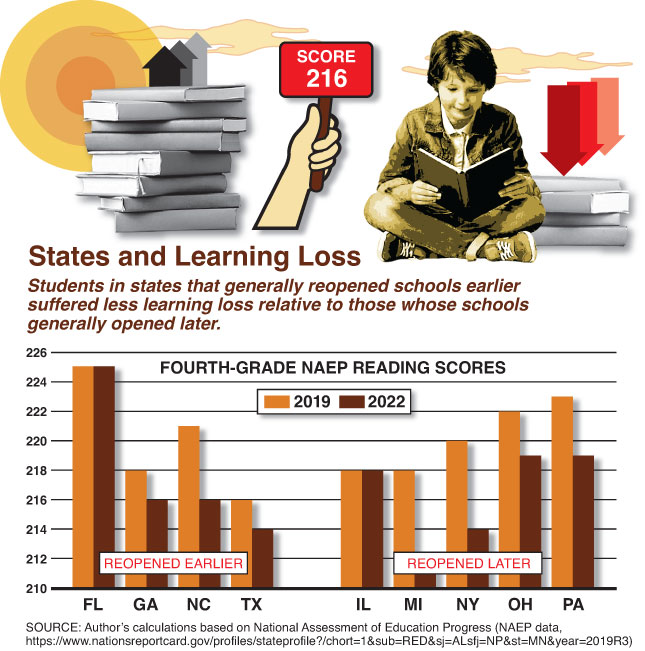
Covid shutdowns, with schools closed for in-person instruction, were accompanied by heavy learning loss and mounting teenage disorder and violence. Here, too, states took wildly divergent paths after their first closures. Florida, Georgia, and Texas restored in-person education in the summer and fall of 2020; North Carolina followed in the spring of 2021. In northern industrial states, however, large urban school districts in New York City, Detroit, Philadelphia, and Chicago stayed largely shut to consistent in-person learning for nearly 18 months. (These dissimilarities were not universal, with sporadic and exceptional shutdowns in the south and faster reopenings in some smaller districts in the north, but they broadly held.)
The grim consequences are reflected in test scores, if not perfectly consistently. Nationwide, fourth-grade students lost three points on their reading tests in 2022, compared with 2019, with the average score dropping from 219 to 216. North Carolina and Florida schoolchildren kept up with their 2019 scores, and Texas and Georgia students lost two points, beating the national average. New York and Michigan students lost six points on statewide tests. Pennsylvania students lost four, and Ohio students lost the national average of three. (The only outlier here was Illinois, where student scores were flat.)
These relative gains for fast-reopening southern states are particularly noteworthy because, unlike with some measures of well-being, such as average wages or (for the most part) statewide life expectancy, the southern states didn’t start off the pandemic with an educational disadvantage. In 2019, Florida and North Carolina actually bested nationwide reading scores, with Florida outperforming New York, and Georgia was close to the national average; only Texas was behind. Now, though, Texas meets the national average, and a preexisting chasm between Florida and low-performing New York is widening. Despite huge differences in education spending—$25,520 per student in New York, compared with Florida’s $9,337—Florida’s reading score of 225 is now 11 points above New York’s score; three years ago, the gap was only five points.
There’s no question, then, that reopening earlier came with clear benefits: faster recoveries and bigger job gains, smaller increases in homicides, and better—or, as with the homicide surge, at least not as bad—educational outcomes. But what were the costs, if any, in terms of illness and death from Covid?
Definitive conclusions aren’t there. Cumulatively, New York State and Florida have remarkably similar Covid-19 overall death rates: New York’s 394 per 100,000 residents to Florida’s 386. New York City’s Covid death rate, at 513 per 100,000, is the highest in the nation, and likely the highest in the developed world. But Miami isn’t far behind, with a death rate of 458 per 100,000. On an age-adjusted measure, Florida’s numbers look considerably better—299 deaths per 100,000 to New York State’s 370—or, more accurately, less awful.
Among other states with vastly different reopening schedules and policies, again no clear pattern emerges, save for Texas’s high age-adjusted death rate, at 412. Michigan’s age-adjusted death rate is 333, according to the Bioinformatics Research Group, North Carolina’s 308, Pennsylvania’s 342, Georgia’s 371, and Ohio’s 380.
“New York State and Florida have similar Covid-19 death rates: New York’s 394 per 100,000 residents to Florida’s 386.”
A risk-averse person might argue that, by reopening too early, southeastern states failed to heed the Northeast’s early-wave warnings and thus allowed preventable Covid deaths. Indeed, New York’s Covid fatalities peaked in April 2020, with a horrific toll of 969 deaths on one mid-April day alone, mostly in New York City; Michigan’s fatality numbers peaked the same month. In Illinois and Pennsylvania, despite widespread school closures and strict lockdown rules on restaurants and other venues, deaths didn’t peak until months later, in December 2020 and January 2021, respectively. Likewise, deaths hit their highs in Texas and North Carolina in the same later period, the winter of 2020 into 2021, despite different rules and weather conditions. And in Florida and Georgia, deaths didn’t hit their worst until September 2021, months after vaccines were broadly available, a full year after those two states’ full reopening.
A closer look at Florida and New York shows how hard it is to draw firm lessons. In Florida, it’s true that, during DeSantis’s reopening of the economy in late spring and summer 2020, Covid deaths rose consistently, even as they steadily fell in New York from their spring peak. Between July and October 2020, 1,704 New York State residents died, most of them in the city; that same summer in Florida, 13,283 people died, seemingly indicating a policy failure.
Yet it’s not so clear-cut. Between March and June 2020, 31,788 New Yorkers had died, and “only” 3,283 Floridians had died. In other words, Florida’s short-lived spring lockdown may have only delayed the state from confronting the deadly wave that New York had already endured. By the winter of 2020–21, daily Covid deaths in Florida were similar to those in New York. Between November and March of that season, 16,025 New Yorkers and 16,288 Floridians died from Covid, against the backdrop of roughly similar state populations and despite enormously different rules governing economic activity, with Florida entirely reopened and New York City, at least, still significantly closed under state decree—with no indoor dining, for instance. New York State’s death toll remained high that first full Covid winter, moreover, even though some of the most vulnerable people in the city had already succumbed during the early 2020 wave.
No governor made perfect decisions in an ever-changing disease environment. But we’ve all gotten either to the same death toll, in the end, or to dissimilar death tolls among different states, with no clear explanation as to why.
With more than 1 million Americans dead from Covid-19, it would be crass to say that any state is a winner. But Florida, Georgia, North Carolina, and Texas have shown themselves to be far more disaster-resilient than their big northern peers. For most large northern industrial states, Covid-19 accelerated a pre-2020 trend: population and jobs have shifted from north to south for decades.
Now, as the nation potentially faces a recession, states such as Illinois, Michigan, and Pennsylvania would effectively enter it before recovering fully from a previous recession—still missing, as they are, so many pre-Covid jobs. New York, in particular, with so much to lose before the pandemic in terms of accumulated success in jobs growth and public safety in New York City, now has the most lost ground, post-pandemic, to make up.
The CIA's "unjustifiable" refusal to formally assess COVID-19 origins suggests the Biden administration is afraid to face the "enormous geopolitical consequences" of a confirmed lab leak "head-on," in line with its reluctance to confront China on its spy balloon, according to President Trump's final director of national intelligence.
John Ratcliffe told the House Oversight Coronavirus Pandemic Subcommittee at aTuesday hearingthat the CIA has "unrivaled capacity to acquire information and near limitless resources to do so," casting doubt on its official explanation that it lacks enough information to evaluate
The FBI and two Department of Energy labs have concluded a Wuhan Institute of Virology (WIV) leak is a likelier source for SARS-CoV-2 than is a natural origin. Four unidentified intelligence community (IC) agencies lean toward the latter hypothesis, according to DNI Avril Haines' unclassified October assessment.
Personal and political motivations may be at play in the holdout IC agencies, according to Ratcliffe. He cited a January 2021 unclassified report where IC analytic ombudsman Barry Zulauf told the Senate Intelligence Committee that in-house China analysts "appeared reluctant" to share analyses that could aid Trump administration policies "they tended to disagree with."
"I do think there were headwinds to get new information" from analysts when he was DNI, Ratcliffe said, and "on occasion" he felt analyses were withheld from him or altered.
Subcommittee Chair Brad Wenstrup (R-Ohio) pledged the panel would examine the motives of IC analysts reviewing the origins evidence. He said he's seen further evidence of this as a House Intelligence Committee member privy to more sensitive information.
The Biden administration, he said, "still has not disagreed with the facts," which he summarized as: WIV has worked with the Chinese military on animal experiments since at least 2017 and performed gain-of-function research at "low biosecurity levels" in conjunction with the federally funded EcoHealth Alliance, which refuses to share its work with the U.S.
His opening statement refers to an "expert in emerging disease outbreaks" who told the subcommittee two weeks ago that the documented sickness of Wuhan Institute of Virology researchers in fall 2019 "would be consistent with a research-related lab outbreak." Press Secretary Olivia Coleman told Just the News this referred to a "private interview."
If Chinese officials had confirmed the researchers were infected by the novel virus and told the world, Ratcliffe told Rep. John Joyce (R-Pa.), COVID could have remained a "regional and local" pandemic.
A former Republican congressman from Texas, Ratcliffe emphasized a WIV leak is "the only explanation credibly supported by our intelligence, by science and by common sense," particularly given China's refusal to offer "even a shred of exculpatory evidence" while destroying tests and samples, intimidating doctors and lying to international health authorities.
The evidence column for zoonotic "spillover," promoted by scientists who covertly consulted with then-National Institute of Allergy and Infectious Diseases Director Anthony Fauci in early 2020, would be "nearly empty" in a head-to-head IC comparison with lab-leak, he said.
Wenstrup, a medical doctor, said he did his own research during COVID lockdown, stumbling across a 2015 Nature Medicine paper by virologists Ralph Baric of the University of North Carolina and WIV's Shi Zhengli about the chimeric virus they created. That paper was attached to Fauci's cryptic Feb. 1, 2020 email to his top deputy, and Wenstrup assumes he was "as alarmed as I was" when reading it in light of the Wuhan outbreak.
Congressional Democrats who derided lab-leak for at least a year as a conspiracy theory, and possibly racist, now emphasize COVID origins can likely never be nailed down because of Chinese Communist Party intransigence, so lawmakers should focus on future domestic and international pandemic preparedness.
While "we are learning more every day" thanks to President Biden's 90-day COVID origins review from 2021, ranking member Raul Ruiz (D-Calif.) said, there is still "no consensus" among federal agencies despite "extreme partisan rhetoric" that "cherry-picks evidence" to "vilify public health leaders."
Democrats' lone witness, Mark Lowenthal, former assistant director of central intelligence for analysis and production, emphasized the "ambiguity" IC analysts deal with and the "constant partisan pressure" they are under for clear answers. "We may never resolve this issue" without Chinese cooperation, and it's harder because the IC is shorthanded on medical experts, he said, explaining: "We can only recruit the people who come to the recruiting table."
House Judiciary Committee Chair Jim Jordan (R-Ohio) made a late appearance to question the IC's reluctance to assess COVID origins. "Even the guys who called us names knew this came from a lab," he said, referring to scientists on Fauci's Feb. 1, 2020 conference call after Scripps Research Institute immunologist Kristian Andersen told the NIAID chief the novel virus looks "potentially" engineered.
Asked if he found it strange that Fauci wasn't communicating with him even as the NIAID director repeatedly deemed natural origin the settled science, Ratcliffe told Jordan the White House coronavirus task force was communicating with the IC but its claims weren't consistent with intelligence.
Rep. Nicole Malliotakis (R-N.Y.) asked if Fauci lied under oath when he told Sen. Rand Paul (R-Ky.) the U.S. didn't fund gain-of-function research at WIV. Ratcliffe said Fauci's testimony was "inconsistent" with public and still-classified intelligence. He had the same view of information from National Institutes of Health officials.
"COVID was not some immaculate infection" that was "spontaneously generated," said David Feith, a former State Department official who helped write then-Secretary Mike Pompeo's WIV fact sheet. If it came from a lab following gain-of-function research, "this was akin to a Hiroshima event" showing that "one mistake in one place" can create global havoc.
The stigmatization of lab-leak by Fauci and the mainstream scientific community "drove underground" these risks, and some colleagues wanted to stifle growing leak evidence because it would show U.S. involvement, according to Feith.
"We don't need a running intelligence community straw poll" of which support leak versus natural origin but rather transparency, he said. "The authorities who know the most about this threat didn't speak up," and the public should know what evidence flipped the Department of Energy's view from natural to leak.
Wenstrup said he's been pressing DNI Haines to identify the experts consulted in agency assessments so the subcommittee can determine the factors behind the wide range of opinions within the IC. All three witnesses said this is reasonable for congressional oversight.
Ratcliffe and Feith agreed with Oversight Committee Chair James Comer (R-Ky.) that the "proximal origin" paper resulting from the Fauci conference call was not factually correct in deeming lab-leak implausible. State's subsequent memo affirming natural origin was "at best overstated," Feith said, with undisclosed conflicts of interest among authors.
Fauci never conveyed the early concerns about a possible lab leak to Ratcliffe, he said, out of fear of drawing "unwanted attention" to U.S. funding relationships and endangering Western scientists' relationships with WIV.
"These scientists flipped 180 degrees with no new evidence," Comer concluded. "This is a how-to manual in orchestrating a coverup."
The recent appeals court decision restoring vital safeguards from the dangers ofchemical abortion drugsis a welcome step and a long-overdue reckoning for the U.S. Food and Drug Administration.
Americans should be able to trust the FDA to keep unsafe and untested drugs off the market. But the agency has long betrayed that trust when it comes to chemical abortion drugs. Instead of safeguarding the public, the FDA has put politics over science and acted as a rubber stamp for the abortion industry and its political allies for decades.
The FDA’s service to the abortion activists inside and outside the government began in 2000 when it illegally expedited and approved the use of mifepristone, a chemical abortion drug, without performing the required scientific studies. The FDA justified its approval of the drug by falsely claiming that pregnancy is a "serious or life-threatening illness" for which mothers need a cure – turning the English language and basic common sense on its head.
Since then, the FDA has ignored the harms wrought by chemical abortion drugs on women. In fact, the FDA got rid of reporting requirements on the harms caused by these drugs. Yet they now cite this lack of reporting as "evidence" that the drugs are perfectly safe, no more dangerous than taking an Advil.
As the U.S. Court of Appeals for the 5th Circuit found, nothing could be further from the truth. These drugs have a complication rate four times higher than even surgical abortions. One in five women who use them end up having to seek medical help. The FDA’s own warning label even highlights the risk of death or serious injury from taking mifepristone – hardly in the same league as taking an over-the-counter pain reliever.
The FDA hides behind the timeline in this case. But as both lower courts found, it’s the FDA that has been delaying and obfuscating for decades. The FDA ignored its obligation to respond promptly to plaintiffs’ petitions, instead taking nearly two decades. In the meantime, the agency has stripped away nearly every basic safeguard on the drug. In 2021, it even went so far as to allow abortion drugs to be shipped by mail, creating a vast new abortion-by-mail regime that now extends into all 50 states.
The result has been tragic: Women and girls are now performing chemical abortions on themselves at home without the involvement of a doctor and with enduring physical and psychological trauma. This is exactly the sort of outcome the FDA should be trying to prevent.
It is a scandal that the FDA has flouted the law for 23 years out of a partisan commitment to abortion. Doctors know that scientific scrutiny would be rigorously applied with virtually any other type of drug, and the drug would face an uphill climb to reach the market. Yet when abortion is involved, the rules have gone out the window.
The courts must correct this raw abuse of power, which is why the Alliance for Hippocratic Medicine and others sued the FDA. My organization, Alliance Defending Freedom, is representing four doctors and four medical associations in the case who have witnessed the harms of these drugs firsthand. On April 7, we prevailed in a lower court ruling, and on April 12, we won a major victory at the 5th Circuit, restoring critical safeguards on chemical abortion while the case proceeds. Notably, the Biden Department of Justice is appealing, and we will soon be arguing before the Supreme Court.
It is no surprise the Biden administration is throwing its weight behind the FDA. President Biden has advocated for abortion on demand through all nine months of pregnancy – a view shared by only 1 out of 5 Americans. The administration is markedly out of step with the 70% of Americans who say abortion should be limited. Yet its chemical abortion scheme is now flooding all 50 states with abortion pills, undermining the ability of states to protect life and help women.
This case will set a crucial precedent for whether a supposedly "neutral" federal body like the FDA can ignore federal rules and safety protocols for political gain and get away with it. Our nation is built on the rule of law, not the unfettered exercise of power, and we should never stand for an FDA that can ignore the law at whim on behalf of extreme special interests.
Every American who wants federal agencies to be held accountable should hope to see the FDA lose this case. No government agency is above the law, and the rules governing the approval of drugs exist for a reason. We are all hurt when the FDA recklessly disregards the law to appease politicians and activists. The courts should hold them accountable.