Search This Blog

Wednesday, April 19, 2023

Illumina wins fast-track appeal of FTC order to offload Grail


A U.S. appeals court on Tuesday said it will accelerate reviewing Illumina Inc's challenge to a federal agency order requiring the biotechnology company to divest cancer diagnostic test maker Grail LLC.

The New Orleans-based 5th U.S. Circuit Court of Appeals issued its ruling over the objection of the Federal Trade Commission. The agency said Illumina had not shown why the appeals court needed to speed up its consideration of the antitrust dispute.

San Diego-based Illumina, which specializes in gene sequencing, is appealing an April 3 FTC order that said the company's $7.1 billion acquisition of Grail will curb competition in the cancer-testing market. Illumina has denied the allegations.

The accelerated pace of the litigation could impose a burden on the FTC. The agency argued to the 5th Circuit that an expedited schedule would be "highly prejudicial" to it based on what it called the "number and complexity" of the issues Illumina intends to raise.

In a court filing, attorneys for Illumina argued expedited review will "enable the possibility of earlier access to a life-saving screening test and eliminate unnecessary roadblocks in the fight against cancer."

An FTC spokesperson did not immediately respond to a request for comment.

A representative from Illumina declined to comment.

The FTC in 2021 sued Illumina over its bid for Grail, a former subsidiary of the company. Illumina completed the deal that year amid the FTC challenge and another from European Union regulators.

The U.S. agency contended Illumina's acquisition will harm innovation and cause prices to rise. Grail uses Illumina's DNA sequencing to make a blood test to detect cancers, the FTC said.

An administrative law judge ruled against the FTC last year in what was the first time the agency's in-house court had dismissed an FTC merger challenge. The agency appealed the decision to FTC leadership and won a divestiture order.

In the EU, Illumina is fighting an order requiring divestiture of Grail. The European Commission last December ordered Illumina to reverse its takeover.

The case is Illumina Inc and Grail Inc v. Federal Trade Commission, 5th U.S. Circuit Court of Appeals, No. 23-60167.

https://www.marketscreener.com/quote/stock/ILLUMINA-INC-9659/news/Illumina-wins-fast-track-appeal-of-FTC-order-to-offload-Grail-43545364/

U.S. banking regulator warns 'open banking' could impact deposit outflows


The evolution of "open banking" in the U.S. could impact how regulators supervise banks, as seamless account portability between financial institutions could lead to increased deposit outflows, a top banking regulator said on Wednesday.

While data portability will likely be empowering for consumers, it could also increase the liquidity risk of retail deposits for banks, said acting Comptroller of the Currency Michael Hsu in prepared remarks.

Open banking describes the process of banks and other traditional financial institutions giving customers and third parties easy digital access to their financial data.

Consumer Financial Protection Bureau Director Rohit Chopra has said his agency expects to propose a rule this year requiring financial institutions that offer transaction accounts to set up secure methods for data sharing, a move that could dramatically boost competition in the consumer finance industry.

While such rules could ultimately increase the 'stickiness' of retail deposits and lower liquidity risks by encouraging banks to take steps to retain customers, the transition to such a state "warrants careful monitoring," Hsu said.

"Already, there is a sense that online and mobile banking may have facilitated unusually large and rapid outflows of wholesale deposits at Silicon Valley Bank and Signature Bank last month," he said.

Depositors at SVB withdrew $42 billion in 24 hours, according to regulators, who shuttered the lender shortly thereafter.

Hsu said while it would be an "overstatement" to attribute the bank run solely to social media and the ease of mobile banking, regulators would be remiss to ignore the impact that both have had on the banking industry.

"We, bank regulators, need to pay closer attention to how changes in technology and associated practices may impact risks in banking," said Hsu.

https://www.marketscreener.com/quote/stock/SIGNATURE-BANK-10755/news/U-S-banking-regulator-warns-open-banking-could-impact-deposit-outflows-43545922/

Manufacturer of generic version of abortion pill mifepristone sues FDA to keep drug on the market

 The pharmaceutical company that makes the generic version of the widely used abortion pill mifepristone filed a lawsuit against the Food and Drug Administration on Wednesday in an effort to keep the drug on the market.

The dispute brought by GenBioPro in federal district court in Maryland comes amid looming uncertainty about the availability of mifepristone after a federal district court in Texas suspended the FDA's approval of the drug earlier this month, and an appeals court rolled back actions taken by the agency beginning in 2016.

Among the moves blocked by the U.S. Court of Appeals for the 5th Circuit was the FDA's 2019 approval of a GenBioPro's application to market a generic version of mifepristone. The Supreme Court issued a temporary order last week preserving access to the drug until 11:59 p.m. Wednesday, and the hold was extended to 11:59 p.m. Friday.

GenBioPro's lawsuit against the FDA is the latest in a legal barrage involving medication abortion that has thrown the availability of mifepristone into uncertainty. The drug maker warns in its court filing that if the order from the 5th Circuit takes effect, "the result will be chaos."

"These circumstances are unprecedented," lawyers for the drug maker wrote in its suit. "No court in history has ever 'stayed' or 'suspended' a longstanding FDA approval, and FDA has no template for resounding to — or implementing — those decisions."

GenBioPro, the country's only manufacturer of generic mifepristone, is asking the court to block the FDA from depriving it "of its constitutional and statutory rights to market mifepristone without affording GenBioPro due process of law." The agency said it does not comment on possible, pending or ongoing litigation. 

The FDA first approved Mifeprex, the branded version of mifepristone, in 2000, and the agency has over the last 23 years relaxed the rules surrounding its usage, including extending the time when patients can take the drug from 7 weeks gestation to 10 weeks, broadening the health care providers who can prescribe it and allowing it to be dispensed by mail.

But in an April 7 order, U.S. District Judge Matthew Kacsmaryk halted the FDA's approval and blocked actions taken by the agency beginning in 2016. The Biden administration appealed the decision to the 5th Circuit, which put on hold the significant part of Kacsmaryk's decision regarding mifepristone approval.

Still, the appeals court unwinded the FDA's policy changes since 2016, limiting access to mifepristone. 

The Biden administration then turned to the Supreme Court for emergency relief, and Justice Samuel Alito on Friday granted an administrative stay, which ensured mifepristone would remain available while the court considered the issue. Alito's order is now to expire Friday at midnight, after which the 5th Circuit's decision limiting mifepristone would take effect absent action from the high court.

The Supreme Court could grant the Biden administration's request to maintain broad access to mifepristone, or fail to act by its self-imposed deadline.

Separate from the Texas case, and less than an hour after Kacsmaryk issued his decision, a federal judge in Washington state issued an order blocking the FDA from altering the status quo as it relates to mifepristone's availability in 17 states and the District of Columbia.

Amid the fast-evolving legal landscape surrounding the drug, GenBioPro said it reached out to the FDA for assurances that it will "follow its own procedures and adhere to the mandates" of federal law and the Constitution in its regulation of mifepristone.

"Notwithstanding the exigent circumstances and the numerous tools available to FDA, FDA has repeatedly refused to assure GenBioPro or the public that it will afford GenBioPro adequate procedures before suspending GenBioPro's ANDA approval," the lawsuit claims.

https://www.cbsnews.com/news/genbiopro-lawsuit-fda-generic-abortion-pill-mifepristone/

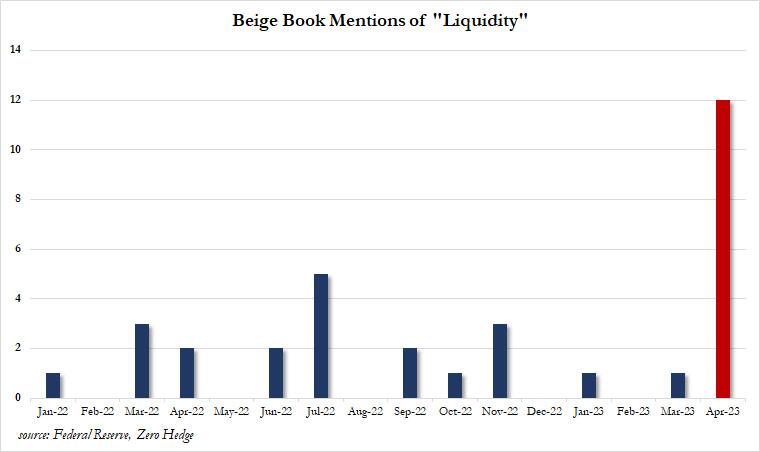
Beige Book Sees Slower Employment And Inflation, Tightening In Credit Standards, "Liquidity" Concern Spike

 The Fed's latest Beige Book, which  based on information collected on or before April 10, 2023, indicated seemingly little change in the Us economy, reporting that "overall economic activity was little changed in recent weeks" but when one reads deeper between the lines, some stark issues begin to emerge.

But first, let's start with the basics: according to the periodic note, Nine Districts reported either "no change or only a slight change in activity this period" while three indicated modest growth. Expectations for future growth were mostly unchanged as well; however, two Districts saw outlooks deteriorate.

Contrary to reports of a sharp drop in spending following the March bank crisis (confirmed by the drop in March retail sales), the Beige Book reported that consumer spending was generally seen as flat to down slightly amid continued reports of moderate price growth. Some more details:

  • Auto sales remained steady overall, with only a couple of Districts reporting improved sales and inventory levels.
  • Travel and tourism picked up across much of the country this period.
  • Manufacturing activity was widely reported as flat or down even as supply chains continued to improve.
  • Transportation and freight volumes were also flat to down, according to several Districts.
  • On balance, residential real estate sales and new construction activity softened modestly. Nonresidential construction was little changed while sales and leasing activity was generally flat to down.

Turning to labor markets, the beige book notes that employment growth moderated somewhat this period as several Districts reported a slower pace of growth than in recent Beige Book reports. A small number of firms reported mass layoffs, and those were centered at a subset of the largest companies. Some other firms reportedly "opted to allow for natural attrition to occur, and to hire only for critically important roles." As a result, Fed contacts reported the labor market becoming less tight as several Districts noted increases to the labor supply. Additionally, firms benefited from better employee retention, which allowed them to hire for open roles while not constantly trying to back-fill positions. And while wages have shown some moderation, they still remain elevated as several Districts reported declining needs for off-cycle wage increases compared to last year.

The slowdown wasn't only in labor markets but also in inflation: overall price levels rose moderately during this reporting period, though the rate of price increases appeared to be slowing. While peak inflation is clearly behind us, some regions are already experiencing defaltion: "Contacts noted modest-to-sharp declines in the prices of nonlabor inputs and significantly lower freight costs in recent weeks." Nevertheless, producer prices for finished goods rose modestly this period, albeit at a slightly slower pace. Selling price pressures eased broadly in manufacturing and services sectors. Consumer prices generally increased due to still-elevated demand as well as higher inventory and labor costs. Prices for homes and rents leveled out in most Districts but remained at near record highs. Contacts expected further relief from input cost pressures but anticipated changing their prices more frequently compared to previous years.

What we found most interesting, however, with everyone still waiting for the May SLOOS report, was the Beige Book comments on the bank sector in general, following the March bank crisis, as well as loan volumes and demand. This is what it found:

  • Conditions in the broad finance sector deteriorated sharply coinciding with recent stress in the banking sector. Small to medium-sized banks in the District reported widespread declines in loan demand across all loan segments. Credit standards tightened noticeably for all loan types, and loan spreads continued to narrow. Deposit rates moved higher. Finally, delinquency rates edged up on residential and commercial mortgages.

  • Lending volumes and loan demand generally declined across consumer and business loan types.

  • Several Districts noted that banks tightened lending standards amid increased uncertainty and concerns about liquidity.

Turning to the specific regional Feds, we find the following banking comments:

  • New York Fed: "Conditions in the broad finance sector deteriorated sharply, coinciding with recent stress in the banking sector. Regional banks continued to report widespread declines in loan demand, ongoing credit tightening, and modestly rising mortgage delinquency rates. Credit standards tightened noticeably for all loan types, and loan spreads continued to narrow. Deposit rates moved higher. Finally, delinquency rates edged up on residential and commercial mortgages.... Amid heightened uncertainty, most businesses do not expect economic conditions to improve in the coming months."
  • Philadelphia Fed: "Banks reported tighter lending standards. Expectations were subdued as sentiment remained cautious."
  • Cleveland Fed: "Economic activity was generally flat in the Fourth District and developments in the banking sector appeared to have very little impact on either recent economic activity or credit availabilityOne dealer hoped that more manufacturer incentives would increase demand, but he cautioned that higher credit standards had become an additional headwind for potential buyers"
  • St Louis Fed: "Banking contacts reported slowing loan growth and a decline in deposits, but expressed confidence in their overall position."
  • Kansas City Fed: "After tightening credit standards over the past several weeks, many contacts reported expectations for further tightening or more strict pricing related to credit risks. Loan demand also weakened modestly in the past month, driven by increased borrowing costs and economic uncertainty. "
  • Dallas Fed: "Credit standards and terms tightened sharply, and marked increases in loan pricing were noted. Banking outlooks continued to deteriorate, with contacts expecting a contraction in loan demand and business activity and an increase in nonperforming loans over the next six months... Outlooks were largely negative, and contacts voiced concern about weakening demand, a potential recession, and the spillover effects of the recent bank failures on the broader economy."

As for the cause of all this apprehension about loans, lending standards and tightening conditions, one look at the chart above showing the frequency of mentions of one key word in recent Beige Books should be sufficient.

Geron, CTI rally


after leaked data for Legend Biotech’s blood cancer drug

RJ Reynolds debuts new menthol-free coolant in latest cigarette ahead of expected national ban

 Cigarette company R.J. Reynolds' latest product is throwing the future of President Biden's menthol product ban into question.

RJR has begun to sidestep California's state regulation on menthol products with a new coolant that mimics the taste of menthol while remaining compliant with the law.

Last year, California banned the sale of all flavored tobacco and nicotine products – including menthol – in a bid to reduce youth smoking.

"The state law prohibits the sale of most flavored tobacco products, including flavored e-cigarettes and menthol cigarettes, as well as tobacco product flavor enhancers in retail locations, including stores and vending machines, in California," the California Department of Public Health states on its website.

Additionally, a federal menthol ban has been expected from the Biden administration. 

The new coolant cigarettes have raised questions of whether the proposed national ban on menthol products would make a substantial difference.

placeholder
Marlboro menthol

Menthol cigarettes on a table in Los Angeles, California. (Mario Tama/Getty Images / Getty Images)

A Reynolds spokesperson told FOX Business the company "is committed to providing adult tobacco consumers a range of acceptable products while ensuring our continued adherence to all applicable laws."

"Reynolds' recent product introductions – like the rest of our combustible and oral portfolios available to adult tobacco consumers in California – do not violate the recently-enacted state law as they do not have a distinguishable taste or aroma other than tobacco," the company said. 

"We are transparent about the ingredients in our products and the science around them," the spokesperson said, directing consumers to its website.

Last year, the U.S. Food and Drug Administration (FDA) released its plan to ban menthol cigarettes and flavored cigars, saying the actions have the potential to significantly reduce disease and death. 

"The proposed rules would help prevent children from becoming the next generation of smokers and help adult smokers quit," Health and Human Services Secretary Xavier Becerra said in a statement. "Additionally, the proposed rules represent an important step to advance health equity by significantly reducing tobacco-related health disparities." 

placeholder
VUSE e-cigarette menthol

A Vuse e-cigarette package is displayed at Cigar N Vape in the Park Slope neighborhood in Brooklyn.  (Photo illustration by Michael M. Santiago/Getty Images / Getty Images)

The FDA announced in January that it issued marketing denial orders for two menthol e-cigarette products made by R.J. Reynolds Vapor, as the agency continues its crackdown on vaping.

The FDA said the company must stop advertising and selling its Vuse Vibe Tank Menthol 3.0% and the Vuse Ciro Cartridge Menthol 1.5%, saying the firm failed to provide sufficient evidence that "marketing of the products would be appropriate for the protection of the public health."

https://www.foxbusiness.com/lifestyle/rj-reynolds-debuts-new-menthol-free-coolant-latest-cigarette-expected-national-ban

UnitedHealth, Elevance Health stocks drop toward four-day losing streaks in wake of earnings reports

 Shares of UnitedHealth Group Inc. (UNH) sank 4.1% in afternoon trading Wednesday, which puts them on track to suffer the worst four-day performance -- down 8.1% -- in 15 months, after the health insurer's first-quarter earnings report raised concerns over the "unintended consequences" of changes to Medicare Advantage rates. Meanwhile, shares of Elevance Health Inc. (ELV) dropped 5.7%, and have slumped 8.2% amid a four-day losing streak, after the health care services company reported first-quarter earnings that beat expectations, but Mizuho analyst Ann Hynes said she believes the stock is under pressure as days claims payable (DCP) declined from the sequential fourth quarter and from a year ago. Among other health care services companies, shares of Centene Corp. (CNC) slid 3.7%, Humana Inc. (HUM) gave up 4.0% and Molina Healthcare Inc. (MOH) dropped 5.1%. The relatively big declines in health care services stocks contrasts with the S&P 500's rise of less than 0.1%.

https://www.morningstar.com/news/marketwatch/20230419539/unitedhealth-elevance-health-stocks-drop-toward-four-day-losing-streaks-in-wake-of-earnings-reports